Photo Albums
My photographs have been moved off this site and are now stored on Picasa. They
were simply taking up too much space on my web host.
Please use
this link to see my list of photo albums.
The Ministry of Culture has been hard at work on the web
again. And not just on the web; but making phone calls as well. The Bangkok
Post has the following report but - sorry dear reader - they do not give
details of any of the web sites ! But expect site like hi5 to come under
pressure or to be censored.
"Assoc Prof Sukhum Chaloeysap of Suan Dusit Poll
on Saturday said that he was not surprised with the report that Ministry of
Culture had found more than 1,000 websites claiming to be by university
students selling sex.
The quoted price ranges from 1,500-3,000 baht or higher for very good
looking female students. When the ministry personnel phoned the published
phone numbers, they could contact actual women claiming to be university
students.
Mr Sukhum said he had been informed by Rajabhaet Suan Dusit students that
some websites featured sex workers dressed in the uniform of Suan Dusit
students as well. He wanted every university to discretely investigate
sex-for-sale students whether it was true and if it were true, the students
should receive psychological therapy as they were also human beings.
Mr Sukhum wondered why the concerned authorities did not take action to
close down the offending websites or the issue was treated as normal.
He also revealed that female students selling sex were not confined to only
websites but by peer-to-peer networking. One female student sex worker could
offer a network of over 20 students with pictures album to be browsed by
prospective clients."
Red shirt pretties
31 January 2009
I really should have stayed in Bangkok for today's red short
protest. There are clearly many distractions as this site's regular Bangkok
correspondent has pointed out !
Nice to see that many young people are politically active;
they are the future of Thailand and it is important that they are seen and
heard and participate.
Red shirt demands
31 January 2009
The Thai political roundabout continued today with some
30,000 supporters of ousted premier Thaksin Shinawatra gathering in Bangkok
today.
The red shirts promised to fight on indefinitely unless the
new Thai government leaves office within 15 days.
The protesters' ultimatum came just before the crowd began a planned march
to Government House, mirroring the tactics of their yellow shirt PAD rivals,
who occupied the main government offices for three months last year.
Over 5,000 police were deployed; where were they when the
yellow shirts marched into Bangkok airport. Many more police were on
standby, along with military units.
The red shirts insisted that they would not go inside Government House. The
red shirts are also calling for those involved in the siege of Bangkok's
airports in November to be fired from government jobs and then prosecuted,
and for parliament to be dissolved.
Newly-appointed Prime Minister Abhisit Vejjajiva sparked outrage among the
red shirts in December by appointing PAD sympathiser Kasit Piromya to the
post of foreign minister and two other PAD members to key adviser positions.
Organiser Jakrapob Penkair asked teh crowd (with some justification !) "How
can the party that lost in elections three times become the government? The
army denies being involved in setting up this government but no one believes
them anymore," he added.
Speaking earlier on the sidelines of the World Economic Forum at Davos in
Switzerland, Prime Minister Abhisit Vejjajiva said he was not worried by the
rally.
"I think the mood of the people now is that they very much want to move
forward, they want to get over the current divisions, they want to see a
government that works hard, that deals with people's concerns and has the
honesty and integrity that has been missing for so long," Abhisit said.
Rhetoric and reality look to be some distance apart.
"If we can keep on working in the way we have for the last month then I'm
not worried about it," he said, adding that deputy prime minister Suthep
Thaugsuban would ensure there was no repeat of last year's siege.
Different rules for some
31 January 2009
Some things just don't seem fair. And the Thai media spin is
always interesting. But it is hard to argue that there is not one rule for
the rich and one for the rest. Do you know who my father is seems to be a
strong defence in Thailand.
The Bangkok Post headline was - 'Mu Ham' sentenced to 10
years in prison. Kanpitak Pachimsawat was sentenced to 10 years and one
month in jail yesterday for ramming his car into a crowd of people at a bus
stop 18 months ago, killing one woman and injuring several other people.
Kanpitak, now 22, is better known by his nickname Mu Ham; he was charged
with premeditated murder, attempted murder and physical assault in
connection with the July 4, 2007 incident.
But in fact he was released on bail pending appeal. And the
appeal process will be long. He even appears to have retained his driving
license.
The defendant rammed his car (a Mercedes) into a crowd
waiting at a bus stop in Bangkok's Watthana district on July 4, 2007,
killing one woman and injuring at least two other people, following a
quarrel with the driver of a bus he was accused of side-swiping with his
Mercedes-Benz car.
There appears to have been no dispute of the facts. The
defence was that Mu Ham was mentally distressed.
The court initially gave him a 15-year jail term for attempted murder and
another two months in prison for assaulting others. As he confessed to the
charges, the court reduced the sentence by a third to 10 years and one month
in jail.
Kanpitak was released on bail pending an appeal after placing a land title
deed worth six million baht as surety. This is a small sum for this family.
A quick review of recent incidents:
Create a death trap, call it a restaurant, turn it into a club with no
safety measures, bribe authorities; make one policeman a shareholder, kill
66. Fine so far is Baht 50,000 for allowing minors into the premises.
Write a bad novel; sell seven copies; poor reference to an unnamed crown
prince in one paragraph. No bail. Three years jail sentence.
Ram a Mercedez Benz into a bus stop, get lucky enough that
only one person dies, sentenced; claim remorse; put some land up as bail.
Close down government house; close down the airports. Cost the country Baht
300 billion in damages and still counting. Become Foreign Minister.
Banned again
30 January 2009
The Economist's distributors in Thailand are refusing to
circulate the current affairs magazine for a second week running because of
an article critical of Prime Minister Abhisit Vejjajiva and the army.
The article contains only a passing reference to the lese
majeste laws in Thailand. But the authorities and now becoming so sensitive
that any criticism is seen as unacceptable.
The article, entitled 'A sad slide backwards' is printed in full below. It
describes as "astoundingly callous" Thailand's handling of 1,000 Muslim
Rohingya migrants from Myanmar, 500 of whom are feared to have died after
being towed out to sea by the army and cast adrift.
"Our distributor in Thailand has decided not to distribute The Economist
this week due to our coverage being sensitive," the weekly's Hong Kong
spokesman, Ian Fok, said Friday.
A spokesman for the distributor, Asia Books, was not immediately available
for comment. A police spokesman said he was unaware of any official ban.
Most of its criticism is aimed at the army and the Oxford-educated Abhisit,
whose rise to power last month owes much to the military's 2006 coup against
Thaksin Shinawatra and its machinations against the previous government.
The article also suggests the United States should threaten to move its
annual Cobra Gold regional war games from Thailand -- a hangover from its
Vietnam War-era alliance that begins next week -- to send a signal to
Bangkok's generals. That would send a strong message.
During his six weeks in office, Abhisit has made much of his commitment to
human rights and the rule of law, although his government has shut down more
than 2,000 websites deemed critical of the monarchy. A prominent leftist
academic has also been charged with lese majeste -- which carries up to 15
years in jail -- for comments made in a 2007 book about the previous year's
military coup.
Critics and freedom of speech advocates say the government's crusade to
protect the crown in the twilight years of King Bhumibol Adulyadej's six
decade reign is a pretext to crush political dissent and opposition.
A sad slide backwards
30 January 2009 - The Economist
Located
in a poor neighbourhood, Thailand is cautious about giving refugees a
generous welcome. Doing so, it worries, might draw millions more across its
borders, especially from Myanmar, a populous, wretched country with a
ghastly regime. But there is no excuse for the astoundingly callous way
Thailand has treated around 1,000 refugees from the Rohingyas, a Muslim
minority group from Myanmar: beating them and casting them adrift on the
seas without adequate supplies. Around 650 survivors have washed up in
Indonesia and India in recent weeks; hundreds more may have drowned. This
week Thailand was still dodging questions from the United Nations’ refugee
agency about a further 126 Rohingyas whom the UN believes Thailand recently
had in its custody but who may also have been dumped at sea.
The army, the source of so much other trouble in Thailand, is to blame. The
Rohingya operation was overseen by ISOC, an army unit formed to fight
communist insurgents during the cold war, whose powers were restored by the
military-backed government that ran the country for 15 months after the 2006
coup. The army’s denials have been undercut by photographs obtained by CNN,
showing soldiers towing rickety boats full of Rohingyas out to sea and
cutting them loose.
Thailand’s new, fresh-faced, Oxford-educated prime minister, Abhisit
Vejjajiva, says that the government will investigate the allegations against
the army. But the army in effect put Mr Abhisit in power, when its chief
orchestrated defections by a chunk of the previous governing coalition that
had been led by allies of Thaksin Shinawatra, the prime minister whom the
army pushed out in 2006. Mr Abhisit’s dependence on the generals means he is
unlikely to be able to probe army misdeeds very thoroughly. The colonel
alleged to have organised the dumping of refugees at sea is also accused of
overseeing an atrocity against Muslims in Thailand’s strife-torn southern
provinces in 2004. Amnesty International, a human-rights lobby group,
accuses the Thai army of continuing to torture suspected Muslim insurgents
in the south.
There was a time, after the passing of its liberal 1997 constitution, when
Thailand looked like becoming a role model for democracy and pluralism in
Asia. The country’s elite still want it to be seen as a progressive,
democratic country and a serious diplomatic actor. Unfortunately, in recent
years it has slid backwards. This started with abuses by Mr Thaksin,
followed by the army’s 2006 coup, and then the tacit backing that Queen
Sirikit, some generals and Mr Abhisit’s Democrat party gave to thuggish
anti-Thaksin protesters, one of whose leading sympathisers is Mr Abhisit’s
foreign minister.
Yet, while soldiers act with impunity and royalist rioters get soft
treatment, the country’s anachronistic lèse-majesté law is enforced
rigorously. America and its allies long turned a blind eye to such stains on
Thailand’s reputation, because King Bhumibol and his army were staunch
anti-communist allies. Recalling that relationship, next month America is
due to hold annual war games with regional allies in Thailand, a source of
prestige for Thai generals. But the cold war is long over. President Barack
Obama should threaten to move the games elsewhere until the Thai army is
tamed. That would hurt the generals in their soft spot—their
self-esteem—while doing little damage to America’s interests or Thailand’s
people.
Being careful with gestures in the UAE
30 January 2009
The following report in today's National newspaper is a
reminder of why it is important to avoid being provoked when you drive in
Dubai and to never use teh wrong gesture; you cannot be sure who will be in
the following car.
"An American man who was previously found guilty of making a
rude gesture to a policeman while driving has protested his innocence before
the Dubai Misdemeanours Appeal Court.
Referred to only as EC, the man was sentenced to one month in prison,
followed by deportation, at the proceedings last December.
At today's hearing, his defence lawyer argued that EC only waved to the
officer with the palm of his hand. “The fingers of my client’s hand may have
been parted but he was not making a rude gesture,” the defence argued.
The incident took place on 19 Oct 2008, while the defendant was driving in
the fast lane of traffic of a major Dubai motorway.
The police officer said he was in his vehicle immediately behind EC and was
honking his horn demanding to be given way.
“My client tried to move to the right lane but could not do so as traffic
was very heavy," the defence said. "This prompted the plaintiff to pass my
client from the right and drive alongside, roll down his window and start
shouting at him in Arabic.”
He said that EC was a foreigner and did not know any Arabic, but could infer
that the words used may have been insulting. Using his hand, EC gestured to
the uniformed policeman to move along and did not make a rude gesture, the
defence argued.
“The officer then stops my client demands his licence and registration and
my client finds himself in a police station held there until the evening as
if he were a dangerous criminal,” the defence said, asking the court to
overturn the earlier verdict and find his client not guilty.
A ruling in the case will be issued on Feb 5 2009."
Not so elite
29 January 2009
Roll the clock back to 2003 and the following story in the
Bangkok Post:
TAT says Elite Card well received -
Target of selling 1 Million cards likely to be met.
The project is making a good start and attracting interest from well-to-do
foreigners, according to Juthamas Siriwan, Governor of the Tourism Authority
of Thailand (TAT).
Brochures outlining privileges and other related services, including offers
at 20 top golf courses, 60 luxury hotels, are ready for distribution.
However, the official opening of the programme will be chaired by Prime
Minister Thaksin Shinawatra as the project is the brainchild of the premier.
Mrs Juthamas said she was confident that One Million Cards would be sold
within five years as targeted, generating One Trillion Baht for Thailand.
With the One Trillion Baht in revenue from Cards and One Million Cardholders
visiting Thailand, spending and shopping, she estimated that spin-off
revenue generated from the activities could reach 20 Trillion Baht.
Bangkok Post / September 16, 2003
Now go back to just a few days ago: and the Nation newspaper:
"The Tourism Authority of Thailand and Thailand Privilege
Card insisted yesterday that privileges for Thailand Elite cardholders
remained unchanged, despite a recent mailing to members that benefits would
be done away with completely.
About 2,500 members across the world recently received a letter, informing
them of the cancellation of the privileges. This led to suspicion that the
card-issuer - Thailand Privilege Card (TPC) - would soon close its business.
Jutaporn Reungronasa, deputy governor for marketing communications at the
Tourism Authority of Thailand (TAT), said the authority, which owns the card
company, had never heard about the suspension of TPC members' privileges and
had no intention of halting operations.
"As the owner of TPC, any important decision must be approved by the board
of the TAT. This latest issue is probably something [stirred up] from
outside," said Jutaporn.
A representative of TPC said the company was running as usual without any
sign of suspending the privileges.
The same person said the mailing was possibly planned by people related to
politics.
"The company was set up five years ago by ex-prime minister Thaksin
Shinawatra. However, it was criticised for a lack of transparency in its
internal management as well for poor performance. It faced the prospect of
closure several times two or three years ago," the representative said.
According members of TPC, they received a letter a few days ago stating that
all privileges had been suspended. The letter also informed them that
because their "elite" status was being removed, they would be required to
adjust to the new circumstances as normal individuals.
Moreover, those members who had benefited from special five-year visas were
urged to make fresh visa applications as general visitors.
All TPC members were also told they said members would not be eligible for a
refund of their membership fee.
Last year, TPC started offering a lower membership fee to boost sales. There
is now a special price of Bt2 million for foreigners, down from the original
Bt3 million.
One membership is valid for two persons, with a limit on spa and limousine
use of 24 times per year. TPC hopes to increase its membership this year
from 2,500 to 2,900.
Last November, TPC laid off 23 staff to reduce operating costs.
The company is managed by Suraphong Triumchanchail, who is chairman and
acting president. It is inviting candidates for the presidency."
Now lets look at today' news:
From The Bangkok Post:
The troubled Thailand Elite Card initiated by the Thaksin
Shinawatra administration and running at a huge loss is to be abandoned.
"To curb further losses, the cabinet sees it as imperative that the Elite
Card programme be scrapped," deputy government spokesman Puttipong Punnakan
said yesterday.
Tourism and Sports Minister Chumpol Silpa-archa said Prime Minister Abhisit
Vejjajiva had instructed his ministry to work out compensation for the small
number of members or find other ways to take care of them.
Its proposals are to be sent to the cabinet within the next two weeks.
Thailand Elite Card was launched by then prime minister Thaksin in 2003 as a
high-class programme to attract wealthy tourists and business people.
It promised fast-track immigration privileges, long-term property leases and
discounts at luxury spas, golf courses and hotels. Thaksin confidently
predicted it would attract one million cardholders by 2008, but to date has
drawn just 2,570.
The state-owned Thailand Privilege Card, which issues the cards and runs the
scheme, posted accumulated losses of up to 1.14 billion baht as of 2006.
Operating results for 2007 and last year have yet to be reported.
******************************
We must assume that Khun Jutaporn at the TAT was aware of
this last week when she gave the above statement to the Bangkok Post.
But then again it may be that the deputy government spokesman
Khun Puttipong, had no idea what to say! Or there was sufficeint fuss today
for the government to be forced to retract as The Nation reports
that:
Prime Minister Abhisit Vejjajiva yesterday ordered the
Tourism and Sports Ministry to conduct a feasibility study on ending the
money-losing Thailand Elite Card programme. The topic did not originally
appear on the Cabinet's agenda.
Deputy Government Spokesman Puttipong Punnakan said Cabinet members were not
sure whether it was feasible to terminate the programme at this stage.
Initiated by the government of ousted prime minister Thaksin Shinawatra to
promote Thailand to wealthy foreigners, Thailand Privileged Card Co (TPC),
which operates the programme, has suffered continuous losses since launching
its services for "premium" visitors to Thailand in 2003. Wholly owned by the
Tourism Authority of Thailand (TAT), the firm lost Bt134 million in 2003,
Bt384 million in 2004, Bt843 million in 2005 and Bt1.14 billion in 2006.
TPC also recorded losses in 2007 and 2008, but exact figures are not yet
available.
Starting with a membership fee of Bt1 million, TPC has issued
2,570 cards.
***********************************
Let's do some simple maths; the card was available initially
for Baht 1.5 million (or Baht 3 million for a couple). The fee then became
Baht 1 million. Many cards were given away to the likes of David Beckham (ie
to lots of people who did not need one!).
So lets assume 2,000 cards were sold at Baht 1 million each
for a cool Baht 2 billion in revenue. Add accumulated losses to 2006 of Baht
2.5 billion and since losses were growing year by year add say Baht 3
billion of losses for 2007/8.
So a total of Baht 7.5 billion needs to be accounted for.
What on earth were these people doing?
In an entertaining gesture, DTAC will be offering
complimentary 600 baht pre-paid mobile phone service cards to compensate for
the 1.5 Million baht spend on the Elite Card. Bit quite
what the member's were expecting."
=
Sadly the message in Thailand, and to be honest this is a
sound investment rule anywhere, is never
invest more than you can walk away from.
Fly Dubai update
29 January 2009
The first FlyDubai 737 has started test flights at Boeing in
Seattle. See the winglets for evidence of the new owner. No start date or
initial route network have yet been announced.
Medical tourism !
28 January 2009
Medical tourism is a growing industry and one where Thailand
has been able to take the lead. I guess this week I fit into that category -
after a visit yesterday to Bangkok Nursing Home (BNH) for a minor piece of
surgery! I will spare my reader the gory details - suffice it to say that
sitting down is painful.
The private hospitals in Bangkok are very business like; and
also very competently run.
Yesterday is a good example. I had booked a 10am appointment.
The specialist carried out his examination; with a running commentary to his
nurse. He gave me two options in terms of treatment; without any over sell
of either.
However, it was clear that the more expensive option was the
better choice in terms of healing and longer term implications. "When would
you like to do the surgery?" I asked. "Now" was the reply.
At which point BNH cranked into action. The admissions lady
came to confirm my details and to give me an estimate of the cost. Valuables
were left and signed for with the cashier; I was then escorted to the
operation theatres, sent to a changing room to don the green robe. Then into
the operation theatre. There must have been 6 or 7 nurses; I did not count
them. The specialist/surgeon was already there.
At this point you lose all dignity. Lying stomach down on the
operating table in the superman position (you can work that out). Heart rate
monitor attached. A nurse asked that I take off my wedding ring; given the
surgery I was having this seemed a little unnecessary - so I said I could
not.
A couple of injections; local anaesthetic; cut and stitched.
Some discomfort. And lots of chat in Thai between the nurses and the
surgeon. They were very relaxed. More so than me. At the end of the
operation the surgeon showed my with some pride what he had removed. Again,
no details are necessary!
Then we were done. I was rolled onto a gurney and wheeled out
of the theatre. As soon as you are in the waiting area one of the nurses was
asking me to complete the customer satisfaction survey. Without glasses and
a pen this was a problem. Dont worry, I can fill it in for you she said and
proceeded to ask the questions. Given that I am still in their care I cant
really give them less than 11 out of 10! The nurses were smiling and chatty.
A few words of Thai help as well.
Then it is time to change and walk rather gingerly back to
see the surgeon for a quick discussion on post operative care and
medication.
Within minutes I am at the cashier's desk and receiving my
itemised bill for the morning's entertainment. Very efficient. And I walked
back to the hotel.
I did not sleep much. It is a bit sore; but that will pass.
However, as the following report from today's Bangkok Post
shows the public medical sector is not always quite so efficient. And this
was one mistake that is rather irreversible!
"The Medical Council of Thailand has come to the defence of a
male nurse at a clinic who mistakenly circumcised a boy who wanted to have
an abscess in his mouth removed.
On Thursday, Rattanaporn Manaschuen, the mother of the 12-year-old boy,
complained to the Public Health Ministry after her son was circumcised at a
clinic in Samut Prakan's Phra Pradaeng district on Monday. She said the boy
actually went there for treatment of an abscess in his mouth.
Acting Medical Council president Somsak Lohlekha said it was a case of
miscommunication.
Dr Somsak said the doctor at the clinic correctly diagnosed the boy with a
mouth abscess and did nothing wrong. The doctor wrote "excision" on an order
assigning the nurse to perform the operation.
But the male nurse confused "excision" with "circumcision" and proceeded to
cut off the boy's foreskin.
Dr Somsak said the mistake was unintentional.
He said the doctor was not to blame, although the matter would go before a
council panel on medical ethics.
"Usually, a circumcision is a minor operation and a doctor can assign a
nurse to do it," Dr Somsak said. He said looking on the bright side, the
accidental circumcision would help the boy keep his genitalia clean and
lower the risk of cancer."
Cathay nostalgia
27 January 2008
With Emirates flying full to Bangkok I was able to get a seat
on Cathay's flight 750 via Mumbai.
When I first moved to Hong Kong in 1994 I used to fly often
on CX751 from Hong Kong via Bangkok to Bombay. The flight was almost always
full to Bombay.
Cathay's only milk-run flight has been operating to Dubai
since 1977. It was in fact the airline’s first commercial flight into the
UAE, and until this day continues to fly from DXB to HKG, via both BOM and
BKK. The flight will apparently be discontinued in March of this year to be
replaced with more direct options.
Several years back, this flight was also Cathay’s most
profitable route, and had remained one of the airline’s top 10 most
profitable routes for many more years after.
How is it this unconventional two-stop flight to Hong Kong a
money maker today? It is the result of fifth freedom rights and the high
loads between the segment pairs. For example, CX experienced an average load
factor of 90+% on this flight in 2007 between DXB and BOM only.
Furthermore, only up to a maximum of 20 or so seats on this
flight are allocated to selling HKG out of DXB, and even those, are
primarily used for any spillage that occurs from the airline’s other flights
from Dubai.
Out of Mumbai the one stop via BKK has always been popular
with the specific market the airline has attracted, as it either offers
Bangkok as a stopover getaway for passengers travelling on their way to Hong
Kong, or as a connecting point for those passengers carrying on to
Singapore.
On our flight for instance there were only 15 passengers in
transit an Bombay. Everyone else on a 80% full flight disembarked.
So this one flight is an interesting mix of routes, markets,
traffic, competition strategies, crews and people all under one flight
number.
For the cabin crew the rotation is to fly overnight from HKG
to Mumbai, and then the following day to fly the return shuttle to DXB
(another overnight) before returning to HKG via Bangkok after another 24 hrs
in Mumbai. The cockpit crew changed at Dubai.
For a long time, the 773 was used to operate the milk-run. Only recently
when Cathay gained additional rights to India, they immediately exercised
all their capacity and introduced their new product 747-400s to India,
Thailand, and also the UAE.
At the back of the plane we had Cathays' new fixed-back shell
seat. Cathay argues that this is innovative as no one in front of you will
ever intrude into your space again. As the seat is fixed the actual bottom
of your seat slides out in an attempt to create a virtual recline. All this
really does is move your knees into the shell in front of you. On a long
haul this must be very uncomfortable. There is no footrest. There would not
be room for one as at the base of the shell in front of you in a low hanging
equipment box for the AVOD system. So there is no space to stretch your
legs. The magazine pouch is now behind your legs in your seat rather than in
front of you.
If you are fortunate to have space next to you should also
know that the arm rest does not fold away properly. In its 'folded' position
it still prominently protrudes from in-between the seat backs.
So what CX has dressed up as innovation is in fact not much
more than lighter seats, easier to clean and less likely to break as they
are fixed shell seats. Cost saving dressed up as innovation.
Still I guess it is not a bad thing that the seat in front
cant be reclined into your face.
Where CX's seat has improved is their 9" widescreen TV with
StudioCX – featuring a rotating library of 100 movies, 350 TV shows, 888
music CDs, 22 radio channels, and entertainment programmes in nine
languages. I have always liked Cathay's movie selection. Always a little
more innovative than most. And less likely to be abused by the censor. I
assume that if EK is showing Woody Allen's menage-a-trois Vicky,
Cristina, Barcelona there are key scenes in the movie that would not be
seen. But CX is a little more tolerant.
The AVOD is great when it works - it was fine from DXB to BOM
and died from BOM to BKK.
The cost cutting is evident in CX's Economy catering; no
menus, no hot towels, plastic cutlery.
CX's crew has always been a strength. Attractive, efficient,
attentive, relaxed and chatty in a way that SQ's crew never were. What is
noticeable is that the crews are more Chinese; and that the airline is
replacing leaving Thai, Filipino, Indian etc crew with local recruitment.
That's about it. I miss my business class trips!
The truth that demands a response
26 January 2009
Kudos to CNN for pursuing the refugee story in Thailand. CNN
is reporting that they have uncovered evidence that hundreds of Rohingya
refugees -- members of a Muslim minority group -- have been abused and
abandoned at sea by the Thai authorities.
The photographs obtained by CNN from someone directly involved in the Thai
operation show refugees on their rickety boats being towed out to sea, cut
loose and abandoned.
One photo shows the Thai army towing a boatload of some 190 refugees far out
to sea.
For days, accusations have been carried in several regional papers that the
Thai army has been systematically towing boat-loads of Rohingya refugees far
out to sea and setting them adrift.
The army denied it, and the Thai government has launched an inquiry or more
accurately a cover-up. Prime Minister Abhisit Vejjajiva insisted last week
that Thailand had respected the rights of boat people from Burma, saying
reports that the migrants were mistreated and abandoned at sea were
"exaggerated".
Mr Abhisit also said that foreign tourists who reportedly witnessed the
incidents may have misunderstood what the Thai army and navy were trying to
do with the immigrants.
The evidence make all the Thai army and government denials
look like embarrassing lies.
CNN's investigation -- based on accounts from tourists,
sources in Thailand and a Rohingya refugee who said he was on a boat towed
back out to sea -- helps to piece together a picture of survival thwarted by
an organized effort not just to repel arriving refugees, but to hold them
prisoner on shore, drag them in flimsy boats far out to sea and then abandon
them.
One tourist provided CNN with photos last week of refugees detained by Thai
authorities on a beach near a tourist site, with the refugees prone on the
sun-bleached sand while guards stood nearby.
A CNN crew traveled to a remote stretch of the Thai coast four hours north
of the tourist island of Phuket to investigate the growing reports that the
Thai military was secretly detaining Rohingya refugees before towing them
out to sea and setting them adrift.
In an isolated beach area, debris including sandals and campfire remnants
indicated that large numbers of people had been there but were nowhere to be
seen.
The crew then traveled to a nearby island, where residents reported that
refugees who had escaped were living in the jungle.
In one hamlet, villagers had captured a Rohingya man they believed had been
living in the jungle for days.
The refugee, who identified himself as Iqbal Hussain, told CNN he was on one
of six boats in a makeshift refugee fleet that arrived in Thailand in
December.
He said all six boats with their refugee cargo were towed back out to sea in
January, and five of the six boats sank. His boat made it back to shore, and
he hid in the jungle for days until nearby villagers captured him.
In broken English and using sign language and drawings, he described what
happened to the other men on the boats:
"All men dead," he said, putting the number of dead at several hundred.
The Rohingya, a persecuted minority in Myanmar, have been fleeing their
country in rickety boats for years, in search of a better life.
In Thailand, many instead have found deprivation and the possibility of
desertion far off shore, according to the CNN investigation.
The source who provided CNN with photos of refugees in a boat being towed
out to sea stressed that the Thai army had given the refugees food and
water, but he also confirmed that the boats had been pulled for more than
two days into international waters before they were set adrift.
His account directly contradicts briefings by senior Thai army sources who
denied any such operation was undertaken.
A source in the Thai military, after extensive questioning, did confirm to
CNN that the Thai army was operating a dump-at-sea policy. But the source
defended it, insisting that each boatload of refugees was always given
sufficient supplies of food and water.
That source claimed local villagers had become afraid of the hundreds of
Rohingya arriving each month, and that they were accusing the refugees of
stealing their property and threatening them.
CNN asked the government for comment and was told an investigation was being
launched.
How cold is the UAE?
25 January 2009
It was snowing in the UAE yesterday. Snow fell in Ras Al
Khaimah yesterday as the temperature fell to two degrees below zero on Al
Jais Mountain. The mountain is 1,900 metres above sea level so it is a bit
cooler; but 20 centimetres of snow blanketed an area extending over 5kms.
It was certainly cold in Dubai last night and a blanket was
needed to sit in the living room!
The snow came a day after a prolonged lightening and thunder
storm on Friday night in Abu Dhabi and Dubai. I know the rain was heavy as I
was driving in it.
The pictures are from the UAE national news agency via The
Gulf News.
Where is Mr. T?
25 January 2009
Like the truth, Shergar and Lord Lucan, Mr. T is out there
somewhere.
But at least Mr.T is still active. Today he attacked the
current government's economic stimulus plans saying they were just
short-term fixes for long-term problems.
"It's more or less like giving the people money to mow the lawn and the next
day the grass still grows back," Thaksin, ousted in a 2006 coup, said on a
new anti-government cable television channel.
"The country will see more people out of job(s) this year due to global
financial crisis," he said. he is of course absolutely right about this and
I hope people are listening.
Moments earlier in a broadcast on state television, Prime Minister Abhisit
Vejjajiva said he might consider borrowing money from foreign countries in
the second half of 2009 if stimulus measures announced this month did not
work.
"The government is speeding up ways to help
low-income people by giving 2,000 baht ($57.40) to workers from state
enterprises, government bodies, independent agencies and teachers," the
Oxford-educated Abhisit said.
"Training seminars are also being organized and we hope to provide this to
as many as 500,000 people who lost their jobs."
In his broadcast, Thaksin, now in exile (but where !!?) after jumping bail
to avoid a graft conviction, confessed to being lonely, but said he would
never give up his fight against what he says is the injustice that has
typified Thailand since the coup.
I doubt he is that lonely. There are always flights to Dubai!
"Please don't think of sending someone to kill me out here because even if I
die, this won't stop," he said. "I'll still have to fight for justice."
"What I want is justice for me, for my family, and for the people. If you
want this to end, all I want is justice and starting over," he said.
UAE announces boxing monstrosity
25 January 2009
Arabian Business reports today that "boxing
legends Mike Tyson and Evander Holyfield will stage an epic third fight in
Abu Dhabi this October"
Full details of the historic fight will be announced on Feb. 1. It is
understood that the bout will be held at the open air Zayed Sports City
Stadium in front of 25,000 boxing fans. Apparently this
will be the “richest fight in history.” The boxers
are expected to both "earn" in excess of US$30 million from this fight.
The Tyson/Holyfield fight will be the finale to an evening that will
apparently feature two separate world title bouts.
One tentative date is Oct. 31, the night before the first ever Abu Dhabi
Grand Prix.
What a farce. One is a disgraced and convicted 42 year
old ear-biting thug. The other an over the hill long retired brawler.
Neither have fought for over 2 years.
To call this 'the biggest ever fight in boxing history' is
comedy. In the middle of this huge recession why are people wasting money on
an ugly and pointless spectacle that has no sporting value!
By way of additional background - in 1992, Tyson was
convicted of raping Desiree Washington, for which he served three years in
prison. After being released from prison in 1995, he engaged in a series of
comeback fights. He regained a portion of the heavyweight title, before
losing it to Evander Holyfield in a 1996 fight by an 11th round TKO. Their
1997 rematch ended in shocking fashion as Tyson was disqualified for biting
off a piece of Holyfield's ear.
Economist withdrawn again
24 January 2009
The Economist will not be distributed in Thailand again. The
magazine was obliged to send the following e-mail to subscribers: "This week
our distributors in Thailand have decided not to deliver The Economist in
light of our coverage relating to the Thai monarchy."
The article is about the use of the law. It is not about the
Thai monarchy so the distributors in their self censoring caution rather
missed the point.
Pointless tokenism really. Anyone who wants to read the
article can do so online.
Here it is. The article may be blocked in Thailand but has been widely
reproduced on other blogs.
In fact awareness of censorship probably increases reading of
the article out of heightened curiosity to see what the fuss is about.
That is the second time in seven weeks that the Economist has
not been circulated in Thailand. The magazine is rapidly becoming even less
popular in Thailand than it is in Singapore.
The Economist could not be a more reasonable or balanced
publication. It is probably the best source of economic thought, analysis
and international news that any Thai politician could, and should read!
As should the Thai Senate who, as part of this near paranoia
to implement ever harsher media controls, resolved yesterday by a vote of 90
to 17 to set up an extraordinary panel to follow up on the enforcement of
laws and articles relating to the protection of the monarchy as proposed by
appointed senator Khamnoon Sitthisamarn.
17 members voted against the resolution ? I am surprised that in the current
atmosphere the result was not 100 %. Nothing less. Like a Burmese referendum
!
The committee, to be headed by national police chief Patcharawat Wongsuwan,
will comprise 30 members - 19 senators and 11 outsiders.
According to the Bangkok Post there are now over 10,000 websites deemed
offensive to the monarchy. The Information and Communication (ICT) Ministry
has been able to block only 2,000 sites.
My favourite part of the Senate resolution is that the
Justice Ministry has been tasked to coordinate with the Foreign Ministry to
launch a campaign among foreigners to educate them about lese majeste laws.
Justice Minister Pirapan Salirathavibhaga said he would coordinate with the
Foreign Ministry to instruct all Thai embassies abroad to launch public
relations campaigns about lese majeste laws which impose harsh punishments
on those who insult the Thai monarchy.
What will they do? Will there be newspaper and television campaigns
organized across the free presses and TV screens of North America, Europe,
India (etc etc) to explain Thai laws.
There is a sense that the Thai government and authorities are
creating there own fortress to fight off what some seem to think is a
Thaksin-led anti-Thai authority conspiracy in the foreign media.
Far from it. Thailand is newsworthy. It is an international
story. And it is creating its own public relations nightmare - airport
closures, drowning refugess, foreign writers in shackles dont make great
headlines overseas.
There are three lese-majeste allegations against the BBC's
Jonathan Head - their Bangkok based reporter. All three allegations have
been made by a policeman, Lt. Col. Wattanasak Mungkandee. Wattanasak
filed all three of his complaints in a personal capacity but Thai law
requires that each of them must be formally investigated by the police.
Should charges be brought against the BBC journalist would
the British Government take the non involvement path chosen by the
Australians in Mr. Nicolaides' case? I think we would see a much more robust
approach.
Myanmar’s unwanted human flotsam From The Economist
- 24 January 2009
"Of all
the myriad groups fleeing the misery of modern Myanmar, few have suffered
more than the Rohingyas, a shunned Muslim minority, concentrated in Rakhine
state. Denied full citizenship at home, many end up in Bangladesh, where
some 200,000 live in squalid border camps. Another 28,000 are housed by the
United Nations High Commissioner for Refugees (UNHCR). The lure of further
migration is strong. Every winter thousands pay to board rickety smugglers’
boats for Thailand, whence a bus can take them to Malaysia, to seek work or
asylum.
This season Thailand’s soldiers had a nasty surprise in store. After being
held for days on a remote island off Ranong, two groups of nearly 1,000
captured Rohingyas and Bangladeshis were forced, at gunpoint, out to sea in
the Indian Ocean on several boats. The vessels had little food and,
crucially, no engines. Some drifted west to India’s Andaman islands. Others
washed up in Indonesia’s Aceh province. Over 500 are believed missing or
dead, according to a tally of survivors’ accounts. One group of over 400
refugees was set adrift on a barge with two sacks of rice and two gallons of
water. Most perished trying to swim ashore. On January 7th the Indonesian
navy rescued another group of 192. Others may have been lost at sea.
For Thailand, the survivors’ accounts, provided to far-flung authorities in
India and Indonesia, as well as to human-rights groups and reporters, are
damning, to say the least. Sending refugees back to danger is bad enough.
Casting them adrift to die is much worse. In the past, Rohingya refugees
caught in Thailand were handed over to the immigration authorities, says
Chris Lewa, a longtime advocate for Rohingya rights. Many were later quietly
sold to traffickers, either to work as slave labour in Thailand or,
preferably, to continue their journey to Malaysia.
Nearly 5,000 have been detained in Thailand in the past two years. Many more
probably went undetected. But the military mindset has changed: undocumented
Muslim men travelling through southern Thailand, where a Muslim-led
separatist insurgency has raged for five years, are now a no-no. Army
officials claim, without any evidence, that Rohingyas are joining the
insurgency. This is cited as justification for a harsh expulsion policy, as
a deterrent. UNHCR officials have tried to alert restless refugees in
Bangladesh of the dangers. The agency is also pressing the Thai authorities
to grant it access to 126 Rohingya boat people believed to be still in
detention.
The prime minister, Abhisit Vejjajiva, has said reports of abandonment at
sea are “exaggerated”, but has promised a full investigation. The army has
issued blanket denials of any ill treatment without fully explaining what
actually happened to the shipwrecked Rohingyas. The abuses date from before
Mr Abhisit took office last month. But they put him in a tough spot. He has
also promised to tackle abuses by the army in combating the southern
insurgency, including the alleged torture and murder of Muslim suspects in
custody. Last month a court in the region ruled that soldiers had tortured
and beaten to death a Muslim preacher. Justice is sorely lacking in the
south. Mr Abhisit, to his credit, has promised to put that right. But going
toe-to-toe with the army brass, who helped him into office, will test his
political courage."
UFO checks in on Obama's Inauguration?
24 January 2009
There has been a bit of buzz that a UFO showed up at the
Obama inauguration. If you were going to come several million light years,
this might have been the one event worth attending!
This is the best video footage to date. Watch the Monument and just before
the 12 second mark of the video something, which some people are calling a
UFO flashes past and disappears.
You decide!
Nigeria, Myanmar and the UAE??
23 January 2009
I am not suggestiing that the UAE is funding Myanmar but its
funding and support of Nigeria looks unfortunate given Nigeria's cash
support of Mynamar.
Last week Nigeria signed a $16 billion investment agreement
with the United Arab Emirates to improve infrastructure in the West African
nation.
The agreement is between Nigeria’s state-owned oil company, the Nigerian
National Petroleum Corp., and the Dubai World Corp, which is owned by the
Dubai government. Areas of likely investment include dams, electricity,
agriculture and mineral resources.
But at the end of last year an official of the Nigerian Presidency handed a
cheque for US$500,000 to the Permanent Representative of Myanmar to the UN.
Nigeria made the donation purportedly as her contribution to the relief
effort for citizens of Myanmar who were affected by the devastation caused
by cyclone Nargis in May 2008. But the donation was almost seven months
after the cyclone and the launch of a global appeal fund. The supposed
beneficiaries of the donation have long since moved on with lives, whatever
pieces of it they are able to piece together after the cyclone catastrophe.
The donation is rather belated.
To rationalize the donation as a simple humanitarian gesture will not
suffice. How does the "donation" fit the foreign policy objectives of
Nigeria.
It is puzzling what compelling foreign policy objectives Nigeria aims to
achieve with the US$500,000 donation to Myanmar.
Cash is easy to misapply. The UN had set up a special fund to
warehouse international donations to assist Myanmar's cyclone victims.
Nigeria's donation was instead made direct to the military government of
Myanmar. The Myanmar junta had been besieged by mounting pressures to
democratize, but has often responded with more brutality on its citizens.
Indeed, Nigeria's former Foreign Minister, Prof. Ibrahim Gambari, is the UN
Secretary-General's Special Envoy to Myanmar, to steer it to democracy. Hot
cash, such as Nigeria has donated, is what the junta needs to stay alive and
entrench itself. It is bizarre that the Nigerian government was unmindful of
this.
The Nigerian Government's handling of its own Santa Claus donation is
something of a diplomatic mystery. Whatever the circumstances it looks
inappropriate and funds the Burmese generals not the Burmese people.
The UAE might want to ensure its funding to Nigeria is
managed with greater transparency.
Suppressing dissenting voices
23 January 2009
Thailand cannot avoid global scrutiny. It cannot isolate
itself. It is a country that seeks to attract 15 million foreign tourists a
year; it has significant foreign investment and an export dependent economy.
But Thailand's image is in the mire. Airport closures,
political morass, abuse of refugees and over zealous use of the lese majeste
laws are all hurting Thailand's image internationally.
Prime Minister, Abhisit Vejjajiva, who says he is determined
to restore his country's reputation after last year's political turmoil. But
he seems unable to make any sort of early impression and his hold over the
army (who facilitated his appointment as Prime Minister) appears fragile.
Abhisit already appears to have endorsed the army action, announcing a
crackdown on illegal immigrants, declaring "we will push them out of the
country".
It is not only Thais who revere King Bhumibol, the
81-year-old monarch who has reigned for more than 60 years and is the
world's longest-serving head of state; many foreigners also admire the way
he has, usually discreetly, exercised a moderating influence to stabilise
Thailand's turbulent politics.
But the country's laws on lèse-majesté appear to have become
a means to control debate and freedom of speech. Thousands of websites are
now banned and there is and an almost paranoid reaction to any discussion of
the respective roles of government and the monarchy.
Thailand's first
internet blogger has been arrested, a prominent academic has been charged
and an unlucky Australian writer languishes in jail hoping his plea for a
royal pardon is granted.
Given the importance of his first 100 days in office these
are surely not the headlines Mr Abhisit would have wanted.
Expat murder in Thailand
23 January 2009 Andrew Drummond in Bangkok in the London Evening Standard
A British music teacher was found brutally murdered in the northern Thai
capital of Chiang Mai early on Thursday.
The body of David Crisp, 56, was found shortly after 10am at his home on the
Lakeland Estate. Police Colonel Pattipol Serichainchana said:
"He had beaten about the head with a teak mug.
His throat had also been cut with a six-inch knife and the murderer tried to
finish the act off by smothering him in a cloth which covered his piano."
Police suspect the killer was a member of the Shan, a hill tribe which
straddles the Burma-Thai border, as he appears to have performed a ritual
invoking animist spirits.
Before leaving the murder scene, he smashed a ceiling light - a custom which
Shan criminals believe puts police off their trail.
Mr Crisp, who was born in Derby, drove a BMW 5 series and a classic Citroen
and was director of a choral society known as the "Spirit House" singers.
His housekeeper Prinjai Saedin, 73, said the Briton often visited gay bars
and on Tuesday brought home a young man who has not been seen since.
Memories
21 January 2009 (updated 22 January)
At some stage I feel I should write more about my life; but
it is not easy to do. There are some actions and events that I am not proud
of. And other successes that it seems strange to revisit. There may also be
people who would not want to, or maybe should not, read what I write. There
are names that should be respected. I do sometimes think too much! So maybe
I should not be too autobiographical.
There is nothing special about me. I have been lucky to see
and experience some special times and special places. I have met people who
have influenced me more that they will know. I have moved around a lot, as a
child and as an adult. I don't have a connection to any one place. That's
where Tai and I are so different. Her family lives in the home where she was
born. Me; I have connections to many places; and with that I have many
memories.
I also grew up pre-digital. Now we can record everything we
do in real time and store it for anyone to see. Stories, pictures, video,
correspondence, We can hoard it all digitally. We can build our own web
sites - we can build digital libraries - we can keep our lives for the next
generation to wonder at ! Maybe no one actually reads any of what I write.
But I know it is here. And recording my life and the events and history that
are part of my life now feels like a part of me.
I have been to all these places but the memory of them is in
my head. Even old picture albums are not with me; but are stored in previous
lives !
And today I made a trip into my past. A visit to the city I
spent my first ten years living in. And a visit to see my old primary
school; and the factory where my dad first worked.
Does there come a time in life when you start to look back
and not forward? Maybe it is because of Tai; although it is over 20 years
since I left England I would still like her to experience a little more of
the country; to see the history that I grew up with.
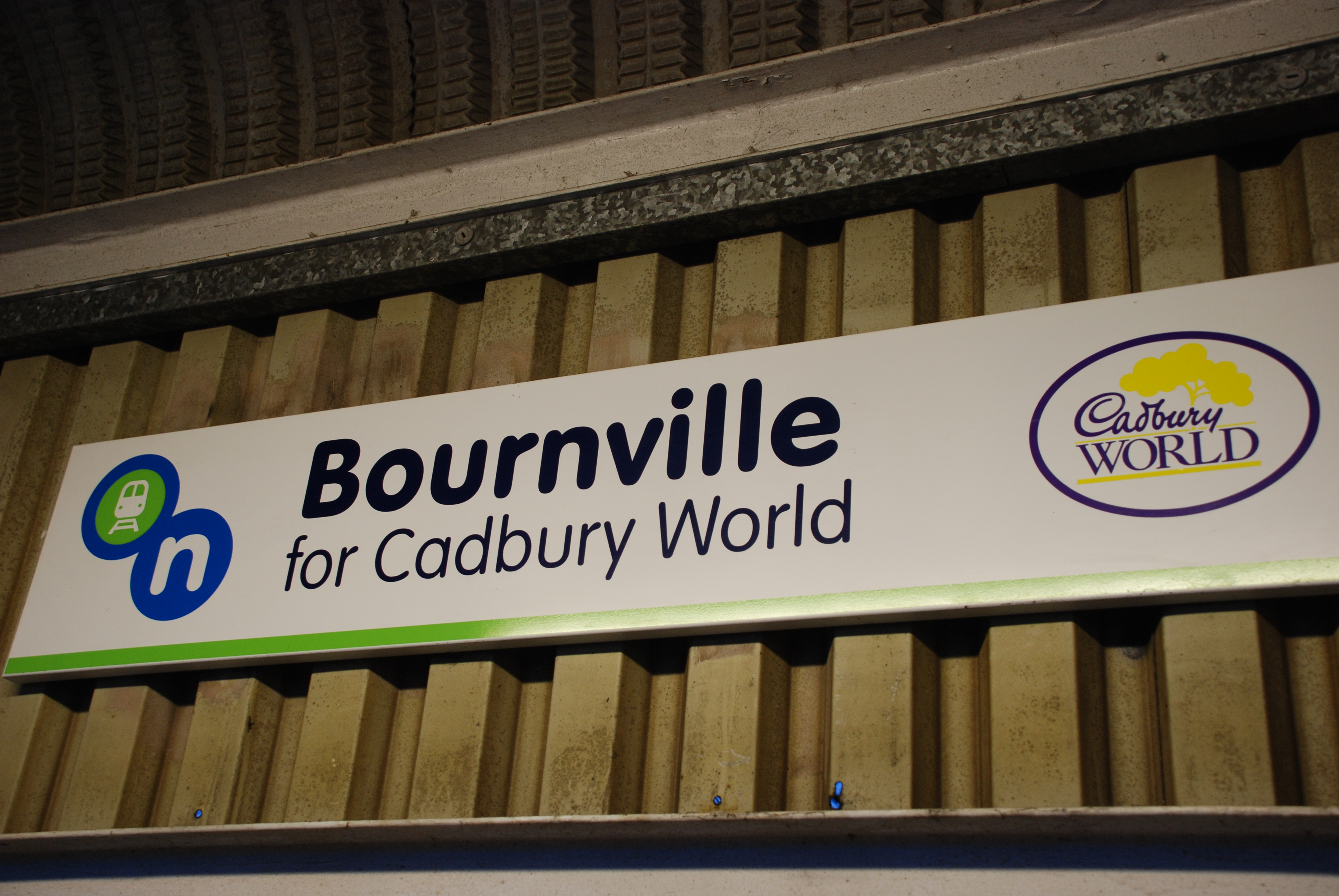
We are back in Bournville. My Dad was a Cadbury man. He
joined as a graduate trainee; when I was born my parents had a flat in
Acocks Green; their first home was on Beaumont Road in Bournville and we
then moved to Bournville Lane when I was about 3 or 4; staying there until I
was 10. In many ways Bournville has not changed. The Cadburys are a Quaker
family; their factory was built with housing, playing fields and a school
for the community. A church and a village green.
A few pictures from today:
The state of the UK
21 January 2009
Sick.
I thought my trip on the subway summed it up this morning.
The circle line had stopped working westbount due to a stalled train. And
eatboubd took 20 minutes to do two stops to Victora- due to a signal
failure.
The signal failure sums up Britain rather well. No one saw
the signals of bank failures, a collapsing economy and the worst
unemployment for over 20 years. Greed had taken over ocprortae England. The
wtachdogs were sleeping.
And no one else cares much now. For a while Tony Blair kept
people interested in England if only beacuse through him they thought
they might be able to temper teh excesses of Mr. Bush. That did not work.
But the USA is cool again. And Engalnd simply is not.
Jim Rogers - co founder of the Quantun Fund with George Soros
was blunt yesterday. Talking to Bloombert TV he said - I would urge you to
sell any sterling that you might have. It's finished. I hate to say it but I
would not put any money in the UK.
He also said that he expects the pound to fall below its
record low of $1.0520 (Feb 1985). The country is bankrupt he says. North Sea
oil is all used up. The financial services industry (banks) are all washed
up.
It may not be apocalyptic. But it is bad. The long period of
adjustment will mean rising taxes and a relative decline in living
standards. The messages given out by Barack Obama yesterday to him fellow
Americans ring true for the British as well.
President Obama attacks "failure" of the Bush era
20 January 2008 - A review of the Obama inauguration speech
from the Guardian newspaper.
A passionate and determined Barack Obama used his inaugural
address as the 44th president of the United States to deliver a stinging
indictment of George Bush's eight years in power.
In front of an estimated 1 million people outside the US Capitol and
billions more watching around the world on television, the new president
attacked a period of "greed and irresponsibility" and "our collective
failure to make hard choices and prepare the nation for a new age".
There had been "a sapping of confidence across our land, a nagging fear that
America's decline is inevitable", Obama said.
As his predecessor looked on, hunched in his overcoat, Obama quoted
scripture to herald a new era of maturity in Washington. "The time has come
to set aside childish things," he said. It was as though he wanted to reboot
American politics by taking it back to the principles set by the father of
the nation, the first president, George Washington.
Obama proclaimed "an end to the petty grievances and false promises, the
recriminations and worn out dogmas, that for far too long have strangled our
politics".
Using an often epic sweep of reference ranging from Christian scripture to
America's frontier history he reaffirmed his country's "greatness" and
mapped out his ambition to get America back on course, which, he reminded
his audience, was set by Washington fighting on the banks of the Potomac
river during the war of independence.
The president said America remained the "most prosperous, powerful nation on
Earth" but added that "our time of ... protecting narrow interests and
putting off unpleasant decisions, that time has surely passed".
In a metaphor that suggested America had been somehow knocked to the floor
under the Bush administration, he said that "starting today, we must pick
ourselves up, dust ourselves off, and begin again the work of remaking
America".
Obama raised the prospect of a new American era of hard work and
determination, and early in his speech he invited the audience to remember
the spirit of America's founding citizens, "who have carried us up the long,
rugged path towards prosperity and freedom. For us, they packed up their few
worldly possessions and travelled across oceans in search of a new life. For
us, they toiled in sweatshops and settled the west, endured the lash of the
whip and plowed the hard earth.
"We understand that greatness is never a given," he said, advocating a new
era of humility in apparent contrast to the previous administration. "It
must be earned."
On foreign policy he promised a predictable hard line against terrorists and
"those who slaughter innocents", warning in powerful tones that "our spirit
is stronger and cannot be broken; you cannot outlast us, and we will defeat
you".But there was little to be gleaned about his strategy on Iraq and
Afghanistan, which he dealt with in a single sentence: "We will begin to
responsibly leave Iraq to its people, and forge a hard-earned peace in
Afghanistan."
This prompted more questions than answers about his policy on Afghanistan in
particular. Did this mean he would press for a rapid end to hostilities or
was he preparing for engagement lasting for years to come?
He promised to "seek a new way forward" with Muslim countries "based on
mutual interest and mutual respect" but said little else about one of the
largest geopolitical fault lines he must negotiate in his presidency.
There was, however, a determined effort to rebrand America as a
multicultural and multi-faith nation after the Bush administration's focus
on Christianity, which was backed by a pointed reference to "restoring
science to its rightful place", and harnessing "the sun and the winds and
the soil to fuel our cars and run our factories", one of several mentions of
his green ambitions.
Obama heralded the strength of his country's "patchwork heritage" – of which
his own Kenyan/American ancestry is a good example.
"We are a nation of Christians and Muslims, Jews and Hindus" as well as
"non-believers", perhaps the first time this group has been mentioned in an
inaugural address.
Aid agencies around the world will have been pleased to hear him tell the
other rich nations that "we can no longer afford indifference to suffering
outside our borders".
To the people of poor nations, he said: "We pledge to work alongside you to
make your farms flourish and let clean waters flow; to nourish starved
bodies and feed hungry minds."
White House gets online revamp
20 January 2009
Moments after Barack Obama took the oath of office as the
44th U.S. president, the Web site for the White House,
www.whitehouse.gov, underwent a
dramatic remaking, offering a new blog for online readers.
It will serve as a place for the most technology-savvy president in U.S.
history and his new administration “to connect with the rest of the nation
and the world,” Macon Phillips, director of new media for the White House,
said on the site.
The site features a blog, an online “briefing room” and allows visitors to
sign up for e-mail updates on major announcements and decisions, and to send
in their own ideas.
As his first official act, Obama proclaimed Jan. 20, 2009 as a “National Day
of Renewal and Reconciliation,” calling on Americans to serve one another
and come together to carry forward American democracy.
Phillips said Obama also remained committed to his campaign pledge to make
“his administration the most open and transparent in history.”
I wonder if he will link to rascott.com......:)
A special inauguration
20 January 2009
The crowds tell the story. This is
America's day in the world spotlight. It is bright, sunny, cold and the Mall
is packed.
African American slaves built the Capitol Building in
Washington. Now we have a Black American President. That is progress.
Why is the inauguration held outdoors in the bitter cold? Why
not hold the swearing in indoors, in private, in the warmth. Easy to answer.
To allow the nation and the world to participate. And there is a sense that
this is a very special day. Michelle Obama's dress is wonderful.
Barack Obama is the first US president who is younger than
me. It really does feel like a change of generation. No more Bush dynasty
and no more Clinton dynasty. We have moved on.
He was introduced to the crowd as Barack H Obama. But he will
take the oath as Barack Hussein Obama. The name matters.
Rick Warren was a bad choice for the inauguration prayer. He
is anti gay rights - he is anti abortion. He rants. He has an evangelical
megachurch in Saddleback California. He is the sort of god squad
megalomaniac that puts me off god and the church.
Aretha Franklin singing in the cold. Sounds like she has lost
her voice.
John Williams score for the event was hardly original - bits
stolen from assorted other tunes.....
The inauguration is now running late - that's a first.
They are getting the oath of office all confused!!! But we
have a new President. At last !!
And now to his speech: Highlights:
"Humbled by the task before us....the oath is taken amidst
gathering clouds.....we are in the midst of crisis....a sapping of
confidence across out land....a nagging fear that America is in
decline....but know this America (the challenges) will be met...we have
chosen hope over fear...the time has come.....all are equal, all are free,
and all deserve a chance to pursue their full measure of happiness.
Greatness is never a given, it must be earned. Our capacity
remains undiminished. We must pick ourselves up...we must remake
America....Everywhere we look there is work to be done. We will harness the
sun and the winds and our soil.....all this we can do...all this we will do.
There are some who question the scale of our ambitions. Their
memories are short. Stale political arguments that have consumed us for so
long no longer apply. Without a watchful eye the market can spin out of
control.
We reject as false the choice between our safety and our
ideals.
Those ideals still light the world and we will not give them
up for expedients sake.
We are ready to lead once more....with sturdy alliances and
enduring convictions....the tempering qualities of humility and restraint.
We will not apologise for our away of life or waiver in its
defence.
We know that our patchwork heritage is a strength.
To the Muslim world we seek a new way forward based on mutual
interest and mutual respect.
The world has changed and we must change with it.
A willingness to find meaning in something greater than
themselves. This spirit must inhabit us all. It is the faith and
determination of the American people that this nation relies on.
The values on which our success depends.....these things are
old; these things are true. What is required form us now is a new era of
responsibility. Duties that we cease gladly. This is the price and the
promise of citizenship.
Let us mark this day with remembrance of who we are and how
far we have travelled.
Let is be said by our children's children that when we were
tested we refused to let this journey end. We carried forward this great
gift of freedom."
And that was the end of his speech. It is about 12.3pm in
Washington. There will be a great party tonite. And then it is down to work.
As for the speech. Soaring oratory - yet it was very business
like. It was a message that we all need to get back to work. It was a blunt
speech. The tone was grim resolve to rebuild the nation and its image.
To President GW Bush's credit he has left office with
dignity. More than any President before him he has made the transition a
smooth one. And to his credit he seems genuinely excited about the change
that Obama represents. Laura Bush and Michelle Obama have both been
gracious.
Joseph Lowery ended on a poignant and humourous note - the
promise of liberty has finally been fulfilled. Brown can indeed stick
around. And white has done right.
From the lower deck
20 January 2009
Yesterday was my debut on the A380 flying with Emirates to
London on EK001. How was it? I hear my reader asking.
The answer is OK. But this is not a Concorde. It is just a
big airplane. And the question is more about how has Emirates fitted out the
plane than about the airplane itself.
Lets start with the airplane.
Boarding was easy - it was not a full load. The plane is
significantly quieter than other modern airliners. The take-off is little
more than a gently powered roll. Sitting on the lower deck you have no idea
that there is another deck full of (premium) passengers above you.
On the lower deck the fuselage is still sloping outwards - so
the window seat is not flush to the fuselage wall. This creates a little
more sense of space. The inner windows are much larger than the outer
windows.
What has Emirates done with its new plane? Well it is like
the old TV series Upstairs Downstairs. And never the two shall meet.
We were on A6-EDD - the fourth and most recently delivered of
the Emirates 380 fleet.
Seats in Economy are 3-4-3; they are a little wider than on
the 777; with a wider armrest between the seats. The seats are firm (hard).
There is no leg rest. There is a very limited seat recline. On an overnight
flight I think these seats would be uncomfortable. Legroom is ok. 32 inches
I assume.
All seats have a widescreen TV and the latest ICE
entertainment (AVOD) system. There is plenty to watch. I think EK's movie
choices are boring, safe and censored. CX has always had a much more
interesting selection of movies. But there is plenty of TV to watch
including new episodes from Dr. Who, Ashes to Ashes, Mad Men and Damages.
As well as forward and downward cameras there is a very
unusual camera view looking forward from high on the tailplane.
Toilets are as cramped as ever. The crew working areas look
reasonably spacious. The meals are standard EK food. Adequate. The coffee
was cold.
EK's 380 crews are the first to wear the new uniform. Sorry -
I dont like it. The chocolate suit for the guys looks very 1970s and the
uniform on many of the girls looks creased and ill fitting. At least the old
blue tabards (now gone) gave a little change of colour from the sand and
brown colours that are everywhere else.
If you are downstairs you most certainly may not go upstairs.
And if you are upstairs why on earth would you want to go downstairs. It
certainly puts "class" back into travel!!
That's about it. It really just feels like another airplane.
Like a big double decker bus. Nothing flash. A workhorse.
Obama's Day
20 January 2009
Today is Obama's Day. And he gets to share his day with the
rest of the world.
It is a day that shines a light on American Democracy and
shows that it is strong. This is also the day that rights the wrongs of the
last eight years. There is a profound sense that this presidential
transition will not be an ordinary one but rather a watershed moment in the
history of the country.
Best of all; he appears to be a decent man who will make
politics honourable again.
Mr. Obama will be the country's first African-American president. This is a
moment in American history when the idea that "Anyone can grow up to be
president" is becoming more true than it had been previously. American
democracy is being significantly deepened and widened by his accession to
the presidency.
But what a task he has ahead of him. This is the world's wish list: first
save global finance from ruin; next get out of Iraq; then fix the climate
and bring peace to the Middle East.
Yes he can. But it wont happen overnight. And there will be
huge challenges along the way.
It is a good day to celebrate.
Abandoned at Sea: The Sad Plight of the Rohingya
By Ishaan Tharoor in Time Magazine - 20 January
2009
"Around early December in eastern Bangladesh, hundreds of people boarded a
few rickety wooden boats and embarked on a journey they thought would convey
them to a better life. They would perhaps land on Thailand's southwestern
coast and then seek work there or in the Muslim promised land of Malaysia.
On Dec. 28, 98 of them were found drifting by India's remote Andaman
Islands, starving and dehydrated, a picture of the hardship weathered by
generations of boat people fleeing adversity only to fall into even greater
trials.
Reports trickling out in recent weeks from various countries lining the
Andaman Sea have related portions of this ordeal as well as other, similar
incidents involving the same ethnic group. But the tale of one survivor has
emerged that, if accurate, paints a picture of a dehumanizing odyssey,
portraying the actions of surrounding governments in horrific tones. The
man's name is Muzaffar, and his testimony was obtained over cell phone from
his place of temporary detention in India by the Arakan Project, a
Bangkok-based group advocating the rights of these boat people. Muzaffar's
account appears to amplify other published reports — except in greater
detail. He said Thai security forces first forcibly detained him and
hundreds of other refugees offshore and then towed them back into
international waters in a motorless barge, where they were at the mercy of
the shark-infested sea. More than 300 people who were with Muzaffar are
missing; they are all believed to be dead.
These refugees were subjected to such treatment partly because few will
defend them. Muzaffar, whose full name is being withheld by the Arakan
Project, is a member of the Rohingya community, a Muslim ethnic group living
in abysmal conditions on the margins of Burma and Bangladesh. Some 800,000
Rohingya, who look South Asian, remain in western Burma, where they are
denied citizenship and most rights by the military-run government; about
200,000 eke out an existence in squalid refugee camps across the border in
Bangladesh. A scattered, quiet diaspora scratches at the fringe of society
in countries as far-flung as Saudi Arabia and Indonesia. Stateless and
unwanted, they are one of the world's most forgotten people.
Over many desperate years, they have tried to flee to the comparatively
richer climes of Southeast Asia. Waves of Rohingya migrants routinely take
to the sea from the marshlands and jungle of eastern Bangladesh, often with
the help of people smugglers who charge extortionate rates for their
services. One report says Thai authorities alone picked up 4,886 Rohingya in
an unspecified period from 2007 to 2008.
Muzaffar was part of the most recent exodus. According to the transcript of
his interview with the Arakan Project, Muzaffar claimed that after he and
his companions had sailed for 12 days in a contingent of two boats, the Thai
navy picked them up and moved them to a barren isle off the Thai mainland —
NGO sources suspect this is Koh Sai Daeng, or Red Sand Island — alongside
Rohingya detainees captured from other refugee expeditions. They were 412 in
total. For eight days, Muzaffar said, they were kept in the open and given
little more than "two mouthfuls of rice" per meal. Thai soldiers, he said,
"beat us up whenever they felt like it."
Then, Muzaffar said, they were all taken aboard a navy vessel, which towed
an empty, open-deck barge behind it. The ship, he said in the transcript,
sailed for a day and a half into international waters, at which point it
stopped and the navy men allegedly ordered the refugees to board the barge.
"First, they pointed their guns at us but we still refused to move,"
Muzaffar said. "Our hands were already tied on the Navy ship, but this time
they also tied the legs of some people and threw four of them into the sea."
Those people, he said, drowned. The rest of the refugees, mostly Rohingya,
boarded the barge. It had no motor or sail. According to Zaw Win, another
Rohingya detainee interviewed by the Arakan Project, the Thais gave the
refugees four bags of rice and two drums of water, a woefully insufficient
supply for over 400 people with nowhere to go. Then they allegedly cut the
rope between the barge and the navy ship and left.
The boat drifted for 10 days and 10 nights. During the daytime, Muzaffar
said, he saw "large fish swimming along the boat that looked like sharks."
His account went on to say that at night they would see a light, perhaps
from a passing ship or a nearby island, and many on board attempted to swim
for it lest their boat drift in the wrong direction. "We saw many drowning,
one by one, as the current was carrying them away and none of them had any
energy left to swim," Muzaffar told his Arakan Project interviewer.
Eventually, the Indian coast guard picked up the surviving refugees and
immediately noticed their abject state. The coast guard's report stated that
there was a significant amount of water flooding the barge; Indian ships
reportedly attempted to search for the 300 missing but were able to rescue
only nine refugees from the sea. The survivors have been fed and given
medical treatment. They are being housed in relief camps, where they were
reached by phone calls from the Arakan Project as well as a reporter from
the BBC. The Thai government has yet to return TIME's calls on the matter of
the treatment of these refugees, but the country's Foreign Ministry released
a statement on Jan. 16 saying that officials were investigating the "facts
and surrounding circumstances" of the incident.
Other reports from around the region suggest that Muzaffar's experience was
not an isolated incident. A Jan. 14 story in the Jakarta Post said 193
Rohingya were rescued by Acehnese fishermen on Jan. 7 and are now being
housed at an Indonesian naval base. The refugees there claim Thai marines
also cut them adrift after destroying the engines on their boats, and they
managed to stay afloat by erecting sails made of plastic tarpaulin.
Survivors from a second wave of refugees "pushed back" from Thailand — a
contingent of some 580 — have also made their way to India's Andaman
Islands. It is not known whether those who landed at Aceh were part of this
same group. The front page of the Hong Kong daily South China Morning Post
on Jan. 15 displayed pictures snapped by an Australian tourist in Thailand
of Thai troops whipping recently detained Rohingya on the beach of an
Andaman island popular for snorkeling — in full view of sunbathing tourists.
What happened to this particular set of migrants remains unclear.
The rescued Rohingya in India and Indonesia are likely to be "repatriated"
to Bangladesh — a return to Burma would spell arrest and far worse. The
Rohingya's lot in Burma is dire, says Sean Garcia, a consultant for the
Washington-based Refugees International. "They are not allowed to survive,"
he says. Denied state documents, the Rohingya have to apply for permission
to move from village to village, to repair a mosque, even to get married.
Rohingya frequently fall victim to forced-labor drives by the military. The
Burmese government, say Rohingya rights-groups, sees them as interlopers in
the predominantly Buddhist land. Illiteracy rates in North Rakhine state,
where the Rohingya are a majority, run near 80%, and malnutrition at 60%.
(See pictures of the devastation of Burma after the huge 2008 cyclone.)
As a consequence of their downtrodden condition, the Rohingya don't have the
kind of diaspora-based support groups that provide publicity and aid to some
of Burma's other oppressed minorities. Their plight, though, may be a
central issue at the next regional ASEAN Summit, which will take place at
the end of February in Thailand. By then, observers hope the Thai government
will employ different methods in tackling the problem. "Governments in the
region need to put together a proactive plan to meet the needs of the
Rohingya," says Garcia. "You can't literally make these people go away, as
if they were less than human." But for thousands of Rohingya refugees, that
is a fate to which they are all too accustomed."
EK A380 Nicolaides jailed for 3 years
19 January 2009
It was sad to see that Harry Nicolaides was sentenced today
to three years in a Thai prison. His crime; writing three ill-conceived
sentences in a novel that sold fewer than 10 copies; and the book was
published in 2006. He must have upset someone enough for them file a
complaint for a case of lese majeste to be heard.
In court, barefoot, wearing leg shackles and looking drawn and weary,
Nicolaides stood to hear his sentence. Leg shackles! He is not a murderer or
rapist. He is not a madman. He is not a threat to the court.
The would-be writer was arrested at Bangkok Airport on August 31 last year
on charges of lese majeste — the crime of maligning the revered Thai
monarchy.
A book he had written in 2006, Verisimilitude, contained a brief reference
to an unnamed crown prince. The passage was deemed insulting and a complaint
was made to the police.
On his way home to Melbourne in late August, the 41-year-old apparently had
no idea a warrant for his arrest had been issued months earlier.
Nicolaides was charged, repeatedly denied bail and finally brought to a
Bangkok court yesterday for his long-awaited trial.
Nicolaides has described his time in prison as "torture". He has been held
in a cell along with dozens of Thai prisoners. His family fears his health
is failing and the emotional pressure is taking its toll.
He insists that he has no idea who had filed the complaint against him.
There appears to be no need for the complainant to be disclosed in court or
to give evidence.
The judges were forced to impose a jail term when Nicolaides declined to
fight the case. The judges sentenced Nicolaides to six years in prison,
reduced to three because he pleaded guilty.
Thailand is one of the few nations in the world to retain the archaic lese
majeste law and the penalty is a mandatory minimum sentence of three years
in prison and a maximum of 15 years.
Watford
Football Club's Wembley moment provides inspiration for author
18 January 2009
I was there - in
fact I was at every game of that cup run - including a nasty 1/4 final at
Birmingham and a finger nail chewing semi final at Villa Park against
Plymouth - George Reilly (what happened to him) got the goal !
Two bottles of champagne for breakfast - and a long hike to the stadium. A
ridiculously young and inexperienced back four.
Barnesy missed an early header. Andy Gray headed the ball out of Shirley's
hands....
Elton cried as we all sang Abide With Me.
A few Scots and Welsh but no foreigners in English teams in those days !
Tai was only 3 at the time - it is hard to explain to her just how great -
and how unlikely - this day was !
And now Nick Corble has written a novel - about that very day !
The review is By
Michael Pickard in the Watford Observor - 18 January 2009
Writing his first published novel has allowed one lifelong Hornets fan the
chance to relive the day Watford met Everton in the 1984 FA Cup Final.
Author Nick Corble uses the only time the Vicarage Road side have reached
Wembley as the backdrop to his new book, Golden Daze, which follows
protagonist Colin Westlake as he makes a series of life choices as he stands
on the brink of adulthood.
Nick, 50, owns his own management company and has previously written several
non-fiction books about local history, canal boating and walking. But this
is his first novel.
He said: “I've always had a hankering for writing. I've been looking for
something to allow me to move into fiction and I thought of the 25th
anniversary of going to Wembley.”
The characters in Golden Daze weave in and out of the timeline that begins
during the General Election of 1983 and sees the Hornets reach the final the
following May.
Nick said: “I've written three or four fiction books but I've never been
happy enough to put them out. This one wrote itself. It all just seemed to
click, remembering what happened the day of the final.
“It's not an autobiography but any fiction writer will tell you if you're
not drawing from your own experiences you've lost your way.”
And for the author, who has been a Hornets fan since they played in the old
Division Four during the 1970s, it was a chance to relive one of Watford's
greatest occasions.
He said: “It was nice to have that moment in the sun. They were magical days
where under Taylor they could build a side and get into the top flight and
stay there. I'm glad we tasted it and when you go back it's nice to taste it
again.
“It was nice to remember all that, but they were different times. You still
walked around the ground and you stood. You only had one substitute. They
were more innocent times. I think we have lost some of that.
“What I remember most is the sheer profusion of yellow. It was the days
before replica shirts and Graham Taylor told everyone to go yellow. The
whole town was decorated.
“At the end of the game, everyone went mad. For us, it (getting to Wembley)
was the absolute pinnacle.”
Nick, from High Wycombe, added that although the storyline revolves around
Watford's famous cup run, his book is not just for football fans.
He said: “People have said to me that you don't have to be a football fan to
enjoy it but if you are, you get it on another level as well. It's about the
rhythm of a football season and what it means to be a football fan. For us,
just to be there (at Wembley) was the fun.”
Nick will sign copies of his book at Waterstones in the Harlequin Centre,
Watford, from 12pm to 2pm on Saturday, January 24 – hours before the
Hornets' FA Cup Fourth Round tie against Crystal Palace at Vicarage Road.
Fans can also read his account of the 1984 final in the match programme.
Copies can also be ordered from
www.nickcorble.co.uk.
Thailand's shame
17 January 2009
There really is no other way to describe news of Thailand's
alleged treatment of Burmese refugees. It is shameful. And the story is
breaking at the end of a week when Thailand has also been accused by Amnesty
International of using torture on suspected rebels in the south of the
country.
The refugee story
(and supporting pictures) appears to have broken in
PhuketWan and has been widely picked up and verified by the
international media. What is clear is that the military and the Thai
bureaucracy are a law unto themselves. The new Prime Miniser, Abhisit, will
need to take action to cool down the international criticism.
Kasit (our ministerial PAD supporter) at the Foreign Ministry
needs to be clear and strong on this issue. Thailand's foreign minister
promised in January, before taking office, that Thailand would pursue a
'clean and humane' foreign policy. He contrasted this with what he called
the 'tainted' and self-serving foreign policies persuaded by the former
regime. He is hardly off to a good start.
In the South of Thailand Amnesty International revealed that
Thai security forces systematically engage in torture and other
ill-treatment. Amnesty International called on the Royal Thai
government to crack down on such practices immediately and to ensure
accountability for any security forces engaged in torture.
The Amnesty report, "Thailand: Torture in the southern counter-insurgency",
documents people being brutally beaten, burnt with candles, buried up to
their necks in the ground, subjected to electric shocks, and exposed to
intense heat or cold. Survivors of torture told Amnesty International that
the most common torture techniques they faced were beatings, being kicked or
stomped on, and having plastic bags placed over their heads until they
nearly suffocated. Amnesty International established that at least four
people died as a result of torture.
“The insurgents in southern Thailand have engaged in brutal acts, but
nothing justifies the security forces’ reliance on torture. Torture is
absolutely illegal and, as the situation in southern Thailand proves,
alienates the local population,” said Donna Guest, Deputy Director of
Amnesty International’s Asia-Pacific Programme.
Amnesty International’s research in the southern provinces of Narathiwat,
Pattani, Songkhla, and Yala established that Thai security forces have
systematically relied on torture and other cruel, inhuman or degrading
treatment or punishment in their efforts to obtain information, to extract
confessions to compensate for poor intelligence and evidence-gathering, and
to intimidate detainees and their communities into withholding or
withdrawing support for the insurgents
Meanwhile the BBC and other news agencies report that
migrants and refugees who turn up on its shores have testified that they are
being sent back to sea in boats without engines, their hands tied, left to
their fate.
Hundreds are thought to have suffered this treatment - among them many
Rohingya people of western Burma - and many have died.
The Rohinya are a Burmese Muslim minority who arrive as refugees on
Thailand's Andaman Sea coast. They are ususally handed over to the Internal
Security Operations Command (ISOC), a military authority set up under the
Cold War and still given sweeping powers to protect national security.
There are no visits from lawyers or refugee advocates. The military can do
what it likes with them.
According to a local civic group, the Arakan Project, whose
staff have done extensive interviews with some of the Rohinya survivors, the
refugees were detained by the Thai security forces in late November and
December last year as they arrived by boat.
Instead of being handed over to the police or immigration for processing as
illegal immigrants, they were instead taken by military units to an island
called Koh Sai Daeng. They were detained there for several days, sleeping
out in the open, their hands tied at night.
On 18 December one group of just over 400 was put on a navy boat, which was
towing a barge behind it, says Chris Lewa from the Arakan Project.
Their hands were tied. Once out at sea they were ordered to move onto the
barge at gunpoint. They refused. The Thai troops then tied the feet of four
of them and threw them overboard.
The group then moved onto the barge, and the rope was cut,
leaving them with food and water for two days.
They drifted for more than 10. According to the testimony she has obtained,
Ms Lewa says they sighted land - the Andaman Islands - on around the 12th
day.
Fearful that the current would sweep their barge away, many of the exhausted
and dehydrated Rohingyas leapt into the sea to try to make it to land.
Fewer than 100 were found on board by the Indian coastguard, although an
unknown number was also picked up from the sea or on beaches.
Some survivors who reached Aceh have told the local media the same story.
The local commander of ISOC in Ranong, Col Manas Khongpan, has denied these
allegations. He told the BBC that illegal immigrants are never held by his
troops.
In addition Navy chief Admiral Kamthorn Phumhiran on Friday
dismissed the BBC report. "The Royal Thai Navy did not badly treated the
Rohingyas. There was no setting them adrift as alleged," he said.
But that contradicts comments the BBC has been given by other military and
police officials, who say all Rohingya boat-people are now being handled by
ISOC. They explained that Rohingyas are seen as a greater security threat
than the tens of thousands of other illegal migrants, because they are
Muslim, because they tend to arrive in large numbers at one time, and
because they are almost exclusively men.
The Thai government has now issued a statement saying it is
investigating all the facts surrounding these allegations.
It has promised to re-assess the situation of all illegal immigrants in
Thailand, numbering perhaps three or four million, most of them from Burma,
and to treat them in accordance with humanitarian principles.
Whether it can truly hold the military to account though is open to doubt.
In many areas of Thailand the army operates with little civilian oversight.
It has huge secret budgets, and extensive business interests.
Prime Minister Abhasit has made the rule of law one of the core principles
of his administration. He has a long way to go.
The Bush years - the good
and bad
17 January 2009
From The Washington Post
"Addressing the nation for the last time as President Thursday night, George
W. Bush identified September 11, 2001, as the defining moment of his eight
years in office. The lesson of that awful day, he suggested, was that "good
and evil are present in this world, and between the two of them there can be
no compromise. Murdering the innocent to advance an ideology is wrong every
time, everywhere. Freeing people from oppression and despair is eternally
right." Americans can never afford to grow complacent, and, above all, must
"maintain our moral clarity," he said.
In those few sentences, Mr. Bush encapsulated both what was valuable in his
approach to national security and foreign policy -- and what has been so
very troubling. He was and is essentially correct to define Islamist
terrorism as an unappeasable menace. His certitude amid the crisis of 9-11
helped galvanize the initial national response, including the toppling of
the Taliban in Afghanistan. Alas, that same certitude led Mr. Bush down many
blind alleys and, in the worst moments, caused him to debase his country's
moral currency. In rejecting the Geneva Conventions, he seemed not to
realize that the world, even those parts of it that were friendly toward the
United States, does not assume American righteousness -- and that even a
necessary counterattack against al Qaeda and other enemies must therefore be
constrained by law. History may credit him for avoiding a second attack on
U.S. soil, but not for his handling of Guantanamo or "enhanced
interrogation."
In Iraq, too, Mr. Bush gambled his nation's international alliances and its
international reputation. We agreed with him that Saddam Hussein's defiance
of multiple UN Security Council resolutions was intolerable, and that
sanctions against his regime could neither contain the long-term threat of
weapons of mass destruction nor deliver the Iraqi people from unendurable
tyranny. Like the president, our sense of the war's necessity was shaken by
the absence of WMD. Unlike the president, our sense of his administration's
competence was shaken by the war's disgracefully bad planning, which
contributed to Iraq's post-invasion plunge into horrific violence. The
global backlash against the war, especially in Europe, has cost the U.S.
dearly, making it more difficult to rally the world against Iran's nuclear
ambitions. Though relations with Europe have been significantly repaired,
Iran exploited the divisions in Western ranks to make mischief in both Iraq
and Afghanistan -- and to advance its bomb-building.
But, as matters in Iraq now stand, there is a decent chance of a reasonably
pro-American incipient democracy in the heart of the Arab Middle East. This
would be a major accomplishment, and one that would cast the invasion, the
failures of the early years of occupation and the painful loss of more than
4,000 American lives and many thousand more Iraqi lives in a different light
than that in which they are seen by most Americans now. It would also
vindicate his unpopular decision to stabilize Iraq with more U.S. troops
rather than abandon it to civil war and possible genocide -- an instance in
which Mr. Bush's self-assurance and steadfastness paid off.
Perhaps the brightest example of humanitarianism in Mr. Bush's record is his
commitment of vast new resources to the battle against AIDS in Africa. In
the Millenium Challenge Account, he attempted to link foreign aid to honest
and efficient governance. And he put the U.S. firmly on the side of
democracy and freedom, arguing, correctly, that the transformation of
dictatorial regimes is, in the long run, necessary to peace and security.
"Around the world, America is promoting human liberty, human rights, and
human dignity," he declared on Thursday. But he did not always practice what
he preached; in Egypt, Saudi Arabia and Pakistan, support for dictators,
justified by the anti-terrorism campaign, trumped support for liberty. The
same desire for anti-terrorism cooperation may explain his protracted
reluctance to recognize or respond to Russia's descent toward autocracy at
home and bullying abroad. In China and North Korea, trade and
denuclearization, respectively, prevailed. It is still too early to tell
whether his choice of diplomacy in those areas will pay off; by not
following through on his rhetoric, though, Mr. Bush insured that he would
get blame for being inconsistent without getting credit for any results.
And, it's worth remembering, his blind faith in simplistic economics -- tax
cuts for every season -- led him to pay for all his wars and foreign aid on
credit, helping produce today's fiscal disaster.
It won't be easy to undo what Mr. Bush has done. We say this because some of
the damage is irreversible. But we also say it because some of the dilemmas
he confronted will persist beyond his presidency. As President-elect Obama
has recognized, for example, closing Guantanamo is not as simple as many of
its critics imagined, because a significant number of those detained there
would try to attack Americans if released. Mr. Bush's characteristic failing
was to apply a black-and-white mindset to too many gray areas of national
security and foreign affairs. But as they assume power with a mind to clean
house, Democrats must be careful not to make the same mistake."
Singapore Air cuts flights and costs
16 January 2009
Singapore Airlines
(SIA) is cancelling more than 200 flights from now until the end of March
in order to cut costs as demand drops dramatically.
In a circular to
travel agents earlier this week, SIA said it would reduce the number of
flights to Shanghai, Hong Kong and Guangzhou in China, as well as to the
Indian cities of Mumbai and New Delhi.
Travellers heading to Perth, Sydney and Brisbane, as well as those bound for
London and Zurich will also have fewer options to choose from.
In all, 214 flights will be cut, about 3 per cent
of the airline's total. While the numbers may seem like a drop in the ocean,
they are a sign of worse things to come, said industry players.
SIA spokesman
Stephen Forshaw said the company would continue to adjust schedules and
consolidate flights where passenger numbers are low.
At the same time SIA plans to offer more fare
specials in an attempt to stimulate demand. One such promotion: an
all-inclusive fare of $798 per person - if two travel together - to
Melbourne, Sydney or Brisbane. In good times, the fare would have easily
been more than $1,000.
US Airways Crew Is Credited for Quick Reaction
16 January 2009
Minutes after
departing La Guardia Airport, what the crew of US Airways Flight 1549 faced
Thursday afternoon, at about 3,000 feet over the central Bronx, was a really
quick decision.
The plane had suffered “a double bird strike,” one of the
pilots told an air traffic controller at the New York Terminal Radar
Approach Control.
Probably feeling the plane shake after hitting the birds, and certainly
feeling the loss of power in both engines and watching the dials show thrust
slipping away, the crew looked ahead as the plane turned west, and caught a
glimpse of a runway.
What is that small airport, one pilot asked a controller.
Teterboro, in New Jersey, the controller replied, and instructed the pilot
to fly south along the Hudson River, then swing back to the north to land
there.
Instead, the pilot told the controller that they would ditch the plane in
the river. They then cleared the George Washington Bridge by about 900 feet,
according to controllers, and at a point near the end of West 48th Street in
Midtown Manhattan, the plane slid into the river’s smooth, gray waters.
In a few weeks, a close comparison of radar tapes and cockpit audiotapes
will establish where the plane was when that clipped, urgent conversation
took place, and other investigators will try to figure out why this one
plane, flying through some of the world’s most congested airspace, was the
only one to report a bird problem.
But from early indications, it appears the pilot handled the emergency river
landing with aplomb and avoided major injuries, evacuating the plane, an
Airbus A320, calmly in the middle of the river, passengers and officials
said.
Airliners are not meant to glide, although occasionally they have to. The
pilot of this one, Capt. Chesley B. Sullenberger III, is certified as a
glider pilot, according to Federal Aviation Administration records.
Captain Sullenberger, known as Sully, flew the F-4 for the United States Air
Force for seven years in the 1970s after graduating from the United States
Air Force Academy. He joined USAir, as it was called at the time, in 1980
and became a “check airman,” training and evaluating new pilots or those
changing to new aircraft or moving up to captain. He also was an accident
investigator for the union, the Air Line Pilots Association.
Captain Sullenberger’s wife, Lorrie Sullenberger, a fitness expert in
Danville, Calif., said she learned about the crash on Thursday afternoon
when her husband called her. “I haven’t stopped shaking yet,” she said in a
brief phone interview.
US Airways pilots can drill for water landings in a simulator, but no one
knows how realistic that is. “You’re landing on a big blue screen,” said one
US Airways A320 pilot, referring to the flat-panel computer screens in the
simulator.
“Better to land at an airport where there’s actual crash-fire-rescue,” said
the pilot, who requested anonymity because he did not have his airline’s
permission to speak. But the pilot and other experts said the crew appeared
to have done a good job.
Ditching can be tricky. The first step is to extend the slats and the flaps,
the movable surfaces on the front and back edges of the wings that allow the
plane to fly more slowly and to descend to just over the water’s surface.
Another step is to hit the “ditching button,” which seals the openings in
the plane. One is the intake, where the engines grab air to pressurize and
force it into the cabin, essential to high-altitude flight. Another is the
valve at the back that lets air out.
When the plane is flying low enough, it will generate its own cushion of
air, a phenomenon called “ground effect,” that lets it fly even more slowly.
“The whole point is to get the airplane slow, to minimize the damage and the
forces on the airplane,” said John Cox, a safety consultant who flew the
A320 for US Airways and USAir for six years.
Mr. Cox said that he knew Captain Sullenberger and that he was “a seriously
good aviator.”
While the plane slows, the crew has to be careful not to let it stall, which
happens when the wind is flowing over the wings too slowly to generate
enough lift and the plane falls from the sky. Mr. Cox said the plane would
probably have touched down at 100 to 120 knots, roughly 115 to 140 miles per
hour.
Ditching is different from landing a glider. Another safety expert, Arnie
Reiner, who was a crash investigator for Pan American World Airways and
later a pilot for the Delta Shuttle flights out of La Guardia, said the
object was to keep the wings level and the nose up slightly, so the fuselage
could plane on the water’s surface. Hit in a nose-down attitude, he said,
and the plane could dig into the water, potentially damaging the fuselage
heavily.
This one settled in with the nose high.
Kai Tak's future
15 January 2009
Details of a long-awaited HK$100 billion plan to transform
the Hong Kong's Kai Tak airport site into a city-within-a-city with its own
international cruise terminal were unveiled by the government this week.
Officials also expressed hope to fast- track the first phase
of the government- bankrolled scheme by creating 1,500 jobs this year in a
bid to ease the strain of the economic crisis.
To do this, the Legislative Council will be asked to release
HK$3.3 billion from the public coffers in the second quarter of this year so
that seven initial sub-projects can be started.
One of the key features of the plan for the 320-hectare site is to turn the
notoriously pungent Kai Tak nullah into a pleasant, more open stretch of
water.
Phase one is due to be completed by 2013 and includes the building of 13,000
public housing flats, three schools and a government office building on the
north apron of the old airport. It will also contain the first berth of the
cruise terminal, a park and a 200-meter long waterfront promenade along with
a new cooling system.
This phase - excluding the cruise terminal and runway park - will cost HK$15
billion.
Key transport projects, including Route Six and the MTR Sha Tin to Central
Link, will be included in the HK$66 billion phase two part of the scheme to
be completed by 2016.
The Kai Tak Approach Channel - better known as the Kai Tak nullah - will be
cleaned up using bio-remediation treatment, the creation of a 600-meter wide
opening in the former runway to improve water circulation in the channel and
the interception of polluted discharges in the hinterland.
The second phase will see the completion of the second berth of the cruise
terminal, underground streets connecting the new development to Kowloon City
and San Po Kong, and a heliport.
The HK$22 billion final phase is due to be completed by 2021. This will
include a multipurpose stadium with more than 45,000 seats, sites for
residential, commercial developments, a metro park and, perhaps, a monorail
and bridge link to Kwun Tong waterfront.
It is over ten years since Kai Tak airport closed. A final
decision on the future of this prime and historic location is long overdue.
Reactionary woes in Hong Kong
15 January 2009
It is impossible to let this letter to the South China
Morning Post pass without comment.
Here we have a large group of minimum wage,
legal, ID card-holding residents
who keep Hong Kong running by working 18 hours a day six days a week
managing the families of Hong Kong's dual income familes.
The letter is ignorant and racist. There cannot be too many
Prakash Mahbubani's in Hong Kong. Hopefully he will get re-educated quickly.
Buying votes and loyalty
15 January 2009
It was not long ago that a Thai Prime Minister lost his job
because he got paid a few dollars for hosting a TV cooking show.
Meanwhile other MPS, mainly associated with Thaksin's old
Thai Rak Thai party have been banned from politics for vote buying.
So what then is the latest gift from the new Democrat led
government to be called?
If you are a salaried employee, registered with a social
security number and earning less than Baht 14,999 a month, you will receive
a once off gift, a thank you for your continuing support, of Bht 2,000. This
covers some 8 million employees and 1.4 million civil servants.
But Baht 2,000 does not go to the unemployed and those below
the poverty line. There are some 23 million Thais who do participate in the
social security fund and who do not have a regular salaried income. This
supplementary spending budget, is designed to win voting loyalty or to say
thank you rather than to prop up the sagging economy.
Too short sighted
15 January 2009
The government will today approve the construction of a sixth
terminal and a third runway at London's Heathrow Airport.
This is the wrong solution to that airport's overcrowding
problems. It really is time to start again. Heathrow is not an airport for
the 21st century.
Heathrow is horrible. Overcrowded, chaotic. It is in the
middle of a built up area. Any expansion of the airport with disrupt the
lives of thousands.
The answer is to copy some of Asia's successes. Bangkok,
Kuala Lumpur, Hong Kong, Seoul, Osaka and Shanghai are built major new
airports to replace older outdated facilities.
London should be doing the same. British Airways sees London
as a "hub" airport, with many flights connecting from elsewhere, a large
proportion of its passengers only transit through Heathrow. This "hub" could
be placed almost anywhere with good rail access to the city.
The Thames estuary has long been proposed as a site where
land can be reclaimed and a first class airport constructed with minimum
public disruption. London's major airport does not have to be in a densely
populated area, where aircraft disturb many millions of people.
Even though the new runway will be approved today it will be years before it
can be built. The planning inquiry will become the next battlefield.
Emirates to drop Nagoya; start Durban.
13 January 2009
It is rare indeed for fast expanding Emirates to actually
drop a route from its network but with effect from the end of the winter
schedule Emirates will be dropping the crew popular, but passenger light,
flights to Nagoya.
Emirates will operate its last flight to NGO will from DXB on
28 March 2009. The route has been stopped due to operating losses. Interim
capacity to Japan will be provided by use of the B777-300ER (with Suites) on
the Osaka (KIX) route, and will be further reinforced in a year's time when
Emirates commences daily flights to Tokyo (NRT) at the end of March 2010.
The 77W for the KIX route will be sourced from EK420/421 (DXB-PER-DXB) which
will subsequently drop down to a B77L.
The A343 from NGO will be used to upgrade EK745/746 (DXB-TIP-DXB) from an
A332.
Emirates has announced that it will introduce daily flights to Durban (DUR)
effective 1 October 2009. This is a year later than originally planned but
is in good time for the 2010 World Cup.
Flight schedule:
EK775 DEP DXB 0445 ARR DUR 1130
EK776 DEP DUR 1300 ARR DXB 2340
Flights will be operated by A330-200 in a high density (J/Y)
configuration.
The
international media and the missing parts of the puzzle
12 January 2009 Chang Noi in the Nation from
January 5, 2009 - worth a read - especially between the
lines!!
"Little more than two
decades ago, Thailand attracted relatively little interest in the outside
world. Its economy was still largely agricultural. Its financial system was
closed. Tourism was limited to adventurous types prepared to hire fishing
boats to get to pristine islands now buried under concrete. Bangkok had few
foreign residents other than employees of international agencies. Beyond the
capital there were only a few left stranded after the Vietnam war. Academic
interest was confined to a specialised coterie, mainly anthropologists
studying picturesque backwardness among the northern hill-tribes or in
deepest Isaan. Thai restaurants were rare even in Bangkok let alone the
outside world.
Fast-forward to the present and the change is overwhelming. The economy has
been inserted into the world spanning production chains of multinationals.
The baht and the stock index bounce around on flows of international
finance. A million people pass through the immigration checkpoints every
month. Thai restaurants are a fixture on every high street.
Many, many people have an interest in understanding what is happening in
Thailand for the simple reason that they have something at stake. The
world's automobile giants have huge investments accumulated over 20 years.
Managers of international financial funds hold Thai currency, stocks, and
bonds. Manufacturers of millions of products depend on a Thai-based supplier
for some part or component. The size of the resident international community
has ballooned as the growth and internationalisation of the local economy
has sucked in everyone from English teachers to Korean restaurateurs. Rural
Thailand is dotted with colonies of European retirees. Thousands of families
hope a vacation in Thailand will be a highpoint of their year.
With more people in the world having more at stake in Thailand, there has
been a growing demand to understand the country and how it works.
International financial firms analyse the economy for the clients on a daily
or weekly basis. Risk analysts publish regular reports. Thai academics can
earn extra pocket money by acting as speakers and consultants. A few blogs
act as forums for debate and comment. In this knowledge industry, the
foreign media play a major role because of the immediacy of their response
to events.
Go back two decades again, and the interest of major international media in
Thailand was almost zero. The Far Eastern Economic Review catered to a slim
and specialised audience, but stories on Thailand in the international press
were very rare, and on BBC or other major broadcasters were virtually
unknown. Journalists resident in Bangkok were mostly focused on neighbouring
countries such as Burma and Cambodia. If anything big happened in Thailand,
journalists flew in and struggled to understand what was going on. During
the political crisis of 1992, many journalists who had last been in Thailand
at the close of the Vietnam War hopped off the planes and tried to
understand what was happening in a framework that was now 20 years out of
date. Today is very, very different. During the peaks of last year's rolling
crisis, Thailand was often the lead story on BBC, CNN, al-Jazeera, and NHK.
The Chinese news agency, Xinhua, named the Thai turmoil among its top 10
international stories of the year. International papers like the
International Herald Tribune , Wall Street Journal, and Financial Times
regularly run a Thailand story several times a week. Several daily
newspapers from Australia, Japan and Europe maintain permanent
correspondents in Bangkok. In contrast to the fly-in/fly-out mob, many of
these international correspondents stay for a long time, become proficient
in the language, and get dug into the culture.
The job of everybody in this knowledge industry is to give a full picture.
The audience for the specialised reports, the blogs, and the international
media demand to know what is really going on because they have a lot at
stake. In the past three years, and especially in the past three months,
that has been very, very obvious. Investors have seen their capital
devalued. Manufacturers have had worldwide production systems disrupted.
Families have lost their holidays. The demand to know and understand how the
country really works has increased. But this creates difficulty because of
those parts of the picture that are blocked out.
The local media practice self-censorship because it would be dangerous not
to. But in private space, Thais compensate for the gaps in public knowledge
by exchanging opinions, relaying gossip, comparing interpretations. This
network of information-sharing is very dense. Of course, it is difficult to
judge the validity of much of what is exchanged. But this informal
information network helps people to fill in the blanks and allow them to
feel that they understand the full picture.
Those consuming the international media do not have access to a similar
network. Hence the gaps in their picture are glaringly obvious. People find
it difficult to accept that an institution that figures so prominently in
the nation's Constitution, in the daily word-of-mouth exchange of
information, and in the visual drama of street protest is not part of the
political landscape. International correspondents try to compensate because
their audience demands it.
Over the past year alone, the nature of political debate within Thailand has
changed utterly. More sections of society are involved in the debate. Things
once unsaid are now said. In public forums, speakers have evolved codes,
metaphors, and gestures, which their audience can understand. On radio,
presenters have quietly transgressed old taboos. In semi-private spaces like
the interior of a taxi, exchanges have become more forthright.
Those restating old truths about Thai politics are perhaps trying to
reassure themselves that nothing has really changed. But it has. The
knowledge industry, both inside and outside the country, will continue
trying to fill in the missing parts of the puzzle because there is such a
large audience that has so much at stake and a desire to understand what is
really going on."
Fears for Thomson Reuters UK listing
12 January 2009 - Financial Times
"More than 150 years after Paul Julius Reuter started
supplying prices from the London Stock Exchange, traders there are beginning
to ask whether Reuters' parent company might one day disappear from the UK
market.
Despite a "dual-listed company" structure, put in place when Thomson Corp
bought Reuters for £7.9bn ($11.9bn) in May last year, the UK listing of
Thomson Reuters is trading at a widening discount to the group's Toronto and
New York quotes.
Yesterday, Thomson Reuters Plc was trading about 16 per cent below the North
American listings for Thomson Reuters Corp.
North American investors are growing concerned that the depressed UK price
is dragging on their stock, and are asking whether further action, possibly
including an end to the London listing, might be needed.
"We are reluctant to continue recommending [the Canadian stock] when we know
that investors can buy an identical economic interest in the company for
[what was then] 22 per cent less via [the London] shares," analysts at TD
Newcrest, a Canadian brokerage, wrote last week.
Analysts attribute the discrepancy to hedge fund activity and differing
views of the company's assets on opposite sides of the Atlantic, but many
have been startled by the widening gap.
"Thomson people think the old Thomson [which encompasses legal, healthcare
and scientific databases] is greatly underestimated [in London]," Patrick
Wellington, a Morgan Stanley analyst, said.
Woodbridge, the Thomson family investment company, has attempted to tackle
one factor behind the UK discount, providing liquidity to arbitrageurs who
struggle to borrow the tightly held Toronto stock by swapping some of its
Canadian shares for UK paper. However, two such attempts have yet to close
the gap.
Woodbridge, which owns 70 per cent of Thomson Reuters Corp, has the
authority to take its holding of Thomson Reuters Plc up to 13 per cent.
It is not thought likely to seek to increase its total holding beyond the
current 55 per cent.
A Thomson Reuters spokesman said it would not comment on the dual-listed
structure, and the company is understood to have no plans to change it in
the next few months.
However, board members are understood to be reviewing the structure
regularly.
The London listing represents 24 per cent of the group's value, and is more
than 50 per cent controlled by North American shareholders. But ending the
former Reuters' presence on the London exchange would be a symbolic shock.
People close to the group say there are no current plans. One theory is that
it can wait for the day when North American ownership is high enough that
the majority of London investors ask for Canadian or US stock instead.
What that percentage would have to be is unclear.
For now, the discrepancy is raising questions about the value of dual-listed
company structures."
Once a pastoral
paradise, has Pai now become too big for its boots?
from the Bangkok Post travel section - 12 January 2009
"Just a three-hour drive from Chiang Mai along
scenic Highway 1095, with its endless series of hairpin bends, lies Pai, the
popular tourist destination that only a couple of decades ago was an
insignificant rest-stop on the gruelling journey onwards to Mae Hong Son.
What was once a hamlet in a picturesque, lushly forested valley is now a
burgeoning little town which seems more than ready to shed its
backpacker-haven image and embrace mass tourism.
Adventurous foreigners on tight budgets were the first group to be lured by
Pai's charming isolation. Its idyllic setting, tranquillity, laid-back
atmosphere and warm-hearted residents made it a sort of Utopia for those
seeking to escape the pressures of city life.
It wasn't until 2006, when Pai was featured in a popular romantic-comedy
film, that it began to attract large numbers of domestic holidaymakers who
today comprise the vast majority of visitors.
Now seen as a gold mine for entrepreneurs and land speculators, the place
has undergone a series of major infrastructure upgrades, wreaking a
transformation which has precipitated something of a crisis of identity.
Scores of hotels, guesthouses, restaurants, coffee shops and bars have
sprung up along with Internet cafes, travel agencies and car-rental firms.
There are 24-hour convenience stores on the main street, banks and
currency-exchange booths all over. An increasing number of small and
medium-sized luxury resorts plus live-music venues has brought colour but
also sweeping change.
During the peak season one has to deal with noisy traffic, crowded streets
and all the commercial hue and cry of a boomtown. It's time to admit,
perhaps, that those seeking peace and quiet might be better off going
elsewhere.
Despite all the unpleasant changes, however, the locals still display
unconditional generosity and remain as friendly toward visitors as ever.
Ironically, what little remains of Pai's former bucolic charm is to be found
in venues opened by artistically minded entrepreneurs who have preserved
some aspects of the local culture and architecture. Rows of traditional
wooden homes now house stylish coffee shops, art galleries and boutiques
selling creative souvenirs and quaint ornaments and decorative items.
Pai still offers a wealth of outdoor activities and travellers can choose to
explore the countryside by bicycle, motorbike, car - on elephant back, even
- or on board one of the bamboo rafts which ply the Pai River. Venture
beyond the outskirts of town and a multitude of attractions await, from
sites of historic interest and religious structures to waterfalls and hot
springs.
Situated about three kilometres west of the town centre, Wat Nam Hoo is a
must-see. The temple's ordination hall houses a 500-year-old, bronze Buddha
image called Un Muang, revered by locals because of a supposedly miraculous
feature: the statue's hollow topknot can be opened to reveal naturally
occurring "holy water" within.
Another old temple that has stood the test of time is Wat Phra That Mae Yen,
built on a hill east of town. From its tranquil compound one gets a
panoramic view of the whole district, making this an ideal vantage point
from which to watch the sun rise and set.
Pai's proximity to the Burmese border makes it a
great place to gain insights into other cultures, too, since Lahu, Lisu and
members of several other ethnic minorities have settled in nearby upland
areas. Descendants of Haw migrants from Yunnan also live in the
neighbourhood and their villages boast houses built in a traditional Chinese
style, mouth-watering Yunnan delicacies, handicrafts, tea shops and a
wooden, non-motorised ferris wheel.
After a long day wandering around you may want to unwind in the hot springs
in the middle of a teak forest in Tambon Mae Hee, or enjoy the refreshing
sight and sounds of a cascading stream at the Mo Paeng Waterfall.
Mass tourism has had both positive and negative effects on the lives of
Pai's original residents. And while some observers see all this development
as "progress", believing that it will inevitably lead to a new age of
prosperity for all, many view it as the sad loss of a traditional way of
life and point out that much of the profits are going to outside investors.
But whatever one's point of view, it is hard to deny that Pai remains a
rather special town, a place to which people are tempted to return again and
again."
The Gulf News plumbs new depths
9 January 2008
I am truly stunned that The Gulf News (Dubai's leading
English language newspaper) printed the following opinion piece. It is hate
writing at its worst; and shows a depressing ignorance of the Nazi
atrocities.
There is much that is troubling
about Israel's actions, but this column is hate mongering at its worst. The
writer (who is a sociology professor at the UAE university) says that Jews
and Nazis concocted the Holocaust as a hoax to "blackmail humanity" and
continues: "It is evident that the holocaust was a conspiracy hatched by the
Zionists and Nazis, and many innocent people gave their lives as a result of
this inhuman plot"...
I suspect that must be uproar in
the editorial offices at the newspaper.
Dubai has tried to position
itself as a moderate Arab state; as a place where east, west, north and
south can come together in harmony. Where religious differences (as long as
you do not have an Israeli stamp in your passport) are tolerated.
But the attack on Gaza is
producing some extremist views and revisionist history. This will damage
Dubai.
Zionists are the new Nazis
By Mohammad Abdullah Al Mutawa, Special to Gulf News
Published: January 04, 2009, 23:35
Today, the whole world stands as a witness to the fact that the Nazi
holocaust was a mere lie, which was devised by the Zionists to blackmail
humanity. The same Zionist entity swindled the world out of billions of
dollars over the years to compensate the wrong and unjust which they claim
to have been inflicted on their people.
It is evident that the holocaust was a conspiracy hatched by the Zionists
and Nazis, and many innocent people gave their lives as a result of this
inhuman plot.
Historians, researchers and conscientious people are aware of the role
played by the Zionist movement and the prevailing forces of the first half
of the 20th century in carrying out the bloody plot.
The holocaust was a major crime in history, and the Israeli culprit is at it
again today. After more than half a century, another holocaust is taking
place against the Palestinian people in Gaza. In the past few days, hundreds
of Palestinian civilians were killed or injured, as the Israeli criminal war
machine set out to annihilate them.
People in Gaza are drowning in a sea of blood and destruction, in a manner
that surpasses all past crimes and massacres that were carried out by the
Zionist entity in Palestine over the past 60 years.
The first day of the Israeli annihilation of Gaza started on the Hijri new
year. It was a message in the form of a gift to the Arab and Islamic world;
reminding us of the Ramadan 1973 war, which coincided with the first day of
the Hebrew new year.
After three decades, the Zionist movement is repeating the tragedy for Arabs
and Muslims.
All this is an unmistaken proof that the Zionists are not peace seekers. And
whosoever has the illusion that coexisting in peace with them is possible is
living outside the boundaries of history.
The barbaric bombing and the killing of hundreds of civilians in Gaza is
evidence of the fascist and inhuman traits of the Zionists. The charred and
bloodied bodies of innocent children, women, and civilians in houses and
streets, are testimonies to the Nazi character of the Zionists, whom they
claim to have fought in the past.
The Zionist entity is using the same weapons that were used in the past, but
in an increasingly savage and modern manner. The US, on the other hand,
points its accusing finger to the innocent victims of the Israeli
aggression.
The whole world stands in shock as they watch the new holocaust in their
homes with the help of advanced technology, satellites and other means of
mass media.
A people that are helpless, unarmed and have nothing to defend themselves
with, save their belief in the righteousness of their cause, are being
murdered in cold blood. Hence, the world stands today in solidarity with the
victims of Zionist terrorism.
The support generated for the Palestinians in many countries shows that
humanity still exists. Thousands of people rallied in the streets around the
world to protest and demand an end to the Israeli crime.
Even Jews in some countries have protested against the new Zionist
holocaust.
The false pretext and cover Israel tried to utilise to mislead people and
international public opinion has failed to do the trick now.
The mask has fallen off the true ugly face of Zionism, and the fascist
monster has been exposed for all to see.
The Israeli massacre in Gaza will boost all efforts for the liberation of
the Palestinian people, and regaining their right in their occupied land.
In the UAE, His Highness Shaikh Mohammad Bin Rashid Al Maktoum,
Vice-President and Prime Minister of the UAE and Ruler of Dubai, ordered the
cancellation of all New Year's celebrations to express the emirate's
solidarity with the Palestinian people.
The decision also highlights the stature and humane qualities of Shaikh
Mohammad's leadership and vision, as he fully understands the pain of the
suffering Palestinians.
A question remains: What will the US do about the current Israeli atrocities
and crimes?
Will the US government intervene to put an end to the bloodbath, or will it
be a silent spectator and ask why the entire world hates it so?@
Dr Mohammad Abdullah Al Mutawa is a professor of sociology at UAE
University, Al Ain.
Not your average lunch
8 January 2008
It is not very day that four US Presidents and one
President elect get together for lunch.
After all lunch is usually not with people who fiercely disagree with
each other on almost everything and where everyone at the
lunch has an ego that can full a room!.
Lunch was in the small private dining room,
reached via a passageway from the Oval Office. Before
eating the five men posed shoulder-to-shoulder in front of the
president's desk: Obama was flanked by a George Bush on either side, with a
beaming Clinton and Jimmy Carter.
The reality is that this is the
transition of power in Washington from an older
generation met a younger one. And that this exclusive
male club has now welcomed a black man.
The economy being what it is, it was in none of their interests to have the
media report they had dined on champagne, caviar and foie gras, and so aides
were at pains to point out that the five ordered from the White House Mess,
the navy-run staff restaurant where the menu is
described as "traditional American".
As for the conversation. No one knows. No press were admitted. But earlier
Bush's spokeswoman, Dana Perino, had speculated that their conversation
might include "raising children in the White House, raising children when
you're a public figure, and how to protect them". Sure !
The last time all living presidents assembled at
the White House, it was also against a backdrop of tumult in the Middle
East. In 1981, Richard Nixon, Gerald Ford, Carter and Ronald Reagan gathered
to discuss policy for the region, prior to leaving for the funeral of the
assassinated Egyptian leader Anwar Sadat.
The outgoing and incoming heads of state will, of course, meet once more
soon, for Obama's swearing-in and the old president's departure: Obama is
expected to escort George and Laura Bush through a passageway at the Capitol
building to a waiting helicopter.
India's Enron
7 January 2008
Today it became clear that Satyam, India's fourth-largest IT
outsourcer, had created fraudulent accounts amounting to US$1billion.
Ironically Satyam means "truth" in Sanskrit. The company was created when Mr
Raju branched out from his family's construction business to start a
software shop and grew to become one of India's largest IT companies, with
TCS, Infosys and Wipro.
Is this isolated or the first of a number of such scandals? Already, many
overseas businessmen are tiring of doing business with a country renowned
for endemic corruption. India to some foreigners already stands for "I'll
Never Do It Again".
In the end the country is a mess of endless bureacracy
greased by payments to get things done.
The flagship IT industry was supposed to be different. Its
companies handle sensitive digital information – from credit card numbers to
top-secret details of algorithmic stock trading programs – for Western
clients. It is where outsourcing and help desks support global business. But
lets be honest about why global companies went there; labour was cheap and
English spoken.
But Satyam failed miserably. This morning, Ramalingam Raju, the chairman of
Satyam, sent a letter to his board and the Securities & Exchange Board of
India. Mr. Raju acknowledged that he had inflated the amount of cash on the
balance sheet of India's fourth-largest IT company by nearly $1 billion,
incurred a liability of $253 million on funds arranged by him personally,
and overstated Satyam's September 2008 quarterly revenues by 76% and profits
by 97%. He also submitted his resignation.
But why did he admit his corporate crime now? How many others
were complicit? What on earth was the audit committee doing? And what
were the auditors doing? Such is the extent of the fraud, analysts in Mumbai
said that nobody could be sure of any of the numbers disclosed by Satyam.
Does it really, for instance, employ 50,000 people.
The letter's impact was immediate. The benchmark Sensex stock index dropped
7.3% and Satyam shares fell nearly 78% on the day as investors fled in
droves. Goldman Sachs (GS) suspended its recommendations on Satyam "because
there is not currently a sufficient basis for determining an investment
rating or price target for this company."
India's financial community has been swift in slamming Mr Raju for raising a
question mark over the country's entire corporate sector. But there will be
many companies now reviewing their own disclosure in detail.
The auditors' (PwC) complicity (or incompetence) in what seems to be a
multi-year mis-statement of financials will be explored. As will that of the
so-called audit committee, which was headed by Professor M. Rammohan Rao,
the dean of the Indian School of Business. In fact, one reason why trust has
been so shaken is because Satyam was no fly-by-night operator, but one of
India’s top IT companies, audited by a top auditing firm and having some of
the best experts as independent directors
To top it all: late last year, The World Council for Corporate Governance,
with Ola Ullsten, the former prime minister of Sweden as its lead judge,
ranked Satyam as among the best run companies in the world.
How many more Indian companies have been misleading
themselves and their shareholders?
UAE
may help redundancy victims
7 January 2008
The National newspaper from Abu Dhabi is reporting new
proposals that would allow expats who have been
redundant to stay in the country while they find a new job.The UAE
government is mulling new proposals aimed at making it easier for skilled
expats who have been made redundant to stay in the UAE to find a new job.
As increasing numbers of companies in the region let people go amid the
global economic crisis, job loss victims currently face having their visas
cancelled and being ordered to leave the country within one month.
But new proposals before government officials will mean it is likely that
either companies will be told not to cancel the visas of sacked skilled
workers or permission will be granted for them to remain in the emirates
while looking for work.
A decision is expected to be made within 7-10 days, sources at the Ministry
of Labour told the paper.
Among the high
profile redundancies announced recently in the UAE have been developers
Nakheel, which cut 500 staff, and Damac Properties which let 200 people in
November.
Seems eminently sensible.
Kingfisher flies into Dubai
7 January 2008
Emirates have been putting a renewed focus on their India
services from the start of the year; enhancing their economy service and
encouraging the crew to learn more about the country and its people.
The reason why became clearer today as Kingfisher Airlines
announced the launch of services from Bangalore to Dubai.
Kingfisher Airlines launched its international operations in
September, connecting Bangalore with a daily non-stop London flight,
followed by a Mumbai-London flight that started this week.
Kingfisher has quickly gained a good reputation for a quality
product and for its attractive crews:
If you have got this far without being distracted here is a
sample of the international inflight offering in Business Class:
Seat with an in-seat massager
and in-seat chargers with USB connectors.Bose headphones. A social area comprising a bar, staffed with a
bartender and a break-outseating area fitted with
2 couches and bar stools - this is on an A330.
Any-time dining with a 5-course meal featuring
amongst other delicacies and fine cuisine: And
my favourite - Service for jacket
ironing on-board and Spectacles cleaning.
Cant wait to see Tai ironing jackets on Emirates!
By end of January, Hong
Kong, Singapore and Colombo will also become part of its network, the
airline has said.
It will initially fly the A320 aircraft for its daily Dubai
flights with a single class economy offering from 8 February. This is not a
huge increase in capacity on this route but expect Kingfisher to add
frequencies and larger aircraft over time.
The carrier has permission from the Indian civil aviation
ministry for flights between Bangalore-Bangkok, Mumbai-Male, Kolkata-Dhaka
and Kolkata-Chittagong.
Dubai-based Emirates Airline is the only other carrier flying
as many as three direct daily flights between Bangalore and Dubai using
wide-body A330 and Boeing 777 aircraft that offer more seats in comparison.
Kingfisher, together with its low-cost carrier Kingfisher Red
(previously Deccan Air), flies about 438 flights a day with a fleet of 87
aircraft.
Air India and Jet Airways, the other two Indian carriers that
fly overseas, offer one-stop flights between Bangalore and Dubai.
Sorrow, anger, hatred, revenge
6 January 2009
It is a vicious cycle. From sorrow grows anger, which creates
long lasting hatred, sworn to revenge.
It was this Reuters picture that removed any last sympathy
for the Israeli cause and for the role being played in this series of
atrocities by the Americans. Bush's last days in office will be remembered
for allowing this crisis to continue and for the unmitigated humanitarian
cost.
The Americans could of course stop this war. A simple threat
of withdrawal of financial and military support for the Israelis unless
there is an immediate ceasefire and this is over. And then deal with Hamas,
their tunnels that they use to break the arms embargo and the future
leadership of the Gaza Strip.
5 January 2009
A Palestinian hospital worker lays down the body of a
child beside the bodies of two other children in the Shifa hospital
morgue in Gaza January 5, 2009.An Israeli
tank shell killed the three Palestinian children in their home in
eastern Gaza City on Monday, medical officials said.
They said several other Palestinians were wounded in the incident
in Gaza's Zeitoun neighbourhood.
The three
little children lying on the floor of the overcrowded morgue looked like
sleeping dolls.
"Get up, boy, get up" cried the weeping father, who lost a total of 13
close relatives when an Israeli shell hit his house east of Gaza City.
"Please get up. I am your dad and I need you," he implored helplessly.
The oldest was 4 years old. Their mother was killed too.
Economic mess and political fall-out in 2009
6 January 2009
I had a long phone call with a friend last night; discussing
unemployment, redundancies and the state of the UAE and global economies.
It was not a very positive discussion. Her company has
reduced its headcount by about one half and sees little chance of a fast
rebound.
But how bad is it? All downturns do eventually reach a point
from which they recover. That is the nature of the trade cycle. But 2009
will be rough. There has already been massive wealth destruction. The
reality is simple: the debt crisis which first appeared in the USA subprime
mortgage market, and then precipitated a Wall Street meltdown which has now
driven the American economy into its sharpest decline since the Great
Depression … has now spread to the entire world.
The economies of Western Europe and Japan are in freefall. The economic mess
now threatens the economic — and potentially political — stability of
Russia, China and several emerging market nations. The question is at what
point of a significant global depression are we? It is not the beginning;
but it is no where near to the end.
Russia's problems are its dependency on oil exports: In just the past six
months, Urals crude, Russia’s primary export blend, has plunged from a high
of nearly $141 per barrel to a low of a meagre $32.34 — a 77% crash that’s
pounded Russian stocks. To balance its federal budget, Russia must get a
minimum of $70 per barrel for its crude oil. At $30 plus Russia is losing
money hand over fist. Russia’s stock market has plunged 72%, forcing 25
separate stock exchange shutdowns!
Transneft, the Russian oil transporter, is down from $2,025 in January 2008
to a recent low of $270. Gazprom, the natural gas monopoly, has lost more
than two-thirds of its market capitalization since May. Meanwhile, Lukoil
fell from a May peak of $113 to a recent low of $32.
Russia’s oil-driven real estate bubble is also collapsing. That’s why
Russian construction and real estate giant Sistema-Hals lost more than 94%
of its value last year alone … why PIK Group, another major construction
giant, collapsed by 96% … and why the entire RCP Shares Index of Russian
developers has sunk 92% since its record high in June 2007.
Ford, Renault and Volkswagen are halting production at
Russian assembly lines.
Unemployment is likely to surge to 10% and beyond. Massive amounts of
foreign capital are fleeing the country.
In a desperate attempt to stem the tide, the Russian government has devalued
the ruble 11 times since November, and thrown a quarter of its foreign
currency reserves at the raging debt crisis. Unless crude oil prices somehow
dounle in a big hurry, Russia’s economic and financial decline cannot end.
Which leads to significant nationalism; an outcry against the
western influences; and growing militarism. The biggest danger: Political
upheaval and social unrest.
In Russia most professionals — such as teachers, doctors, nurses and
government employees — are still living on the edge of poverty. Russian
outbound tourism is quickly drying up.
Expect Putin to take an ever stronger line and a resurgent militarism and
regionalism. Also expect him to try to use geo-politics to push gas prices.
European energy companies receive about a fifth of their gas via pipelines
from Russia through Ukraine. When Russia cuts off supplies to the Ukraine it
cuts off supplies to Europe and pushes up prices!
China meanwhile is also a mess and the world's manufacturer
has been smacked by a huge erosion in demand. An economy that has seen
double digit growth over the last two decades needs that level of growth to
continue to simply sustain the existing economy. Exports comprise two-fifths
of the Chinese economy and are sinking fast. And the domestic economy, much
of which depends directly or indirectly on the revenues flowing from
exports, is also beginning to sink.
Warning signs are everywhere: Stocks, down 60% just in the last 12 months;
imports, down 17.9% in November alone; foreign investments to China, off
36.5% last year.
In response, the government has slashed interest rates and pledged a $582
billion stimulus package. But that’s mere pocket change compared to China’s
trillions in vulnerable exports. What the government cannot control is
the millions of small- and medium-sized businesses which are already
shutting down and laying off millions.
But it is not just SMEs. Airlines like China Southern and
China Eastern, for example, are losing money. China’s auto sales are
plunging. Its shipbuilding industry is in a tailspin. And its real estate
market is collapsing.
Does any of this sound familiar. Thailand has the same
issues; just on a smaller scale.
What next in China; huge unemployment and
underemployment…reverse migrations from urban China to the countryside.
Unrest and a challenge to authority. Today the state-run Outlook (Liaowang)
Magazine said that rising unemployment in 2009 threatened an upsurge in
protests and riots. "Without doubt, now we're entering a peak period for
mass incidents," Huang Ho, a reporter from state news agency Xinhua, told
the magazine.
Though researchers at the country's central bank forecast China's economy
would grow 8 percent this year, many independent analysts' predictions are
substantially lower.
India is also dependent on foreign demand for its goods and is suffering its
worst export slump in recent memory. Overseas shipments plunged 12.1% in
October and another 9.9% in November, forcing companies like Tata Motors,
India’s biggest truck maker, and Hyundai Motor to cut output, fire workers
and shut down factories.
Brazil's growth has come to a screeching halt; foreign money has left
leaving acute capital shortages in its wake. Auto sales have gone dead,
leaving biggest-ever inventories of unsold cars.
Japan has been slammed by its worst recession since World War II … with
stock prices plunging to new 18-year lows.Toyota reporting its first loss in
70 years and has announced that it will halt production at its Japanese
plants for 11 days in February and March as a sharp slide in U.S. sales has
left dealers' lots full of unsold cars.
A 37 percent slump in December sales in Toyota's biggest market was its
sharpest fall in more than a quarter of a century and worse than declines at
struggling U.S. rivals General Motors and Ford Motor.
I don't know where to look for good news. The worldwide debt crisis, the
collapse in commodities and the sharp slowdown in global trade are
transforming massive booms into instant recessions.
Government rescue programs cannot turn the tide. And governments are
suddenly confronted by other issues.
India has largely taken its eye of the economy and since the
Mumbai bombings the country has been focused on potential retribution
against Pakistan; whose government the Indians are convinced was complicit
in the attacks. Expect at some stage in 2009 an escalation of the border
disputes between India and Pakistan and hopefully nothing more than
skirmishes. Another terror attack in India is a real threat.
Meanwhile the UN, Europeans, Middle East leaders and the new
US government will be trying to find a long term solution to the crisis in
Gaza. Every day the conflict continues more Muslims are recruited to the
cause of Al-Qaeda. Middle East governments many not be fond of the Hamas
radicals. But the outcry against Israel and its perceived allies is huge.
Metro plans up in the air
6 January 2008
Dubai has announced plans to triple
its number of buses amid worries that people will snub the new $4.2 billion
metro system if they have to walk to the metro
stations.
This should hardly come as a surprise.
When summer temperatures hitting close to 50C who wants to walk 50 yards let
alone 500 yards to get to a metro line. So the
Roads and Transport Authority (RTA) has said it
will increase its bus fleet to 2,000 from 600 by
the time the Red Line opened in September. It will also raise the number of
bus stops to 1,500 from 500 by 2010, putting every resident within
access of an air-conditioned shelter.
Meanwhile the planned Dubai
Metro Purple Line appears to now be in doubt as the RTA
wants evidence of adequate demand. The
Purple Line was due to provide a high-speed link
between Dubai International Airport and the under-construction Al Maktoum
International Airport in Jebel Ali.
Plans for the original line showed a 49km link with eight stations along its
length. It was intended to cut travel time between the two airports to 40
minutes. Perhaps it is becoming more clear that the long
term strategy is for s ingle airport. Construction was due to start in March
2010 but has now been delayed indefinately.
The red line is
due to open on Sept. 9, 2009 and runs a total of
52.1km from Rashidiya to Jebel Ali.
The green line, stretching 23.9kms around Dubai creek from Al Qusais to
Jedaff, is set for completion on March 21, 2010.
How to tell the time in Thai
3 January 2008
Telling the time in Thailand is a challenge. If a Thai person
tells you that the bus will leave at two o'clock, then don't presume that he
means 2 o'clock in the afternoon. He could mean 8 o'clock in the morning.
Others might tell you that they want to meet at 1 o'clock to watch a movie.
But, they could mean 7 o'clock in the evening. Why is this? Well the day is
broken up into four 6 hour units.
In newspapers and on television, the 24 hour system is often used in telling
the time. Events will be scheduled using the 24 hour system. However, in
conversation Thai people will use the four parts of the day:
The next block is "bai" which is early afternoon and "yen" which is late
afternoon. The word "yen" means "cold" and Thai people often translate 4
p.m. as being in the "evening" when speaking English. So, don't be surprised
if they say "good evening" to you at that time.
1 p.m. - bai mong (afternoon hour)
2 p.m. bai song mong (afternoon 2 hour)
3 p.m. bai saam mong (afternoon 3 hour)
4 p.m. - see mong yen (4 hour late afternoon)
5 p.m. - haa mong yen (5 hour late afternoon)
6 p.m. - hok mong yen (6 hour late afternoon)
But whatever time is discussed there is still the factor of
"Thai time". This means that Thai appointments are a little more flexible on
timing. Thais will get there when they get there. Life is too short to be
worrying about making appointments on time. Some people are worse at this
than others.
Singapore's abhorrent death penalty
3 January 2008
A 20-year-old Ghanaian has been sentenced to death in
Singapore for trafficking 2.6 kilograms (5.73 pounds) of cannabis, the
Straits Times reported Saturday.
The High Court convicted and sentenced Chijioke Stephen Obioha on Tuesday
after a 21-day trial held last year, it said.
Under Singapore’s tough anti-drug laws, the death penalty is mandatory for
anyone caught trafficking more than 15 grams of heroin, 30 grams of cocaine
or 500 grams of cannabis.
The death penalty is carried out by hanging.
Narcotics officers arrested Obioha in April 2007 following a surveillance
operation. He had come to Singapore in 2005 to try out for a football club,
the report said.
He was not hired but remained in the city-state working as a middle man for
electronics goods dealers. His immigration pass expired in January 2007.
Human rights groups have strongly urged Singapore to abolish the death
penalty, but the government maintains that it plays a key role in keeping
crime down and is a strong deterrent to organised crime gangs.
In December 2004, Singapore hanged a 25-year-old Australian drug runner
Nguyen Tuong Van, despite appeals for clemency by then Prime Minister John
Howard.
Two convicted African drug traffickers were put to death in 2007 after their
appeals for clemency were turned down and despite protests from the United
Nations and rights activists.
The execution of Mr. Nguyen was reported by this web site at
the end of 2005 - the report is shown below. A letter was also sent to the
Singaporean President asking for clemency. There was no reply.
I remain convinced that the use of the death penalty is
abhorrent.
Singapore
carries out Nguyen's execution
2 December
2005
Nguyen Tuong Van
was hanged at 6am local time (9am AEDT) at Changi Prison after Singapore
refused to commute his death sentence for trying to smuggle nearly 400 grams
of heroin to Australia through Singapore.
If ever there
was a clear message to young people to stay away from drugs this is it.
Hopefully that message will be heard loudly through the controversy over the
use of the death penalty.
Appeals for clemency in this cased were made by Prime
Minister Howard together with Australian opposition leader Kim Beazley,
Governor-General Michael Jeffery, the British Queen's representative in
Australia, Pope Benedict XVI and European Union officials. The Singaporean
authorities remained firm in their use of a mandatory death penalty.
As Nguyen's coffin was taken away from
the new Changi jail it passed the old Changi museum, which commemorates the
8,000 Allied lives lost as Japanese PoWs. Many were Australians captured
while trying to defend Singapore from the Japanese invasion; many would have
been executed at the end of a rope.
For 60 years, Changi has been known to
Australians as a place of honour, where Australian servicemen and women
endured the Japanese brutality. The Changi experience also helped to forge
this island nation's independence.
Today, it has taken on a new meaning. It
is now the place where an Australian was executed in the face of outrage,
disappointment and sadness, both in Australia and around the world.
I remain utterly convinced that the use of the death penalty
is wrong in all instances; and in this case there were clear grounds for
clemency. Singapore appears to see compassion as weakness; I see it a sign
of strength and confidence.
I can only hope that Nguyen died without excess distress and
that his family can find peace.
Understanding the Gaza conflict
2 January 2008
The cancellation of the new year festivities in Dubai have at
least focused people's attention on the fighting in Gaza. In the Middle East
Israel has few (no?) friends. Every day that the Israelis bomb Hamas in Gaza
there are bodies of injured and killed civilians including children
photographed and shown throughout the Arab media.
And all that lends support to terror attacks on the West, who
are seen as supporting the Israeli attacks.
It is easy to see why the Arab/Muslim world is outraged.
The scale and ferocity of the onslaught on Gaza have been shocking.
But however deplorable, Israel’s resort to military means to silence
the rockets of Hamas should have been no surprise. This war has been a long
time in the making.
Since Israel evacuated its soldiers and settlers from the Gaza Strip three
years ago, Palestinian groups in Gaza have fired thousands of rudimentary
rockets and mortar bombs across the border, killing very few people but
disrupting normal life across southern Israel.
They fired almost 300 between December 19th, when Hamas decided not to renew
a six-month truce, and December 27th, when Israel started its bombing
campaign. This is the basis of Israeli claims that it had
to take action to defend itself from terror attacks.
Only a
dozen Israelis have been killed by Palestinian
rockets since the Gaza withdrawal. But Israel's towns are
under regular rocket attack, no matter how ineffective. In recent
months, moreover, Hamas has smuggled more lethal rockets
(maybe from Iran) into Gaza, some of which are now landing in Israeli
cities that were previously out of range.
Meanwhile on
its border with Lebanon, Israel faces Hizbullah, an
organisation formally dedicated to Israel’s destruction
that has a powerful arsenal of Iranian-supplied
missiles at its disposal.
Despite protests of self defence Israel looks like the
school bully. The attacks have been met by a torrent of indignation
from around the world. Why. Because the attacks
are not proportionate to the objective.
There may have been other ways of appeasing the residents
of Gaza. An economic blockade has hurt Gaza.
Israel has prevented all but a trickle of
humanitarian aid from entering the strip. So although Israel was provoked,
Hamas can claim that it was provoked too. If Israel had ended the blockade,
Hamas may have renewed the truce. There are always two
sides to the story; especially in the complicated and divided politics of
the middle east.
After the first three days, some 350 Palestinians had been killed and only
four Israelis. This is an uneven fight.
Of the Palestinian dead too
many are civilians not combatants. Israel’s
interest should be to minimise the killing. The Palestinians it is bombing
today will be its neighbours for ever.
Hamas’s “resistance” to Israel may make it
more popular, domestically and
regionally. Now Israel will probably have to
send its ground forces into a messy street fight in Gaza’s congested
cities and refugee camps. This is a fight that Israel
cannot win. And a propaganda battle that it is already losing.
Iran is the bigger issue for Israel and has
influence in both Lebanon and Gaza. There will be no
unilateral ceasefire. Neither side seems able to support that and Iran will
continue to supply Hamas and to test the Israelis.
So a ceasefire is needed supported by both sides. The
Europeans are trying to mediate. The Americans cannot. To bring Hamas
on board, a ceasefire would need to include an end to Israel’s blockade, but
that would be a good thing in itself, relieving the suffering in Gaza and
removing one of the reasons Hamas gives for fighting.
In the meantime the Middle East is seething and it is Israel
and its western allies who are in the firing line. And the saddest part of
all. this nasty little war will not bring any peace to the region.
******************************
To understand a little more of the current middle east it is
worth reading Robert Fisk's reporting for the Independent newspaper:
It really is time for the UK to get ff its isolationist hobby
- horse and recognise the clear benefits of Euro membership.
At midnight on 31 December 1998 the exchange rates of
Europe's major currencies, including the Deutsche Mark, the French franc and
the Dutch guilder, were linked together and fixed.
A project that had once been a mere gleam in the eye of Valéry Giscard
d'Estaing had materialised into European monetary union. Without it, the
notes and coins, now taken almost for granted across so much of Europe,
would not have come into circulation three years later. In a remarkably
short time, the euro has become a world reserve currency, cohabiting with
the US dollar, if not challenging its supremacy. That achievement alone
would qualify the euro to be judged a success.
The tenth anniversary conveniently coincides with a high point of the euro.
At a popular level, the strength of a currency reflects the internationally
perceived standing of the nation, or group of nations, that use it – and
that this in turn reflects the way the country thinks about itself. After a
tentative start, the rise of the euro against the US dollar and the recent
sharp devaluation of sterling against both currencies testify to the
relative strength of the eurozone economies and the positive light in which
the European Union is widely seen.
The UK is being left behind.
The success of the Euro is leading countries that had shunned the single
currency, such as Denmark, to reconsider their position.
But the transformation of economic fortunes brought about by the global
economic crisis also poses crucial questions for Britain. As the pound
sinks, apparently inevitably, to parity with the euro, it is reasonable to
ask not only whether Britain made a mistake in not joining the euro at its
inception, but whether euro-membership should not now become a priority.
The Business Secretary, Lord Mandelson insists that the
Government has too much on its hands to fast-track such a contentious policy
just now, while maintaining that euro membership remains a long-term aim. He
is worried about this becoming an inevitable election issue.
Eurozone moves along with confidence and the ease of
business, trade and travel between member nations. The British appear to
still have their heads buried in sand; ignoring the obvious and delaying the
inevitable.
Umm Al Quwain ruler dies
2 January 2009
President His
Highness Shaikh Khalifa Bin Zayed Al Nahyan today
announced the death of Supreme Council Member and Ruler of Umm Al
Quwain, His Highness Shaikh Rashid Bin Ahmad Al Mualla, who passed away
Friday morning in London.
The Ruler of Umm Al Quwain is also my landlord as he is the
owner of Falcon Tower here in Dubai.
A week long state of mourning has been declared during which flag will fly
at half mast, while all ministries and other government departments and
institutions will close for three days beginning on Friday.
Special prayers will be performed on the remains of the late Shaikh Rashid
on Saturday, soon after the "Asr" evening prayers at the Grand Mosque in Umm
Al Quwain.
His Highness Shaikh Saud Bin Rashid Al Mualla, Supreme Council Member and
now the Ruler of Umm Al Quiwain, shall receive at
his palace condolences for three days, beginning on Saturday.
The horse race meeting at Jebel Ali on Friday was cancelled as a mark of
respect. Dubai television stations have cancelled regular
programming and are broadcasting readings from the Holy Koran.
Tragedy in Bangkok nightclub
1 January 2009
The new year celebrations turned into tragedy in Bangkok just
after midnight in Zantika (Santika) nightclub in Soi Ekkemai. At least 59
people are dead and 200 injured after fire destroyed the building.
The club will have been packed with a mixture of well off
Thais and foreigners celebrating new year. It was one of the most popular
music and dance clubs in the city. Packed in a Thai nightclub means that it
will have been almost impossible to move in there. There never appears to
have been any control or limit on the number of people allowed entry and for
the owners the new year is one night when they can make a lot of money.
But anyone who has been there knows that the club gets
packed; the exits are not clearly identified and that there are narrow
stairways and passage ways to be navigated. As fire took over the building
there must have been complete panic. Terrifying. And the stampede to get
escape will have killed many.
On one web board someone who was a Zantika comments that the
club had no water sprinklers, fire extinguishers or emergency lights.
In addition the parking outside, together with packed traffic
on the roads will have meant that emergency firefighting access to the
building was nearly impossible.
Thai Rath newspaper is already blaming foreigners - the
reporter says that the cause of the fire was tourists setting off fireworks
at midnight that set fire to the foam (polystyrene ??) on the ceiling. The
fact that there were insufficient exits to get everyone safely out of the
building is therefore irrelevant to that reporter.
Another report says that guests were given sparklers as
they entered the nightspot and fireworks were sprayed from the stage as
people celebrated the new year.
There will be bodies burned beyond recognition and it will be sometime
before all the dead are identified using forensics. Expect the real death
toll to be higher than the 59 currently announced. Also expect that as part
of Thailand's customary damage limitation we may never know the real number
and a compliant and lazy Thai media will not investigate too hard.
Someone asked how many Bangkok nightclubs are fire traps? The
sad answer is any club that is busy/popular. The tragedy is no surprise
because Thai nightclubs are loosely regulated and often have very poor fire
safety systems. In addition staff will not be trained in managing an
evacuation.
It is not just the nightclubs. Some of the major malls would
be terrifying places to be caught in a fire. MBK?
Politicians and officials will now be all over Bangkok’s night venues and
check every club and pub and bar in town and demand better fire safety for a
few days at least. It will look like they are doing something.
For once it would be nice to get the
the truth out Thailand, and for Thai
authorities and officials to stop worrying about losing face.
I am sorry but the country has no face left to lose.
How many died, how many
people were in the club; what did cause the fire; how many exits were there;
how did Santika get its fire/safety certificate, did the fact that this was
the closing party for the club contribute to the tragedy, what new
regulations and enforcement procedures will now be put in place and how will
they be monitored?
New Year confusion
31 December 2008
At 7pm this evening there is a big fog rolling into a cool
Dubai. So it may be a good thing that all outdoor events to celebrate the
New Year in Dubai, including fireworks and loud music, have been banned,
following a decision by Sheikh Mohammed bin Rashid Al Maktoum to cancel all
events.
According to Sheikh Mohammed's order, Dubai will mark the New Year with a
"sombre tone" as a token of solidarity with the Palestinian people in
general and Gaza Strip in particular which is currently under the barrage of
Israeli's military fire.
But there is much confusion about what type of event will be
banned.
According to Arabian Business the Dubai government's
Department of Tourism and Commerce Marketing (DTCM) permission department
said all New Year celebrations would be cancelled and no fireworks or
outdoor music would be allowed. Any hotel found to be violating the rules
would be fined.
Apparently a spokesperson said that "if it’s a normal dinner, for instance
people have booked it three months in advance, in a hotel that’s fine, but
if it’s specifically a New Year’s party - that should be cancelled.
Now that is nonsense. Any dinner on 31 December will be a
special New Year Dinner and hotels take bookings for these dinners months in
advance.
Tour operator Desert Safari Dubai said it had cancelled all
its New Year parties. At the Irish Village in Garhoud live music has been
cancelled and dancing banned.
Century Village's street party has been cancelled and the all you can eat
and drink packages have been replaced with seperate food and beverage bills.
A member of staff at Dubai Marine Resort where guests have
paid up to 2,000 dirhams each to attend the hotel's Gala Dinner, told
Arabian Business that the hotel was still waiting for official confirmation
but had been advised to dispense of decorations and fireworks and keep noise
to a minimum.
Meanwhile, Egypt has also cancelled official New Year's Eve events.
Meanwhile the Shakira concert 'will go ahead' at Emirates Palace as the Abu
Dhabi gig is not affected by Dubai ruler's New Year order.

 =
=