|
Emirates A380: The inside view
31 July 2008
Emirates has
unveiled it A380. Business Traveller went on board for a look - this is
their report.
www.businesstraveller.com
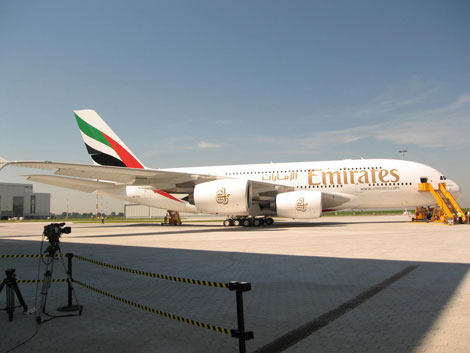
Economy class
This takes up the
whole of the lower deck – 88 rows in a 3-4-3 configuration, making a grand
total of 399 economy seats. There is mood lighting, the fibre-optic
star-effect lights in the ceiling, and large windows. All seats have
Emirates’ AVOD in-flight entertainment system "ICE" with e new larger
screen.
Seat pitch is 32-33 inches, width is 18 inches, and recline is six inches,
with an extra one inch “due to seat articulation”. The seats also have
individual laptop power.
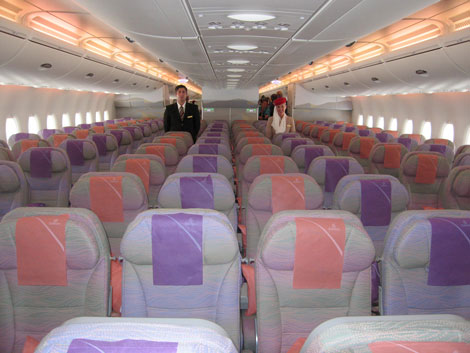
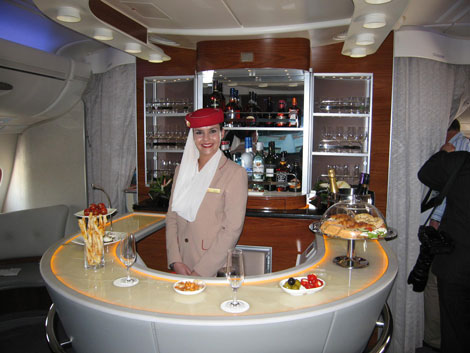
At the back, up the stairs, and into the bar area for business class.
Business class
Starting from the
rear (since this is the way we walked), the bar area is a good size,
although it might get crowded if more than a few of the 20 rows of business
class passengers (1-2-1 configuration) decide to stretch their legs. Through
into the first cabin – there are bassinet attachment points in both of these
two business class cabins, so no certainty on one of these being child-free.
It’s an unusual configuration and what you notice immediately is that every
other row has no walkway. If the seats are close together, there is one, if
not, they don’t. The problem with flat-bed seating, of course, is how you
recline and extend the seat to fully-flat without having several feet of
dead space between the rows.
British Airways
has a yin-yang configuration, with half the seats facing backwards, while
Virgin goes for a herringbone layout and Etihad staggers the seating. What
Emirates has done is arrange for the feet to extend under the side table of
the row in front, meaning the next row has to be sitting to one side.
For those seats
pressed together, there is an optional divider which rises between the
seats, although whether people will realise they are booking seats so close
to one another (or so far apart if they want to travel together) will be a
challenge for the airline to manage for the first few months. For those who
are further apart, it would be difficult to hold a conversation, assuming
they wanted to.
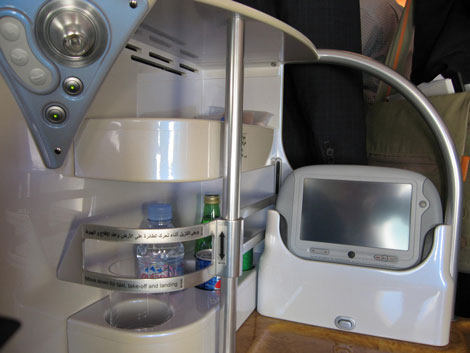
The seat has
several pre-set positions, laptop power, your own minibar replenished with
drinks during the flight and a good-sized table for working and eating.

What is
extraordinary about this new arrangement is that the seats have a different
pitch depending on whether you choose an inner seat or an outer one. The
stats are as follows: seat pitch is 39 and 48 inches, which extends to form
70 to 79-inch lie-flat beds. What that means is that if you go for an
outside seat, you get more legroom both for sitting and sleeping, while the
inside seats have less. Just how Emirates will sell both types of seat for
the same price remains to be seen, yet it is doing so at the moment.
I spoke with Terry
Daly, Emirates’ divisional senior vice-president of service delivery, about
this, and he said the difference was necessary because of the design of the
seat. As for how it would be sold, he said that he didn't think it would
make any difference because the seat is so long anyway (ie: even in its
shorter form).
On the matter of
pricing, note that although Emirates is not charging a premium for flying on
the A380, you will find the aircraft is on the most expensive flight on a
route (whether that is New York from August, or London in December).

First class
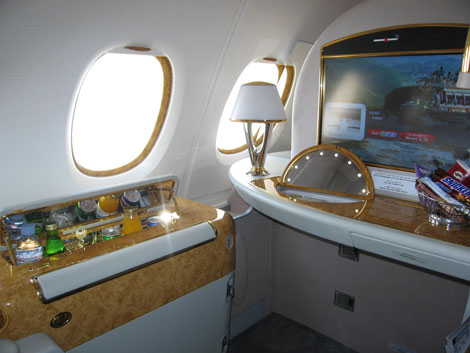
As you’d expect,
there are sliding doors on the suites (which are more like cabins, really,
but that terminology would be confusing). Inside, there is a fully-flat bed,
lots of space, a giant TV and a real sense of privacy once you shut the
door. What’s more, first class passengers have access to showers at the
front, either side of a stairway down to the exit and straight off the
plane.
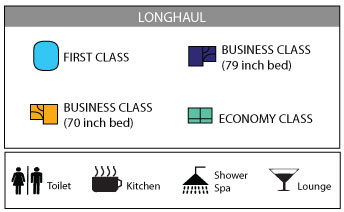
And the seating
plan is:

EK forgets
domain name renewal
31 July 2008
Initially reported
on airliners.net and theregister.co.uk
Dubai's
government-owned airline, Emirates, forgot to renew its domain name this
week, sending its website crashing offline on the same day it was trumpeting
delivery of its first Airbus A380 superjumbo.
Travellers keen to be among the first to book flights on the so-called
"premium hotel in the sky" via Emirates.com were met on Tuesday with a
standard parking page placed by domain seller Network Solutions. It offered
generic flight and Arabian travel-related text ads, rather than the
fully-featured ecommerce site they were expecting.
The site was only
beginning to operate normally today.
One poster on passenger forum Flyertalk.com wrote: "I first thought what
the?! Did Emirates liquidate overnight and management ran away to some
remote island?.. or in the middle of their plane purchasing spree forgot to
pay their domain fees?"
The answer is (b). Emirates sent El Reg this statement:
"Due to an administrative error, our domain registration temporarily lapsed
and this was addressed immediately. However, it did lead to some minor
technical difficulties with the site which our engineers have now resolved.
We apologise to our customers who have experienced any difficulties."
The domain name
affected included emirates.com, flyemirates.com and emirates.ae. There is a
significant exposure to lost revenue as passengers unable to log onto the
emirates web site looked to other airlines for their online booking.
According to our correspondents, the site disappeared for several hours
before re-emerging with the aforementioned snafus on board. Global
availability took a while too, as various DNS providers refreshed their
caches at different times.
I suspect it is a
case of everyone thinking that it was someone else's responsibility. But
there is a lesson for every company heavily dependent on e-commerce.
Gulf airlines
don't feel the pinch
By Caroline Brothers - International Herald
Tribune
Monday, July 28, 2008
HAMBURG: Climbing the stairway Monday to the first Airbus superjumbo to join
his expanding fleet, the chairman of Emirates was doing more than
celebrating receipt of the world's biggest passenger aircraft.
With Sheik Ahmed bin Saeed al-Maktoum taking possession of his long-awaited
A380 plane, the moment represented the shifting balance of power in an
aviation industry grappling with one of the biggest crises it has known.
As carriers from American Airlines to Thai Airway International are
responding to a new era of high oil prices by shedding jobs, culling routes
and grounding aircraft, Middle Eastern carriers are expanding as fast as
they can in hopes of redefining their region as the aviation crossroads of
the globe.
"There is no sign of a crisis there," said Thomas Enders, the chief
executive of Airbus, during an interview shortly before handing over the jet
to the sheik. "These airlines are on a very impressive growth path and
expansion course; they are steering a steady course while others are
experiencing more difficulties."
Emirates, which in 2000 became the first customer to sign a firm commitment
to buy A380s, has increased its order from the initial seven by more than
eightfold since then, despite a delay of nearly two years for the first
delivery.
"Our 58 A380s will certainly fly the flag more, and farther, than all the
others," Ahmed said of the aircraft's other customers, moments before a
screen was lifted to reveal the double-decker plane taxiing toward him at
the Airbus delivery center in Hamburg in northern Germany.
He took the opportunity to sign a letter of intent for another 60 Airbus
jets with a total price tag of $13.3 billion: 30 wide-bodied A330 planes and
30 of the A350s that are still under development. The overall investment by
Emirates in the A380 alone exceeds ?32 billion, or $50 billion, Ahmed said.
The headwinds that are causing U.S., European and Asian airlines such grief
- high oil prices and an economic downturn - are playing out to the
advantage of carriers in the Gulf.
While Thai has suspended nonstop flights from Bangkok to New York, Air
France-KLM is reining in its winter capacity growth and American, United and
Qantas are eliminating jobs, the government-backed airlines like Emirates,
Etihad, Qatar Airways and Saudi Arabian Airlines are adding routes, taking
delivery of new aircraft and placing orders for more.
In a further sign of confidence, Emirates is creating a new airline:
FlyDubai, a low-cost carrier scheduled to start operations next year. It
leapfrogged three U.S. airlines to take early delivery positions for 50
Boeing jets that will serve countries like India and Pakistan.
"Here we have airlines with a clear view of what they want, using
circumstances to accelerate growth," said Chris Tarry, an analyst at Ctaira,
a British aviation consulting firm.
The higher oil prices hurting airlines are stimulating economies in the
Middle East, even if they are importing inflation along with the rush of oil
revenue.
The United Arab Emirates is promoting Dubai as a tourist destination that
offers luxury hotels, shopping malls and beaches for wealthy leisure
travelers.
At the same time, the technological capacity of new-generation aircraft like
the Airbus A380 is allowing the Gulf to leverage its geographical position
at an east-west, north-south crossroads, putting 80 percent of the world's
most attractive markets, like India and China, within nonstop reach.
Tim Clark, president of Emirates, said that from the start, the airline had
focused on the central location provided by Dubai. "What we did want was
longer operations, but the aircraft didn't exist, so we set about pushing
the manufacturers: 'We want more range, we want more payload capability, we
want more seats,"' he said.
The aim was to link places that were not already linked: Africa to China, or
Russia to South Africa, Clark added during an interview in the bar of the
new airliner, which featured 76 business-class beds, a decorative waterfall,
and two "spa" showers for passengers in first class seats. "We are atuning
everything we do to the 21st century and not dwelling in the past."
The Middle East is pouring $54 billion into airport expansion over the next
decade, according to the International Air Transport Association, while
airlines in the region have ordered 700 planes at a cost of $140 billion
over the past three years.
"The size of our order mirrors the rising prominence of the Middle East and
its increasing emergence as a new focal point of global aviation," the
Etihad chief executive, James Hogan, said about the 100-aircraft order he
placed in July that included 10 Airbus A380s.
The big Emirates order for the superjumbos - which would be able to compete
with low-cost carriers if configured for 750 passengers in economy class -
might sound like a recipe for overcapacity.
But so far, airlines in the Gulf have done well in matching demand, which
grew 11 percent in the first five months of this year, with capacity that
rose 11.1 percent, according the IATA.
Furthermore, the Gulf airlines are mining fast-growing routes. Passenger
traffic between the Middle East and Africa rose 19.8 percent in the five
months to June this year, and 14 percent between the Middle East and Far
East, though from a low base, IATA said; that compares with average growth
of 4.5 percent for all international routes.
Emirates, for its part, cannot acquire new planes fast enough. Clark had
expected to have 17 A380s by now, before wiring problems on the troubled
Airbus production line set back his growth plans by two years.
"The need for this aircraft is even more essential now," he said. Alongside
the cost of oil, his airline's biggest problem was a lack of capacity. "We
are maxing out at 90 percent so now we are losing business," he said.
The Middle Eastern carriers are also running a tight ship. During the five
months to May, the "load factor," or percentage of available seats sold, on
airlines of the region was 74.6, according to IATA figures, in line with a
"high" global average of 75.2.
The level means that Middle Eastern airlines are flying as full as their
rivals, and suggests that they are not emptying their competitors' planes.
But over the longer run, aviation experts said, airlines like Emirates,
which competes on price for the mass market and on service for business
travelers, should make some inroads against competitors.
"Their growth clearly relies on transit - they are taking away from markets
occupied by Asia and European carriers," Niko Herrmann, a partner based in
Zurich at the aviation consulting firm Oliver Wyman, said of carriers in the
Gulf region.
"They are still on the cusp and will grow exponentially, partly because
other carriers are not growing," he said.
Experts say they expect the profitable Emirates, which ranked 23rd last year
among world airlines in terms of passenger traffic, to compete among the top
10 airlines in the next five to six years.
In that light, the A380 that Ahmed received Monday represents a crucial
element of a business strategy that makes the Middle Eastern airlines "a
competitive threat to any European-based carrier," according to Daniel
Solon, an independent aviation consultant based in Barcelona.
The technological advances of the A380 mean that it can allow airlines to
fly more passengers farther and for less money than their competitors.
"The capability of airlines has changed the reach of the Gulf region," said
Tarry, the Ctaira analyst. "If you've got planes that can fly farther, you
change the structure of the market."
Industry executives say that the Gulf region is shaping up as a
well-positioned hub for traffic from China to Africa, while Emirates'
services between Europe and Australia mean that passengers can bypass Asia
altogether.
"Qatar and Etihad are following a similar strategy - all of them are
targeting Japan, China, Australia, India," said Peter Morris, chief
economist with Ascend, an aviation consulting firm in London. "They are
redrawing the map."
Court sentences Pojaman to three years in jail
Court said Pojaman should have served as society's good example
31 July 2008
The Criminal Court on Thursday found wife of
ousted prime minister Thaksin Shinawatra, guilty of intentionally avoiding
tax payment of Bt546 million for the transfer of 4.5 million shares of the
Shinawatra Computer and Communications' shares worth Bt738 million.
Found guilty in the same charges were her adopted brother; Bannaphot
Damapong and her secretary Kanjanapa Honghern.
The Court sentenced Khunying Pojaman, Bannaphot to a total of three years in
jail; two years for the charges relating to the conspiracy to evade tax and
one year for giving falsified statements. Kanjanapa faces two years in jail.
The Court said the three defendants had committed serious crimes and filed
false statements with the government agencies in order to avoid paying
taxes. They intended not to pay taxes despite that they were rich people.
The court ruled that the prosecution's evidence was solid and indisputable.
The three suspects were found guilty of fraud or collaboration to evade
taxes.
In addition, Pojaman and Bannapot were also found guilty of filing false
claims and presenting false evidence to the authorities with intention to
avoid paying taxes.
The court also reprimanded Pojaman in particular, saying that with her high
economic, social and political status - especially her status as wife of the
then county leader - she should have acted as good example to society.
The Criminal Court rules out every defence argument on the tax evasion case
as insubstantial in rebutting the prosecution evidence.
The court says the prosecution has proven beyond reasonable doubt that the
defendants committed a conspiracy to evade tax. The ruling says Pojaman and
Bhanapot made the shares transfer in the stock market in order to avoid tax
liabilities even though there was no real transaction.
Bhanapot admits Pojaman gave shares to him and the court finds this is not a
family gift.
The ruling is addressing a key legal issue whether the three defendants
intentionally gave falsified statements to the authorities in order to avoid
tax liabilities.
The charges were from from transaction, which took place in November 1997,
come under the criminal codes of Article 37 (1) (2) of the Revenue Code.
Violation of this law is punishable with a fine of between Bt2,000 and
Bt200,000 and a jail sentence of between three months and seven years. A
multiple violation of this law will result in a jail sentence of not more
than 20 years.
The Office of the Attorney General filed the suit on March 26 last year,
summoning more than 30 prosecution witnesses to testify including Sak
Korsaengruang, spokesman of the nowdefunct Assets Examination Committee who
chaired the AEC panel that probed the accusation of tax evasion, and former
Finance Ministry permanent secretary and former directorgeneral of the
Revenue Department Suparat Kawutkul.
The three defendants denied the charges and almost 20 defence witnesses
testified in the case.
A night out at the FCC
29 July 2008
This is from
the Otago Daily Times. I have no idea what the point of the article is or
what message the writer is trying to convey. But it is not often that anyone
writes about the old FCC in Bangkok.
I hope the
writer loses some of her prejudices before she joins Reuters.
"Hardened old
scribes share hot night in Bangkok. As evening falls in Bangkok the
nightwalkers of Nana - the city's sex district - take to the streets, and
happy mongrel dogs splash through the deep puddles formed by the afternoon
monsoon rains.
Hopeful transvestites pucker their fuschia mouths at a grimy mirror, and the
South East Asian anthem, Hotel California, begins to play.
Dan - a Guardian photographer - throws back another beer, and toasts the
Thai-Cambodia border dispute.
"Perhaps it will blow up and there will be work and good pictures," he says
dryly.
Tom, an Associated Press journalist, laughs his rumbling roar, swilling his
whisky and coke he slaps his thighs with vigour - ready to move on, ready
for more people and more drink - ready for a night out in Bangkok.
The two awkwardly navigate their way on to the Skytrain, distinct from the
hordes of tourists in their total disregard for "doing it right".
"The best ham steaks in Asia!" says Tom, gesturing excitedly at a
forgettable-looking place on a dusty side street.
He is to mention those ham steaks three times tonight.
The two talk shop non-stop, being of the old and hardened variety, they are
critical of almost everyone in the business.
They met in Cambodia after the fall of the Khmer Rouge, and Tom is heading
back to cover the election.
He says it will be quiet, and really just an excuse for the old "Cambo"
hands to get together, drink, and reminisce about the good times of
journalism past (loosely - The Vietnam War).
The FCC (Foreign Correspondents Club) is in the centre of town, on the top
floor of a dated skyscraper.
It shares the space with the BBC, Asia Works, ITV and the ABC.
It is an old-fashioned and unstylish bar - a bit of an embarrassment in the
business - but comfortable and familiar for this old crew.
We are half an hour late meeting the Voice of America Bangkok bureau chief
but she and her husband are unfazed, and drinks are bought for all.
A conversation begins about who got into Myanmar/Burma for Cyclone Nargis,
who tried, and who was too scared.
Of course the best in the business had no option - they were blacklisted
long ago.
For the Asia correspondents, the country has become a good test; get in,
stay in, and you're sure of a story.
The tight restrictions placed on foreign journalists (most enter illegally
on tourist visas and work undercover) add spice to the assignment.
During the September monks' uprising last year, dubbed "The Saffron
Revolution", The New York Times writer won the Pulitzer Prize for his
dispatches, and a Japanese photo-journalist was killed.
The fast approaching Beijing Olympics begin on August 8, the same date as
the 20th anniversary of the 1988 uprising in Burma, in which 3000 people
were killed.
With 20,000 journalists accredited for the Olympics (and scores more not
accredited) all eyes will be on China, an opportunity the Burmese Resistance
are keen to exploit.
It is a loud party, everyone talking at once, and not at all politely.
The Voice of America chief complains about Bangkok's First-World prices for
Third-World facilities.
Dan, the Guardian photographer, shows his friend some photographs taken of
him and his Thai girlfriend visiting her family in the North recently.
Tom drinks, and talks, and eats, and complains - where to next? He asks.
A taxi is hailed and Dan splutters our destination in bad Thai: Gullivers.
The monstrous building is white and glaring on the narrow Nana street, a
three storied sparkling faux-Grecian construction with potted palm trees,
western prices and a tame elephant out the front on a leash.
Dan and Tom begin to talk of a colleague, a conservative fellow who has been
with the same woman for 30 years (and doesn't cheat), and is a bad
journalist - lazy. But don't get me wrong, they both add convincingly, I
like the guy.
It's hot - 28 degrees and not cooling.
More drinks are ordered, thin Thai prostitutes saunter past, and old times
are rehashed once more."
- Eleanor Ainge Roy is a journalist and a University of Otago politics
and history student. She is en route to Beijing for the Olympic Games before
taking up an internship with Reuters news agency in Bangkok.
EK places
another Airbus order
29 July 2008
Emirates, which plans to have a
fleet of more than 450 aircraft by 2020, on Monday ordered 60 wide-bodied
planes from Airbus in a deal worth $13 billion at list prices.
One of the world's fastest
growing airlines, Emirates said the acquisition will support its widening
international route network. The airline has 118 aircraft in operation at
present and flies to about 100 destinations in 61 countries.
Shaikh Ahmad Bin Saeed Al Maktoum,
President of Dubai Civil Aviation Authority and Chairman and Chief Executive
of Emirates airline and Group, signed a letter of intent with Airbus chief
executive officer Tom Enders for 30 A330-300s and 30 A350 XWBs in Hamburg on
Monday.
"We are forging ahead with our
expansion plans and the A330-300s and A350 XWBs will enable Emirates to
continue its growth using modern fuel-efficient aircraft. We remain
ambitious and every bit as determined to achieve our long-term goals,"
Shaikh Ahmad said in a statement.
The airline did not say when the
new planes would be delivered.
"We are still in the process of
finalising all the details, including delivery and configuration with
Airbus," a spokesman told Gulf News.
At the Dubai Airshow in 2007,
Emirates signed a firm order for 70 A350 XWBs with an option for 50 more.
Yesterday's agreement includes the firming up of 30 of these A350 XWB
options and will eventually increase Emirates' total order for the A350 XWB
to 100, according to Airbus.
Before the latest order, Emirates
had 178 planes on order with a value of $58 billion. These included 58 A380
superjumbos.
The mile high
shower club
29 July 2008
Emirates Airline,
which yesterday took delivery of its first A380 aircraft in Hamburg, has
decided to offer its premium customers the chance to refresh themselves.
Such luxury is reserved for the 14 people in the first class cabin, who will
have access to the two showers during the trip.
The passengers will book their 25-minutes slots, which will include five
minutes in the shower itself and some extra time to dry themselves off and
get dressed again.
They will be able to keep track of how much time they have left in the
shower by looking at a dial in the cubicle itself.
In between each passenger an onboard janitor will scrub the facility clean
for the next customer.
While business class passengers get rather large seats, those in first class
are offered "suites", with a 23-inch television screen, plenty of gold trim,
leather and wood.
Such luxuries are how the airlines try to set themselves apart from the
rivals as they hope to lure premium passengers willing to pay significant
amounts for a few hours pampering.
Singapore Airlines, who took delivery of the first superjumbo, boasted huge
amounts of leather and vast seats in its premium cabins.
Emirates has decided that showers and a rather large cocktail bar will be
what is known in business circles as its "unique selling point" for those
passengers unaffected by the credit crisis and soaring fuel prices.
The airline is the second to take delivery of the aviation behemoth and has
ordered 58 A380s.
News of the
World gets a mild slapping
25 July 2008
The Mosley case
concluded yesterday when Judge Eady Ordered the News of the World to pay
Mosley £60,000 damages, the highest for a privacy action in recent legal
history, plus an as-yet-undecided proportion of Mosley's estimated £450,000
legal costs.
The judge ruled
there was no Nazi flavour to what Mosley had always maintained was simply a
private "party". "I decided that the claimant had a reasonable expectation
of privacy in relation to sexual activities (albeit unconventional) carried
on between consenting adults on private property," said Mr Justice Eady in
his ruling. "I found that there was no evidence that the gathering on 28
March 2008 was intended to be an enactment of Nazi behaviour or adoption of
any of its attitudes. Nor was it in fact. I see no genuine basis at all for
the suggestion that the participants mocked the victims of the Holocaust."
Because of this, he said, he was "unable to identify any legitimate public
interest to justify either the intrusion of secret filming or the subsequent
publication".
But the judge did
also acknowledg that the NoTW held an honest belief that there were indeed
Nazi elements to this "gathering". That is why he rejected Mosley's claim
for exemplary damages, which are intended not just to compensate the wronged
party, but to punish the wrongdoer.
Mr Justice Eady also said that Mosley was, to a degree, the architect of his
own misfortune. "Many would think that if a prominent man puts himself, year
after year, into the hands (literally and metaphorically) of prostitutes (or
even professional dominatrices) he is gambling in placing so much trust in
them. There is a risk of exposure or blackmail inherent in such a course of
conduct," he said.
Mr Justice Eady
added: "To the casual observer therefore, and especially with the benefit of
hindsight, it might seem that the claimant's behaviour was reckless and
almost self-destructive. This does not excuse the intrusion into his privacy
but it might be a relevant factor to take into account when assessing causal
responsibility for what happened.
"It is part and parcel of human dignity that one must take at least some
responsibility for one's own actions."
Mosley is a high profile and controversial figure. The newspaper will have
regarded his recklessness as a fair target. Mosley won the case; but is
forever tarnished by it. I suspect the dinner discussions at home are
interesting. The fine is a mild rebuke to the News of the World. It neither
sets precedent or puts new restraints on tabloid editors. Sure they may make
sure that stories are always reviewed by their legal counsel before
publication. Privacy cases will continued to be judged on individual merit.
Dubai: More
Bubble or More Boom? Time Will Quickly Tell
By Martin Hutchinson Contributing Editor
www.moneymorning.com
23 July 2008
"Dubai has plenty of qualities that catch an investor’s eye.
The emirate has the world’s only (self-proclaimed)
7-star hotel. Dubai also is home to the biggest financial market in the
Middle East, which is itself publicly quoted and trades at 25 times forecast
2008 earnings. It has been enjoying one of the greatest construction booms
the world has ever seen.
And Dubai is
planning a huge tourist expansion, aiming to boost that sector to more than
the 18% of the economy it already accounts for. So, why aren’t Dubai
investments a screaming buy, where we should all be investing our money?
After all, plenty of brokers think it’s just that.
From a short-term perspective, Dubai investments haven’t done too badly. The
Dubai Financial Market General Index is down about 13% this year, far less
than the much-hyped emerging markets of India and China, or even the United
States. But there’s a possible catch.
Whereas 2006 and 2007 were good years for investors in India and superb ones
for investors in China, they were lousy for investors in Dubai. The DFM
General Index hit its all time high in November 2005, declined pretty
steadily over the next two years, and is currently sitting about 40% below
that high. Even at that depressed level, the DFM General Index is still
trading at about 17 times projected earnings for this year and 3.3 times
book value, so it’s not cheap.
That immediately raises questions. While Dubai has little in the way of its
own oil reserves, its economy rests fundamentally on its position as
entrepôt for the immense oil-exporting region of the Middle East, and for
the United Arab Emirates (UAE), the oil-rich federation of which Dubai is a
member. Oil prices were around $60 per barrel in November 2005 when the DFM
General Index was at its peak; oil is now trading in the neighborhood of
$130 per barrel, even after last week’s big sell-off – so why is Dubai’s
stock market down 40%?
It’s entirely possible that Dubai isn’t as solid as some of its proponents
believe.
Two years ago – before the real estate crash – it might have seemed
impressive that Dubai, with 0.02% of the world’s population, was employing
more than 10% of the world’s tower construction cranes; today we know
better. Dubai’s rate of inflation is around 20%, and it’s on the upswing,
while home mortgage interest rates sit below 7%. That means that the cost of
making a home mortgage – in real terms – is negative 13%. The UAE government
is considering allowing its currency, the dirham, to float upward against
the dollar, but hasn’t done so yet.
Dubai received more than 7 million tourists last year, with 1 million of
those coming in from Great Britain (who presumably prefer the climate) – but
the British government currently rates Dubai’s terrorism threat at its
highest level. It’s not hard to imagine what a terrorist attack could do to
Dubai’s impressive tourist rates.
Dubai is also planning to spend $82 billion on aerospace projects to include
the world’s largest airport – but with a population of only 1.5 million, it
will need a lot of foreign traffic to fill up such a behemoth.
The potential for that to come to pass is there, given the growing levels of
investment that China and others are making in the Middle East, and because
the Dubai project isn’t solely focused on tourism: The airport and aerospace
hub is viewed as an economic-development project. But success is far from
guaranteed, and an economic downturn could make the objectives tough – if
not impossible – to achieve. Indeed, should the ongoing global financial
crisis eviscerate worldwide growth, Dubai’s development strategy could be
exposed as a bubble, not a boom.
To be sure, other small nations have engineered economic miracles. Consider,
for example, the economic success of Singapore, which has a smaller land
area but three times the population.
Like Dubai, Singapore has no core advantage, such as a wealth of natural
resources. Nor does it have a bevy of natural tourist hot spots. And much
like Dubai, Singapore’s only advantage is one of geographic position.
However, Singapore has an income per capita at purchasing power parity of
$49,700 (eighth highest in the world) compared to the UAE’s $37,300.
Singapore’s growth has been built on two factors: The extremely high
education level of its population (relative to income at first, in the
1960s, but in absolute terms now).
And an obsessive focus on moving up the value chain in everything it does.
Dubai has neither advantage; it supplements its small local population with
a huge underclass of immigrants (more than 80% of the population in the UAE
as a whole), rather than upgrading the capabilities of its own people, and
it relies on building artificial tourism in an area where (because of the
unpleasant climate and relative lack of natural or historic attractions)
it’s possible that no natural flow of tourists would have otherwise
occurred.
An economy built on construction, tourism, and a boundless flow of cash,
without any special knowledge base, is one that could end up being derailed
in the long run. And that long run could be more painful if it turns out
that Dubai has been feeding a major construction bubble through deeply
negative interest rates.
The other potential black cloud looming over the Dubai economy is that of
oil prices, should $130 - $140 per barrel oil turn out to be a short-term
speculative price spike.
With the Bush Administration pushing for offshore drilling and the world
automobile industry devastated by consumer tastes that quickly shifted to
small cars and trucks, increased supplies and decreased consumption could
push oil prices down to a more reasonable level.
Assuming OPEC doesn’t intercede and act to keep prices high, the right
confluence of factors could potentially push oil prices back down under the
Century Mark. And in a perfect world, with the right confluence of factors,
oil could end up below $100 per barrel, or even as low as the $60-$80 range.
And while that price level would still be well above the $10-$15 per barrel
prevalent before 2002, it is far below oil’s current levels.
The Middle East in general has predicated their future plans on the oil
bonanza continuing in full flow for the indefinite future. Even though
$60-80 oil would provide ample revenue for their citizens to enjoy an
excellent living standard, their economies are not properly set up to adjust
to such a lower revenue flow. If oil prices were to fall, the inevitable
effect would be tighter money as interest rates return to normal levels,
exacerbated by an acute cash shortage.
Dubai is looking to diversify itself away from the petro-gusher, which is
one reason it is trying to position itself as a global boom intermediary,
benefiting from tourism and establishing itself as a new residential
destination for the world’s uber-rich. It also aims to utilize its airport
and aerospace ventures to fuel its real estate and global commerce
aspirations.
But a key question remains: Is it still tied in so tightly to the Middle
East “black gold” bonanza that it will suffer in kind should energy prices
hit a deflationary downdraft?
The next few years will be telling. If its global growth aspirations get a
needed lift, the tiny Gulf nation could become more than just a
well-recognized name on a map; it could end up as a key stopping-off point
for business executives traveling from one side of the world to the other,
might one day even evolve into a commercial spaceport, and will stand as an
example of a country that was able to engineer an economic makeover of
massive proportions.
But should oil prices crater, Dubai’s aerospace venture fail to attain
take-off speed, and its vision as a tourism and residential mecca of the
future turn out to be ill-conceived as I fear, the opposite extreme is
possible: With a construction bubble more inflated than the 2006 Florida
condo market and a monetary policy looser than the one being operated by
U.S. Federal Reserve Chairman Ben S. Bernanke, Dubai could shortly resemble
a jungle of half-completed skyscrapers, with 10% occupancy rates and
bankrupt landlords. Its landing would be painful, and, potentially, not long
delayed. It’s not an investment for the risk averse."
Emirates unveils its mega-model (the airplane I mean!)
23 July 2008

Emirates Airline
today unveiled a new landmark for London, a giant model of an Airbus A380 at
the gateway to Heathrow Airport. This is located at the entrance to Heathrow
Airport terminals 1-3, and replaces the old Concorde model.
Plenty of people
are sad that Concorde has gone; but this is the age of globalisation and
money: so why not a UAE owned airline advertising at a Spanish-owned airport
in a city in which 42% of the population is non "British-White" and 31%
foreign born. And, after all, there is also an Emirates Stadium in London.
The pr crew were
also wearing the new uniform in public for the first time.
The 45 tonne world record contender was unveiled this morning at the
"Emirates Roundabout" by the airline's President Tim Clark.
The completion of the giant A380 replica is the culmination of an ambitious
18-month project to place the Dubai-based carrier at the gateway to the
world's busiest international airport, and at one of the most prestigious
advertising sites in the UK.
The Emirates A380 will be seen at Heathrow for real from December 1st.
The newly named Emirates Roundabout at Heathrow is one of the most high
profile advertising sites in the UK. Over 55,000 vehicles a day and
approximately 25 million passengers a year, pass this site. Terminal 4 and 5
passengers use a separate entrance to the airport.
The one third-scale model was flown in ten component parts to Heathrow on
July 5. Since then, specialist teams have been working around the clock to
launch Emirates' "first" A380.
The replica was built by US-based Penwal at its manufacturing base in
California over a six month period, using plans provided by the A380’s
manufacturer, Airbus in Toulouse.
It was then transported by giant truck to Ontario Airport in Los Angeles
where it was flown to Heathrow aboard a massive Antonov cargo plane,
organised by the Emirates SkyCargo team. A special mechanical ramp was flown
into London from Germany to offload the plane as it was too heavy for the
Antonov’s winch crane. The wing section of the plane required a police
escort as it was driven from Heathrow to the roundabout site.
The world’s leading aviation museum, The Smithsonian Air and Space Museum in
Washington DC, has stated it is the largest known aircraft model in
existence. A world record submission is currently with Guinness World
Records.
Model quick facts include:
Weighs more than 45 tonnes
Wingspan of 26 metres and a length of 24 metres
Same size as a real Boeing 737
Exact 1:3 scale of the real A380, the world’s largest airliner
More than twice the size of the roundabout's previous Concorde model
Made of glass-reinforced plastic over a steel frame
Foundations required 600 tonnes of concrete
Airbus has a web
site dedicated to the delivery of the first Emirates A380:
http://www.a380delivery.com/emirates/
Pad: bulldog on
a leash or another nail in democracy's coffin
Published on July 21, 2008 Chang Noi in
the Nation newspaper.
Since it was formed in February 2006, and especially since it was revived in
May of this year, the People's Alliance for Democracy (PAD), has become a
distinctive force on the political landscape.
Formally, the PAD is simply an alliance of five orators. But as a political
phenomenon, the PAD is also what they are saying, how they are saying it,
what visual messages they convey, and who is supporting them.
The movement's main stated aim is to overthrow the current government.
Normally any movement that professed this aim would be labelled dangerous,
even revolutionary, and be strongly handled by the authorities. Strangely
that is not happening. Probably that is because we know its true aim is to
obstruct Thaksin's overt return to politics.
The movement's longer-term aim is to undermine the central principles of
electoral democracy, namely the sovereignty of the people, and the selection
of a parliament by the system of one-man, one-vote. The PAD leaders claim
that the electorate cannot be trusted with the franchise because the mass of
rural people are uneducated and corrupt. They want the elected portion of
the lower house reduced to a minority (perhaps 30 per cent), and the
remainder filled partly by "retired officials and important people" and
partly by ordinary people and workers, selected by appointment. Since the
logic of the PAD's proposal is to disenfranchise the rural poor, this new
system is likely to favour the rich, the urban, and the higher educated.
In addition, the PAD wants the military to have a permanent role of
political oversight. The military would be removed from political control
(by making the defence ministry independent of the Cabinet), and granted the
right to intervene in politics to check corruption and to protect the
monarchy and national sovereignty.
The PAD seems against the freedom of expression, and in favour of the use of
abuse and intimidation to limit the freedom of expression. This conclusion
is based on the way PAD orators treat academics, actors or other public
figures who disagree with its views. This tactic seems to have been quite
successful. Some critics have apologised. The press has been generally
rather uncritical of PAD's views and activities.
The PAD makes use of military and martial symbolism. Some of the leaders
like to wear brown shirts and black shirts that resemble military and
paramilitary uniforms. The headbands worn by leaders and followers recall
the outfits of traditional warriors, samurai, and jungle fighters. The
oversized neckscarf comes from the scouts, village scouts, and jungle
fighters. It is not Chamlong's rural-ascetic look but this barracks-chic
that distinguishes the movement. Among the supporters, yellow flags,
headbands, T-shirts, and caps combine to give the impression of commonality
and conformity which is the role of uniforms.
PAD promotes a visceral nationalism reminiscent of the early Phibun era. The
nation is a body that is being physically ripped by its enemies (internal
and external), causing pain to the citizens, who must rise up in the
nation's defence.
The PAD's agitational practice suggests a high degree of organisation,
strong financing, access to technology, and skill with sophisticated
techniques. The equipment for staging and broadcasting the PAD's message
requires high capital cost and running expenses. The crowds are well
organised and provisioned. The programming shows strategic planning to
sustain support and interest with relatively little novelty. The PAD seems
skilled in the techniques and rituals of litigation. In short, this is not a
few people gathered at a street corner with a soap box.
Analysing the PAD's audience on the streets and in front of television
screens is difficult. There are only stray interviews, plus pictures.
Perhaps the single word that emerges from this impressionistic data is
"respectable". The crowds are generally smartly dressed. The age profile is
quite high, though there are also many families in attendance (and the TV
audience may be significantly younger). Head-counting from press photos
shows a slight preponderance of women over men. From the few on-site
interviews available, the crowds include retirees, public servants, small
business people, and senior executives from modern firms. There seem to be
relatively few manual workers.
The PAD is clearly well connected to other institutions. One of its leaders
is a Democrat MP. Other Democrats have spoken from its stages. So too have
academics from some of Bangkok's major universities. A serving general has
taken the PAD stage in his full uniform. Other military figures, including
General Saprang Kalayanamitra, have been seen backstage and are open in
their support.
The PAD seems to be protected, perhaps by friends in important places, but
also by virtue of its widespread urban support. No other Bangkok protest has
suffered so little harassment. When the prime minister angrily threatened to
clear PAD off the streets, the security forces refused to cooperate and the
prime minister had to back down. When PAD set up a permanent blockade of
roads, the police stood aside and public-opinion surveys were surprisingly
lenient over the disruption to traffic. When the protest moved to Government
House, the police resistance looked like a token showing designed to fail.
This apparent immunity gives weight to PAD's message.
The PAD is flirting with the old agent provocateur's technique of placing
its own crudely armed gangs in places where they will be attacked by
enemies. This creates violent incidents, apparently initiated by their
opponents, though in truth a result of the inherent violence of the PAD
itself.
In short, PAD is an anti-democratic movement, supported by high investment
and shadowy protection, that exploits the fears of the privileged and a
deliberately anti-rational nationalism, and flirts with militarism and
violence.
Is PAD a bulldog, let out on a leash for a specific purpose, that will be
chained up when the threat from thieves has passed? Or is it another step in
the destruction of democracy begun by Thaksin, continued by the coup-makers,
and now plunging ahead on the momentum?
Fly Dubai
starts to outline its plans
22 July 2008
As FlyDubai starts
to plan it's 2009 launch it is clear that the owner's expectations are for
an airline operated independently of Emirates and with a clear brand of its
own. The airline gave some early briefings at Farnborough this week; it is
proposing to link regional cities like Tehran and Cairo to Dubai as well as
countries bordering the region (like the “stans”). It will be focused less
on Emirates transit business and more on point to point traffic enabling
tourists and the relatives of Dubai-based workers to visit the city.
This will also
allow it to operate outside of the Emirates hub and spoke flying hours when
peak slots are already busy.
FlyDubai will also challenge the regional carriers on local routes such as
Dubai-Kuwait or Dubai-Doha in a move that should increase competition,
improve service and lower fares.
FlyDubai is proposing a model that is rather different to the classic budget
airlines of the USA and Europe but is also different to the local
full-service carriers.
FlyDubai passengers will be able to select their service level from an
online menu when they book their ticket, allowing them to determine whether
they want a snack, meal or no food.
They will be to decide what sort of drinks and entertainment they have
onboard and even how they will check-in at the airport.
By encouraging passengers to order in advance FlyDubai will have more
flexibility to offer, for example, quality meals, unlike other budget
airlines. This is obviously good for passengers but also for the airline as
it will make a large proportion of its profits from these ancillary
services.
Still this new carrier has a lot to do, other than generating smart ideas.
It only ordered its first aircraft last week, it still does not know where
its first destination will be, and it has not hired cabin crew or pilots.
There are some areas where it can take a shortcut, and save money, by
partnering with Emirates. It will probably outsource training, catering and
fuel purchasing, which will provide economies of scale and may also help
eliminate some of the errors that are inevitable when a new airline is
launched.
It will likely
also be able to source some crew from Emirates; in particular crew with
Dubai families who want to return home at the end of every day and who want
a regular flying pattern.
What will be
interesting is how much lower Fly Dubai's costs per seat mile can me than
Emirates. Emirates is in many ways the first low cost full service carrier;
with lower operating costs than all the major international carriers.
One-two-well
and truly gone
21 July 2008
A day after low
cost carrier one-two- go announced a voluntary suspension of operations for
two months the Thai authorities went a step further and grounded both the
low cost carrier and its parent airline Orient Thai.
Orient Thai
Airline and its low-cost subsidiary One-Two-Go were ordered on Monday to
cease operations for 30 days, starting from July 22, because of the poor
safety standards.
The Civil Aviation
Department has ordered One-Two-Go airlines to halt operations for 30 days
due to substandard operations and revoked or suspended the flying licences
of nine of its pilots.
Chaisak Angsuwan, director-general of the department, said suspension of the
airline's Air Operator Certificate was effective from today.
The department had found shortcomings in the airline's aviation operations,
flight schedules and maintenance, along with a lack of quality assurance.
The low-cost airline had violated aviation safety regulations and lacked
proper airline management.
The flying licences of seven of the airline's foreign pilots were revoked,
six Indonesians and a Venezuelan, and the licences of two Thai pilots
suspended.
The department found the pilots on the airline's MD80 series aircraft had
submitted documents misstating their level of expertise.
The airline and its pilots were liable to criminal penalties and the
department would file charges against them in two weeks, said Mr Chaisak.
The announcement follows the department's investigation into the crash of
flight OG269, an MD-82, at Phuket International Airport on Sept 16 last
year, killing 89 people and injuring 41.
The airline was required to correct the flaws in its operations during the
suspension period, or the department could either extend the suspension or
terminate the airline's certificate.
One-Two-Go was ordered to correct its flight schedules, aircraft maintenance
and quality assurance system.
Mr Chaisak said One-Two-Go's parent airline, Orient Thai, was also warned it
must change its flight schedules to allow its pilots enough rest time, as
required by aviation safety regulations.
Transport Minister Santi Promphat said other airlines would face similar
punishment if they were found to have committed the same offences. Airlines
should be more careful in examining the qualifications of their staff,
especially their pilots, said Mr Santi.
Udom Tantiprasongchai, the president of One-Two-Go Airlines, said the nine
pilots were sacked on July 8. He had not previously known about the pilots'
incorrect documents. He believed the airline could make all the changes
required within the 30 days.
The paper-free,
cost-saving A380
20 July 2008
The Emirates cost
saving drive continues - at least in the back of the airplane. The latest
initiative us to make its Airbus A380 superjumbos paperless planes.
The airline will remove all seat-pocket paper - in-flight magazines,
entertainment guides and shopping catalogues - when the giant aircraft go
into service in 12 days.
Tim Clark, Emirates’ president, has said that banning paper will lighten the
aircraft by a tonne based upon 2kg per seat and 500 seats. This makes
up for the tonne of water that will need to be carried for the two first
class showers that will be installed (his and hers??) and available by prior
booking with the flight purser. Clark, that not so well known
environmentalist also said that Emirates was doing it because of the
environment.
The printed matter will be replaced by content shown on the aircraft’s
seat-back television screens.
Recently the
airline has been removing the footrests from all economy class seating; also
presumably to save weight.
Clark said Emirates had also begun a project with Airbus to reduce the
weight of the A380 by five tonnes by 2012. This would allow the airline to
use the plane on extra-long routes, such as nonstop from Dubai to Los
Angeles and San Francisco on the US west coast.
Coming to DXB on 28 July
19 July 2008


One Two Gone?
19 July 2008
One-Two-Go
Airlines, one of Thailand's three main budget carriers, will cease
operations (in theory) temporarily, starting on Tuesday, to allow time for a
financial restructuring.
One-Two-Go flys
older MD80s; one of which crashed at Phuket earlier this year. There have
been regular concerns about maintenance and the qualifications on the
airline's crew.
Relatives of the
victims in the Phuket crash have started a web-site, www.investigateudom.com,
to campaign for an investigation into Udom's business conduct.
It was alleged that Udom had misled pilots into flying unsafe planes and
paid bonuses for those who worked beyond the legal maximum of flying hours.
The airline is facing mounting cost pressures led by rising oil prices,
fierce competition from rival airlines, falling domestic passenger demand
and the poor business outlook.
A One-Two-Go statement issued yesterday said that during the suspension,
from July 22 to Sept 15, the airline will consider a new financial system
that will do away with forward ticket sales which have hurt its financial
status.
Forward sales of air tickets have become a critical problem for most
airlines as the tariff is priced when oil prices are lower but by the time
travel actually takes place they have tended to rise.
There may also be a need for it to put in place a new service model to
differentiate One-Two-Go from other low-cost carriers, it said.
It was not clear yesterday how the airline would deal with its 700
employees, passengers who have bought tickets, and its fleet of eight MD 80
series jets.
Parent carrier, Orient Thai, will continue flights to Hong Kong and Incheon.
The degenerates of Dubai
By David Jones - The Mail - 19 July 2008
"Despite the presence of undercover 'love police'
now patrolling its scalding white sands, and the promise of new signs
warning foreigners of dire consequences should their passions get the better
of them, little has changed on the Dubai beach where two drunken Britons
staged their now notorious 'sex romp'.
Last Wednesday, at one end of the vast, crescent-shaped expanse, a
contingent of preening expat women in designer bikinis fried themselves for
as long as they could withstand the 50 degree heat before plunging into the
blue waters to cool their bronzed bodies.
Further along the shoreline, meanwhile, their hapless Emirati counterparts
were forced to wade into the waves wearing their amorphous black abayas,
which weighed them down so heavily when drenched that they could barely
paddle out again.
Set against a backdrop of dizzying new skyscrapers and a forest of giant
cranes (50 per cent of the world's entire stock of the largest cranes is
concentrated here), this tableau neatly epitomises the seismic clash of
cultures and morals which has lately beset this desert-built Disneyland of a
state.
This collision between traditional Islamic values and those of the decadent
West may have been brought sharply into focus by the tawdry sex-on-the-beach
saga - which is expected to reach its denouement next week with the
prosecution of expat publishing executive Michelle Palmer and her fleeting
partner, businessman Vince Acors.
To understand fully its complexities, and potential gravity, however, one
must leave Dubai, with its glitzy shopping malls and nightclubs, and drive
north for 50 minutes along the new Emirates Highway.
Here, sandwiched between the dramatic Hajja Mountains and the Arabian Gulf,
one enters the most beautiful but little-known emirate of Ras al-Kaimah.
Though it is still the same country, here there are no boozy Brits or flashy
hotels. And to its 295,000 souls - naturally hospitable but fiercely
religious and traditional in their ways - neighbouring Dubai is the new
Babylon.
It is no coincidence that the 9/11 hijacker Marwan al-Shehhi, who piloted
the plane that crashed into the South Tower of the World Trade Centre, hails
from these parts.
Indeed, some locals regard his family's white stone villa, which stands near
the mosque in a dusty hamlet where goats roam the streets, as a shrine.
By now, the enormity of the drunken beach romp - which is merely symptomatic
of the routinely appalling behaviour of the new breed of British expats in
Dubai - should be plainly apparent.
But if not, then it is spelt out by Dr Christopher Davidson, a Durham
University lecturer who has spent much time in the United Arab Emirates and
has just published an acclaimed book examining the possible consequences of
Dubai's emergence as the world's fastest-growing commercial and tourism
centre.
He is convinced that Dubai, with its unique position as a cosmopolitan and
capitalist society at the heart of the Middle East, is high on the list of
targets for Islamic fundamentalists - an assertion which gained credence
recently when the Foreign Office elevated the emirate to the highest state
of terror alert.
And Dr Davidson fears that the revulsion of seeing members of the
120,000-strong British community trampling over the sensitivities of their
Islamic hosts could stoke the fire of hatred, turning some disaffected young
Emirati into the next al-Shehhi.
'It's not making a quantum leap to connect the rising threat of a terrorist
attack with badly-behaved Britons,' he told me. 'The Dubai government has
gone for mass tourism and huge foreign investment, and they've been very
successful so far, but the cost could be enormous.
'There is still no outlet for the frustrations of disaffected locals, many
of whom are appalled by loose Western standards, in particular among women.
'I have sat in coffee shops with UAE nationals and they've looked me in the
eye and told me: "I want my country to be an Islamic emirate." There is a
lot of resentment. It is not stretching credibility to imagine that, for
some, the only way to vent that frustration could be by committing an act of
violence.'
For Dubai, of course, such an act would be disastrous. It would, as Dr
Davidson points out, instantly burst the bubble of confidence on which the
ruling Maktoum family have built their incredible dreamland in the dunes.
International investment would dry up; the million British tourists who
flock here to shop and sun themselves each year would melt away; the
Premiership footballers and pop stars who have bought exclusive villas on
the new Palm Islands development, such as Michael Owen and Rod Stewart,
would doubtless move to safer shores.
Moreover, since Dubai is the Middle East's cosmopolitan melting pot, and its
experiment with Islamic capitalism could become the blueprint for
surrounding Arab states, its failure would have dire consequences for the
entire region.
On the surface, the sordid encounter between Palmer and Acors may be the
stuff of saucy seaside postcards, but to the many Dubaian nationals I have
spoken to this week it is no laughing matter.
As I was reminded repeatedly, they are already a minority group in their own
country, where more than 85 per cent of the estimated 1.8 million residents
are from overseas.
And this latest incident is but another reminder of the manner in which,
they claim, their mores are being eroded by the vast foreign influx.
After spending a week here, it is easy to understand why they feel so
strongly, for it is not only on Dubai's beaches that one finds the locals on
the wrong side of an invisible line in the sand.
Take, for example, trendy bars such as Sho Cho, on the exclusive marina
development, where Michelle Palmer and Vince Acors downed cocktails before
their starlit fumble.
Here, as in many fashionable restaurants, only Western clothing is
permitted, and any man wearing an Arab costume is summarily turned away.
This discrimination extends to the workplace. Young Emiratis may be first in
line for civil service positions, but the plethora of perk-laden, tax-free
jobs in the new foreign businesses in places such as Media City and Internet
City routinely go to candidates from London, Birmingham or Manchester.
Generations ago, when an altogether different kind of Briton ventured to the
Middle East to help unite the Arabs and build their country, such privileged
positions were hard-earned.
As one expat, Lucy Roberts, explained scathingly, however, the sad truth is
that many of the new British émigrés have only decamped here after failing
to forge careers back home.
'Frankly, there are a lot of idiots here who are working in jobs they
shouldn't be doing,' said Lucy, 32, who quit her job as a London estate
agent and runs a graphic design company.
'I think the term is "punching above their weight". They brag a lot and
don't deliver. One girl I know works in PR and thinks she's Anna Wintour
(editor of America Vogue), when she's really nothing to write home about.
'People who would never get on at a big company in London can come here and
be the boss in two years.'
These annoyingly brash Britons, who zip about in Porsche Boxters and
Mitsubishi Pajeros with sunglasses perched on their streaked hairlines, and
whose idea of fun is to get legless at Dubai's famously debauched
champagne-and-lobster Friday brunch sessions, are bagging all the best
apartments and villas, too.
With property prices going up at a mesmerising rate (no sign of the credit
crunch here), it means that Emiratis are being priced out of the most
exclusive areas and shunted into what one local government clerk described
as 'up-market ghettoes' on the fringes of the city.
Worse, as Dubai is a hereditary monarchy without any parliament, the
ordinary people have no voice, so no one can question who is really
benefiting from this modern form of colonisation.
However, the UAE government is sufficiently concerned at the creeping loss
of Arab customs and traditions to have staged a two- day 'national identity
conference' recently. And there, one or two senior government figures were
brave enough to express dissent.
Given the fascination for American TV shows and movies, and the need to
master English to secure a good job, a former education minister foresaw the
time when no one could speak proper Arabic.
The refreshingly outspoken UAE police chief General Dhahi Khalfan Tamim went
further, saying in a speech that the nation was flooded with so many
foreigners that it was 'at a crossroads' and in danger of getting out of
control.
'I'm afraid we're building towers but losing the Emirates,' he said, to
frowns from the bearded royals on the podium. For once, someone was telling
them what their subjects really think.
One Oxbridge-educated Dubaian woman in her late 20s, who asked not be named
for fear of damaging her career prospects, told me plaintively how she
returned from her studies in England to find a country in which she no
longer feels at home.
Backdrop to beach loving: The Burj Al Arab hotel, where some 79 people have
been arrested for 'behaving indecently' in recent days
'Taxis don't stop for us, people won't rent us apartments, and we're
routinely ridiculed and insulted,' she said. 'And how do you think it feels
to hear about a British woman having casual sex on the beach when we still
can't even discuss sex with close friends? It's the big unspoken elephant in
the room.
'Our parents are in a collective state of denial. The pace of change in
Dubai is so bewildering that they simply don't know how to react. I think my
father's generation all need therapy.
'While the expats flaunt themselves in short skirts and low-cut tops and get
drunk, we are still at the stage where female students need a pass-card to
leave the university campus.
'I don't want to see this woman [Michelle Palmer] severely punished, but she
needs to understand that she has done irreparable harm to our chances of
improving women's rights here. Incidents like this just make our parents
even more paranoid about what might happen to us if British behaviour
becomes the norm, and so they are more controlling.'
Like others, she would like prospective incomers to be rigorously vetted to
root out the vacuous new breed of British yobs and spivs who are being lured
to Dubai in the expectation of acquiring an easy playboy lifestyle.
For despite its reputation for severe border and customs controls (a British
woman was recently jailed for possessing a codeine-based painkiller, and a
BBC DJ for possessing a minute trace of cannabis), the fact is that almost
anyone can come to stay here.
The effect of this open-door policy, which the government deems vital to
keep the economic wheels turning, is to make Dubai seem wilder and more
debauched than even the Spanish costas after the British invasion of the
Seventies.
Nowhere is more sickeningly emblematic of the country's seedy new underbelly
than the bar at the downtown York International Hotel - a squalid cauldron
that should shame any civilised society, let alone one so devoutly Islamic.
As the overhead TVs show bloody, noholds barred fighting contests, and music
throbs deafeningly, a veritable United Nations of prostitutes - Chinese,
Ethiopian, Russian, Nigerian - barter their services.
So why do Dubai's rulers turn a blind eye to a vice industry now as endemic
as that of Amsterdam or Las Vegas? The answer came from an anonymous expat
executive.
'To them it's one more service industry, pure and simple,' he said. 'If they
are to entice businessmen and tourists here, they know they must cater for
their every need. The only real taboos are gambling and drugs.'
For the government, he added, problems arise only when these 'needs' become
so visible that they begin to offend and corrupt the locals - which is what
is happening with increasing frequency.
They will then make a brief but very public show of propriety by ordering a
crackdown on ' immorality', as has happened in recent days following the
beach sex episode.
These events are dutifully reported by the state-controlled media. Last
week, police announced that no fewer than 79 people had been behaving '
inappropriately' on the beach; all westerners, naturally.
Bizarrely, they also claim to have arrested 41 foreign men for '
crossdressing' - proof that Dubai is fast becoming as exotic a sexual
playground as Bangkok.
To rub salt in the wounds, most of the cavorting is played out on Fridays -
a holy day in the Islamic world but a day of frenetic partying for the
expats, which begins with the notorious Friday brunch and often continues
until the sirens are wailing the first call to prayer at 5am the next day
Many native Dubaians are demanding that the gorging, riotous (and
occasionally orgiastic) brunch ritual be banned.
They also believe westerners should be required to observe the rules of
Ramadan, when locals are forbidden to eat and drink in public.
Bearing in mind the views of many British people who are concerned about the
lack of integration of some ethnic groups in this country, the feelings of
the Dubaians hardly seem unreasonable. At least, in Britain, many immigrants
have the desire to learn about our traditions and values, and master the
language.
But try asking an expat in Dubai whether they have ever toured the
magnificent Jumeirah Mosque (open to non-Muslims on certain days of the
week) or been for dinner with an Arab work colleague and his family.
When I posed that question to British residents here this week, most gave me
a look which suggested that they thought the sun had gone to my head.
One young Briton who works for the Dubaian royal family put it bluntly:
'There is no integration here at all. It may sound insulting, but nobody is
the slightest bit interested in making friends with the Arabs. It's just not
done.'
What the British are interested in is having a good time - and almost
everyone you meet has an anecdote about their shameful excesses.
One Indian taxi driver told me he often picks up British men and women so
drunk and abusive that he simply decants them at the police station, where
they are detained until they sober up and then escorted home. (So much for
'police heavy-handedness'.)
At Barasti, a fashionable bar on the new marina, a Filipino waiter spoke of
another regular spectacle: that of drunkards falling into the swimming pool
besides the decking. 'They are usually British,' he said. 'Sorry, but it's
true.'
Overlooking this bar, incidentally, is the skyscraper from which Ryan Guest,
a 26-year-old oil engineer, plunged to his death this week - reportedly
after an alcohol-fuelled row with his girlfriend.
It is not only the cocktail-swilling younger crowd who are disgracing
themselves. In the massive new Mall of the Emirates, a supermarket checkout
girl grumbled about the habitual rudeness of the so-called 'Jumeirah Janes'
- the expat British trophy wives who take their name from the affluent
district where they usually live.
Among the dozens of nationalities who shop there, she said, these women of
leisure, whose days revolve around nail parlours, beauty salons and luncheon
engagements, were invariably the most obnoxious customers.
'Why are your people so badmannered?'
Why indeed? Such complaints may seem trifling. Remembering Dr Davidson's
doom-laden prognosis, however, they are far more serious.
'Because Dubai has become this successful international brand, and
Premiership footballers go there, it has become so much more accessible, and
people tend to forget exactly where they are when they go there on holiday,
or to find work,' he says.
'But they would do well to remember that, to get there, they have had to fly
over Iraq and Saudi Arabia. That alone ought to be a very sobering thought.'
So it ought. And this week, when the chastened Michelle Palmer and Vince
Acors face an Arab court, they will no doubt be reminded, in the starkest
terms, exactly where their act of drunken folly was committed.
In ordinary circumstances, one might argue that their abject public
humiliation is punishment enough. But given that the stakes are so high,
perhaps it is time for an exemplary sentence to shock the hedonistic British
expats back to their senses.
If not, how long before another disaffected Emirati's home becomes a
terrorist's shrine?
The UAE and Congo air pact
17 July 2008
How strange is
this air alliance. United Arab Emirates-based RAK Airways plans to launch a
new national airline in Democratic Republic of Congo within three months, a
company representative said on Thursday.
RAK Airways, promoted by the government of tiny Ras Al Khaimah (RAK), will
invest around $160 million and hold a 60 percent stake in the joint venture
with the Congolese state. The airline, with the original name, Air Congo,
will fly on domestic routes and to Ras Al Khaimah and to several
African destinations using a fleet of nine aircraft.
The airline is also looking into establishing long-haul flights to two
destinations in China via its hub in the UAE.
The venture is the latest foray by the tiny emirate into the vast
mineral-rich former Belgian colony. RAK Minerals and Metals Congo, operated
by Ras Al Khaimah's investment authority, is already involved in copper and
cobalt exploration in Katanga province, Congo's mineral heartland.
Congo has been fighting a civil war for decades. People rely upon poor
roads, unsafe boats and planes to travel. Congo has one of the worst air
safety records in the world.
In April, at least 21 people were killed when a passenger jet slammed into a
busy market after failing to take off from the eastern city of Goma. The
accident was the country's fifth fatal plane crash in less than a year.
All Congolese airlines are currently on a European Union blacklist of
companies banned from flying to European destinations. Air Congo will need
to be cleared by the EU before serving destinations outside Africa; this
could take 6 to 12 months.
RAK Airways, launched two and a half years ago, is the UAE's third-largest
carrier, with international routes to Colombo, Dhaka, Kolkata, Beirut, and
Sofia.
Man the barricades - this will get ugly
16 July 2008
Let's call it what
it is - a recession of mega proportions. A recession that may rewrite in a
very short time the economics and power map of the world. The USA is
reeling; the US$ is reeling; and all that appears to be saving it is that
the rest of the world holds so much US$ that they cant afford a major
revaluation.
Now down 23% from
its October high, the Dow Jones industrial average has reached a two-year
low. The US Labor Department says wholesale prices are rising at their
fastest pace since Ronald Reagan's first year in the White House. Embattled
automaker and American icon General Motors suspended its dividend to
stockholders. The last time that happened? 1922.
This is no ordinary economic crisis, and it won't be over anytime soon. It
may have started in the USA. But the impact is global. There are few
beneficiaries other than those who want to see the USA humbled. But
will the US financial crisis create a contagion effect that could yet weigh
more heavily on the global economy. The impact is already apparent in Europe
and on world markets. In Paris and London, stock markets fell yesterday to
their lowest levels since 2005, partly as investors doubted plans unveiled
by U.S. regulators this weekend to prop up the ailing government-sponsored
mortgage giants Fannie Mae and Freddie Mac.
It will get worse
before it gets better. A year ago, the financial virus seemed confined to
subprime mortgages, defaults on loans given to those with less-than-perfect
credit. Now, the US and increasingly the global banking system appears
insecure. Huge credit card defaults are starting. While industrialised
economies are slowing to a near standstill the fats-growing countries such
as China and India are making the prices of commodities from oil to food
soar at alarming rates.
The western nations have lived off property booms. Rising house prices
boosted consumption, as consumers tapped home-equity loans for cash to pay
for everything from new cars to college for the kids. It was left to market
forces to act as the regulator. And the market did react but too late and
with dramatic effect.
Global concern is
mounting for several reasons. First, foreign financial institutions are
heavily exposed to U.S. lending giants, and an alarming 50 percent of U.S.
mortgage-backed securities are held by foreign investors. American woes have
fostered a global credit crunch, claiming overseas victims such as Britain's
Northern Rock, where a lack of liquidity led to its nationalization by the
British government in February.
Secondly U.S. consumers, who gobble up more foreign goods than the citizens
of any other land, are eliminated expenses significantly in the face of
falling housing values, rising unemployment and a possible recession.
So governments
step in and in the US there were $91 billion of tax rebates that consumers
began receiving in May. Banks are bailed out of crisis in the US and the UK.
But maybe that merely postpones the recession.
How bad will it
get - who knows. Some are forecasting the worst financial crisis since the
Great Depression. What it does mean is that fortress America is being
breached like never before. American is for sale to foreign investors who
now have the cash that U.S. institutions lack. This week, it was
Anheuser-Busch, maker of Budweiser beer, being sold to a Belgian company.
Earlier this month, the Chrysler building in New York went to an investment
fund based in Abu Dhabi.
As for banks; the housing crisis has left financial institutions with deeply
wounded balance sheets, as the mortgage securities they hold have turned out
to be worth far less than once believed. Major global banks now need to
raise a lot of money. There will be more bank failures; not just in the USA
but in Europe as well.
Meanwhile expect to see some good old fashioned pump priming to try to
salvage western economies; public works projects to the fore and this means
further government involvement in western financial systems is inevitable.
Living in Dubai
makes so much of this crisis feel unreal. Managed economies. Soaring
immigration. Housing prices continuing to escalate and the Middle East
nations using the petro-dollar surpluses to buy significant dollar based
assets at bargain prices.
Is this the
recession that moves the balance of economic power from the west towards the
east? The trouble with being the world's largest economy is that you have
the furthest to fall when the going gets tough. The USA may never be the
same again and there are many people in the Middle and Far East that will be
smiling at that thought.
The "just
business" defence
16 July 2008
This article is by By Peter Navarro and was published by Asia Times -
with only a few weeks until the start of the Olympics expect a few more
articles on China.
"China last week once again demonstrated its willingness to
opportunistically trade diplomatic favors for access to African riches.
Joining with Russia, the People's Republic vetoed a UN Security Council
resolution that would have imposed tough sanctions on Zimbabwe's President
Robert Mugabe and other members of his illegitimate regime for rigging the
country's presidential election.
China has in the past "sold" its UN veto power to protect Sudan from
sanctions over the killing of people in Darfur in exchange for access to
Sudanese oil. China is now Sudan's biggest customer. Beijing has also
provided Iran with diplomatic cover at the UN for the Middle East country's
nuclear development program in exchange for access to its huge natural gas
reserves.
In Zimbabwe, it's not petroleum that China covets. Rather, the African
nation is the world's second-largest exporter of platinum, a key input for
China's auto industry. China is also the world's largest steel producer, and
Zimbabwe controls more than half of the world's known chromium reserves,
used in making stainless steel.
On the agricultural front, China has long coveted Zimbabwe's rich tobacco
fields. As the world's largest cigarette producer, China produces roughly 2
trillion sticks a year (which annually kill about a million Chinese). Over
the past decade, by providing Mugabe with diplomatic cover at the UN and by
lending his regime huge sums, China has been able to gain control of much of
Zimbabwe's valuable tobacco output.
Zimbabwe used to sell its tobacco at international auction for top dollar
and hard foreign exchange. Today, Zimbabwe’s crop is funneled directly to
China's 300 million smokers as payment in kind for the loans Beijing
provides. Even as Zimbabwe's agricultural sector collapses under Mugabe's
rule, Chinese companies control land the Zimbabwean government once
confiscated from white farmers.
China's Zimbabwe gambit is symptomatic of a broader brand of Chinese
imperialism that would have Vladimir Lenin and Mao Zedong turning in their
graves. It is a strategy driven by China's reliance on a heavy-manufacturing
economic model, leading to the country now consuming half of the world's
cement, one third of its steel, one fourth of its copper, one fifth of its
aluminum, and having the fastest-growing share of the world's oil.
China's strategy for securing these scarce natural resources is a zero-sum
game played against the West. Rather than relying on world markets as do
Europe and the US, China seeks to gain physical control of these resources.
It does this by first ingratiating itself with foreign governments, then
encircling the country's natural resource riches with virtually every
strategy described by Lenin in the "imperialist playbook".
As its core strategy, China dangles lavish, low-interest loans as bait and
uses its huge army of engineers and laborers to help the country build up
its infrastructure, from roads and dams to hotels and stadiums, from
parliament buildings and palaces to satellite capabilities and
telecommunications networks. In countries from Angola to Zimbabwe to
Myanmar, China also sells the ruling elites the weapons they need to hold on
to power - and rig the occasional election, as Mugabe just did.
Today, more than a thousand Chinese firms, private and state-owned, have
been deployed to more than 50 African countries, many bringing in their own
workers to add to the estimated 3 million Chinese working overseas. Backed
by heavily subsidized, low-interest loans from the government, both
state-owned and private Chinese construction firms have been able to put
down deep economic roots in African soil, while helping China to solve its
own politically volatile unemployment problems.
The investments made in highway systems and communications quite literally
and digitally pave the way for precisely the kind of imperialistic
"high-low" trade that Lenin once railed against. On the high end, China
directs its financial capital and human resources to the development of the
extraction and harvesting activities and transport of the natural resources
back home for the production of higher value-added goods.
In the process, China systematically strips nations of their raw materials
and natural resources. Adding injury to injury, China recovers the costs of
these resources and materials by dumping cheap finished goods into these
same countries, often driving out local labor and driving up the local
unemployment rate.
That China implements this imperialistic strategy by leveraging its position
as a permanent member of the UN Security Council with veto power is arguably
one of the most reprehensible aspects of an amoral foreign policy. That
foreign policy is founded on a principle that China's own President Hu
Jintao has preached like the lowliest of rug merchants across Africa and
Latin America: "Just business, no political conditions.""
Peter Navarro is a business professor at the University of
California-Irvine, a CNBC contributor, and author of The Coming China Wars
(FT Press). www.peternavarro.com
 FlyDubai
goes Boeing FlyDubai
goes Boeing
14 July 2008
In something of a
surprise FlyDubai has opted for Being 737NG airliners. Many of the
successful low costs carriers operate the passenger popular Airbsu A320
fleet.
New low-cost
airline FlyDubai has ordered 54 Boeing single-aisle 737 passenger jets in
deals worth a total of 4.0 billion dollars (2.52 billion euros). The
purchase was announced at the Farnborough Airshow on Monday.
FlyDubai said on the first day of the key industry
event that it had made a firm order for 50 of Boeing's so-called
next-generation 737-800 fuel-efficient passenger jets for 3.74 billion
dollars at list price.
FlyDubai had also agreed to lease four Boeing 737-800s from Babcock and
Brown Aircraft Management.
The mid-range 737-800 can transport up to 189 passengers and FlyDubai will
take delivery of its planes between 2009 and 2015.
Meanwhile Etihad Airways, the national carrier of the United Arab Emirates,
said it had agreed to firm orders to purchase 45 Boeing passenger
jets.Etihad, which launched in 2003, said it was buying 35 mid-sized
Dreamliner 787 jets -- Boeing's new fuel-efficient aircraft -- and 10
mid-sized Boeing 777s.
The airline made
the announcement at a press conference on the opening day of the Farnborough
International Airshow being held outside London and added that it would take
delivery of the 777s in 2011 and the Dreamliners in 2015.
Watch this space
for more Etihad announcements which are likely to include 10 AirbusA380s and
at least 25 A350s for delivery after 2012.
"Dubai - The Vulnerability of Success"
13 July 2008
A newly published book by Christopher Davidson - Columbia University
Press: 376 pp., $32.50. This is the first review that I have seen and was
published by the LA Times. It is unclear whether the book will get a Dubai
distribution. The issues raised are worthy of thoughtful debate and as Dubai
takes an ever larger role on the world stage it is inevitable that the
city's virtues and concerns will come under ever greater scrutiny. Still it
is better to be talked about than ignored! Read on !
"Back in February, Related Cos., the developer working with architect Frank
Gehry on a $3-billion mixed-use complex on Grand Avenue in downtown Los
Angeles, announced it was bringing in a new investment partner: Istithmar, a
sovereign wealth fund controlled by the ruling family of Dubai. The deal,
which gave Istithmar a 45% stake in the project, was reminiscent of the
1980s, when Japanese companies took advantage of a sagging American economy
to acquire skyscrapers and other high-profile buildings in Manhattan and Los
Angeles. And as was the case 20 years ago, people began asking curious,
anxious questions about the flush foreigners: Where did they get so much
cash, and what's leading them to use it to buy up -- or at least buy into --
our skylines?
For many Angelenos, the answer probably seemed obvious: The Istithmar fund
gets its money from oil, and Dubai's sheiks are keen to stash it abroad as a
way to diversify their portfolios before the petroleum reserves back home
run dry. As Christopher Davidson's "Dubai: The Vulnerability of Success"
makes clear, though, that explanation is mostly wrong. Dubai, one of seven
semiautonomous Persian Gulf sheikdoms that make up the United Arab Emirates,
has turned itself into a rising and nimble economic power that actually
depends on everything but oil to fill its coffers and fund its wide-ranging
domestic and international ambitions.
Unlike its supremely wealthy neighbor Abu Dhabi, which is practically
drowning in petroleum, Dubai never had much of the stuff to begin with. Its
production peaked in 1991, at around 420,000 barrels a day -- less than half
a percent of what Saudi Arabia now produces -- and today no more than 5% of
Dubai's GDP comes from oil-related revenue. The rest is provided by a
remarkably forward-looking economic engine that draws steady profits from
trade, luxury tourism, high technology and high-profile real estate
investments like the one on Bunker Hill.
While we moan about gas prices and try rather fitfully to imagine a
post-petroleum urban future, Dubai has largely already arrived there. Even
as construction workers hammer away at the 2,300-foot-high Burj Dubai tower,
which will rank when finished later this year as the tallest building in the
world, Dubai is showing its ambition below ground as well. The emirate is
building a sophisticated subway system that will be mostly complete by 2010
and rival any in the developing world -- and many (ahem) in the West.
As Davidson traces Dubai's rise from sleepy Gulf port to player on the world
scene, he devotes equal time to highlighting "several key problems that lie
beneath the emirate's glittering facade." Now a fellow at the Institute for
Middle Eastern and Islamic Studies at England's Durham University, Davidson
earlier worked as an assistant professor of political science at the Sheikh
Zayed University in Abu Dhabi and Dubai, and his familiarity with the quirks
and customs of Dubai helps lift the text, while quite dry, above typical
think-tank fare.
The book defines Dubai as a new breed of political and urban animal, equal
parts Las Vegas and Singapore. Nominally Islamic but increasingly Western on
its public face, Dubai combines laissez-faire economic policies with an
unapologetically closed political system. As a place to run an international
business, Dubai has few peers, as was demonstrated last year when defense
contractor Halliburton, to Washington's chagrin, relocated its corporate
headquarters there from Houston. As a political entity, Davidson writes,
"Dubai is still an autocracy, where real evidence of an opening for true
democracy proves hard to find, and where far less political reform has
occurred than in neighboring Gulf states, including even Saudi Arabia."
As singular a place as Dubai has become, with its just-add-water skyline and
its indoor ski resorts, with its archipelagoes of man-made islands topped by
multimillion-dollar villas, its blueprint for success may also be a sign of
things to come. If the titanic, expensive struggle between capitalism and
communism dominated the geopolitics of the second half of the 20th century,
the early years of the 21st are shaping up as a test for a handful of hugely
ambitious regimes trying to mix free-market growth with autocratic rule.
Like China, if on a far smaller scale, Dubai is involved in a high-stakes
game of chance, betting that as long as it can keep its economy revving at a
high enough level, it will be able to keep real political restructuring at
bay.
Unlike China, however, Dubai's government can take some patriotic solace in
the fact that the repressed masses are guest workers rather than its own
citizens. Dubai is both a land of opportunity and a harsh proving ground for
its lower-class immigrant workforce, particularly the South Asian
construction workers brought over to build a mushrooming collection of
skyscrapers in punishing desert heat. In Dubai, economic growth is a means
of maintaining a patronage system for the emirate's 80,000 or so actual
citizens, who make up just 5% of the total population of roughly 2 million.
China's boom, meanwhile, is largely being carried on the backs of its own
people, many of them internal migrants desperate for work. Dubai's so-called
nationals make up what Davidson calls "a business-focused national
population that to some extent views the government as a board of directors
rather than as a forum for political participation." Dubai's first elections
were held in 2006, for a handful of regional positions, and were "widely
regarded as farcical."
That patronage system may pose risks to Dubai's future stability. Because
they grow up coddled by "an extreme nanny state in which every aspect of
their financial lives has been taken care of," Davidson argues, Dubai's
citizens are hardly models of diligent ambition. "A weekday visit to any of
Dubai's major shopping malls [reveals] legions of able-bodied young men
drinking coffee and playing video games."
The emirate's much-vaunted commitment to free trade has a dark side: It has
become a busy hub for gunrunning, money laundering and human trafficking. In
global political terms, Dubai leads a risky double life. It operates under
the Western military umbrella but continues to be attentive to Islamic
fundamentalism and is frequently accused of paying protection to extremists
to prevent terror attacks on its own soil. The UAE was one of only three
states to recognize the Taliban government during its reign in Afghanistan,
and in the wake of the U.S. invasion of Iraq, a number of Saddam Hussein's
top lieutenants took refuge there.
Washington has long had serious worries about the ruling sheiks'
relationship with Al Qaeda. Two of the Sept. 11 attackers were UAE natives,
and much of the funding for the attacks themselves was wired from or
laundered in the emirates. In 1999, American forces were ready to fire
cruise missiles on a hunting camp in a remote corner of Afghanistan where
they believed Osama bin Laden was hiding. Before they could pull the
trigger, intelligence officials noticed that a C130 transport plane with UAE
markings was sitting on an airstrip at the camp. According to the Sept. 11
commission report, the strike was called off because "policymakers were
concerned about the danger that [it] would kill an Emirate prince or other
senior officials who might be with bin Laden or close by."
At the same time, curiously and dangerously enough, Dubai's close
relationship to Washington makes the emirate itself a possible terror target
from the same extremists it is accused by the West of harboring. Rather
ominously, Davidson cites a fiery threat from a group calling itself the Al
Qaeda Organization in the Emirates and Oman. The statement demands that all
U.S. military installations in the UAE be dismantled. Failing that, it
concludes, the UAE's ruling families will find "the mujahideen in their
faces.""
Feed the G8 and forget the rest
11 July 2008
In the ultimate
display of just how out of touch the G8 leaders are; this group of ex-colonisers,
having talked for two days about global hunger, food waste and African
famine, then gorged themselves silly in Hokkaido.
Their eight course
dinner prepared by 25 chefs followed on from a decent sized lunch
washed down with Chateau Grillet 2005, which had clearly fully failed to
quell appetites possibly enlarged by agonising over the starving citizens of
the world.
The G8 gathering had been described by some as a "world food shortages
summit" as leaders sought to combat spiralling prices of basic foodstuffs in
the developed world and starvation in the developing world.
But perhaps not since Marie Antoinette was supposed to have leaned from a
Versailles palace window and suggested that her breadless peasants eat cake
can leaders have demonstrated such insensitivity to daily hardship than at
the luxury Windsor Hotel on the northern Japanese island of Hokkaido.
Gordon Brown, who had earlier called on Britons to waste less food, had been
spending the day talking about the famine in Africa, among other subjects.
He then joined the other politicians, and five of their spouses, at the
social dinner, which began with four bite-sized amuse bouche, featuring corn
stuffed with caviar, smoked salmon and sea urchin, hot onion tart and winter
lily bulb.
Guests at the summit, which is costing £238m, were then able to pick items
from a tray modelled on a folding fan and decorated with bamboo grasses,
including diced fatty flesh of tuna fish, avocado and jellied soy sauce and
Japanese herb "shisho".
Hairy crab Kegani bisque-style soup was another treat in a meal prepared by
the Michelin starred chef Katsuhiro Nakamura, the grand chef at Hotel
Metropolitan Edmont in Tokyo, alongside salt-grilled bighand thornyhead, a
small, red Pacific fish, with a vinegary water pepper sauce.
Further dishes including milk-fed lamb, roasted lamb with cèpes and black
truffle with something called emulsion sauce.
Finally, there was a "fantasy" dessert, a special cheese selection
accompanied by lavender honey and caramelised nuts, while coffee came with
candied fruits and vegetables.
The leaders, also troubled by global water shortages, could choose from five
different wines and liqueurs, including two brought from France.
Earlier, lunch had included asparagus and truffle soup, crab and supreme of
chicken served with nuts and beetroot foam, followed by a special cheese
selection, peach compote milk ice cream and coffee served with petits fours.
How out of touch can people be.....and how arrogant their message?
Public interest
or privacy invasion?
11 July 2008
The British courts
may create significant precedent next week when judgment is passed in the
case brought by Max Mosley against the News of the World. Though even an
adverse judgment against the newspaper wont upset them too much as the story
has already sold millions of copies of the newspaper, driven massive volume
to the web site and even got me writing about it !
Max Mosley is the
son of Nazi war apologist Sir Oswald Mosley who founded the British Union of
Fascists. He is also the president of the Fédération Internationale de
l'Automobile, the governing body of Formula One racing. He also has spent 45
years practising BDSM.
This case that
could define the future freedom of the British press but it contains some of
the key ingredients of a Whitehall farce: a seemingly respectable
middle-aged man caught with his pants down, drinking tea and chattering away
to scantily clad women in badly accented German that sounds more like an
episode of the sitcom 'Allo Allo.
Mosley has brought a legal action for breach of privacy against the News of
the World after the paper secretly filmed his encounter with five
prostitutes. For the newspaper it was a dream story combining sex, crime,
celebrity, motor sports and the Second World War under the headline "Formula
1 Boss Has Sick Nazi Orgy With 5 Hookers."
The paper
described the encounter as a "Nazi-style orgy." Mosley says that these
allegations are so malicious that he is entitled to exemplary damages. For
the News of the World, the case is not simply the latest in its long
tradition of vice-related exposés, it is a revelation of the depraved and
violent behaviour of an elected official with global influence.
Mosley has brought his action under article eight of the European Convention
on Human Rights, which guarantees his right to privacy. It is the same piece
of legislation that has been used by other celebrities, including Princess
Caroline of Monaco and Naomi Campbell, against perceived media intrusion.
News organisations such as News International, which owns News of the World,
have often sought to defend themselves by citing article 10 of the
convention, which protects freedom of expression. Yet, so far, the media
have met with little success.
Precedent indicates that the courts seem to favour privacy over the public's
need to know. That seems for the most part appropriate. As long as there is
a dividing line that recognises the public's right to be aware of serious
investigations. Serious being anything that does not involve the News of the
World !! The judge is likely to find for Mosley. Especially since Madam E;
the lead witness for the News of The World, who was paid by the newspaper to
film the meeting, failed to show in court yesterday and will not now give
evidence.
The News of the
World will argue that the Mosley story amounts to far more than gossip. It
will seek to persuade the judge that the Formula 1 chief's behaviour was
brutal and his sexual activities depraved. It will argue that Mosley's
German speech (and English spoken with a bizarre German accent), and the
wearing of uniforms that it maintains were German, all justify its claim
that this was a role-play exercise inspired by German military history,
1939-45, his father's legacy haunting the son.
The uniforms
appear to have been jackets purchased in MandS, Marks and Spencer, that
bastion of Britsh conservtism!; soon to be renames SandM!
I feel a bit sorry
for the old boy - 45 years on and he still has kept this secret from his
family around him. Maybe what you don't know cant hurt you; but the F1
business is too big, has too much money and is too high profile. And Mosley
made himself as easy target.
In the dock
Jul 10th 2008
From The Economist print edition
Legal cases mount against the former prime minister and his allies
Enemies of Thaksin Shinawatra, Thailand’s deposed prime minister, hope that
a sudden blitz of court cases will achieve what protracted street
demonstrations and even a military coup failed to do: finish off him and his
allies for ever. On July 8th the Supreme Court in Bangkok began hearing the
first of several criminal cases against Mr Thaksin and people close to him.
In a separate case the court banned one of his lieutenants from politics for
five years, which could trigger the disbanding of the pro-Thaksin People’s
Power Party (PPP), the winner of December’s election.
The Constitutional Court was also busy: it struck down an agreement the
government had reached with Cambodia in a territorial dispute over a Hindu
temple—a ruling that prompted the foreign minister’s resignation and could
eventually lead to criminal charges against the whole cabinet.
When the army toppled Mr Thaksin in September 2006, following months of
protests against him, it cited “rampant corruption” in his government as one
of its main justifications. But it has been a long struggle to muster
convincing evidence. Until a few weeks ago it looked possible that no
charges might ever reach court. Now, however, things are moving fast.
In Mr Thaksin’s first trial he is accused of having, when prime minister,
influenced a state agency to sell his wife some land in Bangkok for well
below its market value. In June three of his legal advisers on the case were
jailed after giving court officials a bag holding 2m baht ($60,000). They
said it had got mixed up with another, containing chocolates—but the court
decided it was blatant attempted bribery.
Mr Thaksin’s original party, Thai Rak Thai, was dissolved last year by a
tribunal created by the coupmakers but his allies regrouped in the PPP and
won the largest number of seats in December’s polls. It now rules in
coalition with five small parties, with Samak Sundaravej, Mr Thaksin’s
self-described “proxy”, as prime minister. Now the PPP risks disbandment.
The Supreme Court this week barred Yongyuth Tiyapairat, a PPP
parliamentarian, from office for vote-buying. Since Mr Yongyuth is a party
boss, the Election Commission can now ask the courts to judge the PPP itself
guilty and disband it.
Various other cases are due in court soon, including one in which the
Thaksin government allegedly made illegal loans to Myanmar so it could buy
services from a telecoms firm then owned by Mr Thaksin’s family. Similar
accusations are being made in the case of the disputed Preah Vihear temple
on Thailand’s border with Cambodia. Mr Samak’s government signed an
agreement supporting Cambodia’s bid to have the temple recognised as a
“world heritage” site (which a United Nations committee accepted this week).
The opposition accuses the government of selling out Thailand’s sovereignty
to help Mr Thaksin’s business interests in Cambodia. This week’s ruling that
the agreement was unconstitutional, because parliament was not consulted,
may now be used to press charges against Mr Samak’s cabinet.
Sadly all this judicial activity does not seem to amount to a thorough
cleansing of Thailand’s endemic political corruption and impunity.
Thaksinites see the cases as part of a plot by their foes—Bangkok’s
conservative, royalist elite—to destroy them. Thailand’s poorer, rural
majority may indeed feel angry that they keep voting for Mr Thaksin and his
allies, because they like his policies, such as cheap health care and
microcredit schemes, only to have their will frustrated by the capital’s
elite.
The Thaksinites hope that even if ousted from office again they can regroup
once more and win another popular mandate. They are said to have created yet
another party in case the PPP is banned. Their foes hope that, as guilty
verdicts mount against Mr Thaksin and company, and as high inflation erodes
living standards, popular support for Thaksinism will wane. Meanwhile the
country faces more uncertainty, with the government fighting for survival
instead of tackling Thailand’s mounting economic problems.
Thaksin's friends go one by one
10 July 2008
(Time magazine)
They're falling
like dominoes. In just 48 hours, three top allies of Thailand's Prime
Minister Samak Sundaravej have been forced out of politics by a series of
legal blows. On Thursday, Foreign Minister Noppadon Pattama resigned after a
constitutional court red-carded him for not consulting parliament on a
border dispute with Cambodia. On Wednesday, the same court forced the
resignation of Health Minister Chaiya Sasomsap for not declaring his wife's
assets before taking office, as is required by Thai law. And on Tuesday,
former speaker of parliament Yongyut Tiyapairat was banned from politics for
five years when the Supreme Court upheld a lower court's verdict of
electoral fraud.
Just five months into his tenure as Prime Minister, Samak — a veteran
right-wing firebrand who is equally as famous in Thailand for his TV cooking
show — is now fighting for his political life. Not only has he lost three
linchpins in his People's Power Party (PPP), but one of the court decisions
could also spell the end of the entire party. Thailand's constitution
mandates that a political party can be dissolved if one of its executives is
found guilty of a crime. House speaker Yongyut was the PPP's deputy leader,
and therefore the party — itself a proxy for another political bloc that had
been forcibly dissolved earlier — could be extinct within a matter of weeks.
This latest spasm of political instability has spooked investors, sending
Thailand's stock market down nearly 20% since late May. The index had
already been a lackluster performer, with the country still recovering from
the aftermath of the September 2006 military coup that unseated elected
Prime Minister Thaksin Shinawatra. A billionaire tycoon who is generally
loved by the poor and reviled by the rich, Thaksin was charged with
corruption and his party was disbanded. On Wednesday, the first of many
cases against Thaksin got underway in Bangkok, just as other courts were
busy issuing rulings that dealt body blows to the PPP.
Samak's PPP won elections last December by essentially campaigning as a
proxy for Thaksin's banned party, promising plentiful health care and
village loans. The message resonated with the rural poor, who ignored the
coup leaders and brought Thaksin's supporters back to power. Indeed, even if
the PPP is dissolved because of its deputy leader's alleged malfeasance,
another round of elections would likely bring some other newly formed proxy
party for Thaksin to power. In essence, it would be back to square one.
That potential scenario infuriates many members of Thailand's elite, who
believe that Thaksin, far from being a populist democrat, is actually a
corrupt politician who distorted democratic institutions to cement his
power. Since late May, thousands of protesters have camped out in central
Bangkok calling for Samak to resign because they believe he is little more
than a Thaksin puppet. Samak begs to differ, telling TIME recently that he
doesn't consult with his predecessor on political issues. "I can do [it] on
my own," he says.
But if the political decisions over the past five months are truly Samak's
own, he's shown less than a delicate hand. Case in point is the court
decision that brought down Foreign Minister Noppadon. Earlier this year,
Thailand supported Cambodia's bid to gain UNESCO World Heritage status for a
temple located in a disputed border zone between the two nations. Although
the temple itself sits on land that an international court deemed to be
Cambodia's back in 1962, Thailand claims the main access area to the temple
as its own. So when Noppadon provided official Thai backing for Cambodia's
sole application for World Heritage status�as opposed to a joint bid by both
countries�nationalists in Thailand were up in arms. The constitutional court
then ruled that Noppadon's decision to support Cambodia's bid without
consulting parliament first was unconstitutional because under Thailand's
charter, any agreement with another nation should pass through the
legislature.
In his resignation speech on Thursday, Noppadon insisted he had done nothing
wrong. "I have not sold the country out," he said. "I love Thailand and
would not cause any damage to the nation." But Noppadon is in a vulnerable
position; before serving as Foreign Minister, he was Thaksin's lawyer and
spokesman. One of the reasons the coup leaders gave for deposing Thaksin was
that he supposedly had not shown enough respect for Thailand's beloved king.
For Samak's enemies, in turn, taking an allegedly cavalier attitude toward
Thailand's territorial integrity was not so different from an alignment with
a man they believe had denigrated their monarch.
In order to salvage his rule, Samak will likely have to announce a major
cabinet reshuffle. The 73-year-old P.M. has promised to face the nation on
Sunday during his weekly TV address. In the meantime, Thailand's usually
outspoken leader is keeping uncharacteristically quiet. Nobody wants to be
the next domino.
Top 10 cities -
2008
From Travel and
Leisure Magazine: 10 July 2008
Boozy Brits down and out in Dubai
It is hard to have much sympathy for
the boozy Brits who break the rules, makes fools of themselves and end up
being wrung through the Dubai courts.
Yesterday we had a Brit flying from
Manchester. He drinks too much; starts abusing other passengers, is
offensive to a crew member and then announces that he has placed a bomb on
board the airplane. The crew alerted the Captain; he alerts the Dubai
authorities; the plane is evacuated on landing and the passenger is
arrested and is now held in Dubai where he will be charged; and will
probably be locked up for a substantial time before being deported.
Then there are the two Brits; two much
hotel booze at a Friday brunch; off to the beach. They got lucky the first
time they were seen and only got a warning. They carry on. They get
arrested; they abuse the police officer. Expect charges and a jail term
and deportation to follow.
Foolish. But it t is the
latest in a series of brushes between westerners and the emirate’s penal
code, which is based both on Islamic Sharia and British civil law.
There were 799,582 British visitors to Dubai last year - and more and more
are getting into trouble.
But what is happening is that the
British tourists have been here and seen it and are moving on. And that
may be a good thing. For the tourists
It is overdeveloped and colonised by Premier
League footballers.
For a muslin country there is a high level of tolerance; stay private and
dont openly disrespect the laws. Sex on a beach is definitely a no-no - as
are drugs.
Drugs is the frontline between Dubai tolerance of western behaviour and
feeling the full legal weight of disapproval. But that would also apply in
much of Asia as well. Four years’ imprisonment is a common sentence for
drugs possession, and trafficking carries the death penalty.
It is good advise for anyone carrying any prescription drugs to take a
doctor's letter detailing exactly why they need the medicine and the exact
dose.
Emirates winter schedule changes
Emirates has revealed on Sabre GDS
major frequency and capacity changes across its European, Indian and Asian
network for the upcoming Winter 08-09 season. The main highlights are as
follows:
The big changes are a significant
increase in flights to India - Mumbai flights will be timed into Dubai to
connect with each westbound wave of departures. As the new 777s arrive
some of the A330s are freed up to support second daily flights to Europe
in the bank of afternoon departures: Milan, Athens, Moscow. Istanbul gets
five new flights to go to 12 a week.
Bangkok looks likely to get its first
A330 - presumable to support a daily 372/373 flight.
Mumbai - increased to 5 times daily eff Feb 1st 09 i.e. 9 weekly B 773As +
14 weekly A 332s + daily B 772s + 5 weekly B 773ERs.
Delhi - increased from 18 to 25 times a week eff Oct 28th i.e.
daily A 332 (new) + 5 weekly B 773ER + 9 weekly B 772ERs + 3 weekly A 332s
+ weekly B 773A.
Hyderabad - increased from 19 weekly to triple daily eff Dec 1st
i.e. 9 weekly A 332s + 8 weekly B 772s + 2 weekly B 773As + 2 weekly B
773ERs.
Bangalore - increased from 15 to 19 times a week eff Dec 1st
i.e. 8 weekly B 772ERs + 10 weekly A 332s + weekly B 773ER.
Chennai - increased from double daily to 18 times weekly eff Oct 28th 09
i.e. 12 weekly A 332s + 3 weekly B 772ERs + 2 weekly B 773ERs + 2 weekly B
773s.
Cochin - increased from 10 weekly to double daily eff Feb 1st 09 i.e. 5
weekly B 773ERs + 4 weekly B 772ERs + 4 weekly A 332s.
Karachi - capacity reduced from Jan 2nd 09 i.e. 20 weekly A 332s
+ 2 weekly B 772s + 5 weekly B 773ERs + 2 weekly B 773s.
Lahore - capacity increased to 2 weekly B 773ERs + 2 weekly B 772s.
Islamabad - maintains 5 weekly B 772 service.
Milan - increased to double daily eff Jan 1st 09 i.e. daily 3
class B 773ER + daily 3 class A 332.
Athens - increased to double daily eff Feb 2nd 09 i.e. daily 3
class B 773ER + daily 3 class A 332.
Perth- capacity increased from double daily A 345s to daily B
773ER + daily A 345 eff Oct 28th.
Bangkok - increased to 3 daily nonstop flights i.e. daily B 773A
+ daily A 332 + daily B 773ER which continues onwards to
SYD.
Kuala Lumpur - increased from 9 to 12 times a week effective Dec 2nd i.e.
9 weekly B 773ERs + 3 weekly A 332s.
Dhaka - increased from double daily to 17 times a week i.e.
daily B 773ER + daily B 772ER + 3 weekly A 332.
London Gatwick - capacity increased eff Feb 1st 09 to double
daily B 773ERs + daily B 772ER.
Paris - capacity reduced to daily B 773ER + 2 weekly B 772ER + 5 weekly B
773A.
Frankfurt - capacity increased eff Feb 2nd 09 to double daily B
773ERs from the current daily A 343 + daily B 773ER.
Munich - capacity increased from March 1st 09 from double daily
A 332s to daily A 343 + daily B 773ER.
Zurich - capacity increased from late October 08 from 10 weekly
A 345s + 4 weekly A 332s to daily B 773ER + 4 weekly A 345 + 3 weekly A
332.
Damascus - capacity increased eff Oct 28th to 6 weekly A 332s + weekly B
773A + weekly B 772ER.
Vienna - capacity increased from late October 08 from daily A
332 to daiy B 773ER.
Moscow - increased to double daily from March 1st 09 i.e. daily A 332 +
daily B 773A.
Istanbul - increased to 11 times a week; all flights flown using
a B 773ER.
Larnaca/Malta - increased from 5 weekly to daily i.e. 5 weekly B
773A + 2 weekly B 773ER eff Dec 1st 09.
Alexandria - all flights suspended.
Accra - frequencies increased from 5 weekly to daily A 343s.
Lagos - maintains a daily nonstop terminator flight using a 3
class B 773ER.
Nairobi - capacity reduced to 12 weekly nonstop flights all
using an A 332.
Cape Town - capacity increased from daily B 772ER to daily B
773ER eff late Oct 08.
Shanghai - capacity increased to daily B 773ER + daily A 343.
Guangzhou - frequencies increased from 6 weekly A 332s to daily B 772ER
eff Dec 1st 09.
Manila - maintains 10 weekly nonstop B 773ER service.
Kuala Lumpur/Jakarta - this 5th freedom route has been
suspended.
Singapore/Kuala Lumpur - this 5th freedom route has been
suspended.
Colombo/Singapore/Jakarta - this 5th freedom route has been suspended.
Jakarta - new nonstop terminator flights flown daily using a 2 class B
773ER.
Riyadh - capacity reduced to 3 weekly B 773ERs + weekly A 332 +
2 weekly B 772 eff Feb 1st 09.
Damman - capacity reduced to 3 weekly A 332s + 2 weekly B 772s.
9 July 2008 from Wired magazine
The targeted offenses: "if you are
stolen, call the police at once. please omnivorously put the waste in
garbage can. deformed man lavatory." For the past 18 months, teams of
language police have been scouring Beijing on a mission to wipe out all
such traces of bad English signage before the Olympics come to town in
August. They're the type of goofy transgressions that we in the English
homelands love to poke fun at, devoting entire Web sites to so-called
Chinglish. (By the way, that last phrase means "handicapped bathroom.")
But what if these sentences aren't really bad English? What if they are
evidence that the English language is happily leading an alternative
lifestyle without us?
Thanks to globalization, the Allied victories in World War II, and
American leadership in science and technology, English has become so
successful across the world that it's escaping the boundaries of what we
think it should be. In part, this is because there are fewer of us: By
2020, native speakers will make up only 15 percent of the estimated 2
billion people who will be using or learning the language. Already, most
conversations in English are between nonnative speakers who use it as a
lingua franca.
In China, this sort of free-form adoption of English is helped along by a
shortage of native English-speaking teachers, who are hard to keep happy
in rural areas for long stretches of time. An estimated 300 million
Chinese — roughly equivalent to the total US population — read and write
English but don't get enough quality spoken practice. The likely
consequence of all this? In the future, more and more spoken English will
sound increasingly like Chinese.
It's not merely that English will be salted with Chinese vocabulary for
local cuisine, bon mots, and curses or that speakers will peel off words
from local dialects. The Chinese and other Asians already pronounce
English differently — in both subtle and not-so-subtle ways. For example,
in various parts of the region they tend not to turn vowels in unstressed
syllables into neutral vowels. Instead of "har-muh-nee," it's "har-moh-nee."
And the sounds that begin words like this and thing are often enunciated
as the letters f, v, t, or d. In Singaporean English (known as Singlish),
think is pronounced "tink," and theories is "tee-oh-rees."
English will become more like Chinese in other ways, too. Some grammatical
appendages unique to English (such as adding do or did to questions) will
drop away, and our practice of not turning certain nouns into plurals will
be ignored. Expect to be asked: "How many informations can your flash
drive hold?" In Mandarin, Cantonese, and other tongues, sentences don't
require subjects, which leads to phrases like this: "Our goalie not here
yet, so give chance, can or not?"
One noted feature of Singlish is the use of words like ah, lah, or wah at
the end of a sentence to indicate a question or get a listener to agree
with you. They're each pronounced with tone — the linguistic feature that
gives spoken Mandarin its musical quality — adding a specific pitch to
words to alter their meaning. (If you say "xin" with an even tone, it
means "heart"; with a descending tone it means "honest.") According to
linguists, such words may introduce tone into other Asian-English hybrids.
Given the number of people involved, Chinglish is destined to take on a
life of its own. Advertisers will play with it, as they already do in
Taiwan. It will be celebrated as a form of cultural identity, as the Hong
Kong Museum of Art did in a Chinglish exhibition last year. It will be
used widely online and in movies, music, games, and books, as it is in
Singapore. Someday, it may even be taught in schools. Ultimately, it's not
that speakers will slide along a continuum, with "proper" language at one
end and local English dialects on the other, as in countries where creoles
are spoken. Nor will Chinglish replace native languages, as creoles
sometimes do. It's that Chinglish will be just as proper as any other
English on the planet.
And it's possible Chinglish will be more efficient than our version, doing
away with word endings and the articles a, an, and the. After all, if you
can figure out "Environmental sanitation needs your conserve," maybe
conservation isn't so necessary.
Any language is constantly evolving, so it's not surprising that English,
transplanted to new soil, is bearing unusual fruit. Nor is it unique that
a language, spread so far from its homelands, would begin to fracture. The
obvious comparison is to Latin, which broke into mutually distinct
languages over hundreds of years — French, Italian, Spanish, Portuguese,
Romanian. A less familiar example is Arabic: The speakers of its myriad
dialects are connected through the written language of the Koran and, more
recently, through the homogenized Arabic of Al Jazeera. But what's
happening to English may be its own thing: It's mingling with so many more
local languages than Latin ever did, that it's on a path toward a global
tongue — what's coming to be known as Panglish. Soon, when Americans
travel abroad, one of the languages they'll have to learn may be their
own.
Dubai Mall's
parking woes
7 July 2008
When the Mall of
the Emirates first opened in Al Barsha in September 2005, many sceptical
residents thought that the 7,000 car parking spaces would never be filled.
But, three years later, despite new shopping venues – including the Dubai
Mall, due for completion next year – springing up across the emirate, the
mall parking lot is a traffic jam of honking cars battling for the few
available spaces.
A spokesman for MoE said moves had already been made to increase space.
The mall's management is apparently seeking some short- and long-term
solutions to increase parking spaces, which will be a relief to customers
who can spend 30 minutes or more looking for a space at peak times at the
weekends.
At the moment the best advise is to stay away at weekends. On average, the
mall attracts between 70,000 to 80,000 visitors a day during the week,
mainly in the evening, and between 100,000 and 110,000 on weekends.
And with DSS now under way, and soaring temperatures outside making the
air-conditioned shops, 14-screen cinema, gaming arena, drama theatre and ski
slope even more popular, the mall is expecting to reach its previous record
when on Oct 13 2007, 135,000 visitors passed through its doors.
Is Dubai
catching a cold?
7 July 2008
Is it possible
that Dubai is catching a summer-time cold. Officially all is well. But the
Kipp Report this week is reporting that hotel occupancies are falling
dramatically. The report states that average occupancy in city hotels at the
end of June was 56%; the swanky new Raffles was struggling thanks to a
mixture of high-rates without a beach double whammy at 19%, while the Grand
Hyatt was at 40%.
Last year Dubai Tourism reported record occupancies of 85%.
One nig problem for Dubai hotels is a slowing down in the conference
business. In a globally depressed economy cutting conference costs is an
easy target.
Could it be more; is the hype changing; once people have had a conference in
Dubai or a long weekend shopping in Dubai do they come back or do they go
somewhere else. What does Dubai offer; strained infrastructure, 24/7
building with the dust and noise, choked roads, no public transport for
visitors, ugly cranes and little to do beyond malls.
Once exotic as a
Middle East gateway Dubai is rapidly taking on all the problems of a major
city. For exotic try Sri Lanka, Thailand even Oman.
Nok Air knock
out
4 July 2008
Nok AIr may be
postponing the inevitable with route cuts and salary cuts. The patient is
certainly sick; maybe it is not terminal but it looks mighty close.
Low-cost airline
Nok Air has cut salaries and reduced domestic routes in order to save
costs.CEO Patee Sarasin yesterday said the airline would cut management pay
by 20 per cent. There are 30 to 40 people at management level who will be
affected. The move is expected to save Bt4 million per month.
The airline has apparently already lost Bt114 million. But the airline wont
yet stop operations, as media speculation has predicted. The airline has cut
three domestic routes, from Bangkok to Chiang Rai, Ubon Ratchathani and
Krabi.
Last Novembet the airline cancelled all flights between Bangkok and
Bangalore last November and between Bangkok and Hanoi in May. It is now only
operating Bangkok-Udon Thani, Bangkok-Trang, Bangkok-Nakhon Si Thammarat and
Bangkok-Chiang Mai services. Dont be surprised to see these go as well and
for Thai Airways to focus on its own brand only.
Passengers on cancelled routes are being transferred to Thai Airways
International and Thai AirAsia. Those preferring not to travel can reclaim
their money from Nok Air.
Nok Air was established in December 2003 and started operations on July 23,
2004. The bird may not be around much longer.
Cathay to be
hit by new Taiwan flights
4 July 2008
|
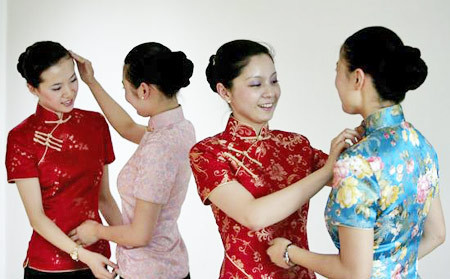 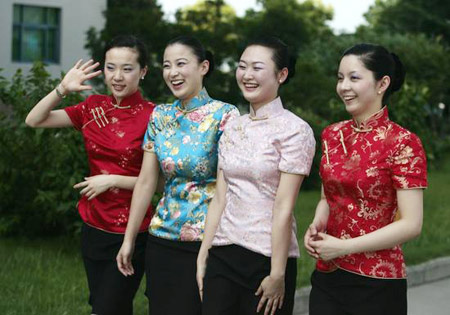
Four
flight attendants from China Eastern Airlines model new colorful
uniforms, which were unveiled Tuesday. The uniform, made from a
traditional southern Chinese silk called yunjin, cost about 10,000 yuan
each. This traditional uniform will be worn for charter flights from the
Chinese mainland toTaipei, which begin on July 4.[Xinhua] |
The first non stop
weekend flights between mainland China and Taiwan for sixty years landed in
Taipei today and the opening up of air links between the mainland and Taiwan
will hurt the Hong Kong's air travel business. That said passengers will
gain price, and choice-wise.
Until this weekend travellers on either side of the 160km Taiwan Strait have
had to make time-consuming stopovers in Hong Kong, Macau and other third
points as longstanding political tensions between the two sides prevented
direct flights.
Hong Kong and Macau airlines thrived on the circuitous route. Some 60 per
cent of air traffic between mainland China and Taiwan transits in Hong Kong,
30 per cent in Macau, and the rest at other points such as South Korea's
Jeju island.
Taiwan accounted for 18 per cent of Hong Kong's 45 million passengers last
year, but the new cross-strait direct flights could lessen that flow.
Over the long term, unlimited direct flights would shave HK$600 million
(S$105 million) off Cathay Pacific's bottom line - about 8.5 per cent of the
Hong Kong flagship carrier's net profit last year.
Cathay operates roughly 15 daily flights to Taiwan, and the routes accounts
for up to 10 per cent of its revenue.
Hong Kong's tourism industry could also suffer a big blow, potentially
losing some 1.5 million tourist arrivals if all Taiwanese travelling to the
mainland opt for direct flights.
Taiwanese transiting in Hong Kong spend an average of HK$200 per visit,
which means the former British colony could lose up to HK$2.5 billion, or
0.2 per cent of its GDP, this year. This could balloon to HK$16.6 billion in
2012.
However, some experts remain upbeat, saying the direct flights will have
only a short-term impact. For now, mainlanders are allowed to travel to
Taiwan in tour groups only. As long as individual travel is restricted,
Taiwan cannot serve as a transit hub.
Aussie Foreign
Minister visits Sister Joan
4 July 2008
A Media release
from The Hon Stephen Smith MP
AUSTRALIAN MINISTER FOR FOREIGN AFFAIRS 
Thai-Australia Partnerships Provide Assistance to the Needy
I had the
opportunity this week to visit two great examples of collaboration between
the people of Thailand and Australia. Both underscore the strength and depth
of bilateral relations between our two nations.
I visited Professor Praphan Phanuphak at the Thai-Australian Collaboration
in HIV Nutrition (TACHIN) project. The Thai Red Cross AIDS Research Centre
and the Sydney-based Albion Street Centre deliver the TACHIN project in
partnership. The Institute of Nutrition at Mahidol University is a
collaborating partner.
The TACHIN project aims to use improved nutrition to enhance the care of
people living with HIV/AIDS. TACHIN is funded by the Australian Agency for
International Development (AusAID) – $600,000 over three years – through the
Australian HIV/AIDS Partnerships Initiative.
As HIV affects metabolism and increases the need for nutrients and energy,
good nutrition is of paramount importance for those with HIV. Adults living
with HIV have 10 to 30 per cent higher energy requirements than adults not
affected. The energy requirements of HIV positive children are up to 100 per
cent higher than otherwise healthy children.
I also visited the Mission of Sister Joan Evans, an outstanding Western
Australian who has worked tirelessly and compassionately to improve the
lives of underprivileged children and adults in the Klong Toei slum area of
Bangkok since 1992.
Sister Joan, formerly a secondary school teacher, helps children from the
slum receive a good education by providing uniforms, food and necessary
funds. Sister Joan also supports new babies and mums, the elderly and the
seriously ill.
The Australian expatriate community in Bangkok has been a longstanding
supporter of Sister Joan's projects. For example, in 2007-08 alone, the
Australian-New Zealand Women's Group (ANZWG) donated 100,000 baht (A$3,700)
and raised a further 110,000 baht (A$4,070) through a "Pie Drive" project.
The Australian Embassy Bangkok made a 100,000 baht (A$3,700) contribution to
help buy school uniforms for children in slum communities. The Australian
Embassy Defence section arranged a "spare change" drive, raising 30,000 baht
(A$1,110) for Sister Joan's projects. In 2006, the Australian-Thai Chamber
of Commerce helped 45 kids visit a Safari Park.
Sister Joan's website
More on Sister Joan's Mission
Bangkok weird
4 July 2008
Thai politics gets
stranger and stranger. Prime Minister Samak Sundaravej is scheduled to
return to Thailand from Brunei this afternoon but he is claiming that
someone is plotting to capture him the instant his plane makes a landing at
Bangkok airport.
The plane carrying Mr Samak is scheduled to land at 4pm. after his official
visit to China and Brunei.
The plot was linked to an earlier rumour that the People's Alliance for
Democracy is working with military officers who were involved in the Sept
19, 2006 coup, and who are working to stage another overthrow to get rid of
Mr Samak and the government.
Unlikely but such
is Thai politics at the moment that anything is possible.
Meanwhile the
Supreme Court has rejected former prime minister Thaksin Shinawatra's
request to leave the country on grounds that his planned trips lack
justification.
Thaksin was supposed to begin his trip on June 27 and the unfavourable
ruling was made due to his graft trial on the Ratchadapisek Road land case.
In a writ lodged on June 24, Thaksin asked for the court's permission to
make three consecutive trips - a two-legged visit to China and England
followed by another two-legged trip to China and Japan. His final visit was
planned for China.
In turning down Thaksin's application to travel abroad, the nine-judge
Criminal Tribunal for Political Office Holders reminded him about the close
proximity between his trial date and his planned trip.
In addition the Criminal Court is scheduled July 31 to hand down the verdict
on the tax evasion case involving Khunying Pojaman Shinawatra, wife of
former prime minister Thaksin.
The court set the verdict session on Friday after reading out a Constitution
Court decision denying the defence to raise constitutional arguments.
Pojaman's fellow defendants are her brother Bannaphot Damapong and her
private secretary Kanchanapa Honghern.
The three are accused of involving in a scam to avoid paying Bt546 million
in a shares transfer from Pojaman to Bannapot wrongfully declared in income
tax return as a gift.
This is all
complicated - but in the end it appears to simply be a power play for
control of Thai politics.
Something in
the air
3 July 2008
Dubai is not quite
as glamorous as the wonderful promotional material would lead you to
believe. And if you are a new resident in International City you are
probably wishing that you were somewhere else right now as sewage has now
flooded this residential area for two weeks in a row.
The Gulf News reports today that an entire car park, roads and pavements are
now submerged under the stinking sewage. The sewage is now just a metre from
the entrances of some residential buildings in England cluster, near one of
the main roads.
The car park is also flooded with the sewage. Motorists have no choice but
to drive through the pools and around the hazard caused by tankers that are
working to pump out the water.
With temperatures reaching 45C the smell must be getting interesting. And
this is a Nakheel development; yes the same people that are bringing you the
Palm Jumairah.
The Gulf News reported a Nakheel spokesperson saying that: "A specialist
team is currently working on measures to resolve a situation related to the
sewage system at International City and we expect operations to normalise by
the end of the week."
Residents had
previously complained about the smell of sewage on one of the main roads as
far back as May.
International City currently has approximately 60,000 residents. All of them
holding their noses!
 Happy
Canada Day Happy
Canada Day
1 July 2008
I miss Canada. And
I have been thinking about it quite a lot recently. I miss Toronto and the
lifestyle there and I miss my trips to Vancouver. Lots of people are
traveling there at the moment to enjoy Toronto's summer. Sadly not me.
And today is
Canada Day so here (courtesy of the Dominion Institute and Canwest) is your
Canada Day Quiz. Answers tomorrow !!
There are 100
questions and no prizes!
|
LAND AND
LANDSCAPE
1) In 1535, which famous European explorer charted the St. Lawrence
River, with assistance from native peoples, and claimed the region for
France?
2) What is the original name for Ottawa?
3) Where does Canada rank in the world in terms of land mass?
4) True or False: Canada has the longest coastline in the world.
5) True or False: Mount Mackenzie is the highest mountain in Canada.
6) Name the first permanent English settlement in Canada.
7) Name the large plot of land held by the Hudson Bay Company from 1670
until 1870 when it was transferred to Canada.
8) What Yukon river was the focal point of the late 19th century gold
rush?
9) What Canadian province is named after Queen Victoria's fourth
daughter?
10) Where did inventor Guglielmo Marconi receive the first transatlantic
wireless signal?
11) What is the most northerly and southerly points in Canada?
12) What was the name given to the 19th century cart pulled by oxen or
horses that travelled, often hundreds at a time, through the Canadian
West?
13) What province experienced a tidal wave on Nov. 18, 1929?
14) In what two provinces is Lake Athabasca located?
15) What Canadian city is known as the "Paris of the Prairies"?
POLITICS AND
POLITICIANS
16) Which province was the first to introduce medicare?
17) What Saskatchewan MP led the campaign for medicare?
18) What French-Canadian prime minister famously proclaimed: "The 20th
century will belong to Canada"?
19) Who was prime minister of Canada when the country entered the Great
Depression of the 1930s?
20) What Canadian won the Nobel Peace Prize for his efforts to
peacefully resolve the Suez Crisis and then went on to become prime
minister?
21) The Winnipeg general strike occurred in what year?
a) 1914
b) 1919
c) 1939
d) 1960
22) In 1942, a national plebiscite sparked a fierce debate over military
service and national unity. What was this plebiscite about?
23) In what year did the federal government pass the Official Languages
Act.
24) During the Great Depression, people converted an automobile with no
engine into a horse drawn car. This form of transportation was named in
honour of the prime minister of the day. What was it called?
25) What 1985 bill repealed a clause in the Indian Act that deprived
aboriginal women of their status upon marrying a non-aboriginal?
26) What MP from Montreal West was assassinated in Ottawa in 1868?
27) What two provinces did not ratify the Meech Lake Accord?
28) The face of what Canadian prime minister adorns the $100 bill?
CITIZENSHIP AND GOVERNMENT
29) Name the province that was part of the initial Confederation
discussions but decided to opt out of joining Canada until 1949?
30) Who is Canada's second largest trading partner?
31) Which is the only legally bilingual Canadian province?
32) What is the largest federal majority (for any political party) ever
recorded in Canadian history?
33) What is the Queen's representative in each province called?
34) In the federal Parliament, what is a law called before it is passed?
35) On what date was Nunavut declared a Canadian territory?
36) In what year was the Canadian Constitution re-patriated?
37) Canada Day was established by statute in 1879 under this name?
38) What is the highest honour that Canada gives its citizens for
outstanding achievements and service to their country or humanity at
large?
39) The government of Canada is best described as:
a) a representative republic
b) a co-operative association
c) constitutional monarchy
d) people's democracy
PEOPLE AND PLACES
40) What medical breakthrough led to a 1923 Nobel Prize for Frederick
Banting and J.J.R. Macleod?
41) Who coined the phrase "the global village" and "the medium is the
message"?
42) Who was the first Canadian in space?
43) Which Canadian boxer won the gold medal in 1988 Olympics?
44) What was the name of Wayne Gretzky's first professional hockey team?
45) Who was the first woman on Supreme Court of Canada?
46) Name the group of French-Canadian inhabitants who were deported from
the Maritimes in the mid-18th century?
47) What was the name of the Cree chief who refused to sign Treaty 6 in
1876 and who was convicted of treason for his involvement in the
North-West Rebellion?
48) What is the name of the fictional Acadian heroine immortalized in a
poem by Henry Wadsworth Longfellow?
49) What poet was dubbed the "Bard of the Yukon"?
50) What was the name given to the thousands of British orphaned or
abandoned children sent to Canada between 1869-1920s?
51) During the summer of 1763, what Odawa War Chief captured many of the
British forts west of Niagara in resistance to expanding English
settlement?
52) On what famous battlefield did General Wolfe and the British army
defeat the French army for control of Quebec in 1759?
INDUSTRY AND
FINANCE
53) What major Canadian economic policy of Pierre Trudeau's government
sparked the creation of a bumper sticker proclaiming "Let the Eastern
bastards freeze in the dark!"?
54) Which NHL team has won more Stanley Cups than any other?
55) The championship trophy for the Canadian university football league
is named after a famous war hero, diplomat and governor general. What is
his name?
56) Name Canada's first female member of Parliament.
57) What was the name given to the group of women who were involved in
the Person's Case/Edwards v. Attorney General of Canada in 1929?
58) What was the name given to the hundreds of French women who came to
New France in an attempt to populate the new French colony?
59) What was the name given to the almost 50,000 women who came to
Canada after the Second World War to join their Canadian servicemen
husbands?
60) Who was the Canadian silent film actress who was known as "America's
Sweetheart" during her career in Hollywood?
61) Name the female artist known also "Klee Wyck" by the Nuu-chah-nulth
First Nation on Canada's West Coast.
62) Name the daughter of a Mohawk chief and an English woman who became
a celebrated Canadian poet and performer.
63) What year did Canada eliminate the $1 bill and replace it with the
loonie?
64) What is the name of the sailing vessel featured on the Canadian
dime?
ARTS AND
CULTURE
65) Who wrote the words to O Canada?
66) What is the name of the Canadian equivalent of the Grammy awards?
a) Genies
b) Mulroney's
c) Junos
d) Trudeau's
67) This Canadian actor is known for going to the future and back in the
1980s, his work on '80s television and his battle with Parkinson's
disease.
68) Who wrote the theme song for Johnny Carson's 'Tonight Show'?
69) What is the name of Canada's official summer sport?
70) Where was Babe Ruth's first professional home run hit?
71) Name the two official animals of Canada.
72) Which one of the following Canadian artists was not a member of the
Group of Seven: J.E.H. MacDonald, Lauren Harris, Tom Thompson, Frank H.
Johnston?
73) What two Canadian cities were part of the "original six" NHL hockey
teams?
74) What annual Alberta event was developed by cowboy and vaudeville
entertainer, Guy Weadick in 1912?
75) What Saint is celebrated on June 24th each year in Quebec?
76) Which Canadian band got its start as a backing band for Bob Dylan?
INTERNATIONAL
AFFAIRS
77) Who was prime minister of Canada during the Second World War?
a) Lester B. Pearson
b) Sir Wilfrid Laurier
c) Louis St. Laurent
d) Mackenzie King
78) Which Canadian city hosted the world during the summer Olympics in
1976?
79) In 1965, prime minister Lester B. Pearson questioned American
involvement in the Vietnam War and recommended a halt to all air strikes
by the U.S. military. President Lyndon B. Johnson later responded by:
a) Shaking Pearson's hand and smiling for the cameras
b) Grabbing Pearson by the lapels and yelling at him
c) Halting military action in Vietnam and sending troops home
d) Making a radio address condemning the actions of Pearson
80) Which French president fuelled separatist tensions in 1967 when he
proclaimed during a speech in Montreal: "Vive le Quebec libre!"?
81) What is the name of the trade agreement linking Canada, the United
States, and Mexico that went into effect on Jan. 1, 1994?
82) In 1837, this political reformer rallied more than 500 men just
outside of Toronto, an action that forced him to flee south of the
border.
83) American Democrat James K. Polk campaigned for the U.S. presidency
under the slogan "54 -- 40 or Fight" because of the border dispute over
which Canadian province?
84) What was the name of the route used by slaves fleeing the United
States to get to Canada?
85) In 1958, the government of John Diefenbaker, created an organization
with the United States to monitor and defend the airspace over our
continent. What is this organization called?
WAR AND
REMEMBRANCE
86) Name Canada's worst epidemic, spread by troops returning from
service overseas during the First World War, which killed 50,000
Canadians.
87) In June 1944, Canadians participated in a major military operation
called "D-Day." Which of the following best describes "D-Day"?
a) The invasion of Japan
b) The bombing of Pearl Harbor
c) The liberation of Hong Kong
d) The invasion of France
88) The term "D-Day Dodgers" applies to soldiers fighting in which
campaign in the Second World War?
89) What 19th century general led the British to successfully defend
Upper Canada from American invaders at Queenston Heights?
90) Name the tragic First World War battle that took place on July 1,
1916 and resulted in the death or wounding of almost the entire 1st
Newfoundland Regiment.
91) Name the Cold War armed conflict where over 26,000 Canadian service
men and women served, 516 of which lost their lives.
92) Lieut.- Col. John McCrae served as a medical officer in the First
World War and wrote what is considered to be Canada's most famous war
poem. What is called?
93) In 1857, the first Victoria Cross, Alexander Dunn, was awarded to a
Canadian for his service in what war?
CONTROVERSY
AND SCANDAL
94) Name the controversial political figure who is credited with the
creation of the province of Manitoba.
95) What was the name of the ship of South Asian immigrants who were
denied entry to Canada in 1914 because of the discriminatory "continuous
passage" immigration policy?
96) Quebec cabinet minister, Pierre Laporte was taken hostage and killed
during the October Crisis initiated by which extremist separatist group?
97) In 1926, Mackenzie King tried to call an election and ended up in a
battle of wills with the Governor General of the day who refused his
request. What is the rhyming name given to this political conflict?
98) Which famous Canadian declared "There's no place for the state in
the bedrooms of the nation" in 1967 in reference to the controversial
Omnibus Bill that brought issues such as divorce law, abortion and
homosexuality to the forefront.
99) Which prime minister was forced to resign after it became known that
he accepted campaign funds in exchange for a lucrative railroad
contract?
100) Name the Canadian settler who was executed during the Red River
Resistance |
ANSWERS
1) Jacques Cartier.
2) Bytown.
3) 2nd, Russia 1st
4) True.
5) False -- Logan.
6) Cupids, Newfoundland.
7) Rupert's Land.
8) Klondike.
9) Alberta.
10) Signal Hill, St. John's, Newfoundland.
11) Cape Columbia and Pelee Island.
12) Red River cart.
13) Newfoundland.
14) Saskatchewan and Alberta.
15) Saskatoon.
16) Saskatchewan.
17) Tommy Douglas.
18) Sir Wilfrid Laurier.
19) Richard Bennett.
20) Lester B. Pearson.
21) b) 1919
22) Conscription.
23) 1969.
24) Bennet Buggy.
25) Bill C-31.
26) Thomas D'Arcy McGee.
27) Newfoundland and Manitoba.
28) Robert Borden.
29) Newfoundland.
30) China.
31) New Brunswick.
32) Brian Mulroney, 1984.
33) Lieutenant-Governor.
34) Bill.
35) April 1, 1999.
36) 1982.
37) Dominion Day.
38) Order of Canada.
39) c) constitutional
monarchy
40) Discovery of
insulin.
41) Marshall McLuhan.
42) Marc Garneau.
43) Lennox Lewis.
44) Indianapolis Racers.
45) Bertha Wilson.
46) Acadians.
47) Big Bear.
48) Evangeline.
49) Robert Service.
50) Home Children.
51) Pontiac.
52) Plains of Abraham
53) National Energy
Program.
54) Montreal Canadiens.
55) Georges Vanier.
56) Agnes MacPhail.
57) Famous five.
58) Filles du roi.
59) War Brides.
60) Mary Pickford.
61) Emily Carr.
62) Pauline Johnson, Tekahionwake.
63) 1987.
64) The Bluenose.
65) Sir Adolphe-Basile
Routhier.
66) c) Junos.
67) Michael J. Fox.
68) Paul Anka.
69) Lacrosse.
70) Hanlan's Point, Toronto, Ont.
71) Beaver and Canadian Horse.
72) Tom Thompson.
73) Montreal and Toronto.
74) The Calgary Stampede.
75) St. Jean Baptiste.
76) The Band.
77) d) Mackenzie King.
78) Montreal.
79) b) Grabbing Pearson by the lapels and yelling at him.
80) Charles de Gaulle.
81) North American Free Trade Agreement -- NAFTA.
82) William Lyon Mackenzie.
83) British Columbia.
84) Underground Railroad.
85) NORAD -- North American Aerospace Defence Command.
86) Influenza.
87) d) The invasion of France.
88) The Italian Campaign.
89) Sir Isaac Brock.
90) The battle of Beaumont Hamel -- the first day of the Battle of the
Somme.
91) The Korean War.
92) In Flanders Fields.
93) Crimean War.
94) Louis Riel.
95) The Komagata Maru.
96) The FLQ -- Front de la liberation du Quebec.
97) The King-Byng Affair.
98) Pierre Elliott Trudeau.
99) Sir John A. Macdonald.
100) Thomas Scott.
|
Wow - that's tough
!
Emirates aims for more cost savings
1 July 2008
Escalating fuel
prices are forcing Emirates to increase cost saving targets significantly,
according to the airline's top executive.
Fuel now accounts for 41 per cent of the airline's total costs. At the time
oil price rested at $115 per barrel, Emirates aimed to save about $100
million (Dh367m) in costs. Oil is currently priced at $143 a barrel. So,
another $40 million saving is a minimum.
Emirates had in fact initially budgeted everything based on oil prices at
approximately $105 a barrel. So high oil prices hurt Emirates as they do any
other airline.
Besides increasing fares, the airline is taking some drastic measures to
combat soaring fuel prices.
Emirates recently suspended the launch of its Durban route in South Africa,
initially due for launch in December this year.
It is also possible that Emirates may not be placing new aircraft orders at
the forthcoming Farnborough International Airshow, one of the largest air
and aerospace trade shows in the world to take place from July 14-20.
Although they may now be out shone by Etihad who will likely place large new
orders at the July airshow.
As another saving from October this year, the airline will abolish the base
(seven per cent) commission for its UAE travel agents.
The carrier also had to push back the launch of its two US destinations this
year – Los Angeles and San Francisco, following aircraft delivery delays of
its four Boeing aircraft.
Emirates would now start services to Los Angeles from October 1, a month
later than scheduled, and to San Francisco from November 20 as against
October 26.
But while airlines across the world are shedding costs through redundancies
Emirates cant do that. Not when its fleet is expanding so quickly. Emirates
focus is making sure that all its assets are profitably used. For example
the Athens flight is now a turnaround not a layover. At nearly 5 hours each
way this is a long flight for the crew but the airline saves the
accommodation costs. That is a saving of say US$2000 a day; so US$750,000 a
year. It adds up quickly to some significant savings.
The evolution of Bangkok retailing
1 July 2008
NITHIPAT TONGPUN in the Bangkok Post on 30 June 2008
"Modern Thai retailing began in the days of middlemen who would offer
commodities in nearby neighbourhoods, often through their own small shops,
known as cho huay. This was followed by clusters of shops in certain areas
known for shopping, such as Sampheng, Banglamphu, Wang Burapha and Yaowarat.
Bargaining between buyers and sellers was expected, as fixed prices were not
yet common.
Central Wang Burapha, Thailand's first modern retail centre, opened in 1956,
followed soon after by Thai Daimaru, located in Ratchadamri Arcade. The
store ushered in the era of modern retail development in Thailand and
offered fixed prices at a time when even the Central stores had elements of
bargaining. Also, it contained Thailand's first escalator, which drew huge
crowds. Two chains well-known today, Robinson and The Mall, followed.
Competition and choices for Thai consumers increased as we became more
comfortable with the format, convenience and price structure of these new
retail centres.
In 1990, Makro was the first "big-box" store to enter Thailand, the first
Asian location for the Dutch cash-and-carry operator. Soon after, CP Group
launched the Lotus brand in Thailand, and they later formed a partnership
with UK-based Tesco in 1998 to create Tesco Lotus. Also new to the market
were Big C, originally from Central Group, and Carrefour, which started as a
joint venture between Central Group and Carrefour.
Also growing in popularity during this time were supermarkets, as they
successfully built a supply chain that soon offered the freshness of wet
markets in a much more pleasant format. Early supermarkets were
proprietorships, but the segment was consolidated when Tops Supermarkets
(operated by Royal Ahold) purchased a number of supermarkets from the
Central Group that were later bought back by Central. Tops can now be found
in Central and Robinson department stores, or as the anchor tenants in
neighbourhood centres.
CP Group is also very active in the convenience store segment. The first
7-Eleven opened in 1989 in Bangkok's Patpong area, and the format proved a
huge success. There are more than 4,400 locations in Thailand currently. The
Japanese chain Family Mart came to Thailand in 1993. Tesco Lotus's Lotus
Express also operates in this segment.
Another segment in the retail sector is the so-called category killer, a
specialised store designed to dominate a segment through a wider range of
products and more competitive prices. The first ones were seen in Thailand
during the mid-90s, with HomePro (home improvement) and Office Depot (office
goods). These stores resulted from increased competition in the typical
format as operators tried to distinguish themselves from shopping malls and
superstores, and have driven many traditional retailers to either improve
their offerings or exit the market. Power Buy and Index Living Mall are more
examples of category killers.
The financial crisis in 1997 had a number of effects on the retail sector.
We witnessed CP Group eventually ending its partnership with Tesco, while
Central sold the majority stake in Big C to the French Casino Group as it
decided to change its focus. However, Central later bought out the stake in
Tops held by the struggling Ahold group of the Netherlands. Retailers became
more prudent, with an emphasis on product offerings and niche launches. A
number of second-tier department stores could no longer compete and were
closed. Today, Central and the Mall Group are the dominant department store
operators.
As the retail sector became more sophisticated, we saw a number of luxury
malls such as Emporium and Gaysorn Plaza developed in the 1990s and
retailers focused more on branding. Central Chidlom underwent extensive
renovations and was soon Thailand's most upscale department store.
The success of The Emporium led to the launch of Siam Paragon, a joint
venture between the Mall Group and Siam Piwat, which owns the Siam Center
and Siam Discovery malls nearby. After Gaysorn Plaza finished its
renovations in 2002, Siam Center followed suit, while Central has recently
completed its renovation of the World Trade Center into CentralWorld. One
quality all of these retail centres share is proximity to the BTS Skytrain.
When the BTS originally launched in 1999, only Central Chidlom had a direct
bridge connection to one of the stations. However, numerous retail centres
have since added this feature, which has become a requirement for luxury
malls given Bangkok's traffic and weather.
The latest wave of development has focused on neighbourhood centres, which
are essentially scaled-down malls built around an anchor tenant, usually a
supermarket or Cineplex. Siam Future Development (SFD) is one of the leaders
in this area. Most neighbourhood centres are located in residential areas on
the outskirts of the central business district, and they have grown in line
with changing consumer behaviour, as they are much more convenient and
satisfy most shoppers' daily needs. Popular neighbourhood centres in Bangkok
include J-Avenue and La Villa.
In just two decades, retailing in Thailand has evolved from a traditional
model to the global model seen today. Retail centres have become
increasingly sophisticated as consumers have become more aware of their
options. In the near-term, we expect to see continued development of
neighbourhood centres in Bangkok, as they provide the most logical solution
for the needs of residents."
Nithipat Tongpun is Director and Head of Retail Services of CB Richard
Ellis.
|