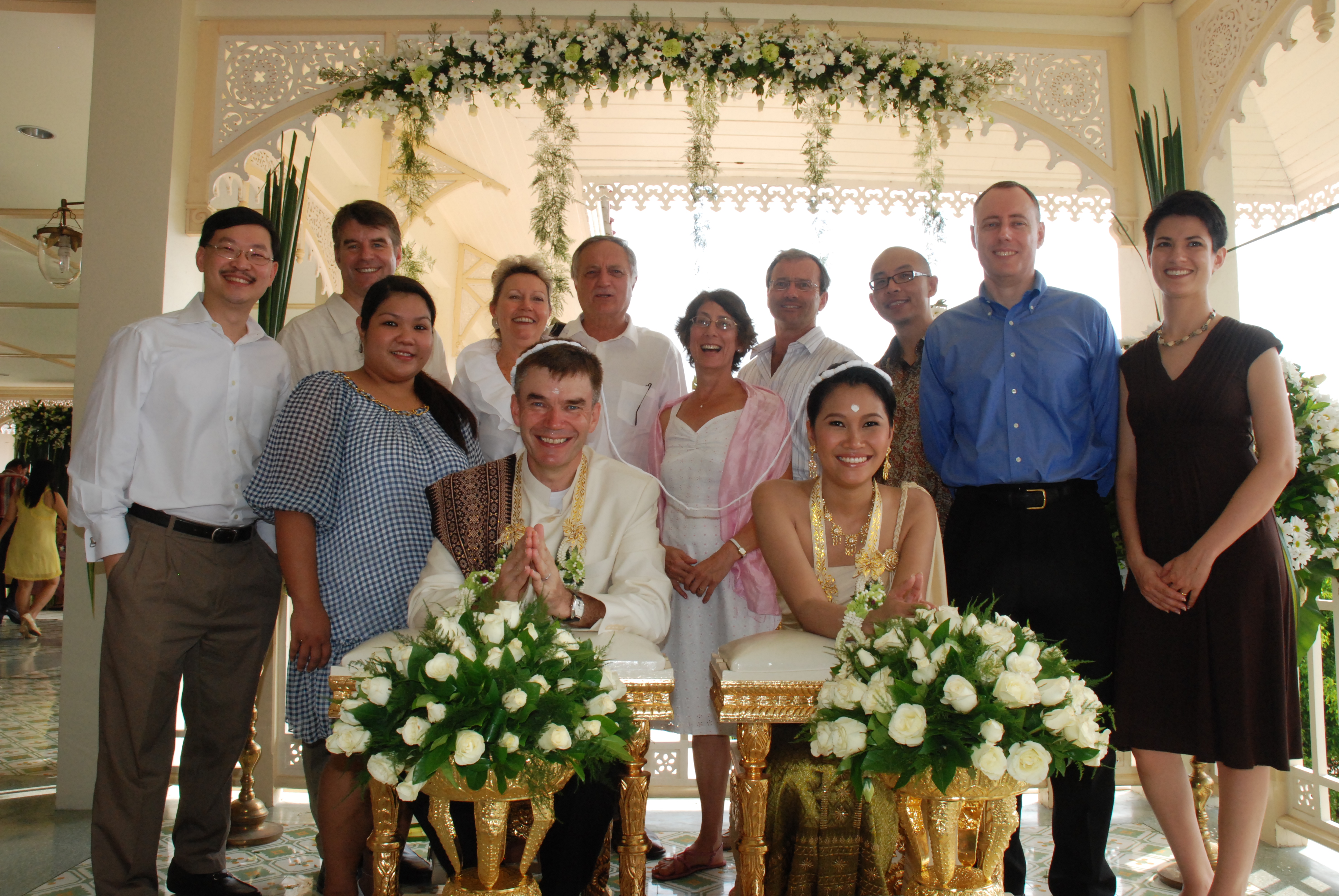
|
Clapper Fever
31 October 2008
From the BBC.
The irony is that the clappers are probably made in a Chinese factory and
not in Thailand. Someone is making money out of this long, long dispute !
"There are lots of things about Thailand's long-running anti-government
protests to startle a casual visitor. The toilet paper stalls that lead down
to the tangle of plastic tents inside Government House, for example, or the
free haircuts handed out to protesters beside its elegant steps.
But perhaps the most surreal hallmark of this political crisis is the craze
known as "clapping hands".
Their noise rises from inside the government compound every few minutes - a
sound somewhere between the chattering of insects and the clickety-clack of
factory machines.
It is the sound of thousands of protesters waving the latest must-have
accessory - hand-shaped plastic rattles, in lurid colours, which clatter
loudly when shaken.
The stalls here sell them in every colour, big or small, tied with string to
hang around your neck, or carrying slogans: "Clapper warrior!" "Clappers
stop the evil!" "My wife is making me do this!"
Buntheung is shopping for a new one. "I already have two," she tells me,
"one for the man who betrayed the country, and one for my husband!"
I ask her how effective they are. "Oh it works on the husband," she says.
And the country, which many people feel has been let down by former prime
minister Thaksin Shinawatra and his brother-in-law, the current leader
Somchai Wongsawat?
"We're almost there," she says.
The handy thing about the clapping hands is that they can be used to express
either agreement or anger. The daily speeches from the main tent at
Government House are punctuated with the rise and fall of the clapping
hands.
Protesters, some of whom have been camped out here for months, wave them
lazily or vigorously depending on who's speaking, and what's being said.
"When I like what they say I just wave it," says Chin-Noi. "It's easier than
clapping my own hands. It's fun and it makes me happy. I use a lot of
clapper."
Lots of shoppers browsing the stalls outside the rally admitted to buying up
several to give away as souvenirs. One woman said she'd been bought dozens
as presents. "I think they're cute," she said, "People keep asking me to
bring some back for them - they're very cool."
Another shopper, businessman Pad-chang, had already bought up several bags
of them, and was still browsing. "You have to test them first," he said
earnestly, "not all of them make a good sound."
They're useful, he explained, because they stop your hands from hurting when
you clap for too long.
"It's the easiest way to show your opinion. When you don't like someone or
you disagree with them, you shake it in front of their face! But we use it
as a greeting too - everyone in my office has clapping hands, and everyone
uses it."
So who are the hands in his bag for?
"Ah," he says, "these are for the children of my customers in the south of
the country. You can see it spreading to other provinces.
"I went to a Thaksin stronghold out in the country the other day, and a
clerk in the bank waved his clapping hand at me, so I took mine from my
pocket and waved it back. Now we're friends."
Asian Golf Tour coming to Hua
Hin
31 October 2008
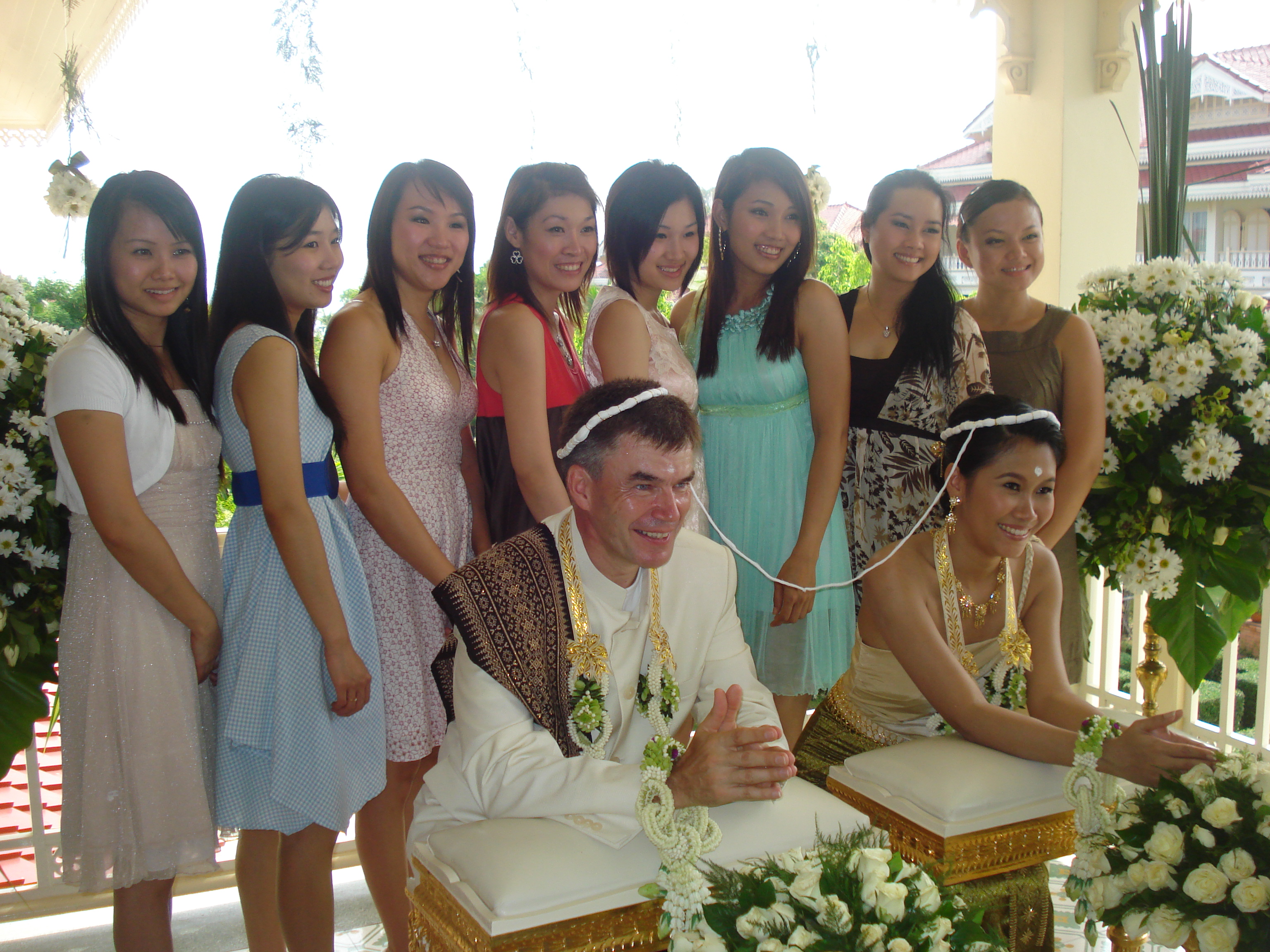
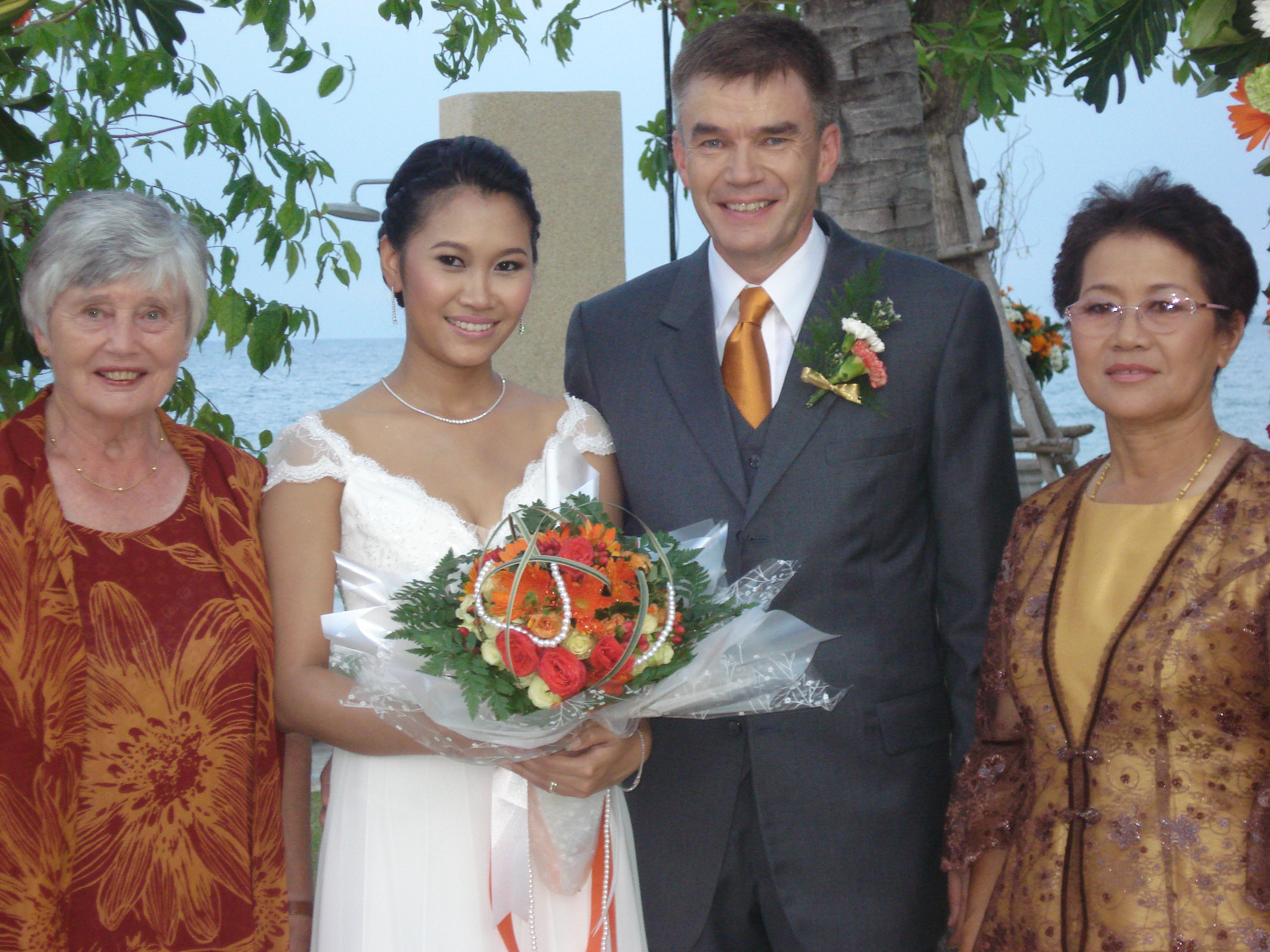
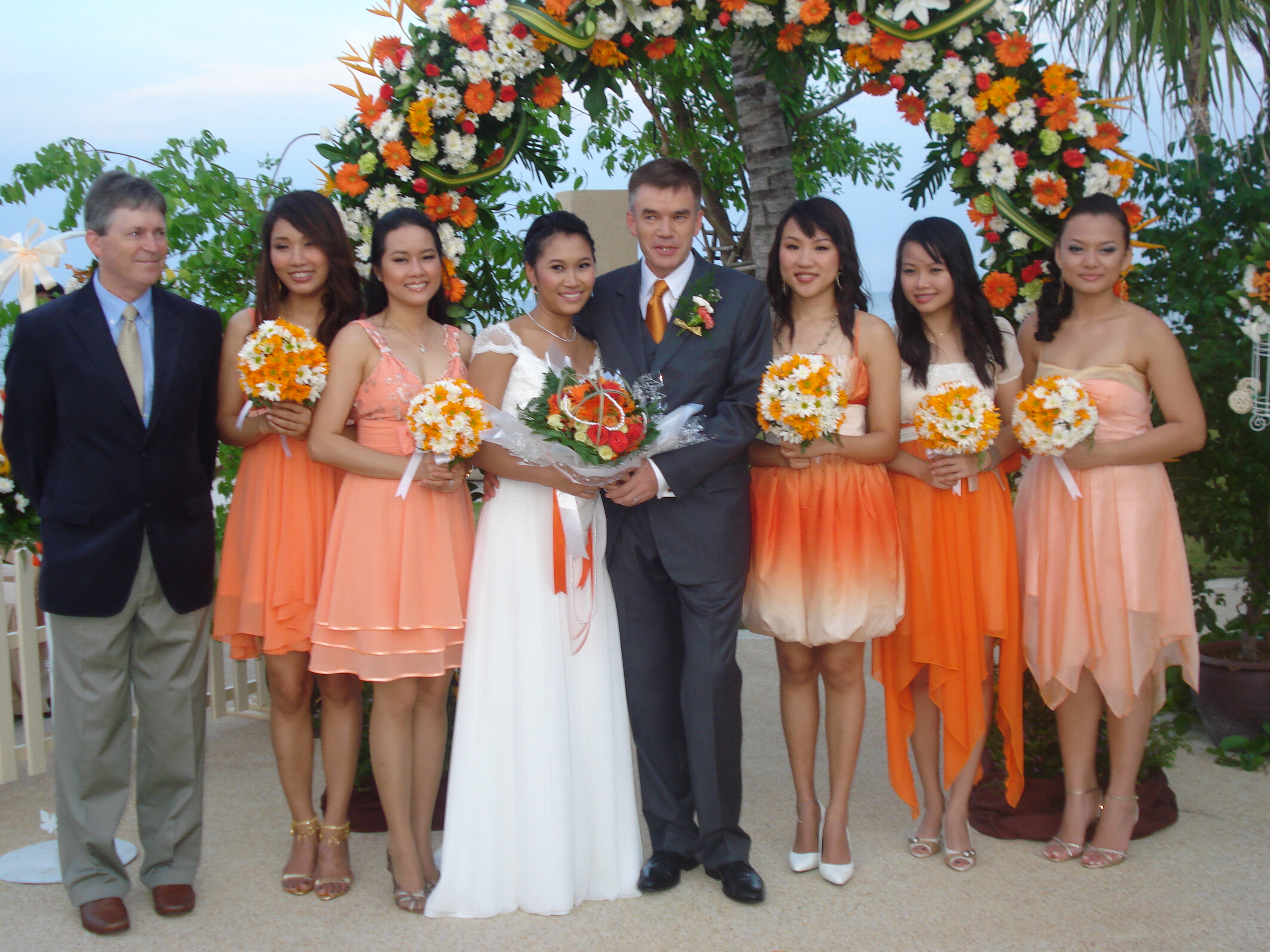
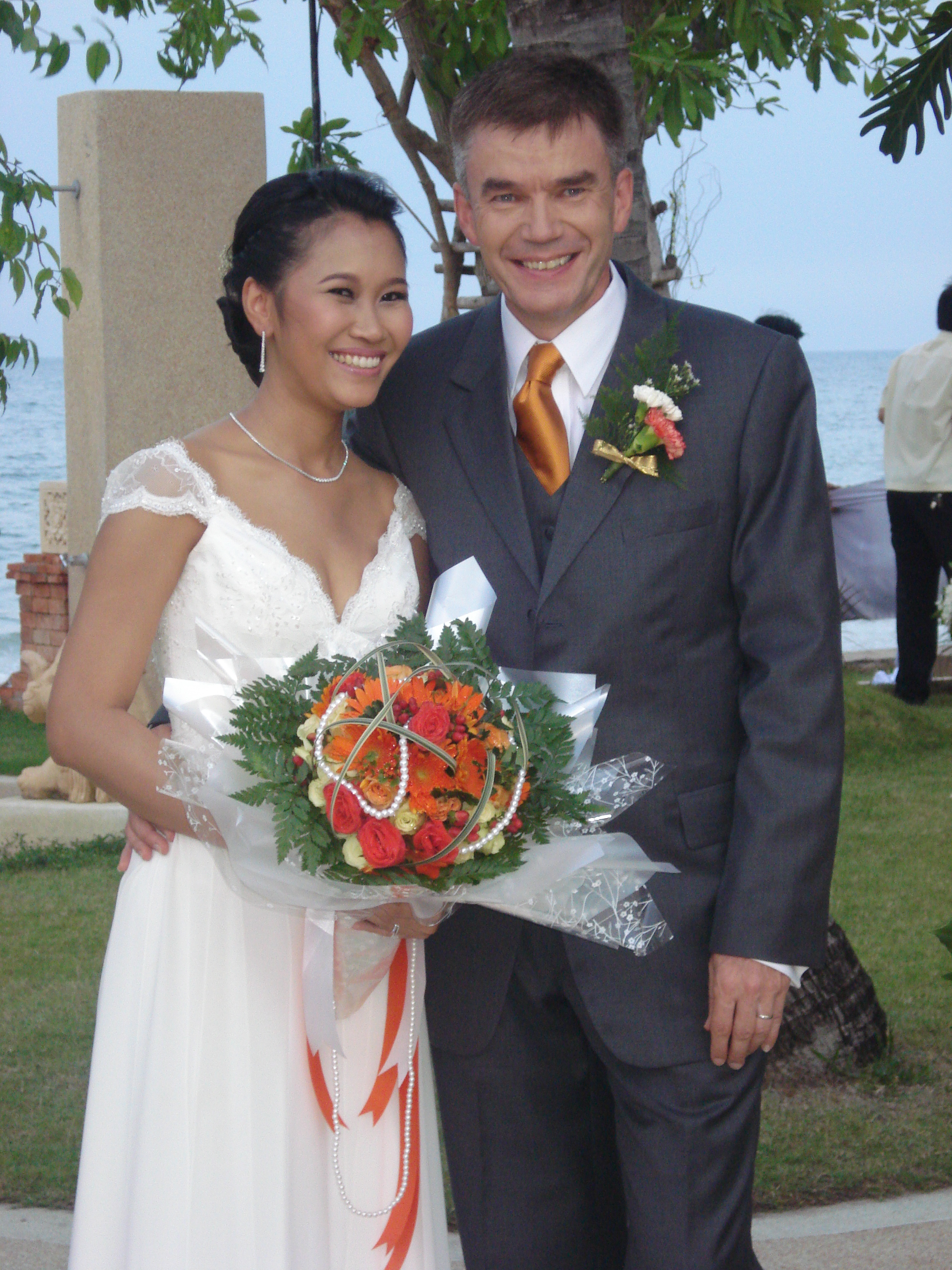
A group of us played the terrific Black Mountain course the day after my
wedding. It is a terrific course, in need of a few finishing touches and a
rather better welcome from the frosty clubhouse staff but it will be on the
Asian golfing map next year.
The Black Mountain Masters will make its debut on the Asian Tour calendar
next year and big names, like Jesper Parnevik and Johan Edfors, have already
confirmed their participation in the Hua Hin event.
The inaugural US$500,000 tournament will be held from March 26 to 29 at
Black Mountain Golf Club.
Finland's Mikko Ilonen and local star Thongchai Jaidee have also confirmed
their participation.
''We are also under negotiation to bring another two European tour stars to
join the event,'' said Harald Elisson, general manager of Black Mountain
Golf Club.
The event will feature leading 148 Asian Tour professional players and eight
invitees.
It is not an easy
course to get to - being some 30 minutes from central Hua Hin along a ragged
country lane so the organisers will need to work carefully on transport
arrangements.
As for Hua Hin, this is a great opportunity to promote the seaside resort to
the world. And for Black Mountain; the chance to sell some of the properties
around the resort and recover some of their investment.
Is Thailands'
PM a movie star?
31 October 2008
The top video in Thailand is a grainy 30-minute short
starring... well, that is the question. The leading man in the video is
neither a popular actor nor a famous singer. He is a slightly built older
man driving around young women, and he bears a striking resemblance to the
prime minister.
The video seems to have first appeared on the Manager Group's web site but
has also been hurriedly burned onto CDs and distributed.
The footage, shot by an unknown cameraman between March 22 and 27 this year,
has become the talk of the town - probably because the man in it looks very
much like the embattled Prime Minister Somchai Wongsawat, a brother-in-law
of Thaksin Shinawatra.
The clip is presented in four parts. The first, taken on March 22, shows the
man picking up a woman in her 20s, in front of a convenience store, in his
red Mercedes. The couple have dinner at a restaurant serving southern-style
Thai dishes, giving more fuel to those who believe the man is Mr Somchai,
who is a native of Nakhon Si Thammarat.
The second part features the same man driving a BMW to a love motel after
picking up another woman from a house on March 24.
In the third part, the man, who is wearing eyeglasses, is shown parking his
white Lexus SUV at a restaurant where he has lunch with his wife, according
to a female narrator who called the man the "target". The "wife" in the
footage looks like Mr Thaksin's younger sister, Yaowapa, who is of course
the Prime Minister's wife.
The final part was taken on March 27 when the target picked up a woman at
the Justice Ministry on Chaengwattana road for lunch, and then went to
HomePro department store where they bought a refrigerator. How cool is that
!!
According to the Manager website, the video clip has been shown on the
internet since early this week.
Mr Somchai apparently drives a Lexus SUV, a Mercedes and a BMW - presumably
not all at the same time.
In Thailand real
life is just an extension of tv soap operas. It is getting harder to
distinguish the two.
Dubai delays
Mall opening at the final hour
30 October 2008
Yesterday
afternoon EMAAR Properties announced that the Dubai Mall would not open
today as planned. They announced a second delay until November 4 as the mall
and other facilities are not ready.
And when it does
open it will only be partially open. On Wednesday despite frantic activity
inside the mall there was only a temporary coffee stand finished. A couple
of shops had merchandise in them, but most of the walls were still boarded
up.
Traffic going in and out of the Dubai Mall was slow and
disorganised, perhaps the biggest reason for the delay. The access roads
from Sheik Zayeed Road and Qatar Road were not ready.
The postponement may not come as a surprise to most in Dubai, as project
delays have become almost as famous as the developments themselves. But it
was left until the last minute after a flurry of publicity for this week's
opening. The Dubai Mall has already been delayed this year, with an original
opening date of August.
The Dubai Mall has a total built-up area of 5.9 million square feet and will
house around 1,200 retail outlets. It will also feature the world's biggest
gold souq, with 220 retailers and an Olympic sized- ice rink.
It will be
interesting to see if as much as 20% of stores are ready to open by next
Tuesday and whether the mall can operate safely with a large amount of
construction still underway.
The PAD and
Thai Politics
30 October
20008
Bangkok's old Don
Mueang airport has been little used since the city's new airport opened in
2006. But Don Mueang's VIP terminal is these days the unlikely refuge of an
elected government struggling to retain control in the face of an
extraordinary challenge to its rule.
In hastily refurbished offices, Somchai Wongsawat, Thailand's new
prime minister and brother-in-law of the exiled Thaksin Shinawatra, is
trying to keep the wheels of state turning - and steer the economy through
the current global financial turmoil - even as the coalition led by his
People's Power party fights to survive.
The coalition, dominated by Thaksin loyalists, took power in February after
winning a general election with strong support from rural voters still loyal
to the former telecommunications mogul. But the current political stand off
this week entered its third month.
The unelected, unappointed opposition is called the People's Alliance for
Democracy. The protesters, drawn mainly from Bangkok's middle class, are
demanding a new political order to replace the one-person, one-vote
parliamentary democracy that they say permits poorly educated rural voters
repeatedly to deliver power to corrupt politicians unworthy of leading the
Buddhist kingdom. In Octobert, protesters trying to prevent Mr Somchai's
government from unveiling its programme in parliament clashed with police in
some of the worst political violence Bangkok has seen since 1992.
Today a grenade
thrown at protesters has injured a number of people. This is a little
surprising. Everyone was expecting a few quiet weeks pending the November
14-18 funeral rites of the King's sister Her Royal Highness Princess Galyani
Vadhana. What is less certain is what happens when the protests start again.
The PAD, whose followers mainly wear royalist yellow, insists its proposed
"new politics" will improve Thailand's democracy. But critics say the PAD -
and its powerful behind-the-scenes military, bureaucratic and palace backers
- are seeking nothing less than a rollback of hard-won democratic gains so
as to restore the political influence of traditional Bangkok elites. Critics
argue that the PAD is the vanguard of the establishment and part of a
counterrevolution to the right.
A loose grouping, the PAD has not defined how it would achieve its aim of
reducing political corruption. Or would it simply be taking its turn?
Chaturon Chaisang, a former deputy prime minister in Mr Thaksin's
government, says the Bangkok showdown reflects the "fundamental political
conflict" that has haunted Thailand since the abolition of its absolute
monarchy in 1932. "It's a question of whether a tiny group of 'good people'
should run the country or do people have the legitimacy to choose their own
leaders."
There is no quick or easy solution; the conflict could take three to four
years to play out - with the economy suffering plenty of collateral damage.
The number of PAD protesters besieging Government House is far smaller than
those who joined the 2006 marches against Mr Thaksin. But they have shown a
willingness to adopt confrontational tactics, such as forcing the closure of
airports including Phuket for several days in September.
The PAD also appears to have strong financial support - and protection -
from elite forces. Not only has the military refused to remove the
protesters from Government House by force, or even to put pressure on them
by restricting the flow of food and people into the compound, but serving
officers have been training PAD guards on how to resist any eviction effort.
Queen Sirikit, wife of the revered King Bhumibol Adulyadej, attended the
funeral of an anti-government protester killed in this month's violence This
gesture was widely interpreted as a display of support for the PAD cause.
The continuing political role of the military was meanwhile in evidence when
Gen Anupong Paochinda, the army chief - flanked by the heads of the navy and
air force - in a televised interview called on Mr Somchai to resign to show
responsibility for the violence. Somchai is still there; and the longer he
is there the harder he may be to remove.
Mr Somchai, who
became prime minister last month after his predecessor was removed by a
court for hosting a cookery show while in office, is trying to reduce
tensions, avoiding any provocation that might trigger further disruption or
violence that could be used to justify a new military coup. He has suggested
that he is open to negotiating with the PAD.
Yet even as Mr Somchai tries to defuse the PAD challenge, his administration
faces another threat to its survival: charges of electoral fraud brought
against his party at the constitutional court. The court has the power to
dissolve the PPP and ban its leaders from political life, by invoking
draconian laws imposed after the 2006 coup that provide for the punishment
of an entire political party, and its leadership, for the misdeeds of a few.
That such laws exist at all - and are so readily invoked - highlight what a
long way Thailand still has to go in building sustainable democratic
institutions, even if the PAD elite fails to win further legal changes.
Emirates'
lavish LA launch
29 October 2008
Emirates began
nonstop flights between Los Angeles and Dubai this week, and in keeping with
a reputation for lavish parties the airline held one of the more lavish
Hollywood parties of the season.
Forget global
economic meltdown Emirates is spending more than $3 million for the party at
the Kodak Theatre, hosted by Hilary Swank and featuring an hour long concert
by Ricky Martin. A four-course dinner is being prepared by Wolfgang Puck.
The start of
flights to Los Angeles International Airport is the latest link in a growing
Dubai connection that has included an investment fund controlled by Dubai's
ruling family taking a 45% stake in Eli Broad's multibillion-dollar Grand
Avenue project in downtown Los Angeles.
A Dubai firm also now owns Newport Beach-based John Laing Homes, which was
the USA's second-largest privately held home builder when it was acquired in
2006.
More recently, Dubai has been courting Hollywood in a big way. DreamWorks
Animation SKG Inc. is helping build the world's largest entertainment
complex in Dubai, a 107-square-mile play zone that will include 40 theme
parks and 50 hotels.
It would be more than twice the size of Disney World in Florida and would
involve park designers from Universal Studios and Six Flags Inc.
Last weekend, the airline was a major sponsor of the Breeders' Cup at Santa
Anita, where three horses owned by the ruling family won races. The horses
arrived at LAX in a private Boeing 747 jumbo jet that has 20 specially built
stalls.
Meanwhile the
airline plans to increase service from three flights a week to daily as soon
as it gets another new plane that has been delayed by the Boeing strike.
Last year,
Emirates celebrated the start of Dubai-to-Houston service with a bash at the
Houston Astros' Minute Maid Park, at which Cindy Crawford was host and Kenny
Rogers the singer. Tom Jones headlined the start of Dubai-to-New York
service, and Bryan Adams rocked the crowd in Toronto.
Now where was my
invitation?
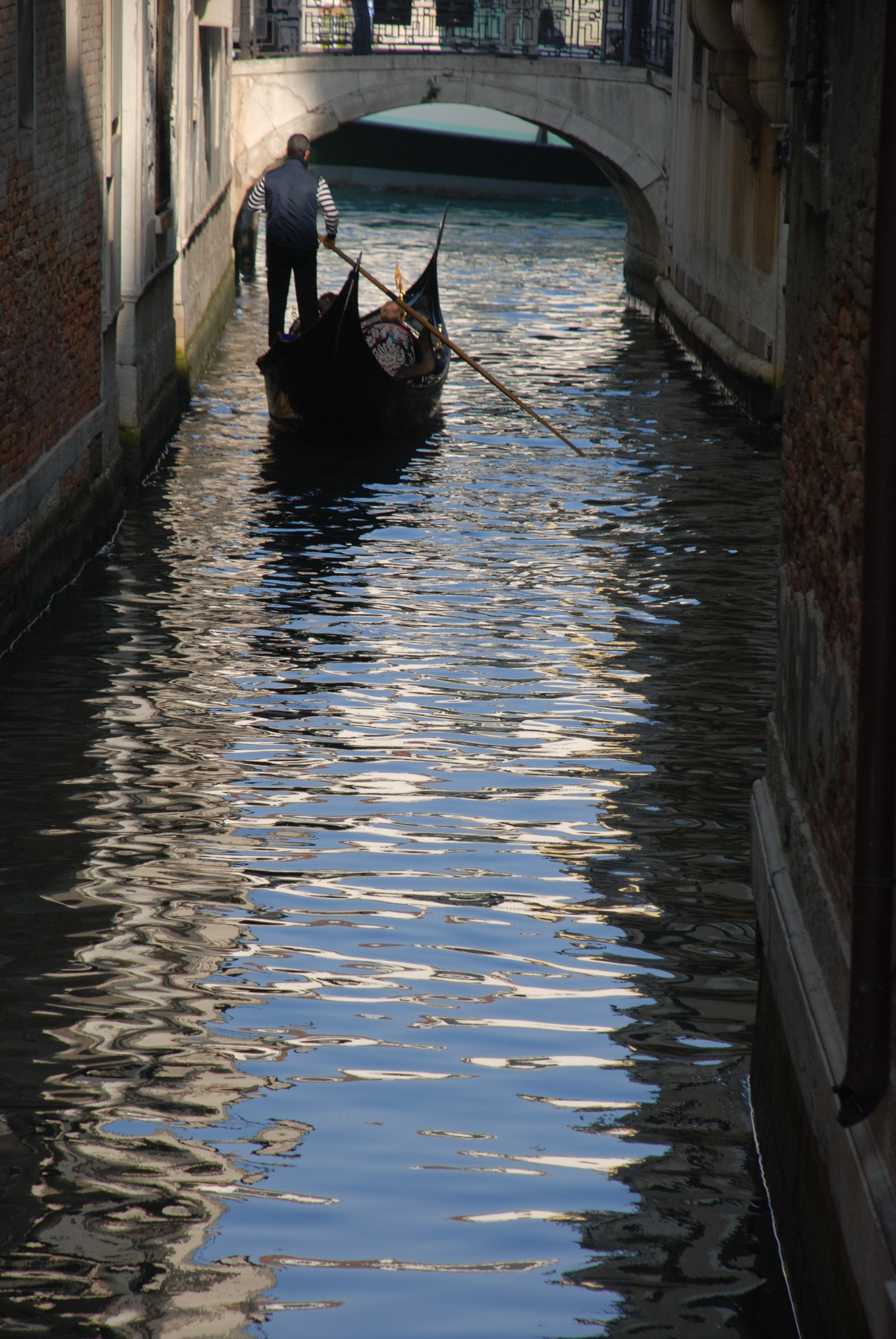
Venice's charm
27 October 2008
It is easy to miss
the serene soul of Venice among the crowds of tourists that clog its maze of
narrow streets.
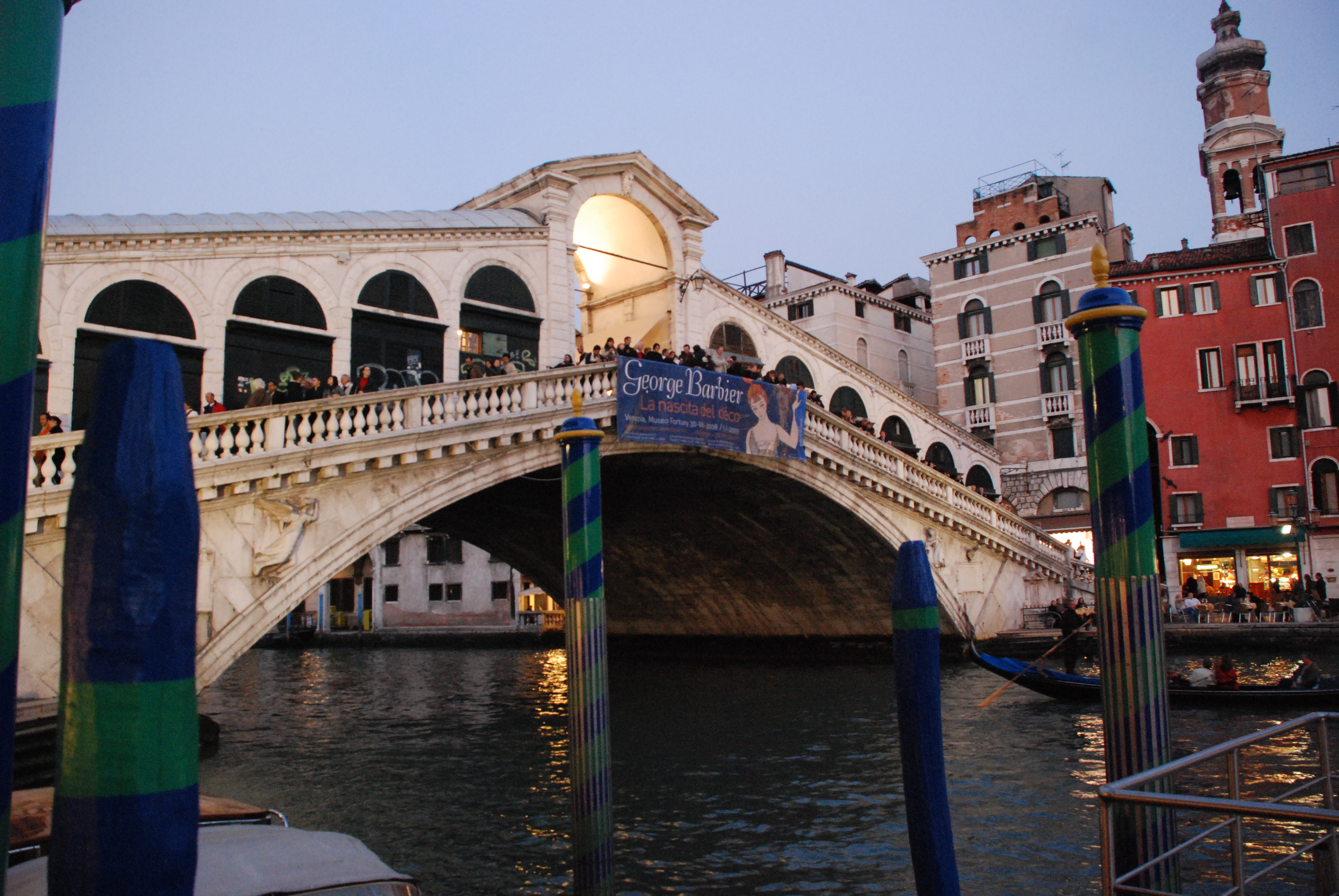
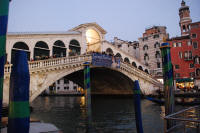
Part of visiting the city is seeing such justifiably world-famous sights as
Piazza San Marco and the Rialto Bridge, and that is where most of the
visitors gather.
But Venice's real
charm is revealed in the city's daily life centered on secluded piazzas and
obscure side streets and canals. Explore this city by foot and across water
and you will see, especially out of season, the true character of this city.
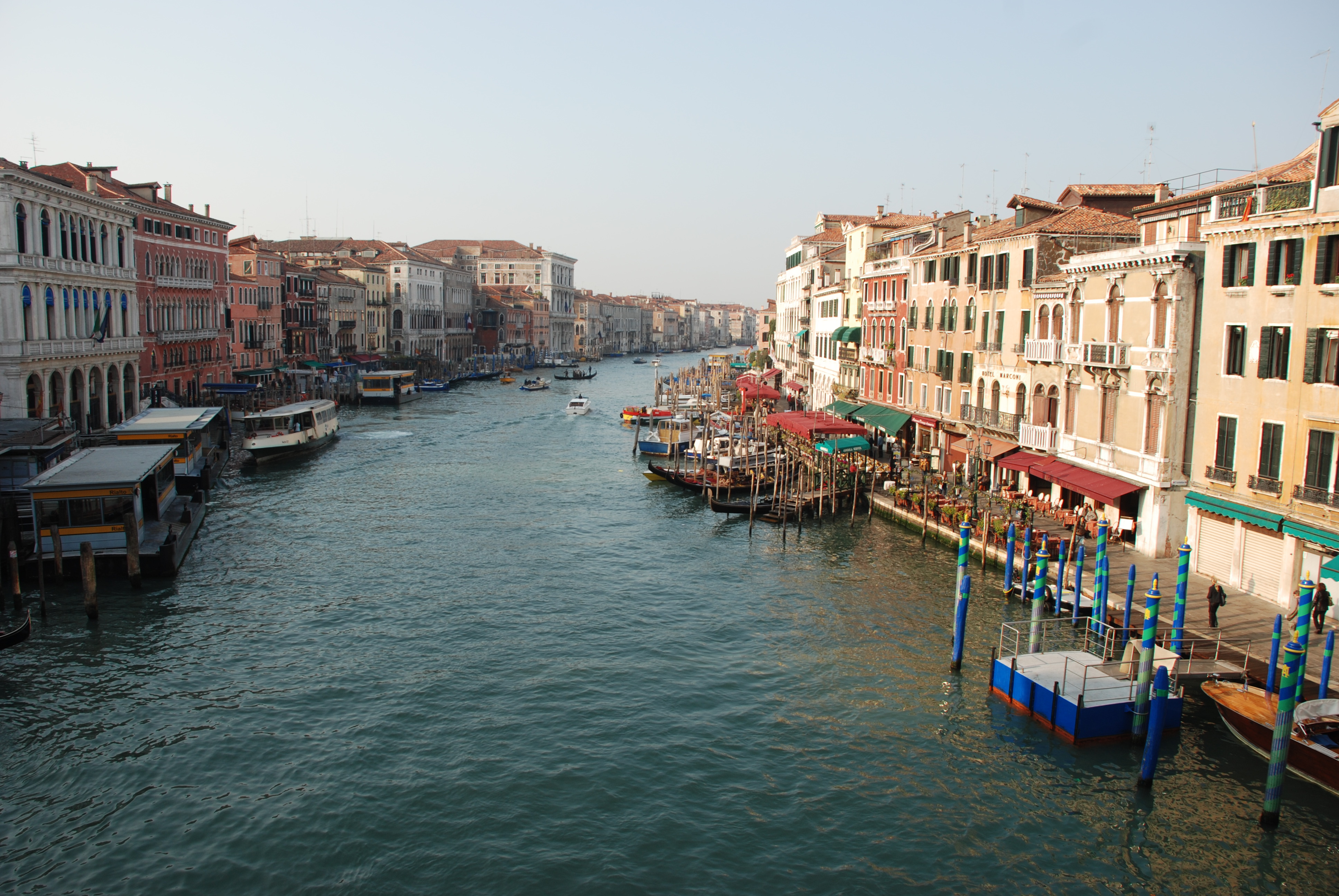
Venice is a network of islands joined together by an elaborate and
increasingly dated water-transportation system. The Grand Canal, the main
thoroughfare used originally by merchants on their way to and from the
markets of the Rialto, is serviced by a fleet of vaporetti (water buses) and
just four bridges—the newest of which was designed by Spanish architect
Santiago Calatrava and completed just last year.
Beware, the
vaporetti are costly, slow and very crowded.
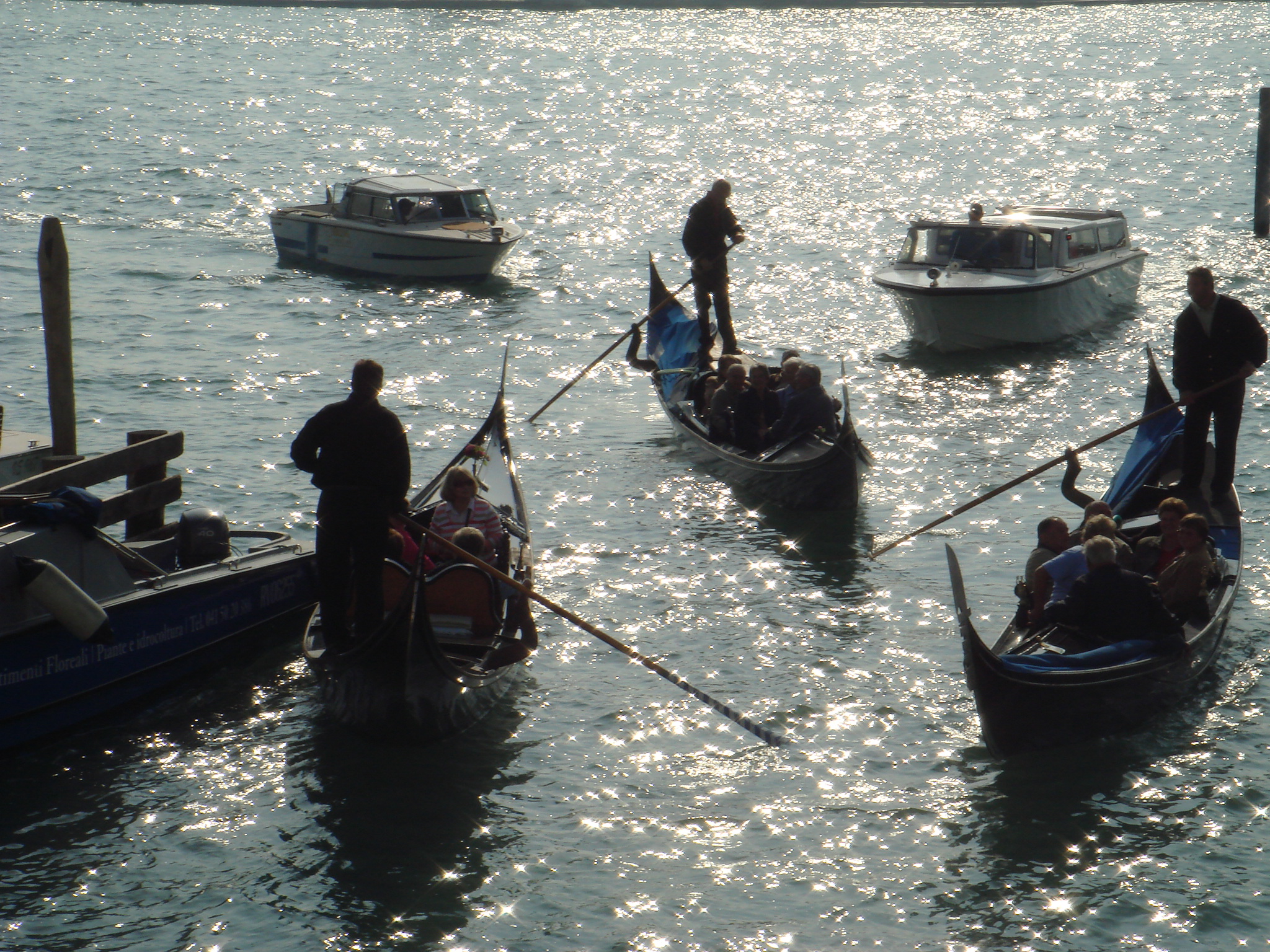
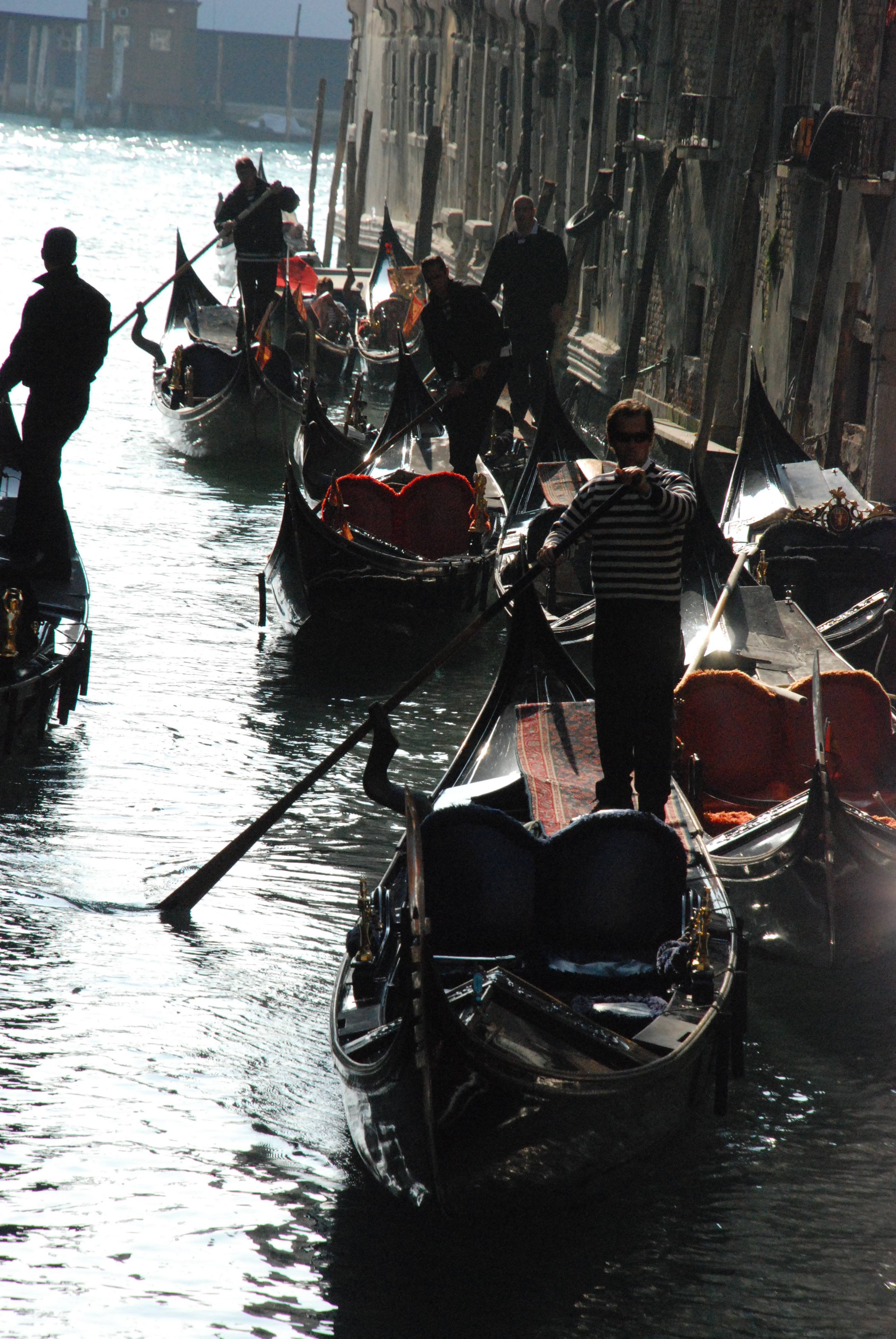
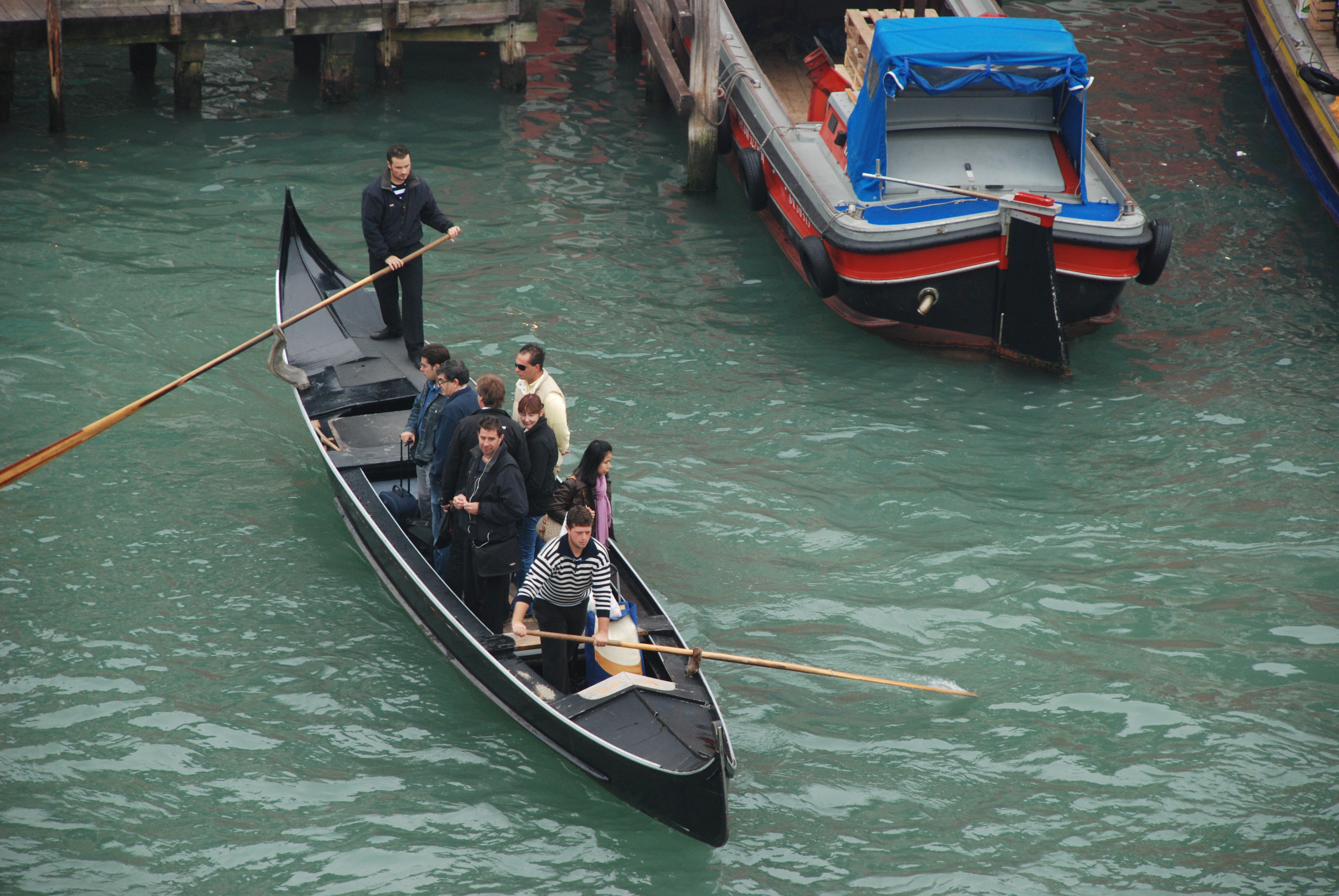
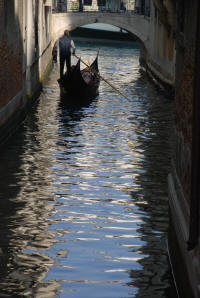
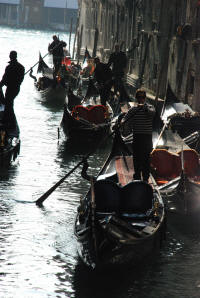
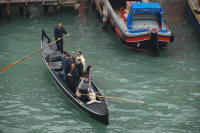
One nice way to
cross the canal is by traghetto ("ferry" in Italian): there are six of these
gondolier crossings along the Grand Canal. And each trip costs Euro 0.50. At
less than a dollar this is a bargain. Especially since 40 minutes in your
own decorated gondolier will cost at least Euro 80.
The service employs the same gondolas—stripped of the velvet seats and
solicitous gondoliers. And for your 50 cents you cross the canal in a
boat rowed by two gondoliers.
Each crossing takes only a few minutes (you just board the boat and pay one
of the gondoliers—preferably with exact change). But you are still dodging
among the traffic on the canal. And briefly you are of city life, visiting
the affordable bars and restaurants that the locals enjoy; the traghettos'
are the link that can take you there.
The Foscari Palace
hotel just north of Rialto is next to the Pescheria-Santa Sofia traghetto.
On the west side is the bustle and banter of the 1,000-year-old Rialto fish
market, housed in a neo-Gothic arcade. The market is not just fish; there
are fresh fruit and vegetables. It is busy and full of life.
Nearby is the
Cantina Do Mori, Venice's oldest bacaro, a typical wine bar that has served
local tradesmen since the 14th century. Good for a mid morning snack. Then
take the gondola at the Pescheria traghetto stop (near Ca' d'Oro).
Disembark in front
of the Santa Sofia church. There is more food and wine at the Osteria Al
Bomba, hidden at the end of a passageway to the right of the church. Typical
cicchetti (snacks) here include the Venetian sarde in saor (sardines with
onions and raisins), baccalà mantecato and polenta.
The Strada Nova is
wide and straight by Venice standards and spans almost the length of
Cannaregio. Beyond the Campo dei Santi Apostoli bridge is the exquisite
Santa Maria dei Miracoliel tucked away on its own between two bridges.
The Strada Nova
will take you toward the train station and you can cross the Ponte Guglie
bridge to Parco Savorgnan, a shady public park. It is tucked away behind the
Palazzo Venier, to your right, and is signposted from Campo San Geremia,
down the little street in front of the bridge.
Back across the
Cannaregio Canal, taking the Ponte Guglie again, to the Jewish Ghetto, the
origin of the term "ghetto," a formerly gated area where Venetian Jews were
confined until the arrival of Napoleon in 1797.
Now only about
one-third of Venice's roughly 1,000 Orthodox Jewish residents still live
there but the neighborhood remains their spiritual center, with two of five
historic synagogues still functioning.
Back near Rialto
it is a short walk to the next traghetto stop, Riva del Carbon, within sight
of the Rialto bridge. Here, take the boat across to the Fondamente del Vin
in the San Polo quarter.
You arrive in the
secluded Campo San Silvestro, a perfect example of the deserted little
piazzas that pop up unexpectedly as you turn a corner, seemingly into the
past. The shopping street Campiello dei Meloni take you back to Rialto.
Just get out and
walk and explore. Venice is very easy on the eye. And away from the tourist
crowds it has a happy pace and life. Even the few suits scurrying to work
seem to know the shopkeepers and always have time for another expresso.
Going backwards
in Bangkok
21 October 2008 Joshua Kurlantzick - The National Post - Canada
As Thailand disintegrates into scenes at the prime minister’s offices more
reminiscent of Animal House than Government House, average Thais could be
forgiven for not being able to follow every other news story. But this
month, one story about the news has received virtually no coverage. In the
last week of August, after nearly two decades, the Sunday Perspective
section of the Bangkok Post, the leading English newspaper, closed down
forever, to virtually no notice.
It shouldn’t have. In a society where the elites — the military, the
bureaucracy, the rich — long went unquestioned, Perspective, a tough
investigative reporting section, provided Thais with a service people in
other countries take for granted: questioning the powerful. It also happened
to be my first job — I was a cub reporter at Perspective just one year out
of university more than a decade ago. Sharing fresh mango with a grizzled
reporter, I realized for the first time how hard many of these men and
women, through their reporting, had fought for Thailand’s democracy — an
inspiration that convinced me journalism would become my career path. Today,
contacting an old friend from the section, I realized a sadder truth: While
the growth of Perspective showed how Thailand itself was building a
democracy, its demise reveals how that democracy has collapsed.
Arriving at Perspective, I was puzzled at how the section worked. As a cub
reporter, it was more than foreign to me: Rather than a room of people
banging away furiously at computers, as I’d expected, many reporters rarely
came to the office, which was a warren of desks. I’d see them in a nearby
dive restaurant, huddled in a smoky corner with someone I didn’t recognize,
and I quickly learned not to intrude.
I soon saw that these methods made sense. In a country where retribution
against writers could come in the form of a gun, rather than an angry denial
the next day, sources feared even talking to Perspective reporters, and
writers spent months cultivating key contacts. One Perspective reporter,
Supara Janchitfah, became a one-woman crusade, constantly travelling to
cover ever injustice against the Thai poor.
On trips to southern Thailand and other parts of the country, reporters
frequently were harassed. When I travelled to the Thai-Burmese border, just
a few weeks after I started work, to interview a rebel general, I had no
idea what I was in for. I volunteered for the trip with Ralph, a
hard-drinking older reporter. We drove for hours into the rural northwest of
the country, finally meeting our contact at a dive hotel in a small town.
Ralph stared around nervously, pointing out men in the hotel coffee shop he
believed were Burmese spies — which they well might have been. Finally, an
older Burmese refugee met us, and we piled into another truck, to be driven
in a crazy, circuitous route to the border, and a small house guarded by
heavily armed men. Inside, the rebel leader, Bo Mya, looked like a Southeast
Asian version of Jabba the Hut — a corpulent older man with a small court
around him, dispensing angry threats against the Burmese government, and
then stopping to pick at a row of snacks in front of him.
Back in Bangkok, several days later, I remember thinking, “I can’t believe
this is my first job.”
Beginning in the mid-1990s, just as Thailand began to build a democracy,
those methods still worked. Perspective reporters showed the Bangkok Post’s
readers a country beneath the false harmony and smiles: the environmental
disasters covered up by industry, the simmering separatist movement in the
south, the massive graft of the Thai political class and much more.
The payback came anyway. Reporters were constantly threatened. In the south,
Bankgok Post journalists were constantly on the move, fearing an attack at
any time from militants who knew they were in the area. Still, the section’s
middle-class readership, who’d fought like the reporters for democracy in
the 1990s, protected the staff, in a way. As long as Perspective remained
required reading among Bangkokians, it remained hard for the powerful to
damage the staff, and at the section we took this kind of unique protection
for granted.
In the streets of Bangkok today, those same middle-class people storm
Government House, wrap themselves in royal colours and protest in the
streets, claiming they are once again taking the country back for democracy
— even though, just as often, they are actually instigating fights with
police, which have left several dead on the streets of Bangkok in recent
weeks.
They’re not fighting for democracy, either. Thailand’s one-time democrats,
the people who once delved into Perspective each Sunday, have totally lost
their way. Since the first election of Thaksin Shinawatra as prime minister
in 2001, Thailand’s urban middle-class has forgotten the principles it stood
for. Though Thaksin was far from an angel — an autocratic egomaniac who
disdained the rule of law — he won two elections, using populist policies
and corralling the mass of rural voters who’d, until then, played little
role in Thailand’s new democracy.
Rather than responding to tough politics with tough, but effective,
democratic politics of their own, Bangkokians have fallen back on tired,
anti-democratic tactics. Instead of trying to help educate rural voters so
they, like Bangkokians, value clean politics and progressive platforms, too
many city-dwellers just disdain the rural masses, not realizing that these
elections were the democratic result of the blood they spilled before on
Bangkok’s streets.
Instead of trying to take the fight into parliament, Bangkokians storm the
streets and, in 2006, threw flowers on coup-makers, after Thailand’s army
launched a coup promising to return order and democracy to the country — the
coup was really initiated to take power away from Thaksin and return it to
the elites. Instead of fighting for Thai institutions, rival paper The
Nation welcomed the 2006 coup and then became little more than a Pravda for
the post-coup government.
A city that returns to entrenched ways of the past is a city that no longer
needs Perspective, since it is a city that no longer cares for reform — and
a sign of how a once-promising democracy has come unraveled. In recent
years, friends at Perspective told me, readership of the section had
declined. Top editors no longer really cared whether the paper invested time
and money pursuing long investigative pieces, because they knew few readers
really paid attention. And in truth, facing these pressures, the section
hemorrhaged staff and sometimes produced less impressive work, like printing
inspirational pieces about local business leaders.
Perspective’s writers will still find their bylines in the paper, but now
they’ll be jotting down news briefs, or covering the stocks. Readers can
still find tough stories, but they will have to look harder, perhaps to
online sites with less penchant for facts. And cub reporters might still
arrive at the Bangkok Post, which now looks like any newsroom with banks of
gleaming computer screens. They’ll learn to take quick notes, edit copy in
the newspaper style and work with page layout. But nothing more.
— Joshua Kurlantzick is a special correspondent for The New Republic and a
visiting scholar at the Carnegie Endowment for International Peace’s China
Program.
Bangkok on the edge
20 October 2008
Bangkok is
increasingly on edge with anti- and pro-government groups mobilising onto a
collision course. Three groups are already planning action - the
anti-government People's Alliance for Democracy (PAD), the pro-government
United Front of Democracy Against Dictatorship (UDD) and a group of police
supporters.
The PAD held a rally outside CentralWorld Plaza in Ratchaprasong today and
distributed VCDs and documents about the government's crackdown on its
supporters on October 7. The group then marched to police headquarters.
The PAD also plans to gather at the Supreme Court tomorrow to hear the
verdict in the Ratchadaphisek land case in which former prime minister
Thaksin and his wife, Khunying Potjaman, are the defendants.
UDD supporters and several progovernment movements from the Northeast and
the North also plan to gather at the Supreme Court tomorrow to hear the
verdict, the source said.
A source at the Supreme Court said clashes between supporters and opponents
of Mr Thaksin outside the court are a strong possibility unless measures are
taken to control the crowds.
On Wednesday, a mass merit-making ceremony will be held at the Royal Plaza,
organised by former deputy police chief Salang Bunnag. Many retired and
serving police officers are expected to take part in the ceremony.
The PAD wants the military to seize power and return it to civil society and
respected parties to form an interim government.
There have been rumours of a new coup since the leaders of the armed forces,
led by Army Commander Gen Anupong Paojinda, appeared on a television
programme on Thursday 16 October and called on Mr Somchai to take
responsibility for the Oct 7 clashes between police and protesters. The
military's move was perceived as a threat to stage a coup.
It also became
known as the TV coup and was probably the dullest prime time TV broadcast in
history. It also backed the military leaders into a corner. Prime Minister
Somchai has ignored the military and plans to continue as the elected
leader. So what do the military do now? They certainly raised the stakes in
their TV show where they were dressed in full military uniform.
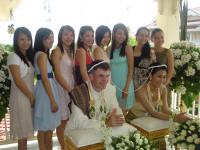
A Day to Remember
17 October 2008
More pictures and
some thoughts to follow. Enough for now to say that this was a wonderful,
wonderful day.
   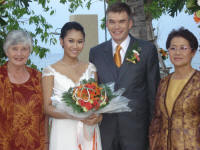
 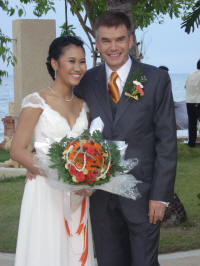  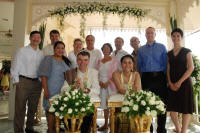
The bounce of a
ping-pong bomb
By Shawn W Crispin ASIA TIMES
15 October 2008
BANGKOK - Who was primarily responsible for the grisly violence which killed
two people, maimed many and injured hundreds of anti-government protesters
in the Thai capital on October 7? The answer to that question, now under
investigation by two government-appointed panels, could have a large impact
on the outcome of the country’s violently escalating political conflict -
and, as such, alter the course of Thai democracy.
One week after police fired tear-gas canisters to disperse a group of
People's Alliance for Democracy (PAD) protesters in front of parliament, the
history of those violent events is hotly contested, with each side blaming
the other for detonating improvised explosive devices, or so-called
ping-pong bombs, amid the fog of the government's crackdown.
Local newspapers last week were splattered with gory and graphic images of
bloodied protesters who lost limbs in the attacks' hazy early dawn
aftermath. A protester who had half of his leg completely severed was even
shown on state-controlled television. The mainstream Thai media have in the
main played up the PAD-perpetuated narrative that rogue police officers
likely threw the explosives, which killed two demonstrators and maimed an
estimated six others.
More significantly, army commander Anupong Paochinda demanded that Prime
Minister Somchai Wongsawat's government accept full responsibility for the
violence - the latest indication that under Anupong the military considers
itself independent of the elected government. That's raised speculation that
the military could eventually intervene and bump Somchai from power on the
grounds of protecting the Thai people from abusive politicians if the two
panels' findings unanimously pin the blame for the October 7 events to the
police.
All agree the police mishandled the crowd control operation by firing the
tear-gas canisters directly into rather than nearby the protesters. At the
same time, government officials have countered that there is compelling
evidence indicating the PAD itself may have triggered the low-grade
explosions, in a cynical ploy to generate public sympathy for their
anti-government cause, which includes a "new politics" bid to move towards
more appointed, and fewer elected, government representatives in parliament.
One official, who requested anonymity, believes the interpretation of events
so far represents a public relations failure. He pointed to lack of
attention to the still-unexplained explosion of a white Jeep Cherokee,
allegedly laden with bombs and owned by a prominent PAD supporter and police
lieutenant colonel, which exploded on October 7 near the PAD's main protest
site at Government House.
The official claims that if the police had lobbed grenades among protesters
the number of injuries would have been higher and that there would have been
noticeable craters left in the cement and evidence of shrapnel. He also
contends that widely circulated photos of injured protesters holding in
their hands some of the round unexploded devices were not published in the
mainstream Thai media.
Meanwhile, a recent online discussion at Pantip.com's Rajdamnern chat room
raised questions about perceived pro-PAD bias in the mainstream media's
coverage of events and posted pictures under "black propaganda" headings
that appear to corroborate the official's claim that certain protesters were
in possession of the mysterious devices.
One possible check and balance on the investigative panels could come from
the United States government. According to the same government official, a
US citizen was among the injured and required surgery after the October 7
assault. There is a precedent for the US Federal Bureau of Investigation
(FBI) to launch its own probe into attacks involving American nationals, as
the agency did this after a grenade attack that killed several during a
Khmer Nation Party rally in Cambodia in 1997.
Thriving on violence
For its part, the PAD has so far parlayed the violence to its political
advantage, stoking always close-to-the-surface popular resentment against
the Thai police and re-energizing the movement's popular support base, which
since the October 7 violence has seen a noticeable surge in its yellow-clad
numbers. PAD leaders have vowed to file criminal charges against the
government both in local and global courts.
Despite what many view as the protest movement's reactionary agenda, the PAD
has deftly mobilized the leftist symbolism of the 1970s' pro-democracy
movement - which likewise was violently suppressed by Thai police forces on
October 6, 1976 - to consolidate support among Thai progressives, academics,
students and non-governmental organizations.
The PAD's numbers had dwindled substantially after prime minister Samak
Sundaravej, previously the PAD's prime target for serving as a proxy for
ousted premier Thaksin Shinawatra, was disqualified from the premiership by
a Thai court for hosting and receiving payment for a television cooking
show. The PAD was also handed a popular rebuke when an opinion poll showed
around 70% of Bangkok residents supported the arrest on October 5 of protest
co-leader Chamlong Srimuang on treason charges.
What is clearer is that the PAD has abandoned its earlier claim to being a
non-violent movement. Three police officers were shot by PAD supporters near
parliament after protesters retook the building in the afternoon of October
7. That same day, another officer was run over and injured by a PAD
supporter driving a pick-up truck. The violence followed up the PAD's
commando-style assaults on government buildings on August 26, including an
apparent armed attack on a state-run television station.
A government official claims that as many as 1,000 off-duty military
officials are at any given time positioned at the PAD protest site and that
they had even recently established a grenade unit. Another military insider
says he has recently seen lieutenant colonels in charge of fighting units,
including from Chantaburi and Lopburi provinces, dressed as civilians at
recent PAD rallies. (PAD co-leader Sondhi Limthongkul denied in an ATol
interview last month that the PAD receives any military support and that his
movement is financed and organized by "the people". See What Sondhi really
wants for Thailand, Asia Times Online, September 9, 2008)
With or without military support, other important institutions have
seemingly lined up behind the PAD, including the political opposition
Democrat party, activist courts and, at least symbolically, members of the
royal family. The Administrative Court last week dropped treason-related
charges against the PAD's nine co-leaders, who surrendered to police to
contest lesser charges and were immediately released on bail.
Royal condolences
Meanwhile, at least two senior opposition Democrat party members double as
top PAD supporters and the party has echoed the PAD's calls for Somchai to
resign in the wake of the violence. Most significantly, Queen Sirikit and
Princess Chulaborn Valayalaksana on Monday presided over the funeral service
of a PAD protester who was killed during the October 7 melee. According to
the local press, the queen told the female victim's parents that she had
died a "protector" of the monarchy.
By law the Thai monarchy is above politics, but the highly revered queen's
presence was widely interpreted as at least tacit royal support for the
anti-government movement. One government supporter noted without comment
that royal family members did not attend the funeral service of a
pro-government demonstrator who was killed in street clashes on September 2.
If those interpretations hold true - and barring any investigative findings
which show irrefutably that the PAD was not only the victim but also the
perpetrator of the violence - then Somchai's days as premier are likely
numbered. Though not necessarily without a fight: over the weekend, tens of
thousands of red-clad pro-government supporters, known as the Democratic
Alliance Against Dictatorship (DAAD), convened in a show of force at
Bangkok's Sanam Luang park.
The group threatened to confront the PAD if it followed through on plans to
rally in front of the national police headquarters on Monday. Those plans
were put on hold after the PAD's leadership decided instead to direct their
supporters to the royally attended funeral service. That provided a
temporary reprieve, but the two groups are now mobilized and seemingly on a
collusion course. One government insider said the group plans to bring
off-duty border police and marines to fortify its ranks.
What happens next is altogether unclear. Some believe the Constitution Court
could rush through a decision on the Election Commission's recommendation to
dissolve Somchai's People's Power Party (PPP) and two coalition parties on
electoral fraud charges. The court agreed to hear the charges today and a
guilty verdict would at least temporarily defuse political tensions and set
the stage for new democratic polls.
Army commander Anupong has consistently ruled out the possibility of another
coup, but has simultaneously through his aloofness positioned the military
as a mediator of last resort. He refused to implement Samak's emergency
decree in early September and has repeatedly voiced his support for the
establishment of a national unity government, presumably including the
PAD-supporting Democrat party, to resolve the crisis.
If bigger clashes break out on Bangkok's streets, Anupong may have no choice
but to intervene and establish a national unity government by force. Indeed,
he may already be preparing, at least rhetorically, for that eventuality.
One military insider notes that content analysis of Anupong's recent
speeches reveals the number of times he mentions that the military are the
"people's soldiers" and not solely the protector of the state, religion and
monarchy. He believes that a possible scenario in which the military
professionally contains a clash between the PAD and DAAD could consolidate
Anupong's and the military's reputation as a "hero who saves the day".
Perhaps, but a public opinion poll in August showed that less than 5% of
Thais would support another military coup after the perceived misgovernance
that followed the 2006 intervention. That was before pro- and
anti-government groups first clashed on Bangkok's streets on September 2 and
the shocking images from the still-unexplained violence of October 7.
Popular sentiment could shift again, either against the PAD or government,
once the findings from the investigative panels are made public.
Some Thais feared have that a sort of civil war pitting competing political
groups with divergent visions for the country's future would break out after
the passing of King Bhumibol Adulyadej's long-stabilizing influence. That
those tensions have come to the fore while Bhumibol is still on the throne
provides some hope yet that Thailand will not slide completely into the
abyss.
Thailand's
urban rural divide
New York Times
- 15 October 2008
When he was a young man, Damneun Pangsopha worked for a while in a doll
factory in the big city, Bangkok, and he did not like it.
Sompap Bunnag, who lives in Khon Kaen city, was on his way to take part in
demonstrations in Bangkok, the capital.
“They think differently from the people here in Isaan,” he said, referring
to the rural heartland of Thailand’s northeast. “In Bangkok it’s all work
and pressure, work and pressure. Not like here, where life is slower. Fish
in the river, rice in the field.”
The rice is ripening now in Ban Huay Chan, about 250 miles northeast of
Bangkok. As the farmers wait for the harvest, they gather in the mornings to
pass the time, and they are angry.
“The people of Isaan are people, too,” said Mr. Damneun, 48, who is now a
farmer, as are most people here. “We also eat rice and we also have an
education, and they can’t insult us like this.”
The insult comes from the leaders of an antigovernment protest in Bangkok
who say rural voters are misguided and ignorant. In the hope of changing the
balance of political power, the protesters have put forward a reform plan
that would weaken rural voices.
Huge crowds have barricaded themselves into the compound of the prime
minister’s office in Bangkok for nearly seven weeks in what has become
Thailand’s most severe crisis in years, splitting the country along social,
economic and political lines. Last Thursday, one person was killed and more
than 400 were injured when demonstrators clashed with the police in clouds
of tear gas.
As the protesters see it, Mr. Damneun and rural people like him are the root
of the country’s problems. It is largely their vote — the biggest
constituency in Thailand — that has barred the political opposition from
power.
The proposed solution is to dilute the voice of rural voters by creating a
mostly appointed Parliament that might better represent the aspirations and
needs of a traditional urban middle-class elite.
“That’s not democracy,” said Sawai Marongrit, 56, a farmer. “They can’t win,
so they try to find another way to fight. Because if we have an election
they’ll lose again.”
The farmers who are gathered in the shade here in Khon Kaen Province swagger
a bit when they talk of their political clout.
In the last election, in December, the party that won the rural vote, the
People Power Party, took 233 of 480 seats in Parliament.
“If the Isaan people don’t vote for them, the Democrats will never have a
chance to win,” said Mr. Sawai, referring to the main opposition party.
To put it another way, Mr. Damneun said, “The only way they’ll ever win is
if all the people of Isaan drop dead.”
Thailand is sometimes described as two nations: Bangkok and everything else.
About 10 percent of the population of 65 million lives in Bangkok, the
capital, a number that expands by several million when migrant workers are
counted. Nearly a third of the Thai population lives in Isaan.
On election days, Bangkok’s taxi drivers, laborers, housekeepers, street
vendors and factory workers head home to Isaan to vote, draining the streets
of much of their life.
Wooed by populist programs like low-cost health care and cheap loans, the
rural poor came together in support of Thaksin Shinawatra, who transformed
Thai politics during six years as prime minister.
Mr. Thaksin was ousted in a coup in 2006 and is now in London, where he fled
to evade corruption cases. But the rural base he created remains solid, and
his supporters control the government.
“The people of Isaan and the poor people everywhere all like Thaksin,” said
Prasart Pangsopa, 54, who breeds cows and grows long beans and red chili as
well as rice.
The farmers here are one element in destabilizing social, economic and
political divisions that have become sharper and more emotional as the
Bangkok protests continue.
The protesters, calling themselves the People's Alliance for Democracy, are
a diverse mix of royalists, military officers, business owners, social
activists, students and middle-class homemakers whose common ground is a
passionate discontent with the state of the nation.
These passions showed themselves last week when doctors at a Bangkok
hospital said they would refuse to treat police officers wounded in the
clash with protesters.
Separately, a Thai Airways pilot refused to fly three members of Parliament
from the governing party last week, calling one a threat to national
security.
The anger runs the other way here in Ban Huay Chan, where the farmers spun
violent fantasies of mayhem against the protesters.
“If those people come here, I’ll beat them to death and throw them into the
river,” cried Noochen Sinkham, 67, as he squatted with a cleaver, chopping
bamboo. Everybody laughed, and Mr. Sawai, the farmer, declared: “I want the
police to throw a bomb into that demonstration. Let them die.”
The divide between rural and urban plays itself out here in Isaan, where
many people in Khon Kaen city support the People’s Alliance for Democracy
and disparage people like the farmers in Ban Huay Chan, nearly eight miles
to the north.
“It is impossible to change the way rural people vote,” said Achara
Chantasuwan, 53, a librarian who recently attended a live broadcast of the
Bangkok demonstration in Khon Kaen city’s central square.
“That’s why the P.A.D. wants to introduce the New Politics,” she said,
referring to the People’s Alliance for Democracy plan in which 70 percent of
seats in Parliament would be appointed by professional groups, while 30
percent would be elected by voters.
“They’ll have the right to vote, but it will not allow their vote to
dominate our country,” she said. “If we let people be like that we cannot
develop our country.”
But the ruptures run deeper than a clash between city and countryside, she
said. They are dividing friends, colleagues and families.
“Sometimes we condemn government actions, and the pro-Thaksin people are
very angry,” she said, speaking of her colleagues at the library. “They’ll
say, ‘No, no, no,’ and try to say we are wrong. My friend nearly hit me. She
was very angry.”
Sompap Bunnag, 62, a social worker, stopped at the screening for a few
minutes on his way to Bangkok to take part in the People’s Alliance for
Democracy demonstration. He said he would catch an overnight bus and join
the protest in the morning. In his hand he held a set of newly purchased
swimming goggles to protect his eyes in case the police used tear gas.
“I don’t know what’s going to happen,” he said. “I hope nothing happens.”
Open letter to
EK
13 October 2008
Flight 372 is a
morning departure to Bangkok; a flight of almost 6 hours.
In addition to
flying safely and more or less ontime there are some basic expectations for
anyone flying business class; one that we get fed a decent meal and we are
not expected to be washroom attendants.
I would also like
to have a job that gives me time to sit and quietly read the newspapers
while the passengers either watch tv or clean the washrooms. The flight
purser certainly did not appear to be having anything other than a very
restful flight.
If I was flying
morning flight to London I would enjoy a continental breakfast and then a
full lunch service and still arrive before lunchtime.
Instead I am
flying to Bangkok. I was up at 6am for my 7.10am car pick up. By the time we
are bussed to the airplane, which appears to be waiting in Upper Mirdiff, it
is 10am before we push back.
An hour into the
flight; still no food; but a drinks service.
When the food does
appear it is very average indeed. A small plate of perhaps five pieces of
fruit; nothing exotic. Some bread is served. It is an eternity before the
hot meals arrive. They are economy meals served on a plate!
Dessert is already
on the tray. That's it. In the back of the plane I would get to have some
cheese, some packaged dried fruit.
Wine is offered as
the hot meals are being finished. But they are never offered again. No one
walks around to offer a refill. When the cart comes back it is to clear the
trays.
And the coffee.
Disgraceful; muddy water. The same as EK serves in the back of the plane.
You can order a cappuccino or espresso. They are not offered to you. So you
will need to ask - or more accurately on this flight, beg.
That's it. That is
the service. Does it look like EK discriminates against its passengers to
Asia? Sadly yes. Older planes. Poorer service.
Curiously during
the flight I was reading about the business class service on Austrian
airlines. With an inflight chef and an estimated US$110 to US$130 spent on
food alone (excluding wine) I was envious !If this meal cost Emirates US$10
I would be surprised.
Yes the ICE
entertainment system is good; although the selection of movies is really
quite unimaginative and has the heavy handed middle eastern censorship.
The seats;
adequate. But the comparison would be to a Far Eastern airline's regional
business class; not a long haul.
The service; the
basics were done. Nothing more. My name; which is not a difficult one was
not used at all. But the feeling was that you have to ask for anything that
you wanted. It would not be offered to you.
I am cautions of
criticising Emirates; the reasons are obvious to any reader of this web
site. But I was disappointed by a poor flight at the start of a celebratory
week.
This government
will not last
11 October 2008
The current Thai
government will not last - and the sooner the political impasse is resolved
the sooner a Thai government can start to manage the impact on Thailand of
the world financial meltdown, which will surely affect Thailand just as
badly as any other export-dependent Asian economy.
The deadlock
between the government, still led by close allies of one-time Prime Minister
Thaksin Shinawatra, and its opponents, spearheaded by the well-funded
People's Alliance for Democracy protest movement, has been going on for
months.
It is actually a continuation of a political crisis that began two years
into Mr Thaksin's second term of office, in early 2006, when the hugely
profitable sale of his family's business empire sparked mass demonstrations,
which eventually led to the coup that forced him from power in September
that year.
Mr Thaksin's supporters, most of them in the rural north and north-east,
still see him as a champion who pushed through policies that made real
improvements to their lives. They felt robbed by the coup, and insulted by
the PAD protesters who say their votes for Mr Thaksin were bought. Last
night's taxi driver at BKK airport was forceful in his denouncement of the
PAD, from the moment that we got into the car !
Mr Thaksin's opponents still see him, even in exile, as a dangerous
politician of overreaching ambition, a man who used his wealth to
concentrate power in his hands, and who had a hidden republican agenda.
The PAD argues that the police used excessive force this week, and that the
government was being deliberately provocative in sending them in to clear
the protesters who had surrounded parliament. Thai websites are running
gruesome video clips showing horrific injuries. These, say the PAD, could
not have been caused by just teargas; the police must have been firing other
explosives as well, they say. The police were clumsy and uncontrolled; of
that there is little doubt.
But Bangkok's English media has little condemnation of the PAD's own
tactics: the construction of tyre-and-barbed-wire barricades to blockade MPs
inside parliament, the use of guns by some PAD supporters against the
police, video showing a PAD truck ploughing into a line of police then
reversing over the injured body of one officer.
This is
symptomatic of the growing gulf between Bangkok and rural Thailand. No one
asks where the PAD gets its very substantial funding. And Bangkok's media is
dismissive of Thailand's corrupt police force and of the new cabinet.
Prime Minister Somchai Wongsawat has appeared weak and indecisive in his
response to the violent events around parliament. Climbing over a fence to
escape from the PAD protesters is not the image of a successful PM.
No one expects this government to last long. But no one has an effective
solution. The greatest concern is that there is no obvious way out of the
deadlock.
In times past King Bhumibol Adulyadej has used his unrivalled moral
authority to settle such crises. There are many Thais who wish he would
intervene now.
But the 80-year-old monarch has said nothing. So little is seen or heard of
the king these days that it is impossible to guess what his thoughts are on
this crisis.
But his silence makes the prospect of a royally endorsed government of
national unity under an appointed prime minister - one possible solution
touted by some - more remote.
A military coup seems unlikely too, although in Thailand it can never be
ruled out. So far General Anupong Paochinda, the army commander, has sat on
the sidelines.
But another election would almost certainly lead to little change. So Mr
Somchai will keep going for now. But his cabinet is hopeless and helpless.
And the economy is about to tank.
And as Mr
Thaksin's brother-in-law it is widely assumed that he is working to protect
the exiled former prime minister and engineer his eventual return to
Thailand. Maybe that is the solution? It would make for a final showdown.
Dubai's
worrying debt levels
11 October 2008
Doubts are growing
about Dubai's mounting international debt load and its ability to fund its
ambitious growth strategy.
Dubai has been spending heavily on roads, a subway system and other
infrastructure projects to keep up with the city-state's explosive growth.
The government, through state-owned and state-controlled real-estate
developers, has embarked on a series of ambitious property projects aimed at
turning Dubai into a tourism and business destination. More were announced
at this week's Citiscape show.
Dubai doesn't have
big reserves of oil. Instead, it has been bankrolling much of its building
boom through international debt markets. With those all but shut these days,
analysts are warning of a slowdown if global markets don't free up soon.
Dubai is among the
most heavily indebted governments in the wealthy Persian Gulf. Standard &
Poor's estimated at the end of last year that Dubai government debt
represented 41.8% of its gross domestic product, compared with 22% in
Bahrain and 2.9% in Abu Dhabi.
While Dubai
doesn't have much oil, its economy is diversified and growing. But it hasn't
obtained a government-debt rating from international ratings agencies. A
rating might reassure debt investors somewhat that government assets and
revenue are sufficient to back up that borrowing.
Many analysts and
economists still argue that the chances of the government getting into
real trouble remain low. Most assume that next-door-neighbor Abu Dhabi, one
of the world's largest oil producers, would extend a lifeline.
There are other
headwinds buffeting Dubai, clouding the ability of the government and its
corporate entities to raise cash. Banks have tightened lending. Dubai's
red-hot real-estate market shows signs of cooling. Its stock markets have
fallen recently, wiping out billions of dollars of wealth among retail
investors and further constraining liquidity.
This crisis is
global and the Middle and Far East will be part of it.
The darker side
of Dubai
11 October 2008
It is only fair to
reprint this to show the other side of Dubai The side that is largely
ignored while we marvel at the growth of the city. Dubai has a social
hierarchy like no other I have ever seen.
The Guardian
10 October 2008
"The sun is
setting and its dying rays cast triangles of light on to the bodies of the
Indian workers. Two are washing themselves, scooping water from tubs in a
small yard next to the labour camp's toilets. Others queue for their turn.
One man stands stamping his feet in a bucket, turned into a human washing
machine. The heat is suffocating and the sandy wind whips our faces. The
sprinkles of water from men drying their clothes fall like welcome summer
rain.
All around, a city of labour camps stretches out in the middle of the
Arabian desert, a jumble of low, concrete barracks, corrugated iron,
chicken-mesh walls, barbed wire, scrap metal, empty paint cans, rusted
machinery and thousands of men with tired and gloomy faces.
I have left Dubai's spiralling towers, man-made islands and mega-malls
behind and driven through the desert to the outskirts of the neighbouring
city of Abu Dhabi. Turn right before the Zaha Hadid bridge, and a few
hundred metres takes you to the heart of Mousafah, a ghetto-like
neighbourhood of camps hidden away from the eyes of tourists. It is just one
of many areas around the Gulf set aside for an army of labourers building
the icons of architecture that are mushrooming all over the region.
Behind the showers, in a yard paved with metal sheets, a line of men stands
silently in front of grease-blackened pans, preparing their dinner. Sweat
rolls down their heads and necks, their soaked shirts stuck to their backs.
A heavy smell of spices and body odour fills the air.
Next to a heap of rubbish, a man holds a plate containing his meal: a few
chillies, an onion and three tomatoes, to be fried with spices and eaten
with a piece of bread.
In a neighbouring camp, a group of Pakistani workers from north and south
Waziristan sit exhaustedly sipping tea while one of them cooks outside. In
the middle of the cramped room in which 10 men sleep, one worker in a filthy
robe sits on the floor grinding garlic and onions with a mortar and pestle
while staring into the void.
Hamidullah, a thin Afghan from Maydan, a village on the outskirts of Kabul,
tells me: "I spent five years in Iran and one year here, and one year here
feels like 10 years. When I left Afghanistan I thought I would be back in a
few months, but now I don't know when I will be back." Another worker on a
bunk bed next to him adds: "He called his home yesterday and they told him
that three people from his village were killed in fighting. This is why we
are here."
Hamidullah earns around 450 dirhams (£70) a month as a construction worker.
How is life, I ask.
"What life? We have no life here. We are prisoners. We wake up at five,
arrive to work at seven and are back at the camp at nine in the evening, day
in and day out."
Outside in the yard, another man sits on a chair made of salvaged wood, in
front of a broken mirror, a plastic sheet wrapped around his neck, while the
camp barber trims his thick beard. Despite the air of misery, tonight is a
night of celebration. One of the men is back from a two-week break in his
home village in Pakistan, bringing with him a big sack of rice, and is
cooking pilau rice with meat. Rice is affordable at weekends only: already
wretched incomes have been eroded by the weak dollar and rising food prices.
"Life is worse now," one worker told me. "Before, we could get by on 140
dirhams [£22] a month; now we need 320 to 350."
The dozen or so men sit on newspapers advertising luxury watches, mobile
phones and high-rise towers. When three plastic trays arrive, filled with
yellowish rice and tiny cubes of meat, each offers the rare shreds of meat
to his neighbours.
All of these men are part of a huge scam that is helping the construction
boom in the Gulf. Like hundreds of thousands of migrant workers, they each
paid more than £1,000 to employment agents in India and Pakistan. They were
promised double the wages they are actually getting, plus plane tickets to
visit their families once a year, but none of the men in the room had
actually read their contract. Only two of them knew how to read.
"They lied to us," a worker with a long beard says. "They told us lies to
bring us here. Some of us sold their land; others took big loans to come and
work here."
Once they arrive in the United Arab Emirates, migrant workers are treated
little better than cattle, with no access to healthcare and many other basic
rights. The company that sponsors them holds on to their passports - and
often a month or two of their wages to make sure that they keep working. And
for this some will earn just 400 dirhams (£62) a month.
A group of construction engineers told me, with no apparent shame, that if a
worker becomes too ill to work he will be sent home after a few days. "They
are the cheapest commodity here. Steel, concrete, everything is up, but
workers are the same."
As they eat, the men talk more about their lives. "My shift is eight hours
and two overtime, but in reality we work 18 hours," one says. "The
supervisors treat us like animals. I don't know if the owners [of the
company] know."
"There is no war, and the police treat us well," another chips in, "but the
salary is not good."
"That man hasn't been home for four years," says Ahmad, the chef for the
night, pointing at a well-built young man. "He has no money to pay for the
flight."
A steel worker says he doesn't know who is supposed to pay for his ticket
back home. At the recruiting agency they told him it would be the
construction company - but he didn't get anything in writing.
One experienced worker with spectacles and a prayer cap on his head tells me
that things are much better than they used to be. Five years ago, when he
first came, the company gave him nothing. There was no air conditioning in
the room and sometimes no electricity. "Now, they give AC to each room and a
mattress for each worker."
Immigrant workers have no right to form unions, but that didn't stop strikes
and riots spreading across the region recently - something unheard of few
years ago. Elsewhere in Mousafah, I encounter one of the very few illegal
unions, where workers have established a form of underground insurance
scheme, based on the tribal structure back home. "When we come here," one
member of the scheme tells me, "we register with our tribal elders, and when
one of us is injured and is sent home, or dies, the elders collect 30
dirhams from each of us and send the money home to his family."
In a way, the men at Mousafah are the lucky ones. Down in the Diera quarter
of old Dubai, where many of the city's illegal workers live, 20 men are
often crammed into one small room.
UN agencies estimate that there are up to 300,000 illegal workers in the
emirates.
On another hot evening, hundreds of men congregate in filthy alleyways at
the end of a day's work, sipping tea and sitting on broken chairs. One man
rests his back on the handles of his pushcart, silently eating his dinner
next to a huge pile of garbage.
In one of the houses, a man is hanging his laundry over the kitchen sink, a
reeking smell coming from a nearby toilet. Next door, men lie on the floor.
They tell me they are all illegal and they are scared and that I have to
leave.
Outside, a fistfight breaks out between Pakistani workers and Sri Lankans.
The alleyways are dotted with sweatshops, where Indian men stay until late
at night, bending over small tables sewing on beads.
A couple of miles away, the slave market becomes more ugly. Outside a glitzy
hotel, with a marble and glass facade, dozens of prostitutes congregate
according to their ethnic groups: Asians to the right, next to them
Africans, and, on the left, blondes from the former Soviet Union. There are
some Arab women. Iranians, I am told, are in great demand. They charge much
higher prices and are found only in luxury hotels.
Like the rest of the Gulf region, Dubai and Abu Dhabi are being built by
expat workers. They are strictly segregated, and a hierarchy worthy of
previous centuries prevails.
At the top, floating around in their black or white robes, are the locals
with their oil money. Immaculate and pampered, they own everything. Outside
the "free zones", where the rules are looser, no one can start a business in
the UAE without a partner from the emirates, who often does nothing apart
from lending his name. No one can get a work permit without a local sponsor.
Under the locals come the western foreigners, the experts and advisers,
making double the salaries they make back home, all tax free. Beneath them
are the Arabs - Lebanese and Palestinians, Egyptians and Syrians. What
unites these groups is a mixture of pretension and racism.
"Unrealistic things happen to your mind when you come here," a Lebanese
woman who frequently visits Dubai tells me as she drives her new black SUV.
"Suddenly, you can make $5,000 [£2,800] a month. You can get credit so easy,
you buy the car of your dreams, you shop and you think it's a great bargain;
when you go to dinner, you go to a hotel ... nowhere else can you live like
this."
Down at the base of the pyramid are the labourers, waiters, hotel employees
and unskilled workers from India, Pakistan, Sri Lanka, Ethiopia, the
Philippines and beyond. They move deferentially around the huge malls,
cafes, bars and restaurants, bowing down and calling people sir and madam.
In the middle of the day, during the hottest hours, you can see them
sleeping in public gardens under trees, or on the marble floors of the Dubai
Mosque, on benches or pieces of cardboard on side streets. These are the
victims of the racism that is not only flourishing in the UAE but is
increasingly being exported to the rest of the Middle East. Sometimes it
reminds you of the American south in the 1930s.
One evening in Abu Dhabi, I have dinner with my friend Ali, a charming Iraqi
engineer whom I have known for two decades. After the meal, as his wife
serves saffron-flavoured tea, he pushes back his chair and lights a cigar.
We talk about stock markets, investment and the Middle East, and then the
issue of race comes up.
"We will never use the new metro if it's not segregated," he tells me,
referring to the state-of-the-art underground system being built in
neighbouring Dubai. "We will never sit next to Indians and Pakistanis with
their smell," his wife explains.
Not for the first time, I am told that while the immigrant workers are
living in appalling conditions, they would be even worse off back home - as
if poverty in one place can justify exploitation in the other.
"We need slaves," my friend says. "We need slaves to build monuments. Look
who built the pyramids - they were slaves."
Sharla Musabih, a human rights campaigner who runs the City of Hope shelter
for abused women, is familiar with such sentiments. "Once you get rich on
the back of the poor," she says, "it's not easy to let go of that lifestyle.
They are devaluing human beings," she says. "The workers might eat once a
day back home, but they have their family around them, they have respect.
They are not asking for a room in a hotel - all they are asking for is
respect for their humanity."
Towards the end of another day, on a fabulous sandy beach near the Dubai
marina, the waves wash calmly over the beautiful sand. A couple are
paragliding over the blue sea; on the new islands, gigantic concrete
structures stand like spaceships. As tourists laze on the beach, Filipino,
Indian and Pakistani workers, stand silently watching from a dune, cut off
from the holidaymakers by an invisible wall.
Behind them rise more brand-new towers.
"It's a Green Zone mentality," a young Arab working in IT tells me. "People
come to make money. They live in bubbles. They all want to make as much
money as possible and leave."
Back at the Mousafah camps, a Pakistani worker walks me through his
neighbourhood. On both sides of the dusty lane stand concrete barracks and
the familiar detritus: raw sewage, garbage, scrap metal. A man washes his
car, and in a cage chickens flutter up and down.
We enter one of the rooms, flip-flops piled by the door.
Inside, a steelworker gets a pile of papers from a plastic envelope and
shoves them into my lap. He is suing the company that employed him for
unpaid wages. "I've been going to court for three months, and every time I
go they tell me to come in two weeks." His friends nod their heads. "Last
time the [company] lawyer told me, 'I am in the law here - you will not get
anything."
Economically, Dubai has progressed a lot in the past 10 years, but socially
it has stayed behind," says Musabih. "Labour conditions are like America in
the 19th century - but that's not acceptable in the 21st century."
Killer coach
accident in Eastern Thailand
10 October 2008
At least 22 people
were killed and 27 injured Friday when a bus carrying university students
fell down a ravine in eastern Thailand, the public health ministry said.
The Thai tour bus was taking the students on a field trip.
The driver apparently lost control of the vehicle about 3am when it was
coming down a steep hill in Nadi district, Prachinburi province, 140
kilometres north-east of Bangkok, and it overturned after crashing into a
road guard up a dirt ramp.
The driver died in the crash along with 18 male and three female students
from Kaset Techno Khon Kaen University.
Prachinburi police chief Major General Sanchai Chaiamporn said police
suspected the driver had fallen asleep at the wheel.
British council
funds in deep freeze
9 October 2008
What on earth was
going on. While no one was watching British taxpayers money was being dumped
into Iceland's banks. And now the Brits are crying foul as Iceland's banking
industry collapses.
Gordon Brown, the
British prime minister is considering legal action. He should be seeking
action against the Icelandic government but against the clowns who invested
funds in this near banana republic.
Hundreds of
millions of pounds have invested by the UK's district and city councils in
collapsed Icelandic banks. This is taxpayer money. It should be better
managed. One authority alone - Kent County Council - has £50 million
deposited in troubled Landsbanki and its UK subsidiary Heritable, as well as
Glitnir Bank.
Dozens more, as well as Transport for London and the Metropolitan Police
Authority, have assets in the banks, estimated by the Tories to be worth in
excess of £1 billion. .
The Local Government Authority insisted councils had stuck to Whitehall
rules encouraging them to get the best return and to invest their money
across a number of financial institutions to spread risk. One local
authority, Brighton and Hove City Council, said it suspended transactions
with one Icelandic bank - Kaupthing Singer & Friedlander - about a year ago
amid concerns about the country's banks expanding too rapidly.
Local government finances are now at risk and people will be concerned about
their local services and council tax bills. The latest estimate is that 45
of the 400 councils in England and Wales it represents have deposits in the
affected banks.
Three outside
Views of the Thai Crisis...none of them good.
9 October 2008
Reuters: No end
in sight for divided, bloodied Thailand
BANGKOK (Reuters)
- The struggle for control of Thailand gets uglier with each round of street
violence, but three years after the foes of then-prime minister Thaksin
Shinawatra took up the fight, there is still no sign of a winner.
The only thing analysts agree is that the strife, which has meandered from
street protests in late 2005 to a military coup to elections and back to
street protests, is likely to drag on for months, if not years, and will not
end happily.
Such a forecast bodes ill for investors and the economy, which is likely to
remain rudderless at a time of slowing export growth, with government more
focused on survival than staving off the effects of the global financial
crisis.
Throughout, the conflict's basic structure has not changed.
On one side is Thaksin, a super-rich businessman from the north who redrew
the political map by courting rural voters to gain an unassailable mandate
that he then used to advance the interests of major companies, including
many of his own.
On the other are the traditional elites threatened by his meteoric rise
after the 1997 Asian crisis -- mainly the military, monarchy and
bureaucracy, but also the unions, academics who saw Thaksin as a corrupt
rights abuser, and the urban middle-class who resented their taxes being
used as his political war chest.
Each of these finds a voice in the People's Alliance for Democracy (PAD),
the street movement that has occupied the prime minister's compound since
August and which laid siege to parliament and fought running battles with
police on Tuesday.
Behind its round-the-clock railing against Thaksin and his brother-in-law
Somchai Wongsawat, the current Prime Minister, the PAD's aim is to rewrite
the constitution under the banner of "new politics" to reduce the clout of
the rural vote.
"They are not opposed to just individuals any more. They are opposed to the
entire system of one man, one vote," said Thitinan Pongsudhirak of Bangkok's
Chulalongkorn University said. "That's the bottom line. It's a
sophisticated, protracted power grab."
WHO'S IN CHARGE?
Whether they pull it off remains to be seen.
Even if Somchai's days are numbered, as most analysts agree they are, and
even if his party is dissolved for electoral fraud, as most analysts agree
it will be, the fact remains that rural voters will always return another
broadly pro-Thaksin government.
And as long as the PAD refuses to accept election results it does not like,
the ballot box will only defer the crisis, rather than end it, said
political analyst Giles Ungphakorn.
"I can't see this being solved very quickly because the PAD are certainly
never going to compromise," he said. "But the government can't just give in.
They also feel they have the backing of the electorate.
"It's a very strange situation whereby the police, military intelligence,
all sorts of people, don't know what to do. They don't know who's going to
be the master," he said.
The PAD's main tactic appears to be create anarchy in Bangkok to the point
that it triggers extra-constitutional intervention either by revered King
Bhumibol Adulyadej or the military.
Chastened by its wretched performance after the 2006 coup and well aware of
the enormity of Thailand's social rift, the army is loathe to march into
politics again and has repeatedly stressed its neutrality.
KING "IN THE MIDDLE"
Which leaves the king -- officially above politics but who by his own
admission has been "in the middle, and working in every field" during his 62
years on the throne.
It is hard to know exactly how supportive he is of the PAD, but the movement
constantly invokes the royal family, in particular Queen Sirikit, who is
venerated in a huge shrine at the gates to its Government House protest
headquarters.
"We, ladies and gentlemen, are the musketeers of the king and queen," PAD
leader Sonthi Limthongkul told supporters on Tuesday, trumpeting a 100,000
baht ($2,900) donation from the queen to injured protesters as evidence of
her explicit backing.
Yet the PAD could be playing with fire by sucking the royal family into a
high-stakes political fight at a critical juncture for the Chakri dynasty --
the twilight of the reign of Bhumibol, now 80 years old and in declining
health.
Crown Prince Vajiralongkorn's skills as a behind-the-scenes political
arbiter are untested, and he will struggle to earn the respect accorded his
father, seen as semi-divine by many.
"What happens after the current king leaves the scene could be the most
wrenching crisis yet," Thitinan said in a paper to be published this week in
the U.S.-based Journal of Democracy.
"All bets are off when the current royal twilight finally fades to full
darkness."
Wall Street
Journal - Thailand in Turmoil
Two years after
the Thai military ousted then-Prime Minister Thaksin Shinawatra, the full
cost of that bloodless coup is finally becoming clear. Violent
antigovernment protests this week have left two people dead, 443 injured,
and the country's democratic prospects in jeopardy.
The struggle is over whether Thai citizens will continue to enjoy their
democratic rights. The protesters, who seek to oust the current government,
have brought the government to near paralysis. The cast of characters is
similar to 2006: Seven months ago the same group that had helped organize
protests to oust Mr. Thaksin re-formed, led by a similar coterie of Bangkok
elites, businessmen and academics.
They now call themselves the People's Alliance for Democracy, but they are
anything but. Their goal is to eliminate Thailand's one-man-one-vote
democracy and replace it with a parliament that is 30% elected and 70%
appointed. Why? To make sure that no one like Mr. Thaksin is ever elected
again.
The generals behind the 2006 coup thought that by simply removing Mr.
Thaksin they could solve what they saw as the problem of Thailand's
democracy: The fact that voters might choose to elect someone whom the
generals and their friends in Bangkok didn't like. But when they organized
elections in December, at the end of their 15-month stint as caretakers, the
People Power Party, political heirs to Mr. Thaksin's party, was the victor.
Mr. Thaksin, who had been in exile, jetted back to Bangkok.
The PPP may not be perfect, but it has a mandate from the voters. A
vote-buying case against the PPP and two smaller parties will be brought to
court next week, and a guilty verdict could force the PPP to dissolve. Until
then, it remains the popularly elected government.
The PAD, in contrast, wishes to rewrite the constitution to get rid of the
one-man-one-vote principle. And since it cannot win at the ballot box, it is
hoping to win in a street fight instead. For the past six weeks, PAD
supporters have besieged Government House, demanding that the PPP government
step down.
After two PAD leaders were arrested over the weekend, 1,500 PAD supporters
blockaded Parliament House while parliament was in session. The ensuing
melee left hundreds wounded. The newly appointed prime minister, Somchai
Wongsawat (who is Mr. Thaksin's brother-in-law), had to scale a wall and
dive into a military helicopter to escape the mayhem. Thai police eventually
cleared the way for the other politicians using tear gas, rubber bullets and
stun grenades to dispel the crowd, according to the Associated Press. By
yesterday the situation had calmed.
The PAD is crying foul over the measures employed by what they call a
"killer" government. But they themselves operate like a small army: Several
PAD supporters were carrying guns during the street battle on Tuesday, and
others had iron rods, slingshots, spears, etc. One policeman was impaled,
and two were shot.
These are not merely disgruntled citizens: The PAD is a well funded, highly
organized force that operates a small city inside the government compound it
has occupied for more than a month. The occupiers have electricity from
generators, a constant supply of free food and water, and even portable
toilets.
Facing these circumstances, Mr. Somchai doesn't have any good options.
Dialogue with the PAD may be all but impossible after the violence this
week. He could call a state of emergency, which would give more power to the
military and police to enforce law and order, although that could turn out
to be embarrassing if they didn't follow orders. A third option is to form a
unity government and share governing powers with the opposition Democrat
Party, albeit at the risk of looking weak. He could also hunker down and
wait for the PAD to wear out -- although this could take a long time, seeing
as the PAD is constantly rotating in new "protesters" from the countryside.
Meanwhile, the PAD continues its occupation of Government House. Pipop
Thongchai, a PAD leader, told reporters, "We will continue to fight until
Somchai resigns."
Thailand's democracy has weathered many blows, including three coups since
1973. The peaceful transition of power to the PPP after polls that were
largely fair and free was a step forward. If the PAD succeeds in overturning
those elections, it will be at the cost of disenfranchising millions of
voters -- and at a cost to Thailand's struggling democracy.
The Economist -
Blood on the Streets
IT HAS seemed
likely, especially since it seized Government House in Bangkok two months
ago, that the anti-government People’s Alliance for Democracy (PAD) wants to
provoke a violent confrontation that would prompt the army to stage another
coup. This would achieve what the PAD’s protests had not: the removal from
power of the elected administration led by supporters of Thaksin Shinawatra,
the prime minister toppled in a 2006 coup.
Last month the PAD clashed with pro-Thaksin protesters. The government
declared an emergency in the capital, asking the army to take charge of
security. But the army chief, General Anupong Paochinda, did nothing. On
October 7th worse violence erupted. Two people were killed and hundreds
injured as police fought to stop the PAD blockading the parliament building.
This time General Anupong said his troops would help the police keep the
peace. So, no coup—not yet, anyway.
However, nor was there any sign by mid-week that the security forces were
ready to deal decisively with the protesters and end the occupation of
Government House. Two PAD leaders, Chamlong Srimuang and Chaiwat Sinsuwong,
were arrested a few days before the latest clashes. The courts later watered
down the “treason” charges the PAD leaders face. This might encourage the
others to report to police—but not necessarily end the siege.
The fighting began as the PAD tried to stop the new prime minister, Somchai
Wongsawat (Mr Thaksin’s brother-in-law), from convening parliament to make a
policy statement. At daybreak police fired tear-gas to clear protesters and
let members enter. In the ensuing fighting, several protesters lost limbs in
explosions whose causes were unclear. Either side may have used small bombs.
A PAD supporter died in a car that exploded at the offices of one of the
parties in the ruling coalition.
Within hours, as casualties streamed into hospitals, the deputy prime
minister, Chavalit Yongchaiyudh, a former general and prime minister who had
recently joined the government to mediate with the PAD, resigned to take
responsibility for the disorder. The PAD talked as if it were all the fault
of a brutal police force. But its members also shot police with handguns and
stabbed them with sharpened poles.
Queen Sirikit, wife of the revered King Bhumibol, let it be known that she
was “very worried” about the police’s use of tear-gas and was paying for the
injured demonstrators’ treatment. The PAD trumpeted this as evidence of
royal backing for their cause. It was then announced that the queen had
donated money to the police hospital, to treat injured officers.
The king has remained silent. He intervened publicly in past episodes of
political violence, such as in 1992 when a military government ordered
troops to shoot pro-democracy protesters (led by Mr Chamlong). A former
senior official with close royal ties laments that nobody in the palace
seems to be seeking solutions to a crisis that threatens to make the kingdom
ungovernable. Mr Somchai recently met Prem Tinsulanonda, the king’s chief
adviser and, it is widely assumed, the driving force behind the 2006 coup,
but to little effect.
The PAD dresses in royal yellow and alternates between spewing ferociously
nationalist-monarchist rhetoric and affecting the slogans of a leftish
“people power” revolution. Its footsoldiers, those getting maimed in the
current violence, include many genuine liberals, disgusted at the corruption
and human-rights abuses under Mr Thaksin’s government. Some PAD leaders are
former progressives who have bought into “royal liberalism”, the idea that a
powerful crown can act as a check on rapacious politicians. But its prime
movers are reactionaries seeking a return to rule by the traditional elites
under the figleaf of a partly elected parliament.
They argue that Thailand’s rural majority, who voted to bring back the
Thaksinites last December after a year of incompetent army rule, are “ill
educated” and too easily have their votes bought. But Mr Thaksin’s was the
first Thai government to offer coherent policies, such as cheap health care,
to improve their lives. This seems to have inclined them to overlook its
many failings in other areas.
Many dangers lie ahead. The army is divided and a coup by middle-ranking
officers, pro- or anti-Thaksin, is conceivable. Or the pro-Thaksin protest
groups, which sprang up after the 2006 coup, could lose patience with the
failure to curb the PAD’s excesses, and return to the streets.
The Democrats, the parliamentary opposition, have wavered between
encouraging the PAD and seeking a compromise with the government on the
controversial issue of reforming the army-backed 2007 constitution. There is
talk of a national-unity government but presumably it would have a majority
of Thaksinites and so still be rejected by the PAD. The courts, supposedly
cleaning up political sleaze, are making things worse with disproportionate
decisions, such as the disqualification of Samak Sundaravej, Mr Somchai’s
short-lived predecessor as prime minister, for moonlighting as a television
chef.
After this week’s violence Thai Airways suspended a pilot who refused to
carry parliamentarians from the ruling party on his plane. It also cut some
international flights. The national tourist board, alarmed by the slump in
bookings, has been flying in foreign journalists to show that the country is
safe for foreigners. It probably is, so far. But with the chaos unchecked,
the question is how safe it is for Thais.
Thais behaving badly
8 October 2008
Two separate
professions at the heart of Thailand have taken action today to raise their
own protests against Tuesday's police actions in Bangkok. In doing so they
raise significant questions about their own professionalism and maturity,
A group of doctors
has vowed not to treat any policeman or soldier injured during clashes with
People's Alliance for Democracy (PAD) demonstrators. Several hospitals and
the Medical Council, however, were quick to point out that doctors are
ethically required to treat every one, without any discrimination.
Dr Sutep Gonlachanvit, who works at Chulalongkorn Hospital announced that
the hospital would not treat policemen and soldiers who clashed with the
PAD, said: "Many doctors, nurses and resident doctors from eight medical
schools have agreed to this measure. It's a social gesture to show that we
can't accept what the government and police have done."
He said the measure to not treat policemen and soldiers is not too harsh
given the excessive force used against PAD demonstrators.
"There are deaths and losses of limbs. Still, Prime Minister Somchai
Wongsawat does not show any responsibility," Sutep said. He said his group
members would treat the policemen and soldiers again only after they take
responsibility for what had happened.
Whatever happened
to the Hippocratic oath? Doctors have a professional duty of care. And that
care extends to people from all walks of life including a police force who
were simply doing the job they had been instructed to do.
Meanwhile national
flag carrier Thai Airways (THAI) has temporarily suspended a pilot who
refused to allow three Members of Parliament from the ruling People Power
Party (PPP) to board his flights Wednesday morning.
The pilot was upset with Tuesday's street violence in Bangkok and held that
the government members of parliament should not be permitted to fly. Forget
that these are democratically elected members of parliament and also fee
paying passengers.
Surin member of parliament Farida Sulaiman and two other government MPs met
the press Wednesday afternoon. Ms. Farida said she was about to board a THAI
flight from Don Mueang Airport to Khon Kaen at 6am.
She said the pilot for the flight challenged her, asking if she was an MP
from the government (PPP) party. Answering 'Yes', she was astonished to hear
the captain state 'THAI Airways does not welcome PPP MPs.'
MP Farida insisted on boarding the flight, stating her right as a passenger,
but the pilot, later identified as Chakkri Pongsiri, denied her entry into
the plane.
Hours later two other government party members of the House of
Representatives, Nongbua Lamphu MP Chaiya Promma and Nong Khai NP Chompoo
Chanthathong, were refused permission to board a THAI flight to Udon Thani.
The rejected MPs said they were informed by THAI ground staff that the pilot
disallowed them from boarding the aircraft "as they worked for 'tyranny'".
The MPs later learned of the incident with MP Farida.
In a poor attempt to defend the undefensible THAI labour union
president Chamsri Sukchoterat said the captain of any flight has the legal
right to reject passengers whom he believes would cause trouble. She added
that the captain could also refuse a passenger if he felt other passengers'
safety was at risk.
THAI vice president Norahuch Ployyai then had to tell a press conference
that the company apologised for the incidents and has begun an investigation
of Captain Chakkri's actions to determine if they inconsistent with pilot's
regulations and professional ethics. That should not be a very long
investigation.
The THAI executive said that after the incident company executives met with
its pilots, cabin crews and ground staff asking them not to repeat such
actions, and that all passengers have a right to service as patrons.
Montree Jumrieng, who heads THAI's human resources and general management,
said the pilot has been suspended from duty while the investigation is
underway, and that disciplinary action will be taken against him if he is
found to have violated company regulations.
Qantas mishaps
continue
8 October 2008
As Qantas has yet
another accident prone flight it is beginning to look more like a systematic
failure of maintenance and preventive checks rather than just a bad dose of
lady luck.
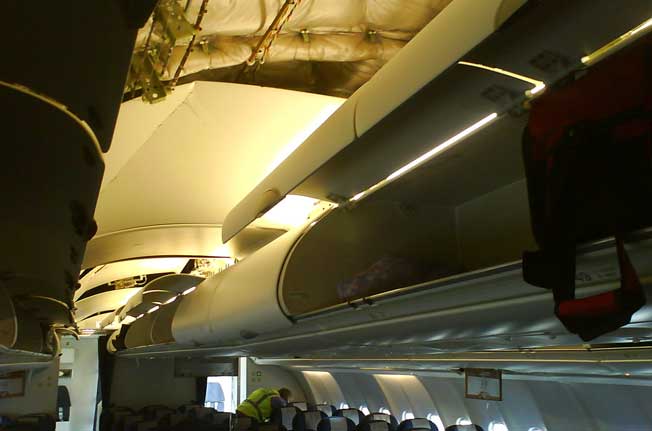
Air safety
investigators say there was an "irregularity" in the on-board computer
equipment of a Qantas plane involved in today's mid-air incident between
Singapore and Perth.
The Airbus A330-300, with 303 passengers and a crew of 10, struck what the
airline described as a "sudden change in altitude" north of its destination
yesterday.
The plane landed at Learmonth, about 40 kilometres from Exmouth in NW
Australia, without any further incidents.
West Australian police said at least 20 passengers and crew aboard QF72 were
seriously injured - some with spinal injuries and others with broken bones
and lacerations.
Two Australian Transport Safety Bureau investigators are on the ground at
Learmonth and five more are expected to arrive there later today.
The bureau's director of aviation safety investigation, Julian Walshe, said
the plane was travelling at 37,000 feet and 110 miles (177 kilometres) north
of Carnarvon when the incident occurred.
"The pilots received electronic centralised aircraft monitoring messages in
the cockpit relating to some irregularity with the aircraft's elevator
control system," he told reporters in Canberra.
The aircraft then "departed level flight", and climbed approximately 300
feet. "The crew had initiated the non-normal checklist response actions. The
aircraft is then reported to have abruptly pitched nose down."
A number of passengers, cabin crew and loose objects were thrown about the
aircraft cabin, primarily in the rear of the aircraft, resulting in a number
of injuries to some cabin crew and passengers, Mr Walshe said. It was by all
accounts pretty bad; some passengers who were not wearing seatbelts flew
into the air, some hitting the ceiling of the plane.
Keith Burns, from Lancashire, said: "It was like a hurricane inside ... like
a war zone. All of a sudden it dropped like a brick, a lead balloon and then
it levelled off again and a couple seconds later it fell again.
"There were screams and all the interior was breaking all over the place,"
he said.
The crew made an emergency broadcast to air traffic control, reporting that
some people had been injured. The injuries were serious enough to require an
emergency landing at Learmonth.
The plane landed at Learmonth about 3.30pm local time, approximately 40
minutes after the event.
The bureau understands 14 people with serious, but not life-threatening,
injuries including concussion and broken bones, were taken by air ambulance
to Perth, Mr Walshe said.
Thirty other passengers were taken to hospital for concussion, minor
lacerations and fractures. Another 30 people with minor bruises and stiff
necks did not require hospital treatment.
Qantas' A330-300
remains in Learmonth because the ATSB is inspecting it, says the airline.
The airline's CEO, Geoff Dixon, says the carrier is assisting with the
investigation and the aircraft's flight data recorders and cockpit voice
recorders have been removed and will undergo assessment.
Tense stand-off in Thai capital
8 October 2008
Troops are on the streets of Bangkok after its worst anti-government
protests for 16 years left at least two dead and hundreds injured.
PAD demonstrators had set up a blockade outside the parliament building,
which Prime Minister Somchai Wongsawat escaped by climbing over a fence.
The activists were trying to stop the inauguration of a government they say
is run by ousted PM Thaksin Shinawatra.
The appearance of troops outside parliament is a clear sign that the
government is struggling to maintain its authority.
The demonstrators - from the staunchly royalist People's Alliance for
Democracy (PAD) - have been occupying the grounds of government buildings
for weeks, but until Tuesday their demonstration had been largely peaceful.
But yesterday several thousand protesters left the compound where they had
been staying and marched to the parliament.
They tried to seal off the building by putting up barriers of old tyres and
barbed wire.
Police fired volleys of tear gas in an unsuccessful attempt to disperse the
demonstrators and many people, estimates vary between 200 and 400, were
injured in ensuing clashes.
The protesters later regrouped, locking some lawmakers inside the building
and cutting off the power supply.
Amid the worst street violence since pro-democracy activists challenged
Thailand's army in 1992, one person was killed when a suspected car bomb
exploded outside the building. A woman also later died, reportedly of chest
wounds.
Troops were eventually brought in to help the police and, as army commanders
took pains to ensure the public there would be no coup, most protesters
pulled back to their camp in Government House. There is an uncertain calm on
Wednesday morning.
The violence prompted the resignation of Deputy Prime Minister Chavalit
Yongchaiyudh, the government's chief negotiator with the PAD, who said
police had failed to exercise the restraint he had requested.
The PAD wants to replace the one-man, one-vote system with one in which the
majority of representatives are chosen by professions and social groups
rather than the general electorate.
Mr Thaksin, Mr Somchai's brother-in-law, was forced from office in a
military coup in 2006. The alliance says the government must resign because
of its links to Mr Thaksin, who lives in the UK and has requested political
asylum there. It accuses him of corruption and abuse of power while he was
in office.
It has also suggested that Mr Thaksin and his allies have a hidden
republican agenda, a serious charge at a time when the country is beset by
anxiety over the future of the monarchy.
Thailand’s Establishment Supports Chaos
Hard hitting analysis by Giles Ji Unphakorn in the
Asia Sentinel
07 October 2008
"Since late in the evening of October 6, the ultra right-wing mob that calls
itself the People’s Alliance for Democracy has laid plans to lay siege to
the Thai parliament.
They came prepared with iron bars and crash helmets.
Their plan, as always, was to create chaos in the hope that the military
would stage a coup or that the ruling party would once again be dissolved by
the courts. Their claim is that the present government led by the Peoples
Power Party or PPP -- ex-Premier Thaksin Shinawatra's Thai Rak Thai in
another name-- is illegitimate.
The PPP and the previous Thai Rak Thai have consistently won large
majorities in elections, proving that they are popular with the poor, who
make up the majority of the population. This support from the poor is not
surprising, since the party was the first elite party in 30 years to offer a
universal health care scheme and public funds to develop the rural economy.
The PAD's claim that the government is somehow "illegitimate" is based on
the belief that the poor do not deserve the right to vote because they are
too stupid. This belief is shared by the opposition Democrat Party, which
supported the 2006 military coup and is now supporting the actions of the
PAD by boycotting parliament. Previously the Democrats boycotted the 2006
elections because they knew that the poor would not vote for their
monetarist and neo-liberal policies. The Democrats when in office set police
dogs on peaceful protestors from the Assembly of the Poor. That protest was
nothing like the PAD riots of the past few weeks. The Democrats also used
public funds to bail out the banks in the 1997 crisis. The poor were told to
fend for themselves.
The PAD is calling for the defense of the military constitution of 2007,
which has already restricted the electorate's right to vote for the Senate.
They want to bring about a Suharto-style "New Order", in which only half of
the parliament will be elected and the Prime Minister need not be an elected
MP.
On the morning of the 7th October, the police cleared one side of parliament
using tear gas. This was to allow MPs to enter the building. The police made
it clear that the PAD would continue to be allowed to protest outside the
other entrance to parliament. However, the PAD responded by attacking the
police with sharpened flag poles, homemade guns and their own tear gas
grenades. In any other parliamentary democracy, the PAD leaders and their
rioting supporters would have been arrested. They have been illegally
occupying Government House for over a month. Yet the police have been told
to "lay off the protestors" by people in high places.
Every public institution and organization in Thailand is now compromised by
this inter-elite conflict and the losers, as usual, are the poor: workers
and small farmers. The monarchy has failed to defuse the situation. The
queen has openly sided with the PAD mob. The courts are practicing double
standards, attacking Thaksin and Thai Rak Thai/People’s Power Party
corruption while ignoring illegal coups, mob violence and corruption by
opposition politicians and the military.
The military as always is on the side of the conservative royalists. The
police are unable to act and the government lurches from crisis to crisis.
The majority of academia is hopelessly compromised by its support for the
coup and their support for decreasing the democratic space. Democratic
principles have been thrown out the window by professors who teach
"democratization" and the need for "the rule of law."
Even the People’s Movement has shown itself not to be up to the job. Instead
of building an independent political position at the side of the poor and
oppressed, sections of the NGO movement supported the coup, the military
constitution and the PAD. Rosana Tositrakul, the so-called NGO Senator,
elected from Bangkok, has joined into ultranationalist fanaticism,
especially over the ancient Khmer temple on the border with Cambodia that
was almost conflated into a border skirmish.
These people must bear responsibility for the recent injuries of both Thai
and Cambodian troops in a needless border dispute. Rosana also disrupted
parliament today, working with military-appointed senators. She believes
that the poor are too stupid to be allowed to vote. Yet all these people
bang on about the need for "good governance" and "accountability". Who are
they themselves accountable to?
The Thai economy is facing the full force of the global economic meltdown.
It needs measures to protect the poor, income redistribution and a welfare
state and peace for the three southern provinces. Thaksin and his top
military men should have been clapped into prison long ago over human rights
abuses in the south and the so-called War on Drugs, in which hundreds of
people, many of them innocent, were killed.
Yet this is never mentioned and Thaksin and his wife are seeking asylum in
Britain while poor people from all over the world are sent home to die by
the British government.
We need to reform society to bring about progressive changes. This means
expanding democracy, not allowing Thailand to slide back into the dark ages
of dictatorship. But the task will only take place by forces in the Peoples'
Movement – the left, the NGO networks, social movements and trade unions
coming together to outline our own reform strategy. We cannot rely on the
corrupt human-rights abusers in the government, nor the fascists of the PAD
and their allies to achieve these aims."
PAD siege broken
7 October 2008
Riot police
launched a surprise tear-gas raid Tuesday morning to break up a siege and
tear down barricades at parliament erected up overnight by supporters of the
People's Alliance for Democracy (PAD).
At around 6.20am, the PAD protesters retreated as unarmed police with
shields and face masks moved through the barbed-wire barricades on Sukhothai
and Rachavithi roads and tore them down.
Several people, including a local radio news reporter, were injured. It was
not clear how their wounds occurred. Several people were carried from
the protest by fellow demonstrators after the short tear-gas attack.
Prime Minister and Defence Minister Somchai Wongsawat ordered police to
clear the way into parliament for the scheduled policy debate on Tuesday
morning. He had called an urgent cabinet meeting late Monday night after the
PAD ringed parliament to prevent the meeting.
About five companies of police massed in riot formation marched up to
parliament shortly after sunrise at 6am. Officers armed with grenade
launchers immediately began firing tear gas canisters at the barricades.
Most of the gas grenades burst in piles of tyres placed by the demonstrators
as part of their barricade. With the CS gas still heavy in the air and
wafting over the area, police moved in to tear down the steel gates and
barbed wire that had been strung by the PAD.
PAD supporters screamed at police through the loudspeaker system as officers
moved in.
The Bangkok Post noted that "from the rear", PAD leader Somsak Kohsaisuk
called on the PA system, "I call on our followers from all over the country
to come to Bangkok to join us. The police are using tear gas, bombs and guns
on us."
PAD founder and leader Sondhi Limthongkul could be heard deploring the
"police attack on children in our midst" but he also did not come to the
foreground of the action. Why the PAD would bring children to a highly
charged confrontation is a mystery.
The haunting of
the new Bangalore airport
6 October 2008
After capacity
constraints, connectivity hurdles and criticism from all and sundry over
shabby infrastructure, there is now a problem quite without precedent at the
Bengaluru International Airport (BIA) in Bangalore.
With Tai flying to Bangalore tonight it is a good time to report the rumours,
which have been doing the rounds for the past week, that airport staff have
been seeing ghosts on the runway. The description of the ghost has been
varied: its gender, attire and features all change, depending on who sees
it. A few claim that the ghost is a woman in a white saree, while others say
the mysterious creature is headless.
A Kingfisher employee who works at the Cargo section told to this website's
newspaper that the ghost, a woman in a white saree with her hair flying
loose, has been wandering on the runway. He said this saree-clad ghost had
disrupted flight movements. “A pilot of an international carrier had to
abort landing after spotting a ‘woman’ with outstretched hands in the middle
of the runway. Finally, after two failed attempts, when the ‘woman’ did not
move from the runway, the pilot could only land in his third attempt,” he
said.
Several employees say another ghost, a headless creature, was spotted near
the escalators in the terminal area and in the parking bays. A photograph of
the ghost is also said to have been captured on an infra-red camera by an
employee.
“All that was visible on the photograph was a skeletal figure of the
‘woman’. This was later passed on via bluetooth to mobile phones and posted
on YouTube,” he said. On checking, however, one only got images of ghosts
wandering about airports in Thailand and Malaysia; there was nothing on our
own native ghost! BIA officials flatly deny these rumours: there was no
ghost buster team deployed at the airport. “It’s hard to convince someone to
come down from New Delhi to investigate a bhoot. If a flight had to be
diverted, we would need to take permissions. There are 10 airport
controllers and none of them have seen the woman on the runway. One of the
staff had a picture on his mobile, but it cannot be true,” said a BIAL
official.
Thailand moves
closer to political anarchy
6 October 2008
The People's Alliance for Democracy (PAD) led
its supporters to besiege Parliament on Monday night in order to prevent the
government from announcing its policy statement.
Parliament is scheduled to convene from Tuesday to Thursday to hear the
government's policy statement and debate it. This will now happen in the
government's temporary Don Muang offices.
As of 10pm on
Monday, protesters had blocked all roads leading to the Parliament. Dozens
of riot-gear protected police were deployed to protect the inside compound
of the Parliament. They chained all gates and entrances.
Only part of the
PAD supporters who are gathered at Government House and the adjacent areas
have moved to Parliament in order to avoid authorities seizing back
Government House.
Today's moves by
the PAD come after the weekend arrests of two senior PAD leaders. The
Criminal Court on Sunday ruled in favour of the police and dismissed a
defence petition that claimed the arrest of PAD leader Chaiwat Sinsuwong was
unlawful.
After police
arrested Chaiwat on Friday, the court ruled on the next day to remand him
into its custody for 12 days pending the completion of police report on
serious offences, including treason.
The defence did
not apply for bail but argued for unconditional release of Chaiwat on
grounds that police had wrongfully arrested him without a warrant.
After reviewing
the defence arguments, the court ruled that the warrant to arrest Chaiwat
remains in effect in spite of it being a subject of the appellate review.
Chamlong Srimuang
was arrested on Sunday and similarly charged with treason. He has also been
sent to the Bangkok Remand Prison. His detention has sparked serious
concerns that there could be a repeat of the Black May uprising of 1992 when
Maj-Gen Chamlong was also the protest leader.
Singapore loses
a lone and needed voice
4 October 2008
South East Asia
lost a genuine hero last week. Joshua Benjamin Jeyaretnam, Singapore's
opposition leader, died on Wednesday's night. He had fought for all his life
for what he believed in—justice and democracy. He was 82.
His was a lonely voice in Singapore. A once-wealthy lawyer, he was
driven to bankruptcy under the weight of multimillion-dollar defamation
lawsuits by government leaders.
Jeyaretnam was the first opposition politician to get elected to Parliament
in 1981 22 years after the ruling People's Action Party took power in 1959
when colonial ruler Britain granted self government.
Singapore joined Malaysia in a federation in 1963 but broke away as an
independent state two years later, led by then Prime Minister Lee Kuan Yew,
a contemporary of Jeyaretnam and his most bitter foe.
In 1981, Jeyaretnam seemed poised to carve out a lasting power base when he
entered Parliament as a Workers Party lawmaker. But since then, the
opposition has made little headway. Today, 27 years later, the PAP has 82 of
84 parliament seats.
At best, the opposition has been a minor irritant and Jeyaretnam its most
vocal nuisance for the PAP as it maintained its stranglehold over power
while limiting civil liberties and freedom of speech.
The government, first led by Lee and now by his son Lee Hsien Loong, says
such restrictions are necessary to preserve the hard-won economic prosperity
and racial stability of this multiethnic nation of 4.8 million people, who
have seen per capita annual income rise to US$$35,163 last year from $512 in
1965.
The government's prudent economic management that turned Singapore from an
economic backwater to one of the wealthiest countries in the world is one of
the reasons why the PAP wins elections handsomely.
But critics argue that the PAP domination is achieved wiping out any
opposition through massive legal cases. Bankrupt candidates are not eligible
to participate in a complex election process. A 1988 amendment in the law
ensured only nine constituencies have straight fights between ruling and
opposition parties. The remaining 75 lawmakers are elected through a
multimember group constituency, ostensibly to promote better representation
from the minority Malay and Indian communities in the ethnic
Chinese-majority country.
Voters select from among closed party lists of five or six candidates, and
the party that receives a plurality of votes wins all seats in the district.
This means Singapore's poorly-funded and weak opposition have to field about
400 candidates for 75 seats a near impossibility given their limited appeal.
Singaporeans with a few exceptions such as Jeyaretnam and Chee Soon Juan of
the opposition Singapore Democratic Party have accepted this system largely
without protest.
Chee was charged in August with assembling without a permit for a protest
against poverty in 2006. He also was bankrupted and barred from standing in
elections after failing to pay Lee Kuan Yew and Goh about US$300,000 in
libel damages for comments he made during the 2001 elections.
In reality the
opposition fails to connect with many Singaporeans. Singaporeans are not
culturally liberal. The opposition has been debilitated over the year sby
government law suits and voter apathy.
Jeyaretnam estimated he paid out more than S$1.6 million (US$925,000) in
damages and court costs over the years. Still, after emerging from
bankruptcy earlier this year, he had said he would run for Parliament in the
next elections, due by 2011. Even at 82 he had not plans to give up what he
believed in.
Singapore has lost an iconic opposition figure and is a poorer place for his
passing.
Thai Ginger
Chicken
3 October 20008
I am going to try
and have a day off from politics and economics - so here by way of a change
is a recipe to make your mouth water ! Now that Khun Samak has been
relegated from Prime Minister and cook to alleged criminal this web site
will try and take over his culinary responsibilities !
This classic Thai
dish is both simple and delicious with the ginger complimenting the chicken
to perfection -- A healthy combination of ginger, mushrooms and protein.
Please also note that that this is more “to taste”, where you can add or
lessen spice, sweetness or saltiness. Serve with steamed rice; some
vegetables and maybe some soup.
Try it! Here’s the recipe…
Preparation Time 15 mins; Cooking Time 20 mins; Serves 2-4.
Ingredients
6 boneless chicken breasts, chop into small pieces.
4 pieces of fresh ginger ginger (1 inch), sliced to pieces like
"matchsticks."
Few pieces fresh shiitake mushrooms.
4 stalks of Chinese cabbage.
1 red bell pepper, de-seeded and sliced.
1 medium onion, cut to quarter.
3 cloves garlic, minced.
1-2 red chilies, minced.
1 Tbsp. soy sauce
1 Tbsp. fish sauce
1 tsp. brown sugar
1 Tbsp. rice vinegar (or other type of vinegar)
Cornstarch dissolved in ½ cup water
2-3 Tbsp. oil for stir-frying
Directions
1. Heat oil in a wok or large frying pan over medium-high heat.
2. When oil is hot, add the onion, garlic, chilies, mushrooms, chicken and
stir fry for a full minute.
3. Add the ginger matchsticks, soy sauce, fish sauce, brown sugar and
vinegar. Stir-fry for 5-10 minutes, or until chicken is cooked.
4. Add Chinese cabbage, bell pepper and the grated ginger. Stir-fry for
another 3 minutes, or until Chinese cabbage is cooked. Add a little water as
needed to keep ingredients frying nicely.
5. Finally, add the cornstarch dissolved in water and soy sauce, stirring
quickly to dissolve in the sauce. When the sauce is thick, remove from the
heat.
6. Slide onto a serving platter immediately. Serve with jasmine rice.
Enjoy!
Lèse
majesté and Harry Nicolaides
October 2nd,
2008 by Andrew Walker and Nicholas Farrelly
An interesting
article about a largely forgotten man who is still in a Thai jail. The
article is on the blog site -
New Mandala - new
perspectives on mainland south east asia.
"In Thailand the
legal system seeks to ensure that public comment about the monarchy can only
be favourable. Under the lèse majesté provision of the criminal code, any
action that insults or disrespects the royal family can bring a sentence of
up to 15-years behind bars.
The most recent victim of this law is Melbourne man Harry Nicolaides, who
has worked in Thailand as a university lecturer and freelance writer. He was
arrested at Bangkok airport on 31 August 2008. As Nicolaides continues to
languish in a Bangkok prison cell, the use and abuse of the lèse majesté law
has received a modicum of worldwide scrutiny. However since 21 September,
Nicolaides’ case has been completely out of the news.
He has been quietly forgotten.
Lèse majesté is a weapon used to defend the perceived honour of Thailand’s
royal family. According to Paul Handley, the author of an unauthorised 2006
biography of the king, “[i]n Thailand, all that truly stands between royal
virtue and London-tabloid-style media treatment is the lèse majesté
statute.”
Since Handley’s controversial book–which is banned in Thailand–there have
been a number of high-profile cases of lèse majesté involving foreigners.
The two most recent instances where accusations have been levelled at
non-Thais are illustrative of the problems with implementing this law.
In December 2006 Oliver Jufer was charged with the offence after defacing
images of the king in Chiang Mai during a drunken spree. He was held for
four months without bail, and after a quick trial was sentenced to ten years
in prison. Jufer served another few weeks before he was pardoned by the king
and deported to his native Switzerland.
At the time, outrage about his draconian treatment for an act of immature
vandalism led to even more outlandish attacks on the Thai monarchy. There
was a flurry of provocative and childish online protests that used the
global reach of the YouTube video-sharing website to mock the Thai royals.
In response, the Thai government banned YouTube. This sparked further
international bemusement and condemnation. To conform to local expectations
of fair comment, YouTube is today only available in Thailand in filtered
form.
Since the Jufer fiasco, in April 2008 the BBC’s Bangkok correspondent
Jonathan Head has been embroiled in a lèse majesté fight of his own. He has
not been charged but is the subject of ongoing investigations. Head’s case
is related to that of Jakrapob Penkair, an outspoken critic of military
intervention in Thai politics and an eloquent ally of deposed former Prime
Minister Thaksin Shinawatra. Comments made to the Foreign Correspondents’
Club of Thailand during 2007 landed both men in trouble.
When only Thais are involved, lèse majesté does not get as much attention.
But one case that has entranced the international press involved student
activist and social critic, Chotisak Onsoong. Earlier this year he was
charged with lèse majesté after refusing to stand during the playing of the
king’s anthem at a Bangkok cinema. Almost unique among recent lèse majesté
cases, Chotisak welcomed the charge with further acts of public defiance.
The view of the king himself on lèse majesté is not completely clear. In his
2005 birthday speech he cautioned against the over-exuberant use of this
criminal provision. Nonetheless many factions within the Thai elite continue
to indulge in episodes of lèse majesté accusation and counter-accusation to
score political points.
The king’s formidable media management apparatus is apparently comfortable
with this situation. While he may have some personal reservations, the king
has yet to make any explicit recommendation that lèse majesté be abolished.
Perhaps it remains too useful as a tool for stifling open public debate
about the role of the royal family in national political and economic life.
Lèse majesté helps guarantee an unrelenting public diet of positive royal
news.
In Thailand, it is even hard to report the details of a lèse majesté charge
without fear of sanction. Detailed reporting runs the risk of repeating the
offence. Self-censorship reigns. So Harry Nicolaides will be unlikely to
ever see substantial details about his case published in the Thai media.
Hopefully foreign journalists will exercise their greater freedom to report
on his predicament. Some, including the BBC’s Jonathan Head, The Age’s Peter
Gregory, Reuters, the Associated Press and Reporters Without Borders have
already made important contributions. But for the past two weeks there has
been silence.
All reports suggest that the charge relates to a passage in an obscure book
published by Nicolaides that describes the rather flamboyant private life of
a Thai prince. This may have been an error of judgement on Nicolaides’ part
but it does not, in any way, justify his current treatment. Respect for
other country’s legal systems is all very well. But this is a law that
silences Thais and foreigners alike. It prevents what we would regard as
perfectly normal, if somewhat prurient, reporting on royal lives. More
importantly, it muzzles public discussion of a range of issues that lie at
the heart of Thailand’s ongoing political crisis.
The Australian media could be doing more to highlight the plight of
Nicolaides and to open up broader regional discussion on this outdated
taboo."
Fair and balanced.
Lets hope sense prevails and Mr. Nicolaides is quietly sent home.
Dubai wastes
its best asset
2 October 2008
Dubai sells itself as a year long resort of sand, sun and
shopping. But private tests of water off
Dubai's beaches have found the presence of faecal matter in 'exceedingly
high proportions'. The water along parts of Dubai's coastline is highly
contaminated due and not safe for swimming or sailing, independent tests
have revealed.
All this is due to raw sewage that has made its way into the water because
of illegal dumping of raw sewage. The Dubai sailing club has banned all
activities until the pollution is cleaned up due to safety fears.
People are advised not to swim or sail in the waters until it is cleared.
Dubai Municipality and doctors on Sunday warned beachgoers to stay out of
the sea after it was discovered sewage tanker drivers have been dumping
waste illegally to avoid long queues at Dubai's only sewage treatment plant.
The sewage has affected the waters close to Jumeirah Open Beach and further
up the coast in the same area.
One comment left
on the Arabian Business web site seems to sum up the state of Dubai: I did
not post it:
"The waters are contaminated with faecel matter...people are
sleeping in their cars....The municipality are cutting off peoples water and
electricity if they share housing, every Gov't department is trying to 'fee'
us to death....the price of property is outragious, the cost of living is
skyrocketing, the traffic is the worst in the Gulf..school fees are out of
this world and the quality of everything is so bad it isn't funny. Paradise
in the Gulf is becoming hell on earth...time to go."
The issue of waste in the water and on the beaches was
escalated by private business and concerned residents - the Dubai
municipality appears, like most of the tanker drivers, to have been asleep
at the wheel.
Dubai next for
credit squeeze?
2 October 2008
Arabian Business
and the National newspaper have highlighted the possibility that
international banks may be unwilling (or unable) to renew loans taken out by
Dubai government and its companies suggesting that the Dubai government and
its companies could face difficulty renewing around $20 billion in loans.
For this to be
reported in the local media there must be a serious concern that the lack of
liquidity in the banking sector could see banks unwilling to refinance the
debt, especially that of companies connected to the real estate sector,
which could stunt economic growth.
“People are worried whether the big Dubai names will be able to roll over
their debt, especially those who are related to real estate,” Ibrahim Masood,
a senior investment officer at Mashreqbank, was quoted as saying.
“Given the level of growth we’ve seen, there must have been a large amount
of funding raised to fuel that growth, and the funding is not of an
indefinite maturity.
"The credit prices for guys like Dubai Holdings are so high right now, that
people are beginning to take a serious look at whether those guys will be
able to roll over the debt when it reaches maturity."
Eckart Woertz, an economist at the Gulf Research Centre, told the newspaper
the UAE, and in particular Dubai, was "vulnerable" to a liquidity squeeze.
Is this
positioning the local market for rapid bank mergers? And what happened to
the huge profits that the UAE was making when oil prices were north of
US$100 earlier this year?
The A380 in service - the early reviews are in
1 October 2008
From The National
newspaper - Abu Dhabi
"Travellers may be
of two minds over the commercial introduction of the A380, the world’s
largest airliner.
Now that it is being flown by Singapore Airlines, Emirates and soon Qantas,
they may ask themselves: do I want to fly on the A380 because it has the
most space, or do I shun it because it will be crammed with so many people?
Travellers now have help. A proliferation of websites scrutinises every
aspect and every minute of an airline’s service. The advent of the internet
has created a colossal, global water cooler where recent flyers can parse
through their 14-hour flight from Doha to Washington DC in intimate detail.
With names like FlatSeats.com, SeatGuru, FrequentFlier, AirlineQuality and
FlierGuide, the sites post floor plans of each aircraft type for each
airline and offer discussion boards and reviews where people can exhort
their fellow flyers to choose seat 16E, for example, instead of 16D.
With the A380, reviews are beginning to flow in, and none more than for
business class, where airlines haul in a disproportionately large amount of
revenues.
A typical post, on Singapore’s A380 service: “The washroom was quite big,”
wrote Zachary August, on FlatSeats.com. “The snack bar was very
disappointing.”
With so much attention given to outfitting the first aeroplanes, the reviews
are overwhelmingly enthusiastic, said Peter Harbison, the executive chairman
of the Centre for Asia-Pacific Aviation in Sydney. “These first aircraft are
being used to showcase the A380 and to generate as much novelty premium as
possible,” he said. In the future, passengers may expect denser
configurations, such as Emirates plans to fly 604 passengers per flight –
compared with the current norm of 450 to 500 passengers – on high-demand
routes.
There are seven A380s in the air today, with Emirates airline operating one
A380 and the rest run by Singapore Airlines. By the end of October, Emirates
will have its second and Qantas will have begun flying its first.
These companies have scrutinised every square inch of the aeroplane’s cabins
to throw in all available accessible luxuries, working hard to design
interiors that are stylish, functional and with a certain bit of “wow
factor” in each cabin.
Everyone may know first class passengers on Emirates will be able to have a
shower mid-flight, but airlines have sought to add small details, too.
Emirates business class suites have lockers where customers can stow away
their shoes, said Terry Daly, the senior vice president of service delivery
at Emirates, who has worked on the design of Emirates’s A380 for the past
five years. “Those little sorts of things make a difference,” he said.
Fashion designers have been brought in to help outfit the cabins at all
three airlines. Givenchy, the French fashion house, designed the sheets,
dishware and other amenities in the business class suites for Singapore. The
rest of the interior was designed by James Park Associates, the same
designers on the Eastern and Orient Express train service.
Qantas’s interior designer, Marc Newson, added a twist to the standard
economy class seat with extra legroom carved out of the back of each seat.
The front of the seats also angle up as the back reclines.
Mr Daly at Emirates has also tapped the fashion world for guidance in the
form of Jacques Pierre Jean Design Studio in Paris, which has designed
interiors for Amiri Flight, the Federal Government’s royal flight service,
and on million-dollar luxury yachts. The airline said it had received
enthusiastic reviews to its inflight business class lounge area and bar,
which comes with a bartender.
Both Emirates and Singapore have gone for polished metal finishings, wood
panelling and gold flourishes, while Qantas has adopted more simple tones.
To date, Emirates flies the A380 on one route, from Dubai to New York. A
business class ticket costs roughly Dh24,222 (US$6,600), the same fare on
other aeroplane types that the carrier uses on the route.
Rows of Emirates A380 business class seats are staggered, and passengers
stick their feet in an enclosed space right next to the passengers in front
of them. The top of this capsule serves as a credenza for the passenger
sitting in front to put a personal mini bar and other items.
Some reviews give the business class cabins at Emirates and Singapore a
cramped feel.
Emirates’s business class seats do not have much more width than in economy
class. Also, the distance between seat rows is 122 centimetres, which is
below the industry average.
Mr Daly said the amount of seat pitch was no longer the only measurement to
use to evaluate comfort. “The business class seat is not a wide-open seat
where one may look out across the cabin, but instead holds a high degree of
personal space and privacy. Is is comfortable? Yes. And it also an
absolutely horizontal lie-flat product.”
Singapore Airlines flies from Singapore to London, Tokyo and Sydney with the
A380, with a business class seat to London costing roughly $6,700, slightly
more than the same seat on older aircraft in its fleet.
Singapore’s A380s have been in service longer and reviews are now being
posted and shared online.
One traveller, Gilbert Schwartz, gave Singapore a five-star rating across
the board. But he noted that the seat turned into a bed through an
unfamiliar process. “Oddly enough, the seat reclines only slightly so to
fully recline, you need to have the seat converted to a full bed. This is a
rather complicated process that needs to be done by the flight attendant.
[The] service sets a new standard in comfort for premium class travel.”
In Singapore’s business class cabin, the legroom between rows measures 140cm
– which is about the industry average. But Singapore compensated for this by
making the seats an ample 86cm wide.
The wide seats were designed to provide space for travellers to stow books
and laptops, and Singapore provides cushions and pillows to help fill the
space.
Qantas business class flights from Melbourne to Los Angeles will cost
roughly $18,000, once flights commence on Oct 20. The airline has said it
may charge customers more to ride on premium class seats on the A380 versus
older aeroplanes.
Its business class seats will look more standard than the innovative designs
at its two rivals. But one thing it has in droves is legroom. The bed is
203cm long, the biggest on any A380.
In the first round of the battle for comparative space, Qantas may have
emerged victorious. But the Australian carrier may have to wait until after
its A380 commercial launch, when places like SeatGuru and FlatSeats.com
begin issuing their own verdicts."
Political farce
fuels wall street melt down
30 September
2008
It is back to the
drawing board for the Treasury's proposed $700 billion rescue plan for the
US financial industry. In the meantime stock markets are floundering and
credit markets drying up.
After more than a week of intensive negotiations the bailout bill failed in
a vote in the House early Monday afternoon, Sept. 29. Washington, and the
financial markets, were stunned.
The vote started at 1:30 p.m. and was supposed to have been completed
quickly. And, given the bipartisan support the reworked measure got over the
weekend—with Treasury Secretary Henry Paulson and President George W. Bush
winning the backing of key Democrats like Speaker of the House Nancy Pelosi
and the likely support of Presidential candidates Barack Obama and John
McCain—the House leadership was counting on a positive outcome. But by a
little after 2 p.m., only 205 House members had backed the bill, vs. 228
against. The bill needed 218 to pass.
Most of the shortfall came from the President's own party. This is
remarkable. Only 66 House Republicans voted for the bill, with 132 against.
Congressional leaders predicted they needed at least 80 supporters from the
GOP and at one point hoped to get 100. Among Democrats, 141 backed the bill
and 94 voted against. The legislation, as has been obvious since Secretary
Paulson and Federal Reserve Chairman Ben Bernanke first told congressional
leaders help was needed 11 days ago, lacked support from a rebellious band
of conservative Republicans who are dead set against the plan and the notion
of the government taking such an extensive role in fixing the private
sector's woes.
It is now far from clear how the bill can be revived. Lobbyists from both
sides of the aisle were equally stunned. There is no Plan B. Congressional
leaders held a series of meetings to try to find a way forward, in hopes of
getting a revised deal passed by week's end. But Conservative Republicans,
who see the costly bailout as an affront to their free-market values, remain
the most strongly opposed to it.
The political gamble is significant. Are the Republicans
thinking that they are appealing to Main Street America by opposing
government intervention and a bail out? It is telling that so few
Republicans supported the Bill. McCain found himself in a particularly
awkward position after bragging about his role in building a coalition
behind the rescue package yesterday morning, hours before it was defeated.
There was np coalition.
But McCain and his top aides then accused Obama and the Democratic
leadership in Congress of orchestrating the bill's failure to embarrass
McCain, even though many more House Republicans voted "no" than did
Democrats.
Here is the
problem: Americans are worried, they want Congress to do something, but they
don't trust the Bush Administration plan. And while they're unhappy with
everyone involved, they're more unhappy with Republicans.
Bad news for
McCain; bad news for the economy. Bad news for stockholders. And for anyone
who still though America plays a leading role in the world economy - think
again.
|