rascott.com                                                                                 news, views and an occasional blogu


Welcome to rascott.com
This is a personal site that reflects my interests in news,
current affairs, aviation and travel.

email me: robert@rascott.com

Home
Up

Now In Dubai:
Scott Consulting

Photo Albums
My photographs have been moved off this site and are now stored on Picasa. They were simply taking up too much space on my web host.
Please use
this link to see my list of photo albums.

Some Useful links:
Information:
World Time Clock
Exchange Rates

Journalism:
ForeignPolicy

Nationsonline.org
Project Syndicate
Amnesty International
Reporters w/o borders

The Guardian
BBC World News
CNN Asia
Bangkok Post

Daylife.com - news

Gulf News
Arabian Business
World News
WSJ - Asia
SCMP
Good causes:

Sister Joan - Bangkok

Regional Info:

BKK Magazine
HK Magazine
In Singapore Magazine
TimeOut Dubai
Back in the UK:
Newton Ferrers

And for fun:
Lin Ping live panda tv

EarthCam
History

BBC Archive

National Media Museum
The British Library
Imperial War Museum

There are many other links on my AOB blog page.


Notes from a brave country

30 October 2013

Poland is a remarkable country. It is also a young country - its modern borders were only established in 1919 at the end of the first world war. There can be few countries that have suffered as Poland has in the last 80 years and has constantly been rebuilt into a proud confidant nation.

Many historians trace the establishment of a Polish state to 966, when Mieszko I, the ruler of a territory roughly coextensive with that of present-day Poland, converted to Christianity. The Kingdom of Poland was founded in 1025, and in 1569 it cemented a longstanding political association with the Grand Duchy of Lithuania by signing the Union of Lublin, forming the Polish–Lithuanian Commonwealth. The Commonwealth ceased to exist in 1795, when the Polish territory was carved up between Prussia, the Russian Empire, and Old Austria.

Poland regained independence (as the Second Polish Republic) at the end of World War I, in 1918.

Two decades later, in September 1939, World War II started with the invasions of Poland by Nazi Germany and it's Russian allies. More than six million Polish citizens died in the war. Thousands of other Poles escaped and continued the fight outside Poland. Polish pilots accounted for one of every eight German planes shot down during the Battle of Britain. Liberation was not quite the freedom that the Polish people deserved. Instead Poland became a part of the Soviet Union in 1944. It was not until the momentous year of 1989 that Poland's communist government was overthrown and Poland adopted a new constitution establishing itself as a democracy and renaming itself the "Third Polish Republic".

It is not perfect; where is? And while it's resilience and spirit are remarkable there are dark undercurrents. That said Poland is at the same time very old and very new.

Warsaw is the Comeback Kid. Occupied by the Germans from 1939 the people rose up against their German occupiers in 1944. Without any promised allied support the Warsaw revolt was doomed. 250,000 people died in six months of fighting. German vengeance was extreme. Himmler promised to use the Uprising as an excuse to literally wipe Warsaw off the map.

There is a small museum in the former Gestapo headquarters that pays chilling tribute to the sacrifice of those who challenged German occupation.

By the time the Soviet Army arrived in Warsaw in January 2005 85% of Warsaw lay in total ruin. 

After the war there was a plan to abandon Warsaw and move the capital to Lodz.

But maybe there was some good from being a part of the new Soviet empire. The communists saw an opportunity to rebuild Warsaw as a model socialist city. And while much of the city was built as Stalinist blocks the Old City was to be rebuilt as a copy of its past. A way of establishing the patriotic credentials of the new post war leaders. Against all odds Warsaw was to be reconstructed with work on the old town only ending when the Royal Castle re-opened in 1984.

Yes it is a bit unreal - a bit Disney-like. It is a 20th century copy of centuries old buildings. But on a sunny day it makes for a very pleasant walk and is home to many cafes, bars and restaurants.

Of course much of the city retains its communist facade from the Centralna main railway station to the gaudy Palace of Culture, a gift from Uncle Stalin that he then sent the bill for. The Russian built constitution square where military parades were held has become a symbol of that time. No one knows quite what to do with it and the square is given up to car parking.

Modern Warsaw is high rise, gleaming malls and Starbucks. Luis Vuitton stores and all the usual fashion chains. There is a new train line to Chopina airport. There are tram lines everywhere. The North South metro will soon be joined by a new East West line. There is a new football stadium bringing life to Praga over the other side of the river from Warsaw.

Salaries are not high. Much of the city is still poor as a trip to Praga will show. But the cities creative side grows and will continue to do so.

Better still the fare from the airport is just US$1.50 on the train or bus and a 24 hour city transport pass just US$5.

Warsaw is also a very green city - Ujazdowski Park is a delight - especially in the fall colours.

Krakow is just over three hours by train or road to the south of Warsaw. Once the medieval heart of middle Europe the old town and its famous market square have survived German occupation, Russian rule and appear to just about survive the weekend onslaught of British stag parties. Although I did feel sorry for the early Sunday morning street cleaners.

It is not a large city; easy and rewarding to walk around. Horses and hansom cabs still walk anti clockwise around the old square. There are bars, restaurants and plenty of music; which unfortunately continues throughout the night.

About an hours drive away is the UNESCO protected memorial to Auschwitz. Our guide was articulate and forceful. I suspect there is some personal history that she does not tell. Clearly she felt more anger than sadness; although she did add that the hardest days are when family members come to search for the memories, names or even evidence of their history.

The number of visitors to Auchwitz is remarkable; perhaps there were more as it was a Saturday. But it is a tribute to people's need to connect with and understand history and to pledge or at least pray that this should never happen again.

Some extra reading:

World War II: The Invasion of Poland and the Winter War
The Noble and the Base: Poland and the Holocaust
Warsaw, Krakow … which is in pole position?

RERA is not working

29 October 2013

Back in Dubai to two more days of phone calls and sms messages from desperate Dubai real estate agents.

It is worth noting that the sms messages do not offer any opt out choice.

One email yesterday was of particular concern; not only was it bulk marketing but it was not blind bcc’d; therefore all the owners' email addresses are visible which is a blatant disregard of private information. The email was copied to approximately 300 owners.

This company is registered with RERA and you should ensure that they cease their bulk marketing practices.

Stangely it was only at the start of October that Dubai’s Real Estate Regulatory Authority (Rera) warned real estate brokers to cease unsolicited calls to property owners not listed with them.

The warning comes after Rera received numerous complaints from property owners and developers who have been contacted by third parties promoting their marketing services. The instruction came in the form of an official letter written by Rera’s Real Estate Inspection division, which was sent to all registered property brokers in Dubai. It informed them that the practice of direct telemarketing violates the agency’s rules and regulations. It also made clear that any real estate broker not adhering to these mandatory stipulations would be fined.

Sadly it appears that the real estate agents are not listening; and that says a lot about the potential lack of enforcement.

The official request to exercise restraint and abide by Rera’s terms and conditions, which outlaw unsolicited approaches to property owners and developers, is registered in the Dubai Land Department’s records in accordance with Rera’s regulation No 85, as laid down in 2006.

Sultan Al Suwaidi, Head of Permits and Inspections at Rera, explained that contacting property owners directly in order to offer sales and marketing services is not only a breach of the guidelines from Rera, it goes against the whole ethos of the profession.

Al Suwaidi continued, “Real estate brokers are allowed to place advertisements promoting their own services and can also promote projects that have been pre-approved with the developer, owner or landlord. When advertising their services online, every real estate office is required to include their unique registration number, which must be placed on all communication documents.


He added that Rera is working towards creating a professional real estate environment for Dubai’s property sector operators that is governed by clear and transparent laws and regulations for all.

They are not making a great deal of progress.

Qatar Air announces DWC

27 October 2013

Qatar Airways has announced the addition of Sharjah and Dubai World Central as its newest routes to the UAE with 14 flights per week to each destination.

Beginning the March 1 2014, the airline will operate twice daily to Sharjah International Airport and twice daily to Dubai World Central - Al Maktoum International Airport from its hub in Doha, the carrier said in a statement.

“The ever increasing demand for flights to the UAE has provided the business case for expanding our services to Sharjah and Dubai World Central,” said Qatar Airways CEO Akbar Al Baker.

“The location of both airports will offer travellers alternative options to reach their final destination when flying to Dubai.”

Qatar has emphasised that these flights are to support its Doha hub allowing customers from Europe, Africa and the America’s increased availability to the UAE, and providing passengers from Australia, Asia and the Indian subcontinent with convenient connection times when transiting via Doha.

So far in 2013, Qatar Airways has launched ten destinations to date – Gassim (Saudi Arabia), Najaf (Iraq), Phnom Penh (Cambodia), Chicago (USA), Salalah (Oman), Basra (Iraq), Sulaymaniyah (Iraq), Chengdu (China), Addis Ababa (Ethiopia), and Ta’if (Saudi Arabia).

In addition to Dubai World Central and Sharjah, Qatar Airways' network will grow further over the next few months with Clark Manila International Airport, Philippines (October 27), Philadelphia, USA (April 2, 2014) and Miami, USA (June 10 2014).

Gulf Air plans DWC flights

23 October 2013

Bahrain carrier Gulf Air has become the first network airline to propose flights to Dubai’s new airport, Al Maktoum International, after it opens for passenger service at Dubai World Central (DWC) later this year. The carrier has signed a memorandum of understanding to operate a daily service linking DWC to its home base in Bahrain from December 8, 2013.

Gulf Air already operates 51 flights per week into Dubai International but is targeting travellers who value the new airport’s convenience and proximity to developments in Dubai. As such, the carrier confirms this route will complement rather than supplement its existing operation, although it is possible that there could be some adjustment of schedules to get the right balance of demand between the two airports.

“We are thrilled to announce the signing of an MOU with Gulf Air, the first full-service airline to commit to operations into DWC,” Paul Griffiths, chief executive officer, Dubai Airports. “Gulf Air’s daily service to Bahrain and onward connections through its network are sure to be appealing to a wide number of travellers. It’s clear the interest in our new passenger terminal is growing in leaps and bounds. (
Mr Griffiths is prone to press release hyperbole!) We are confident passengers will appreciate the sleek efficiency of our newest passenger terminal (ie there is no one else there!) and the growing slate of flights it has on offer.”

Gulf Air has been operating to Dubai since 1960 and currently offers seven rotations every day between Bahrain International Airport and Dubai International.

Upon opening on October 27, 2013, DWC will offer full retail as well as food and beverage amenities. It is serviced by one A380 capable runway, 64 remote aircraft stands and has capacity for up to seven million passengers per year. Dubai World Central first opened for cargo operations in June 2010 and has quickly established itself as an emerging cargo airport in the region with 36 airlines. Dubai Airports launched general aviation operations at DWC on April 28, 2011.

70 million

23 October 2013

Dubai-based Emirates airline expects to fly 70 million passengers in 2020 - that was the headline number unveiled by Emirates Airline President Tim Clark yesterday at a presentation to delegates of Bureau International des Expositions (BIE) this week. The BIE were visiting the UAE to make their final decision on the host city for the World Expo 2020. Dubai is a candidate city.

“By 2020, we will have more than 250 aircraft serving some 70 million passengers across six continents. It will make us the largest airline on the planet by international passenger traffic,” said Clark.

He added: “However, being the biggest airline in the world is not really the end goal. Our aim has always been to connect travellers from around the world to Dubai, and other destinations with just a single stop via our hub. The strategic location of Dubai makes it possible for us to serve almost 90 per cent of the world’s population with non-stop flights, for example our 16-hour Dubai to Houston service on the Boeing 777-300ER, or our 14-hour Dubai to Sydney flight with the Airbus A380.”

Clark further highlighted Dubai’s strategic location and how it was key to Emirates’ success. “Our location is a key advantage. The leaders of Dubai recognised this from the onset, and that is why Emirates is investing in the most advanced long-haul aircraft, and why Dubai has invested over the years to develop its infrastructure for international commerce and tourism.”

Currently Emirates operates nearly 3,200 flights globally per week to 135 destinations in 76 countries. Emirates is currently the largest operator of Airbus A380s and Boeing 777s, with an order book for 53 and 64 more of each aircraft type respectively.

Clark insisted that EK works closely with our stakeholders in Dubai including Dubai Airports and the GCAA amongst others saying they collaborate on every aspect of operations, from technical things like air space and stand operations, to the customer experience such as terminal facilities and efficient processing at check-in.

It is a partnership that must be strectched at the moment as Dubai Airports tries to get as much use out of the existing Dubai Airport as possible having delayed by a decade the full development of the new DWC airport.

Dubai International has already grown from 24.8 million passengers in 2005 to 47.2 million in 2010. Last year, the airport handled 57 million passengers from 225 destinations, travelling in on more than 140 airlines including Emirates.

Concourse D, for the other airlines operating international flights at DXB, is now due for completion in 2015.

67 died but Santika owner not held responsible

23 October 2013

Wisuk Setsawat, the owner of the Santika Pub, which caught fire on New Year's Eve 2008, killing 67 revellers and injuring 117 others, was yesterday acquitted by the Appeals Court which found that the charges in his indictment for directly causing death through carelessness were unclear and lacked evidence.

However, the verdict also upheld a lower court decision, reached in September 2011, which sentenced Bunchoo Laoseehanart, executive of Focus Light Sound System, to a three-year imprisonment term without suspension.

So the little guys get short jail terms and the owner serves no jail time.

The suspicion is that Wisuk was not the "owner", just the front man for others who were the real "owners". Details that can never be proven.

Bunchoo was held responsible for the use of pyrotechnics in the upscale pub that resulted in the fire.

The court ordered Bunchoon and the company to pay a total of Bt8.7 million to families of some fire victims. Bunchoo has been released on a Bt500,000 bail guarantee.

The Appeals Court judges said Wisuk's failure to provide adequate fire-safety equipment in the pub, located off Soi Sukhumvit 33, though in violation of the 1979 Building Control Act, was not a direct cause of the fire.

The prosecution lacked evidence to support an allegation that more than 500 revellers were allowed inside the pub in violation of the legal limit, the judges said.

The owner had no current nightclub license - he had a noodle stall license.

Clearly real justice is only for more serious crimes... like old men sending SMS's.

This is what I wrote on 1 January 2009 "For once it would be nice to get the the truth out Thailand, and for Thai authorities and officials to stop worrying about losing face. I am sorry but the country has no face left to lose. How many died, how many people were in the club; what did cause the fire; how many exits were there; how did Santika get its fire/safety certificate, did the fact that this was the closing party for the club contribute to the tragedy, what new regulations and enforcement procedures will now be put in place and how will they be monitored?"

Sadly Thailand does not change. Important, well connected, wealthy people do not serve jail time.

How the UN lost Saudi Arabia

18 October 2013

It is rare for Saudi Arabia to be this outspoken or this critical of an international organisation.

But on  Friday Saudi Arabia said it refuses to accept its rotating U.N. Security Council seat, saying the council is incapable of ending wars and resolving conflicts.

“The kingdom sees that the method and work mechanism and the double standards in the Security Council prevent it from properly shouldering its responsibilities towards world peace,” the foreign ministry said in a statement carried by state news agency SPA.

On Thursday, Saudi Arabia won, for the first time, a seat as a non-permanent member in the U.N. Security Council.

But the kingdom later said it was unable to take its seat until reforms were introduced.

The Saudi Foreign Ministry blamed the Council for failing in its duties toward Syria. It said this has allowed Syrian President Bashar al-Assad to commit crimes against Syrian people without facing any punishment.

The ministry also said the Council has been unable to resolve the decades-long conflict between Palestinians and Israelis. It also criticized it for failing to transform the Middle East into a region free of mass destruction weapons.

Saudi Arabia, meanwhile, has not yet officially notified the United Nations of its decision to reject its Security Council place, U.N. leader Ban Ki-moon said Friday.

Ban told reporters it would be for U.N. member states to decide how to replace Saudi Arabia, but said “I would like to caution you that I have received no official notification” from the Saudi government, Agence France-Presse reported.

Diplomats said it could be possible to persuade the Saudi government to reverse the decision announced in an outspoken foreign ministry statement.

While Russia criticized the Saudis’ “strange” decision, the kingdom got a more understanding reaction from western nations.

“We have an ongoing dialogue on the subject of Syria with Saudi Arabia. We share its frustration after the Security Council’s paralysis,” AFP quoted French foreign ministry spokesman Romain Nadal as saying.

Nadal noted that France is proposing reforms to the council’s veto system.

France in September proposed that the five permanent Security Council members no longer have the power to veto resolutions when they involve “mass crimes.”

Saudi Arabia was elected but rejected membership “until it is reformed and given the means to accomplish its duties.”

Meanwhile, Russia on Friday sharply criticized Saudi Arabia for rejecting the U.N. membership, slamming the kingdoms “strange” argument that the body had failed over the Syria conflict.

“We are surprised by Saudi Arabia’s unprecedented decision,” the foreign ministry said in a statement. “The kingdom’s arguments arouse bewilderment and the criticism of the U.N. Security Council in the context of the Syria conflict is particularly strange,” it added.

Meanwhile, if Saudi Arabia maintains its stance, the Asia-Pacific group of nations would have to propose a new candidate for the U.N. General Assembly to vote on.

“These things have to be decided by the group, and others, and I don’t know whether or not Saudi Arabia can be persuaded to assume its position,” said Pakistan’s U.N. envoy Masood Khan. Saudi Arabia was to replace Pakistan on the council.


London’s Great Exodus

13 October 2013 - The New York Times By MICHAEL GOLDFARB

Our neighbors Lauren and Matt and their kids moved out of London to Cambridge the other week. Bibi, Andy and their two left for Bristol in June. Another of my 8-year-old’s classmates and her family are heading out after Christmas.

In my book this is a trend.

The moves are not examples of the life cycle of the striving middle classes. Nor are they examples of middle-class folks being thrown on hard times by the sluggish British economy. The families moving out had good incomes.

Matt, who had been looking for a house for more than three years, summed up the reason for leaving best: “I don’t want to be a slave to a mortgage for the next 25 years.” Given the astronomic rise in house prices here, he wasn’t speaking metaphorically.

This is what happens when property in your city becomes a global reserve currency. For that is what property in London has become, first and foremost.

The property market is no longer about people making a long-term investment in owning their shelter, but a place for the world’s richest people to park their money at an annualized rate of return of around 10 percent. It has made my adopted hometown a no-go area for increasing numbers of the middle class.

According to Britain’s Office for National Statistics, London house prices rose by 9.7 percent between July 2012 and July 2013. In the surrounding suburbs they rose by a mere 2.6 percent. The farther away from London you go, the lower the numbers get. When you finally cross the border into Scotland, house prices actually decline by 2 percent.

The gap between London prices and those of the rest of the country is now at a historic high, and there is only one way to explain it. London houses and apartments are a form of money.

The reasons are simple to understand. In 2011, at the height of the euro zone crisis, citizens of the two countries at the epicenter of the cataclysm — Greece and Italy — bought 400 million pounds’ worth of London bricks and mortar. The Italian and Greek rich, fearing the single currency would collapse, got their money out of euros and parked it someplace where government was relatively stable, and the tax regime was gentle — very, very gentle.

Considering that tax evasion in Italy and Greece was a significant contributory factor to their debt problems, it just seems grotesquely cynical to encourage this kind of behavior.

But that’s what Britain in general and London in particular do. The city is essentially a tax haven with great theater, free museums and formidable dining. If you can demonstrate you have a residence in another country, you are taxed only on your British earnings.

And the savings on property taxes are phenomenal.

The property taxes on Mayor Michael R. Bloomberg’s $20 million London home come to £2,143.30 per year. That’s $3,430. Clearly, the mayor bought in at the right time. The Google executive chairman, Eric Schmidt, is reported to be house hunting here — he’s looking in the £30 million (about $48 million) price range. Yet he will pay a similar amount in property tax.

There are other facets of London real estate as a medium of exchange. British gross domestic product has yet to return to pre-crash levels, but the financial-services industry has roared back. Banks are paying out big bonuses again, and anyone looking for a safe investment is getting into London property.

From the top of Parliament Hill, on Hampstead Heath, look eastward. Out around the Olympic Park and beyond you see clumps of high-rise apartment buildings sprouting like toadstools in a meadow after a particularly heavy rain. These aren’t being built to meet the calamitous shortage of affordable family housing in the city; they are studio and one- or two-bedroom apartments. The developments are financed by “off plan” buying. Bonus babies look at the blueprints and put their money down with no intention of living in what they’ve bought — just collecting decades of rent.

And it’s not just those who work in London’s financial district, the City, who buy in. Hot money from China, Singapore, India and other countries with fast-growing economies and short traditions of good governance is pouring into London.

When I say property is money I mean it. An astonishing £83 billion worth of properties were purchased in 2012 with no financing — all cash purchases. That’s $133 billion.

I suppose the development that houses equals medium of exchange isn’t all bad. I have friends who were seriously successful “creatives” (architects, cinematographers, commercial and television directors, etc.) in their 30s and 40s. They bought houses when houses were places to live in. Once they turned 50, they passed through a mirror that turned them invisible. Work dried up. They have survived in London via the magic of remortgaging. They accept that their children will never be able to afford to stay on in the city.

The ripple effect of this frankly demented situation is felt all over town. The foreign rich and the City rich (there is some overlap) have made most of the center of London unaffordable to any but their own kind. Those who were once considered rich — in the top 10 percent of earners — now can barely afford to move to my neighborhood, where a typical row house, with three bedrooms (the third bedroom wouldn’t qualify as a closet in Manhattan) and a total living space of around 950 square feet tops a million dollars, three times what it cost in 2000.

The overall economy of Britain certainly doesn’t justify these prices. Bank lending for businesses is flat, but mortgage lending? Hoo-ha, it’s soaring up and up, and the bulk of it is concentrated in London. It’s as if the whole British economy is based on housing speculation in the capital. David Cameron’s government seems to think that is the case. Mr. Cameron may be pursuing austerity policies elsewhere in the economy, doing virtually nothing to help subsidize employment or industry, but his government has just started a “Help to Buy” program. The government will guarantee up to 15 percent of the purchase price of a house up to £600,000 ($960,000), if you have a 5 percent down payment.

The ordinary uses of the city have been changed beyond recognition. London was never a cheap place to live, but now more expensive property means more expensive everything else: restaurants, cinemas, bars and theater tickets.

And as for services, the minimal tax paid by those who have made property into money means that a city whose population has increased by 14 percent in the last decade can’t afford to build new schools. There will be a capacity shortfall of an estimated 90,000 places by 2015. Children won’t be turned away from school, but class sizes will grow to untenable proportions.

So younger people, like my former neighbors, feel compelled to leave — even though they were making a very decent living. The delicate social ecology that made London’s transformation into a great world city over the last two decades is past the tipping point, I fear.

For the quarter of a century I have lived here a sense of community has defined my life. A very organic sense of London pride has allowed this city to withstand substantial shocks — some welcome, like its transformation into a true cosmopolis; some unwelcome, like jihadist terrorism.

Now it is beginning to feel that the next phase of London’s history will be one of transience, with no allegiance to the city. I wonder whether those just parking their money here by buying real estate will ever be able to provide the communal sensibility to help the city survive the inevitable shocks it will experience in years to come.

How this story will end doesn’t bear thinking about. It seems a very reasonable bet, though, that those who use London property as just another form of money aren’t thinking about it at all.

Michael Goldfarb is a writer whose most recent book is “Emancipation: How Liberating Europe’s Jews From the Ghetto Led to Revolution and Renaissance.”

Not just an opera house - a very Dubai solution

13 October 2013

The multibillion-dirham opera house in Downtown Dubai will not just be an opera house - it is to be built using technology that allows the 2,000-seat theatre to be converted into a banqueting hall for weddings etc or exhibition space. Maybe they can turn it into more condos as well!

900 of the 2,000 seats can be removed with the use of hydraulic technology and stored in vast garages beneath the theatre until they are needed said the specialist designer Theatre Projects Consultants.

The opera house is set to open in 2015 and is the centrepiece of Emaar’s new 500-acre cultural district close to the Burj Khalifa in Downtown Dubai.

Emaar said the cultural district would include a modern art museum, galleries, two “art hotels”, flats and serviced apartments, a retail plaza, restaurants, waterfront promenades, recreational spaces and parks.

Plans to build an opera house are not new. Earlier proposals to build a 2,500-seat opera house, designed by the Iraqi-British architect Zaha Hadid, on an island in the Dubai Creek that was announced in 2008 were shelved during the property crash.

Cityscape fantasy time

13 October 2013

The Dubai based Cityscape exhibition and conference was held last week. A good week to be out of town.

With the Dubai property market recovering - though still well off its 2008 highs - the developers are looking at some rapid gains to turn around their fortunes.

Much of the 2013 Cityscape was about relaunching projects that have been on hold since the 2008-2010 financial crisis.

But there were also some new projects including some fantasy, ego and vanity projects from a range of developers whose track record of actually delivering projects according to plan and timetable is dire.

So here are ten of this years highlights:

1. The master developer behind Dubai's Motor City has confirmed it has permanently scrapped plans for a F1-branded theme park and revealed proposals for a new mixed-use redevelopment at the site in Dubailand, with a replica of the famous Champs-Élysées area of Paris.

Yes - only in Dubai - a formula 1 theme park replaced by the Champs Elysees remodelled into condominiums.

2. Dubai Properties Group will proceed with the development of Culture Village, a creek side destination which aims to capture the culture and heritage of Dubai. This is only four years late after all.

The Arabic themed development will be interconnected by 3.8km of promenade walkways, landscaped features, a retail souk and mixed-use complex overlooking the creek, the developer said in a statement.

3. Dubai property firm Deyaar Development is planning to build two new towers in the emirate’s Business Bay district, its CEO said in an interview.

Speaking to Bloomberg, Saeed Al Qatami said that the buildings will have 65,000 square metres of space, including apartments and retail outlets, with sales likely to start this year.

4. Nakheel will restart work on part of one of the three palm-shaped islands that came to symbolise the excesses of the emirate's boom years.

Nakheel, which was taken over by the government as part of a $16 billion rescue plan completed in 2011, will change the manmade island group's name to Deira Island from Palm Deira, chairman Ali Rashid Lootah told reporters.

Deira Island will have about 1,400 retail units and restaurants including a night market, plus a 250-room hotel, a 30,000 capacity amphitheatre and other attractions.

A theme park then; probably with more apartments.

A company-supplied photo of the revamped project does not show any of the palm fronds that defined the original project's shape, indicating it will be significantly smaller than Palm Deira was envisaged.

5. Meydan, which runs the opulent racecourse in Dubai that hosts the world's richest horse race, also opened sales for its new high-rise Entisar Tower which will be about 520 metres high - the second tallest in the emirate after Burj Khalifa that stands at about 830 metres. Apparently.

6. DPG also announced the imaginatively named Business Bay Towers – two 365-metre-high buildings comprising a five-star hotel, 377 serviced apartments and 471 flats. This is located at and connected to the Business Bay metro terminal. An area that will see traffic chaos when the Dubai Canal extension is being constructed and SZ road diverted to allow construction of a massive bridge over the canal.

7. In conjunction with developer Dubai Holding, Emaar said that it had unveiled a mixed-use project covering 6 million square metres called The Lagoons. In fact this is an old DPG project. The Lagoons is described as a huge new ‘waterfront city’ three times the size of its Downtown Dubai district. The project is part of the emirate’s high-profile Mohammed bin Rashid City and the extension to Dubai Creek.

8. A number of developers, including Meydan and Al Habtoor, said they would build residential and hotel projects along a 2 billion U.A.E. dirham ($544 million) canal project announced last week by the Dubai Government - see details below.

9. DAMAC Properties is promising budding buyers will have seen “nothing like” the “100 luxurious mansions” that make up its new project ‘The Trump Estates’. The new properties overlook the firm’s Trump International Golf Club - the first course in the region to bare the name of famed tycoon Donald Trump. Oh dear. Whatever happened to the Tiger Woods course?

10. Regional developer Omniyat announced plans to build ‘The Pad’ - a 24-storey building tilted at a 6.5-degree angle (why???) - near Dubai’s Burj Khalifa. ‘The Pad’ boasts 231 luxury apartments and will, the firm claims, “bring a slice of Miami to Dubai…”. Miami Slice rather than Miami Vice?

One or two words of caution were sounded at Cityscape :

Damac managing director Ziad El Chaar said that investors should steer clear of developments built around waterways because they are unsustainable and ownership costs will only skyrocket. Mind you Damac is developing a master community centered around a golf course....not exactly desert friendly.

El Chaar said waterways make no money and end up costing owners. He may have a point. After all car parks make far more money. Ask DPG.

And then the head of an Abu Dhabi real estate firm backed by the Mubadala Group predicted Dubai’s property sector will hit another slump in 18 to 24 months, saying the change was inevitable in an emerging market.

Speaking on a debate panel on the first day of Cityscape Global, Faris Mansour, director of Mubadala Pramerica Real Estate Investors, which is 50:50 joint venture between the Abu Dhabi investment vehicle and Pramerica Real Estate Investors, said “there’s no reason why as an emerging market we should expect there to be 10-year real estate cycles”.

He said emerging markets, moved in short, sharp cycles, reflecting the movement of capital, as proven over the years around the world.

“We should expect that to happen here as well,” he said. Correction, slow-down or slump? You decide.

And then there are the relaunches that are not relaunches. Damac showed that the developers remain as dishonest as ever as revealed by Arabian Business: "Damac appeared to go one better by appearing to rebadge its La Residence by Lotus project under a different name — despite previously claiming that 75 percent of it had already been sold off-plan — and then trying to charge existing investors 75 percent more for apartments that should have been completed four years ago."

And here is the problem. New projects are announced before old projects are completed, or in some cases before they are started. Plans simply get suspended. And guess what? Existing legislation dictates that developers will only be forced to return investors’ cash if a project is cancelled.

Therefore a developer can keep promising that homes will eventually be delivered, even if there are no concrete plans to do so. In the meantime, investors are left having paid in many cases up to 75% of the purchase price and have nothing but empty promises.

All that could change when Dubai’s new property investor protection law is promulgated. The legislation, called Tanweer, should provide certainty as to the process of project cancellation. But will it apply to existing projects? We don’t know. When will it be released? Again, we don’t know; rumours that it will be passed “soon” have been swirling around the market for a year now.

I think changes will come - but only after the 2020 expo announcement.

Upstart Abu Dhabi Airline Becomes Ally to European Carriers

5 October 2013 - The New York Times

Just a few years ago, James Hogan, the chief executive of Etihad Airways, probably would have had trouble scoring a meeting with one of his European counterparts. These days, however, it seems he’s never been so popular.

Like its larger Persian Gulf rivals — Emirates of Dubai and Qatar Airways — Etihad, of Abu Dhabi, once faced stiff resistance from established flag carriers. The big European airlines like Lufthansa, British Airways and Air France-KLM lobbied their governments to restrict the fast-growing Gulf carriers’ access to European airports for fear of losing market share on lucrative long-distance routes, particularly to Asia and the Middle East.

They also argued that Etihad and its peers, backed by deep-pocketed governments and not burdened with outdated terminals, airport taxes and rigid wage schemes, enjoyed an unfair advantage that European airlines could never match.

That attitude changed as Europe’s protracted economic crisis erased billions in airline profits and wiped out thousands of jobs. Some of the region’s weakest carriers are now reaching out for a financial lifeline, which reduced the industry’s protectionist impulses.

These days, instead of being viewed as a predator, Mr. Hogan increasingly finds himself welcomed as a partner — even as a potential savior.

Central to this change of heart, analysts say, has been a dawning appreciation of Mr. Hogan’s unique strategy for expanding the global reach of Etihad, which is wholly owned by the government of Abu Dhabi, the capital of the oil-rich United Arab Emirates.

Flush with Abu Dhabi’s wealth, over the last two years Etihad has spent more than $1 billion buying equity stakes and lending cash to half a dozen struggling airlines on three continents, building what Mr. Hogan calls an “equity alliance” to complement Etihad’s existing network of shared-ticketing agreements with more than 40 carriers.

In terms of its overall passenger carrying capacity, Etihad is still dwarfed by both of its gulf rivals, as well as most major airlines in the United States, Europe and Asia. But Etihad’s emerging status as a go-to financier has helped raise its global profile.

“There have been various cross-border acquisitions in the airline industry over time, but nothing like this,” Craig Jenks, an independent airline consultant in New York, said of Etihad’s strategy. “It is quite distinctive and a radically new way for an airline to position itself in the global marketplace.”

Etihad embarked on its equity-investment strategy in Europe at the peak of the euro crisis in late 2011, sweeping in to buy a 29 percent stake in Air Berlin, an unprofitable German carrier that was more than $600 million in debt. One month later came the purchase of a 40 percent stake in Air Seychelles, a struggling state-owned airline serving the remote island in the Indian Ocean.

That was followed last year by a 3 percent stake in Aer Lingus of Ireland and a modest investment in Virgin Australia that has since grown to 17.4 percent.

This spring, Etihad announced a $600 million deal with Jet Airways of India for a 24 percent stake and access to Jet’s coveted takeoff and landing slots at Heathrow Airport in London.

In August, it snapped up a 49 percent stake in Serbia’s national carrier, Jat, joining forces with Belgrade to inject $100 million into the unprofitable airline that it plans to re-brand as Air Serbia in November.

Mr. Hogan has hinted that Etihad has an appetite for still more. “We don’t have a shopping list,” Mr. Hogan said in a recent interview in Paris. But “we invest where we feel we can achieve a strong commercial agreement and work together on cost synergies.”

During a late-September trip through Europe, Mr. Hogan found himself besieged with questions over his next move. Media reports speculated that Etihad was considering an investment in Alitalia, the troubled Italian flag carrier. (For now, Etihad’s code-sharing partner, Air France-KLM, which already owns 25 percent of Alitalia, is the only airline that has expressed any willingness to consider such a deal.)

Others suggested that Mr. Hogan had his eye on Poland’s state-owned carrier, LOT, which last year resorted to a 100 million euro ($136 million) government bailout in a bid to avert bankruptcy. And with Ryanair facing a regulatory mandate to reduce its large minority stake in Aer Lingus, might Etihad be interested in raising its holding?

Mr. Hogan seems bemused by such speculation. “We don’t invest for the sake of it’s the nice thing to do,” he said. “Unless we believe we can make it work long term, we’re not going to step in.”

A broad-shouldered, former Australian rules football player from Melbourne, Mr. Hogan, 56, joined Etihad in 2006 after more than three decades in the travel industry.

His career has spanned three continents and included stints at the airline Ansett Australia, now defunct; British Midland International, which is now part of British Airways; the American car rental group Hertz; the Forte hotel chain; and the Bahrain-based airline Gulf Air.

He was brought in to run Etihad by Abu Dhabi’s governing Al-Nahyan family, which had ambitions of turning its young regional airline into a global powerhouse and was impressed by his success in restoring Gulf Air, which had been a perennial money-loser, to profit in just four years.

Analysts agree that Mr. Hogan’s strategy has succeeded in feeding ever more passengers from its partners onto Etihad’s network. The airline’s annual traffic has grown by 42 percent over the last two years, to nearly 12 million passengers. Etihad says that a fifth of its revenue, which hit $4.8 billion last year, is now generated by its equity partners.

Etihad reported a net profit of $14 million in 2011 — its first year in the black. That nearly tripled to $42 million last year, despite an uncertain economic and geopolitical environment.

And while Etihad, an unlisted company, does not report quarterly results, it says it is on track for further profit gains this year.

Its network now encompasses 94 destinations in 45 countries. Alongside its gulf peers, Etihad, whose name means “union” in Arabic, has cultivated a reputation for luxury.

Its first-class and business-class services are consistently rated among the world’s best in passenger surveys, offering amenities like private suites with fully flat beds, Wi-Fi and meals prepared by onboard chefs.

This year, Etihad was ranked seventh out of 200 airlines in the Airline of the Year survey by Skytrax, a British air travel research company. (Emirates, followed by Qatar Airways, topped the list, which is based on an online satisfaction survey of 18 million passengers worldwide.)

Mr. Hogan insists that Etihad’s investments are not purely opportunistic. There is a coherence, he argued, in a strategy that takes advantage of having a hub in the Persian Gulf which, thanks to advances in aircraft technology, allows Etihad to fly nonstop to almost any point on the globe.

“When you sit where I do, at a crossroad to the world, I think the logic is pretty clear,” Mr. Hogan said.

“When you’re flowing traffic and moving passengers through our system as we are — from Virgin Australia over Abu Dhabi, over Frankfurt, over Munich, over Düsseldorf with Air Berlin — that’s a strong natural flow coming over the hub and distributing traffic accordingly.”

Mr. Hogan argues that being a shareholder in Etihad’s partner airlines gives the company access to confidential financial and marketing information from its partners and opportunities to shave costs by pooling functions like crew training and call centers.

There are also joint procurement deals. “We take advantage of scale,” Mr. Hogan said, by negotiating as a bloc for as much as possible — whether for in-flight entertainment systems, jet engines or even new aircraft orders from Boeing and Airbus.

He cited plans for Etihad and Air Berlin to share a common interior, with a new business-class cabin, on the 56 Boeing 787 Dreamliners that the two carriers have on order.

“In their own right, they couldn’t have afforded that,” Mr. Hogan said of Air Berlin, in which Etihad has invested $105 million for its stake and extended a further $225 million in loans. “But they’ve achieved a big cost reduction on the back of us.”

There is a risk, though, that even backed by Abu Dhabi wealth, Etihad could overextend itself.

“Some of the airlines they have got involved in face significant financial challenges,” said John Strickland, the director of JLS Consulting in London, citing Air Berlin, which barely broke even in 2012 after four years of losses, and Jet Airways, which remains unprofitable and struggling to service more than $2 billion in debt. “They are gaining market access, but in a way that creates enormous financial obligations.”

Mr. Strickland and others noted that, for at least one airline, expansion through acquisition ended in tears. Back in 2001, Swissair — once so flush with cash that it was called the “flying bank” — collapsed under the burden of losses and financial guarantees from minority stakes in several troubled European carriers, including Sabena, then the Belgian flag carrier. Swissair was eventually resurrected, but as a much smaller airline now owned by the German group Lufthansa.

Mr. Hogan rebuts such comparisons. “This isn’t the Swiss model,” he insisted. “We won’t step into other peoples’ problems. We only invest if we see network cooperation, the ability to take out costs collectively and a good management team.”

As for Etihad’s future investments, Mr. Hogan remains coy. For the next several months, he said, the focus will be on India. Last month, India and the United Arab Emirates signed an air services pact that will allow both Etihad and Emirates to triple their capacity on Indian routes for the next three years. Etihad’s investment in Jet Airways, which won approval from India’s cabinet on Thursday, is expected to take full advantage of that.

But Mr. Hogan concedes that he would like to expand his foothold in the United States, the world’s biggest passenger market, where Etihad so far has only limited service — to New York, Washington, Chicago and, soon, Los Angeles. Etihad is heavily reliant on its code-share partner, American Airlines.

But even Middle East oil money would go only so far in the sprawling, brawling airline market in the United States. The field of prospective targets is limited, Mr. Hogan said, by the high operating costs and financial liabilities of prospective partners.

“It would probably be difficult with a big U.S. airline,” he said.

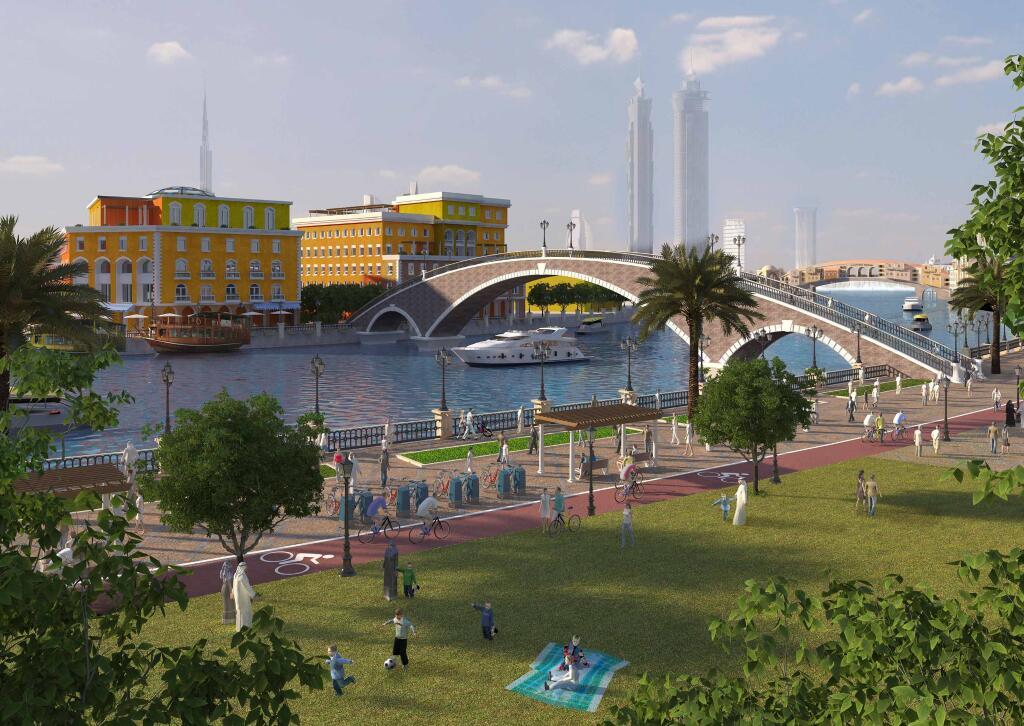
Coming soon: the Dubai Water Canal Project


3 October 2013

UAE Vice President, Prime Minister and Ruler of Dubai His Highness Sheikh Mohammed bin Rashid Al Maktoum yesterday launched the oddly named Dubai Water Canal which will connect the Business Bay with the Arabian Gulf passing through the heart of Dubai at a total cost of about AED 2 billion.

Why oddly named? The Dubai Canal should be sufficient - a canal is filled with water!

The project stretches from Business Bay up to the Arabian Gulf in a waterway stretching 3 km in length with a width ranging from 80 to 120 meters. The Canal crosses (yes it will be a bridge) over Sheikh Zayed Road (between Al Safa Interchange and the first interchange) and passes alongside Safa Park, Al Wasl Road, and Jumeirah 2 to terminate at the Arabian Gulf. All construction works of the project’s infrastructure including drilling and building bridges is set for completion in 2017.

Three years of noise for residents and anyone enjoying Al Safa park, road closures and traffic jams.

Now it could be interesting when finished: almost Venetian!


The Project includes new shopping (surprise!) and entertainment centres linked through a uniquely designed bridge, more than 450 new restaurants along with a wide array of luxurious marinas for yachts, and 4 world-class hotels. At the entrance of the Project from Sheikh Zayed Road, an iconic Trade Centre will be constructed comprising 4 levels, including one underground level and three elevated levels linking the Business Bay with the project zone in a total area of more than 50 thousand square metres.

The development of the waterfront will allow for the construction of deluxe residences and private marinas for boats along with pedestrian pathways, cycling tracks, together with fine business outlets, hotels and deluxe restaurants. The project will boost the position of the Jumeirah area as a premier and distinctive tourist destination in Dubai. The project is expected to attract 20 to 22 million visitors per annum. That by the way is over double the number of visitors currently arriving annually in Dubai!

The ‘Dubai Water Canal’ will have a depth of six meters and bridges above it will rise more than eight meters, offering free navigation for deluxe yachts extending up to 200 feet. The canal will ensure the replenishment of water supplies in the entire Business Bay Canal automatically without any need for pumps.

Now I am confused again as the press release states that bridges will carry Sheikh Zayed Road, Al Wasl Road and Jumeirah Road over the canal and will be constructed 8.5 meters above the water level, thus allowing for a round the clock free navigation in the canal. So the earlier proposal to carry the canal over SZ road has gone. There will be chaos on SZ road while this bridge is constructed.

This is one project that has high enough profile that it is now likely to happen. And if Dubai is awarded the 2020 Expo then expect the Canal to be completed close to schedule.

My note on Arabian Business which may or may not be published highlighted four problems.

One - this is the same project that was launched in April 2007

Two - the cost has increased from AED1.5 bn (December 2012) to AED2.0 billion (Sept 2013). Don't journalists ask questions anymore?

Three - the concept of a hanging canal - taking the canal over SZ road has been removed - and we are back to building a bridge to carry SZ road over the canal. Has anyone thought about the traffic chaos that construction will cause?

Four - a two year construction period (Dec 2012) has been extended until 2017.

I have visions of traffic chaos on SZ and Al Wasl roads and of lovely, quiet Safa Park being substantially turned into a building site.

Cityscape, lagoons and records

3 October 2013

Cityscape next week; and it is time once more for unlikely press releases from developers that sound wondrous on paper but where the reality is likely very different.

Crystal Lagoons Corp., have started by announcing that it will launch its latest and grandest project to date at Cityscape in Dubai, which starts next week.

Trouble is that Crystal Lagoons declared the same project to be nearly complete in 2010. when it announced that "In Dubai, Crystal Lagoons is close to completing the first stage of the ground breaking $1.2bn Dubai Lagoons project, located in Downtown Dubai. It will construct, maintain and provide technical support for initially a pilot lagoon, before the end of 2010, prior to taking responsibility for all of the main water features through the development" - Emirates 24/7

That did not stop them releasing a media statement saying that Crystal Lagoons has signed a deal to construct the world’s largest manmade lagoon, covering 40 hectares, almost four-times bigger than the world’s largest existing lagoon.

Located in Mohammed Bin Rashid City – District One residential community the lagoon will apparently form an integral part of the $7 billion project.

Mohammed Bin Rashid City – District One is a prestigious joint venture between Dubai-based Meydan Group and Real Estate developer, Sobha Group.

The new lagoon will have expansive beaches, surrounded by residences, parklands, waterways, a shopping and dining pavilion and large recreational spaces. Apparently.

Mohammed Bin Rashid City (MBRC) is planned as a mixed-use development containing four components; family tourism, retail, the arts and entrepreneurship and innovation.

Cityscape Global 2013 takes place from October 8-10, 2013, at the Dubai International Convention and Exhibition Centre. Much hot air is expected.

An American farce

1 October 2013

The world's most powerful government shut down last night due to a futile Republican effort to stop people from getting health care from a bill that has already been enacted.

The first shutdown since 1996, when Bill Clinton was president and Newt Gingrich was the House speaker, occurred after Republicans staged a series of last-ditch efforts to use a once-routine budget procedure to force Democrats to abandon or delay the healthcare reforms that were the signature of Obama's first term.

Three separate attacks on the Affordable Care Act, also known as Obamacare, were staged by the Republican controlled House of Representatives, only to be rejected in turn by the Democrat-controlled Senate, which accused Republicans of holding the country to ransom.

Shortly before midnight on Monday, Senate majority leader Harry Reid marked the end of the process by rejecting House calls for formal talks to reconcile their conflicting positions.

Though essential government services will continue for now, 800,000 other public employees will be told to stay at home, many without pay, causing untold disruption to everything from national parks to the Nasa's space programme. The long-simmering resentment and bitterness that drove politicians to the brink will make it mighty hard to find a way back.

The White House has drawn up a list of essential staff who are legally allowed to carry on working, but President Barack Obama warned that a shutdown would have an immediate effect on the fragile US economy.

National monuments and museums in Washington are closed. 97% of NASA staff are now at home without pay - only Mission Control is functioning to maintain contact with the space station. Washington Zoo is closed though the animals will be fed.

Military forces will still be paid; though salaries may be delayed. Airport security and ATC continue; although non-essential staff will be sent home.

The Finance Bill that should have been passed last night has traditionally been non contentious. There was been bi partisan acceptance that government needs to continue to function. Yet Republicans may go further; if they do not vote to raise the so-called “debt ceiling”, they risk triggering default on US government debt – a fate far worse than the shutdown or fiscal sequestration.

Why now? It makes so little sense that it is perplexing. The Republicans are doing all of this in order to impede a modest improvement in the worst healthcare system of any high-income country.

The Patient Protection and Affordable Care Act (known as “Obamacare”) is modelled on one introduced in 2006 in Massachusetts by then governor Mitt Romney. Its simple aims are to cover 32m uninsured Americans and to ensure coverage of those with pre-existing conditions.

The idea that one should close the government – or risk a default – to stop universal insurance, which other high-income countries take for granted, seems mad.

Part of the problem is that the complexities of the bill are poorly understood. The fact that it is nicknamed Obamacare creates mist-trust. It is the same bill as the Affordable Healthcare Act - but many people hate the former while supporting that latter - although they are the same thing!

Maybe this shows how much some Republicans loath Barack Obama. It is dislike of the federal government may be part of the explanation. Republicans might fear not that the programme will fail, but that it will work, cementing the credibility of government.

So what happens now? Shutdowns are relatively predictable. They have also happened before. Goldman Sachs notes that “the longest shutdown equivalent to the current situation occurred in 1995 and lasted five days”.

Even if the shutdown is short lives the fight over the debt ceiling may require resolution this month. At best, a failure to raise the debt ceiling would necessitate a sharp cut in spending. At worst, the US would default.

Analysts at Bank of America Merrill Lynch argue that hitting the ceiling would require the US to balance its budget at once, cutting spending by about 20 per cent, or 4 per cent of GDP. That would push the US into another recession – even if there were no default. The consequences of an actual default, particularly one that lasted for some time, are beyond prediction. Unlike a shutdown, there is no precedent, for good reason. The notion is suicidal.

So what does Obama's administration do? In a democracy, people overturn laws by winning elections, not by threatening the closure of government or even an outright default (or by staging a military coup - eg Thailand or Egypt.

Nor can Obama call a snap election - he has a four year term to serve. And the US political process does not allow a shorter term. But it is impossible to run the government of a serious country under blackmail threats of this kind.

In the meantime it is easier for Obama to talk sens to Iranian leaders than it is to the leaders of the House. And also in the meantime, too many people are at home, insecure and unpaid.

It is an appalling mess. Those who govern the USA should be profoundly and deeply embarrassed.

By the way the Affordable Care Act was passed in 2009. It is law. It is not up for negotiation or approval.

Dubai Airports - full steam ahead without a plan

1 October 2013

Chief Executive Officer of Dubai Airports Paul Griffiths gave an interview to Bloomberg yesterday where it became ever more clear that he is steaming ahead without any plan.

It is quite entertaining if it was no so potentially wasteful. Decisions need to be made and it is clear that Mr. Griffiths is not empowered to make them.

In the heart of old Dubai adjacent to the creek is Dubai International airport, which is being expanded to handle 90 million passengers a year.

Meanwhile in new Dubai, almost half way towards Abu Dhabi, a new super-hub is under construction that could when finished host up to 200 million passengers a year.

But will Dubai operate with two airports. Will the existing airport close. If so, when?

Griffiths told Bloomberg that Dubai Airports won’t retain the existing base if owning two hubs hampers the take up of flights at its new Al Maktoum site, and could find “alternative purposes” for the prime real estate.

He said that the airport authority is accelerating construction of Al Maktoum in a push to persuade main customer Emirates to move in before 2025. The trouble with that statement is that originally the new hub was due to be fully operational around 2017. Then the financial crisis happened and the new airport has one runway instead of the six that were planned and currently handles a small umber of cargo flights.

The new airport opens for passenger flights in late October with a small passenger terminal and no airbridges; it will serve LCC WizzAir with 14 departures a week and two weekly departures on Jazeera to Kuwait. Less than 3,00 passengers a week. 156,000 passengers a year. In a terminal built for approximately 6 million passengers a year. Griffiths says that at least three more prospective customers are looking at the facility.

Saudi Arabian low-cost operator NasAir, which had been touted as one of two initial customers, is undergoing management changes and may rethink its strategy, Griffiths said adding that the three potential customers represent different regions and operating models and include one that doesn’t currently serve Dubai.

In time Dubai World Central aims to become the world’s biggest air hub once fully open, with five (not six) runways and an annual capacity of 160 million passengers and 12 million tons of freight.

Dubai International, known as DXB, expects to attract 65.4 million passengers this year. The airport will reach peak capacity in 2018 even after its own $7.8 billion upgrade, which includes the Concourse D project, due to open in early 2015 after completion next year.

Further growth at the airport is constrained by the two runways that are too close together to permit simultaneous take offs or arrivals and the lack of parking space for more aircraft.

Griffiths told Bloomberg that “if we don’t use it as a major airport in 10 or 12 years’ time it will be a very valuable piece of real estate, very close to the city center, so we could use DXB for alternative purposes."

Worryingly he went on to say “But it’s not a decision we have to make now. Options are on the table for consideration, but it’s not a decision that has to be rushed.”

Well actually it should be rushed - because a long term plan is needed.

When will DWC have enough capacity for Emirates to be able to move to the new airfield. When will it have the necessary transport and infrastructure links to a) attract new airlines and b) to meet capacity needs in the future. There are no firm plans for those integrated transport links at this time

But Emirates will not want to operate at both airfields; the airline’s business model based around the ease of passenger transfers between regular waves of intercontinental flights served by wide-body planes. So Emirates would only move when there is a 100million passenger airport ready, tested and available.

One obvious proposal is to move flyDubai to DWC. It is a point to point carrier. It is an LCC that does not use airbridges. It's move would free up capacity at DXB - especially in time for the runway repairs and single runway ops at DXB for four months next summer.

But fly Dubai does not want to move as they do funnel traffic onto Emirates flights.

Of course the 2014 runway repairs would not have been necessary if DWC had been ready by its original 2017 date. But it will not be and DXB has been given an extended life and new A and D concourses. The aim must be to maximise the cash generation at DXB in order to fund the construction of DWC.

A plan is needed; decisions should be made. Some will be tough. But this just looks like extended dithering.

Dubai to repay Abu Dhabi debt in 2014

30 September 2013 The EIU

Dubai, which needs to repay US$20bn to three Abu Dhabi entities next year, will meet its obligations and is not negotiating to refinance its debt, according to the chairman of the emirate's Supreme Fiscal Committee, Sheikh Ahmed bin Saeed Al Maktoum. However, if necessary, Abu Dhabi would probably roll over the debt, to avoid any negative impact on market sentiment.

The emirate, which was on the brink of a default in 2009, borrowed US$20bn from its wealthier neighbour to shore up a troubled conglomerate, Dubai World, and others. The debt comprised US$10bn from the Central Bank of the UAE and US$5bn each from two state-owned banks, National Bank of Abu Dhabi and Al Hilal Bank. The US$10bn debt is due to mature in February and the bank debts in November 2014. In comments to reporters, Sheikh Ahmed also said that Dubai's state-linked companies were doing well and were able to meet their debt repayments.

Debt rises on improved sentiment

Dubai's debt, including that of government-related entities (GREs), has continued to rise since the global financial crisis. The IMF stated in June that the total debt of the emirate and its GREs rose by US$13bn between March 2012 and April 2013, to US$142bn. This is equivalent to 102% of the estimated 2012 GDP of Dubai and the UAE's poorer northern emirates. Of the estimated US$93bn owed by GREs, US$60bn will fall due between now and 2017, the Fund added.

The increase in GRE debt in 2012 and early 2013 reflects successful debt restructuring, the strengthening of the UAE economy and its property sector and ample global liquidity. These factors meant that Dubai GREs regained access to international credit markets and sought to take advantage of favourable borrowing conditions.

Fundamentals

Dubai's performance in 2014 will be pivotal to maintaining solid investor sentiment. Senior government officials have said consistently that the emirate will meet its debt obligations next year, buoyed by the UAE's wider economic recovery. The UAE is not well served with high-frequency economic indicators, but what indications there are regarding tourism, transport, the property sector, the stockmarket and company results point to considerable strength in the economy persisting in 2013. Ongoing support from high oil prices and the UAE's appeal as a safe-haven investment location in the region have bolstered the economy.

Rises in airport traffic and hotel occupancy contributed to a strong performance by the tourism industry in Dubai and Abu Dhabi in the first six months of the year. Tourist arrivals in Dubai rose by 11.1% year on year to more than 5.5m in the first half of 2013, helping to drive overall hotel occupancy to 84.6%. The city state's main airport handled 32.6m passengers during the period, marking an increase of 16.9% year on year. Furthermore, the property market in Dubai sparked back into life in 2012 and has continued to gain momentum in 2013. This has certainly benefited the finances of many GREs.

The main risks to this ongoing rebound include a shift down in oil prices and slowing global growth. We forecast that international oil prices will dip next year but will remain above US$100/barrel. On balance, we expect global GDP this year to expand by 2% at market exchange rates, down from global growth of 2.2% in 2012. However, we expect most of the currently suffering emerging markets to perform better in 2014, if only because the US, the EU and Japan are poised for faster growth. This should lead to a mild rebound in global GDP next year, to 2.7%.

More reforms needed

Dubai has been successful in restructuring GRE debt since the financial crisis, with most major agreements in place; a final deal regarding the debt of Dubai Holding is advanced but still pending. Progress with restructuring certainly boosted investor sentiment in 2012. Alongside this, the UAE is working on reforms to limit the risk of a renewed debt crisis.

The Central Bank has moved to curtail local banks' exposure to GREs, proposing that lenders should offer no more than 100% of their capital base to local governments and to state-linked entities. This law was announced in April 2012, and banks were told to be in compliance by the end of September last year. However, several banks—including leading UAE banks such as National Bank of Abu Dhabi, Emirates NBD, Abu Dhabi Commercial Bank and Noor Islamic Bank—said that they were unable to comply. The Central Bank has not yet managed to finalise this rule, but it announced in mid-September that an agreement had been reached with commercial banks and would be confirmed before the end of 2013.

The IMF has also stressed the importance of greater transparency with regard to the finances of GREs. The Fund acknowledged that the government had taken some steps towards better oversight. For example, the Dubai government has put in place a team to oversee debt issuance, and any new borrowing by GREs needs to be approved by the Supreme Fiscal Committee. Abu Dhabi, meanwhile, has improved its monitoring of GRE debt. Nevertheless, the IMF has urged a more comprehensive approach to transparency and the governance of GREs, stressing the importance of better data availability on debt and further reforms to improve corporate governance of GREs.

Roll over?

The finances of Dubai and the emirate's GREs have benefited from the economic rebound in 2012‑13. As a result, Dubai may now be in a position to repay its debts to neighbouring Abu Dhabi on schedule in 2014. However, any difficulties in meeting the due debt would play out behind closed doors, and Abu Dhabi would probably roll over the debt if necessary, to avoid any negative impact on market sentiment.

Tax grab or market regulation

29 September 2013

Dubai Land Department has announced that it will double the transfer fees on property sales, with just one week's notice of the change.

The fees will rise from 2 percent to 4 percent of the sale price for all properties, except the first direct sale from a developer to buyer, which will remain at 2 per cent.

The land department argues that the intent is to curb property flipping.

But if they were trying to control property flipping the higher tax would apply to properties sold on within for instance a few months of the previous purchase.

Instead this applies to all sales which makes it no more than a revenue grab to take advantage of the recovered property market.

By law, the property transfer fee is paid equally by both buyer and seller, but industry spokespeople say that in practice, the buyer usually ended up paying the full amount.

The increase to 4 percent means the charge on a AED2m home would double from AED40,000 to AED80,000.

The amount must be paid in full in cash to the Land Department and cannot be incorporated into a mortgage.

With more than $6bn worth of property and land transferred in the year to July, according to Dubai Land Department figures, the increased fees will see government coffers significantly enhanced.

One way to moderate speculation would be a scaled transfer fee. If you sell within the first year, its 5%, after 2 years it's 3%, after three years and thereafter it's 1%.....but this policy  penalizes all the longer term investors and owner-occupiers as well.

Cash grab. Let's just call it what it is and not pretend it is anything else.

Why the Y in Canada's airports?

25 September 2013

With thanks to www.theloop.ca

"When it comes to navigating Canadian airports, do you scratch your head and ask Y?

Unlike most airport codes that actually make sense – JFK (JFK), Boston (BOS), Miami (MIA), Sydney (SYD) Madrid (MAD) and Singapore (SIN) – Canadian airport codes begin with a Y. And just when you figure there's a pattern – YOW for Ottawa, YVR for Vancouver along comes Montreal (YUL), Edmonton (YEG) and Saskatoon (YXU). Not to mention the four U.S. airports that begin with their own Y, – tasty Yuma (YUM) for example and the anomalies that begin with a Z (ZBF for Bathurst, New Brunswick). Considering there are around 7,000 planes flying above North American skies each day, one would think there's a well-planned and logical explanation for all this. One would be wrong.

Every airport in the world has a 3-letter code that is maintained by the International Air Transport Association (IATA). There's also the International Civil Aviation Organization (ICAO), which uses 4-letter codes, tagging a C at the front of all Canadian airport codes, and a K for U.S. Airports. JFK becomes KJFK, YWG becomes CYWG, and KMART becomes a place you can still do your shopping. Airport codes evolved rather haphazardly as flying took off (ahem) in the 1930s. Flat fields with strong winds evolved into transportation hubs, places of work, and growing shopping malls. North America's first airports typically had just two letter codes, usually based on the weather station or radio transmitter where the strip was located. Aviation officials came up with the 3-letter code, figuring it unlikely that 17,576 airports would dot the world (the number of combinations allowed with 3 letters.) Airport codes were determined by weather stations, radio transmitters, cities, or in some cases, the name of the original fields in which they were located (for example Chicago's O'Hare Airport code is ORD, for Orchard Field).

Chicago’s ORD airport code is strange enough to Canada’s case to bring us back to the Y. Why the Y? Airport codes expanded into radio codes, and radio codes ultimately looped around, broke the internet and become airport codes again. Why isn't Toronto called YTO? Actually it is. YTO is the airline code for the entire region, with YTZ for Billy Bishop Airport, and YYZ the original radio transmitter code for a village called Malton, which is where Toronto Pearson International Airport is located today. Since Canada locked up the Y for its radio transmitters, it also locked up the Y for its airport codes. Tied into this somehow are radio stations. Did you know that all U.S. stations start with either a K or a W, depending on which side of the Mississippi they are? KWTF?

To offer a glimmer of hope, the International Air Transport Association assured us that “any new applying airport in Canada can suggest to be assigned any available code, they are not forced or even recommended to select a code with the letter Y.”"

Tales from Kai Tak

25 September 2013

Listen here.

A Radio Documentary about landing at the old Hong Kong Airport with contributions from pilots who flew this challenging approach on the IGS-13 making a sharp right at the checkerboard at 500ft over the Kowloon buildings with just seconds to line up and land on the runway often in treacherous weather conditions.

NOTE THIS IS AUDIO ONLY. Over 1000 hours production time went in this project which features three flight deck landing (one in a simulator training for an engine fire on take off. Contributors include captains David West, Dick Duxbury, Chip Crosby, Ralph Requa, Barry Schiff, Manny Puerta, Tom Erikson, Chip Crosby, Randy Sohn, Tim Olson, Jim Hancock, Nick Bristow, and from Hong Kong Airport GM Tony Norman. Produced by John MacCalman and first broadcast on Radio Clyde in 1998 with special thanks to British Airways, Northwest Airlines (now part of Delta), Cathay Pacific and the most excellent team at Hong Kong Air Traffic Control.

There really was nothing like it!

American gun use is out of control. Shouldn't the world intervene?

21 September 2013 The Observer

Last week, Starbucks asked its American customers to please not bring their guns into the coffee shop. This is part of the company's concern about customer safety and follows a ban in the summer on smoking within 25 feet of a coffee shop entrance and an earlier ruling about scalding hot coffee. After the celebrated Liebeck v McDonald's case in 1994, involving a woman who suffered third-degree burns to her thighs, Starbucks complies with the Specialty Coffee Association of America's recommendation that drinks should be served at a maximum temperature of 82C.

Although it was brave of Howard Schultz, the company's chief executive, to go even this far in a country where people are better armed and only slightly less nervy than rebel fighters in Syria, we should note that dealing with the risks of scalding and secondary smoke came well before addressing the problem of people who go armed to buy a latte. There can be no weirder order of priorities on this planet.

That's America, we say, as news of the latest massacre breaks – last week it was the slaughter of 12 people by Aaron Alexis at Washington DC's navy yard – and move on. But what if we no longer thought of this as just a problem for America and, instead, viewed it as an international humanitarian crisis – a quasi civil war, if you like, that calls for outside intervention? As citizens of the world, perhaps we should demand an end to the unimaginable suffering of victims and their families – the maiming and killing of children – just as America does in every new civil conflict around the globe.

The annual toll from firearms in the US is running at 32,000 deaths and climbing, even though the general crime rate is on a downward path (it is 40% lower than in 1980). If this perennial slaughter doesn't qualify for intercession by the UN and all relevant NGOs, it is hard to know what does.

To absorb the scale of the mayhem, it's worth trying to guess the death toll of all the wars in American history since the War of Independence began in 1775, and follow that by estimating the number killed by firearms in the US since the day that Edward Kennedy was shot in 1968 by a .22 Iver-Johnson handgun, wielded by Sirhan Sirhan. The figures from Congressional Research Service, plus recent statistics from icasualties.org, tell us that from the first casualties in the battle of Lexington to recent operations in Afghanistan, the toll is 1,171,177. By contrast, the number killed by firearms, including suicides, since 1968, according to the Centres for Disease Control and Prevention and the FBI, is 1,384,171.

That 212,994 more Americans lost their lives from firearms in the last 45 years than in all wars involving the US is a staggering fact, particularly when you place it in the context of the safety-conscious, "secondary smoke" obsessions that characterise so much of American life.

Everywhere you look in America, people are trying to make life safer. On roads, for example, there has been a huge effort in the past 50 years to enforce speed limits, crack down on drink/drug driving and build safety features into highways, as well as vehicles. The result is a steadily improving record; by 2015, forecasters predict that for first time road deaths will be fewer than those caused by firearms (32,036 to 32,929).

Plainly, there's no equivalent effort in the area of privately owned firearms. Indeed, most politicians do everything they can to make the country less safe. Recently, a Democrat senator from Arkansas named Mark Pryor ran a TV ad against the gun-control campaign funded by NY mayor Michael Bloomberg – one of the few politicians to stand up to the NRA lobby – explaining why he was against enhanced background checks on gun owners yet was committed to "finding real solutions to violence".

About their own safety, Americans often have an unusual ability to hold two utterly opposed ideas in their heads simultaneously. That can only explain the past decade in which the fear of terror has cost the country hundreds of billions of dollars in wars, surveillance and intelligence programmes and homeland security. Ten years after 9/11, homeland security spending doubled to $69bn . The total bill since the attacks is more than $649bn.

One more figure. There have been fewer than 20 terror-related deaths on American soil since 9/11 and about 364,000 deaths caused by privately owned firearms. If any European nation had such a record and persisted in addressing only the first figure, while ignoring the second, you can bet your last pound that the State Department would be warning against travel to that country and no American would set foot in it without body armour.

But no nation sees itself as outsiders do. Half the country is sane and rational while the other half simply doesn't grasp the inconsistencies and historic lunacy of its position, which springs from the second amendment right to keep and bear arms, and is derived from English common law and our 1689 Bill of Rights. We dispensed with these rights long ago, but American gun owners cleave to them with the tenacity that previous generations fought to continue slavery. Astonishingly, when owning a gun is not about ludicrous macho fantasy, it is mostly seen as a matter of personal safety, like the airbag in the new Ford pick-up or avoiding secondary smoke, despite conclusive evidence that people become less safe as gun ownership rises.

Last week, I happened to be in New York for the 9/11 anniversary: it occurs to me now that the city that suffered most dreadfully in the attacks and has the greatest reason for jumpiness is also among the places where you find most sense on the gun issue in America. New Yorkers understand that fear breeds peril and, regardless of tragedies such as Sandy Hook and the DC naval yard, the NRA, the gun manufacturers, conservative-inclined politicians and parts of the media will continue to advocate a right, which, at base, is as archaic as a witch trial.

Talking to American friends, I always sense a kind of despair that the gun lobby is too powerful to challenge and that nothing will ever change. The same resignation was evident in President Obama's rather lifeless reaction to the Washington shooting last week. There is absolutely nothing he can do, which underscores the fact that America is in a jam and that international pressure may be one way of reducing the slaughter over the next generation. This has reached the point where it has ceased to be a domestic issue. The world cannot stand idly by.


Dordogne travel tips

21 September 2013

Do not even think about coming to this region without a car.

When you do bring your car also bring lots of changing; parking almost always requires a payment. And the machines only take coins. And there is never anyone or any machine to provide change.

Carrefour closes at 7.30pm in St-Cyprien and probably elsewhere as well. And byo bags.

French food can be depressingly over-rated. There are very few Michel Roux's.

Stick to red wine.

The French cannot cook pasta.

The reason the Dordogne is so green. It rains a lot.

Do not expect to get anywhere quickly.

Forget the balloons - Euro180 an hour per person. Ouch.

There is very little public access to the Dordogne River - unless you are living in a caravan.

The prettiest Dordogne villages have the largest and ugliest carparks. Truly eyesores.

Sarlat market, on Saturdays, seems to bring in everyone from miles around. Recommended. Though parking is a headache.

Brantome - severely over-rated. A large parking lot.

Domme - a nice town to take your mistress for lunch!

The french love roundabouts...they are everywhere.

Buying petrol/gas on a Sunday is a nightmare - even worse if you do not have a French credit card.

High unemployment is explained by stupid/pointless automation.

EK to Boston

19 September 2013

At long last Emirates has announced its newest USA route with a daily Dubai – Boston service to commence on 10th March 2014. The Boeing 777-200LR service will operate to the following schedule:

EK237 Dubai 0945 – Boston 1515
EK238 Boston 2255 – Dubai 1910+1

Boston will do well and will likely upgrade to a 77W before too long.

EK to Kabul

17 September 2013

Emirates crews will not be looking forward to the latest turnaround with the airline announcing that  it will commence a daily passenger service to Khwaja Rawash Airport, Kabul, Afghanistan from December 4.

Despite the obvious security concerns it is worth noting that flyDubai goes three times daily to Kabul and National Air has been operating passenger flights there for a year.

The route will be operated by an Airbus A340-500 configured in a three cabin configuration, offering 12 First Class, 42 Business Class and 204 Economy Class seats.

“Emirates has identified a demand for a premium service airline offering between Dubai and Kabul. With this new route Emirates will be able to offer passengers travelling to and from the city excellent global connections via Dubai, combined with the award-winning product and service the airline is renowned for. This includes operating the only First Class cabin between Dubai and Kabul”, said Barry Brown, Emirates’ divisional senior vice president, Commercial Operations East.

“We expect the flight to be particularly popular with corporate business travellers, as well as Afghan nationals returning home to visit friends and family. It will also present a new opportunity for cargo operations to the country, particularly for the shipment of pharmaceuticals, perishable foodstuffs and construction materials.”

EK 640 will depart Dubai daily at 09.55 hours and arrive in Kabul at 13.15. The return flight, EK 641 will leave Kabul at 15.30 hours and arrive back in Dubai at 18.00.

Welcome to the world of FZ pilots. Do your homework on this one, especially the approach for runway 11. For me its the most demanding of airports that we fly into. Terrain, weather, military VFR traffic everywhere. Good luck guys !


Recent transport disasters blamed on spirits

15 September - Khaosod online - and no this is not April 1st.

"Supernatural powers are cited as the factors behind recent high-profile accidents in Thailand, namely the botched landing of a Thai Airways plane at Bangkok′s main airport earlier this week.

14 people were injured during the evacuation from the Airbus A330-300 which skid off the runway of Suvarnabhumi Airport on 9 September.

While initial investigation pointed to a malfunctioned landing gear (the officials have not yet finished their inquiry), the Managing Director of Thai Aiways, Mr. Sorajak Kasemsuvan, is not taking chances. He said his company will conduct a major ceremony to appease the malevolent spirits said to be haunting the airport.

He is quoted as saying that the ceremony will also thank the said spirits for assisting with the successful operation to salvage the plane from the runway.

Mr. Sorajak′s comment followed a series of coverage by Thai Rath, the best-selling newspaper in Thailand, which gave extensive attention to the supposed involvement of ghosts and spirits in the accident.

Previously, Thai Rath has reported that a ghost in "traditional costume" (which strangely resembles the outfit Thai Airways flight attendants wear) has helped evacuate the passengers from the aircraft shortly after it slid off the runway.

The newspaper has also quoted Mr. Chotisak Asapaviriya, a former director of Airports Authority of Thailand (AOT), as saying that he had organised a regular prayer session to placate the vengeful spirits which reside in the airport vicinity.

At the ceremony to unveil the airport in 2006, Mr. Chotisak told Thai Rath, an official in charge of searching for explosive materials had broken down into a trance, claiming that he was being possessed by a "grandfather ghost" who demanded a shrine to be built on the airport compound. The shrine was quickly built afterwards.

Thai Rath helpfully points out that 8 major shrines have been built around Suvarnabhumi Airport by the staff in order to ward off evil spirits, such as a shrine dedicated to the Naga (holy big snake in Buddhist myths) which is presumably angered by construction of the airport on what was once a swamp inhabited by snakes.

Other smaller shrines include a strangely named "Italian Shrine".

The newspaper cited the curses of the residing ghosts as the main reason the construction of the airport had been delayed for decades. The more rational Thais, however, would point to mire of corruption that has plagued the project before the government of Thaksin Shinawatra finalised the project in late 2005.

Dr. Smith Thammasaroj, former director of Suvarnnabhumi Airport, told Thai Rath he was convinced of the existence of supernatural entities around the airport even though, he admitted, he had never encountered any particular case personally.

The scientist who once headed Thailand′s Meteorological Department said he had invited so many psychics to conduct ceremonies and constructed so many shrines "that I can′t keep count".

"We even had to build a condominium for the ghosts to reside," Dr. Smith said, "Because the spirits are so many individual spirit houses won′t be enough".

However, there has been few secular responses to the accident at Suvarnabhumi Airport on 9 September, too. Sqn.Ldr. Sitha Tiwaree, Managing Director AOT, said the authority has conducted an Emergency Plan Rehearsal, in which the airport′s fire and rescue departments took part.

The accident involving the Airbus was the most severe case at the airport since its opening 7 years ago, he said.

Sqn.Ldr. Sitha stressed that the incident will be analysed for future adjustment of the Emergency Plan, particularly how to transport passengers to the airport building - the procedure that received several complaints on 9 September. The rehearsal also pointed out that the airline crew was not familiar with the runway, causing complications during the latest accident, the director noted.

In long term, he said, the airport plans to build another substitute runway, in order to sustain further service. The AOT board will meet on Tuesday, 17 September to discuss about the construction budget, according to Sqn.Ldr. Sitha.

But it seems the spirits do not only roam the sky.

After a train headed from Malaysia to Bangkok′s Hua Lamphong Station derailed in the capital city yesterday, Daily News, the second best selling newspaper of the kingdom, reported that a certain curse might be involved.

According to Daily News, a painting at Hua Lamphong depicted a small obstacle in the rail track, which perfectly explains the frequent derailments - more than 15 incidents this year alone.

Even Transport Minister Chatchart Sitthipan, best known for his hands-on approach in inspecting problems of public transports, is mulling a paranormal hands-on solution. He has reportedly ordered the Deputy Permanent Secretary of the Ministry to consider a plan to organise a merit-making ceremony for the sake of his Ministry.

During the past few months, Mr. Chatchart noted, the country has suffered from many transport accidents such as minivan crashes, train derailments, boat crashes, and the Thai Airways incident.

"There have been more deaths than usual. Many have suggested that the Ministry of Transport needs a large-scale merit-making ceremony" Mr. Chatchart said."


How to hire

15 September 2013

The following is quoted this month from the CEO of the most profitable airline in history, Southwest Airlines. It is not rocket science. But SWA's success is built by leaders that have left their ego's at the door; this will not happen in the ME.

Copied from their inflight magazine:

"Our People formula is pretty simple: We hire for attitude and train for skill. Fortunately, because of our Brand rankings, great pay and benefits, history of no layoffs or furloughs, and our world-famous Culture, a lot of great folks want to work at Southwest. This means our pool of potential Employees is chock-full of the best and brightest. In fact, last year we received 114,845 résumés and only hired 2,499 candidates. (A person has a better chance of getting into an Ivy League university than getting hired at Southwest.) We take great pride in hiring the right People and spend a lot of energy on doing so.

Once onboard, we don’t focus intensely on rules or policy applications, except those related to Safety. Instead, we give our Employees the Freedom to be themselves, to do the right thing, and to take care of our Customers. But we do have one rule that overrides all others, and that is The Golden Rule—treating others as you wish to be treated. We’ve found over our 42-year history that if we hire People with passionate Servant’s Hearts and empower them to do what’s right, they will consistently surprise, delight, and amaze our Customers.

By building a Company that is People-centric, we have built the most successful and profitable airline with the best Customer Service in the history of commercial aviation. Thanks for coming along for the ride!

Gary Kelly - Chairman, President, and CEO"

Faye Wong announces second divorce

14 September 2013

I was saddened to read that the wonderfully talented singer Faye Wong has announced that she has divorced her second husband, Li Yapeng.

The disclosure on her Weibo page was reposted more than 70,000 times and attracted almost 30,000 comments from her shocked fans within half an hour.

"Our affinity and connection as a husband and wife in this life has come to an end," she wrote on the mainland's Twitter-like social media platform at around 7.30pm. "I'm well. Please take care of yourself as well."

Now based in Beijing Faye Wong had married mainlander and former actor Li in 2005.

In a posting on his Weibo page later, Li, who is two years Wong's junior, admitted that they had broken up.

Li confirmed the split in his own microblog at 8:07pm, saying: "I need a family, but you are destined to be a legend. I miss all the best times of the past decade. I still love you as I have always been, but I'm sorry that letting it go is the only thing I can do now" implying that the two divorced because of a difference of values.

He said their daughter would be taken into his custody and that there would not be any disputes over money because the pair had remained independent in their financial affairs.

State-owned CCTV also put the news on its Weibo page. Citing an anonymous source said to be close to Li, it said the couple had signed a divorce agreement in Urumqi , Xinjiang , where Li was born, and that he was on his way back to Beijing.

In 2006 the couple had successfully set up the Smile Angel Foundation, a charity for Chinese children with cleft palates, after their daughter Li Yan was born with a severe cleft lip.

They hosted their first charity gala dinner for the foundation in Hong Kong in May. The event, held on Li Yan's birthday, raised a total of about HK$56 million including funds from the record-breaking sale of a painting by contemporary artist Zeng Fanzhi for HK$30 million. A panda painting by their daughter fetched HK$1 million.

Wong married her first husband, musician Dou Wei, in 1996 and divorced three years later. They had a daughter, who lives with Wong.


Lies, damned lies and house price statistics

14 September 2013

Arabian Business has been on the happy pills again reporting that Dubai house prices have surged 21.7 percent year-on-year in the last twelve months, according to the latest figures by London-based real estate firm Knight Frank.

It all depends where you start from.

Arabian Business adds that Dubai leads the annual rankings as the emirate’s housing market has gained momentum since late 2012.

Real estate agents say residents are increasingly looking to buy their own property as they cash in on an “under-priced” market while shunning rising rents.

An analysis of the Land Department data by Arabian Business showed property sales totalled $6.26bn between January and the end of July this year, up from $3.74bn for the same period last year.

For real estate sales, the data pointed to the number of transactions increasing from 1922, or 275 a month, last year to 3012, or 430 a month this year.

Here is the problem.

Say your value at the start is 100. You then lose 60% so that your value is just 40. You then gain 22% and your value increases to 49. Guess what. Your property is still worth only 50% of what it was at the start.

So all this rooftop shouting about Dubai's turnaround and its world leading increase in property values needs to take account of just how awful the fall was before the slow recovery began.

Get stuck in again

13 September 2013 The Economist

Saudi rulers are once again trying to exert their influence in the region

"As the world’s richest family, the House of Saud has a geopolitical wish-list that has—of late—been strikingly short. Its main aim is to thwart the ambitions of Iran, a Shia Muslim republic that has for three decades been the Sunni Muslim kingdom’s stubborn rival for regional influence. And the Saudis want their fellow Arabs to settle down quietly and stop all this talk of democracy and revolution.

The infectious mood of the Arab spring, along with Iran’s extension of influence into troubled Iraq and Syria, has challenged both those policies in recent years. Revolutionary turmoil in the region not only revealed that many Arabs view autocracy in general, let alone Saudi-style absolute monarchy, with disfavour. It pushed close friends of the kingdom, such as Egypt’s Hosni Mubarak, out of power, while boosting the fortunes of the Muslim Brotherhood, a group whose pretensions to Sunni leadership, tentacular reach and secrecy have long stirred deep Saudi suspicions. Iran’s massive commitment of money, men and materiel to bolster Bashar Assad in Syria has meanwhile outweighed Saudi Arabia’s hesitant backing for bickering rebel groups. Worse yet, the Sauds’ oldest and strongest ally, America, looked ever more keen to abdicate its regional role.

Yet things may be tilting nicely back in the Saudis’ favour. Post-uprising messes in Bahrain, Egypt, Libya, Syria, Tunisia and Yemen have all served to dampen the general enthusiasm for revolution. The toppling of the Muslim Brotherhood’s Muhammad Morsi as Egypt’s president in July was especially gratifying. Egypt’s generals, many with close ties to the Saudis, are back at the helm. Qatar, the small but punchy Gulf emirate that had annoyingly backed the Brothers, has been put back in its box. And for now at least, Mr Mubarak is out of prison. Small wonder the kingdom is showering Egypt with aid, and loudly voices diplomatic support in the face of criticism for the new regime’s ruthless suppression of its opponents.

Events in Syria may have also begun, in Saudi eyes, to unfold their way. Saudi-supplied arms, which began to flow in earnest only earlier this year, are grinding down Mr Assad’s war machine, encouraging rebels on the southern front to push closer to Damascus. The chemical attack on rebel-held suburbs of Damascus on August 21st may have helped the Saudi cause still more. After months of quiet Saudi lobbying in Washington for a tougher American line, Mr Obama is being prodded—albeit hobbled by his foes in Congress and the UN Security Council—into taking drastic action. The Saudis still hope that Mr Assad’s forces will be clobbered by American cruise missiles before too long.

The turnaround has been particularly satisfying for Prince Bandar bin Sultan, who served for two decades as ambassador to America but now runs Saudi intelligence. Back in the old days, he played a quiet but crucial role in America’s covert cold-war forays, providing funds, when the CIA could not, to Afghan mujahideen, Nicaraguan Contras and the Iraqi army then fighting Iran. Especially if Mr Obama gets his way and gives Mr Assad’s regime a drubbing, the Saudis will be hoping that the good times will roll again."


Divine intervention saves passengers!

13 July 2013

This is one of those only in Thailand stories.

Remember the Thai Airways A330 landing accident from a few days ago - the hasty paint job and some highly questionable customer service. All that led to some appalling PR for the airline.

How do you deflect that PR. You create a fantastical ghost story.

The Bangkok Post reports today that "public curiosity has been stoked by a passenger's account suggesting divine intervention aided the emergency operation."

Apparently a passenger has claimed on a radio programme to have spotted a woman thought to be a cabin crew member in a traditional outfit helping evacuate people from the A330-300 aircraft, which veered off the runway on Sunday night after arriving from China.

A traditional outfit is worn by female cabin crew during flight, but they typically switch to the airline's skirt and blouse uniform before landing. A THAI source said the passenger's story has bewildered airline executives and crew, particularly those on board Flight 679.

Bewildering Thai Air executives is not difficult at the moment.

The crew insisted none among them were wearing the traditional outfit when the accident took place. The source said the passenger may have seen a guardian angel who "stepped in" to help. Oh please. How about simply saying that the passenger was delusional.

To make matters worse an Airports of Thailand (AoT) source said some airport fire brigade and emergency response personnel claimed to have seen a woman in traditional dress shuffling into and out of their office, causing crackling in their radio transmissions.

And these people are entrusted with saving our lives in the event of an accident.

The AoT source said Suvarnabhumi has seven spirit houses at the airport to ward off ill fortune....clearly not very successfully. The first one is Sarn Thepparak, erected before the airport was inaugurated in 2006.

AoT former president Chotesak Artpawiriya said technical glitches and accidents at the airport persisted despite the presence of the spirit house. He later ordered six more to be constructed. After all that would be cheaper than repairing the taxiways and runways!

Khun Cotesak said that he recalled an incident in which a bomb disposal expert at the airport exhibited signs of being possessed by a deity. The man said he was a wandering spirit called Phor Kae Ming who needed a home.

The last spirit house was constructed to be its dwelling place.

Now lets get on with investigating what really happened.

TV's golden age

11 September 2013

Are we in a TV golden age?

The answer is a qualified yes. At least in terms of TV drama. As a medium television is attracting some of the brightest and best directing talent.

The ensemble tv dramas really become prominent in the 1970s not with Dallas and Dynasty but with the grittiness of shows like Hill Street Blues.

The 1980s brought us Northern Exposure - a magical mix of drama and whimsy.

But there were only a handful of shows that anyone wanted to watch on a handful of networks.

Now we have independent networks producing major dramas for Showtime, HBO, Netflix, AMC. These shows can be watched week to week or increasingly are packaged as box sets. You can do so much more to develop plots and personalities over 10 to 20 hours of television that in a 100 minute film.

My must watch list at the moment includes Person of Interest, Homeland, The Good Wife, True Blood.

Season 3 of Person of Interest is scheduled to premiere Tuesday, Sept. 24 at 10 p.m. on CBS

Homeland Series 3 will debut on Showtime in the US on 29 September

The Good Wife Season 5 kicks off on September 29 also on CBS.

AMC produces the hugely successful Breaking Bad and Mad Men.

Others that I watch from time to time include House of Cards, House of Lies, Suits, Dexter and sometimes even The Mentalist.

I have not seen Game of Thrones but I probably should.

Meanwhile the British brought us Luther - wonderful tv.

And there is of course the hugely popular soap opera Downton Abbey with season four begining on Sunday 22 September.

But we are also moving to binge TV - watching multiple episodes back to back - online or as a boxed set. That does not work so well for the traditional major networks who still like to test a market with pilot episodes. House of Cards for instance was released online to Netflix subscribers.

TV is changing - but its drama output may be better than ever.


Lessons in crisis management

10 September 2013

Fourteen passengers were injured on Sunday night/Monday morning after a Thai Airways service, TG 679, from Guangzhou, China, skidded off the runway at Suvarnabhumi airport in Bangkok. Early reports suggest the landing gear on the Airbus A330-300 malfunctioned.

The plane veered off the runway, came to a halt and the captain ordered an emergency evacuation. It is likely that most of the injuries among the 288 passengers came as passengers left the airliner.

There are many lessons emerging from this incident.

Traditional and social media have focused on the fact that within hours of the incident maintenance crews were spraying black paint over the airline logos. However, the distinctive colour scheme of the airline remained clearly visible.

The good news is that the crash was not more serious. The pilots and cabin crew appear to have done an effective job in halting and evacuating the airplane.

But type Thai Airways into google news and the story is all about hiding the logo and not about the wellbeing of the passengers and the actions of the crew and airport safety teams.

Thai Airways official Smud Poom-On said that the "blurring the logo" after the accident was a recommendation from Star Alliance - a global group of 29 airline partners - known as the "crisis communication rule". He added that "it is meant to protect the image of both the airline and other members of Star Alliance.”

The trouble with that explanation is that it does not seem to be correct. A Star Alliance spokesman has pointed out that it does not require this logo-covering. "The [Thai Airways] official is misinformed," he said. Thai had its story sorted out by Monday afternoon, though, and issued an official statement to clarify that "de-identifying an aircraft after an incident" is the company's policy, and not that of Star Alliance.

Rather an outdated policy - and one that has unfortunately earned Thai Airways huge ridicule in the media. After all, plenty of images are available of the crippled plane before the black paint job was applied to its logos. And it's hardly a secret that this is a Thai Airways service. Perhaps it just seems less embarrassing this way.

The AWSJ covered this in more detail quoting John Bailey, the managing director of Icon International, a communications firm that also advises airlines on crisis management. “It is now not considered best practice in the airline community to do this,” he said.

Bailey pointed out that passengers and airport visitors commonly have smartphones with cameras, marking quite a different world than two decades ago when airlines commonly masked their logos on damaged planes.

“The environment has changed, and the challenge for airlines is infinitely more complicated. If an accident happens in a visible and populated area, the airline can’t hope to match the speed of response of eyewitnesses and survivors,” said Mr. Bailey, who previously worked with the International Air Transport Association.

Andrew Herdman, the director general of Association of Asia Pacific Airlines (AAPA) said it was up to the airlines to make a decision.

“Historically, some airlines have had a policy of masking the airline logo following an accident rather than have the beleaguered aircraft advertise their corporate misfortune so graphically. However, in the modern era of social media and instantaneous sharing of images, this obviously is of limited effectiveness,” Mr. Herdman said in an emailed response to a query from The Wall Street Journal.

The International Air Transport Association, the industry’s trade group, released a document on best practices on crisis communication after a conference last year that discussed the role of social media such as Twitter and Facebook in the November 2010 engine failure of a Qantas Airways Ltd. Airbus A380 superjumbo jet over Batam island in Indonesia.

The IATA document advised airlines to be “proactive” in their communication and put out facts as quickly as possible because, with passengers and eyewitnesses firing posts on social media, they don’t have a lot of time to gather information before issuing a formal statement.

The communications chief of another airline, who spoke on condition of anonymity, said logo masking doesn’t go over well with today’s more savvy, Internet-empowered public. The public expects more transparency and responsibility, he said.

“It [logo masking] used to be standard practice to prevent damage to reputation, but the world’s a different place now and most crisis management people believe you’d be sending the wrong message to the public if you paint over,” the airline spokesperson said.

However, many airlines continue with such paint jobs. Most recently an Alitalia S.p.A. ATR-72 turboprop plane that veered off the runway in Rome in February 2013 was covered in white paint.

The logo story has obscured other issues arising from the incident which led to about 40 passengers complaining of poor treatment by ground staff to THAI president Sorajak Kasemsuvan.

The comments from passengers suggest that Thai Airways responded slowly and poorly to the Sunday night incident.

The complaints included:

1. No one from the airline had informed them of how the company would reimburse their medical fees.

2. A lack of communication immediately after the accident, with passengers saying they were left abandoned.

3. There were no interpreters to inform passengers of the situation. Many of the passengers were Chinese tourists.

4. Passengers were marshalled to shuttle buses but the buses remained stationary with passengers locked inside unattended for 20 minutes. Some in shock. Some needing first aid.

5. Passengers were taken from the accident scene to immigration counters, but some of the passengers had left the aircraft without their passports, causing confusion.

6. At the terminal, no staff members were there to receive passengers. There was not even a glass of water to drink.

Former Bangkok governor candidate Kosit Suvinitjit was travelling in business class on the flight; Mr Kosit praised the efforts of the pilots and cabin crew, saying they controlled the situation well. He also thanked the airport's emergency response staff, including firefighters, for reaching the stricken aircraft swiftly.

What the airline needed to do was focus on the well-being of its passengers and crew; praise their efforts and those of the emergency teams and ATC; and worry less about covering up the fact that they had pranged one of their airplanes.

Lessons that will hopefully be learned.

Kanpai Tokyo!

10 September 2013

So it is Tokyo 2020.

The city fended off not-especially-stiff competition from Madrid, whose chances were damaged by Spain’s sickly economy, and Istanbul, whose image was tarnished when its police spent the summer practising for the 100-metre baton-charge.

It was not the strongest field of candidate cities in Olympic history. But the contest demonstrated the lengths that countries will go to for the privilege of hosting the world’s biggest sporting bash.

All three country's Prime Ministers were in attendance in Buenos Aires, where the International Olympic Committee (IOC) was voting, to make the official case for their respective countries.

Tokyo had previously bid unsuccessfully for the 2016 games; Madrid had bid for both 2016 and 2012. Poor Istanbul has now been rejected five times. Why are cities so keen to host the Olympics?

On the face of it, throwing the world’s biggest party—and paying for it—is not especially appealing. The cost used to be fairly modest: London’s 1948 Olympics cost £732,268, or about £20m ($30m) in today’s money. Nowadays hosting the games is a different business. The 2008 Beijing games, the priciest ever, are reckoned to have cost about $40 billion. That is likely to be eclipsed next year by the Sochi winter games, which are on course to cost $50 billion. Tourism may help to offset the expense, but a spike in arrivals is not guaranteed especially in Sochi!

Beijing saw a drop in hotel bookings during its Olympic summer. And the chance to spruce up a city sometimes ends up creating eyesores instead. Some of Greece’s costly stadiums now look as run-down as the Parthenon (and have fewer visitors).

The main reason cities want to host the Olympics is that, perhaps against the odds, they are wildly popular with the voters who foot the bill. The IOC found that public support for hosting the games was around 70% in Tokyo, 76% in Madrid and 83% in Istanbul.

Londoners, sometimes a cynical bunch, were in favour of the 2012 games. At the end of last year, with the crowds departed, eight out of ten said it was worth the extraordinary cost, even as cuts to public services began to bite.

Popularity aside, Olympic bids often have other agendas. The Beijing games were intended to show off China’s spending and organisational power. London’s games were a means of bringing back to life a poor part of the capital at a speed that defied normal budgets and planning regulations. Tokyo hopes the 2020 games can gee up Japan’s lacklustre economy.

It is a high-risk game. Rio’s hosting of the 2016 games had strong local support during the bidding process, but has since become a focus of those protesting against government waste (they also rage against the World Cup, which Brazil will host next year). Politicians can be left looking ridiculous, or worse: Mexico’s 1968 Olympics are remembered as much for the massacre of student protesters ten days before the games as for the sporting events themselves.

Even if it goes well, the seven-year gap between bidding for the games and staging them means that the politicians who shepherd the bid through are seldom around when the fun begins. The Labour government and Labour mayor of London who helped to win the bid for Britain were long gone by 2012. Luiz Inácio Lula da Silva is no longer Brazil’s president (though some wonder if he might just try to make a comeback). Shinzo Abe faces no term limits as Japan’s prime minister, so could, in theory, still be around to open the Tokyo games in 2020. More likely, though, someone else will be there to take the credit—or the blame.

2020 will be spectacular, efficient and popular. Will it bring a lasting legacy? Unlikely. It might be a good time to leave town for a month but for those who stay Tokyo will have a party.

The 2020 Olympic vote

7 September 2020

Olympic officials in Buenos Aires will vote on Saturday to determine who will host the 2020 Games on 7 September 2013.

The three candidate cities are Madrid, Tokyo and Istanbul.

Spanish authorities have already started spending billions of dollars on the construction of 35 projects including the main stadium, which will become the new home of Athletico Madrid.

Tokyo had the Olympics in 1964; Barcelona in 1992. Istanbul never. Spain is bankrupt; Tokyo is difficult for the big money broadcasters from the USA and Europe. It is also hard to gauge whether the city truly backs this bid; Istanbul’s bid was setback by the harsh response to antigovernment protests there in June. 

Though the protests have subsided, they have left the I.O.C. delegates to contemplate seven years ahead of time what Turkey’s political situation might be in 2020.

Add to this the regional uncertainty of war in neighboring Syria and a possible military intervention there by the United States; a doping scandal that ensnared more than 30 track and field athletes in Turkey; possible transportation shortcomings; and spectator indifference to the recent under-20 world soccer championships in Turkey.

Maybe that is a long enough list to rule out Istanbul.

One thing is for sure - the lessons from all previous Olympics is that building and hosting costs will be far greater than budgeted and that the idea of an Olympic legacy is very short-lived. The feel good factor that the UK enjoyed lasted no more than a few weeks; budget cuts have decimated sports programmes and the Olympic stadium is being handed over to West Ham United (hardly a glamour club other than to the East End faithful) for a basement rental.

So who will it be. I would like Istanbul; they have bid for five Olympics now and must deserve an opportunity.

Tokyo would be a good choice as well....everything will be on time and wonderfully efficient. And it is likely that the IOC would like a safe choice given the continuing construction, budget and unrest issues in Brazil (the 2016 host).

Madrid...it may just be the favorite; it also bid for 2012 and 2016; but Spain's war chest is not on the scale of Japan's.

So 100 delegate will vote. And there is no clear favorite.

My guess - the IOC will still take a risk - and award the games to Istanbul.

Re-read this in one year

3 September 2013

The Gulf News published the following editorial on 1 September 2013. It is as though the deaths of over one thousand Egyptian civilians on August 14th never happened. The editorial concludes that " Egypt is on its way to recovery and prosperity." There is no mention of those who died; no mention of the continuing unrest and the curfew that remains in place. No hint of the possibility of civil war.

There is a lull in activity in Egypt. It may be that Syria is taking priority in the news. Meanwhile Egypt’s chief prosecutor has ordered former president Mohamed Morsi and other Muslim Brotherhood leaders on Sunday to stand trial on charges including inciting murder, the state news media reported. This order could extinguish hope of any political resolution that would bring the Brotherhood out from underground and back into the political process.

The Gulf News states the official UAE position and we can all hope for a peaceful resolution of the Egyptian conflict. But recovery and prosperity look a dream rather than reality at this time.

"UAE reiterates its support for Egypt - Editorial - Gulf News

"During the turbulent months of Muslim Brotherhood rule in Egypt, which ended early July, relations between the UAE and the largest Arab country soured. The Brotherhood movement thought that by dominating Egypt, it could secure similar dominance and spread its influence in other Arab states using a complicated network of followers and so-called charities that pay allegiance to the movement’s Supreme Guide.

The UAE and other Gulf states confronted those plans. They conveyed their message repeatedly to former Egypt president Mohammad Mursi’s government that they will not accept interference in their internal affairs and will not tolerate such transgression by cross-border movements. The Brotherhood, known for its arrogance, ignored those friendly messages and displayed hostility towards most Gulf governments. On July 3, the Mursi government was dissolved by the army following three days of popular anti-Brotherhood protests.

Since then, relations between Egypt and the UAE have been repaired. Ties between the two countries have always been strong. The hundreds of thousands of Egyptians living in this country always considered the UAE as their home country and Emiratis, inspired by the love Shaikh Zayed had for Egypt, always considered that country a strategic partner.

In this context, the visit to Egypt by General Shaikh Mohammad Bin Zayed Al Nahyan, Crown Prince of Abu Dhabi and Deputy Supreme Commander of the UAE Armed Forces, the highest ranking Gulf official to visit Egypt since the formation of the new government, comes as proof that ties are back to their traditional strength. It is also a clear message to the Egyptian people that the UAE, along with other Gulf states, will firmly stand by them at this critical juncture in their country’s history.

The West has been threatening Egypt with aid cuts since the overthrow of Mursi’s government. Shaikh Mohammad’s visit and the strong statement by Saudi Arabia on the aid issue last week show that Egypt is on its way to recovery and prosperity."

The Syrian question

1 September 2013

The Syrian conflict is now in its third year. The battle lines are between the Assad regime and anti-government rebels, mostly from the disparate Free Syrian Army. The fighting has spilled periodically across Syria's borders with Lebanon, Iraq and Turkey, threatening to engulf the region. It has made almost two million refugees and last month the UN Secretary General Ban Ki-Moon said it has claimed more than 100,000 lives.

The west sits outside the conflict. It is likely that western nations are trying to bring down the Assad regime; that there is logistical support for the Free Syrian Army. But the Syrian regime has a staunch ally in the Russians; and the Chinese sit happily on the fence. Which leaves it to the USA, Britain and France to determine what, if any, military action they will take.

Evidence of the use of chemical weapons has stepped up calls for western intervention. On Thursday in the UK, MPs debated military intervention, with Prime Minister David Cameron claiming evidence suggests President Assad did use chemical weapons against his own people. Cameron's motion for possible military action was defeated by 285-272, with a strong rebellion by his own MPs and some ministers.

In the USA Obama has back-tracked and says that he will now seek a vote of approval in Congress before he authorises any military action. That vote cannot be held until after September 9th.

Meanwhile Vladimir Putin has dismissed as "utter nonsense" America's claim that the Syrian regime used chemical weapons against its own people. Not unreasonably Putin also called on the Obama administration to present the evidence behind its claims to the UN Security Council. Although maybe Putin should simply watch the BBC. Seems the broadcaster may be providing more reliable information than Russian intelligence.

Syria 21 August attack: Frank Gardner on what we know.

The US Secretary of State, John Kerry, accused pro-Assad forces of killing 1,429 people - including 426 children - with chemical weapons in a Damascus suburb on 21 August. He called the attack an "inconceivable horror".

Pushed beyond his infamous red line President Barack Obama said the US was now considering a "limited narrow act," based on the intelligence.

The Assad regime said the Kerry statement was "full of lies", claiming opposition fighters launched the attack.

After a week of debate Obama has now said that he will seek congressional authorisation for military intervention in Syria.

The reality appears to be that we simply do not want to get involved. The British Parliament clearly reflected public sentiment. Indeed it is possible to be proud of a parliament that said no to the executive on a matter like military action.

But was it the right decision. Or is it rather a shameful hiding from responsibility.

Why the no vote in Britain? The leftover poisons of the Iraq war; the toxic effect of public distrust in our politics. Mishandling by the government that did not have the support it needed. A Labour opposition that used its parliamentary duty to ask questions as an excuse to avoid making decisions. These are reasons why we are where we are. But they are not excuses.

Britain is side-lined. The French may be America's new best friend. As once leaders in international law and engagement Britain continues to move to growing isolationism.

The bottom line is this. Parliament was asked to join an international coalition led by a US Democrat president, whose aim, a firm response to a flagrant breach of international law, was supported by most European nations and many Middle Eastern ones. And parliament said no.

But if that is the line to be taken then why does Britain need the world's fourth most expensive defence forces?

But here is the problem - Parliament needed overwhelming, verified, proof. It did not get that. Cameron released a three-page assessment of the Joint Intelligence Committee which said it was "highly likely" the Assad regime launched the chemical weapons attack. But the document failed to ascribe a motive to the regime for the attack.

Downing Street also released a government summary of the legal advice by the attorney general, Dominic Grieve, which said military action would be lawful "under the doctrine of humanitarian intervention". Opening the debate in a packed Commons, the prime minister said the attorney general had delivered a clear judgment. But he acknowledged that the intelligence agencies had not delivered a definitive verdict.

Philippe Sands, a leading expert in international law, said the document failed to provide a "sound or persuasive legal argument" in favour of military action.

Cheryl Gillan, a former Wales secretary under Cameron, said: "I do not have enough accurate or verifiable information to support direct UK military action in Syria." Recalling the vote on Iraq, she said she was cautious because she "cannot sit in this House and be duped again".

But Bernard Jenkin, the chairman of the commons public administration committee, called on the House of Commons to stop "post-Iraq panic paralysing the country".

With hundreds killed with conventional weapons each week in Syria why are chemical weapons different? Why should the west respond to one type of killing when it took no military action to prevent the deaths of an estimated 100,000 Syrians by more conventional but often brutal methods.

“Chemical weapons are genuinely horrible, and they are indiscriminate,” said Jeffrey Lewis, an arms-control expert at the James Martin Center for Nonproliferation Studies. “They are a particularly cruel way to kill someone.”

It is true that civilians will die in any conflict — often in excruciating ways. But maybe it is right to draw a line and ban the most inhumane weapons, the things that kill on a mass scale. Disclosure; my grandfather was one of the long term sufferers from poison gas in World War One.

Last Saturday, Obama evoked images of gassed Syrian children.

“What message will we send if a dictator can gas hundreds of children to death in plain sight and pay no price?” the president said. “What’s the purpose of the international system that we’ve built if a prohibition on the use of chemical weapons that has been agreed to by the governments of 98 percent of the world’s people and approved overwhelmingly by the Congress of the United States is not enforced?”

It sounds obscene but even war needs to be regulated by a widely shared principle on acceptable conduct. The trouble is that smells of hypocrisy from the US - think napalm in Vietnam.

So where are we?

In a looping debate. Words and not actions. In the UK the people have spoken. The USA looks almost as isolated as Syria. The tragedy is that there are people dieing as you read this and no clear way to stop it. Assad has to go. But he has great longevity and powerful allies.