|
Welcome to rascott.com
This is a
personal site that reflects my interests in news,
current affairs, aviation and travel.
email me:
robert@rascott.com
Home
Up
Now In Dubai:
Scott
Consulting
Photo Albums
My photographs have been moved off this site and are now stored on Picasa. They
were simply taking up too much space on my web host.
Please use
this link to see my list of photo albums.
Some
Useful links:
Information:
World Time
Clock
Exchange Rates
Journalism:
ForeignPolicy
Nationsonline.org
Project Syndicate
Amnesty International
Reporters w/o borders
The Guardian
BBC World News
CNN Asia
Bangkok Post
Daylife.com - news
Gulf News
Arabian Business
World News
WSJ - Asia
SCMP
Good causes:
Sister
Joan - Bangkok
Regional Info:
BKK Magazine
HK Magazine
In
Singapore Magazine
TimeOut Dubai
Back in the UK:
Newton Ferrers
And for fun:
Lin Ping live panda tv
EarthCam
History
BBC Archive
National Media
Museum
The British Library
Imperial War Museum
There are many other links on my
AOB blog page.
| |
|
Emirates 777 continued flight after loud bang,
messages
31 August 2011
Flight Global
The US National Transportation Safety Board revealed in a preliminary report
issued 30 August that an Emirates Boeing 777-200ER crew continued a 5h
flight from Moscow's Domodedovo airport to Dubai on 5 March after hearing a
"loud bang" and receiving several error messages on departure.
Pilots of Flight EK 132 (A6-EMH) reported the incident after landing at
Dubai, according to the General Civil Aviation Authority (GCAA) of the
United Arab Emirates, the authority handling the investigation.
"Following the bang a number of status messages were annunciated, these
messages occurred over a 16 minute time as per the Boeing AHM (airplane
health management) data," the report stated.
Messages indicated a problem with the right Rolls-Royce Trent 800 engine,
and included a thrust asymmetry compensation message that is issued when the
flight control computer automatically uses rudder input counter the yaw
effects of a failed engine.
Four additional messages were received on departure, followed by two AHM
messages after landing.
Flightglobal's ACAS database shows that the 14-year-old aircraft is owned by
Veling and has Trent 884-17 engines, members of the Trent 800 family. As of
31 June, the aircraft had accumulated 61,581 cycles and 12,945h, according
to ACAS.
Inspection of the aircraft in Dubai revealed "a large section" of the right
engine's inboard fan duct and thrust reverser were missing, starting at the
trailing edge and ripping forward.
Overall, officials estimated that 2.8-3.7m2 (30-40m2) section of engine
covering to be missing, along with the primary exhaust nozzle outer skin.
The primary nozzle inner skin had been "holed in several locations at the 12
to 1 o'clock position," the report stated.
External to the engine, the one tyre on the main landing gear "was observed
to have a large cut to the sideway" of approximately 36cm (14in), officials
said. Examination of the aircraft and engine was to continue but the results
have not yet been posted.
The report does not discuss what procedures the Emirates crew followed after
hearing the bang and receiving the AHM annunciations or whether the aircraft
should have been returned to Domodedovo.
But the
very fact that the NTSbindings of the report are a pretty big hint that
continuing this flight was imprudent.
On 22 August, an Emirates Boeing 777-300, registration A6-EMU performing
flight EK-60 from Hamburg (Germany) to Dubai (United Arab Emirates), was
enroute at 35,000 feet about 20nm east of Rzeszow (Poland) when the crew
decided to divert to Vienna (Austria) (distances: Rzeszow 20nm, Krakow
110nm, Warsaw 155nm, Budapest 200nm, Vienna 240nm) due to problems with the
left hand engine (a Rolls Royce Trent 895)
Topless air hostesses and champagne pool parties
31 August 2011
The Daily Mail
British Airways bosses fear having to scrap lucrative flights because of
mounting complaints about raucous cabin crew parties at luxury hotels. Now
BA has warned its captains to control their crews during overnight stops –
or the airline may be forced to abandon at least one route.
The problem is particularly acute on routes crewed by young recruits –
so-called ‘mixed fleet’ which was at the heart of the recent BA industrial
dispute. A BA source said: ‘Mixed fleet crews are basically kids of 18 and
20 years old, in their first jobs on pretty low pay, who think it’s a
wonderful life staying in posh hotels.
‘They pilfer champagne from the aircraft to drink in the crew hotels because
buying their own drinks in a five-star hotel is too expensive. Then they run
amok, holding wild room parties and going topless in the pool.’
Crews on long-haul flights to the Kenyan capital Nairobi have been told the
route could become ‘financially unviable’ unless they rein in their
behaviour.
But in an internal memo sent to BA captains recently, a manager warns: ‘We
continue to receive complaints from our management team at our crew hotel in
NBO [Nairobi] regarding the behaviour of some of our crews. ‘In the current
security environment, the current hotel is the only approved hotel available
to us.
‘Should they choose to terminate our contract, or elect not to renew it
later this year, the route will become financially unviable.’ The note begs
captains and senior cabin crew members to ‘sensitively manage pool/room
parties and any raucous crew behaviour’.
Other routes allegedly suffering ‘crew behaviour issues’ include Mauritius,
Las Vegas, San Diego and other U.S. destinations where the legal drinking
age is 21 – meaning crews who cannot drink alcohol in public bars are more
likely to party in their hotel rooms.
Separately, BA has sent out an internal message to all crews warning they
face dismissal if they are caught taking alcoholic drinks off planes without
paying for them. However they are allowed to buy them under the ‘crew
purchase scheme’ at cheap rates.
Although cabin crew are banned from drinking alcohol in uniform, another BA
source said: ‘Those rules are only adhered to “in public”. What goes on in
the hotel room is different.
‘Often when away from home, crew have room parties. Crew are able to buy
cheap alcohol on board the aircraft and consume this in hotel rooms, thereby
avoiding expensive bar prices. Games often played are variations on “spin
the bottle”, “truth or dare” and “I have never...”.
‘The room parties often get quite wild. I have seen damage occurring to the
hotel, I have seen nudity and streaking. I once saw two male crew members
leaving the room party with a male pilot, and they reported the next day
that they had a ‘threesome’ with the pilot.
‘In Cyprus once, crew returning to the hotel from a night out found a donkey
tied up in a field. The donkey was led back to the hotel and the crew
managed to get it into a lift and up to the fourth floor, before hotel
security intervened.’
The source added: ‘A phrase often used is: “What happens ‘down-route’ stays
down-route”, however this is not always the case. Rumours do the rounds all
the time.
'The rumours are known as “Galley FM”, and cover everything from who's
sleeping with who, to what plans the company has for routes or expansion and
so on.
‘When away from home, crew are accommodated at British Airways' expense in
luxury hotels. The agreement between the union and BA means we have to be
put up in somewhere with restaurants/bars etc, therefore we end up staying
in some of the world's finest hotels.’
A BA spokesman said: 'We speak to all of our hotel suppliers on a regular
basis. We purchase around 5,000 hotel rooms a year in Nairobi for our crew
and have received a small number of concerns from the hotel.
'We take any complaint extremely seriously and have reminded our Nairobi
crew of the high standards that are expected of them when off duty
overseas.'
Melbourne replaces Vancouver as the 'most liveable' city
31 August 2011
Melbourne is now the world’s most liveable city, ending Vancouver’s
nine-year reign on the Economist Intelligence Unit’s (EIU) bi-annual Global
Liveability Survey.
Vienna was rated the second best place to live, and Vancouver the third.
Toronto and Calgary rounded out the top five. In another coup for Australia,
Sydney jumped ahead of Helsinki to sixth spot.
Longtime runner-up Melbourne edged in front for its low crime rates,
political stability, and comprehensive health care and infrastructure.
Melbourne’s vibrant restaurant scene and European-style café culture didn't
hurt its ratings, either.
Vancouver fell from grace because of the recent intermittent closure of the
key Malahat Highway, causing the city to lose points for infrastructure,
said the EIU. Presumably the Stanley Cup rioting cannot have helped the
city's image either.
As in previous years, Australian and Canadian cities
dominated the rest of the top 10, while New Zealand's Auckland, ranked
tenth.
Cities in Africa and the Middle East languished at the bottom of the 140
cities in the survey, with Zimbabwe's Harare once again trailing in last
place due to flagging scores in stability, health care and infrastructure.
The "Arab Spring" saw a fall in regional stability, with war-torn Tripoli in
Libya sliding into the bottom 10 from its previous placement at 107.
The ongoing eurozone crisis also made European cities less liveable
generally, the report said.
Osaka and Tokyo were Asia’s top ranking cities in 12th and 18th place
respectively. Hong Kong came in 31st, Singapore 51st, Seoul 58th, and
Shanghai 79th. Mumbai moved up one place from last year at 116th.
Honolulu was placed highest in the United States at 26th, followed by
Pittsburgh at 30th. New York came 56th.
"Those that score best tend to be mid-sized cities in wealthier countries
with a relatively low population density," the EIU report pointed out. "This
can foster a range of recreational activities without leading to high crime
levels or overburdened infrastructure."
Cities are rated out of 100 points. Stability, health care, education,
infrastructure, culture and environment are factors that the survey takes
into consideration.
The world's top liveable cities:
1. Melbourne, Australia
2. Vienna, Austria
3. Vancouver, Canada
4. Toronto, Canada
5. Calgary, Canada
6. Sydney, Australia
7. Helsinki, Finland
8. Perth, Australia
9. Adelaide, Australia
10. Auckland, New Zealand
And the worst cities on the planet:
131: Abidjan, Côte d’Ivoire
132: Tehran, Iran
133: Douala, Cameroon
134: Karachi, Pakistan
135: Tripoli, Libya
136: Algiers, Algeria
137: Lagos, Nigeria
138: Port Moresby, Papua New Guinea
139: Dhaka, Bangladesh
140: Harare, Zimbabwe
Cathay to offer premium economy
30 August 2011
Cathay Pacific Airways Ltd plans to launch a premium economy
class in 2012, promising a "real upgrade over economy" to attract
increasingly price-sensitive travelers.
The new class would be introduced on routes to Australia, Europe, the Middle
East, North America and other destinations from the second quarter of next
year, Cathay said in a statement on Monday.
"The seat will be more like a regional business class seat. We'll have great
recline and plenty of leg space," Chief Executive John Slosar said in the
statement.
Recent rounds of job cuts by global financial institutions point to a
slowdown in premium travel, and June data from industry body the
International Air Transport Association (IATA) showed a slight decline in
premium travel growth from May.
Cathay's premium yields were expected to come under pressure as the global
economy slows, analysts said. "We think the new product protects its
downside against any slowdown at the front-end," UBS said in a research note
on Monday.
Maybe business and first class travel have simply become too
expensive and too luxurious. The difference between today's business class
and business class travel ten years ago is remarkable. A premium economy
seat would now be an improvement on ten year old business class; where there
was no or limited IFE; no full recline and in BA's case seats that were
converted from old economy seats.
Other airlines that offer premium economy product in between economy and
business classes, included All Nippon Airways Co Ltd , Qantas Airways Ltd
and British Airways.
Just how long can airlines maintain four class airplanes -
maybe first class has to go; business becomes the new first and premium
economy the new business. Driving the yields is the answer for all the
airlines.
Rewarded for bad behaviour
30 August 2011
In one of the more bizarre schemes Dubai motorists will be
entitled to a 30 per cent discount on traffic fines in a policy to be
announced after the Eid holiday.
All outstanding dues have to be settled in one go and other
conditions met which will be announced later.
So anyone who paid their fines on time gets nothing.
This should not be necessary. All fines are supposed to be
cleared when the annual registration fee is paid and the new sticker issued.
The implication being that there must be a lot of Dubai
vehicles that do not pay their annual registration fee in order to avoid
paying their outstanding fines.
EK adds more HKG
29 August 2011
From 2 December 2011, EK is increasing its Dubai - Hong Kong
non stop service from 7 to 12 weekly.
The new flight is at the usual middle to the night departure
time for Asian departures.
EK382 DXB0320 - 1430HKG 332 x24
EK383 HKG1605 - 2120DXB 332 x24
Nice to see the Airbus crews getting a new destination that
is not a middle of the night turnaround.
And this appears to fit Emirates strategy of adding capacity
to existing routes as a priority over adding new routes.
Emirates engine incident
29 August 2011 source
AvHerald
I missed this news a week ago - apologies to my Emirates crew
friends:
On 22 August, an Emirates Boeing 777-300, registration A6-EMU
performing flight EK-60 from Hamburg (Germany) to Dubai (United Arab
Emirates), was enroute at 35,000 feet about 20nm east of Rzeszow (Poland)
when the crew decided to divert to Vienna (Austria) (distances: Rzeszow
20nm, Krakow 110nm, Warsaw 155nm, Budapest 200nm, Vienna 240nm) due to
problems with the left hand engine (a Rolls Royce Trent 895). The airplane
landed safely on Vienna's runway 16 about 50 minutes later.
After landing in Vienna it was determined the left hand engine (Trent 895)
had suffered substantial damage and needed to be replaced. The engine casing
was found penetrated suggesting an uncontained engine event and a subsequent
fire.
Austrocontrol said the crew reported problems with the left engine and
decided to divert to Vienna because of the maintenance facilities at that
airport; presumably as an EK destination it also made operation sense as
passengers could be sent to Dubai on EK's two daily Vienna flights.
During approach, landing and taxi no smoke was observed from
the engine.
Emirates confirmed the aircraft diverted to Vienna as a precaution due to
technical problems
Gulf Air incident at Cochin
29 August 2011
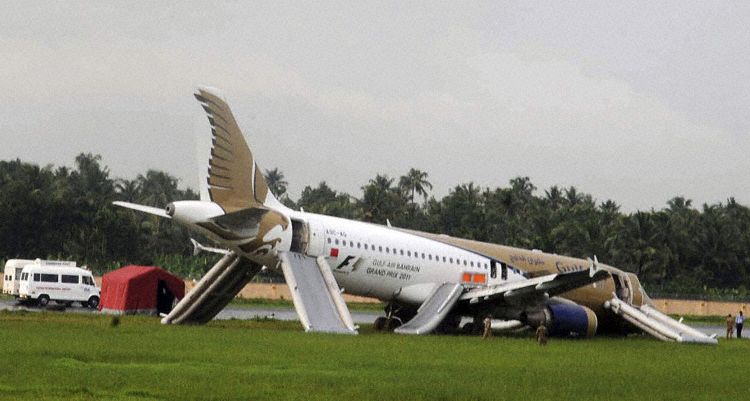
A picture tells this story. A night landing in light rain at
Cochin. The METAR reports suggest nothing unusual and just light winds.
Airplane leaves the runway. Nose wheel collapses. Passengers evacuated. One
serious injury; seven minor injuries.
The
Gulf News report is predictably sensational:
"Terrified passengers jumped out of a plane in India on
Monday after it skidded to halt on landing, trying to escape before
emergency ladders were put in place, officials said.
Seven passengers were injured in the pre-dawn incident when the Gulf Air
flight from Bahrain to Kochi in the southern Indian state of Kerala landed
badly in wet weather conditions and veered onto muddy grassland.
"The Bahrain-Kochi Airbus 320 shot 10 metres (30 feet) off the runway. Some
passengers in panic jumped out of the emergency exit before the ladders were
brought," A.C.K. Nair, Kochi Airport director, told Agencies.
"Because the nose of the plane was damaged the emergency (inflatable) ladder
did not work, so a rescue team started bringing ladders to the site. But
before they arrived, people began to jump."
"All those injured were injured because they jumped out too soon."
One passenger remained in hospital and the runway was closed for several
hours, Nair said.
"The preliminary investigation revealed bad weather and poor visibility
caused the accident," another airport official who declined to give his name
told Agencies.
Nair said 137 passengers were on board the flight. In May 2010, a passenger
jet overshot the runway in the south Indian city of Mangalore, killing 158
people in the country's worst aviation disaster since 1996."
There is no indication in the pictures of any ladders; the
inflatable slides seem to have deployed normally and "bad weather and poor
visibility" are not indicated by the METARs and do not on their own cause an
accident!
Picture from AP.
We're all terror suspects now
29 August 2011 Pico Iyer for The Guardian
I'm sitting in the expansive spaces of Renzo Piano's four-storey airport
outside Osaka, sipping an Awake tea from Starbucks and waiting for my bus
home. I've chosen to live in Japan for the past 20 years, and I know its
rites as I know the way I need tea when feeling displaced, or to head for a
righthand window seat as soon as I enter a bus. A small, round-faced
Japanese man in his early 30s, accompanied by a tall and somewhat cadaverous
man of the same age, approaches me.
"Excuse me," says the small, friendly seeming one; they look like newborn
salarymen in their not-quite-perfect suits. "May I see your passport?"
When I look up, surprised, he flashes me a badge showing that he's a
plainclothes police officer. Dazed after crossing 16 time zones (from
California), I hand him my British passport.
"What are you doing in Japan?"
"I'm writing about it." I pull out my business card with the red embossed
logo of Time magazine.
"Time magazine?" says the smiling cop, strangely impressed. "He works for
Time magazine," he explains to his lanky and impassive partner. "Very famous
magazine," he assures me. "High prestige!"
Then he asks for my address and phone number and where I plan to be for the
next 89 days. "If there is some unfortunate incident," he explains, "some
terrorist attack" (he's sotto voce now), "then we will know you did it."
Six months later, I fly back to the country I love once more. This time I
need to withdraw some yen from an ATM as I stumble out of my trans-Pacific
plane, in order to pay for my bus home.
"You're getting some money?" says an attractive young Japanese woman,
suddenly appearing beside me with a smile.
"I am. To go back to my apartment."
"You live here?" Few Japanese women have ever come up to me in public, let
alone without an introduction, and shown such interest.
"I do."
"May I see your passport?" she asks sweetly, flashing a badge at me, much as
the pair of questioners had done two seasons before.
"Just security," she says, anxious not to put me out, as my Japanese
neighbours stream, unconcerned, towards the Gakuenmae bus that's about to
pull out of its bay.
I tell my friends back in California about these small disruptions and they
look much too knowing. It's 9/11, they assure me. Over the past decade,
security has tightened around the world, which means that insecurity has
increased proportionally. Indeed, in recent years Japan has introduced
fingerprinting for all foreign visitors arriving at its airports, and takes
photographs of every outsider coming across its borders; a large banner on
the wall behind the immigration officers in Osaka – as angry-looking with
its red-and-black hand-lettering as a student banner – explains the need for
heightened measures in the wake of threats to national order.
But the truth of the matter is that, for those of us with darker skins, and
from nations not materially privileged, it was ever thus. When I was 18, I
was held in custody in Panama's airport (because of the Indian passport I
then carried) and denied formal entry to the nation, while the roguish
English friend from high school with whom I was travelling was free to enter
with impunity and savour all the dubious pleasures of the Canal Zone. On my
way into Hong Kong – a transit lounge of a city if ever there was one, a
duty-free zone whose only laws seem to be those of the marketplace – I was
hauled into a special cabin for a lengthy interrogation because my face was
deemed not to match my (by then British) passport. In Japan I was
stripsearched every time I returned to the country, three or four times a
year – my lifelong tan moving the authorities to assume that I must be
either Saddam Hussein's cousin or an illegal Iranian (or, worst of all, what
I really am, a wandering soul with Indian forebears). Once I was sent to a
small room in Tokyo reserved for anyone of South Asian ancestry (where
bejewelled women in saris loudly complained in exaggerated Oxbridge accents
about being taken for common criminals).
Another time, long before my Japanese neighbours had heard of Osama bin
Laden, I was even detained on my way out of Osaka – and the British Embassy
hastily faxed on a Sunday night – as if any male with brown skin, passable
English and a look of shabby quasi-respectability must be doing something
wrong if he's crossing a border.
But now, having learned over decades to accept such indignities or
injustices, I walk into a chorus of complaints every time I return to
California, from my pale-skinned, affluent neighbours. They're patting us
down now, my friends object, and they're confiscating our contact-lens
fluid. They're forcing us to travel with tiny tubes of toothpaste and moving
us to wear loafers when usually we'd prefer lace-ups. They're taking away
every bottle of water – but only after bottles of water have been shown to
be weapons of mass destruction; they're feeling us up with blue gloves, even
here in Santa Barbara, now that they know that underwear can be a lethal
weapon.
I listen to their grousing and think that the one thing the 9/11 attacks
have achieved, for those of us who spend too much time in airports, is to
make suspicion universal; fear and discomfort are equal-opportunity
employers now. The world is flat in ways the high-flying global
theoreticians don't always acknowledge; these days, even someone from the
materially fortunate parts of the world – a man with a ruddy complexion, a
woman in a Prada suit – is pulled aside for what is quixotically known as
"random screening".
It used to be that the rich corners of the world seemed relatively safe,
protected, and the poor ones too dangerous to enter. Now, the logic of the
terrorist attacks on New York and Washington has reversed all that. If
anything, it's the rich places that feel unsettled. It used to be that
officials would alight on people who look like me – from nations of need, in
worn jeans, bearing the passports of more prosperous countries – as likely
troublemakers; now they realise that even the well-born and well-dressed may
not always be well-intentioned.
I understand why my friends feel aggrieved to be treated as if they came
from Nigeria or Mexico or India. But I can't really mourn too much that
airports, since 9/11, have become places where everyone may be taken to be
guilty until proven innocent. The world is all mixed up these days, and
America can no longer claim immunity. On 12 September 2001, Le Monde ran its
now famous headline: We are all Americans. On 12 September 2011, it might
more usefully announce: We are all Indians.
Going Going
28 August 2011
The Economist
The climax of Libya’s six-month-old revolt was not only
televised via satellite but also text-messaged. Shortly after armed rebels
captured the state telecoms company during their entry into the capital,
Tripoli, on August 21st they sent a note to millions of mobile-phone users
saying “Long live free Libya”. Then they added the equivalent of $40 to all
accounts and restored the country’s internet connection, which had been cut
at the start of the rebellion.
Earlier in the day, thousands of fighters had rushed from the west and south
into the surprisingly lightly defended city, accompanied by television crews
and cheered on by dancing crowds. They were aided by rebels hiding in
suburbs, troops arriving by sea and NATO aircraft. In Green Square,
previously the scene of countless stage-managed rallies in support of the
old regime, Tripolitans tore down pictures of Colonel Muammar Qaddafi, their
ruler for the last 42 years and the world’s longest-reigning dictator.
Benghazi, the rebel capital at the other end of the country’s coastline, was
illuminated by fireworks as hundreds of thousands of people celebrated in
the streets (see article).
But the fight is not quite over. As The Economist went to press, troops
loyal to the dictator still resisted fiercely, using heavy weapons inside
Tripoli. They appear to be well-organised, even claiming that letting the
rebels into the city was a ploy. That seems unlikely. The rebels now control
large parts of the capital. The colonel is hemmed in. His rule has
undoubtedly ended. Men loyal to him control only a few towns across the
sparsely populated country. Aided by NATO, the rebels should be able to rout
them or negotiate a surrender.
The toppling of Colonel Qaddafi—no matter whether he is eventually tried,
killed or exiled—will be a boon to the Middle East and Western powers that
supported the rebels. The implications for Libya itself are less clear and
in part depend on whether Qaddafi loyalists will disperse and keep their
weapons or agree to disarm. To become a rule-based democracy—the stated goal
of all the various rebel groups—Libya must avoid an Iraqi-style insurgency,
as well as disputes among the new rulers.
Helpfully, Libya has no sectarian divide. Its society is relatively
homogeneous but grievances abound after four decades of oppression. Revenge
killings loom, as well as tribal conflicts and large-scale looting, given
the lack of physical security at the moment. The fall of Saddam Hussein in
Iraq and the Taliban in Afghanistan showed that a temporary power vacuum can
lead to long-term instability and undermine the formation of a functioning
state.
The impact of Libya’s liberation on the rest of the Arab world looks
clearer. What counts there is the dethronement of a tyrant. It will lift
spirits in Syria, where another reformist revolt is under way. It will also
give renewed drive to Egyptians and Tunisians who toppled their dictators
several months ago but have since been grappling with constitutional change.
Libya will inject new momentum into the Arab spring—raising hopes that
decades of stagnation and repression can be ended.
Libya will have an impact on NATO too. The military alliance that faced down
the Red Army might have been expected to crush the clumsy forces of Colonel
Qaddafi in days. Instead it took five months of fighting and 17,000 air
sorties. An embarrassment for NATO? Not at all. The alliance has had a good
war so far (who said “stalemate” not long ago?) and is winning the best kind
of victory given the circumstances: one achieved mostly by Libyans
themselves. Rebels entered the capital without a single Western soldier
visible on the ground (though there were some special forces). NATO air
attacks, as well as weapons supplied by friendly Gulf states, aided the
rebels. But they alone manned trenches, which will give them added
legitimacy in months to come.
The surprising length of the Libya campaign is a result of tactics employed
on both sides. The colonel managed to hold out until now because he fights
without restraint. This contrasts markedly with NATO. Its pilots have bombed
selectively, keeping collateral damage to a minimum. Despite what pro-regime
propagandists say, few civilians have been killed from the air. British and
French generals, who led the campaign, rightly paid much attention to the
interception of supplies to pro-Qaddafi forces, successfully weakening them
over time.
Most important, NATO avoided “mission creep”, the dread of modern military
forces. There is no sign so far that alliance ground troops will follow in
the path of pilots as they did in Afghanistan, where a 2001 air campaign
against the Taliban allowed a weak and divided opposition to take over, only
later to need rescuing. Libya may still require peacekeepers but nobody is
yet volunteering NATO for the task.
The moral and legal case for a limited intervention in Libya has not come
undone as many critics predicted, though that may change if the country
implodes under rebel control and the West is forced to deploy troops. In
March, when pro-Qaddafi forces threatened to annihilate Benghazi, Western
powers built a broad coalition to save it. Some squabbling inevitably
followed, but Americans, north Europeans, Turks and Gulf Arabs did not fall
out, as the colonel had hoped (and as they did over Iraq). Instead NATO
developed a new—and desperately needed—modus operandi.
Libya is the first alliance campaign where America took a back seat.
Europeans—with some shameful exceptions—carried most of the burden. This
division of labour, in select circumstances, could be a template for future
operations. But this does not mark the return of liberal interventionism.
The bitter lessons of Kabul and Baghdad will be remembered far longer than
any triumph in Tripoli.
What comes next? Many hands toppled Libya’s bombastic colonel. Even more
will be needed to clean up after him. The West has much technical expertise
to offer—for example to restore the country’s battered oil infrastructure.
The United Nations could send peace monitors to reassure Qaddafi supporters.
If needed, other Arab states should provide peacekeepers. In the meantime,
NATO might conduct a public investigation into the air campaign to show its
bombs killed few civilians.
As during the revolt, most heavy lifting now will be done by Libyans. The
first priority of the rebels-turned-rulers must be physical security to
stave off anarchy and looting. Next ought to come the formation of a truly
representative government, starting perhaps with a national forum of
community leaders from all regions to show inclusiveness. The rebels have
said all the right things about reconciliation. To show they mean it and to
lessen the chance of a pro-Qaddafi revolt, they should invite a few
loyalists to join their government.
At the same time, justice needs to be seen to be done to avoid disaffection
among rebel fighters who sacrificed much and will soon be asked to give up
cherished weapons. If caught alive, Colonel Qaddafi must be tried, either in
Libya or at the International Criminal Court in The Hague. On balance, the
first would be preferable: the more responsibility Libyans take for their
future, the better.
Qatar's Olympic 2020 bid
26 August 2011
Doha tonight confirmed that is to launch a bid for the 2020
Olympics and Paralympics, meaning that five cities are set to be involved in
the campaign.
It follows the announcement earlier today by the International Olympic
Committee (IOC) that they would allow Doha to host the event outside the
designated summer dates if they are successful.
Doha joins a field that already includes Istanbul, Madrid, Rome and Tokyo.
Cities are due to declare their candidacy before 1September 2011.
The IOC meets in Buenos Aires in September 2013 for what
could be an historic moment for the Olympic Movement and the Middle East.
Qatar is already hosting the 2022 World Cup.
This would mirror, hosts of the 2014 World Cup with Rio as
the 2016 Olympic City.
Doha had requested that if their bid was successful they would be allowed to
host the Olympics between September 20 and October 20 to avoid the searing
temperatures which, at its height, can average 106 degrees. It will still be
hot in September !
Four years ago, Doha's bid for 2016 was controversially cut from the
short-list because their proposed dates were outside the window that the IOC
had published.
They claimed that Rogge had led them to believe that they could host the
Games outside the window, just as Sydney had done in 2000 when they started
in September and finished in October.
The IOC changed the criteria for this contest and any cities who propose to
hold the Games outside the normal Olympic window of between July 15 and
August 31 had until July 29 to make their intentions known.
The QOC submitted a letter on July 28.
The United States revealed earlier this week that they would not be entering
the running.
There is precedent for a city shifting the Summer Games outside the
traditional July/August window; in 2000 the Sydney Olympics were held from
September 15 to October 1.
With Qatar's cash and a real need for the IOC to host a first middle east
Olympic Games the Qatar bid may well be successful. Spain, Italy and Japan
have all hosted previous Olympics. The Turkish challenge will be strong.
Is Scoot Air the new SQ brand?
26 August 2011
Singapore Airlines may be considering calling its new
no-frills low-cost subsidiary Scoot Airlines.
The domain name scootairlines.com was registered in Singapore by SIA's
advertising agency TBWA in late June, according to Flightglobal.
The Intellectual Property Office of Singapore, which is responsible for
Singapore-registered trade marks, said SIA's application indicates it plans
to use the brand name for airline and air travel services, reported Aviation
Week.
An SIA spokesman did not confirm nor deny the news.
"Several names have been under consideration but the management of the new
airline is not able to confirm details of the branding at this stage.
Details will be announced by the management of the new airline in due
course," said the SIA spokesman.
SIA announced in May that it will launch the new budget airline for medium
and long-haul routes within a year. The carrier, to be wholly-owned by SIA,
will be managed separately.
Mr Campbell Wilson, an SIA executive, was named CEO last month. He has
worked with the SIA Group for more than 15 years in places including Japan,
Canada and Hong Kong.
SIA said the new airline, expected to use some of its existing Boeing
777-200s, will enable the group to serve a largely untapped new market and
cater to the growing demand among consumers for low-fare travel.
It joins a growing number of low-cost carriers, such as Singapore-based
Jetstar Asia, owned by Qantas, and Malaysia's AirAsiaX, in introducing
low-fare flights to medium and long-haul routes.
Aviation Week said SIA's trademark application gives some insight into how
it may use the Scoot brand in the future. It said it wants the trade mark to
cover aircraft chartering, travel agency services, luggage storage services
and loyalty privileges among other things.
It is a bit of a silly name but the intent is clear; it needs
to be distinct from SQ, it needs to be understood internationally and
because it needs to cover all the ancillary services.
This brand name is also not limited to a specific geographic region. In
future if SIA wanted to launch a LCC in another country, say for example a
nation in Europe, then the Scoot brand would work in that market too.
It is important to SQ to brand the LCC in such a way that it is distinctly
different to SIA mainline. The Scoot brand name should achieve that
objective. It still sounds a bit juvenile. I liked Delta's Song better. But
at least it is not another animal and it is not Singapore specific.
Fly Dubai seeks Belgrade rights
26 August 2011
The low cost airline Flydubai has applied for a license to
commence 4 weekly flights to Belgrade. The service from Dubai will commence
in the first week of November. The no frills airline would be in direct
competition with Jat Airways which is scheduled to operate 3 weekly flights
from the Serbian capital to Dubai during the 2011/12 winter season. Dubai
has been one of Jat’s signature routes and carries mostly transit passengers
to and from Australia and New Zealand in cooperation with Emirates Airlines,
made possible through a Special Prorate Agreement the two airlines have.
Flydubai, which flies out of Dubai’s terminal 2, operates mostly to the
Middle East and West Asia region although has recently begun expanding into
Russia and Ukraine. It was created by the Government of Dubai and although
it is not a subsidiary of Emirates Airlines, the two are tightly knitted.
Flydubai will operate its flights non stop to Belgrade with a Boeing
737-800. Jat operates its flight to Dubai via Larnaca in Cyprus, making the
route profitable thanks to the large amounts of passengers flying to the
Cypriot city.
Now this is a long trip on a 737, and for a turnaround. It is
also a route that might have suited Emirates; but maybe the a A330s have to
much capacity for this route as a start up. Provided that fly dubai can
market connections onto Emirates international fleet this route should
Should I or not ?
26 August 2011
Question of the day. Do I need a long putter.
The problem is the yips. These affect too many golfers and
are a nervous affliction in which the person putting cannot make short putts
due to the inability to create a smooth putting stroke.
Usually, "the yips" take the form of jerking the putt to one
side or pushing the putt to the other. It's usually felt by the golfer as a
nerve-tingling experience in which he or she feels unable to be steady over
the ball.
Exactly. Worse at the start of the round it can be an
inability to grip the putter at all - let alone make a decent putting
stroke.
But one cure now enjoying wide acceptance is the long putter.
Even Michelle Wie is using one; maybe to go with those long legs!
It used to be that long putters were for old guys. You know, golfers on the
Champions Tour, such as Orville Moody or Bruce Lietzke. Times have changed.
In the past three weeks on the PGA Tour, Adam Scott, 31; Keegan Bradley, 25;
and Webb Simpson, 26, have won using either a long putter or a belly putter.
Bradley's PGA Championship win was the first time a major winner has won
using a belly putter. It was historic enough for the World Golf Hall of Fame
to request a replica of the putter to display. Overall, six PGA tournaments
have been won by players using belly or long putters this year. They are not
just for old guys anymore.
The belly putter
It's called a belly putter because the end of the shaft is supposed to rest
on the belly. The typical length is between 30 and 40 inches, depending on
the player's size. A traditional putter is between 18 and 36 inches.
The idea is to have the end of the shaft rest on the belly button. The
player makes a pendulum-type motion, which takes the wrists out of the
equation.
Players still bend over to use the belly putter and hold it with the hands
together.
"You're trying to secure the end of your putter into your belly," said
Pasadena Country Club head professional Brian Lake, who wrote a book in 2008
titled Putt Like a Pro. "It creates a solid pivot point. They are securing
the end of the putter, which makes it a fixed pivot point. That makes the
pendulum motion so much smoother.''
Belly putters must be fitted so the end of the shaft fits into the belly and
the putter head lays flat on the ground. They can range in price from $30 to
$175.
"They must be custom-fit,'' Lake said, "not only because of the size of the
person but the girth of their belly.''
The long putter
Long putters should go up to the sternum. Either the right hand or the left
hand is placed on top of the shaft, and the other is placed lower on the
club. These putters are more for players who have back problems or like to
have their eyes farther above the putting line.
The swing required is more of a true pendulum swing. It eliminates wrist
hinge and shoulder turn, and it usually helps with the tricky 10- to 15-foot
putts. More time is needed to learn distance control for putts farther away.
The putters are generally between 37 and 66 inches long. Players should also
be fitted for long putters.
"You hold the club, generally, at your sternum,'' Lake said. "You hold your
thumb at the top of the putter grip, and that becomes the pivot point.''
Long putters can be a little more expensive, ranging from $50 to $425.
The question is whether these putters are fair and within the spirit of the
game or are they natural improvements.
The putters are legal. USGA rules say putters may not be shorter than 18
inches, but there is no limit to their length. The putter is the only club
with no length restriction.
Though the USGA has not limited the putter's length, it has ruled on putting
styles. In 1968, the USGA and the Royal and Ancient in Europe banned
croquet-style putting after Sam Snead tried it in an attempt to cure his
shaky putting. The rule-making groups determined it made putting too easy.
Keegan Bradley understands fuss about the long putters; "I get it, I
understand it," he said of the critical feedback. "But the belly putter is
part of my generation. For the purists, it's not and never will be. It's not
going away."
Michelle Wie has also adopted the long putter. Meanwhile Simpson and Bradley
are at the fore of the first real wave of players who have used the putter
for most of their golfing lives, and don't fully understand the stigma
discussion. To them, it's merely taking advantage of the best available
resources at hand, aesthetics be darned.
And that may be the answer.
ID card farce
25 August 2011
Expatriates and Emiratis will be fined Dh20 for each day they
do not possess an Emirates ID card from mid-October. mid-October 2011
apparently!
Residents will be penalised every day up to a total of Dh1,000. Fines will
also be imposed for delays in renewing the cards 30 days after they expire
and delays in reporting data changes 30 days after the change occurs.
The new fees for extra registration services were also outlined in Cabinet
decision No 25 for 2011, which was published on Thursday.
UAE residents who work in the private sector will now need to
renew their Emirates ID card every two years, rather than every three years.
The change is in line with the Ministry of Labour's new laws that shorten
the validity of work visas.
Abdul Aziz al Maamari, the public relations manager for the Emirates
Identity Authority (Eida), said the validity of ID cards for expatriates was
linked directly to the length of work visas. For Emiratis, the ID cards are
valid for five years.
Eida is finalising plans to issue the cards as people enter the country, and
when they renew residency visas. In Fujairah, Umm al Qaiwain and Ras al
Khaimah, officials already have begun registering new residents after they
complete preventive medical procedures for the work visa.
By the end of the year, registration for ID cards should be linked directly
to the visa process in all emirates, Mr al Maamari said.
Fees for renewing ID cards will not change. Residents will be charged Dh100
for each year their visa is valid, plus Dh20 for delivery. Emiratis renewing
their five-year-old IDs are charged Dh120.
The ID cards are mandatory for Emiratis to get a driving licence, and to
register and re-register a vehicle. For other residents, the ID card is
required only for new procedures — registering a vehicle for the first time
or applying for a driving licence.
The card will eventually be used as a regional passport, health card and a
credit card for government-related financial transactions.
At present the card is basically useless; many people do not
have one; or have not bothered to register for one. You pay an extra AED150
to convert the card to an e-gate; but mine does not work.
'Love is better than anger. Hope is better than fear’
23 August 2011
48 hours before his untimely death after a battle with cancer
Jack Layton wrote to his family, friends, his NDP party and to all
Canadians.
It was a letter than mirrored his long political career;
civil, literate, classy and eternally optimistic.
You did not have to agree with Jack Layton to respect him.
Even those who shared few of his political convictions appreciated the
passion with which he held them, the astute political judgment that helped
him advance them, and the principled foundations on which they rested.
Jack Layton was the leader of the ordinary man and woman; he championed
fairness and decency, respect and social justice.
He smiled, he hoped, he dreamed. And Canada is a poorer
country for his passing.
This is the text of his farewell letter:
August 20, 2011
Toronto, Ontario
Dear Friends,
Tens of thousands of Canadians have written to me in recent weeks to wish me
well. I want to thank each and every one of you for your thoughtful,
inspiring and often beautiful notes, cards and gifts. Your spirit and love
have lit up my home, my spirit, and my determination.
Unfortunately my treatment has not worked out as I hoped. So I am giving
this letter to my partner Olivia to share with you in the circumstance in
which I cannot continue.
I recommend that Hull-Aylmer MP Nycole Turmel continue her work as our
interim leader until a permanent successor is elected.
I recommend the party hold a leadership vote as early as possible in the New
Year, on approximately the same timelines as in 2003, so that our new leader
has ample time to reconsolidate our team, renew our party and our program,
and move forward towards the next election.
A few additional thoughts:
To other Canadians who are on journeys to defeat cancer and to live their
lives, I say this: please don’t be discouraged that my own journey hasn’t
gone as well as I had hoped. You must not lose your own hope. Treatments and
therapies have never been better in the face of this disease. You have every
reason to be optimistic, determined, and focused on the future. My only
other advice is to cherish every moment with those you love at every stage
of your journey, as I have done this summer.
To the members of my party: we’ve done remarkable things together in the
past eight years. It has been a privilege to lead the New Democratic Party
and I am most grateful for your confidence, your support, and the endless
hours of volunteer commitment you have devoted to our cause. There will be
those who will try to persuade you to give up our cause. But that cause is
much bigger than any one leader. Answer them by recommitting with energy and
determination to our work. Remember our proud history of social justice,
universal health care, public pensions and making sure no one is left
behind. Let’s continue to move forward. Let’s demonstrate in everything we
do in the four years before us that we are ready to serve our beloved Canada
as its next government.
To the members of our parliamentary caucus: I have been privileged to work
with each and every one of you. Our caucus meetings were always the
highlight of my week. It has been my role to ask a great deal from you. And
now I am going to do so again. Canadians will be closely watching you in the
months to come. Colleagues, I know you will make the tens of thousands of
members of our party proud of you by demonstrating the same seamless
teamwork and solidarity that has earned us the confidence of millions of
Canadians in the recent election.
To my fellow Quebecers: On May 2nd, you made an historic decision. You
decided that the way to replace Canada’s Conservative federal government
with something better was by working together in partnership with
progressive-minded Canadians across the country. You made the right decision
then; it is still the right decision today; and it will be the right
decision right through to the next election, when we will succeed, together.
You have elected a superb team of New Democrats to Parliament. They are
going to be doing remarkable things in the years to come to make this
country better for us all.
To young Canadians: All my life I have worked to make things better. Hope
and optimism have defined my political career, and I continue to be hopeful
and optimistic about Canada. Young people have been a great source of
inspiration for me. I have met and talked with so many of you about your
dreams, your frustrations, and your ideas for change. More and more, you are
engaging in politics because you want to change things for the better. Many
of you have placed your trust in our party. As my time in political life
draws to a close I want to share with you my belief in your power to change
this country and this world. There are great challenges before you, from the
overwhelming nature of climate change to the unfairness of an economy that
excludes so many from our collective wealth, and the changes necessary to
build a more inclusive and generous Canada. I believe in you. Your energy,
your vision, your passion for justice are exactly what this country needs
today. You need to be at the heart of our economy, our political life, and
our plans for the present and the future.
And finally, to all Canadians: Canada is a great country, one of the hopes
of the world. We can be a better one – a country of greater equality,
justice, and opportunity. We can build a prosperous economy and a society
that shares its benefits more fairly. We can look after our seniors. We can
offer better futures for our children. We can do our part to save the
world’s environment. We can restore our good name in the world. We can do
all of these things because we finally have a party system at the national
level where there are real choices; where your vote matters; where working
for change can actually bring about change. In the months and years to come,
New Democrats will put a compelling new alternative to you. My colleagues in
our party are an impressive, committed team. Give them a careful hearing;
consider the alternatives; and consider that we can be a better, fairer,
more equal country by working together. Don’t let them tell you it can’t be
done.
My friends, love is better than anger. Hope is better than fear. Optimism is
better than despair. So let us be loving, hopeful and optimistic. And we’ll
change the world.
All my very best,
Jack Layton
Thai's silly name airline
21 August 2011
Proof if ever that branding should be left to professionals.
Thai Airways (THAI) has announced the creation of a sub-brand airline
called Thai Smile yesterday.
Ampon Kittiampon, chairman of the airline's board, said the
board had approved the establishment of the airline.
Thai Smile will start flying in July next year. Mr Ampon characterised it as
a light-premium airline segmented between full-service and low-cost.
The name supersedes an earlier choice Thai Wings, after staff
were given the chance to vote on their preference. There were apparently
2,229 entries in the naming contest and the board clearly chose one of the
daftest suggestions.
He said Thai Smile will operate using THAI's TG airline code
with 11 Airbus A320 planes in its fleet, four of which are slated for
delivery next year.
Thai Smile will apparently not affect THAI's plans to also launch Thai Tiger
Airways (TTA), a discount carrier in partnership with Singapore's Tiger
Airways, which will materialise ''as soon as possible''. Or it may never
happen as there appears to be no progress on this.
Thai Airways said that Thai Smile and TTA will not undercut each other
because they are seeking different groups of customers. THAI also operates
another budget airline, Nok Air. Confused?
Woranate Laprabang, THAI executive vice-president for new airline units,
said Thai Smile would initially fly short-haul flights one to two hours from
Bangkok.
Flights on high-traffic routes will be frequent and schedules made
convenient for passengers connecting to THAI flights.
In the first year of operation, Thai Smile will fly to Ubon Ratchathani,
Udon Thani, Khon Kaen, Chiang Rai and Surat Thani. In 2013, the airline will
begin operating short-haul international routes within Asean, and to India
and China. So the airline competes with Nok and Thai Air Asia. And becomes
the Thai Airways domestic service.
Thai Smile will offer a meal service, free baggage allowances and mileage
accrual, he said. Tickets will be sold mainly online
Time for mouldy old fourth Major to change
17 August 2011
Mark Reason for Stuff.co.nz
Reason is spot on with this article - the
US PGA is a bore. Worse still it is the third of three majors in 8 weeks.
And this year (and most years) it is some of the dullest sport on
television. Sadly this is not likely to change in a hurry - a fifth major is
more likely than the USA giving up one of its major tournaments.
"There in the back of the fridge lies the US PGA
Championship, pumped full of water and vitamins and preservatives, but still
rotting away.
Nearly everyone in golf knows that the fourth major is past its sell by
date.
So will someone please get off their vast, corporate behind and bin the
mouldy old tournament.
That man is unlikely to be Allen Wronowski, the current president of the PGA
of America. Mr Wronowski's waist band may well be large enough to circle the
earth which is more than the occupant looks capable of doing.
The president is likely a very agreeable fellow - the US PGA has always been
the most hospitable of the majors - but Wronowski's days as a man of action
look behind him.
What a strange tableau it was at the denouement of golf's fourth major.
There was the vasty Wronowski presenting the oversized Wanamaker trophy to
the slender Keegan Bradley, a man who seemed to have been born without
buttocks.
Was this a sports broadcast or some weird diet plan commercial?
The undernourished Bradley cried after holing the winning putt, as seems
almost de rigueur for young America these days, and the TV audience was also
overcome by emotion.
"Why, oh why," we sobbed, "have we spent the last three hours of our lives
watching a barely mobile dumpling called Jason Dufner blow a five shot lead
to a man with two surnames?"
It's the sort of question that has become commonplace in the recent history
of the US PGA, or "glory's last shot" as it likes to style itself.
As one scribe noted, the PGA seems to have morphed into a competition to
find "the world's khakiest man."
It is not as if golf's majors have a long and 'storied history', as TV
America likes to dub it, or 'history' as we say in the English speaking
world.
The initial Grand Slam of golf consisted of the Open Championship, the
Amateur Championship, the US Open and the US Amateur.
Many of the previous winners of the US PGA Championship - first played in
the middle of World War I and therefore not open to the thousands of golfers
who were dying on the Somme - had no idea that they would subsequently be
granted a 'major' victory.
Although the International Lawn Tennis Federation came up with the idea of
an official Grand Slam in 1925, the modern quartet of golf majors is
uncertain in its history.
Certainly the American pros once considered the Western Open a far more
significant and lucrative event than the Open Championship.
The idea that the US PGA Championship is part of golf's grand history is
just poppycock. It initially began as a matchplay championship, sponsored by
the owner of a big department store, to enrich the likes of Walter Hagen and
only switched to its current 72 hole strokeplay format in 1958.
The US PGA has largely ignored history. It kept going through all but one of
the years of the Second World War. Defeating Naziism at that time was a
major victory. Winning a restricted golf tournament on the other side of the
Atlantic was not.
Let's see the US PGA for what it is, another American golf jamboree founded
on the whim of a very rich man and shoehorned into history by a
self-interested group of equipment salesmen, professional golfers and
American media.
We can do so much better than that. If a combination of Asian TV networks
and corporate interests like HSBC and Sony could come up with enough dosh,
surely a new Oriental Open could replace the moribund US PGA.
America's influence is waning on and off the course as Tiger and Wall Street
crash together.
Yes, Asia would be buying a major, but that is the way of professional
sport. It is how the US PGA started and the Ryder Cup and many of golf's
premier events.
And as Asia is already joined with New Zealand, Australia and South Africa
in the President's Cup, maybe the fourth major could also come to these
shores every now and again.
It is anachronistic for America still to stage three of the game's majors.
We could build a statue to the 'unknown golfer' and place it in a square in
Middle America to commemorate the passing of the US PGA and American heroes
like David Toms, Larry Nelson and Keegan Bradley, khaki Confederates who all
won glory's last shot in Atlanta.
This year's US PGA was the first major to be won by a belly putter. Uggh.
It's time to move on. It's time to make golf the global game it pretends to
be.
Thaksin's travels are bad luck for Yingluck
17 August 2011
The Thai newspapers are full of news about Thaksin Shinawatra
starting to travel again....and whether the Thai government is assisting his
travel.
All this does is give Thaksin the attention he craves, rather
than allowing Yingluck to start doing the job for which she was elected.
As for his Japan trip this month, Foreign Minister Surapong
says it was the Japanese who requested the meeting with him. The Japanese
then wanted to sound out the new government on what their view on Thaksin
traveling to Japan was and whether their position had changed from the
Abhisit government.
Once Surapong gave the all-clear and asked the Japanese help,
the Japanese issued a visa in Dubai - apparently in Thaksin's Montenegren
passport.
William Pesek at Bloomberg interprets Thaksin’s Japanese trip to signal that
the new Yingluck government will look at bringing Thaksin home sooner than
expected.
We don’t know the real reason why Thaksin went to Japan, but
Japan is not the only country that Thaksin has gone to recently. He also
went to Germany. In doing so Thaksin gave a message to Abhisit and Kasit
saying I can now visit theses countries; which may also send a message
(whether accurate or just perceived) on how outsiders view Thaksin and his
conviction.
The trouble is that Thaksin has created an awkward position for the Yingluck
government, in particular for Surapong who is facing enough problems because
of his lack of direct experience in foreign affairs.
Thaksin wants to travel to say that he is not a criminal.
This is his doing it is not Puea Thai who I suspect would prefer Thaksin to
take a lower profile for some time.
A year of campaigning
13 August 2011
And so it starts. 15 months of expensive, wasteful
campaigning until the November 2012 Presidential election.
If feels like only months since Obama's January 2009
inauguration. Maybe it only feels like months because so little has been
achieved; and hope has turned to stagnation.
I always thought Obama was a shoe-in for a two term
presidency. Sadly the Republican forces are massing; and they are
invigorated by mid term elections that gave them control of the lower house
and by Obama's perceived failure to deliver. This of course fails to
acknowledge the lousy hand that he inherited from eight years of George
Bush.
Now it looks increasingly likely that the Texas Governor, Rick Perry, will
go head to head with Mitt Romney, former Massachusetts Governor, in seeking
the Republican nomination to take on Barack Obama. The only unknown is
whether the divisive Sarah Palin will join the race.
Perry, who has been labelled "Bush on steroids", is to formally announce
that he is standing on Saturday at a conservative conference in Charleston,
while Romney emerged unscathed from a debate of the presidential candidates
in Iowa on Thursday night.
The two are likely to leave the rest of the crowded field behind.
Palin kept speculation alive by putting in an appearance at the Iowa state
fair, an agricultural show where the candidates were scheduled to make stump
speeches throughout Friday.
Head to head (from the Guardian)
Mitt Romney
Born: 12 March 1947
Background: privileged. He was brought up in Michigan, where his father was
governor.
Religion: Mormon. May be a problem for him with some Christian evangelicals
suspicious of his beliefs.
Political experience: Governor of Massachusetts from 2003.
Political beliefs: In order to get elected and to govern Massachusetts, one
of the most liberal states in America, he moved to the centre, and
introduced health reforms similar to those later brought in by Barack Obama.
He has since shifted to the right.
Strengths: He has a large personal fortune that he can tap. He will also
benefit from the tendency in the Republican party to give the top spot to
previous runners-up - he lost out to John McCain in the 2008 election.
Weaknesses: Poor speaker, lifeless, with one cliche followed quickly by
another. Seen as "flip-flopper", switching beliefs for electoral
convenience.
Rick Perry
Born: 4 March 1950
Background: Son of relatively poor ranchers in Paint Creek, near Abilene,
Texas. Served as captain in the air force.
Religion: Methodist and part-time preacher who organised 30,0000-strong
prayer rally in Houston, Texas, last weekend. Can expect support of large
bloc of Christian evangelicals, who have a lot of sway in Republican
politics.
Political experience: In third term as governor of Texas.
Political beliefs: Began as a Democrat but quit in 1989 and is now a solid
Republican rightwinger.
Strengths: Unemployment is the number one issue in America and, while he has
been governor, Texas has accounted for at least a quarter of all job growth
in the US. He is a good, natural speaker and has a rough-hewn charisma.
Weaknesses: The Texas job growth has been partly because of strong
anti-union laws that encouraged companies to move from elsewhere in US. His
views on social issues such as opposition to same-sex marriages, while
appealing to some Christian evangelicals, will alienate some. One of his
biggest drawbacks is whether American voters, just four years after the Bush
presidency, are ready for another rightwing Texan.
Cameron's idiotic position on social networks
13 August 2011
How sad is this: China's official Xinhua newswire has used
the British PM's remarks to justify China's own web censorship. The Xinhua
headline was "Britain's U-turn over web-monitoring."
And this is some of the Xinhua article:
"BEIJING, Aug. 12 (Xinhua) -- Following days of violent riots in Britain,
speculation has grown as to why and how the trouble spread so rapidly.
Apparently the rioters used social media, like Twitter, Facebook and the
Blackberry messenger system and Prime Minister David Cameron said Thursday
he's looking at banning potential troublemakers from using the online
services.
The British government, once an ardent advocate of absolute Internet
freedom, has thus made a U-turn over its stance towards web-monitoring.
Learning a hard lesson from bitter experience, the British government
eventually recognized that a balance needs to be struck between freedom and
the monitoring of social media tools.
Cameron himself admitted that the "free flow of information can be used for
good. But it can also be used for ill."
For the benefit of the general public, proper web-monitoring
is legitimate and necessary."
Oh dear. People are rioting; lets cut off all freedom of
speech and expression. Better still; lets shut down government. Mr Cameron’s
high-profile backbencher Louise Mensch instead advocates simply pulling the
plug on Facebook, Twitter and BBM when trouble strikes. Aside from the
uncomfortable comparisons with Hosni Mubarak’s Egypt that this invites, it
brings its own technical and legal challenges.
Sorry but any attempt to exert state control over social
media will fail. Bad things happen when governments take advantage of fear
and instability to restrict freedom of speech.
Social media tools don't cause, fuel or incite rioting. They're neither a
force for good nor a force for evil. They are simply communication tools.
Replace "social media" with "telephone" to get a sense of how ridiculous
these statements will seem in 20 years. "How the telephone fuelled Britain's
first 21st century riot." "Rioting thugs call each other on the telephone to
boost their number in thieving store raids." "When people are using the
telephone for violence we need to stop them."
To be fair, (and the Chinese did warp his words) Cameron didn't suggest a
total web and social media blackout, like the one imposed on Egypt during
the recent revolution. What he's considering is putting a stop to "people
communicating via these websites and services when we know they are plotting
violence, disorder and criminality."
But even a total web blackout wouldn't necessarily stop the rioting, just
like it didn't stop the revolution in Egypt. Spot-blocking suspected rioters
would also eliminate a crucial form of evidence.
If Cameron follows through on his proposal, it may prove totally
ineffective, even counterproductive. What he would certainly accomplish is a
serious and frightening erosion of free speech. In the long run, that's even
more disturbing than the riots.
Blowing a good career
13 August 2011
Cathay Pacific has confirmed that the two employees caught in
a set of Internet photos apparently engaging in oral sex on board an
aircraft have left the company.
The Hong Kong carrier launched an investigation last week after photos
emerged of a woman in a Cathay cabin crew uniform performing oral sex on a
man, reportedly her boyfriend, on board an aircraft.
"I can confirm that two members of our crew shown in compromising situations
in photographs published recently in Chinese-language daily newspapers are
no longer employees of the company," Cathay chief executive John Slosar said
in a statement released late on Friday.
"I know that many people were disturbed by the damage this incident caused
to the reputation of our cockpit and cabin crews."
It was not clear whether the pair were sacked or resigned voluntarily, as
the airline said it would not disclose details.
The airline also refused to say whether the incident took place in the
plane's cockpit, but said the investigation found no evidence to suggest the
act happened on any of its flights while airborne. Really? We are supposed
to swallow that ?
Cathay said the findings of the investigation would be submitted to the
city's aviation authorities.
The photos prompted action from the Hong Kong flag carrier after they were
circulated on an online forum for pilots and later attracted the attention
of local media.
The pilot told Apple Daily that the pictures were stolen from
his computer.
'Strategic partnership' or monopoly?
12 August 2011
I doubt Tony Fernandes at Air Asia truly saw the irony of his
twitter message last night. He was complaining about the Malaysian Airport
Authority monopoly that allows them to increase car parking charges by 67%.
Odd really, as he had only the previous day signed a so
called strategic agreement that will create a near monopoly in the Malaysian
skies.
Malaysian Airways, Firefly, Air Asia and Air Asia X control
between them 78% of all air traffic movements at Kuala Lumpur's
international airport. No one else even comes close.
The airlines, Malaysia Airlines, budget carrier Air Asia and
long-haul, low-cost operator AirAsia X have entered into a comprehensive
collaboration agreement. In many countries this would fall foul of
competition laws.
As part of the deal Tune Air and Khazanah Nasional Berhad,
the major shareholders of AirAsia and Malaysia Airlines respectively, have
agreed to acquire from each other existing shares of both companies. As a
result, Tune will hold 20.5 per cent of shares in Malaysia Airlines and
Khazanah will hold ten per cent of shares in AirAsia with a proposal to
double this stake to 20 per cent in the future.
“Broadly, the Collaboration Agreement enables Malaysia Airlines, AirAsia and
AirAsia X to respectively focus on business segments in which they are
capable of developing the most value,” say the carriers in a joint
statement.
What this means is that competitive routes will be cut and
fares increased. There is also talk of interlining.
The Collaboration Agreement will come into effect immediately upon its
execution and will remain in effect for a period of five years from the date
of signing with an option for a further five-year renewal.
Executives at the airlines have denied their new agreement will lead to
major network changes, but there must be some level of rationalisation,
especially in the domestic market.
According to the latest schedule data, the airlines’ networks
overlap directly on 38 routes, while there are some indirect synergies in
some markets. These include London, where Malaysia Airlines serves Heathrow
and Air Asia X flies to Stansted (Gatwick from the end of October) and Paris
where Malaysia Airlines flies to CDG and Air Asia X to Orly airports.
So where there used to be fierce competitors MAS and Air Asia have chosen to
collaborate instead. Consumers will be the losers.
Expect higher ticket prices, less frequent flights, poorer
service levels and reduced job prospects.
The growth of Air Asia which broke MAS’ dominance of Malaysian air travel
gave millions of Malaysians the opportunity to fly. The competition
introduced by Air Asia resulted in in more connectivity, choice and jobs for
Malaysians.
As the airlines competed, Malaysians got the opportunity to fly to more
destinations, more frequently and at cheaper prices.
In the process, MAS itself introduced yet another new airline – community
carrier Firefly, whose turbo-prop planes opened up yet more destinations and
more choice at reasonable prices.
It is not just consumers who benefited. Working Malaysians also benefited.
Those in the airline industry – whether flight crew, or cabin crew or ground
services and other support personnel – now had a choice of employers. And
the millions of new passengers flying around also contributed to economic
growth across the country as they consumed other goods and services during
their travels.
The new collaboration will end much of this.
Maybe all this is aimed at saving the national carrier, MAS. But it is bad
news for Malaysian consumers and I think damages Fernandes who has long
portrayed himself as a champion of the consumer. Everyone can fly will be
Some can fly at a price.
The moral decay of our society is as bad at the top as the
bottom
12 August 2011 By
Peter Oborne
The Daily Telegraph
(This is a first - in ten years this is the first time I have referenced an
article from the UK's telegraph newspaper - it is known as the Torygraph for
a reason....but this article from their senior political editor is unusual.
Ok it continues to trumpet the Telegraph's ground breaking work on
government expense scandals - but it does go to the heart of what is rotten
in the state of England.)
David Cameron, Ed Miliband and the entire British political class came
together yesterday to denounce the rioters. They were of course right to say
that the actions of these looters, arsonists and muggers were abhorrent and
criminal, and that the police should be given more support.
But there was also something very phony and hypocritical about all the shock
and outrage expressed in parliament. MPs spoke about the week’s dreadful
events as if they were nothing to do with them.
I cannot accept that this is the case. Indeed, I believe that the
criminality in our streets cannot be dissociated from the moral
disintegration in the highest ranks of modern British society. The last two
decades have seen a terrifying decline in standards among the British
governing elite. It has become acceptable for our politicians to lie and to
cheat. An almost universal culture of selfishness and greed has grown up.
It is not just the feral youth of Tottenham who have forgotten they have
duties as well as rights. So have the feral rich of Chelsea and Kensington.
A few years ago, my wife and I went to a dinner party in a large house in
west London. A security guard prowled along the street outside, and there
was much talk of the “north-south divide”, which I took literally for a
while until I realised that my hosts were facetiously referring to the
difference between those who lived north and south of Kensington High
Street.
Most of the people in this very expensive street were every bit as
deracinated and cut off from the rest of Britain as the young, unemployed
men and women who have caused such terrible damage over the last few days.
For them, the repellent Financial Times magazine How to Spend It is a bible.
I’d guess that few of them bother to pay British tax if they can avoid it,
and that fewer still feel the sense of obligation to society that only a few
decades ago came naturally to the wealthy and better off.
Yet we celebrate people who live empty lives like this. A few weeks ago, I
noticed an item in a newspaper saying that the business tycoon Sir Richard
Branson was thinking of moving his headquarters to Switzerland. This move
was represented as a potential blow to the Chancellor of the Exchequer,
George Osborne, because it meant less tax revenue.
I couldn’t help thinking that in a sane and decent world such a move would
be a blow to Sir Richard, not the Chancellor. People would note that a
prominent and wealthy businessman was avoiding British tax and think less of
him. Instead, he has a knighthood and is widely feted. The same is true of
the brilliant retailer Sir Philip Green. Sir Philip’s businesses could never
survive but for Britain’s famous social and political stability, our
transport system to shift his goods and our schools to educate his workers.
Yet Sir Philip, who a few years ago sent an extraordinary £1 billion
dividend offshore, seems to have little intention of paying for much of
this. Why does nobody get angry or hold him culpable? I know that he employs
expensive tax lawyers and that everything he does is legal, but he surely
faces ethical and moral questions just as much as does a young thug who
breaks into one of Sir Philip’s shops and steals from it?
Our politicians – standing sanctimoniously on their hind legs in the Commons
yesterday – are just as bad. They have shown themselves prepared to ignore
common decency and, in some cases, to break the law. David Cameron is happy
to have some of the worst offenders in his Cabinet. Take the example of
Francis Maude, who is charged with tackling public sector waste – which
trade unions say is a euphemism for waging war on low‑paid workers. Yet Mr
Maude made tens of thousands of pounds by breaching the spirit, though not
the law, surrounding MPs’ allowances.
A great deal has been made over the past few days of the greed of the
rioters for consumer goods, not least by Rotherham MP Denis MacShane who
accurately remarked, “What the looters wanted was for a few minutes to enter
the world of Sloane Street consumption.” This from a man who notoriously
claimed £5,900 for eight laptops. Of course, as an MP he obtained these
laptops legally through his expenses.
Yesterday, the veteran Labour MP Gerald Kaufman asked the Prime Minister to
consider how these rioters can be “reclaimed” by society. Yes, this is
indeed the same Gerald Kaufman who submitted a claim for three months’
expenses totalling £14,301.60, which included £8,865 for a Bang & Olufsen
television.
Or take the Salford MP Hazel Blears, who has been loudly calling for
draconian action against the looters. I find it very hard to make any kind
of ethical distinction between Blears’s expense cheating and tax avoidance,
and the straight robbery carried out by the looters.
The Prime Minister showed no sign that he understood that something stank
about yesterday’s Commons debate. He spoke of morality, but only as
something which applies to the very poor: “We will restore a stronger sense
of morality and responsibility – in every town, in every street and in every
estate.” He appeared not to grasp that this should apply to the rich and
powerful as well.
The tragic truth is that Mr Cameron is himself guilty of failing this test.
It is scarcely six weeks since he jauntily turned up at the News
International summer party, even though the media group was at the time
subject to not one but two police investigations. Even more notoriously, he
awarded a senior Downing Street job to the former News of the World editor
Andy Coulson, even though he knew at the time that Coulson had resigned
after criminal acts were committed under his editorship. The Prime Minister
excused his wretched judgment by proclaiming that “everybody deserves a
second chance”. It was very telling yesterday that he did not talk of second
chances as he pledged exemplary punishment for the rioters and looters.
These double standards from Downing Street are symptomatic of widespread
double standards at the very top of our society. It should be stressed that
most people (including, I know, Telegraph readers) continue to believe in
honesty, decency, hard work, and putting back into society at least as much
as they take out.
But there are those who do not. Certainly, the so-called feral youth seem
oblivious to decency and morality. But so are the venal rich and powerful –
too many of our bankers, footballers, wealthy businessmen and politicians.
Of course, most of them are smart and wealthy enough to make sure that they
obey the law. That cannot be said of the sad young men and women, without
hope or aspiration, who have caused such mayhem and chaos over the past few
days. But the rioters have this defence: they are just following the example
set by senior and respected figures in society. Let’s bear in mind that many
of the youths in our inner cities have never been trained in decent values.
All they have ever known is barbarism. Our politicians and bankers, in sharp
contrast, tend to have been to good schools and universities and to have
been given every opportunity in life.
Something has gone horribly wrong in Britain. If we are ever to confront the
problems which have been exposed in the past week, it is essential to bear
in mind that they do not only exist in inner-city housing estates.
The culture of greed and impunity we are witnessing on our TV screens
stretches right up into corporate boardrooms and the Cabinet. It embraces
the police and large parts of our media. It is not just its damaged youth,
but Britain itself that needs a moral reformation.
Another rake on the problems facing Britain from Russell Brand in the
Guardian.
EK updates
12 August 2011
Tokyo Narita Increase from 5 weekly to Daily from 30OCT11.
77W operating. No more two or three day layovers in Tokyo; this will now be
a stay one night and come back the next day flight. Not sufficient time to
enjoy Tokyo.
The new Singapore flight (EK 354) will only be five weekly at first,
increasing to daily in February. Singapore service increases from 14 to 19
weekly (excluding the 1-stop via CMB) from 30OCT11, and then increase to 21
from 01FEB12. EK354/355 is the new flight, there is still no tag-on flight
despite the airplane sitting at SIN for a lengthy period of time. I still
think this flight will continue to Bali.
Is EK missing out on China?
11 August 2011
Qatar Airways has announced that on 28 November 2011it will
become the First Middle-Eastern carrier to launch service to Western China.
Qatar will offer 3 weekly Doha – Chongqing service, on board 2-class Airbus
A330-200 aircraft.
The schedule:
QR848 DOH0115 – 1305CKG 332 135
QR849 CKG0100 – 0500DOH 332 246
Etihad has already announced flights to Chengdu.
Emirates used to be the pioneer and other airlines would
follow. But EK appears focused on adding capacity to existing routes and
maybe opening new routes to the USA. But I am surprised that they are not
taking the initiative on Chengdu, Chongqing and Kunming.
Emirates' message to Airbus
11 August 2011
Air Transport World reports that Emirates Airline President
Tim Clark remains skeptical about the Airbus A350's operating performance,
and is particularly concerned about the A350-1000.
Clark has previously said that, according to the airline's calculations, the
-1000 needs a 105,000 lb. thrust engine to truly leapfrog the Boeing
777-300ER, which means a new fan and significant wing pylon and
undercarriage modifications. In an interview last week in Vienna, he told
ATW that the A350-900, which will be deployed on 85% of the routes EK plans
to utilize the A350, "will be a fine aircraft."
But he does not shy away from expressing his displeasure with the A350-1000
performance parameters outlined by Airbus at the Paris Air Show in June,
when it was revealed that Rolls-Royce is developing a higher thrust variant
of the Trent XWB engine that will power the aircraft. "In our view, the
aircraft is heavy and to deal with the extra weight, you've got increase the
thrust," he elaborated. "We believe that the specific fuel consumption gain
Rolls-Royce says the [-1000 will] have will be lost because of the extra
weight."
EK has 50 A350-900s and 20 -1000s on order, but Clark is concerned that the
-1000 won't meet the airline's needs. EK has not decided if it will still
take delivery of the aircraft or perhaps convert its A350-1000 orders to
-900s—or, worse from Airbus's perspective, cancel the orders in favor of a
potential next generation Boeing 777-300ER.
"I told Airbus I really want to see the aircraft flying," Clark said. "Let's
certify the A350-900 and then we'll decide what we are going to do. [Airbus]
still has to do work on [the -1000]."
Though he is more satisfied with the A350-900, Clark noted the aircraft is
heavy as well. But he said, "I think it will be okay. The aircraft will
replace all of our A330s, 777-200s and A340s. The only [concern] on the -900
is that it gives us just 274 seats in a three-class configuration. It will
be too small. We need 340 seats."
That us a pretty big concern for an aircraft that seems
critical to Emirates' future plans and that incidentally has still not
flown.
Why?
11 August 2011
The big question of the week. And one that has no simple
answer.
Thirty years on from the Brixton and Toxteth riots of 1981,
England's inner cities erupted this week in violence and looting.
There is always a catalyst for this sort on unrest. Something
that releases all the built up indignation and hatred. Once again it was an
allegation of police brutality. The Metropolitan Police has improved
significantly since the 1980s but its response to the shooting of Mark
Duggan in Tottenham by its Operation Trident team was inept. It was wrong
that Mr Duggan's family had to wait 36 hours to see his body and that
confusion over whether the suspect had fired at police was allowed to
spread.
The riot that exploded in Tottenham in response at the
weekend took place in an area with the highest unemployment in London, whose
youth clubs have been closed to meet a 75% cut in its youth services budget.
But that catalyst does not explain why the riots moved so quickly from
Tottenham to other London suburbs and then to other cities across the UK.
This suggests a far more complex and profound sense of social alienation.
The reaction of the British media, government and middle
England were fearfully predictable. Birching. Corporal punishment. Vigilante
groups. Newspaper headlines crying out "scum." Ministers calling for social
networks, used to organise and move protestors, to be closed down. Freedom
of speech and movement under assault. The mistake here is to blame the
medium and ignore the motive.
Prime Minister Cameron describes the behaviour of the youths as
"criminality, pure and simple" failing to consider "why?"
So what is going on? The riots are an uprising against the
coalition's spending cuts. Many of the cuts deemed responsible for the
violence have not even taken effect. They may in time make matters worse.
The answers are deep rooted in decades of history that have caused social
and economic deformities.
Simple view; education ends at 16; and for too many young people education
gives them nothing that they can use when they leave school too early at 16.
After school activities no longer exists. After school facilities are in
disrepair. Trades and apprenticeships that used to be the back bone of
British industry have been dramatically eroded.
Schools
close their doors at mid-afternoon, Monday to Friday. Extra-curricular
activities are out the window.
And forget university places:
these are being cut back under the weight of a tripling of
tuition fees. For richer kids or foreign students only.
Worse with both parents working, or single parent families,
kids are left to look after themselves, to roam with their mates looking for
the thrills that come from the protection of a pack.
Too many young people feel that have no stake in their
locality or their country. Youth crime is a problem for all developed
countries but, and inevitably the problem is worst in those societies in
which the gap between rich and poor is greatest.
There is universal condemnation of the looters. Businesses have been abused;
homes burned; lives terrorised. Desperately needed jobs have gone.
It is even admirable that people are ready to defend their neighbourhoods.
But it is too easy for these vigilante groups to be taken over by racist and
hate groups. Anarchy. There are good reasons why security is done by the
state. The police need the means and the public support to enable them, and
them alone, to do their job.
But to refuse to recognise the causes of the unrest is to
make it more likely to recur. Some of the media will not accept this. But
one trip through some of London's poorer suburbs or through the old
industrial cities of northern England reveal far too much about urban
deprivation.
Simple statistic; in the UK black people are 26 times more
likely to be stopped and searched by police than their white counterparts.
And just who are the country's real hooligans; government
support for Britain's banks has reached a staggering £850bn and the eventual
cost to taxpayers will not be known for years. Worse still, despite
salvaging the banks they are still issuing massive redundancy notices.
The National Audit Office (NAO) even revealed in 2009 that £107m will be
paid to City advisers called in to work on the rescue because the Treasury
was too "stretched" to cope with the sudden financial crisis which broke in
the autumn of last year. So the financial crisis really just lined the
pockets of the lawyers and bankers.
And what drove the banking crisis; massive cheap credit
fuelling greed and crazy consumerism. It is hardly a great surprise that the
people left out by that capitalist boom are the ones who now loot a phone or
a tv.
The demise of British industry and traditional trades is not
helped by government sponsored decision making;
controversy is raging over the government's decision to
appoint Siemens as the preferred bidder for the Thameslink Rolling Stock
Programme. The reserve bidder is Bombardier, based in Derby, which is the
last train manufacturer in Britain.
Bombardier's 3,000-strong workforce should now be celebrating the award of
this £1.4 billion contract guaranteeing work in Derby for the next four
years. Instead the government's apparent preference for German-built trains
has already resulted in Bombardier announcing nearly 1,500 job losses, with
more likely later this year.
For every job at Bombardier there are at least four more in its supply chain
companies, so these 1,500 job losses at Bombardier actually equate to 7,500.
That would be bad enough, but beyond the autumn, Bombardier only has enough
work for a few hundred people delivering a contract for London Underground.
The total impact on employment in the Derby area could ultimately be closer
to 14,000 job losses in the railway industry.
What can and should
the government do - simple - invest and employ people.
The government has cited commercial confidentiality as the reason for
refusing to give details about its claims that Siemens offered better value
for money.
The future of the British train-building industry with a proud tradition
stretching back more than 170 years hangs in the balance, as do the
livelihoods of thousands of Derby families.
Meanwhile, the latest phase of the economic crisis lurching
back and forth between the United States and Europe risks tipping austerity
Britain into slump or prolonged stagnation. So the spending cuts will be
here to stay. And too many young people will still be given no hope.
I am not arguing that economic hardship justifies looting -- to say that it
does is to insult the many young people and community leaders who strive to
overcome that hardship without resorting to crime. But it is also a mistake
to think that condemning the rioters is an alternative to trying to
understand them.
Understanding the cause is a complex task involving psychological, social,
and cultural factors. Take something as mundane as boredom: clearly it has
to be a factor? Many of the rioters are far younger than their counterparts
in the 1980s. Surveys of young people find 8 in 10 saying they have little
to do outside school, and no one is surprised when youth anti-social
behaviour and petty crime increase during the long summer holidays; this is
not a new problem but it is likely to get worse with the cuts to youth
services.
It is economic factors, however, which are the most significant. Again,
youth unemployment is not an excuse for criminality but does anyone believe
it is not a factor? Youth unemployment remains historically high at around
20 per cent and of course unemployment was even higher among young black
people, close to 50 per cent.
IPPR's research suggests that around ten
years ago, roughly one in ten of 18-24 year olds had been unemployed for a
year; according to the latest figures it is now one in four, and higher
still among young men.
For maybe the first time in British history there is a generation growing up
that will suffer for the rest of their working lives from poor job
prospects, low skills and repeated spells out of work.
The government's talks of tackling youth unemployment through private sector
economic growth. But that growth looks ever more fragile. At the same time
tuition fees are being increased, funding for colleges and skills training
has been cut, and the Education Maintenance Allowance has been abolished.
The young person's job guarantee, a temporary measure aimed at mitigating
the scarring effects of long term unemployment, has also been scrapped.
Unemployment is not an excuse. But what if government could announce a
guaranteed job at the minimum wage for all young people who have been out of
work for a year.
I was wondering why there have not been similar riots in the
economically depressed inner cities of the USA. One reason; most kids are
afforded the chance to join all manner of clubs and sports teams. Staying
behind after school isn’t abnormal or uncool, because peer pressure works in
that direction. Hours of evening and weekend activity keep school students
physically active and mentally stimulated. Granted, there are schools that
fail and pupils that fail – just like anywhere.
But in US cities you will not find bored teenagers habitually
roaming the streets. You are unlikely to hear this in the US: “Nobody is
doing nothing for us - not the politicians, not the cops, no one,” a
19-year-old who lives near Tottenham, the blighted London neighbourhood
where the riots started.
In 2008, there were more than 1 million reported cases of violent crimes in
England and Wales alone. By comparison, there were 331,778 reported
incidents in France and some 210,885 incidents in Germany. Violent crime
carried out by children and teenagers is also among the highest in Europe.
While business and families do not deserve their losses or to
be live in fear the reality is that the the UK deserves these riots; they
are the result of decades of complacency; of preserving the status quo and
of bailing out the undeserving.
Murdoch's headline writers call the rioters and looters
"morons", "thugs" and "idiots." I doubt they see the irony. Sadly.
"SWEEP SCUM OFF OUR STREETS" thundered the Express front page
confirming the Express as the lowest of the low.
Mall shambles
11 August 2011
Retailers in Dubai Mall's gold souk have been given just over
three weeks to close up their shops for renovations. The notice, which was
delivered a week ago has informed outlets in certain areas of the gold souk
that they have until September 4 to leave.
The Gulf News say that according to Chetan Dhakan, owner of National
Jewellery and two other shops in the gold souk, the renovations have been in
discussions for about a year now. This is the first time, however, that they
have received an official notice.
"We are not sure if this will happen for sure. They are always changing
their minds and there is talk that it might be delayed," said Dhakan.
He added that around 30 shops situated in certain areas of the gold souk,
such as Caravan Court, have been given notices.
The notices are unclear as to what kind of renovation will take place and
retailers have not yet been told what will happen to their shops after the
renovation and how long the work is expected to take.
"We have heard from others that they are going to break down the walls and
open up the entrances so it's more accessible, but we don't know exactly
what is happening," said Affan, a showroom manager at Mahallati Jewellery.
When contacted, Emaar, the developer behind Dubai Mall, was not available
for comment. I never understand this. You have issued the notice; you must
have a plan; what is wrong with being transparent and honest. Oops, my
mistake, we are talking about a Dubai developer. Transparancy and honestly
are not words they seem to understand.
Affan said this closure comes at an unfortunate time.
"Sales right now are slow, as they usually are at around this time of the
year. Our high season is after Eid and until December and we will lose those
months due to this renovation," he said.
To be fair to Emaar the Dubai Mall gold souk is a bit of a disaster. A walk
through the souq show many stores have already closed; and have left with
rent unpaid.
A retailer, who did not want to be named told the Gulf News
that a reason for the souk not doing well was its structure. "It's like a
maze and in a space with 270 outlets, there's not a single rest room. It's a
really bad design," he said.
At its launch, the gold souq was highlighted as one of the key attractions
of Dubai Mall.
Worse still for retailers is that they will face higher rent levels if they
are looking to renew their contracts. According to the retailer Gulf News
spoke to, shop owners have been informed contract renewals for another year
will entail hikes in rent and they will have to take up bigger retail spaces
than the smaller ones that are available now.
None of this sounds very promising for the retailers; the
souk or this part of the mall.
Anything for a dollar
9 August 2011
Bahrain has called in a Washington PR firm to tackle the
portrayal of this year's anti-government protests by foreign media
Qorvis Communications has been appointed; they list the Kingdom of Saudi
Arabia and Amazon.com among their clients.
Qorvis has already issued its first statement to the press on behalf of
Bahrain’s Ministry of Health, condemning a report from charity Medecins Sans
Frontieres that claimed its Bahrain office had been raided and one employee
arrested.
Qorvis Communications will be paid $40,000 per month in addition to expenses
for travel, production and accommodation, a contract signed by managing
partner, Michael Petruzzello and Bahrain’s Minister of Foreign Affairs,
Sheikh Khalid Bin Ahmed Bin Mohamed Al Khalifa.
Bahrain has repeatedly blames the unrest on outside forces seeking to
destabilise the country. The Gulf state this week accused Doha-based Al
Jazeera of “slander and lies” after it aired a documentary purporting to
show human rights abuses by government forces against activists.
In March, Bahrain's rulers imposed martial law and called in troops from
fellow Sunni-ruled Gulf neighbours to quell weeks of unrest led by mostly
Shi'ite protesters.
Sometimes people should simply turn down work. Earlier this year Huffington
Post reported that several Qorvis partners had departed the firm because, in
the words of one unnamed insider, "I just have trouble working with despotic
dictators killing their own people." Qorvis had previously worked for
Bahrain through another PR firm, Bell Pottinger.
Sad what some people will do for a lucrative contract.
Germany 'releases royal jet'
9 August 2011
The Bangkok Post reports that a court in Germany has released the Boeing 737
seized from HRH Crown Prince Maha Vajiralongkorn, according to former prime
minister Abhisit Vejjajiva.
Mr Abhisit told reporters the government has posted the full 38 million
euros bond demanded by Walter Bau company in an account to be controlled by
the German court.
As a result, the court released the jet.
Terms of the agreement were unclear, as was the role of Mr Abhisit.
The government used public money for the deal. The Crown Prince had earlier
offered to pay expenses of the legal fight, but Mr Abhisit told him it was a
civil matter and the government would cover the expenses.
Panic on the streets of London
9 August 2011 -
PennyRed
One of the best attempts to explain events from last night in
London and now across the UK - and an article that should be widely read:
"I’m huddled in the front room with some shell-shocked friends, watching my
city burn. The BBC is interchanging footage of blazing cars and running
street battles in Hackney, of police horses lining up in Lewisham, of
roiling infernos that were once shops and houses in Croydon and in Peckham.
Last night, Enfield, Walthamstow, Brixton and Wood Green were looted; there
have been hundreds of arrests and dozens of serious injuries, and it will be
a miracle if nobody dies tonight. This is the third consecutive night of
rioting in London, and the disorder has now spread to Leeds, Liverpool,
Bristol and Birmingham. Politicians and police officers who only hours ago
were making stony-faced statements about criminality are now simply begging
the young people of Britain’s inner cities to go home. Britain is a
tinderbox, and on Friday, somebody lit a match. How the hell did this
happen? And what are we going to do now?
In the scramble to comprehend the riots, every single commentator has opened
with a ritual condemnation of the violence, as if it were in any doubt that
arson, muggings and lootings are ugly occurrences. That much should be
obvious to anyone who is watching Croydon burn down on the BBC right now.
David Lammy, MP for Tottenham, called the disorder 'mindless, mindless'.
Nick Clegg denounced it as 'needless, opportunistic theft and violence'.
Speaking from his Tuscan holiday villa, Prime Minister David Cameron – who
has finally decided to return home to take charge - declared simply that the
social unrest searing through the poorest boroughs in the country was
"utterly unacceptable." The violence on the streets is being dismissed as
‘pure criminality,’ as the work of a ‘violent minority’, as ‘opportunism.’
This is madly insufficient. It is no way to talk about viral civil unrest.
Angry young people with nothing to do and little to lose are turning on
their own communities, and they cannot be stopped, and they know it.
Tonight, in one of the greatest cities in the world, society is ripping
itself apart.
Violence is rarely mindless. The politics of a burning building, a
smashed-in shop or a young man shot by police may be obscured even to those
who lit the rags or fired the gun, but the politics are there.
Unquestionably there is far, far more to these riots than the death of Mark
Duggan, whose shooting sparked off the unrest on Saturday, when two police
cars were set alight after a five-hour vigil at Tottenham police station. A
peaceful protest over the death of a man at police hands, in a community
where locals have been given every reason to mistrust the forces of law and
order, is one sort of political statement. Raiding shops for technology and
trainers that cost ten times as much as the benefits you’re no longer
entitled to is another. A co-ordinated, viral wave of civil unrest across
the poorest boroughs of Britain, with young people coming from across the
capital and the country to battle the police, is another.
Months of conjecture will follow these riots. Already, the internet is
teeming with racist vitriol and wild speculation. The truth is that very few
people know why this is happening. They don’t know, because they were not
watching these communities. Nobody has been watching Tottenham since the
television cameras drifted away after the Broadwater Farm riots of 1985.
Most of the people who will be writing, speaking and pontificating about the
disorder this weekend have absolutely no idea what it is like to grow up in
a community where there are no jobs, no space to live or move, and the
police are on the streets stopping-and-searching you as you come home from
school. The people who do will be waking up this week in the sure and
certain knowledge that after decades of being ignored and marginalised and
harassed by the police, after months of seeing any conceivable hope of a
better future confiscated, they are finally on the news. In one NBC report,
a young man in Tottenham was asked if rioting really achieved anything:
"Yes," said the young man. "You wouldn't be talking to me now if we didn't
riot, would you?"
"Two months ago we marched to Scotland Yard, more than 2,000 of us, all
blacks, and it was peaceful and calm and you know what? Not a word in the
press. Last night a bit of rioting and looting and look around you."
Eavesdropping from among the onlookers, I looked around. A dozen TV crews
and newspaper reporters interviewing the young men everywhere ‘’’
There are communities all over the country that nobody paid attention to
unless there had recently been a riot or a murdered child. Well, they’re
paying attention now.
Tonight in London, social order and the rule of law have broken down
entirely. The city has been brought to a standstill; it is not safe to go
out onto the streets, and where I am in Holloway, the violence is coming
closer. As I write, the looting and arson attacks have spread to at least
fifty different areas across the UK, including dozens in London, and
communities are now turning on each other, with the Guardian reporting on
rival gangs forming battle lines. It has become clear to the disenfranchised
young people of Britain, who feel that they have no stake in society and
nothing to lose, that they can do what they like tonight, and the police are
utterly unable to stop them. That is what riots are all about.
Riots are about power, and they are about catharsis. They are not about poor
parenting, or youth services being cut, or any of the other snap
explanations that media pundits have been trotting out: structural
inequalities, as a friend of mine remarked today, are not solved by a few
pool tables. People riot because it makes them feel powerful, even if only
for a night. People riot because they have spent their whole lives being
told that they are good for nothing, and they realise that together they can
do anything – literally, anything at all. People to whom respect has never
been shown riot because they feel they have little reason to show respect
themselves, and it spreads like fire on a warm summer night. And now people
have lost their homes, and the country is tearing itself apart.
Noone expected this. The so-called leaders who have taken three solid days
to return from their foreign holidays to a country in flames did not
anticipate this. The people running Britain had absolutely no clue how
desperate things had become. They thought that after thirty years of soaring
inequality, in the middle of a recession, they could take away the last
little things that gave people hope, the benefits, the jobs, the possibility
of higher education, the support structures, and nothing would happen. They
were wrong. And now my city is burning, and it will continue to burn until
we stop the blanket condemnations and blind conjecture and try to understand
just what has brought viral civil unrest to Britain. Let me give you a hint:
it ain’t Twitter.
I’m stuck in the house, now, with rioting going on just down the road in
Chalk Farm. Ealing and Clapham and Dalston are being trashed. Journalists
are being mugged and beaten in the streets, and the riot cops are in retreat
where they have appeared at all. Police stations are being set alight all
over the country. This morning, as the smoke begins to clear, those of us
who can sleep will wake up to a country in chaos. We will wake up to fear,
and to racism, and to condemnation on left and right, none of which will
stop this happening again, as the prospect of a second stock market clash
teeters terrifyingly at the bottom of the news reports. Now is the time when
we make our choices. Now is the time when we decide whether to descend into
hate, or to put prejudice aside and work together. Now is the time when we
decide what sort of country it is that we want to live in. Follow the #riotcleanup
hashtag on Twitter. And take care of one another."
Also worth reading - a surprisingly
sensible analysis from The Telegraph
China China China
8 August 2011
The East African
An interesting article in The East African asks simply: Why
are the Chinese taking over the whole of Kenya?
Here is the article:
"We certainly need development but we very certainly need to
be careful too! Why am I saying that? Because China has a great reputation
for ripping places off for their products and natural resources. They have
become known as just another capitalist oppressive developer! Without any of
the hassles of actually running a country! That’s why.
Oh — they are building a port in Lamu, bigger than Mombasa. They will use
all local labour and companies… BUT they have a reputation for bringing,
with them, everyone they need.
A well-known international development consultant, James Tomeko, tells me
that when they built the railway from Tanzania to Zambia, they even brought
all their own coolies, general workers and carriers, with them, too.
They built the roads through Nairobi and, almost the first thing they did,
was to demolish the brand new and very beautiful archway at the National
Museum. They could have gone around it! They could have negotiated and
informed the Museum early enough.
But NO! And that’s how they are. Just bulldoze through everything to get
where they want and think others should go too. Bulldoze!
They are even planning to build their own cement factory for the projects
they are building! Their own cement factory, for goodness sakes! Why?
So they can increase their profits and not have to deal with anyone local.
Any local company like Portland or Rhino could easily satisfy their needs.
They should be made to support local companies...
They have taken over the local news input! Can you believe that? Jeeez! What
about the Standard and the Nation?
Ever heard of them Mr President?"
The point is that this is not just happening in Kenya but is
happening across Africa. And it wont stop at Africa.
The race to the Antarctic
8 August 2011
100 years ago Robert Scott (Robert Falcon Scott) was hauling
his way to the South Pole - Scott led a party of five which reached the
South Pole on 17 January 1912, only to find that they had been preceded by
Roald Amundsen's Norwegian expedition. On their return journey, Scott and
his four comrades all perished from a combination of exhaustion, starvation
and extreme cold.
Now it is the Chinese that look most likely to colonise the
Antartic. Drawn to it by the frozen continent's potentially vast mineral and
energy resources.
Australia currently has the largest land claim in the Antarctic which covers
42 percent of Antarctica, an area roughly three-quarters the size of
Australia. The country positions its policy in terms of science and
environmental management rather than national security.
For now a global treaty bans resource exploitation in
Antarctica but the prohibition becomes reviewable in 2048, and some states
may then decide to withdraw from it given the continent's mineral deposits.
These include coal seams, manganese, iron and uranium, while Antarctica's
forecast oil reserves are estimated as among the largest in the world after
Saudi Arabia and Venezuela.
The British, Americans and New Zealanders also have claims on
parts of the Antartic.
Other nations such as Russia and China are unapologetically increasing their
efforts in Antarctica, including in the 5,800,000 square kilometre
Australian Antarctic Territory (AAT).
There are even reports that Kunlun Station, established on the AAT's Dome
Argus, features a sign stating 'Welcome to China,' implying Chinese
territoriality and denial of Australia's claim," according to the Lowy
Institute.
China's insatiable demand for mineral and energy resources
means their ambitions have to extend to the Antarctic and do not be
surprised to see a rapid build up of Chinese military and operational
resources there over the next decade.
Air Asia's strange MAS deal
8 August 2011
In the rather strange world of SE Asian aviation Tony Fernandes, the
entrepreneur behind AirAsia, is poised to take a significant minority
shareholding in Malaysian Airline System, the loss-making state-controlled
carrier.
Shares in both airlines were suspended from trading on today to allow
executives to conclude talks that are understood to centre on a proposed
share exchange between Khazanah Nasional, the Malaysian sovereign wealth
fund (the Malaysian equivalent on Temasek) that owns 69.3 per cent of MAS,
and Tune Air. Fernandes
is part-owner, with his long-time business partner Kamarudin Meranun and
others, of the privately held Tune Group, which runs substantial hotel,
financial services and mobile phone businesses.
Tune Group owns 23.6 per cent of AirAsia.
The airlines have refused to comment but both have asked Bursa Malaysia, the
Kuala Lumpur stock exchange, to suspend trading in their shares until 5pm on
Tuesday in order to prepare for a material announcement.
The biggest losers here could be the traveling public; it
wont be a full merger but the idea of the two airlines working together
suggests that Air Asia focuses on the domestic and regional business and MAS
on full fare long haul.
Malaysia only has two major airlines - AirAsia and Malaysia
Airlines. In many other countries, the prospect of two carriers coming
together would set off alarm bells among competition authorities. However,
in Malaysia, there appears to be no such regulatory hurdle. As long as the
government is happy with the deal, it will go through.
The government already controls MAS and controls access to landing rights
for Air Asia - in particular Air Asia X.
The analysts probably have called this correctly recognising
that the deal could lead to reduced competition through the rationalisation
of routes and higher fares to raise yields. Part of the deal will see MAS'
low cost subsidiary reduced to turboprop operations from Subang.
Air Asia has been one of Malaysia's rare and most significant regional
success stories.
It is hard to understand the position of Fernandes; he has
long promoted competition and decried government intervention; but now he is
taking part in an exercise that appears to have the opposite effect.
Is it a shotgun marriage; and if so who holds the shotgun?
Apparently the two sides are discussing an exchange of shares of equal
financial value, which would give Tune a holding in MAS of about 20 per
cent, double the size of Khazanah’s holding in Malaysia-based AirAsia.
MAS has been restructured twice since 2002 and slumped to a
net loss of $79m in the quarter ended in March 2011. Maybe Khazanah are
hoping that bringing Mr Fernandes on to the airline’s shareholders’ register
would help to overcome resistance to radical change among the existing
management.
More after tomorrow's announcement.
Flydubai launches flight(s) to
Ahmedabad
8 August 2011
Dubai-based budget carrier Flydubai has announced plans to launch flights to
the Indian city of Ahmedabad; but dont get too excited; this will be just
one flight a week. Unusual for a low cost carrier which usually wants to
establish a regular schedule to make the investment worthwhile.
The once weekly flight will start on August 27, and is Flydubai’s third
Indian destination, after Lucknow and Hyderabad. The flight departs every
Saturday from Dubai at 10:10pm and reach Ahmedabad on Sunday morning at 2:50
am.
The same aircraft will depart for Dubai on Sunday at 3:35am and will reach
Dubai at 5:05am.
The crew will love this; another nice overnight turn to
India.
Flydubai says that it has no plans to announce any more
routes to India this year, although there will be other new routes.
Flydubai have also said that there are no plans to
order more aircraft, with deliveries of its 18th aircraft taken last week;
this was the latest in an investment of $80 million of the order of 50
placed by Flydubai at the 2008 Farnborough Airshow.
China's debt message - 2
8 August 2011
China's rhetoric about the US debt misses the point on just
how linked the US and Chinese economies are.
After Standard & Poor’s downgraded the U.S.’s credit rating, the Xinhua news
wire said on Saturday that Beijing, as “the largest creditor of the world’s
sole superpower,” had “every right” to demand that Washington “address its
structural debt problems and ensure the safety of China’s dollar assets.”
China holds an estimated $1.5-trillion worth of U.S. government debt.
“The U.S. government has to come to terms with the painful fact that the
good old days when it could just borrow its way out of messes of its own
making are finally gone,” Xinhua lectured.
So what is China proposing; well not much I suspect.
Despite talk that China and its Asian neighbours would “decouple” their
economies from the U.S. and the West after the 2008 financial crisis, the
U.S. trade deficit with China hit a record $273-billion last year. The last
thing the Chinese government needs is for US consumers to stop spending.
Less US spending means fewer Chinese exports, which means factory shutdowns
and the spectre of social unrest.
The Xinhua solution was for the US to curb its deficit by
chopping military spending and social programs. That would certainly suit
the Chinese as they rapidly modernise their own military. Raising taxes,
which could affect consumption of Chinese goods, was noticeably left out as
a possible remedy.
This would be a difficult moment for China to see any kind of decline in
demand for its products. The Communist Party is about to begin a sensitive
transition at the very top, with President Hu Jintao and Premier Wen Jiabao
set to give way next year to a new Politburo likely led by current
Vice-President Xi Jinping. Chinese authorities are already struggling to
control stubborn and rising inflation in the cost of foods and other basic
goods. As are the rest of the world.
China holds and continues to buy so many US dollar assets primarily because
it props up the value of its currency, the yuan. A cheap yuan has been
crucial to China’s export-led growth, and the social stability it has
created here. Which is why the US continues to push for the Yuan to be
revalue.
The important note in the Xinhua editorial was not the threat to find
another international reserve currency (really, the euro? the yen? the yuan?),
but its worried forecast about what might happen if the U.S. credit rating
is downgraded again in the future. “The spluttering world economic recovery
would be very likely to be undermined and fresh rounds of financial turmoil
could come back to haunt us all.”
The Chinese may even recognise this - on Sunday there was an
analysis in the People’s Daily newspaper that was written by respected
economist Sun Lijian.
“The lowering of the United States’ long-term sovereign credit rating has
sounded a warning bell for the international currency system dominated by
the U.S. dollar,” Mr. Sun wrote in the Communist Party mouthpiece. “Yet the
biggest victims may not be the United States itself, but other countries
that have depended on external demand to amass national wealth.” Exactly.
Sacked stewardess stranded in UAE
7 August 2011
Albayan newspaper is reporting today that a former stewardess
who had lost a court case against her employers is still stranded in Abu
Dhabi after failing to pay Dh20,000 in court fees in return for the return
of her impounded passport.
The unidentified ex-stewardess had sued her former employing airlines for
Dh600,000, accusing the company of delaying her treatment of allergic rash
and ensuing swelling she had suffered during work when she used air
freshening spray inside the aircraft. She said the delay had resulted in
permanent marks on her hand and demanded damages from the company.
“When the stewardess lost the court case, the airlines decided to sack
her…she tried to travel back to her home country but could net get back her
passport from court after failing to pay Dh20,000 in court fees,” Albayan
newspaper said.
“She then filed a petition to the court chairman asking for exempting her
from fees so she can go back home…the court has not yet taken a decision,
leaving the former stewardess stranded in the country without home after she
was kicked out of her apartment,” the paper added, without identifying the
airlines or saying how long the ex-stewardess has been stranded in the UAE.
China's debt message
7 August 2011
Note from China to the USA: “China, the largest creditor of the world’s sole
superpower, has every right now to demand the United States to address its
structural debt problems and ensure the safety of China’s dollar assets.”
The world has changed. The USA may have been the most powerful nation in the
world in the 20th century; but the Chinese media recognise the alarming
state of American financial health and the historic reshuffling of power on
the planet.
But there is also a growing desperation in China to insulate
itself from American political and economic disarray.
Some notes from the Chinese media commentary:
"…the credit rating cut is an overdue bill that America has to pay for its
own debt addition [sic] and the short-sighted political wrangling in
Washington."
"…mounting debts and ridiculous political wrestling in Washington have
damaged America’s image abroad…"
"All Americans, both beltway politicians and those on Main Street, have to
do some serious soul-searching to bring their country back from a potential
financial abyss."
OK - it is all a bit sanctimonious - but why not; China has the USA by the
financial testicles.
But, and
the Chinese media do not address this, America’s peril will force China
to confront its own years of delayed maintenance. Beijing’s dollar
investments are estimated to account for about two-thirds of its $3.2
trillion in foreign-currency reserves; it also holds about $1.2 trillion in
treasuries. For years it has known that it is overly reliant on the dollar,
but it delayed diversifying in order to sustain its export economy.
Now the value of China’s dollar investments will fall and it
will be forced to seek alternatives at a moment when there are vanishingly
few.
It is fair to acknowledge that the world has changed
Fun in a Cathay cockpit?
7 August 2011
Cathay Pacific airline said Saturday it is investigating photographs that
appear to show one of its stewardesses giving oral sex to a pilot in the
cockpit of an aircraft, accordiing to the SCMP.
The existence of the photos was first reported in Chinese blogs on Saturday.
Industry sources said they suspected the photos were a malicious stunt
designed to hurt the company.
Apple Daily has a video on the subject.
The paper reported that a video was also rumored to have been posted online,
but it was not clear where the sex act had taken place nor if any airline
staff were involved.
"One of the photos appears to have been taken inside an aircraft cockpit,"
an airline spokesman said, according to Deutsche Presse-Agentur quoting the
SCMP.
"There is no way to tell conclusively whether the photo was taken while the
aircraft was on the ground or airborne."
The woman in the photograph was wearing what appeared to be a Cathay Pacific
stewardess uniform but her identify had yet to be confirmed, the spokesman
said. The male was "not identifiable as the face is not shown."
"There is no evidence whatsoever that he is a pilot on duty. His clothing
does not appear to be a Cathay Pacific pilot uniform,' the spokesman said.
The airline said it had more than 8,000 cabin crew, mostly based in Hong
Kong.
Cathay Pacific Flight Attendants Union former chief Becky Kwan Siu-wa said
she believed the photos were fakes.
"It is just someone trying to be malicious who has sent these photographs
around out of spite," she said.
"These photographs could have been taken anywhere and people can dress up to
look like a flight attendant.
"This has happened before where photographs of this kind have been
circulated like this, but they have always been discredited."
Of course this is getting lots of comments on pprune -
including one saying that: news from the front is that they are bf and gf,
and she leaked the pic.
The pprune messages have now been deleted apparently because
legal action is being taken. This is confirmed by the Chinese-language Apple
Daily, which reported that the pilot has issued a legal letter to the
newspaper saying the photos had been stolen from his personal computer and
that he had lodged a police report.
The implications of all this is that the pictures are probably legitimate;
that Cathay Pacific will be taking action and that a lovers' tiff got out of
hand (no pun intended!).
And bigger problems for the dollar
6 August 2011
Standard and Poors statement on their downgrade of the US debt rating.
The United States lost its top-tier AAA credit rating from
Standard & Poor's on Friday in an unprecedented blow to the world's largest
economy in the wake of a political battle that took the country to the brink
of default.
S&P cut the long-term U.S. credit rating by one notch to AA-plus on concerns
about the government's budget deficit and rising debt burden. The action is
likely to eventually raise borrowing costs for the American government,
companies and consumers.
"The downgrade reflects our opinion that the fiscal consolidation plan that
Congress and the Administration recently agreed to falls short of what, in
our view, would be necessary to stabilize the government's medium-term debt
dynamics," S&P said in a statement.
The outlook on the new U.S. credit rating is "negative," S&P said in a
statement, indicating another downgrade was possible in the next 12 to 18
months.
The move reflects the deterioration in the global economic standing of the
United States, which has had a AAA credit rating from S&P since 1941, and it
could have implications for the U.S. dollar's reserve currency status.
"The global system must now adjust to the many implications and
uncertainties of the once-unthinkable loss of America's AAA," said Mohamed
El-Erian, co-chief investment officer at Pacific Investment Management Co
which oversees $1.2 trillion in assets.
The outlook on the new U.S. credit rating is "negative," S&P said in a
statement, indicating another downgrade was possible in the next 12 to 18
months.
The decision follows a fierce political battle in Congress over cutting
spending and raising taxes to reduce the government's debt burden and allow
its statutory borrowing limit to be raised.
On August 2, President Barack Obama signed legislation designed to reduce
the fiscal deficit by $2.1 trillion over 10 years. But that was well short
of the $4 trillion in savings S&P had called for as a good "down payment" on
fixing America's finances.
The political gridlock in Washington over addressing the long-term fiscal
problems facing the United States came against the backdrop of slowing U.S.
economic growth and led to the worst week in the U.S. stock market in two
years.
The S&P 500 stock index fell 10.8 percent in the past 10 trading days on
concerns that the U.S. economy may be heading into another recession and
because the European debt crisis has worsened.
Treasury bonds, once indisputably seen as the safest security in the world,
are now rated lower than bonds issued by countries such as Britain, Germany,
France or Canada.
U.S. TREASURY QUESTIONS CALCULATION
Obama was briefed earlier in the day regarding S&P's intentions, but
discussions only took place with Treasury officials and did not include the
White House, a source familiar with the discussions told Reuters.
Late on Friday, the Treasury said the rating agency's debt calculations were
wrong by some $2 trillion.
S&P confirmed it changed its economic assumptions after discussion with the
Treasury Department but said it did not affect its decision to downgrade.
"We take our responsibilities very seriously, and if at the end of our
analysis the committee concludes that a rating isn't where we believe it
should be, it's our duty to make that call," David Beers, head of sovereign
ratings at S&P, told Reuters.
The theme running throughout S&P's analysis is the breakdown in the ability
of the Democratic and Republican parties to govern effectively.
The agency said that policymaking and political institutions had weakened in
the past few months "to a degree more than we envisioned." This has major
implications for the nation's budget and debt problems.
For example, S&P now assumes that tax cuts brought in under President George
W. Bush in 2001 and 2003 would not, as planned, expire by 2012 because of
staunch Republican opposition to any measure that would raise revenues.
The compromise reached by Republicans and Democrats this week calls for
creation of a bipartisan congressional committee to find $1.5 trillion of
deficit cuts by late November, beyond the $917 billion already identified.
'DAUNTING' IMPLICATIONS
While the downgrade is a blow to U.S. prestige, it was largely expected and
may not have a big impact on trading of U.S. Treasuries and other assets
when markets reopen in Asia on Monday.
In fact, Treasuries have rallied this week, driving the yield on the
benchmark 10-year note to 2.34 percent, its lowest level in about 10 months.
This reflects a belief among investors that U.S. government debt is still a
safe bet at a time when prices of stocks and commodities are falling on
concern about slowing global economic growth.
"To some extent, I would expect when Tokyo opens on Sunday, that we will see
an initial knee-jerk sell-off (in Treasuries) followed by a rally," said Ian
Lyngen, senior government bond strategist at CRT Capital Group in Stamford,
Connecticut.
But the downgrade has implications for the country's financial sector,
ranging from insurance companies to government-related firms such as housing
financiers Fannie Mae and Freddie Mac.
"At least initially, the impact on the market will be negative because there
will some forced liquidation of U.S. assets," said Boris Schlossberg, GFT
director of currency research.
The downgrade could add up to 0.7 of a percentage point to Treasuries'
yields over time, increasing funding costs for public debt by some $100
billion, according to SIFMA, a U.S. securities industry trade group.
The Federal Reserve and other bank regulators moved on Friday to reassure
global markets that the downgrade would not mean that additional capital
would be needed by banks and other institutions holding Treasury securities.
The Fed also said the cut would not impact the operation of its emergency
lending window for banks, nor its buying and selling of Treasury securities
to conduct monetary policy.
The impact of S&P's move was tempered by Moody's Investors Service's
decision earlier this week confirming, for now, the U.S. Aaa rating. Fitch
Ratings said it was still reviewing its AAA rating and would issue its
opinion by the end of the month.
S&P's move is also likely to concern foreign creditors especially China,
which holds more than $1 trillion of U.S. debt. Beijing has repeatedly urged
Washington to protect its U.S. dollar investments by addressing its budget
problems.
"China will be forced to consider other investments for its reserves. U.S.
Treasuries aren't as safe anymore," said Li Jie, a director at the reserves
research institute at the Central University of Finance and Economics.
One currency strategist, however, did not think there would be wholesale
selling by foreigners.
"One of the reasons we don't really think foreign investors will start
selling U.S. Treasuries aggressively is because there are still few
alternatives to the Treasury market in terms of depth and liquidity," said
Vassili Serebriakov, currency strategist at Wells Fargo in New York.
He said there was likely to be weakness in the U.S. dollar but a sharp
sell-off was unlikely.
S&P had already placed the U.S. credit rating on review for a possible
downgrade on July 14 on concerns that Congress was not adequately addressing
the fiscal deficit of about $1.4 trillion this year, about 9.0 percent of
gross domestic product, one of the highest since World War II.
But Obama administration officials grew increasingly frustrated with the
rating agency during the debt limit debate and accused S&P of moving the
goal posts in its downgrade warnings, sources familiar with talks between
the administration and the agency have said.
The downgrade was immediately pounced on by candidates vying for the
Republican presidential nomination. Mitt Romney said the move was "a deeply
troubling indicator of our country's decline under President Obama," while
Jon Huntsman said it was due to spreading of a "cancerous debt afflicting
our nation."
The downgrade, 15 months before the next presidential election, and debt
will be top campaign issues.
The problem with the Swiss Franc
4 August 2011
The Swiss National Bank intervened yesterday to try and
weaken the red-hot Swiss franc despite big losses it sustained in earlier
interventions.
Sadly this looks like throwing good money away.
In a surprise move, the SNB cut interest rates to zero and said it will
boost liquidity to fight a "massively overvalued" franc.
The Swiss franc initially weakened after the announcement but then clawed
back those losses, with most analysts saying the SNB was unlikely to succeed
in weakening the franc for more than a short period of time.
The bank will be cautious about any further interventions
after it suffered a 9.9 billion franc first-half loss on its foreign
exchange holdings, following a record loss in 2010.
The strength of the franc and the SNB's response has become a hot political
issue ahead of national polls on October 23, especially as the SNB losses
mean it may not be able to make its annual payment to Switzerland's 26
cantons (states).
The problem faced by the Swiss is that debt fears in Europe
and the United States will keep investors on the hunt for a safe haven.
The franc has surged 42 percent since the start of 2008 against a basket of
currencies of Switzerland’s main trading partners, after remaining little
changed over the previous decade. The Organization for Economic Cooperation
and Development now calculates that the franc is the world’s most overvalued
currency.
As investors seek safe havens they are left with the Swiss franc and gold.
There is not an endless list of options.
For anyone with costs in Swiss francs the situation is not
going to improve soon or substantially.
Thailand's PM elect
2 August 2011
Yingluck Shinawatra; due to be voted in as Thailand's new PM
on Friday. Pictures from Reuters and AP.
The End of Obama?
1 August 2011
Is this the end of Obama. A light that shined so bright 3
years ago is now looking very dim, almost expired. A country held hostage by
the sins of the previous government and the msrepresentations of the right.
The US economy is stagnant. In an economy crying out for more
jobs all Washington can deliver, despite a Democratic president and a
Democrat run Senate, is cuts.
The outline deal on raising the debt ceiling which emerged yesterday is not
a triumph of compromise and reason. Perhaps it is right that raising the US
debt ceiling should not just happen. But it has happened about 140 times in
the last 60 years. Until now.
This deal itself marks the sharpest rightwing turn of Mr
Obama's presidency – $3trillion in spending cuts over the next decade, much
of which would be decided by a joint congressional committee. The scale of
the cuts is guaranteed with triggers of across-the-board cuts if the
committee can not agree on where to find them. The principle of spending
cuts, in the absence of tax raising-measures, has been surrendered.
This is bad news for America's jobless. Austerity is not the
road to recovery. And compare where Mr Obama ended up in this debate with
where he started. In April this year as he laid into the GOP's opening shot
by Paul Ryan, Mr Obama said: "... at a time when the tax burden on the
wealthy is at its lowest level in half a century, the most fortunate among
us can afford to pay a little more". Substitute one word in that prophecy,
the "least" for the "more" fortunate and it will turn out to be true.
But that is not what Mr Obama was voted in to do.
The deal will ease the immediate crisis but repercussions
will be felt for years to come. Bitter brinkmanship has made government
dysfunction. Washington looks weak. The stage is now set for a deeply
ideologically and bitter 2012 presidential race when President Barack Obama
is seeking re-election.
"Yes we can" has become "my hands are tied".
The following New York Times article explains why the deal is
a disaster.
The President Surrenders
1 August 2011 By Paul Krugman New York Times
"A deal to raise the federal debt ceiling is in the works. If it goes
through, many commentators will declare that disaster was avoided. But they
will be wrong.
For the deal itself, given the available information, is a disaster, and not
just for President Obama and his party. It will damage an already depressed
economy; it will probably make America’s long-run deficit problem worse, not
better; and most important, by demonstrating that raw extortion works and
carries no political cost, it will take America a long way down the road to
banana-republic status.
Start with the economics. We currently have a deeply depressed economy. We
will almost certainly continue to have a depressed economy all through next
year. And we will probably have a depressed economy through 2013 as well, if
not beyond.
The worst thing you can do in these circumstances is slash government
spending, since that will depress the economy even further. Pay no attention
to those who invoke the confidence fairy, claiming that tough action on the
budget will reassure businesses and consumers, leading them to spend more.
It doesn’t work that way, a fact confirmed by many studies of the historical
record.
Indeed, slashing spending while the economy is depressed won’t even help the
budget situation much, and might well make it worse. On one side, interest
rates on federal borrowing are currently very low, so spending cuts now will
do little to reduce future interest costs. On the other side, making the
economy weaker now will also hurt its long-run prospects, which will in turn
reduce future revenue. So those demanding spending cuts now are like
medieval doctors who treated the sick by bleeding them, and thereby made
them even sicker.
And then there are the reported terms of the deal, which amount to an abject
surrender on the part of the president. First, there will be big spending
cuts, with no increase in revenue. Then a panel will make recommendations
for further deficit reduction — and if these recommendations aren’t
accepted, there will be more spending cuts.
Republicans will supposedly have an incentive to make concessions the next
time around, because defense spending will be among the areas cut. But the
G.O.P. has just demonstrated its willingness to risk financial collapse
unless it gets everything its most extreme members want. Why expect it to be
more reasonable in the next round?
In fact, Republicans will surely be emboldened by the way Mr. Obama keeps
folding in the face of their threats. He surrendered last December,
extending all the Bush tax cuts; he surrendered in the spring when they
threatened to shut down the government; and he has now surrendered on a
grand scale to raw extortion over the debt ceiling. Maybe it’s just me, but
I see a pattern here.
Did the president have any alternative this time around? Yes.
First of all, he could and should have demanded an increase in the debt
ceiling back in December. When asked why he didn’t, he replied that he was
sure that Republicans would act responsibly. Great call.
And even now, the Obama administration could have resorted to legal
maneuvering to sidestep the debt ceiling, using any of several options. In
ordinary circumstances, this might have been an extreme step. But faced with
the reality of what is happening, namely raw extortion on the part of a
party that, after all, only controls one house of Congress, it would have
been totally justifiable.
At the very least, Mr. Obama could have used the possibility of a legal end
run to strengthen his bargaining position. Instead, however, he ruled all
such options out from the beginning.
But wouldn’t taking a tough stance have worried markets? Probably not. In
fact, if I were an investor I would be reassured, not dismayed, by a
demonstration that the president is willing and able to stand up to
blackmail on the part of right-wing extremists. Instead, he has chosen to
demonstrate the opposite.
Make no mistake about it, what we’re witnessing here is a catastrophe on
multiple levels.
It is, of course, a political catastrophe for Democrats, who just a few
weeks ago seemed to have Republicans on the run over their plan to dismantle
Medicare; now Mr. Obama has thrown all that away. And the damage isn’t over:
there will be more choke points where Republicans can threaten to create a
crisis unless the president surrenders, and they can now act with the
confident expectation that he will.
In the long run, however, Democrats won’t be the only losers. What
Republicans have just gotten away with calls our whole system of government
into question. After all, how can American democracy work if whichever party
is most prepared to be ruthless, to threaten the nation’s economic security,
gets to dictate policy? And the answer is, maybe it can’t."
Confusion over Crown Prince's statement
1 August 2011
There was a
statement released by His Royal Highness Crown Prince Maha Vajiralongkor's
secretariat late last night. You can
read the statement in Thai here.
Bangkok Pundit writing for Asian Correspondent say it is his
understanding "that the payment to settle the dispute is just referring to
paying for the cost of the current dispute in German courts relating to the
seizure of the plane and NOT payment of the arbitration award although am
unsure because of the wording."
The Bangkok Post has a different view and says that "His
Royal Highness Crown Prince Maha Vajiralongkorn will use his personal funds
to secure the release of his 737 aircraft that was impounded at Munich
airport on July 12, according to a statement released by HRH's secretariat
late last night.
The Bangkok Post continued "The Crown prince hoped the payment of the bond
would help end the legal dispute between the Thai government and German
construction company Walter Bau AG over revenue sharing from toll fees on
the Don Muang Tollway.
The Crown Prince did not wish to be involved in the dispute, and wanted it
to be settled quickly and smoothly, said the statement said.
The statement said the Crown Prince wanted to show benevolence to his
country, and did not want the dispute to affect the cordial relations
between Thailand and Germany."
|
| |
|