|
Welcome to rascott.com
This is a
personal site that reflects my interests in news,
current affairs, aviation and travel.
email me:
robert@rascott.com
Home
Up
Now In Dubai:
Scott
Consulting
Photo Albums
My photographs have been moved off this site and are now stored on Picasa. They
were simply taking up too much space on my web host.
Please use
this link to see my list of photo albums.
Some
Useful links:
Information:
World Time
Clock
Exchange Rates
Journalism:
ForeignPolicy
Nationsonline.org
Project Syndicate
Amnesty International
Reporters w/o borders
The Guardian
BBC World News
CNN Asia
Bangkok Post
Daylife.com - news
Gulf News
Arabian Business
World News
WSJ - Asia
SCMP
Good causes:
Sister
Joan - Bangkok
Regional Info:
BKK Magazine
HK Magazine
In
Singapore Magazine
TimeOut Dubai
Back in the UK:
Newton Ferrers
And for fun:
Lin Ping live panda tv
EarthCam
History
BBC Archive
National Media
Museum
The British Library
Imperial War Museum
There are many other links on my
AOB blog page.
| |
|
BHA publishes its Godolphin report
30 April 2013
The British
HorseRacing Authority today published its report on last week's Godolphin
stables doping scandal; it makes for pretty grim reading. It does, however,
suggest that the trainer, Mohammed Al Zarooni, was acting on his own and
that no one else in a senior role at the stables was involved.
The BHA confirmed
that samples were taken from 45 horses on 9 April. Al Zarooni was not
present as he was in Dubai at the time. Mr Charlie Appleby, the yard manger,
accompanied the BHA staff and Mr Simon Crisford, Racing Manager to Godolphin,
arrived during the sampling to check what was happening. The Medication
Books were assessed and in the view of Dr Hillyer they appeared 'in good
order' with the overall use of medication seeming to have decreased compared
with a review three years previously.
After positive findings were identied Al Zarooni admitted being responsible
for the administration of Stanasol (which contains stanozolol) on 14 March
2013 to the four horses that returned positive samples for stanozolol. He
also admitted being responsible for the administration of Nitrotain to seven
horses (which contains ethylestranol), between 14 March and 7 April 2013 to
those horses which returned positive samples for ethylestranol .
At the interview
Al Zarooni produced the box of Nitrotain which was the source of the
ethylestranol and handed over the unused Nitrotain that had not yet been
dispensed together with a list of the horses that had received the
medication. He confirmed he no longer held any more stock of Stanasol.
Al Zarooni informed the BHA that he had also administered Stanasol to one
additional horse, and Nitrotain to three further horses which had not been
tested at the initial visit on 9 April 2013.
Al Zarooni explained at interview that his knowledge of the drug came from
working in Dubai where use of anabolic steroids in training is permitted. He
told the Investigating Officer that he thought the drug could be used if the
horse was not racing. Al Zarooni confirmed that he had not recorded the
administration of any of the anabolic steroids in the stable's Medication
Books. He could offer no explanation for this omission.
At the hearing Al Zarooni admitted, when questioned by the Panel, that he
personally brought the anabolic steroids into the UK in his luggage when
returning from Dubai. In relation to the administration of Stanasol, he
informed the Panel that on 14 March 2013 he made up five unmarked syringes
each containing 4ml of the drug from his bottle of the drug. He then drove
to Moulton Paddocks Stables and passed the syringes out of his car window to
an unqualified veterinary assistant, Sharif Mahboob, and asked him to give
the drugs to five horses which he listed on a piece of paper. All five
horses were under veterinary care at the time in respect of musculoskeletal
problems and in one case, colic. Al Zarooni said he thought the drug would
help improve the horses' condition.
In relation to the Ethylestranol, Al Zarooni told the Panel that he asked
his stable staff to include this medication, which was in paste form, to be
included in the feed of a number of horses to stimulate their appetite.
Al Zarooni explained to the Panel that in Dubai anabolic steroid drugs are
given to horses in training. Having received the drug, the horses are only
allowed to race following elapse of the 28 day withdrawal period for the
drug.
(This is alarming
- racing authorities say that steroids stay in the blood for up to six
months but in Dubai they can race after 28 days.)
Basically the BHA says that Al Zarooni is lying. They said that his
assertion at the hearing that he did not know that such administration was
not permitted in the UK was simply not truthful.
"The Panel
concluded that Al Zarooni sought to confer an unfair advantage on his horses
by the underhand administration of illegal medication. His attempt at
cheating was uncovered by the regulatory inspection and he had no
justifiable excuse for his behaviour."
The BHA found that "this was a widespread systematic misuse of illegal
substances which are absolutely prohibited under the Rules. Nearly a quarter
of the 45 horses tested at the stables had positive samples. These were
horses in training, some of which were entered into races in April and May."
The Panel
concluded that "this was a deliberate flouting of the governance framework
of British racing by one of the most high profile flat trainers working in
the racing industry."
But really - are we supposed to believe that no one else either knew or was
involved.
And - since Dubai
allows horses to race 28 days after being administered steroids what was the
condition of 2012 Dubai World Cup winner, Monterosso, also trained by Al
Zarooni.
Emirates Boosts
Capacity to Bangkok and Hong Kong from October 2013
30 April 2013
From 27 October 2013 Emirates is adding capacity on Dubai – Bangkok and
Dubai – Hong Kong services.
Dubai – Bangkok EK372/373 will be operated by an Airbus A380 instead of
Boeing 777-300ER. Overall A380 operation increases to 2 daily as a result.
Flights will be timed as follows.
EK376 DXB0255 – 1155BKK 77W D
EK384 DXB0305 – 1205BKK 388 D
EK418 DXB0905 – 1805BKK 77W D
EK372 DXB0940 – 1840BKK 388 D
EK374 DXB2310 – 0800+1BKK 773 D
EK385 BKK0105 – 0450DXB 388 D
EK419 BKK0225 – 0600DXB 77W D
EK375 BKK0935 – 1315DXB 773 D
EK377 BKK1540 – 1930DXB 77W D
EK373 BKK2040 – 0030+1DXB 388 D
Dubai – Hong Kong will see a 3rd daily non stop service with an A330-200
operating an overnight service at 9pm.
EK382 DXB0320 – 1420HKG 77W D
EK380 DXB1005 – 2105HKG 77W x12
EK380 DXB1005 – 2105HKG 388 12
EK386 DXB2100 – 0805+1HKG 332 D
EK381 HKG0035 – 0535DXB 77W x23
EK381 HKG0035 – 0535DXB 388 23
EK387 HKG0940 – 1455DXB 332 D
EK383 HKG1755 – 2310DXB 77W D
From 1 February 2014 EK386/387 will be operated by a Boeing 777-300ER
aircraft.
UAE and Britain: credibility gulf
30 April 2013 - The Guardian - editorial
"A state visit will take place on Monday which, not for the first time,
showcases the very worst of British diplomacy. The visit involves not only
the president of a Gulf state which is crushing a pro-democracy movement,
flouting international standards governing fair trials and breaching
conventions on torture and human rights, but also the moral evasions of
Britain's prime minister about such issues when there is a large arms deal
in the offing.
The red carpet is being rolled out for Sheikh Khalifa, president of the
United Arab Emirates. In his honour, a state lunch is being hosted at
Windsor Castle, tea is being served at Clarence House, a wreath is being
laid at Westminster Abbey and a meeting will take place at Downing Street.
In the shadow of all this lies a closely fought deal for at least 60 BAE
Systems-backed Eurofighter Typhoon jets, which is still not in the bag after
five years. France's Dassault Rafale jets are the main competitor and both
David Cameron and François Hollande have been in the Gulf state to promote
rival bids. A parallel $10bn arms deal between the US and Israel, Saudi
Arabia and the UAE is also under way in the name of shoring up the Gulf
states' defences against Iran. Sheikh Khalifa's visit will be a "significant
personal moment" in his warm relationship with the Queen, Britain's
ambassador to the UAE has said.
To the dishonour of all involved, a show trial of which Stalin would be
proud is taking place in Abu Dhabi. In all, 94 people are accused of
plotting to overthrow the state. No evidence that would stand up in a court
elsewhere has yet been presented. Accounts of the conduct against the
detainees amount to systematic torture, according to a trial observation
report issued by the Emirates Centre for Human Rights. Basic trial rights,
such as the right to prepare a defence, are being flouted. A panel of UK
legal observers has been denied access to the courthouse. Publicity is
discouraged. Abdullah al-Hadidi was sentenced to 10 months in prison after
tweeting from the court where his father is being tried. Human Rights Watch,
Amnesty International and Reprieve have all written to David Cameron about
it.
The trial has less to do with state allegations that a conservative
religious group, al-Islah, is plotting to replace the ruling families with a
hardline Islamist regime, and more to do with a petition in May 2011
demanding basic democratic rights. Rough Emirati justice is applied to all,
whether Islamist or not. Three Britons held without trial for seven months
on drugs charges have allegedly been tortured by police with beatings and
electric shocks.
The tangle between arms sales, strategic interests and the protection of
human rights is age-old. This visit does nothing to resolve it. Mr Cameron
cannot be permitted to sacrifice human rights on the altar of the arms
trade."
Four decades of
friendship built on affection and respect
30 April 2013 The National
"President Sheikh Khalifa commences his two-day state visit to the United
Kingdom today at the invitation of Queen Elizabeth. He's familiar with the
country, of course, having made many private visits over the years, during
which he has met the Queen, other members of the British royal family and
senior politicians, many of whom he has also met on their visits to the UAE.
This time, though, it's different. Few nations can stage ceremonial events
as well as the British. Since the occasion is a formal state visit rather
than a private or an official one, the full panoply of British ceremony will
be on display.
Elite units of the armed forces will turn out in resplendent uniforms, some
mounted on fine horses to escort the Queen and the President as they ride in
a horse-drawn carriage. Guards of honour will be mounted, a royal salute
will be fired from cannons at the historic Tower of London by the Honourable
Artillery Company and a bevy of officials holding ancient and arcane titles
will be presented to the President, including the Master of the Horse, the
Master of the Household, the Captain of the Yeomen of the Guard and the
Captain of the Honourable Corps of Gentlemen-at-Arms (who happens to be a
woman).
This will all be followed by a luncheon (a mere "lunch" is scarcely an
appropriate term) at Windsor Castle, which has been a royal residence for
nearly 1,000 years. History and ceremony is an essential part of the British
way of life.
The state visit, though, includes much more than the ceremonial. President
Khalifa will be meeting the British prime minister, David Cameron, and the
heir to the British throne, the Prince of Wales, Prince Charles. Senior
officials accompanying the UAE President will also meet other British
ministers and are expected to sign a number of agreements between the two
countries.
The intention, on both sides, is that the outcome of the visit should
underline the long-standing and friendly relations that exist between the
ruling families, the governments and peoples while, at the same time, making
a commitment to future collaboration and partnership.
Nearly a quarter century ago, in 1989, Sheikh Khalifa's father, the late
Sheikh Zayed, paid a state visit to Britain in which, like this week's
visit, I also took part. Then, too, the desire to emphasise collaboration
and partnership was a central theme. Looking back, it's instructive to
examine the way in which the relationship has developed.
At that time, the UAE was still a relatively young country, with less to
bring to the partnership. But in the last two and half decades the UAE has
vastly more experience - not just in terms of its own internal development
but in the international arena, with a voice that carries a significant
amount of weight, and with a record of having made important contributions
on issues such as humanitarian aid, help for the needy and the international
fight against terrorism.
In many of these areas, the UAE and Britain work closely together. British
investment in the UAE, dating back to well before the federation was
established in 1971, is now paralleled by major UAE investment in Britain -
in industry, in renewable energy and in many other areas. The partnership
that Sheikh Zayed sought to build so many years ago is something that has
now become a reality, to which both countries can - and do - contribute in
concrete ways.
Anchored in a shared history that stretches back for over 200 years,
characterised by amity rather than by enmity, the relationship between the
UAE and Britain is, at the same time, one which looks to the future. Amity,
I should note, means a little bit more than friendship: it's defined, in
part, as a "relationship which involves mutual knowledge, esteem, affection
and respect". All of those are present, on both sides.
There are, of course, fundamental differences between the two countries:
from geography to culture and heritage, to the structures of their economies
and systems of governance. All of these, at times, can, and do, lead to
divergences of opinion.
That's natural. The best of friends never agree on absolutely everything.
The warmth and duration of the relationship, however, coupled with common
aspirations and objectives across a wide range of fields, has ensured that
the partnership built over many years has prospered, and will continue to do
so.
This week's state visit will lay the foundations for its further growth in
the years ahead."
Peter Hellyer is a consultant specialising in the UAE's history and culture
NAC crash at Bagram
30 April 2013
National Airlines
aircraft N949CA, flight NCR102 has been involved in an accident departing
Bagram, Afghanistan on April 29, 2013. The 747-400 freighter was operated on
behalf of US Mobility Command and was leaving Bagram for Dubai's Al Maktoum
airport with either seven or eight (number still unclear) crew and cargo
consisting of 5 military vehicles.
The airplane
crashed shortly after takeoff from Bagram Air Base's runway 03 at 15:30L
(11:00Z) and erupted into flames near the end of the runway within the
perimeter of the Air Base.
Afghan Authorities
immediately denied claims that the crash of a large civilian cargo aircraft
was the result of enemy activities.
Several observers on the ground reported the National Air Cargo Boeing
747-400 had just lifted off and was climbing through approximately 1200 feet
when it's nose sharply rose, the aircraft appeared to have stalled and came
down erupting in a blaze.
According to a listener on frequency the crew reported the aircraft stalled
due to a possible load shift.
The aircraft was carrying 5 military vehicles.
National Air Cargo operated three Boeing 747-400s with the registrations
N952CA, N919CA and N949CA.
National has two
small operations in Dubai; the cargo operation flying 747s from Dubai's Al
Maktoum airport (Dubai World Central) and a passenger 757 flying military
charters from DXB. I know crew at both operations; as a small airline this
loss will hit the National family hard and I am sure everyone sends their
heartfelt condolences to the families of the crew.
DXB's 2014
crisis
29 April 2013
We are a year away
from a very difficult time for the airlines using DXB.
The Northern
runway 12L/30R is to be completely strengthened and re-surfaced. New
taxiways will be added as well and new lighting installed.
Before work on the
North runway starts the airport will complete access improvements to the
Southern runway (12R/30L).
This will mean
almost three months of single runway operations. It may be longer. All this
work will be carried out during Ramadan in 2014 and that is notoriously a
time that truly slows down all work in Dubai.
This is the
proposed timetable:
1 May 2014:
• Full time closure of the Southern Runway commences at 1100 hours local.
• Single runway operations will commence on the Northern Runway.
• Regular maintenance on the Northern Runway will thereafter be conducted
every Sunday
between 1559 hours and 1800 hours local.
31 May 2014:
• The Southern Runway will be handed back to ATC at 1300 hours local and
re-enter
operational service.
• ATC will subsequently close the Northern Runway.
• Regular maintenance on the Southern Runway will thereafter be conducted
every Sunday
between 1559 hours and 1800 hours local.
20 July 2014:
• Northern Runway handed over to ATC at 1800 hours local.
• Dual runway operations commence.
What does it mean
for the airlines:
Dubai Airports say
that just 50% of the total required reduction will come from Emirates and
flydubai - who between them control something like 80% of movements at DXB.
Emirates and
flydubai will be required to reduce their combined total operations by
approximately 22%.
Other Airlines
with multiple daily frequencies will be required to reduce their schedules
by up to 50%. This obviously affects airlines such as Qatar, Qantas and the
Iranian and Indian carriers.
Dubai Airports
will try to protect airlines with a single daily operation, such as United
and Thai.
Freight, general
aviation and charter operations will not be permitted to use DXB during the
closure period.
Airlines will be
encourages to use DWC - Dubai World Central - during the closure period. And
Dubai Airports will wave landing fees for airlines that relocate to DWC
during the closure period.
One obvious
solution is to move all flydubai operations to DWC; that allows more of the
EK fleet to operates from DXB with larger planes and with flights that
depend on connectivity.
More on this as
the story evolves and the plans become clearer.
Etihad bets on
India in pricey Jet Airways deal
27 April 2013
Reuters
Etihad Airways is betting big on India. The ambitious UAE carrier is
throwing indebted Jet Airways, the largest publicly traded airline on the
subcontinent, a $600 million lifeline. The deal buys Etihad a 24 per cent
stake, control of Jet’s loyalty programme, and landing slots at Heathrow.
That makes it the first company to take advantage of newly relaxed foreign
ownership rules in India, as it seeks to tap one of the fastest growing
aviation markets in the world.
Jet is one of India’s top airlines but the price paid still looks a bit
generous. Etihad is paying $380 million or a 32 per cent premium for its
minority interest. That’s on top of a 63 per cent rise in the share price
since mid-September when reports of a deal between the pair first surfaced.
That type of premium is usually justified by a change of control. In this
case, Jet founder Naresh Goyal will remain non-executive chairman, and
retain a 51 per cent stake.
Goyal has obviously driven a hard bargain even though his company badly
needed the funds. The airline has to repay $400 million each year. At the
end of December, Jet had $134 million of cash on total debt of $2.2 billion
and had already been forced to enter sale and lease back agreements ahead of
the tie-up. With Etihad, it will have a deep-pocketed partner.
The premium reflects the importance of India to Etihad. Over the last two
years, the airline has snapped up minority stakes in Air Berlin, Virgin
Australia, Aer Lingus and Air Seychelles but this is its biggest and most
important bet. Only three hours away by air, India’s population is over 150
times bigger than that of the UAE and can provide traffic for Eithad’s
routes to the US, Europe, Africa and the Middle East.
The success of Etihad’s bet will depend on the capacity of the two strong
characters at the head of each airline to stay on friendly terms, in order
to navigate difficult political waters. Goyal long opposed the entrance of
foreign airlines into India. And Etihad chief executive James Hogan might
want a bigger say in how the Indian carrier is run after handing over cash
worth two thirds of Jet’s market value. Working together, the pair could be
a powerful partnership. If they ever fall out, it would be a disaster.
Etihad's unlikely new #BFF is Air Canada
25 April 2013
In a sign of
thawing relations between Canada and the UAE, Etihad Airways and Air Canada
have signed a Memorandum of Understanding (MoU) for a commercial cooperation
agreement.
The agreement
would offer customers through-checked bags, reciprocal codeshare services
and frequent flyer benefits, including points and lounge access.
Subject to
regulatory approval, Etihad Airways will place its EY code on Air Canada
flights between Toronto and select North American points.
In return, Air Canada will place its AC code on Etihad Airways’ non-stop
services between Toronto and Abu Dhabi, as well as Etihad Airways’ flights
between London Heathrow and Abu Dhabi.
Etihad Airways and Air Canada will also work together to enhance cargo
services into and out of Abu Dhabi and Toronto, and beyond on each other’s
networks.
The deal should become effective from third quarter 2013 though it is
limited at the moment by the fact that Etihad only flies three days a week
to and from Toronto.
More than 40,000 Canadians reside in the UAE. Furthermore approximately 150
Canadian companies are based in the UAE.
The deal conveniently follows the agreement between Etihad and India's Jet
Airways that will link 23 Indian destinations into Etihad's Abu Dhabi hub,
and is expected to offer significant travel opportunities to more than
960,000 Canadians of Indian subcontinent origin.
It is also a bit
of a snub to Air Canada's Star Alliance partner, Lufthansa. Air Canada has
been a feeder into Frankfurt for Lufthansa to carry passengers onto India,
the Middle East and Asia.
Aviation analysts believe it could be the start of Canada opening up its
traditional protectionist stance towards its airline industry.
"Both Etihad and Emirates [Airline] have been pressing for some time for
better access to Canada, Emirates aggressively so. It is a huge untapped
market, and the Canadian authorities have been very jealous when it comes to
handing out international routes, essentially to ensure their national
carrier remains dominant," said John Strickland of JLS Consulting in London.
Godolphin doping; punishments and questions
25 April 2013
Two big
announcements today on the Godolphin doping.
Mahmood al-Zarooni
has been disqualified for eight years by the disciplinary panel of the BHA
after admitting administering anabolic steroids to horses in his care.
In the earlier of today's announcements the British Horseracing Authority (BHA)
informed Godolphin that the 15 horses known to have been administered with
either Ethylestranol or Stanozolol have been suspended from running in races
for a period of six months, with effect from Tuesday 9th April 2013.
The BHA said that "the length of suspension reflects the period beyond which
the BHA is confident that the horses in question can have derived no
performance related benefit from the administration of these prohibited
substances."
So the performance
enhancing substances can positively impact performance for up to six months.
What does that mean for some previous winners from this stable?
The trouble is so
many questions are still unanswered: Who administered the steroid injections
into the horses? Were records kept? Was trainer Mahmood al Zarooni present?
Who supplied the steroids, who paid for them and who else knew? Did Al
Zarooni bring the drugs from Dubai, is steroid use common there? After two
Godolphin horses returned post race positives last Aug, what policies put in
place to protect the integrity of the operation?
Al Zarooni has
been with Godolphin for over five years. This was the first year that most
of his stable stayed in Newmarket for the winter rather than moving to
Dubai. His comments that he did not see a problem as the horses were out of
competition suggests that steroids may be regularly used outside the UK as
they legally can be.
Anabolic steriods
are permitted out of competition in UAE, as they are in Australia. Then at
the start of the season trainers can call for elective testing to screen the
horses before racing to ensure they are clean.
"Will it ever be
possible to watch a Godolphin horse win again without a nagging doubt?",
wrote a letter-writer in The Times today. That is the damage done to the
Godolphin brand.
In Sheik
Mohammed's strong statement he states his shock that the rules of racing in
the UK had been broken. But clearly horses in Dubai
and Australia have very different rules regarding steroids. At its simplest
this case has highlighted need for consistency worldwide. If trainers can
use steroids they will use them. The solution is a worldwide ban with
regular testing in and out of the season.
For those unfamiliar with these medications, the use of anabolic steroids
such as stanozolol, better known as Winstrol, can increase appetite, muscle
mass, strength and red blood cell production in horses. Whether it will make
a slow horse faster is a point of debate, but it can undoubtedly help a
horse to physically thrive and reach its full athletic potential.
In Australia and Dubai, Al Zarooni would have actually escaped punishment
altogether for his offences, as out-of-competition use of anabolic steroids
is permitted as long as they don’t turn up in raceday samples.
In America, anabolic steroids were a legitimate and routine part of the
conditioning of racehorses until being banned by most states in 2009.
However, there is a totally different stance on anabolic steroids in Britain
and Ireland. They are not permitted to be used on horses in licensed racing
yards at any time.
Simon Crisford, Godolphin’s racing manager, is conducting an internal review
into the stable’s procedures but an independent investigation is surely
warranted.
Crisford is making
it very clear that the fault is all down to Zarooni. He has made the
unlikely claim that vetinerary assistants gave the injections under orders
from Zarooni without knowing what they were injecting.
The discovery of the steroids has also been condemned by a leading equine
welfare organisation. Roly Owers, chief executive of World Horse Welfare,
said: ‘These drugs are banned from racing for good reason, one of which is
protecting horse welfare. Horses can become quite aggressive but, most
significantly, horses are bulked up to a weight their body is potentially
not able to cope with."
But Godolphin is
“too big to fail”. Godolphin and Sheikh Mohammed have become so hugely
powerful in the sport, investing hundreds of millions of pounds around the
world, that for it to pull out would bring catastrophe on the industry.
Which is why everyone will want to move on as quickly as possible from this
scandal.
But it is also why
an independent enquiry would be so much wiser than an internal enquiry lead
by the damaged Crisford.
The Goldolphin probe must be quick — but not so fast that too many questions
remain unanswered.
The Godolphin operations are systemically important to the industry but must
be properly scrutinised. If not, racing’s reputation will be hobbled for
years to come.
Abu Dhabi - Jetihad's gateway to India
24 April 2013
Hail the birth of
Jetihad.
Only last week it
was Jatihad after the Serbian national airline JAT joined with Etihad
Airways in a code-share partnership. Etihad said their partnership could
prove to be the first step towards a more comprehensive tie-up.
Now Etihad has
taken a 24% interest in NareshGoyal-owned Jet Airways of India. The deal is
accompanied by a huge revision of air capacity between India and Abu Dhabi.
In the backdrop of
the financial deal between Jet Airways and Etihad, the two respective
government authorities decided to revise up air capacity to Abu Dhabi by
36,670 seats per week from the existing 13,300 seats.
The linking of
bilaterals with the investment into Jet is far from transparent and suggests
that both governments were heavily involved in the outcome of this
transaction between two private companies.
National carrier Air India along with other private airlines have been
protesting the revision of traffic rights between India and Abu Dhabi,
saying that this would serve to create another Emirates, Dubai's national
carrier, which through a similar windfall increase in bilateral rights has
now cornered the largest share of Indian outbound traffic.
This revision of 36,670 seats per week allocated to each region, which will
be staggered over 2013-15, is against a demand of 42,000 seats per week that
Abu Dhabi government had asked for.
"What's happening now is worse than Emirates. At least Emirates did whatever
it had to on a standalone basis. Jet Airways is literally the Trojan Horse
right now carrying Etihad inside it. So now both Jet and Etihad will feed
traffic to Abu Dhabi," a senior official from Air India said.
An official statement from the partner airlines underscores this fear
saying, "The proposed codeshare expansion will significantly enable Etihad
Airways to tap into India's rapidly growing travel market, providing
additional passenger traffic to Etihad Airways' Middle Eastern, North
American and European destinations, and give Jet passengers from various
cities access to an expanded network."
Jet Airways will sell 27.26 million new shares in a preferential offer to
Abu Dhabi-based Etihad at Rs 754.74 a share – 32% higher than the stock’s
closing price in Mumbai – totalling $379 million, or a little over Rs 2,061
crore.
The deal will give Etihad 24% stake in the Indian carrier, subject to
shareholder approvals. The overall investment by Etihad will be $600
million, including $150 million in Jet’s frequent flyer programme and $70
million for buying three pairs of Heathrow slots from Jet through a sale and
leaseback agreement announced in February.
“Its a great deal for Jet Airways and Etihad. Jet will now have adequate
capital and a source for future capital needed for expansion at low interest
rates. On the other hand, Eithad will get a strong foothold in the Indian
market,” said Saroj Datta, aviation expert and ex-Jet Airways official.
The deal could well help Jet wrest back leadership in the domestic market,
which it had surrendered to IndiGo last year. In February, IndiGo continued
to be the largest airline with a 27.4% marketshare, followed by Jet Airways
group (including Jet Konnect) at 25.4%, SpiceJet at 20.4%, Air India
(18.9%), and GoAir (7.8%), as per data provided by the Directorate General
of Civil Aviation.
The big deal for
Jet is the cash injection; otherwise Jet was in danger of heading the way of
Kingfisher with debts it could not service.
Etihad has also
made equity investments into Air Berlin, Air Seychelles, Virgin Australia
Holdings and Aer Lingus Group Plc. It's management and oversight of these
investments must be a significant stretch for Etihad.
In the end what
this deal really means is Jet feeding passengers into Abu Dhabi who then
continue on code-shared flights operated by Etihad into Europe and North
America.
It is good news
for Abu Dhabi and Etihad. It is bad news for the hub ambitions of both
Mumbai and Delhi international airports.
Etihad and Jet Airways were expected to announce the deal in the second week
of February, but the Arab carrier was said to have sought an assurance from
the Indian government against any policy reversal that would mean being
forced into making a similar exit.
It is hard to determine a real strategy at Etihad beyond randomly sweeping
up small investments in struggling airlines. Jet and Virgin Australia may be
obvious long term strong partners, but Air Seychelles, Aer Lingus and
Air Berlin all have financial issues.
Interesting times.
I wonder if EK and EY discusss their alternative strategies and investments
or whether they are healthily competitive.
Godolphin's
reputation shattered
23 April 2013
A reputation that
took 20 years to build could now be in tatters after Godolphin trainer
Mahmood Al Zarooni admitted administering outlawed drugs to horses in his
yard.
The trainer is to
attend a British Horseracing Authority (BHA) disciplinary inquiry after the
positive tests from eleven of the horses in his care at Newmarket, southern
England.
Certify, unbeaten
in four outings and among the favourites for next month’s 1000 Guineas, was
one of the seven horses whose samples tested positive for ethylestranol.
Opinion Poll, winner of the Dubai Gold Cup, was one of four horses that
tested positive for stanozolol.
Forty-five horses
were tested. Eleven positive results suggest the doping is widespread.
Adam Brickell, Director of Integrity, Legal and Risk for the BHA, said:
“Ethylestranol and stanozolol are anabolic steroids and therefore Prohibited
Substances under British Rules of Racing, at any time – either in training
or racing.
At its most basic
Godolphin needs to act quickly. Any investigation should be independent and
not internal. And it needs to be transparent. There are simply too many
champion horses caught up in this scandal.
Al Zarooni said on Godolphin's website (www.godolphin.com): "I deeply regret
what has happened. I have made a catastrophic error. Because the horses
involved were not racing at the time, I did not realise that what I was
doing was in breach of the rules of racing. I can only apologise for the
damage this will cause to Godolphin and to racing generally."
"Because the
horses involved were not racing at the time, I did not realise that what I
was doing was in breach of the rules of racing. I can only apologise for the
damage this will cause to Godolphin and to racing generally."
The trouble with
this is that Zarooni was fined last year after two of his horses tested
positive for the painkiller propoxyphene ; he knew that the BHA would
re-test anytime in the following year.
Godolphin racing manager Simon Crisford said the incident marked a "dark
day" for Godolphin. "His Highness Sheikh Mohammed was absolutely appalled
when he was told and this is completely unacceptable to him. We will await
the outcome of the BHA inquiry before taking any further internal action.
"Sheikh Mohammed has instructed me to begin an urgent review of all of our
procedures and controls. That is already underway and we will take advice
from the BHA in completing it."
This suggests an
internal investigation which could end up hiding rather than revealing the
truth.
One other concern.
It is early in the UK's flat season. Many of these horses wintered in Dubai.
Where did the doping start?
Samples were taken from 45 horses at Godolphin's Moulton Paddocks Stables on
April 9. Founded in 1992, the Godolphin stable has won more than 2,000 races
worldwide with winners in 14 countries.
This is the the biggest drugs scandal to hit British racing; it will
embarrass the rulers of Dubai. Godolphin is renowned for its great expertise
in racing across a variety of jurisdictions; it is an unlikely candidate for
breaching one of the most fundamental rules in the sport.
Al Zarooni, who has been three years in the job, is almost certain to
receive a long ban from UK racing. The question is how was Zarooni able to
jeopardise the whole operation without alarm bells ringing somewhere.
The consequences will be far-reaching. Reputations are at stake, personal
and professional, and the man caught up in the middle of it is the biggest
owner that racing has ever seen.
Godolphin's
damage-limitation exercise is already under way – Zarooni's biographical
page on their website has already been deleted – but then, they had a head
start, because the British Horseracing Authority alerted Zarooni and his
employers to the results of their "testing in training" visit to Moulton
Paddocks on 9 April. Most of us are still trying to grasp the idea that a
man who had spent his entire working life around horses could make such a
hideous and calamitous mistake.
Since Zarooni is not disputing the results of the tests, it will be for the
BHA's disciplinary committee to decide whether he is indeed guilty of the
most dull-witted incompetence in turf history or whether he is willing to be
damned for all time as the most inept trainer to hold a licence, because the
truth is even worse.
The case against him, as so often, comes down to the question: mistake or
conspiracy? Is it, in essence, even faintly credible that anyone in charge
of any training yard could be unaware that anabolic steroids, the most
dangerous and insidious performance-enhancing drugs of them all – are banned
under all circumstances?
The Guardian's racing pages make clear a number of questions that now need
to be addressed:
Assuming that Zarooni was not creeping around the yard after midnight with a
rucksack full of syringes, who was helping him? And who was supplying the
steroids for what was, even if it was inadvertent, such a significant doping
programme? Where were the drugs stored and who knew that they were there?
How many other horses have been given steroids at Moulton Paddocks since
Zarooni took charge in 2010? Eleven from 45 implies perhaps two dozen more
may have had a dose this year alone. And that is only the start.
What about Encke, for instance, who denied Camelot the Triple Crown at
Doncaster last September when tens of thousands of spectators and millions
of TV viewers were aching for history to be made? Were they all duped by a
doper too?
Any Classic winner will be tested, so Encke must have been clean after the
Leger. Yet anabolic steroids are such insidious substances that there is now
a cloud of doubt over the entirety of Zarooni's relatively brief but very
lucrative training career. What about Blue Bunting, surprise winner of the
2011 1,000 Guineas ? And what about Monterosso, another outsider, who won
last year's Dubai World Cup? Was he even subject to a post-race test?
Ouch - that last
question could really hurt Dubai.
Beyond this particular case, there are obvious questions for British racing
too. If Zarooni was injecting horses with steroids, either in the belief
that it was not against the rules or, alternatively, that he would not get
caught, how many other trainers have, or are, labouring under the same
misapprehension? Are there trainers, both in Newmarket and elsewhere, who
are suspending their own "medication" programmes this morning, at least
until the Zarooni case blows over?
If there is a morsel of positivity to be drawn from this scandal, it is that
the BHA has caught and charged Zarooni without any regard to his status in
the sport or that of his employer, Sheikh Mohammed.
There will be more to come on this story.
On 24th April His
Highness Sheikh Mohammed Bin Rashid Al Maktoum issued the following
statement (from the Godolphin web site):
"I was appalled and angered to learn that one of our stables in Newmarket
has violated Godolphin's ethical standards and the rules of British racing.
I have been involved in British horse racing for 30 years and have deep
respect for its traditions and rules. I built my country based on the same
solid principles. There can be no excuse for any deliberate violation.
Godolphin is fully cooperating with the British Horseracing Authority to get
to the bottom of this matter and take any appropriate disciplinary action. I
have ordered the Godolphin management to undertake an immediate review of
our internal procedures and controls to ensure to prevent any reoccurrence
of this type of activity in any stables of mine. We will be locking down the
Moulton Paddocks stables with immediate effect, and I have instructed that I
want a full round of blood samples, and dope testing done on every single
horse on that premises. I can assure the racing public that no horse will
run from that yard this season until I have been absolutely assured by my
team that the entire yard is completely clean. I have worked hard to ensure
that Godolphin deserves its reputation for integrity and sportsmanship, and
I have reiterated to all Godolphin employees that I will not tolerate this
type of behaviour."
Maybe - one day!
22 April 2013
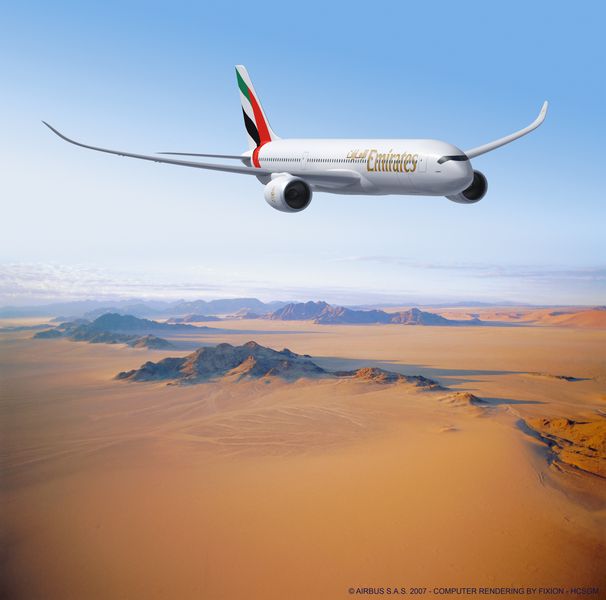
EK A350-800 - as
drawn by Airbus.
RIP Mike
Denness
20 April 2013
Mike Denness was
captain of Kent cricket club when I went to the University of Canterbury in
1976. In my early days on UKC Radio I did a one hour interview with Mike. He
was charming and very generous with his time and comments.
The interview was
also included in Incant - the university newspaper.
He died yesterday
aged 72 from cancer - this is the Guardian's obituary:
****************************
Mike Denness, who has died of cancer aged 72, was an immaculate cricketer,
the first Scot to captain England, whose record of almost 26,000 runs was
achieved with an elegance as pleasing to the eye as that of any batsman of
his time. He was known for graceful drives to the offside, but was also a
deft and twinkle-footed player of spin, and a brilliant cover fieldsman.
Fourteen times he made 1,000 runs in an English season, and once abroad; he
played 28 Test matches between 1969 and 1975, 19 of them as captain, and his
win-loss ratio left him in credit.
As captain of Kent from 1972, in succession to Colin Cowdrey, he proved a
resourceful leader of a very good team, and helped them lift six limited-overs
trophies in five years as well as a runners-up place in the county
championship. When he was relieved of the captaincy, he left Kent and joined
Essex, where he helped the team to their first ever county championship
title.
His accession to the captaincy of England was not greeted with universal
acclaim, for although there was an undeniable toughness and shrewdness to
his character, he was viewed by some as too sensitive to handle strong
characters. Having played only a single Test match, he had been appointed
vice-captain to Tony Lewis in India in 1972-73 and although he did not play
a Test that summer, was made captain in the West Indies the following winter
in succession to Raymond Illingworth. The antipathy said to be felt by
Geoffrey Boycott at what he saw as a snub to his own hopes of leading the
side never left.
In the final match in Trinidad, in a relatively low-scoring match, Boycott
scored 99 first-innings runs and then 112 in the second, instrumental in a
26-run win to level the series. Of his own volition, Boycott, who was
England's most prolific batsman, never played under Denness again.
Denness led through the summer of 1974, in which India were beaten 3-0 (the
captain, at Lord's and Edgbaston, becoming the first since Peter May to
score back-to-back hundreds for England) and Pakistan were held to a draw.
Denness was duly chosen to lead the side to Australia for the Ashes series
that winter. In this he was honoured but unfortunate because, deprived at
the outset of Boycott – who opted out – they encountered Dennis Lillee and
Jeff Thomson at their collective peak.
His team were battered mercilessly and none more so than he, his form so
shattered by the pace that after scores of 6, 4, 2, 3, 8 and 5 in the first
three Tests, he dropped himself from the team for the fourth Test. He
returned to finish the series and made a courageous 188 in the final Test,
which, as consolation, England won by an innings. But by then Thomson was
injured and Lillee bowled just six overs before he, too, retired from the
fray.
England progressed to New Zealand after that series and Denness made the
fourth and final hundred of his Test career in Auckland, where he and Keith
Fletcher added 266, which remains an England record for the fourth wicket
against New Zealand, and the third highest for any wicket against them.
The Australians came to England in the summer of 1975, and in the first
Test, at Edgbaston, Denness, having first consulted with his senior players,
made the catastrophic decision to put Australia in to bat under cloudy
skies, despite a prediction of rain and the prospect of difficulty for them
on an uncovered pitch. Help for his seamers failed to materialise as
expected, Australia making 359, whereupon England, after a heavy
thunderstorm had changed the character of the pitch, capitulated for 101 and
173 against Lillee, Max Walker and, second time around, Thomson, the young
debutant Graham Gooch making a pair. It was enough for Denness, who resigned
and handed over the reins to Tony Greig. He never played for England again.
Denness, born in Bellshill, Lanarkshire, began playing cricket when his
family moved to Ayr, where the ground was close to his home. Educated at Ayr
academy, he made his debut for Kent in 1962. Denness retired from
professional cricket in 1980, after 501 first-class and 232 one-day matches
over almost two decades, and earned a subsequent living in insurance,
finance and public relations.
He also became an International Cricket Council match referee, an
appointment that was to embroil him in far-reaching and lasting consequences
in South Africa in 2001. Following a Test match against India in Port
Elizabeth, he sanctioned six of the visiting team, including the captain,
Sourav Ganguly, for an inability to control his team's behaviour, and, most
controversial of all, Sachin Tendulkar, for ball tampering. Denness, under
ICC orders, failed to offer explanations at a subsequent press conference
and India threatened to abandon the tour if he was not replaced.
The ICC supported Denness, but the South African board sided with India,
replacing him for the next match and refusing him entry to the ground. The
ICC therefore deemed the Test "unofficial" and awarded the series to the
home side. The bans on Ganguly and Tendulkar were eventually overturned but
that on Virender Sehwag remained, so that the Indian insistence that they
would select him regardless, making future matches also unofficial, almost
put England's impending tour of India in doubt. Negotiations between the two
boards resulted in Sehwag missing the first match and the series going
ahead.
Denness refereed only two more Tests and three one-day internationals before
ill-health forced him out. The ICC committee abandoned its investigation
after Denness underwent heart surgery. His career as match referee came to
an end when he was not selected for the new ICC elite panel despite
endorsement from the England and Wales Cricket Board. He was made an OBE in
this year's New Year honours.
His marriage to Molly ended in divorce; they had a son and two daughters. He
is survived by his partner, Doreen.
• Michael Henry Denness, cricketer, born 1 December 1940; died 19 April 2013
Thatcher service - overdosed, over-hyped, over-spent
16 August 2013
I am all for
giving people a good sending off into the next world but the trouble with
the Thatcher funeral service today is that it feels like a political rally,
rather than a family and friends celebrating the life and mourning the
passing of an 87 year old.
It is not a state
funeral; it is not a private funeral; but it is a ceremonial funeral with
military honours which will involve more than 700 personnel from the three
armed services, largely recognising the awful and peculiar little war over
the Falkland Islands.
The last state
funeral for a British Prime Minister was Churchill's 1965 funeral. Churchill
of course led Britain through World War 2. He also led a national government
comprising all political parties.
A state funeral
requires legislation; this is not at that level. The Queen always sends
representatives to all the funerals of British Prime Ministers but for
Thatcher the Queen herself is attending and that gives it the trapping of a
State event.
Six Prime
Ministers have died since Churchill; Anthony Eden, Harold Macmillan, Alec
Douglas-Home, Harold Wilson, Edward Heath and James Callaghan. None have had
a ceremonial funeral anywhere close to this scale.
I remember the
Churchill funeral; I was 8. Television was grainy and black and white.
After his funeral
service, Churchill's body was loaded onto a barge to be transported along
the Thames to Waterloo station and then by train to Blenheim; as it passed
them, in the most moving moment of a day of genuinely national mourning, the
workers in the dockyards lining the river silently lowered their cranes one
by one. Those industries are gone, but a similar tribute to Thatcher from
today's industrial workers (those that are left) is difficult to conceive.
"This was the last time that such a thing could happen," wrote O'Donovan of
Churchill's extraordinary funeral. "This was an act of mourning for the
imperial past."
With this ceremony
Thatcher is being buried as a stateswoman; a mythic figure. This is no
leveller, it is calculated elevation.
There is some uproar among the Tory faithful at an apparent snub by the
Obama government. The US will be represented officially by George Shultz,
Ronald Reagan's second secretary of state, and James Baker, who was the late
president's treasury secretary. Dick Cheney, the US vice-president under the
second President Bush, will attend in a personal capacity.
No Obama and no
previous US President will attend.
Part of this is down to the confusion between a state and ceremonial event;
some countries are sending former leaders, for example Australia's John
Howard, while several serving prime ministers have said they will attend,
including Stephen Harper of Canada, Italy's Mario Monti, and Donald Tusk
from Poland.
It is easy to
respect Thatcher for her service to the country; for her resoluteness and
for her determination. It is sad to think that by the time of her death this
strong forceful woman had become a shadow of her former self. Ageing can be
fearsome.
Let her rest in
peace. Let the protests be dignified. But a more restrained service would
have been appropriate and would have avoided the controversy that Thatcher
embraced in life and that has also been a part of her death.
More:
Margaret Thatcher's legacy: roundup of the best writing
What
Churchill’s funeral says about Margaret Thatcher’s
16 April 2013 -
Jon Snow's blog at Channel 4 news
It was the smoke billowing above the dreaming spires far away
down the line that announced he was coming.
We had stood in the bitter January wind waiting for what seemed hours. In
our grey flannel suits and inadequate coats, we waited for the coffin of a
man we had been told was perhaps the greatest prime minister of all time. In
short, a man who saved the very country into which we had been born.
I was 17. I had no memory of the war, I was a bulge baby born after it. In
life Churchill had seemed a remote figure from history. And yet as the train
bearing his coffin drew closer, announcing its presence with a wailing horn,
I and the boys among whom I stood felt huge emotion.
We had all grown up among parents who still grieved for lost loved ones;
parents who had lived in the Blitz; parents who spoke chillingly of Hitler
and the concentration camps; parents who talked of the “few”.
There had been strip cartoons about Churchill in our Eagle comics. We knew
of his time in the Boer war as a correspondent. We knew too that he had
written a remarkable multi-volume History of the English Speaking Peoples.
History records his flaws: spirits, a temper, a headstrong sense of his own
being and capacity. But above all we knew that this was a man like no other
who had led our families and the country through the country’s darkest hour.
When I saw Churchill’s coffin, draped in the union flag, flanked by a
guardsman at each corner of the wagon. I cried and bowed my head. This was
history, and every fibre of my being knew it. I glimpsed the driver in the
engine cab, the guard at the rear, and then the disappearing red tail light
as the train wound its way on to Blaydon and his final resting place.
I find myself thinking of that day, on Oxford’s Port Meadow. Today we bury
another prime minister, a leader who leaves a population divided upon her
legacy. It is a kind of moment in history.
For me, however – and, I feel sure, for a good many who witnessed
Churchill’s passing – the emotions are less stirred. Respectful, aware that
this day is not the same, and not eliciting the same acknowledgement of
history.
7 years of
Downtown Dubai
15 April 2013

Europe’s Top
Airlines Squeezed by Emirates-Ryanair Growth
16 April 2013 Bloomberg
European network carriers including Air France-KLM Group (AF) and Deutsche
Lufthansa AG (LHA) face a heightened challenge from both local discount
airlines and Gulf operators serving routes to Asia, analysis by Amadeus IT
Holding SA (AMS) shows.
Low-cost carriers led by Ryanair Holdings Plc (RYA) lifted their share of
European traffic 4 percent to 38 percent in 2012, while travel from Europe
to Asia via the hubs of Emirates, Qatar Airways Ltd. and Etihad Airways PJSC
grew 20 percent, according to data from Madrid-based Amadeus’s global
booking system.
Air France, Lufthansa and Iberia of Spain are among former flag-carriers
revamping short-haul operations in an effort to end losses and stave off the
advances of Ryanair and its peers. Cologne-based Lufthansa said last month
it might also establish a low-cost operation to Asia in response to airlines
that have exploited the Gulf’s geographical position to grab a growing share
of lucrative inter-continental transfer traffic.
“These figures are quite worrying for the network carriers,” said Yan
Derocles, an analyst at Oddo Securities in Paris with a “neutral” rating on
Lufthansa and IAG SA, parent of Iberia and British Airways, and a “buy” on
Air France-KLM. “They’ve begun to take action in Europe, where the challenge
is crystal clear, but they’re going to have to do more to maintain market
share in long-haul, which has been quite profitable.”
Low-cost penetration is greatest in Europe, according to Amadeus. The
nations there with the highest proportion of departing passengers using
discount airlines are Spain, on 57 percent, and the U.K., home country of
EasyJet Plc (EZJ) and the location of Ryanair’s biggest base, with 52
percent.
In the long-haul market, Gulf airports in Dubai, Doha and Abu Dhabi have
already grabbed a 15 percent share of air traffic from Europe to the
Asia-Pacific, according to the report.
While IAG’s British Airways has maintained some room for maneuver by
recruiting Qatar Airways to its Oneworld alliance, Air France-KLM and
Lufthansa will “have to fight” to stave off the Middle Eastern challenge,
Oddo’s Derocles said.
Airlines everywhere face heightened competition, Amadeus said, with 38
percent of total traffic involving routes served by four or more airlines,
rising to 75 percent in Asia, where 27 percent of travel involves markets
with at least five carriers.
Only 35 percent of traffic worldwide is on routes with one or two operators
-- a four-point drop in the past two years -- falling to 25 percent in Asia.
Seven of the world’s 10 busiest routes by passenger volume are in Asia,
according to the report, with the globe’s busiest link being between the
South Korean island of Jeju and Seoul, followed by flights between Sapporo,
Japan, and Tokyo.
Guantanamo Bay - President Obama's shame: The forgotten prisoners of
America's own Gulag
15 April 2013 -
The Independent
For long periods we forget it, even though it is a human rights disgrace
surely unequalled in recent American history. But now, 11 years after it
opened, the prison for suspected terrorists at Guantanamo Bay is demanding
our attention once again, thanks to the largest hunger strike by detainees
in its infamous history. Al-Qa'ida has been decimated; America's war in Iraq
is over and the one in Afghanistan soon will be. But the scandal of
Guantanamo endures.
Today, 166 inmates remain. Three have been convicted, while a further 30
will face trial. Fifty or so are in a legal no-man's-land, deemed by the
authorities too dangerous to release but against whom there is not enough
evidence to prosecute. And then there are 86 who have been cleared for
release, but who instead rot in a hell from which there is no escape. No
wonder yesterday more than 160 of them were involved in clashes with guards
that led to what the US said were "less than lethal" rounds being fired.
In 2009, Barack Obama entered office vowing to close Guantanamo within a
year. Perhaps he should have listened more closely to his predecessor.
George W Bush, too, wanted to shut Guantanamo; even he came to understand it
was perhaps the most powerful single recruiting agent for global terrorism.
But, he warned presciently, the devil was in the detail – or, more exactly,
in Congress.
Mr Obama's planned to transfer most inmates to a high-security prison in
Illinois, but that idea was blocked. Then Congress made things harder still,
first scotching a plan to try Khalid Sheikh Mohammed, the organiser of 9/11
and Guantanamo's best-known prisoner, in a civil court in the US, and
effectively banning the use of public money to transfer Guantanamo detainees
to the US or abroad.
Even so, Dan Fried, the special envoy in charge of closing the prison,
managed to resettle 40 detainees during Obama's first term. But at the end
of January, Mr Fried was reassigned and not replaced, his duties
incorporated into the State Department's existing legal office. For the 86
inmates eligible for release it was the last straw. Within a week the hunger
strikes started.
Detainees tell their lawyers that up to 130 now are taking part. The
Pentagon claims they number no more than 40, of whom a dozen are being
force-fed. Given the lack of independent access to Guantanamo, the exact
number is impossible to establish.
Like others before it, the protest may have been sparked by complaints that
guards were abusing detainees' copies of the Koran. But even the Pentagon
admits the real reason was despair. Inmates were "devastated" by the signal
that the administration no longer believed that closing the prison was a
realistic priority, Marine General John Kelly told Congress, so "they want
to turn the heat up, get it back in the media". And who can blame them?
By all accounts, the atmosphere within Guantanamo has never been as bleak.
The Soviet Union had gulags, "but no Soviet gulag ever had 52 per cent of
its prisoners cleared for release," says Clive Stafford Smith, director of
the legal charity Reprieve, who has been representing Guantanamo detainees
almost since the place opened in January 2002.
One of his clients is the Saudi-born British resident Shaker Aamer, captured
in Afghanistan in November 2001 and brought to Guantanamo in February 2002.
He has been cleared not once but twice, in 2007 and then by the Obama
administration in 2009. But the US won't let him go, not even back to its
trusty ally Britain, where Aamer's family live. Fluent in English, Mr Aamer
is regarded as a "leader" among the detainees. Many suspect that the
Americans will never free him, because he knows so much, and would speak
out.
Today, even George Orwell would have been pressed to conceive the plight of
the 86: cleared for release, but denied freedom, using a hunger strike as
their last weapon, only to be kept alive by the very people who will not let
them go. On Thursday, Mr Aamer gave the most recent account of events at
Guantanamo to Mr Stafford Smith in an hour-long phone conversation,
described by his lawyer in a sworn affidavit.
Mr Aamer is participating in the hunger strike, although he is not yet being
force-fed. But other harassments abound. He is in Guantanamo's Camp Five,
where "non-compliant" prisoners are held. His health is poor and
deteriorating. There is noise throughout the night. It is getting harder to
speak to lawyers. Then there are the FCEs, or "forcible cell extractions",
to use the euphemism for being picked up and shackled by a team of six
guards who burst into your cell. "They FCE me just to give me water," Mr
Aamer recounted.
Each day, he says, there are 10 to 15 "code yellow" incidents, when a
prisoner on hunger strike collapses or passes out. Even contact with lawyers
is a mixed blessing. "Each phone call [from a lawyer] is a curse. They hear
what I am saying to you and use that against me to make things worse," he
told Mr Stafford Smith. The situation, in short, is grimmer even than during
what Mr Aamer calls "Miller time". For ordinary residents of the US, the
phrase advertises a well-known brand of beer. But in the extra-territorial
Hades of Guantanamo, the reference is to General Geoffrey Miller, the
prison's second commandant before he was sent to Iraq in August 2003 to
advise on "more productive" interrogations of prisoners, that is, to "Gitmo-ise"
Iraq.
The hunger strike is succeeding in returning the spotlight to Guantanamo. On
the day Mr Stafford Smith talked to Mr Aamer, Chuck Hagel, the Defence
Secretary, told Congress he favoured closing the prison, while leading human
rights groups wrote to Mr Obama demanding again that Guantanamo be shut and
its inmates either released or tried in civilian court. But it seems
optimism bordering on insanity to believe these entreaties will succeed
where every other has failed.
Mr Aamer, by all accounts, is a proud man not given to self-pity. But by the
end of the phone call, Mr Stafford Smith declared, his client seemed to be
crying. "They are killing us, so it is hard to keep calm. It's hard to
understand what they are doing, or why. No matter how much I show you I am
tough, in reality I am dying inside. If you want us to die, leave us alone.
But they do not want us to die, and they do not want us to live like a human
being. What is worse than that?" What indeed?
International medical groups have denounced the forced-feeding of Guantanamo
Bay prisoners, which invariably involves strapping detainees into restraint
chairs (marketed as a "padded cell on wheels" by their manufacturer),
pushing a tube up their nose and down their throat, and pumping liquids into
their stomach. Although it is considered a method of torture by the United
Nations Human Rights Commission, the US military insists forced-feeding is a
form of "medical intervention" and that the practice is less aggressive than
it was.
Forced-feeding first received widespread public attention in the Edwardian
era, when it was used against hunger-striking suffragettes who were held
down as the instruments were painfully inserted into their bodies, an
experience that has been likened to rape. This technique was also performed
on hunger-striking Irish Republicans: in 1917, Thomas Ashe died as a result
of complications from the procedure.
Forced-feeding in prisons has been outlawed since 1975 when the World
Medical Association issued the Declaration of Tokyo, guidelines for
physicians concerning torture and other cruel or degrading treatment in
relation to detention. The declaration stipulates that: "Where a prisoner
refuses nourishment and is considered by the physician as capable of forming
an unimpaired and rational judgement concerning the consequences of such a
voluntary refusal of nourishment, he or she shall not be fed artificially."
More:
Why Obama Can't Close Guantanamo
Not a day to stay dry
14 April 2013
The Economist on Songkran
Songkran, the
Buddhist festival marking Thailand’s new year that begins on April 13th, was
once, it is said, a mellow, pious affair. Thai people visited temples to
sprinkle scented water on monks, symbolically bathing them. It is now a
nationwide water war, where the weapons are water-pistols, buckets and
hoses, the battlefield is the street and the fuel that keeps the armies
going is often alcoholic.
Survivors have a ball, albeit a soaking-wet one. But alongside those who
have long lamented the corruption of an ancient religious tradition are
others who worry about the growing number of casualties. Last year 320
people died in 3,129 road accidents, up from 271 in 2011. Of those who died
in 2012, three-fifths were driving or riding pillion on motorcycles. Most
were not wearing helmets. Most had been drinking.
The carnage this year has already started. On April 11th, in the warm-up to
the holiday proper, and already the first of seven dangerous days, 39 people
across the country died and 342 were injured in 326 road accidents.
An effort has been made to tighten up. Alcohol-free zones have been declared
in 86 locations in 66 provinces, after a campaign by the culture ministry,
the Thailand Health Promotion Foundation and the Stop Drink Network.
But a campaign for a national ban on alcohol over the holiday was thwarted.
Songkran is good for tourism, one of the country’s most important
industries. Few of the white-skinned tourists who turn out seem to mind that
they are especially favoured targets for a dousing.
Helmets are already compulsory for motorcyclists and drinking and driving is
illegal. The problem seems to be not so much the laws and regulations, as
the enforcement of them.
Brett Bivans of the International Centre for Alcohol Policies, a
not-for-profit group financed by multinational drinks companies to promote
responsible drinking, says that many traffic policemen are loth, for
example, to use their breathalysers to test drivers in their own
villages—and still less in other peoples’.
In Thailand’s neighbour, Myanmar, breathalysers are usually not even
available. Thingyan, the Burmese variant on the new-year water festival,
makes Songkran seem tame. In Yangon, the main city, open-top trucks tour the
streets to be drenched by what amount to water-cannon fired from temporary
road-side pavilions sponsored by local businesses.
As each day lurches on, Myanmar's drenchers and drenchees alike lose most of
their inhibitions and all of their sobriety. In the years of military rule,
the festivities could have a rather desperate, angry undertone. Last year,
falling just a fortnight after the by-elections that put Aung San Suu Kyi
and the opposition party she leads into parliament, it had the euphoric air
of a post-revolutionary celebration.
No reliable statistics are available for Thingyan casualties. But it is a
fair bet that one sad side-effect of the country’s reforms is that they will
mount.
One rule for some
13 April 2013
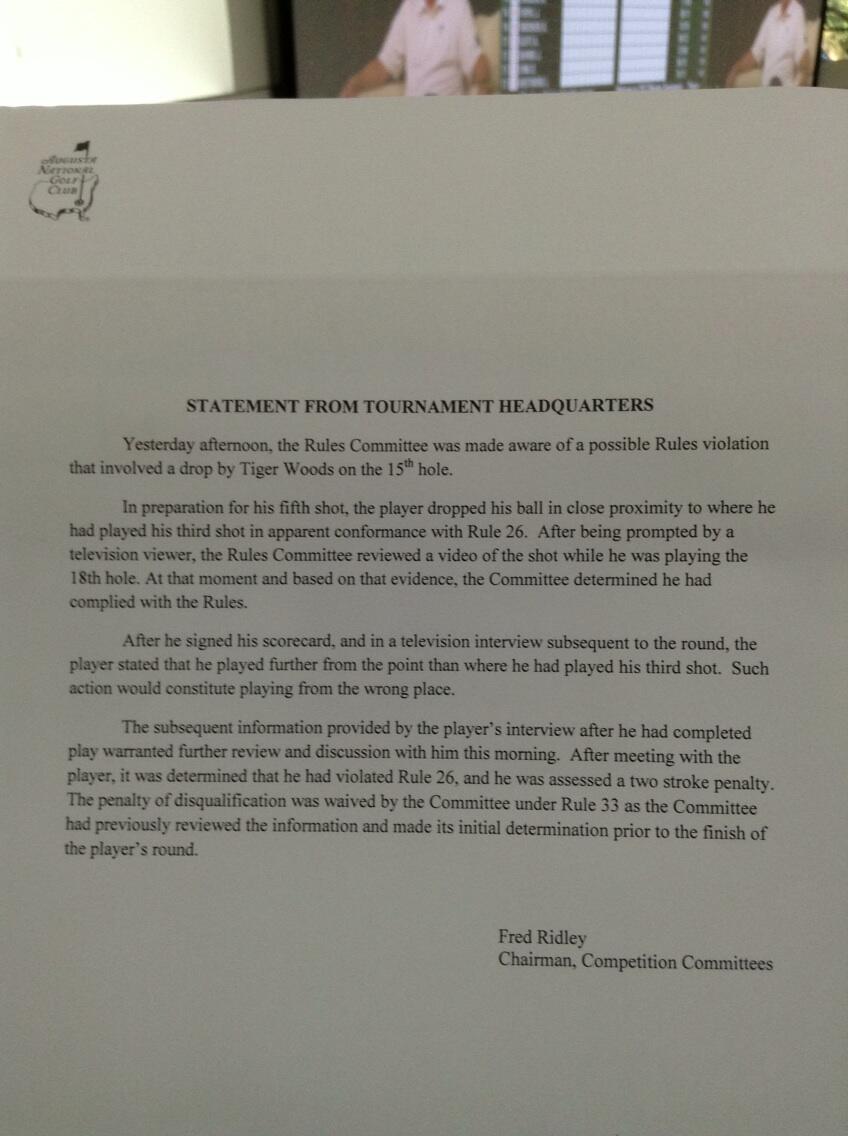
The picture is the
official statement from the Masters rules committee - after Drop-Gate...
It is a poor
decision; which would probably have only been made for Mr. Woods.
So it is OK to
penalise a 14 year old Chinese amateur. But how about applying the rules to
a multi major winner and golfing icon?
This was Tiger's
press conference last night:
Q. How hard is it, that second shot on 15 after getting a bad break like
that?
TIGER WOODS: Well, I went down to the drop area, that wasn't going to be a
good spot, because obviously it's into the grain, it's really grainy there.
And it was a little bit wet. So it was muddy and not a good spot to drop. So
I went back to where I played it from, but I went two yards further back and
I took, tried to take two yards off the shot of what I felt I hit.
And that should land me short of the flag and not have it either hit the
flag or skip over the back. I felt that that was going to be the right
decision to take off four right there. And I did. It worked out perfectly.
Q. He's playing
with a guy shooting in the 80s, just wonder what you think of the harshness
of that.
TIGER WOODS: Well, rules are rules.
Tiger Woods
press conference is here.
Signing an
incorrect scorecard should result in a disqualification. The question
appears to be twofold: 1) since Tiger took his drop about two yards back
from the original location of the shot, did he violate a rule saying his
shot must be played from the same spot; or 2) he should have taken a drop on
the line last crossed, which was at different angle from where he dropped.
The rule that covers this issue is Rule 26-1, which reads:
26-1. Relief For Ball In Water Hazard
It is a question of fact whether a ball that has not been found after having
been struck toward a water hazard is in the hazard. In the absence of
knowledge or virtual certainty that a ball struck toward a water hazard, but
not found, is in the hazard, the player must proceed under Rule 27-1.
If a ball is found in a water hazard or if it is known or virtually certain
that a ball that has not been found is in the water hazard (whether the ball
lies in water or not), the player may under penalty of one stroke:
a. Proceed under the stroke and distance provision of Rule 27-1 by playing a
ball as nearly as possible at the spot from which the original ball was last
played (see Rule 20-5); or
b. Drop a ball behind the water hazard, keeping the point at which the
original ball last crossed the margin of the water hazard directly between
the holeand the spot on which the ball is dropped, with no limit to how far
behind thewater hazard the ball may be dropped;
The fact is that
the rules will not be applied equally; the Masters cannot afford to lose
Tiger Woods. CBS cannot afford to lose him from their TV broadcasts. And now
he will probably win.
But his press
conference makes it very clear that he deliberately dropped the ball two
yards further back from the original shot in order to take advantage of the
new position - which he did.
What the rules
committee did was give Woods a two-shot penalty after applying a change in
the rules that was brought in last year to alleviate the situation where
players are disqualified for signing for the wrong scorecard as a result of
television evidence coming into play.
A statement said the incident had already been reviewed by the rules
committee - prompted by a television viewer - prior to Woods' second round
being completed. They determined he had complied with the regulations.
Since no one was
discussing this at the close of the golf last night it is incredibly
unlikely that the Rules Committee or anyone on the Committee was aware of an
issue with Tiger's drop on the 15th last night.
This is the new
rule 33.7 which the Royal & Ancient and US Golf Association announced before
the 2011 Masters and seeks to ensure that pPlayers who learn of a violation
after they sign their cards can be penalised without being disqualified.
Fred Ridley, chairman of the competition committee, said: "After he signed
his scorecard, and in a television interview subsequent to the round, the
player stated that he played further from the point than where he had played
his third shot. Such action would constitute playing from the wrong place.
"The subsequent information provided by the player's interview after he had
completed play warranted further review and discussion with him this
morning.
"After meeting with the player, it was determined that he had violated Rule
26 and he was assessed a two-stroke penalty.
"The penalty of disqualification was waived by the Committee under Rule 33
as the Committee had previously reviewed the information and made its
initial determination prior to the finish of the player's round."
Even though Woods was able to continue his quest for a fifth Green Jacket,
three-time Masters champion Nick Faldo believes the American should have
disqualified himself from the tournament.
"He still has time," Faldo told BBC Radio 5 live. "He is going to be
watching this and he knows what has gone on. If he is smart and if he
understands we have got to uphold the rules of this game, the gentlemanly
conduct and the integrity of our game."
"He took advantage and he knows he took advantage and he knows you are not
allowed to."
The 2001 Open champion, David Duval, agreed with Faldo.
He said on Twitter: "There is some leeway with the signing the incorrect
card. Not with intentionally not dropping as near as possible.
"I think he should withdraw. He took a drop to gain an advantage."
And that is the
point - Woods even said that he dropped where he did to gain an advantage.
Maybe it is a fair
outcome - Woods was unlucky that the ball hit the flag and ricocheted into
the water. But as Woods himself said "rules are rules". Rule 33-7
exonerates player if they couldn't have known they broke a Rule. Tiger
should have known. Ignorance of the laws is no excuse. 33-7 was inspired by
a ball moving fractionally (Harrington), visible only in slo-mo HD replay,
not to the naked eye. It's not for bungling a basic drop.
The Committee has used a rule that protects a player from disqualication for
signing for the wrong scorecard as a result of HD television evidence coming
into play. But this was not about TV evidence. This was about Tiger's own
admission that he dropped to his advantage.
This is all about
keeping Tiger Woods in the tournament. There is an awful lot of feeling
within golf that Tiger Woods broke a rule - inadvertently, but did break a
rule in regard to how he dropped a ball at the 15th yesterday. They have
used a technicality to keep Tiger Woods in the tournament. That is not
right.
As for Woods he
tweeted:
"At hole #15, I
took a drop that I thought was correct and in accordance with the rules. I
was unaware at that time I had violated any rules. I didn’t know I had taken
an incorrect drop prior to signing my scorecard. Subsequently, I met with
the Masters Committee Saturday morning and was advised they had reviewed the
incident prior to the completion of my round. Their initial determination
was that there was no violation, but they had additional concerns based on
my post-round interview. After discussing the situation with them this
morning, I was assessed a two-shot penalty. I understand and accept the
penalty and respect the Committees’ decision."
Golf and
integrity. History. Masters and its supposed value. Bullshit
Emirates meets
its Waterloo
11 April 2013
Emirates Airline
has announced that it will begin operating a daily flight to Stockholm,
Sweden from 4th September 2013.
Consistently voted in the world’s top ten places to live and work, Stockholm
is famous for offering visitors a vibrant and diverse cityscape. Sweden is
well known for iconic global brands such as IKEA, Volvo, and fashion
clothing brand H&M.
The new service
will provide welcome connections to the Swedish winter travelers; many of
whom head for Thailand where Emirates currently operates six flights per
day.”
Operated by a Boeing 777-300ER the daily service will offer three cabin
classes with eight seats in First Class, 42 seats in Business Class and 304
seats in Economy Class.
Emirates new daily flight to Stockholm will depart Dubai as EK157 at 0715hrs
and arrive at Stockholm Arlanda Airport at 1200hrs the same day. The return
flight, EK158 will depart at 1355hrs and arrive at Dubai International
Airport at 2225hrs.
In addition to passenger operations Emirates SkyCargo will offer 19 tonnes
of cargo capacity between the two cities. Popular commodities are expected
to be; Pharmaceuticals, construction equipment, electronics, perishable food
items, textiles, leather goods, plants and flowers. Emirates SkyCargo
already successfully operates a three times weekly service to Gothenburg in
Sweden and the addition of Stockholm is expected to further boost the
airline’s cargo operations in the region.
Stockholm, is the most populated urban area in Scandinavia with over 1.4
million residents. Emirates’ launch of Stockholm will follow on from the
launch of Haneda on 3rd June. Closely following the launch of Stockholm in
September Emirates will launch a daily flight to Clark in the Philippines on
1st October.
An Abba reunion at
the Stockholm launch party has to be a possibility.
IVF pioneer
Robert Edwards will never be forgotten by those he helped
11 April 2013
For someone who transformed the lives of so many, Sir Robert Edwards, who
passed away yesterday, was a remarkably modest and unassuming man. It was
the pioneering work he carried out along with his colleague Patrick Steptoe
that had allowed me to have my own two children, both conceived by IVF, so
when I was sent to interview him I was daunted at the prospect of coming
face to face with the man who contributed so much to my own happiness.
What was immediately apparent on meeting Edwards was the empathy that he had
for those with fertility problems. It's not easy to understand how
devastating infertility can be unless you have had difficulty conceiving
yourself, but although he was in his early 80s at the time, he was still
passionate about helping infertile couples to have families of their own.
If you ask most parents to imagine life without their children, they'd
probably joke about having more time, or more money or more sleep – but
Edwards appreciated just how precious children really are to their parents.
A kind and generous man, he was very aware of the difference his work could
make to those who were trying unsuccessfully to conceive. He felt that
everyone should have access to the treatment that might allow them to have a
child of their own, and told me it made him angry that the postcode lottery
in the UK was denying many people the opportunity to have NHS-funded IVF.
The aspect of his work I'd never really appreciated until meeting him was
what a lonely business it had been in the early days: when Edwards began
trying to fertilise human eggs in the laboratory, his attempts were not
greeted with enthusiasm. He and his colleague, the gynaecologist Dr Patrick
Steptoe, endured years of criticism as they attempted to develop the
technique of in vitro fertilisation. They faced the disapproval not just of
the media, the church and a sceptical public, but were also attacked by many
of their fellow scientists, who denounced their work as potentially
dangerous and unethical. They were refused funding by the Medical Research
Council, and it was only their resolve and strength of character that
enabled them to carry on. Edwards said that he had felt "quite alone" at the
time, but that he'd been carried by his absolute certainty that eventually
he would be proved right. It was that certainty and his determination that
so many of us have to thank for our families today.
Even after the birth of the first IVF baby, Louise Brown, in 1978, Edwards
and Steptoe were still regarded with some suspicion, but couples who
couldn't conceive began flocking to their fertility clinic at Bourn,
Cambridge, to try this amazing new treatment. Scientists across the world
learnt from them and were soon successfully performing IVF, and offering
hope to thousands of couples with fertility problems.
Infertility has an impact on every aspect of your life when you are trying
unsuccessfully to conceive. It affects your friendships, your work and your
well-being; it makes you feel powerless, angry and guilty; you put your life
on hold, waiting for something that might never happen; you become isolated,
depressed and lonely, blaming yourself for being a failure. I know I didn't
realise quite how much infertility had changed me, how much it had soured my
outlook on life, until I finally got pregnant after my second attempt at IVF.
It was as if someone had lifted a grey veil I'd been looking through for
years, and suddenly the world was full of colour again.
My first IVF baby is now 16, and his younger sister is 12. There's not a day
that passes that I don't have cause to remember how very lucky I am to have
them, and I will be forever indebted to Edwards for battling against
adversity for what he believed in, and for bringing such joy into my life.
It always seemed strange to me that a man who had done so much for so many
didn't gain the accolades he truly deserved until relatively recently,
receiving a Nobel prize in 2010 and a knighthood in 2011. Edwards may not
receive the pomp and circumstance of a ceremonial funeral, but he will be
remembered forever in the hearts of those of us who have benefitted from his
work, and he has an extraordinary legacy with the birth of an estimated 5
million IVF babies across the world.
Bangkok -- the Lady Gaga of Asia
11 April 2013
Robert Oliver in The Huffington Post
I love Bangkok. I even love arriving here,
slipping into the languorous heat of this fabulous city. Food, traffic, sex,
pollution: this town has it all. Far from the austere majesty of Beijing,
the befuddling hubbub of Hanoi, the dilemma that is Delhi, Bangkok screams
and teems. All pinks and neons, there is nothing half-baked about Bangkok.
Pouting, flouting, leering, sneering, Bangkok is the Lady Gaga of Asia.
Thai food is like condensed milk: I cannot even imagine the amount of self
loathing required to not absolutely love it.
And Bangkok is hands down the world's greatest city for street food. It
simply doesn't get better than this. I've never had a bad meal here, and its
street food is the foundation of Thai culinary culture. In fact, twice I
have been here and only eaten street side, it's that good. Everywhere,
everyday everyone chows down on cheap, great grub.
In a few short chilli addled days, I quaffed sweet sausage soup with salted
egg and rice noodles, sugar stoked Thai iced coffee with espresso,
evaporated milk, sugar, sugar and then sugar (when once I asked to "hold the
sugar," I got a look that conveyed concern at my sanity), fresh squeezed
fresh juice made from giddily sweet tiny green oranges, Chiang Mai sausage,
som tum-Thailand's eponymous green papaya salad made to order in a big
wooden mortar, green coconut juice, spicy fried chicken, jackfruit smoothie,
searingly hot noodle dishes, sparkling salads of pork skin and morning
glory, fried crab and green mango. It's a rollercoaster of counterpoints:
hot, cold, smooth, crunchy, sweet, sour, up, down that at times has you
gasping, but always happy. Countless satays, noodle salads, fresh cut
mangoes, guavas, papayas juicily displayed in glass cases on wheels, and
more and more and more that you grab and graze as you go. It's endless and
fabulous and expertly made. People specialize -- one vendor makes only
coconut pancakes, another banana fritters -- that's it. Hence, they are
perfect, all finesse and focus.
But do you know what I see, as I jostle through barely passable streets and
markets, crowded with food stalls and happy eaters? I see an extremely
successful cuisine. Each of these vendors is a micro- economy -- often
family based -- making food that is an expression of the heart. And because
this food is Thai in origin, it reaches further into the farms and fisherman
and food producers to create a dynamic of culinary prosperity.
With all of this outside, why would you go into a restaurant? Simple,
really. In a city that is devoted to eating, the excellence on the street
has urged even greater excellence indoors. So when my buddy Quentin Dante, a
restaurant refugee from New York, now happily based in Bangkok from where he
creates restaurants all over Asia, said to me one sultry Silom soir "Tonight
I am going to take you to the best restaurant in the world," I nodded meekly
like an obedient food slave.
Issaya Siamese Club is a gorgeous, colourful Thai style plantation mansion
-- replete with its own organic gardens -- set within an intestinal maze of
streets in Bangkok's Sathorn district, an absolute oasis in the midst of the
madness. Ian Kittichai, hands-down Thailand's hottest, hippest celebrity
chef, owns it, although he would never call himself that. I knew of him from
New York days when he wowed som tum savvy New Yorkers with his sparkling
cuisine at Kittichai. At Issaya, we loved the banana flower and heart of
palm salad, with crispy shallots and roasted peanuts in a dried
chili-coconut dressing -- all crunch and contrast -- and woofed down the
warmly spiced chilli glazed baby back ribs, cooked on a small banana leaf
wrapped grill on the table. Equally more-ish was "Larb Gai," a tangy, bright
chicken salad with home-grown mint and saw tooth coriander in a roasted
sticky rice dressing. In fact, everything we ate was a revelation -- it was
as if I had never had Thai food before. Everything was familiar, yet
reinvented and refined. Ian was bought up on the streets of Bangkok, and as
a lad cooked for his mothers food stall, Ian is the real deal. Chatting with
him, the street is never far away. His playful nature coupled with seriously
good food makes him far more than a celebrity chef -- he is strengthening
Thai food culture. This food, in this place, with this very likeable chef:
the sum of the experience, yep, I'm with Mr. Dante. Issaya Siamese Club
really may be the best restaurant in the world.
When it rains in this town, it does so forcefully and outdoor dining loses
it's thrill quickly. Rain forced me off the street and into Som Tum Der on
Soi Saladaeng just off Silom, and I am glad it did. Once again, the menu
here respects the roots of its wonderful dishes, this time from the Isan
region in Northern Thailand. Chef and partner Kornthanut Kittiyanon excels
at casual but terrifically satisfying plates like Sa Pok Kai Tod Der, the
best fried chicken I've ever had, som tum green papaya salad with Isan's
distinctive fermented crab, cooling Lemongrass Ice Tea, and his desserts are
worth a long distance flight for. I loved his Bua bi Pheuk, smoothly
soothing taro balls in a kind of warm coconut soup with shredded young
coconut meat. Plus he is about the chicest chef you'll ever see, sporting a
jauntily askew panama hat and a fabulous smile! The room is wi fi wonderful
and a cool respite from the street. I noticed that there was terrific
clarity of flavour here that I put down to using high quality oils and less
sugar than the more typical Bangkok fare. Chatting to co-owner Eh
Laoraowirodge, I was impressed by the dedication that both he and Chef Korn
have for the preservation of Isan cuisine. " You ought to try my other
restaurant then" he said. "That's Isan home style food."
One adrenalin pulsing tuk-tuk ride later, I was in Sukhumvit and at
Supanigga Eating Room. The menu is based on the dishes that Eh's mother and
grandmother cooked for him as child, Isan Soul Food. It's a whole education
in the heritage of the region, with unique ingredients and dishes that evoke
country cooking and warmth. Moo Cha Muang (Pork stew with pleasingly bitter
cha muang leaves with supposedly medicinal properties) is out and out
grandma food. I loved the hard boiled eggs with a tangy tamarind dressing,
and the chilli spiked pork mince served on a cooling tangerine round. Yam
Cha Plu- a delicate warm sardine salad with cha plu leaves was, well...
sardines have never been so well dressed. Eh is passionate about this food,
it is full of emotion and recollection for him, and he comes alive when
talking about it. The room is like the home you wish you had, with lighting
that makes everyone look sultry in an unfussed but stylish décor.
I love that all three restaurants offer authentic, rooted cuisine, but with
the added know-how of great technical chefs, the cuisine is energized, made
dynamic. Also -- I learnt so much about Thailand from each place. This is
Thailand beyond tum yum. All three "told the story" and this is what I think
makes a restaurant truly great.
Ed Miliband's statement on Margaret Thatcher
10 April 2013
Mr Speaker, I want to join the Prime Minister in commemorating the
extraordinary life and unique contribution of Margaret Thatcher.
And I want to join him in sending my deepest condolences to her children,
Carol and Mark, the whole family and her many, many close friends.
Today is an opportunity for us to reflect on Margaret Thatcher’s personal
achievements, her style of politics and her political legacy.
As the Prime Minister said, the journey from being the child of a grocer to
Downing Street is an unlikely one.
And it is particularly remarkable because she was the daughter, not the son,
of a grocer.
At each stage of her life, she broke the mould.
A woman at Oxford when there was not a single woman in the University who
held a full professorship.
A woman chemist when most people assumed scientists had to be men.
A woman candidate for Parliament in 1950, against the opposition of some in
her local party in Dartford, at the age of only 24.
A woman MP in 1959 when just 4 per cent of MPs in the whole of this House
were women.
The only woman in the Cabinet when she was appointed in 1970.
And, of course, the first woman Prime Minister.
Mr Speaker, it is no wonder she remarked as early as 1965 in a speech to the
National Union of Town Women’s Guilds’ Conference:
"In politics if you want anything said, ask a man. If you want anything
done, ask a woman."
I am sure some people in this House—and no doubt many more in the country -
will agree with this sentiment.
Having broken so many conventions as a woman, it can’t be a coincidence that
she was someone who in so many other areas of life was willing to take on
the established orthodoxies.
Margaret Thatcher’s ability to overcome every obstacle in her path is just
one measure of her personal strength.
And that takes me to her style of politics.
You can disagree with Margaret Thatcher.
But it is important to understand the kind of political leader she was.
What was unusual, was that she sought to be rooted in people’s daily lives,
but she also believed that ideology mattered.
Not for her the contempt sometimes heaped on ideas and new thinking in
political life.
And while she never would have claimed to be, or wanted to be seen as, an
intellectual, she believed, and she showed, that ideas matter in politics.
In 1945 Mr Speaker, before the end of the War, she bought a copy of
Friedrich Hayek’s Road to Serfdom. There is even a story that she suggested
that Conservative Central Office distribute it in the 1945 campaign.
She said, "it left a permanent mark on my political character."
And nobody can grasp Margaret Thatcher’s achievements, and Thatcherism,
without also appreciating the ideas that were its foundation.
And the way in which they departed from the prevailing consensus of the
time.
In typical home-spun style, on breakfast TV she said this in 1995:
"Consensus doesn’t give you any direction. It is like mixing all the
constituent ingredients together and not coming out with a cake...Democracy
is about the people being given a choice."
It was that approach that enabled her to define the politics of a whole
generation and influence the politics of generations to come.
The Prime Minister, the Deputy Prime Minister and I all came of age in the
1980s, when you defined your politics by being for or against what she was
doing.
It’s fair to say, we took different paths.
Thirty years on, the people of Britain still argue about her legacy.
She was right to understand the sense of aspiration of people across the
country.
She was right to recognise our economy needed to change.
She said in 1982:
"How absurd it will seem in a few years time that the state ran Pickfords
removals and the Gleneagles Hotel."
She was right.
And in foreign policy, she was right to defend the Falklands and bravely
reach out to new leadership in the Soviet Union.
And something often forgotten, Mr Speaker, she was the first political
leader in any major country to warn of the dangers of climate change.
Long before anyone thought of hugging a huskie.
But it would be dishonest and not in keeping with the principles that
Margaret Thatcher stood for, even on this day, not to be open with this
House about the strong opinions and the deep divisions there were, and are,
over what she did.
In mining areas, like the one I represent, communities felt angry and
abandoned.
Gay and lesbian people felt stigmatised by measures like section 28, which
today’s Conservative Party has rightly repudiated.
And it was no accident that when he became leader of the Conservative Party,
the Right Hon Member for Chingford wrote a pamphlet, called There is Such a
Thing as Society.
And on the world stage, as this Prime Minister rightly said in 2006, when he
was Leader of the Opposition, she made the wrong judgement about Nelson
Mandela and about sanctions in South Africa.
Mr Speaker, debates about her and what she represented will continue for
many years to come.
This is a mark of her significance as a political leader.
Someone with deep convictions, willing to act on them.
As she put it:
"Politics is more when you have convictions than a matter of multiple
manoeuvrings to get you through the problems of the day."
And as a person, nothing became her so much as the manner of her final
years.
The loss of her beloved husband, Denis, and her struggle with illness.
She bore both with the utmost dignity and courage.
The same courage she showed decades earlier after the atrocity of the
Brighton bombing.
And Mr Speaker, I will always remember seeing her at the Cenotaph in frail
health but determined to pay her respect to our troops and do her duty by
the country.
Whatever your view of her, Margaret Thatcher was a unique and towering
figure.
I disagree with much of what she did.
But I respect what her death means to the many, many people who admired her.
And I honour her personal achievements.
On previous occasions, we have come to this House to remember the
extraordinary Prime Ministers who have served our nation.
Today, we also remember a Prime Minister who defined her age.
Lyon's friendly folks and food failures
9 April 2013
Tai and I spent
last weekend in Lyon. One of Emirates newest and perhaps less than likely
destinations. The flights are doing well and are full of traveling French
who no longer need to pilgrimage to Paris for an international flight.
A few thoughts.
The good people of
Lyon were universally welcoming, friendly, entertaining and happy to try
their English or to indulge my French.
People still shop
at markets....sure Carrefour is big. But the markets are full of character
and characters.
The city is
largely closed on Sunday beyond the main tourist area of the old town. That
means finding somewhere decent to eat can be a challenge. Worse the city
only slowly wakes up on a Monday - this is not good when you arrive late on
Saturday and are leaving on Monday evening.
The weather felt
more like Manchester than Dubai - it was not very spring-like.
The public
transport system is a safe and rapid way to get around town. A map of all
routes is far more helpful than a map of just the major routes.
A day pass on all
metro service is Euro5. Uselessly the ticket machines at each stop require
coins and do not take notes.
The biggest
disappointment - the food. This is meant to be a gastronomic capital. In the
19th century hungry silk workers clustered in tiny bistros, called
“bouchons” to consume the robust, cheap fare necessary to carry them through
their 18-hour work days.
Then, bouchons
were bare-bones, family-run establishments, sorely lacking in style and
décor, but infused with a welcoming, home-style atmosphere.
The bouchons
continue now. They serve traditional Lyonnaise cuisine, heavily meat based,
often offal. This is not nouvelle cuisine, this is simple, cheap, rich food.
Local dishes
include:
salade lyonnaise (Lyon salad): green salad
with bacon cubes, croutons and a poached egg;
saucisson chaud: a hot, boiled sausage; can be cooked with red wine (saucisson
beaujolais) or in a bun (saucisson brioché);
quenelle de brochet: dumpling made of flour and egg with pike fish and a
crayfish sauce (Nantua sauce);
tablier de sapeur: marinated tripes coated with breadcrumbs then fried, even
locals often hesitate before trying it;
andouillette: sausage made with chopped tripes, usually served with a
mustard sauce;
gratin dauphinois: the traditional side dish, oven-cooked sliced potatoes
with cream;
cervelle de canut (cervelle' = ' brain): fresh cheese with garlic and herbs.
rognons de veau à la moutarde: veal kidneys in a mustard sauce. a textural
experience.
Avoid the poached fish fillets in a white sauce. This is tasteless.
Some of Lyon's best food can be found at Lyon’s main food market, Halles de
Lyon Paul Bocuse. This 60 store market is located near the Part-Dieu
station; this is where to buy local fruits, vegetables, game, fish, fowl,
produce and a host of French delicacies. The shop of Renée Richard, the
celebrated cheese monger, has famous creamy St. Marcellins. Chefs throughout
Lyon buy their cheese from Madame Richard. It is busy later in the day and
at weekends.
As for wine the house wine will likely be either a Beaujolais or Côtes du
Rhône, both of which are wines of the region. The Beaujolais wine region
lies just north of Lyon, while the Côtes du Rhône region is just south. The
wines are distinctly different. Beaujolais are almost always reds made from
Gamay grapes, producing a light-bodied wine. Côtes du Rhône may come from
any of several grape varietals, may be white, rosé or red, and have flavors
that range from flowery to dessert sweet. At traditional bouchons, you may
have to drink whatever wine the owner is serving.
Another city market is Marché St.-Antoine (Quai St.-Antoine and Quai des
Célestins): go here for ripe cheeses, salamis, baked breads, pungent fish,
roasting chickens, briny oysters, quince tarts, praline tarts. Nearby are
the outdoor book dealers along the adjacent Quai de la Pêcherie. There are
books, vintage maps, postcards and LPs.
On top of the hill overlooking Lyon is the Croix-Rousse market. It opens on
Tue-Sun 7AM-1PM. It is very local and very popular. On Tuesdays, also sells
non-food items. This really is a neighbourhood market. But it is easily
accessible by bus. Then walk back down the hill to the City Hall at Place
des Terreaux.
It is a city for
exploring.
But after two days
I was craving a good Thai red curry!
Thatcher's
sorry legacy
9 April 2013 -
from Giar
Baroness Margaret
Thatcher died yesterday aged 87. She was the British Prime Minister from
1979 to 1990. She was also the most divisive political leader in British
history. Her legacy is a noun. Thatcherism. No other Prime Minister was that
dubious honour.
What is clear from
social media is just how divisive her legacy is. All the debates that matter
today in the public arena, whether in economics, social policy, politics,
the law, the national culture or this country's relations with the rest of
the world, still bear something of the imprint she left on them.
She changed
politics. She changed the nation. There were things to admire. There was
plenty that was wrong.
She was Britain's
first and so far only woman major party leader and then Britain's first, and
only, woman prime minister. These are huge landmarks.
But she was also a
political dogfighter and a loner. She had this depressing conviction that
she was always right; and that those who did not agree with her were against
here. She had little need for consensus; she had a force of will that
others in her cabinet fawned upon; and needed for their own political
office.
She stepped up as the compromise leader in a divided conservative party. A
Britain led by Willie Whitelaw or Michael Heseltine would have faced most of
the same challenges that the one led by Thatcher faced. But the response
would have been completely different.
Major events in
British history would not have happened the way they did under different
leadership.
The first was the Falklands war of 1982 and an astonishing and absurd
military triumph; which was a calculated gamble to ensure sweeping electoral
success.
A second, which
was supported by her massive electoral win, was the dethroning of trade
union power. She would not compromise. And she had the backing of major
(greedy) business leadership; including Murdoch's media empire. She fought
the miners' strike to the bitterest of finishes.
Her economic policy was based on the assumption that the public sector was
an unproductive burden on the wealth-creating sector and on taxpayers, and
must therefore be reduced and privatised. She insisted that government
economic policy should never give priority to reducing unemployment or to
stimulating demand.
But Thatcher's
market driven economy was assumed to require strong state intervention and
support including the abolition of local government autonomy; enhancement of
police powers, intolerance towards gay rights, a broadcasting ban on Sinn
Féin, and increased defence spending.
She made enemies.
Her rule was marked by the most serious urban riots of the 20th century, one
of the most divisive strikes in recent times, and the century's most
audacious prime ministerial assassination attempt (the Brighton bombing),
which thankfully she survived.
During her time in
office she used up more than 100 ministers and surrounded herself with
yes-men. She was never interested in the women's movement, and only one
women made it into her cabinet during her long tenure.
She also enjoined two confrontations that ultimately undid her. The first
was the poll tax, which was disastrous and unjust. It was her policy alone.
The poll tax came to embody a prime minister who ruled from conviction not
sense, and who did not care about, indeed gloried in, a confrontation that
destroyed the Tory party in Scotland and may indirectly come to destroy the
union she otherwise championed.
In Europe,
Thatcher began her prime ministership as a pragmatic, if often acerbic,
European. But as she became a bigger figure on the world stage she became
increasingly strident and disruptive towards Europe.
Thatcher's British vision was a low-tax, home-owning, privatised,
high-carbon, possessive, individualist, winner-takes-all nation. Any many
did win. The rich got richer. The poor poorer. The north south divide became
a chasm.
There was plenty
wrong with 1979 Britain including undemocratic and abusive union power. But,
as Germany and other northern nations have shown, economic dynamism has been
possible without the squandering social cohesion.
Thatcher created
division. She thrived upon it. And now the gushing tributes and other more
questioning obituaries show the extent of that division.
When she spoke, as
she often did, about "our people", she did not mean the people of Britain;
she meant people who thought like her and shared her prejudices. She
abhorred disorder, decadence and bad behaviour.
She was an exceptional leader. No question. But her legacy is of public
division, private selfishness and a cult of greed, which together shackle
far more of the human spirit than they ever set free.
Emirates goes
transatlantic - again
8 April 2013
Dubai-based
Emirates Airline said it has received approval from the Italian Civil
Aviation Authority to launch direct flights between Milan and New York
commencing on October 1.
Operated by a
Boeing 777-300ER, the service will originate in Dubai with passengers then
able to enjoy a stopover in Milan en-route to New York. On the return
flight, passengers will have the option of stopping in Milan before
continuing on to Dubai.
"Operating a trans-Atlantic route has been on our agenda for some time,"
said Tim Clark, President Emirates. "Having carefully monitored traffic
flows we have identified strong demand for both a direct connection and,
importantly, for the Emirates product. The route is currently underserved,
particularly with a strong premium product offering this is where we see a
clear opening for Emirates. We intend to capitalise on this opportunity,
stimulating further demand and encouraging additional traffic flow in both
directions,"
Emirates has
previously flown transatlantic from Hamburg to New York.
The new service, an extension of Emirates three daily flights to Milan, home
to the Emirates-sponsored football club AC Milan, will boost Emirates'
flights to New York to three daily.
Emirates flight
EK205 will depart Dubai at 09:05hrs arriving in Milan at 13:50hrs, the
flight will then depart Milan at 16:00hrs arriving in New York at 19:00hrs
the same day. The return journey on flight EK206 will depart New York at
22:20hrs arriving in Milan at 12:15hrs the following day before departing
for Dubai at 14:00hrs, touching down in Dubai at 22:05.
DWC to start passenger operations in October
3 April 2013
Dubai Airports has
announced that Dubai World Central will open its doors to passengers on
October 27, 2013 when launch carriers nasair and Wizz Air commence
operations into Dubai's second airport.
nasair plans to operate over 50 flights per week between Dubai and a number
of destinations in Saudi Arabia. The Saudi-based carrier already operates
950 weekly flights to 28 destinations with a fleet of 21 aircraft comprised
of Airbus A320s and Embraer E190s.
Wizz Air, which provides low-cost air transport across 30 countries with 16
bases across Europe, will provide non-stop services linking Dubai World
Central to Central and Eastern Europe. Wizz Air has a fleet of 40 Airbus
A320 aircraft operating over 1,500 weekly flights to 93 destinations.
WizzAir will fly 4
weekly flights each from Budapest & Kiev and 3 each from Bucharest & Sofia.
Bucharest – Dubai
Al Maktoum eff 29OCT13 - 3 weekly
W63255 OTP1430 – 2120DWC 320 246
W63256 DWC2155 – 0105+1OTP 320 246
Budapest – Dubai Al Maktoum eff 28OCT13 - 4 weekly
W62497 BUD1140 – 2005DWC 320 x246
W62498 DWC2040 – 2340BUD 320 x246
Kiev Zhulyany – Dubai Al Maktoum eff 28OCT13 - 4 weekly
WU6021 IEV0615 – 1310DWC 320 x246
WU6022 DWC1345 – 1700IEV 320 x246
Sofia – Dubai Al Maktoum eff 29OCT13 = 3 weekly
W64429 SOF1230 – 1925DWC 320 246
W64430 DWC2000 – 2320SOF 320 246
Reservations for these new services have already opened.
Dubai Airports say that construction of the DWC passenger terminal building
was completed in 2012. That is hard to believe after driving to see it last
week. The basic structure is there but the supporting infrastructure looks
incomplete. Upon opening, the new facility will offer full retail as well as
food and beverage amenities.
DWC has a single
runway, 64 remote aircraft stands; there are no air bridges. It has capacity
for up to 7 million passengers per year. The terminal will undergo a full
testing and trial programme over the coming months to ensure a seamless
opening.
What the airport
will need is a transport infrastructure. It's location is remote from most
of Dubai - though reasonably convenient for Jebel Ali. It will not have
rail/metro access therefore will need airport buses to a downtown location.
The only passenger car parking appears to be open air and not ideal.
Upon completion, Dubai World Central will become the world's largest airport
with five runways and an ultimate capacity of 160 million passengers and 12
million tonnes of cargo per annum.
Canada and UAE start to make their peace
2 April 2013
Canada and the
United Arab Emirates have agreed to end their visa dispute which has for the
last two years required Canadians to pay visa fees to enter the Gulf
country.
Foreign Affairs Minister John Baird and his U.A.E. counterpart Sheikh
Abdullah bin Zayed Al Nahyan say they have agreed to restore the visa regime
that existed prior to a dispute that erupted in 2010.
They say the two countries are also ready to sign a nuclear co-operation
deal. Details on the two agreements will be formalized in the next month.
The two countries have also created a Canada-UAE business council to improve
commercial relationships.
And presumably at
some time soon we will see an announcement extending Emirates' and Etihad's
flying rights to Canada.
In 2010, Canada refused to grant two Emirati airlines extra landing rights
in Canada, while Baird was minister of transport. That move prompted the UAE
to end access to a key Canadian Forces staging base outside Dubai. The
following year, the expensive visa requirements were put in place.
Baird is on a lengthy swing through the Middle East, which has included a
surprise visit to Iraq as well as stops in Jordan and Cyprus.
Visitors from most European countries, Australia and the U.S. don’t need
visas for the UAE. Canadians, however, must pay $165 for a single-entry,
30-day visa; $330 for a single-entry 60-day visa; and $660 for a six-month,
multiple-entry visa.
London losing
hub business
2 April 2013
Heathrow Airport has strongly defended its status as the UK’s only hub
airport in a submission to the country’s independent airports inquiry.
The airport, which
is running at capacity, said that the UK is currently losing out on
additional hub traffic and warned that “a significant proportion” of
un-served hub demand could be lost for good by the time the country builds
more runways.
Completely
self-serving of course - and in reality London is a bit of a hybrid - more a
destination that it is a hub.
Heathrow argues
that rivals such as Dubai and Istanbul are making major investments that
“exploit the UK’s hub capacity constraint”.
The Airports Commission was set up late last year and is investigating if
and how the UK should expand its airport capacity.
Of course if
London was Dubai or Beijing you would not need a year long commission or 12
years to build a single runway!
The commission will recommend to the government whether Heathrow should be
allowed to build a third runway, or whether expansion should take place
elsewhere.
In its submission to the Airports Commission, the airport said: “by 2024 the
UK’s hub will have been capacity constrained for two decades and a
significant proportion of the un-served hub demand will have been lost,
either for good, or for the very long term until it can be recaptured.
“Overseas governments, airlines and hub airports, such as Dubai and
Istanbul, are already making major investments that exploit the UK’s hub
capacity constraint.
“The UK has an urgent need for hub capacity to meet continued growth in hub
demand and UK connectivity needs.”
Other proposals include new runways at Gatwick or Stansted – or a brand new
four-runway hub airport, which would overtake Heathrow as the UK’s main
gateway.
What the
Commission has not heard is that people like to use hubs in Dubai, Amsterdam
or Istanbul so that they can avoid Heathrow's appalling and creaking
infrastructure, its miserable security staff, and the complete paralysis
that breaks out any time the weather turns marginally inclement.
The fall and
rise of Don Muang
2 April 2013
Its a done deal. Airports of Thailand says it will open Don Mueang Airport
to all international airlines putting it on an equal par with Suvarnabhumi
Airport.
The mothballed
airport arises from its ashes.
The decision will open Don Muang to all airlines regardless of their
business model. Today, the airport is open to domestic airlines, low-cost
airlines, charters and regional airlines that serve point-to-point routes
and do not need to offer connections to other services or airlines.
International scheduled airlines all operate out of Suvarnabhumi Airport,
but the plan is to offer them an option at Don Muang.
AoT officials hinted that the OneWorld alliance, led by Hong Kong-based
Cathay Pacific Airways, have expressed interest in using Don Muang airport.
The airlines group also suggested that the airport should be expanded to
allow for giant Airbus A380 aircraft to use the airport.
Bangkok’s main international airport, Suvarnabhumi, has the capacity of 45
million passengers per year. It is now handling over 51 million passengers
per year and is needs to be extended urgently to keep pace with growth.
It is also an unpopular airport with many Bangkok residents and visitors.
Long queues at immigration checkpoints have been standard at Suvarnabhumi;
in part dues to unmanned desks. a
The Thai government closed Don Mueang Airport when the new airport opened in
2008. Airport of Thailand expects Don Mueang airport will be able to handle
60 million passengers by 2017 taking considerable pressure of Suvarnabhumi;
indeed this would probably delay any further expansion of Suvarnabhumi.
Don Mueang Airport (DMK) regained its international airport status last
November after AirAsia moved all of its regional services out of
Suvarnabhumi. Of all the domestic airlines use it as their home base with
the exception of THAI (including Thai Smile) and Bangkok Airways that
continue to serve their domestic networks from Suvarnabhumi, due to the need
to provide connecting services for international flights.
Doha's jinxed
new airport
1 April 2013
And this is not an
April Fool story.
The new Doha
airport was initially scheduled to start operations in 2010, but the opening
was put off to November 18, 2011, a date that was also scrapped.
The new opening date was December 12, 2012 (12/12/12), but the inauguration
was again delayed to April 1. Today was meant to be a soft opening; just for
low cost ailines that dod not require lounge access in the terminal for
premium passengers; as the lounges are still not ready.
But then it
appears that the airport itself is not ready; as the opening of Qatar’s new
Hamad International Airport (HIA) has been delayed hours before the first
inaugural Qatar Airways plane was scheduled to arrive at 12.20am.
The last-minute cancellation was reportedly due to the airport’s failure to
meet the new safety and security standards set by the Civil Defence
Department.
Apparently flights
were already enroute when the Notam was published (with typos!):
"A0203/13 NOTAMR A0188/13
Q)OBBB/QFAXX/IV/NBO/A/000/999/2516N05136E005
A)OTHH
B)1303312030 C)1305312359 EST
E)OPENNING OF HAMAD INTERNATIONAL AIRPORT WILL BE DELAYED UNTIL FURTHER
NOTICE"
This presumably
was known some time ago; and airlines and crews would have been planning to
arrive at the new airport today.
The two runway
airport sits on reclaied land just on the north side of the existing single
runway airport; which is due to stay open until the new airport is finally
complete.
Abdul Aziz Al Nuaimi, Chairman of the New Doha International Airport (NDIA)
Steering Committee, said in a statement that the new date for the opening of
the airport would be announced within days, Qatari media reported.
Qatar is of course set to host the football World Cup finals in 2022,
prompting the authorities to push hard for massive development, construction
and infrastructure projects to reshape the country. The precedent should be
a concern.
Qantas and Emirates launch their alliance
31 March 2013
Pictures of the Sydney flypast are here.
Qantas and
Emirates marked the official launch of their partnership today with two
A380s flying in tandem over the Sydney Harbour Bridge.
The planes flew over the bridge at about 1,500 feet (450 metres).
The planning was
complex and included seeking approval from safety regulators in both
Australia and the United Arab Emirates."
Pilots from both airlines completed dozens of special simulator training
sessions since January.
The aircraft took off from Sydney airport early Sunday, flying north along
the coast, then south and slightly out to sea, before turning and cruising
over the city, passing the Opera House and flying over the Harbour Bridge.
Qantas says that it has moved its hub for European flights from Singapore to
Dubai, ending a decades-long partnership with British Airways on the London
route.
But it is not
really a Qantas hub. Two planes a day fly from Australia to Dubai and
continue to London. What the alliance does offer is one stop travel via
Dubai to multiple points in the Middle East, Europe and Africa; but this
will be a Qantas codeshare using Emirates hardware and crews.
The impact
has been significant already. Qantas says bookings for trips to Europe have
gone up six-fold.
The tie up should be worth about $90 million a year before tax to Qantas, as
it fills more seats on combined flights to Europe, New Zealand and Southeast
Asia and drops the unprofitable Frankfurt service, according to an analyst
at Goldman Sachs.
The upside for Emirates is the increased passenger flow to its worldwide
network.
The airlines describe this as a seismic shift for the industry. It is not.
It is a recognition of the strength of the middle east carriers and their
geographical hubs.
And despite all
the rumours running around the Dubai HQ of Emirates it is just two airplanes
a day from Australia. And no, there will not be QF staff on EK flights or
vice versa.
|
| |
|