|
Welcome to rascott.com
This is a
personal site that reflects my interests in news,
current affairs, aviation and travel.
email me:
robert@rascott.com
Home
Up
Now In Dubai:
Scott
Consulting
Photo Albums
My photographs have been moved off this site and are now stored on Picasa. They
were simply taking up too much space on my web host.
Please use
this link to see my list of photo albums.
Some
Useful links:
Information:
World Time
Clock
Exchange Rates
Journalism:
ForeignPolicy
Nationsonline.org
Project Syndicate
Amnesty International
Reporters w/o borders
The Guardian
BBC World News
CNN Asia
Bangkok Post
Daylife.com - news
Gulf News
Arabian Business
World News
WSJ - Asia
SCMP
Good causes:
Sister
Joan - Bangkok
Regional Info:
BKK Magazine
HK Magazine
In
Singapore Magazine
TimeOut Dubai
Back in the UK:
Newton Ferrers
And for fun:
Lin Ping live panda tv
EarthCam
History
BBC Archive
National Media
Museum
The British Library
Imperial War Museum
There are many other links on my
AOB blog page.
| |
|
Dubai Properties makes money by not delivering
30 April 2012 -
The National
This is the
National newspaper's article published yesterday - where Dubai Properties
excitedly reports making US$179 million from failing to deliver their
projects on schedule. That the reporter simply publishes this as basically a
press release without question is hugely irresponsible.
What Dubai
Properties has done is delay the completion on their real estate projects;
at Executive Towers that delay was two years; and then force completion on
investors at a time that suited DP and was critical to their cash flow. They
them handed over developments that bore only passing resemblance to their
off-plan promotional literature. Developments that were also incomplete and
lacked promised facilities.
As property prices
collapsed from the bubble that DP had themselves helped to create DP ensured
that penalty clauses for cancellation or late payment were enforced without
any compensation being due on their part for late delivery or incomplete
projects.
Cancellation
clauses for delayed delivery were never unenforceable. DP would simply claim
force majeure - acts beyond their control. And any litigation taken by
individual investors would be both time consuming and expensive.
Pathetic.
The National's
report:
One of Dubai's
biggest developers earned more than Dh656 million (US$178.5m) from
cancellation fees last year as people who bought at the market peak were
unable to pay for their homes.
Dubai Holding Commercial Operations Group (DHCOG), which owns Dubai
Properties Group (DPG), earned Dh656.4m from cancellation penalties and
late-payment charges - an almost tenfold increase on 2010.
Dubai property developers are rushing to finish developments on which work
was well advanced to raise desperately needed revenue while shelving
projects that are less-than-halfway completed. At the same time, many
investors who bought at the peak of the market are seeking to escape
contracts binding them to properties that have lost as much as half of their
value.
"The irony is that the last thing the market needs at the moment is all that
extra stock," said Craig Plumb, the regional head of research at Jones Lang
LaSalle in Dubai. "But the financial realities are that they will complete
those properties, putting further downward pressure on prices."
Some 3,000 units were finished in Dubai in the first three months of this
year, while 28,000 additional units are expected to be finished by the end
of the year, according to research by Jones Lang LaSalle. That is an 8 per
cent increase in the current stock of homes. Most of the handovers will take
place in Dubailand, where DPG has already delivered thousands of new
apartments and villas in the past year.
Cancellation fees and late-payment charges have become a thorny issue
between developers and investors seeking to minimise their exposure to the
downturn in property prices.
"Dubai law allows a developer to cancel an agreement and retain a portion of
money paid depending on what stage construction is at on a development,"
said Brent Baldwin, a property lawyer at Hadef & Partners. "We get a lot of
cases where the developer is not building or the purchaser is not paying."
But while some buyers have taken their cases to court, others have chosen to
pay the fees demanded by developers so as to avoid potentially lengthy and
costly litigation.
"For the smaller investor, the cost of going to court can be prohibitive,"
said Mr Baldwin. "A lot of developers are relying on the unwillingness of a
purchaser to go the whole way." Like many developers in the emirate, DPG is
moving away from generating income from property sales, focusing instead on
steady lease revenue.
Emirates goes on the offensive
30 April 2012
Emirates Airline
has produced a brochure addressing the vexed subject of "Airlines and
Subsidy - our position."
The 27 page document is online here.
It is an odd
document - undated. Authorship unknown. Was it prepared by Emirates
internally or by Oxford Analytics who have done similar work before.
It is also both
disjointed and repetitive. Maybe the work of a number of authors. There is
no real explanation of the purpose of the document and no executive summary.
I will come back
to this in May when I have read it in full.
Verdict delayed
for Thai media site's webmaster
30 April 2012 - Associated Press
The AP report
follows - there is a great deal of speculation on why the judge has delayed
his decision. The suspicion is, and this may well be right, is that a guilty
verdict was lined up, until someone in power realised the massive
implications domestically and internationally, of a guilty verdict. The
postponement is probably a good thing - and means that someone is trying to
figure out a compromise solution
AP:
"A Thai judge
postponed a verdict that had been expected Monday for a webmaster accused of
failing to act quickly enough to remove Internet posts deemed insulting to
Thailand's royalty.
Judge Nittaya Yaemsri said more time was need to process documents in the
case, which has drawn global criticism because many see it as an assault on
freedom of speech. A new court date was set for May 30.
Chiranuch Premchaiporn - widely known by her nickname, Jiew - is facing up
to 20 years in jail for 10 comments posted on her paper's now-defunct web
board by readers she says she does not know.
She is being tried under Thailand's computer-crime laws, which were enacted
in 2007 under an interim, unelected government that came to power after a
coup a year earlier. The laws address hacking and other online offenses, but
also bar the circulation of material deemed detrimental to national
security, which includes defaming the monarchy.
New York-based Human Rights Watch said last week that the prosecution of
Chiranuch "sends a chilling message to webmasters and Internet companies."
Prachatai was founded by several respected journalists, senators and press
freedom activists to serve as an independent, nonprofit, daily Internet
newspaper. It has attracted an audience of critics of the status quo,
especially on the web board where the comments at issue in the court case
were posted between April and November 2008.
Most of the comments were removed within one or two days, but one remained
online for 20 days and another for 11.
Prosecutors say Chiranuch was guilty of "intentionally supporting or
consenting" to post unlawful content by failing to delete the offending
comments quickly enough. Her lawyers point out, among other arguments, that
there are no guidelines on the matter.
Chiranuch is the first webmaster prosecuted under the law and her case could
set a precedent for other media companies here.
The prosecution of Chiranuch has become a cause celebre. Last year she was
one of three winners of the Courage in Journalism award given by the
International Women's Media Foundation, and also one of 48 global writers
given grants under a Human Rights Watch program for their commitment to free
expression."
More background reading here:
Thailand Awaits Pivotal Verdict on Liability for Internet Intermediaries
Chiranuch Premchaiporn
Golden Dubai
- From the Economist Archive (6 June 1970)
1970: Dubai is in strange and welcome contrast to anywhere else on the Gulf
(and this was only 42 years ago).
If the accident of oil had not brought such wealth to Abu Dhabi Sheikh Zayed,
remarkable a man as he is, would not have been the unchallenged leader among
the Trucial states' rulers. His neighbour, Sheikh Rashed bin Said al Maktum,
a shrewd, cunning and hard-working merchant who has ruled Dubai since 1958,
would have been as likely a candidate. And Dubai, which in effect is a town
straddling a 6-mile long creek (although there are 1,500 square miles of
desert too) has for centuries been the main port and trading post serving
the Trucial states and the interior of Oman. Sheikh Rashed intends that it
shall remain so.
With a thriving and well-established trading community of some 60,000
people, a frantically active waterway running through its heart, with
lighters and dhows being loaded and unloaded 24 hours a day at its centre,
Dubai is in strange and welcome contrast to anywhere else on the Gulf. The
difference is not only physical. The tolerant and broadminded attitude of
Sheikh Rashed (what other Arab ruler would lay the foundation stone of a
Protestant church?) infects the life of his state. There are almost no
restrictions on anyone opening businesses; the foreign community (Iranians
alone number 11,000) is treated as equal to the indigenous, and no eyebrows
are raised if young Arabs take to the dance-floor.
The tolerance extends to trade. It is no secret that a large proportion of
the wealth accumulated by Dubai merchants comes from smuggling gold bullion
(mostly from Britain), Swiss watches and Japanese cloth into Pakistan and
India and tea into Iran. Between 15 and 20 tons of gold (at £600,000 a ton)
arrive by air in Dubai each month. It is taken to India, often in fast,
modern launches, and by the time the agents are paid off, and the rupees
converted into hard currency the organising syndicate can expect a profit of
between 18 and 22 per cent on a consignment. This adequately covers the
losses on consignments that are caught by Indian or Pakistani customs
patrols, or which have to be dumped into the Indian Ocean if arrest seems
imminent. Import statistics show that Dubai is the second largest importer
of Swiss watches in the world—£7 million worth arrived in 1968.
The state's main source of income has been its 4.625 per cent custom duty on
imports, but in 1967 oil was discovered in commercial quantities off-shore
and shipments began last year. This year Sheikh Rashed's income could reach
£10 million and next year £14 million. In anticipation Rashed has embarked
on one of the major development projects on the Trucial coast—a 15 berth
deep-water harbour, which is being constructed by Costain at a cost of £24
million. It is a brave venture, for Qatar, Abu Dhabi and Sharjah are in the
process of building their own, more modest ports, and if Dubai's is to prove
worth its cost, it will have to attract the merchandise destined for the
other states as well. This is not just the Sheikh's wild dream, for by the
time his harbour is finished, the whole Trucial coast from Doha to
Ras-el-Khaimah will be joined by asphalted roads. He is also confident that
the experience and standing of the Dubai merchants will justify his
investment.
Rashed understands the economic advantages that will follow a federation of
the states, but he does not hesitate to tell his brother rulers and his
visitors that no one is going to interfere in the running of his state. It
is very much a family affair. One son heads the municipal council of
appointed merchants which runs the town; another, the Crown Prince, heads
the Land Registration Committee; and a third is in charge of the police. But
Rashed has his own eyes and ears and little escapes his notice. He drives
around the town, fishing his pipe tobacco out of an old aspirin bottle, and
if he notices anything amiss or new he stops to find out for himself what is
afoot.
His next-door neighbour, Sheikh Khalid of Sharjah, whose state boundary is
just a few miles down the road, is another able, hard-working ruler with a
business background. In the five years since he took over he has also
trasformed his small domain from a run-down fishing village into a small
active trading town with water and electricity supplies. He is indebted to
Sheikh Zayed for the road to the agricultural centre of Dhaid and to the
Trucial States Development Fund for aid in developing the fishing industry
in Sharjah's enclave on the Indian Ocean coast. The long jetty built at
great cost by his predecessor to give the state a deep-water harbour is
doomed to be a white elephant as the prevailing winds and tides deter
captains from tying up alongside, but Sheikh Kahlid has started work on
dredging the silted-up creek and this, he hopes, will bring trade back to
Sharjah. He has recently granted oil exploration concessions to two groups
on favourable terms and this income will more than compensate him for the
loss of revenue from the British base, when it disappears.
Oil concessions have also brightened the outlook for the next two small
states along the Gulf coast, Ajman and Umm al-Qaiwain, both little more than
primitive villages. Ajman, however, sports a large cinema that could take
more than its whole population, and both now have water and electricity and
are trying to develop their dried fish industries. The youngest state,
Fujairah, which was only recognised in 1952, lies on the Batinah coast of
the Indian Ocean. It, too, is poor and its working population ekes out a
living by farming and fishing. Both industries could be developed
considerably were the money and the expertise available. Finally, there is
Ras-al-Khaimah and its wily old ruler, Sheikh Saqr. A simple, stubborn,
fighting man, Sheikh Saqr rules his 10,000 subjects without much outside
aid. He keeps his fingers crossed that one of the two oil groups prospecting
on and off shore will strike oil in commercial quantities. If they do, he
may well insist on building his own international airport—a useless
project—but he has plans as well for a cement factory and agriculture and
fishery developments, while a power station will be in action in 1971. Saqr
has been insisting that the defence headquarters of the proposed federal
force should be in his capital—an impossible idea—but the motive behind this
and his plan for an airport is his fear of Zayed of Abu Dhabi. In the
conferences up to date, he has aligned himself with Ahmed of Qatar and
Rashed of Dubai and it is noticeable that the Iranians have taken trouble to
fête him on his visits there. He owns the two small Tumbs islets which the
Shah wants for himself, and if Saqr plays his cards right, he could get a
handsome cash payment for them. But so unpredictable are the alliances and
feuds on the Trucial coast, that the recent news that Sheikh Saqr and his
son have been visiting Sheikh Zayed comes as no surprise.
Replacing the Met
27 April 2012
Starwood Hotels
and Resorts has signed an agreement with Al Habtoor Group to open three
hotels in Dubai, including the emirate’s first St Regis and W branded
properties. These hotels will be buily at the Habtoor Palace complex on the
site of the old Metropolitan hotel - currently being demolished - on Sheikh
Zayed Road.
The 1m sq ft
development will include the 241-key St Regis Dubai, the 384-key W Dubai -
Sheikh Zayed Road, and a 966-key The Westin Dubai Sheikh Zayed Road. All
there all scheduled to open in 2017.
The contractor, Al Habtoor Leighton Group, will start construction of the
hotels by May 1.
The three hotels
are expected to open within months of each another in 2017, starting with
the St Regis, followed by the W hotel and then the biggest hotel, the
Westin.
Starwood insists that this will become a destination in itself. In addition
to the three hotels, the Habtoor Palace complex - which was unveiled in
January - will include 1100-seat theatre, a shopping arcade, tennis and
sports academy and multiple-themed restaurant.
Starwood currently operates 15 properties in Dubai, representing the second
largest concentration of the company’s hotels in a single city outside of
New York.
Lets hope Al
Habtoor brings a little more quality to the hotel construction than they did
to the Executive Towers development.
Why Flydubai is anything but Emirates lite
25 April 2012 -
Flight Global
Flydubai was spawned from Emirates in 2008 as an attempt by Dubai to lure a
segment of the travelling public being lost to the large airline's
full-service, widebody product. But the low-cost carrier - which launched
services in June 2009 with a flight to Beirut - is anything but Emirates-lite.
In its early days, the Boeing 737 operator relied on its big sister for most
of its back-office functions. Today, however, any visible links with
Emirates are few and flydubai has developed its own low-cost infrastructure
and a clear identity in the market.
Its infrastructure includes a grey, two-storey prefabricated headquarters
near Dubai International's low-cost Terminal 2 - a far cry from Emirates'
palatial complex across the runway, with its leafy atrium crammed with
restaurants. The airline has a fleet of 22 aircraft and goes to almost 50
destinations across 27 countries, all within a 5h radius that allows a
return daily flight. Half its routes are also served by Emirates, although
Ghaith Al Ghaith, the former Emirates executive who has run flydubai since
the beginning, says there is no consultation with his former employer over
route planning.
Flydubai's service is traditional unbundled no-frills - food, drink and even
over-the-counter medicines are available to buy on board - with one
exception. All its 44 new 737-800NGs - which are entering service now - come
with a fibre-optics-based in-flight entertainment system from Lumexis, which
offers passengers 150 movies as well as games, maps and news, and for which
flydubai was launch customer in 2010. "This is one of the most innovative
IFE systems ever and is a huge differentiator for us," says Al Ghaith. "We
charge for the movies and we have already covered the running costs,
including the additional fuel burn."
Life for flydubai's 315 flightcrew is very different to that of their
counterparts at Dubai's flag-carrier too. Pilots are expected to live in or
near Dubai and there is no overnighting. As with Air Arabia, they receive a
flat salary and find and pay for their own accommodation. "The single
payment works very well," says Al Ghaith. "People who work for us have the
ability to manage their budget and their lifestyle. We don't like hidden
costs."
Al Ghaith with crew: "People who work for us can manage their budget and
lifestyle"
Flydubai arrived on the scene a year before launching services with a
50-aircraft order for 737-800s. "All we had at the time was a business plan
and a brand," says Al Ghaith. All the aircraft will be delivered by 2016.
The fleet growth will require another 300 pilots, which will be recruited at
a rate of around 100 a year. So far, says Al Ghaith, finding the right
candidates has not been difficult given the number of qualified 737 pilots
around the world.
After almost three years of existence, Al Ghaith says the airline is where
it wants to be. "Overall, I think we're in a better position. There are
places we wanted to fly to that we don't, but also destinations we didn't
think would be possible. We are still growing rapidly but we've matured," he
says.
The airline has opened a training centre next to Dubai International's
Terminal 2 and signed a deal with Dubai-based Emirates CAE Flight Training
to be anchor tenant for the joint venture's second simulator centre in the
city. Earlier this year, it launched a cargo operation. Beyond 2016, Al
Ghaith is looking at further fleet expansion with either the 737 Max or the
Airbus A320neo, and is keeping his options open. "It was a very marginal
call when we opted for the 737 over the A320," he says. "Moving forward, we
will be closely monitoring what both new types can offer."
Away from unrest, Bahrain Grand Prix plays to empty stands
23 April 2012
Reuters on the Bahrain Grand Prix. The last few lines are hilarious and for
Reuters, unusually subversive.
"When Formula One drivers performed their usual parade around the circuit on
the back of a flatbed truck ahead of Sunday's Bahrain Grand Prix, they waved
at rows of empty seats.
Few inside the Formula One bubble had any contact with the demonstrations in
villages around the capital in which protesters hurled Molotov cocktails and
police fired teargas and birdshot in nightly clashes.
Opposition activists denounced the Grand Prix as a lavish publicity stunt
for a government that crushed Arab Spring protests. Their banners depicted
race car drivers as riot police. Bahrainis mostly just stayed away.
Formula One earns its money from TV rights and corporate sponsors, not from
selling tickets. But a government that wants to show that life is returning
to normal had spared no expense to attract punters.
There was a rock music stage. Kids could enjoy tents for circus performers,
arts and crafts, and musical theatre.
"It's like Disneyland," said one foreigner working in the stalls. "This is
the best entertainment village I've seen in a long time. They've really
pushed the boat out for obvious reasons."
Official attendance was announced at 28,000 in a circuit that seats 46,000.
It looked like fewer. TV cameras on the front of the cars beamed to the
world the unmistakable images of many empty seats as the racers roared past
the grandstands.
With organisers doing what they could to attract crowds, even super-elite
status had lost some of its cachet. Regulars at the normally overflowing
Paddock Club, reserved for big-ticket corporate sponsors and their guests,
said attendance had fallen through the floor.
No-longer-so-coveted Paddock Club passes were even falling into the hands of
ordinary mortals - unaware, for example, that access includes free gourmet
meals.
"You can see people wandering around with Paddock Club passes and eating at
the fast food stalls. They clearly don't know what to do with them," said
the foreigner at the stalls.
A column of black smoke could be seen from the circuit on the distant
horizon before the race, although there was no way to tell whether it had
anything to do with the violence. Tyres were set alight overnight in the
village of Budaiya, scene of mass demonstrations this week.
Most of those who did attend were expatriates, like Phil Mitchell,
originally from England, who wore a McLaren cap and was rooting for Jenson
Button and Lewis Hamilton.
"There is definitely more security. But not marked. I think it's just a
precautionary measure," he said. "I'm just looking forward to a really good
race today."
Omer Mazhruddin, originally from Lahore in Pakistan but living in Manama,
attended with his visiting father.
"We're very excited and happy it's happening," he said. "I think this will
help normalize things in Bahrain going forward as well. You can see people
are very excited."
Bonkers, Buttons and Chuckles - three British clowns flown in as part of the
family entertainment - said the show would go on.
"Everything's been alright so far, fantastic," said Buttons.
"No worries," agreed Bonkers. "Obviously we've seen stuff on the news about
what's been happening but we didn't have any real concerns."
Tonight is the peak of the 2012 Lyrid meteor shower
21 April 2012

Tonight is an opportunity to see the 2012 Lyrid meteor shower, at its best
from late night Saturday (April 21) until dawn Sunday (April 22). Usually,
the hour before dawn is best, regardless of your location on the globe. The
Lyrids are generally a modest shower, offering perhaps 10 to 20 meteors per
hour. Since it’s radiant point – the point in the sky from which the meteors
appear to radiate – is fairly far north, it’s better seen from the Northern
Hemisphere than from the southern part of Earth’s globe. With no moon to
ruin the show, and clear skies over the Grand Canyon we should try and stay
out tonight to watch. But it will be cold.
The radiant point for tonight's Lyrid meteor shower is near the bright star
Vega in the constellation Lyra. They rise in the northeast in late evening
in April.
The chart at the top of this page shows the constellation Lyra the Harp,
radiant point for this meteor shower. If you’re in the Northern Hemisphere,
Lyra rises over your north-northeastern horizon around 10 to 11 p.m.
tonight. What is a radiant point? If you see a meteor tonight, you can trace
its path backwards to find that it radiated from the constellation Lyra. Yet
you don’t have to know how to identify Lyra – or even know its direction in
the sky – to see a meteor in this annual shower. Meteors often don’t become
visible until they are 30 degrees or so from their radiant point. In other
words, the meteors will appear in any and all parts of the sky after Lyra
ascends over the horizon in late evening.
The constellation Lyra is easy to see because it’s small and compact. Many
people see it as a little triangle set on top of an oblique parallelogram.
If you’re standing out there looking, you might also try checking out some
of the stars in Lyra. The constellation is dominated by the brilliant star
Vega. Vega is sometimes called the Harp Star.
This tiny but prominent constellation represents a lyre, an ancient musical
instrument that is essentially a small harp. In Greek mythology, Lyra
represents the lyre or harp of the musician Orpheus. It was said that when
Orpheus played this instrument, neither mortal nor god could turn away.
Bahrain Grand
Prix: Formula One demeans itself with this event
21 April 2012 Editorial The Observer (from 14 April)
"The kingdom of Bahrain is a repressive regime that has jailed and killed
citizens who campaign for the reform of its monarchy. In Shia villages in
the minority Sunni-led state, which was propped up by last year's
intervention by Saudi troops, protests continue daily.
Only last week, Shia villages were attacked by supporters of the regime with
knives and sticks. And while it is true that the country's ruling family
commissioned a critical report into the violence of last year, it is also a
fact that despite promising reform the regime has reneged on most of its
promises while the perpetrators of abuses in its security services have gone
largely unpunished.
You might think, in these circumstances, that a leading international sport
and those who represent it might feel a little queasy about being asked to
stage an event in Bahrain that is already being used by the regime to
whitewash what happened last spring and the abuses that are still occurring.
But the "sport" we are talking about is Formula One, whose administrating
body, the FIA, announced last week that it is "safe" for the Bahrain Grand
Prix to go ahead next Sunday, even though last year's was cancelled in the
midst of the bloody government crackdown.
The reality is that Formula One is not really much like other sports or,
indeed, much like a sport at all.
Instead, the business, owned by venture capital firm CVC and run by Bernie
Ecclestone on its behalf, more routinely demonstrates the worst aspects of
global corporate culture than the best of the Corinthian ideals.
It consists of a too-cosy arrangement of rich teams, super-wealthy
"athletes" – if they can be called such – sponsors and grand prix-staging
countries whose interest is more about the bottom line and prestige than
competition.
Unwilling to upset Bahrain's royal family – which owns 40% of the McLaren
team – the cynical manoeuvres to justify holding the Bahrain Grand Prix have
become ever more shoddy.
That has included Bahrain's employment, as a consultant, of former
Metropolitan Police chief John Yates who dutifully wrote to the FIA's
administrator, Jean Todt, to say he felt "safer" living in Bahrain than
London and blamed protests on a "criminal" minority.
The reality, however, as Amnesty made clear a few days ago, is that "the
human rights crisis in Bahrain is not over". It added: "Despite the
authorities' claims to the contrary, state violence against those who oppose
the Al Khalifa family rule continues, and in practice, not much has changed
in the country since the brutal crackdown on anti-government protesters in
February and March 2011."
Perhaps it is too much to expect Ecclestone, who has enriched himself hugely
out of Formula One, to show a moral backbone. But the drivers, sponsors and
team owners who participate should consider that they will be giving cover
to a violently human rights-abusing regime by their participation and will
be seen by many Bahrainis and others as accomplices in those continuing
abuses. We can act, too, by not watching. Because sport – despite the
protestations of Formula One's paid lobbyists – is not divorced from the
moral world and this event, and Bahrain's continuing behaviour, demands our
disapproval."
Razorfish to
drive Emirates social media
19 April 2012
The Emirates Group has appointed
Razorfish to handle its global social media activity after a pitch.
Razorfish provides services including digital advertising and content
creation, media buying, strategic counsel, analytics, technology and user
experience.[
The appointment comes as the global airline group, which has previously
lacked an organised social media presence, is turning to Facebook to build
an emotional connection with its customers.
Razorfish will create a Facebook page as the first step in establishing the
group's social media footprint.
The airline hopes to make its brand more relevant to a wider audience, as
well as driving loyalty among existing customers.
Emirates is hoping to catch up with rivals such as American Airlines and Air
France - the carriers with the most popular Facebook pages.
British Airways launched an app last August and also uses its Facebook page
as a marketing tool.
Emirates recently launched a global TV campaign by its lead creative agency,
StrawberryFrog, using the strapline: "Hello tomorrow."
Emirates - Jet Blue code share
19 April 2012
JetBlue and Emirates have announced a codeshare agreement to connect the
carriers' networks via New York's John F. Kennedy (JFK) International
Airport.
The two airlines have been interline partners since 2010, enabling customers
to enjoy the convenience of a single combined ticket for Emirates and
JetBlue-operated flights, plus other benefits including one-stop check-in
and baggage transfer.
Tickets featuring an Emirates flight number will soon be available for sale
for JetBlue-operated connections between New York/JFK and the following U.S.
destinations:
Boston (BOS) Burlington, Vermont (BTV) Buffalo, New York (BUF) Charlotte,
North Carolina (CLT) Chicago/O'Hare (ORD) Fort Lauderdale, Florida (FLL)
Jacksonville, Florida (JAX) Orlando, Florida (MCO) Portland, Maine (PWM)
Raleigh/Durham, North Carolina (RDU) Tampa, Florida (TPA) and
Washington/Dulles (IAD).
"We are pleased to expand upon our successful relationship with Emirates
through this new codeshare at JFK, where JetBlue is the number one domestic
airline," said Scott Laurence, JetBlue's vice president of network planning
and partnerships. "Emirates has been a terrific travel partner for JetBlue,
affording our customers easy access to all corners of the globe in comfort
and style."
This is similar to
the arrangement with Westjet out of Toronto.
Mall of the
masses
16 April 2012
The traders in
Dubai’s Dragon Mart are kitting out the emerging world’s new middle class.
And the article touches on many issues: the emerging market middle class,
the hybrid state/ free market capitalism model, Chinese trade in Africa, the
imminent rise of Chinese brands, Dubai's position as a trading hub, the
surrender (or at least failure to adapt) of established brands in this new
market space.
The Economist:
"Dubai boasts some of the world’s most spectacular shopping malls, including
the Mall of the Emirates with its indoor ski slope and the Dubai Mall with
its 33,000-creature aquarium. But for anyone with an eye to the future the
most interesting mall is one that few tourists visit: 20 minutes’ drive from
downtown, through scrubland and past abandoned building projects.
The embellishments on the Dragon Mart are feeble by Dubai standards. The
architects did try to make the building look like a dragon; at least, they
gave it some curves and stuck scalelike spikes into the roof. There is also
a dragon coiled around a giant golden globe near the main entrance. Yet the
mart is resolutely utilitarian. The most colourful decorations are giant
Chinese flags. The first thing the visitor encounters upon entering the
dragon’s mouth is the Zhong Dong Sanitary Ware Centre, “the largest sanitary
ware centre in the Middle East”.
But what the mart lacks in bling it makes up for in size and vitality.
Dragon Mart is the biggest Chinese shopping mall outside the Chinese
mainland: it is 1.2km (0.75miles) long and contains 3,950 shops. Here you
can buy everything from mock Roman pillars to “development cream for the
intimate parts of man”, tablet computers to mobile phones shaped like
handguns. Girls in tight jeans and T-shirts sell hijabs and prayer mats.
Chinese immigrants who cannot speak a word of Arabic flog talking Korans:
you trace a pen over the Arabic words and a computerised voice renders them
in any one of a dozen languages.
Both the shops that fill the mall and the products that fill the shops bear
unfamiliar brand names. Most of the world’s malls are full of things made by
Chinese hands but designed and branded by Western brains. The Dragon Mart
provides an insight into a different world: of Chinese-owned companies that
are injecting their cut-price products into the world’s commercial
bloodstream, often via the Dragon Marts springing up across the Middle East
and Africa. Companies such as JZX Double Goats Grinding Wheel Manufacturing
(which sells building machinery), Snow White Princess Trading (carpets),
Yongde Shoes and Wen Ling Better Shoes (which respectively sell wallpaper
and handbags). Or innumerable electronics companies that sell cut-price
gadgets bearing names such as Wintouch and Titanium.
The mart is dedicated to efficiency and cheapness. The China Ocean Shipping
Company (COSCO) has a huge logistics centre next to the mall allowing new
goods to be brought straight off the ship from China and wholesale purchases
to be exported anywhere in the world. The workers who man the stores live in
the Chinese section of the International City that abuts the mart.
The customers are wholesalers and bargain-hunting migrant workers. This is
the mall where the people who build and maintain Dubai shop. They include a
fast-growing Chinese population. The bargains are enticing—a digital camera
for 99 dirhams ($27) or a treadmill for 700 ($190) dirhams if you pay the
advertised price; less if you haggle.
It is easy to make fun of Dragon Mart. It sells some of the most hideous
things devised by man—polyester Persian carpets, plastic executive desks and
plastic gilded bookshelves. Many companies specialise in producing cheap
knock-offs of Juicy Couture or Barcelona Football Club paraphernalia. Others
peddle slimming soap or slimming navel magnets or Touch Me Please Breast
Enlarging Cream. It is hard to see Boil Fashion becoming a challenger to
Zara or Zhejiang Best Plastic becoming a global leader in its signature
product, wallpaper.
Yet it would be foolish to dismiss these frugal Chinese manufacturers. They
cater for the world’s most exciting group of consumers, the emerging middle
class, a group that McKinsey, a consultancy, estimates includes two billion
people who spend $6.9 trillion a year. These people cannot afford to shop in
the Mall of the Emirates; yet they are greedy for the trappings of
middle-class life. Many of the goods displayed, like children’s desks and
patio furniture, represent a dream of upward mobility. Plastic tat to
Western eyes may be luxuries to the offspring of slum-dwellers.
The Dragon Mart is evidence of the symbiotic relationship between state and
entrepreneurial capitalism. It is tempting to think of these as polar
opposites: the more you have of one the less you have of another. But the
mart suggests they can advance together. It is owned by a local state-owned
company, Nakheel, a subsidiary of Dubai World, and fed with daily shipments
by a Chinese state-owned company, COSCO. But the mart is home to thousands
of independent “bamboo capitalists”, its Chinese retailers.
The Dragon Mart is also evidence of the rebirth of one of the world’s oldest
trading routes, the silk road. The old silk road specialised in luxuries
like silk. The new silk road specialises in everything, albeit with a stress
on plastic. Dubai boasts two of the most important nodes on this road: the
world’s ninth-biggest container port and one of its busiest airports. It is
also building a new airport close to the port which will reduce the time it
takes to transport goods from port to airport from seven hours to an hour.
The trading route will increasingly bypass Europe and take goods from China
to Africa. So too the products: rather than providing labour for Western
companies, the rising Chinese companies will produce their own designs. Some
of the firms hawking goods in the Dragon Mart, such as Haier in kitchen
goods and Go Baby in prams, have already gone global. Others will follow.
These new global champions will have no shortage of space in Dubai. The
builders have already started work on a second mart right next to the first
that will provide another 175,000 square metres of space and 4,500 parking
spaces. The dragon’s coils encircling the world are getting tighter by the
day."
Looking for peace and love
14 April 2012 -
The Economist
Almost six years after Thaksin Shinawatra (above) was ousted as prime
minister in a coup by royalist generals, it might seem like time to move on.
Not a bit of it, Thailand’s politicians seem to think. Legislators have
spent the past few weeks arguing obsessively and bitterly about the rights
and wrongs of the coup and its long aftermath—all, apparently, in the name
of “national reconciliation”. The result, not unexpectedly, is not so much
reconciliation as even more recrimination.
National reconciliation has the laudable aim of bridging the chasm that
opened up in Thai society after the coup. Politics swiftly descended into
colour-coded enmity, with the “red shirts” backing Mr Thaksin and the
“yellow shirts” supporting the army, monarchy and, in part, the Democrat
Party (DP). The cycles of protest and confrontation culminated in bloody
street battles in central Bangkok in April and May 2010 between the red
shirts and the police, leaving over 90 people dead.
Right after these events the government of the day, which was led by Abhisit
Vejjajiva of the DP, set up a Truth for Reconciliation Commission to look
into the killings in Bangkok. Yet to its critics the commission lacked the
authority to delve deep, especially into the actions of the police and army.
The new government that took over last year, headed by Mr Thaksin’s younger
sister, Yingluck Shinawatra, has instead vested its own hopes of
reconciliation in a committee of legislators, the House Committee on
National Reconciliation (HCNR). It has an inbuilt majority of
parliamentarians from Mr Thaksin’s and Ms Yingluck’s Pheu Thai party.
The chair of the HCNR is none other than a general, Sonthi Boonyaratglin,
turned member of parliament, who led the coup against Mr Thaksin in 2006.
His appointment may have been an attempt at humour, or more probably a bid
to give the committee some credibility among anti-Thaksin types. By the
standards of a former general, he has tried to sound conciliatory. Recalling
that Thailand used to be “a society of love, peace and unity”, he has
acknowledged that the political divisions of the past six years have made
things “very dangerous”—without ever quite regretting the coup.
Yet however touchy-feely Mr Sonthi now appears, his committee’s proposals,
presented to parliament last week, failed to fill the legislators with peace
and love. After two days of acrimonious debate, 307 of the MPs supporting
the government voted for the committee’s plans, while all those from the DP
refused to vote. It left everyone more divided and upset.
Two proposals by Mr Sonthi’s committee are particularly controversial. One
is a broad amnesty for those involved in the violence in 2010, and even back
to 2006. The other is to drop all corruption charges brought against Mr
Thaksin and his administration by the now defunct Assets Examination
Committee (AEC), a body set up by the military junta that assumed power
after Mr Thaksin’s fall.
The second proposal has enraged the DP, whose members say it has nothing to
do with the national interest but is a contrivance to enable Mr Thaksin to
return to Thailand after years of self-imposed exile. (He has lived in Dubai
to avoid a prison sentence for corruption on charges brought by the AEC.)
This week Mr Thaksin was in Laos, with plans to travel to Cambodia to play
golf with the local strongman and prime minister Hun Sen, and to hold a
rally to which Thai red-shirt supporters were expected to flock.
The DP has called for time for a nationwide debate on these reconciliation
proposals, an idea turned down by Ms Yingluck’s government. Democrats see it
as further evidence that the committee’s proposals are a ruse to get Mr
Thaksin home as soon as possible. The idea of a general amnesty has upset
many people. Human Rights Watch, a New York-based lobby group, argues that
it “will undermine justice by giving immunity to those responsible for
human-rights abuses.”
Nonetheless, the proposals now go to the cabinet for consideration. Ms
Yingluck has to tread carefully. She could endorse them. But she also knows
how divisive her brother remains in Thailand. His return might easily set
off further protests.
Meanwhile, any reconciliation looks even more out of reach in Thailand’s
three southernmost provinces, where a Muslim insurgency has raged since
2004. On March 31st car bombs exploded in the city of Yala, killing 14
people and injuring hundreds, the deadliest attack in years. The lethal
insurgency cries out for a resolution, yet the politicians in Bangkok only
bicker about Mr Thaksin.
No fairytale
ending in land of smiles
12 April 2012 -
W. Scott Thompson in the
New Straits Times
After reading the article then read
PTT's commentary which is here.
I've never known any farang in any country who has assimilated and learned
his adoptive country as well as Professor Bill Klausner, who has been in
Thailand 56 years, and written eloquently on its culture. Our friendship
goes back 43 years and no one has taught me more about the kingdom.
We covered the whole spectrum at a long lunch last week. He's neither "red"
nor "yellow", but understands the grievances of the Reds -- he is married to
an Issan -- and understands the creation that the Thai elite are responsible
for: a modern but different player in international politics that has
elicited a particular form of respect, for its patience, economic miracle,
smiles, ability to manoeuvre gracefully but successfully in politics, for
presenting a unique personality in world affairs.
"Why are the vaunted vales of civility and graciousness no longer in
evidence? How has traditionally polite discourse been so easily sidelined?"
Klausner asks in an essay.
It's all gone. The Reds and Yellows are playing a zero-sum game, of which
only the outcome is clear, not its timing or its manner. The finest analyst
in Bangkok now, Dr Thitinan Pongsudhirak, recently wrote: "I can now say
with some sadness and measured conclusiveness that the royalist
establishment has lost the battle, although the winner is as yet unclear. It
now depends on whether/when/ how/under-what-conditions they throw in the
towel. Resistance will breed more turmoil. But concession requires the right
conditions to keep Thaksin out of play and democratic institutions to
strengthen and rule the day."
Former prime minister Thaksin Shinawatra is not willing to be the lamb led
to slaughter. He's busy placing his people in every agency and ministry, and
his political hacks visit him wherever abroad he's staying (often Dubai) to
get his guidance.
In fact, he's more of a raging bull right now, feeling not without reason
that he's been cheated out of his rightful job, for which he was
overwhelmingly elected. But his opponents know that his return means the end
of democracy. His Mussolini-like bullying may bring benefits to the masses,
but at the end of the day, even they will no longer have any say in whether
he ever leaves office.
Under the arrangement between the powerful army chief and Thaksin's sister,
Yingluck, serving as prime minister, no one touches the royal family and
Thaksin doesn't return.
But unless the opposition and the royalists play their cards very well
indeed, he'll find a way, and then they are history.
The king is still alive, almost well. Twenty years ago, he could summon the
leaders of two sides fighting it out with many casualties and in they went,
prostrating themselves, and pledged to stop the carnage. He could summon the
spirits from the "vasty deep", as Glendower brags in Henry IV. Hotspur
replies: "But will they come when you do call for them?" Now, the answer
appears to be no, they won't, which is why the palace has been so quiet. It
would hardly enhance the throne's majesty for it to be ignored when trying
to be relevant.
Last week, a majestic funeral was held for the only child of King Rama VI,
Princess Phetcharat.
Millions of dollars were spent on it and the temple. Very few people whom I
talked to knew what it was about, who she was, or in fact cared.
The king is still venerated for his lifetime of good deeds. But there's
going to be a "a long twilight", to use Thitinan's phrase, during his
decline and the emergence of a new order, with no one except Thaksin clear
about what to do.
"Stopping him" is not a programme. The opposition has only a negative
agenda, and all of them, from the politicians to the very top, are seen as
compromised.
They used the military to oust Thaksin in 2006, but then wasted their
opportunity to build an alternative programme to negate his appeal. So no
matter how his support group is renamed, it wins, overwhelmingly.
Of course, it would be convenient were he to disappear from the scene, and
there are some who hope they can accomplish just that. It's wishful
thinking; he's well-guarded and not stupid.
About the only good solution that is faintly possible is if the "opposition"
-- from Democrat Party to the palace itself -- realised its hopeless
position and negotiated a long-term deal, in which they gave up much of
their privilege, yielded full power to Thaksin's people, but with a
backed-up and locked-in guarantee that he would not himself take the
leadership, and that the palace was safe. But this more and more sounds like
a fairy tale. As Klausner summed it all up: "Something is lost."
Emirates latest A380 changes
12 April 2012
Dubai –
Johannesburg EK761/762 A380 resumes operation from 01JUN12 (Previously
planned eff 16MAY12)
Dubai – Kuala Lumpur EK346/347 A380 resumes operation from 26APR12
(Previously planned eff 22APR12)
Dubai – Munich EK049/050 A380 replaced by Boeing 777-300ER from 17APR12 to
21APR12 (Latest addition to A380 operation changes)
Dubai – Rome EK097/098 A380 resumes operation from 01MAY12 (Previously
planned eff 28APR12)
Dubai – Seoul Incheon A380 resumes operation from 01MAY12 (Previously
planned eff 28APR12)
Previously reported adjustment remains unchanged:
Dubai – Beijing EK306/307 A380 resumes operation from 14APR12
Dubai – London Heathrow 4th Daily A380 service on EK029/030, to start from
01JUN12
Thaksin getting
ever closer to home
12 April 2012 -
Reuters
Thailand's
fugitive former premier Thaksin Shinawatra took some small but symbolic
steps towards the fringes of his homeland on Wednesday after five years in
self-exile and at the heart of a bitter and bloody power struggle.
The tycoon arrived on his personal jet in the Lao capital Vientiane and
waited seven hours before greeting a crowd of 1,000 of his cheering "red
shirt" supporters, who crossed the nearby border to greet the populist hero
as legal moves to bring him home a free man gather steam in Thailand's
parliament.
"I think about home all the time," a smiling Thaksin told a scrum of Thai
reporters, photographers and TV cameramen.
"I'm here because there are so many people I haven't seen for a long time. I
will come back home, but in a smooth way."
With his 44-year-old sister Yingluck Shinawatra installed as prime minister
and backed by three-fifths of parliament, Thaksin's return, whitewashed of
his graft conviction, is looking increasingly likely, but could be anything
but smooth.
But while his homecoming might unnerve his powerful and uncompromising
enemies among the military and establishment elite who might try to thwart
him, those who elected him in 2001 and 2005 landslides are counting down the
days.
"This is the most exciting moment of my life. When I see him, I want to tell
him to fight, fight and to hurry back home," said red shirt Somboon
Chaiyasuth, wearing a T-shirt and necklace bearing pictures of a smiling
Thaksin.
Thaksin's visit to Vientiane, just 20 km (12 miles) from Thai soil, is the
closest he has been to home since fleeing into exile for a second time in
August 2008 to evade a two-year jail term for a conflict of interest case
levelled by graft-busters appointed by the military junta that toppled him
in a 2006 coup.
He pleads innocence and insists he wants to stay out of the limelight and
has no political ambitions.
His chief aide, Kwanchai Praipana, a radio deejay who commands Thaksin's
vast network of northeastern red shirts and led bloody confrontations with
the army in 2009 and 2010, insists Thaksin has officially retired.
"If Thaksin returns it won't be as prime minister," he told Reuters on
Tuesday, dressed in red bathtowel at his radio station in Udon Thani, a city
he calls the "red shirt capital" an hour's drive across the border from
Laos.
"Yingluck is the best replacement for Thaksin."
Thaksin, 62, met politicians, businessmen and loyalists in Vientiane on
Wednesday, adding fuel to opposition claims he is a "remote-control
premier", running a government from his Dubai mansion via his proxy, the
politically inexperienced Yingluck.
While Yingluck has utilized her charisma to uphold an unspoken truce with
Thaksin's enemies since coming to power last July in the third Shinawatra
election landslide in a decade, her elder brother remains an divisive figure
seen by many Thais as capable of derailing the fragile peace.
To the rural and urban working classes, Thaksin was a mould-breaking premier
who prioritised millions of downtrodden poor, but for the army top brass and
the elite in faraway Bangkok, he is crony capitalist who manipulated the
masses and orchestrated the violent red shirt uprisings to try to re-take
power.
Thaksin is racing to consolidate power and shore-up allegiances with big
business and politicians as Yingluck's government pursues changes to the
constitution and a reconciliation programme to strengthen democracy and heal
rifts.
The current parliament session has been extended to allow debates over the
formation of a 99-member Constitution Drafting Assembly and a peace bill
that has sparked widespread anger, with the opposition warning of an
imminent "reconciliation war".
A house reconciliation committee, chaired by retired General Sonthi
Boonyaratakalin, who led the coup against Thaksin, has selectively picked
out two recommendations by an independent research body to put to debate: an
amnesty for political offenders since 2005 and the nullification of probes
by the now-defunct Assets Scrutiny Committee, appointed by the army to
investigate alleged graft by Thaksin and his cabinet.
Commentators see trouble brewing and warn of a return of devastating "yellow
shirt" street protests or even a coup if Yingluck's "parliamentary
dictatorship" - as the anti-Thaksin camp calls it - moves to rescue the
multi-millionaire.
Emirates seeks
way around Heathrow night ban
11 April 2012
The London Evening
Standard reported last night that Emirates' A380s could be allowed to land
at Heathrow for more than 20 hours a day under plans being considered by
ministers.
This is not going
to happen; and is really little more than PR for Emirates.
Emirates says that
it would like to bypass restrictions on night flights by landing its A380
airbuses — the world’s largest passenger airliners — at steeper angles to
protect homes from jet-engine noise. The airline wants permission to fly in
and out until 1am every day, restarting flights after 4am.
Immediate
problems; there are no rail and subway connections at this time.
At present tough restrictions are in place on night flights, with only 16
allowed at the airport, the majority of which are arrivals between 4.15am
and 6am. Campaigners today warned that around 500,000 people who live near
Heathrow are already affected by night flights and that steeper approaches
would not help the problem.
Actually the A380
is significantly quieter than older airplanes and a steeper approach would
help. The problem is that the UK government was never far sighted enough to
build a new airport for London in a location that would support 24/7
operations. And now such a plan is prohibitively expensive.
However, Emirates believes that it could increase the number of daily
flights from London to Dubai from five to seven using the new take-off and
landing methods. If allowed, it could allow Heathrow — which is operating at
nearly full capacity — to increase flight numbers despite continued
opposition to a third runway.
Tim Clark, Emirates Airline’s president, told the Financial Times: “If you
can demonstrate the noise profile is much quieter, why not look at that as a
means of growing capacity at constrained hub airports?”
Emirates estimates that the steeper descents into the airport could reduce
the impact from jet engine noise by between 15 and 20 per cent.
So the A380 would
fly an approach similar to landing at London's city airport in a small
regional jet. Possible? Maybe. Practical?
The planes would fly into Heathrow at a 5.5-degree angle, rather than the
usual three degrees. Aircraft would also land a kilometre further along the
runways, meaning that they would be further from homes near the airport.
John Stewart, of campaign group HACAN clearskies, said: “At night, there is
no such thing as a quiet plane. A new landing approach will not mean fewer
people being affected by noise.
“It seems that they are using the fact that the A380 is a bit quieter to try
to get this through, but I don’t think they’ll get away with it. Night
flights are so controversial. It’s almost impossible to see a minister
authorising any more night flights.”
Last month, the Government said it would keep existing night flying
restrictions at the airport until 2014 but would consult on the issue this
year.
A Department for Transport spokesman said: “We will launch a first-stage
consultation this year which will seek detailed evidence, and we welcome any
contributions to this debate.”
Any change to the permitted 480,000 annual flights allowed at Heathrow would
need a planning application to be submitted by airport owner BAA.
Both Boris Johnson and Ken Livingstone today said they would oppose moves to
increase night flights.
Emirates will go
ahead and launch a sixth flight anyway - expect a 6.45am departure to
London; arriving about 11.00am in summer - departing at 1.30pm for an
11.00pm arrival in Dubai. This is likely by summer 2012 in time for the
London Olympics.
Cashing in - big time
10 April 2012
Social network
giant Facebook has bought Instagram – a profitless, two-year-old photo
sharing website – for a staggering $1bn...yes One Billion Dollars!
Yet only days
before the acquisition, the blogosphere buzz around Instagram was of a new
$50m funding round for the company – a round that TechCrunch is claiming
went through – valuing it at $500m rather than $1bn.
Instagram is a mobile app that counts Twitter co-founder Jack Dorsey among
its backers. It has been downloaded by over 30 million people. When the
Silicon Valley startup released a version for Android phone users this
month, it was downloaded a million times in its first 12 hours.
Celebrities including Justin Bieber and Kim Kardashian have accounts.
President Barack Obama signed up in January.
The app allows people to share photos taken with their mobiles with friends
on its own site and Facebook, Twitter or via text. Photographers can use a
variety of filters to alter the look of their pics, with names like Lo-fi,
Earlybird or Nashville giving their images a vintage, old world feel. Users
can then vote on pictures and add comments.
Facebook founder Mark Zuckerberg broke the news on Facebook: "This is an
important milestone for Facebook, because it's the first time we've ever
acquired a product and company with so many users. We don't plan on doing
many more of these, if any at all. But providing the best photo sharing
experience is one reason why so many people love Facebook and we knew it
would be worth bringing these two companies together."
Instagram was was founded in October 2010 by Stanford graduates Kevin
Systrom and Mike Krieger. At $1bn the price is the highest for a profitless
startup since Google – also founded by a couple of students from Stanford,
Sergey Brin and Larry Page – bought YouTube for $1.65bn in 2006.
Asked about Instagram's history on the Q&A site Quora recently, Systrom said
he had "never expected the overwhelming response" the app had received. "We
went from literally a handful of users to the No 1 free photography app in a
matter of hours."
Systrom said Instagram took just eight weeks to build and launch, but was
the result of over a year or work. "We decided that if we were going to
build a company, we wanted to focus on being really good at one thing. We
saw mobile photos as an awesome opportunity to try out some new ideas," he
wrote.
After experimenting with a more complicated app, the pair scrapped the
project and started with something far simpler. "What remained was Instagram.
(We renamed because we felt it better captured what you were doing – an
instant telegram of sorts. It also sounded camera-y)," he wrote.
Last year he told the Guardian that for all its apparent simplicity
Instagram had a lot of technological depth.
"There's this large network underneath where people can connect and follow
inspiring photographers and friends around the world," said Systrom.
"That's what a lot of other apps don't provide, but we've combined it with
the effects. We tried to lower the bar for producing awesome stuff, so
people can walk around with their iPhones and produce amazing pictures. The
network really democratises attention: everyone from celebrities to a random
guy in Japan taking pictures of his dog every day can get many thousands of
followers. Taking images is the great equaliser."
At the SXSW conference in Austin this year, Systrom and Kreiger announced
that the company's iPhone app had nearly doubled its number of registered
users since December, going from 15 million users to 27 million.
This is the first time that Facebook, which is in the process of going
public in a deal that could value the company at more than $100bn, has made
a big acquisition.
Zuckerberg said the Instagram team would continue to operate as a separate
company.
"We will try to learn from Instagram's experience to build similar features
into our other products," Zuckerberg said in a statement. "At the same time,
we will try to help Instagram continue to grow by using Facebook's strong
engineering team and infrastructure."
The sale comes shortly after Zynga, the online games firm, paid $200m for
OMGPOP, maker of Draw Something, an online version of Pictionary that in
less than two months has been downloaded over 50m times.
In the meantime,
watch for knock-on effects. Instagram rival Path may have just become an
even more tempting acquisition prospect for Google or Apple, for example.
Remember this is
US$1 billion for a two year old business, with thirteen employees that has
never ever made a profit. Bizarre.
It will also be interesting to see how Instagram's co-founders and
still-small team fare at Facebook. Wired is already suggesting that Systrom
owns 40% of the company, meaning a cool $400m from the acquisition, with
co-founder Mike Krieger taking $100m, and another $100m to be shared between
the company's 13 employees.
Continuing "to add new features to the product and find new ways to create a
better mobile photos experience" is an important ambition for an app that is
still relatively young. The challenge – for Systrom and Zuckerberg alike –
will be to keep this creative momentum going in the face of such riches.
Instagram users
immediately took to social networks to denounce the deal. For many, Facebook
is already an internet hate-figure – and the prospect of an internet
behemoth swallowing up a popular start-up seems to have caused a pretty
strong backlash.
At BreakingViews, Robert Cyran thought the acquisition a defensive move by
Facebook, keen to retain the "whip hand" in mobile photo-sharing. But he
worried about the implications:
For serious photographers Instagram is a toy; a misguided replacement for a
properly composed shot and a decent sensor.
Lets come back to
this in 5 years and see if Facebook even exists then. The simple fact that
my very tech savvy 15 year old has no interest in continuing to use facebook
should be a loud message. It has become the tool of the middle aged.
CX versus EK
9 April 2012
|
Flights on
5 and 8 April 2012 |
Dubai to
Hong Kong - Airbus A380 Emirates |
Hong Kong
to Dubai - Airbus A330 Cathay Pacific |
|
Flight time |
Six and 1/2
hours. Departure delay of about 45 minutes from DXB due to ATC. |
Eight and 1/2
hours. One hour delay on departure. |
|
Economy seat |
A380 economy
seats are in 3-4-3 configuration. Ok legroom. Some recline. Firm
cushion. 2 power sockets for 4 seats.
This flight
was only about 60% full so the cabin felt more spacious than a full
flight would be. |
A330 seats are
in 2-4-2 configuration. Shell seats. No not recline. Seat slides forward
electronically. No support in seat cushion. Not comfortable at all. The
gun metal coloured seat backs add to a sense of claustrophobia. Power
socket for every seat.
Flight was
100% full. |
|
IFE |
IFE is video
on demand. Huge collection of films and tv. But very conservative
choices. Heavily edited to remove swear words and nudity. EK has some
boxed sets of TV series but tends to show just a few episodes from each
series rather than the whole set.
Very wide
range of international movies. |
IFE is video
on demand. Film and TV appears to be uncut. The Girl with the Dragon
Tattoo contained nudity and a rape scene. CX is showing the True Blood
series 3 boxed set. And for instance CX in its classic movies has
Brokeback Mountain. You wont see that on EK. Much larger number of full
boxed sets of dramas and comedy.
Cantonese and
Mandarin movies and some movies from other Asian countries. |
|
Meal services. |
Menus
distributed before take-off. Hot towel before take off.
Drink service
with peanuts. Followed by lunch - drinks arrived after most passengers
had already finished their hot meal. Wine is served in quarter
bottles and is hit or miss. The sauvignon blanc served on this flight
was unpleasant. Lunch was chicken or fish. Appetiser, dessert, inedible
white bread roll, cheese, biscuits. No toothpick. Metal cutlery.
Sandwich and soft drinks before landing. |
Menus
distributed before take off. no hot towel.
Drink service
with peanuts. Lunch served with wines and soft drinks carried on the meal
cart. Wine is served from full bottles in generous cups. Lunch was a
fish in red curry or a baked vegetarian penne pasta. Appetiser, dessert,
heated brown roll, no cheese. No toothpick. Plastic cutlery.
Snack box
before landing served with soft drinks or coffee and tea. Sandwich;
fresh fruit salad, biscuit and mango dessert. |
|
Crew |
Visible during
flight. Regular water runs.
Some EK crew were a little uncertain about what to do and how to do it.
Can hear crew debating where service starts from and who does which
rows. Drinks service with lunch is so slow that passengers have finished
their meal before drinks arrive. |
Visible during
flight. Regular water runs.
Experienced crew that were pleasantly efficient. Used
four carts to serve from front to back and back to front. Works well.
|
|
Extras |
3 external
camera views. |
No external
camera |
|
|
IFE available
when on ground and throughout take off and landing. |
IFE turned on
20 mins into flight and off 25 mins before landing. |
|
Magazine |
Open Skies.
Relaunched a year ago. Has some very low quality advertising but some of
the features and graphics work are top quality. I still dislike the
maps.
IFE guide in
seat pocket. |
Discovery.
Dull presentation and even duller writing.
No IFE guide -
just on screen. |
|
Announcements |
Safety video
in Arabic and English. Immediately followed by inflight service video in
Arabic and English. Crew announcements in English, Arabic and Cantonese. |
A single
safety video runs with simultaneous English and Cantonese and with sub
titles. No Arabic. Crew announcements in English and Cantonese. |
So who wins?
It is not a very fair comparison. A half full A380 is always going to be
so much more comfortable than a full A330. In my ideal world I would combine
EK's seat with CX's more broad minded IFE selections. And I would change
EK's meal service delivery to the match CX. Call it a draw.
Rendition
ordeal that raises new questions about secret trials
In 2004, Fatima Bouchar and her husband, Abdel Hakim Belhaj, were detained
en route to the UK, and rendered to Libya. This is the story of their
imprisonment, and the trail of evidence that reveals the involvement of the
British government. This story has extraordinary details of the
roles of both the
UK and Thai governments in the rendition operations.
8 April 2012 Ian Cobain for The Guardian
Just when Fatima Bouchar thought it couldn't get any worse, the Americans
forced her to lie on a stretcher and began wrapping tape around her feet.
They moved upwards, she says, along her legs, winding the tape around and
around, binding her to the stretcher. They taped her stomach, her arms and
then her chest. She was bound tight, unable to move.
Bouchar says there were three Americans: two tall, thin men and an equally
tall woman. Mostly they were silent. She never saw their faces: they dressed
in black and always wore black balaclavas. Bouchar was terrified. They
didn't stop at her chest – she says they also wound the tape around her
head, covering her eyes. Then they put a hood and earmuffs on her. She was
unable to move, to hear or to see. "My left eye was closed when the tape was
applied," she says, speaking about her ordeal for the first time. "But my
right eye was open, and it stayed open throughout the journey. It was
agony." The journey would last around 17 hours.
Bouchar, then aged 30, had become a victim of the process known as
extraordinary rendition. She and her husband, Abdel Hakim Belhaj, a Libyan
Islamist militant fighting Muammar Gaddafi, had been abducted in Bangkok and
were being flown to one of Gaddafi's prisons in Libya, a country where she
had never before set foot. However, Bouchar's case is different from the
countless other renditions that the world has learned about over the past
few years, and not just because she was one of the few female victims.
Documents discovered in Tripoli show that the operation was initiated by
British intelligence officers, rather than the masked Americans or their
superiors in the US. There is also some evidence that the operation may have
been linked to a second British-initiated operation, which saw two men
detained in Iraq and rendered to Afghanistan. Furthermore, the timing of the
operation, and the questions that Bouchar's husband and a second rendition
victim say were subsequently put to them under torture, raise disturbing new
questions about the secret court system that considers immigration appeals
in terrorist cases in the UK – a system that the government has pledged to
extend to civil trials in which the government itself is the defendant.
This year, the Crown Prosecution Service announced police had launched an
investigation into the "alleged rendition and alleged ill-treatment" of
Bouchar and Belhaj, and a second operation in which a Libyan family of six
were flown to one of Gaddafi's prisons.
It appears inevitable that Scotland Yard's detectives will want to question
the man who was foreign secretary at the time – Jack Straw.
Ten years before Bouchar's abduction and rendition, many of her husband's
associates had been permitted to settle in Britain. These men were members
of al-Jama'a al-Islamiyyah al-Muqatilah fi-Libya, the Libyan Islamic
Fighting Group (LIFG), an organisation formed in the early 1990s and
dedicated to Gaddafi's removal. The LIFG was not banned in the UK, and its
members appear to have found the country a convenient place to gather and
raise funds. There were even reports – officially denied – that MI6
encouraged the LIFG in an unsuccessful attempt on the dictator's life.
But from 2002 the UK ceased to be such a safe haven for the LIFG. The US and
UK governments were beginning to repair their relations with Gaddafi, a
rapprochement that would soon see him abandon his WMD programme and open his
country's oil and gas reserves to western corporations.
One Thursday evening in November that year, a 36-year-old LIFG member who
was living in London was arrested by armed police as he attempted to board a
flight at Heathrow. He was told he was being detained under the
Anti-terrorism, Crime and Security Act, a piece of legislation that had been
rushed on to the statute books within weeks of 9/11, and which allowed the
British government to detain international terrorism suspects without trial.
From that moment the man was anonymised, by court order – in part to protect
his relatives in Libya – and could be referred to only as "M".
When M had arrived in the UK as an asylum seeker eight years earlier, he had
readily told Special Branch detectives that he was a member of the LIFG. On
his arrest at Heathrow he insisted that the organisation had no connection
with international terrorism and was concerned only with the removal of
Gaddafi. After being detained at Belmarsh high security prison in south-east
London, M appealed to the Special Immigration Appeals Commission (SIAC), a
tribunal that allows the government to give evidence in secret, unseen by
the appellant or the appellant's lawyers.
In March 2004, M became the first and only person detained under the act to
win an appeal at SIAC. The tribunal accepted that there were no links
between LIFG and al-Qaida, and criticised the Home Office for its
"consistent exaggeration" of M's alleged links with members of al-Qaida. As
the law permitted only "international terrorists" to be detained without
trial, and not domestic insurgents, M was set free. A few days after SIAC's
decision, notice was passed to the Home Office and MI5, and Fatima Bouchar
and her husband were detained in Bangkok.
Bouchar's husband made no secret of being a leading member of the LIFG. That
year, the couple had left China, where they had been living in exile, and
attempted to travel to the UK via Malaysia. When they were detained in Kuala
Lumpur and questioned about Belhaj's false Iraqi passport, an acquaintance
went to the British high commission to explain that the couple were
attempting to reach London. Shortly after this, they were told that they
would be permitted to travel to the UK on a BA flight, despite not having EU
passports or UK visas. But when the aircraft stopped off at Bangkok, the
pair were detained and taken to a US-run detention facility.
It was known that the CIA had been operating a secret prison in Thailand
since 9/11, but its precise location was unknown. Bouchar and Belhaj arrived
there within minutes of being detained, suggesting that it was located
within the perimeter of Don Muang international airport. They were
immediately separated.
Belhaj says he was blindfolded, hooded, forced to wear ear defenders, and
hung from hooks in his cell wall for what seemed to be hours. He says he was
severely beaten. The ear defenders were removed only for him to be blasted
with loud music, he says, or when he was interrogated by his US captors.
Bouchar says that when she was dragged away from her husband she feared he
was going to be killed. "I thought: 'This is it.' I thought I would never
see my husband again ... They took me into a cell, and they chained my left
wrist to the wall and both my ankles to the floor. I could sit down but I
couldn't move. There was a camera in the room, and every time I tried to
move they rushed in. But there was no real communication. I wasn't
questioned." Bouchar found it difficult to comprehend how she could be
treated in this way: she was four-and-a-half months pregnant. "They knew I
was pregnant," she says. "It was obvious." She says she was given water
while chained up, but no food whatsoever. She was chained to the wall for
five days. At the end of this period she was taped to the stretcher and put
aboard the aircraft, unaware of where she was going or whether her husband
was on board. At one point the aircraft landed, remained on the ground for a
short period and then took off again. Only when it landed a second time did
she hear a man grunting with pain, and realise her husband was nearby.
Belhaj says he had been shackled to the floor of the plane, with his hands
chained to his feet in a manner that made it impossible either to sit or lie
down. Sometimes his grunts would be met with a kick; on other occasions, he
says, a cushion would be placed under his elbows, giving him temporary
respite before it was taken away again.
The plane touched down at Tripoli with its cargo still trussed up; a gift,
apparently, to the regime they had hoped to overthrow. The pair were driven
separately to Tajoura prison, east of the city, and Bouchar was led to a
cell where she would spend the next four months. Initially, she was
interrogated for around five hours a day. "At one point a cot was brought in
the cell along with some baby clothes, nappies, a bed cover and a baby
bath," she says. "I really thought I was going to have to have my baby
there, and that we would both be held there.
Bouchar was released shortly before giving birth to a son, apparently
because word of her husband's capture had reached the outside world. Belhaj
was brought to her cell for a few moments, and then she was set free, though
not permitted to leave the country.
Two weeks after the couple were rendered to Libya, Tony Blair paid his first
visit to the country, embracing Gaddafi and declaring that Libya had
recognised "a common cause, with us, in the fight against al-Qaida extremism
and terrorism". At the same time, in London, the Anglo-Dutch oil giant Shell
announced that it had signed a £110m deal for gas exploration rights off the
Libyan coast.
Three days after that, a second leading LIFG member, Abu Munthir al-Saadi,
was bundled aboard a plane in Hong Kong and taken to Tripoli in a joint
British-Libyan rendition operation. Saadi's wife and four children were also
kidnapped and taken to Libya. The youngest was a girl aged six. The family
was incarcerated at Tajoura for more than two months before being released.
Saadi and Belhaj were held for more than six years, however, and say they
were subjected to torture throughout this time.
At one point, they say, early in their incarceration, they were interrogated
by British intelligence officers after being tortured by the Libyan captors.
These visitors wanted to learn more about LIFG members living in the UK. The
two men say their torturers had made clear that their treatment would
improve if they told the British that these LIFG activists were linked with
al-Qaida: something that SIAC had ruled, just weeks earlier, was not the
case.
The flight plan for the 2004 rendition operations found in Moussa Koussa's
office.
The role that MI6 played in arranging the rendition of these two Libyan
dissidents and their families is now well known, thanks to a discovery made
last September by Peter Bouckaert, a director with Human Rights Watch,
inside the abandoned office of Moussa Koussa, Gaddafi's foreign minister and
former intelligence chief. Bouckaert found a file containing hundreds of
secret letters and faxes that MI6 and the CIA had sent to Koussa during the
early days of the rapprochement between Libya and the west. Among them were
a series of documents detailing the 2004 rendition operations.
A close examination of those papers show that a great deal of planning went
into the operations, withMI6 informing Koussa's office as early as November
2003 that they were seeking the assistance of Chinese intelligence officers
in their attempt to deal with "the Islamic extremist target in China". When
MI6 learned that Belhaj was being held in Malaysia under his nom de guerre,
Abdullah al-Sadiq, along with his pregnant wife, they were quick to tip off
Tripoli.
Notoriously, perhaps, one fax from Mark Allen, then head of
counter-terrorism at MI6, congratulated Koussa on the "safe arrival" of
Belhaj – "the least we could do for you and for Libya" – and referred to an
"amusing" request by the CIA that anything the dissident said under
interrogation should be passed first to them.
"I know I did not pay for the air cargo," Allen says: but after all, the
intelligence that led to the couple's rendition was British.
Another fax, sent by the CIA two days before Blair's visit, with a cover
sheet marked "rendition of Abu Munthir", shows the US to be eager to join
and finance that operation after learning that MI6 and Gaddafi's government
were about to embark upon it. Also buried away inside the secret document
cache is a fax that shows MI6 felt itself not to be bound by the anonymity
order imposed after M had been detained under the Anti-Terrorism, Crime and
Security Act in November 2002. The following January, the intelligence
service sent Koussa what it described as an MI5 "intelligence resumé",
detailing M's full name and date of birth and disclosing that he was an
active member of the LIFG. The fax also listed the Libyan telephone numbers
called by M. It was being sent, MI6 explained, "for research purposes and
analysis purposes".
By piecing together records of air traffic control logs and matching them
with a document found in the Tripoli cache, it is possible to trace the
route taken by the aircraft that rendered Bouchar and Belhaj from Bangkok to
Tripoli in March 2004. There are a couple of surprises along the way. The
aircraft was a Boeing 737 with the tail number N313P, operated by a North
Carolina company called Aero Contractors, which has been widely reported to
be a CIA front.
N313P is now known to have been used in a great many rendition operations:
it was one of the aircraft that carried a shackled and hooded Binyam
Mohamed, for example.
According to the records of the European air traffic management agency,
Eurocontrol, and the Federal Aviation Administration in the US, N313P took
off from Dulles airport in Washington DC at 2.51am on 7 March 2004, landing
at Misrata in Libya shortly after noon local time. When N313P departed from
Misrata, it flew beyond Eurocontrol's area of responsibility, and
disappears, temporarily, from its records.
But a flight plan had been prepared by the CIA the previous day, and faxed
to Libya, where it was found among the secret cache of letters and faxes
recovered from Koussa's office. This document shows that after leaving
Libya, the rendition aircraft planned to stay overnight on the Seychelles
before continuing to Bangkok. It was then due to leave Bangkok on the
evening of 8 March, the date that Bouchar and Belhaj were forced on board an
aircraft.The CIA flight plan shows that the aircraft was then due to fly to
Tripoli via Diego Garcia, where it would refuel during the early hours of 9
March.
Any evidence that the rendition plane landed on Diego Garcia would be
enormously damaging for the British government. Although the remote coral
atoll in the Indian Ocean is operated as a US military outpost, it is a
British Overseas Territory, and the UK is legally responsible for events
there.
The last Labour government was highly sensitive to reports that Diego Garcia
played a part in the global rendition programme. Both Blair and Straw
insisted on a number of occasions that there was "no evidence" for this.
Those assurances proved to be wrong: in February 2008, amid mounting
evidence that rendition aircraft had landed on the atoll, David Miliband,
one of Straw's successors at the Foreign Office, told the Commons that he
was "very sorry indeed" to report that two rendition flights had refuelled
there in 2002.
By way of reassurance, Miliband told MPs that no prisoners had been allowed
to disembark while the aircraft were refuelled, and that "US investigations
show no record of any other rendition through Diego Garcia or any other
overseas territory, or through the UK itself, since then".
When the CIA flight plan was recovered from Koussa's office, the Guardian
asked the Foreign Office whether the plane carrying Bouchar and Belhaj had
indeed stopped off on Diego Garcia, despite Miliband's assurances. The
department sought initially to imply that the aircraft had been refused
permission to land, but would not answer the question directly. Asked for a
yes-or-no answer, a spokeswoman declined.
In any case, by the evening of 9 March, N313P had reappeared on the radar of
Eurocontrol. The agency's records show the aircraft landed once more at
Misrata airport: the exact place that the CIA flight plan said it would be.
On board were Bouchar, taped to her stretcher, and Belhaj, still shackled in
an excruciating stress position at the end of their 17 hour flight.
With its prisoners rendered and the Libyan mission accomplished, N313P left
for Palma de Mallorca. Hotel records from the five-star Gran Melia Victoria,
a favoured destination for rendition teams, show that the crew of 10 men and
three women booked in for two nights of rest and recreation.
Curiously, however, when the aircraft left Palma on the evening of 11 March,
it did not return to the US. Instead, it flew east to Baghdad. After less
than two hours on the ground in Baghdad, it departed for Kabul. N313P
remained in Kabul for 24 hours, then flew back to Washington via Larnaca on
Cyprus and Shannon on the west coast of Ireland.
The flight to Kabul appears to coincide with another British-initiated
operation, one that saw two more people being subjected to extraordinary
rendition, this time from Iraq to Afghanistan.
Yunus Rahmatullah and Amanatullah Ali were two Pakistani men suspected of
having travelled to Iraq to fight for al-Qaida. MI6 is understood to have
tracked them as they travelled across Iran and into Iraq, and when they
arrived at a house in southern Baghdad, a decision was taken to raid the
building, a mission codenamed Operation Aston.
SAS troopers attacked the house in late February, shooting dead two men and
capturing several others. After the detainees were handed over to the US
military, Rahmatullah and Ali were held at a prison at Baghdad international
airport, according to a British military source. Then they were flown to
Afghanistan and taken to the US-run prison at Bagram, north of Kabul, a
transfer that was in breach of the Geneva conventions. They remain at Bagram
today, despite an attempt to secure the release of Rahmatullah by persuading
the appeal court in London to grant a habeas corpus writ.
The SAS troops who took part in Operation Aston were members of a joint
US-UK special forces task force that rounded up large numbers of people in
Iraq, missions in which the US was, on every other occasion, deemed legally
to be detaining authority. But former members of the taskforce say Operation
Aston was an all-British affair, and they were never sure why.
The Guardian has asked the Foreign Office on several occasions whether N313P
flew Rahmatullah and Ali to Afghanistan, but the department has always
failed to answer.
The following year, 2005, the LIFG was banned in the UK, and a number of its
members, including M, were arrested. The Home Office said it had taken this
step because it had come to the conclusion that the group was "part of the
wider global Islamist extremist movement, as inspired by al-Qaida". To what
extent this assessment drew upon intelligence provided by Gaddafi's
government – including statements made by LIFG prisoners under interrogation
– remains unclear.
What is becoming clear, however, is that the rendition of Abdel Hakim Belhaj
and Abu Munthir al-Saadi had a number of unintended consequences.
By early 2005, the British government had been forced to conclude that the
capture of the more moderate elements among the LIFG leadership, such as
Belhaj and al-Saadi, had resulted in a power vacuum that was being filled by
men with pan-Islamist ambitions. Among a number of documents found in a
second Tripoli cache, at the British ambassador's abandoned residence, was a
secret 58-page MI5 briefing paper that said "the extremists are now in the
ascendancy," and that they were "pushing the group towards a more
pan-Islamic agenda inspired by AQ [al-Qaida]".
The realisation that MI6 had passed M's name and information about his
contacts to Gaddafi's notorious intelligence agencies, despite the existence
of an order seeking to preserve his anonymity, provoked outrage among
lawyers who work within the SIAC system.
There was also dismay at the manner in which the rendition operations were
mounted shortly after SIAC had ruled that there were no links between the
LIFG and al-Qaida. M's lawyer, Gareth Peirce, believes that to be one of the
reasons the two men were taken to Libya. "The UK's complicity in the
renditions of Belhaj and Abu Munthir is sickening," Peirce says. "Their
synchronisation with the obtaining of perceived missing 'intelligence' for
domestic proceedings damns both enterprises equally."
Last December, the attorney general, Dominic Grieve, wrote to the head of
Scotland Yard, Bernard Hogan-Howe, drawing his attention to the two
rendition operations. A few weeks later the Yard announced it was mounting a
criminal investigation, which is continuing.
Meanwhile, no attempt is being made to deny MI6 involvement in the
renditions: instead, well-placed sources say the operations were "ministerially
authorised government policy". This has led to reports that police will need
to interview Jack Straw.
The Guardian has repeatedly put a number of questions about the
renditions to Straw, asking whether he authorised the operations and, if
not, which minister was responsible; the former foreign secretary has
repeatedly declined to answer.
A further consequence is that lawyers representing the rendition victims are
suing MI6, MI5, the foreign office, and Mark (now Sir Mark) Allen. Belhaj –
who was released from prison along with Saadi in 2010 – led the militia that
drove Gaddafi's forces out of Tripoli last year, and is now settled in the
city with Bouchar. They embarked on legal proceedings only after the UK
government declined to offer them an apology.
Bouchar appears to remain deeply traumatised by her abduction and
imprisonment, and that of her husband. "The time around the birth of a first
child should be among the happiest in a couple's lives," she says, "but it
is very difficult for me to look back at that time because I wanted to die
rather than be going through what I did."
Happily, she is now pregnant with the couple's second child.
Asked whether it wished to say anything that would help explain the UK
government's role in the rendition operations, the Foreign Office declined
to comment.
The justice ministry, meanwhile, is pressing ahead with proposed legislation
that would introduce SIAC-style secrecy to any civil trial or inquest in
which a minister has decided that some evidence is too sensitive to be aired
in public.
Bouchar's lawyers condemn not only her mistreatment, but the plans to force
litigation on her behalf into secret court hearing.
Sapna Malik, of the law firm Leigh Day, says: "Fatima's utterly barbaric
treatment, and Britain's role in it, must come under the full scrutiny of an
open court and not be condemned to a secret chamber."
Cori Crider of the legal charity Reprieve, which is also representing her,
added: "It is bad enough that MI6 and the CIA had Abdel Hakim Belhaj
tortured, when his only opponent was Colonel Gaddafi, but it is impossible
to see what they hoped to achieve by kidnapping his pregnant wife, taping
her up and forcing her on a plane back to Libya.
"Instead of saying sorry, the security services are busily trying to shunt
Fatima's case and those like it into secret. Make no mistake: when Ken
Clarke says a 'tiny' category of national security cases will be heard in
closed court, it is Fatima, taped to the stretcher, he and those behind him
have in mind."
EK A380 tyre burst in Hong Kong
7 April 2012
From avherald and others.
Avherald.com is
reporting an incident at Hong Kong this afternoon as an Emirates A380 blew
two tyres on landing in Hong Kong.
The Emirates
Airlines Airbus A380-800, registration A6-EDQ was performing flight EK-384
from Bangkok (Thailand) to Hong Kong (China). The flight landed on Hong
Kong's runway 07L at 17:33 local time this afternoon (09:33Z) and exited the
runway via high speed turn off A7 stopping just past the hold short line
with two blown right hand main tyres. The aircraft was disabled and unable
to taxi.
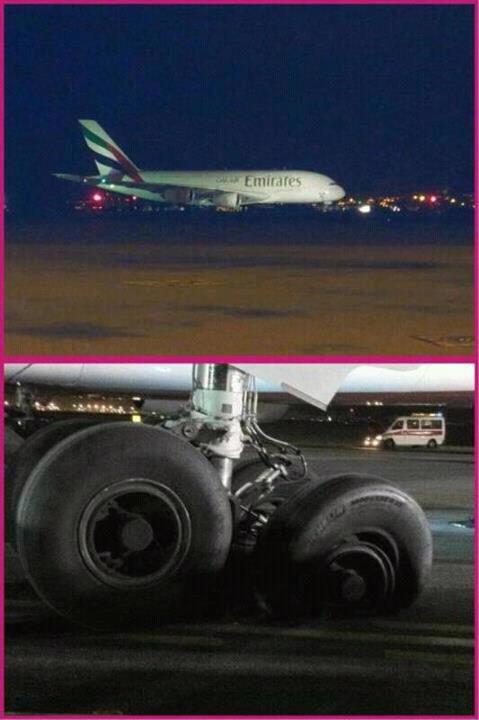 Passengers
were held on the plane for an hour while stairs and buses were found and
logistics sorted to bus passengers across the airfield. Passengers exited by
mobile stairs onto the taxiway. Passengers
were held on the plane for an hour while stairs and buses were found and
logistics sorted to bus passengers across the airfield. Passengers exited by
mobile stairs onto the taxiway.
The northern runway 07L/25R was closed for about 4 hours until the aircraft
was towed off the taxiway.
Passengers reported they saw sparks from an engine at the right hand side
and noticed a burning smell, the crew quickly announced they had burst tyres.
The sparks were probably from the tyre axles; the smell burning tyres.
An observer on the ground reported maintenance staff were replacing a number
of tyres.
Sources at Hong Kong Airport report the aircraft suffered an anti-skid
failure on landing resulting in brakes blocking and causing two main wheels
to be ground down to the axle.
The airline reported the aircraft blew two tyres on landing.
Metars at Hong Kong. It was overcast; but there was no wind and no rain.
VHHH 071030Z 11015KT 9999 FEW025 SCT030 22/14 Q1016 NOSIG
VHHH 071000Z 10013KT 9999 FEW025 SCT035 22/12 Q1015 NOSIG
VHHH 070930Z 11013KT 9999 FEW025 SCT032 22/12 Q1015 NOSIG
VHHH 070900Z 10013KT 9999 FEW025 SCT032 22/12 Q1015 NOSIG
Emirates flight
EK385 due to depart from HKG to BKK at 10.30pm tonight was cancelled. The
airplane is presumably under repair in HKG. Meanwhile it appears that a 777
has been sent to BKK to operate from BKK to DXB as EK385 leaving BKK at
04.30am.
Quick update -
A6-EDQ was ferried empty back to DXB from HKG on Monday 9th April.
There is a video
of the incident posted on
youtube.
Something you
wont see on Mad Men
7 April 2012
Players
Sidestep Question of Augusta Membership Practices
7 April 2012 -
Karen Crouse in the New York Times
There are many tight spots a Masters contestant can find himself in at
Augusta National, not the least of which is having great affection for a
tournament run by a club that would not allow one’s wife, mother or daughter
to become a member.
Several players in this year’s field of 96 were approached under the shade
of the oak tree in front of the clubhouse and asked their opinion of Augusta
National’s not yet extending (to the best of anyone’s knowledge) membership
to the new I.B.M. chief executive, Virginia M. Rometty, as it did her four
male predecessors.
Nobody would talk on the record, with players’ answers ranging from “I can’t
comment on that” to “I’ll talk to you off the record after the story has
run.” On Tuesday, Phil Mickelson, a married father of three, including two
daughters — Amanda, 12, and Sophia, 10 — was willing to address the topic.
Outside the media center after his news conference, Mickelson was asked what
he would tell his daughters if they asked why Augusta National does not let
women become members.
“What I care about,” he said, “is a woman like Ginni Rometty, whom I’ve
never met, works her way up at I.B.M. for 30 years and now is the C.E.O.
That’s inspirational because decades ago, that probably would not have been
the case. And it’s an inspiration as a parent to be able to share that with
my kids to show them. …” His voice trailed off.
In terms of teachable moments for his children, Mickelson added: “Where she
does or doesn’t play her golf doesn’t matter to me. What matters to me is
that brilliance has been rewarded in the workplace.”
Bahrain Grand Prix will end in tears
6 April 2012 -
The Independent
- Andrew Anderson
The FIA, its management,
the formula one teams and drivers are making a huge mistake in proceeding
with the Bahrain Grand Prix. They will be used as propaganda. They will be
part of a message that says all is well and harmonious in Bahrain. It
clearly is not. But the FIA has few scruples when it comes to putting money
before dignity.
I accept that F1
teams do race in other countries with questionable human rights records. But
that does not mean it is right for F1 to collude in presenting to the
outside world a picture of normality at the Bahrain International Circuit.
Because what is happening in Bahrain is not normal. Indeed it may well be
that the Bahrain GP can only proceed after martial law is established in
order to hold the race.
This is the latest
opinion piece in the Independent:
**************************
"The good thing about Bahrain is it seems more democratic there than most
places. People are allowed to speak when they want, they can protest if they
want to," said Bernie Ecclestone in an interview with the BBC on 27th March
2012.
Ahmed Ismael Al-Samadi, (22 years old) from Salmabad, was shot in the
stomach by a man in civilian clothes accompanying the security forces during
a protest on 30th March 2012. He later died from his wounds.
I was in Bahrain this week to try and see my friend and former colleague
Abdulhadi Alkhawaja, an internationally renowned human rights defender, who
was arrested in April 2011, brutally tortured and then sentenced to life in
prison after a grossly unfair trial. I attended his appeal court hearing on
Monday but Abdulhadi, who is currently on the 57th day of a hunger strike,
was not brought to the court. He was moved from Bahrain's Jaw prison on 3rd
April to be held in a clinic at the Ministry of Interior. He is currently at
serious risk of organ failure having lost 25% of his body weight.
The Bahrain Government has invested millions in Western PR companies in
order to try and present a better image of the situation inside the country.
They have also detained and tortured human rights defenders, journalists,
doctors and others who have spoken out inside Bahrain. They have even
blocked international journalists entering the country. But the truth has
stubbornly refused to be silenced.
The report of the Bahrain Independent Commission of Inquiry (BICI) accepted
by the King in November 2011 documented killings of protesters and the
systematic use of torture. According to the recent report of the Bahrain
Centre for Human Rights (BCHR) there have been “31 deaths since the BICI
report: 20 due to teargas suffocation...3 reported deaths by torture.”
The judges considering the appeal of Abdulhadi Alkhawaja and 13 others
refused to acknowledge the BICI report as evidence on Monday. I was able to
speak briefly to Abdulhadi on the phone and it is not hard to understand why
he has no confidence in the judicial process.
The Bahraini Government seeks to present an image of normality and action to
address previous failings but the reality on the ground remains unchanged,
the same Ministers remain in power and the brutal repression continues. BCHR
estimate there are currently around 600 detainees with 397 individuals
imprisoned after unfair trials on sentences ranging from 6 months to life.
In their report of 28 February 2012 Human Rights Watch state:
The trial of the 20 medical personnel was riddled with many fair trial
problems as well. The presiding judge reportedly would not allow defense
counsel to cross-examine prosecution witnesses, insisting that counsel
address the questions to him; the judge then reformulated the questions
before allowing the witness to respond, and in some cases simply refused to
ask the questions of the witness. The court also prohibited the defendants
from testifying.
The doctors had been detained, tortured and forced to sign confessions
because the authorities were outraged they had shown evidence of deaths as a
result of torture the killings of protesters to journalists. Some of them
are the same trauma and intensive care specialists who have provided cover
for previous Bahrain Grand Prix.
On 28th March the Daily Telegraph reported a FIA spokesperson: "We welcome
the spirit of reconciliation expressed by all parties and look forward to an
exciting F1 race at the Bahrain International Circuit." However, the reality
is that the Formula 1 authorities do not seem to have spoken with all
relevant parties in Bahrain and have instead relied on the assurances of the
Bahraini Government. It is crucial that they also speak with independent
civil society, community leaders and opposition political figures in
Bahrain.
Having just returned from Bahrain where I witnessed the indiscriminate use
of tear gas and met with the families and lawyers of those who continue to
be detained and persecuted I can assure the Formula 1 authorities that the
situation in the country has not returned to normal. Bahrain is definitely
not a safe country for Bahrainis.
The security forces violently disperse protests on a nightly basis. There
has been no resolution of the political crisis that brought hundreds of
thousands onto the streets as recently as the 8th of March 2012. If they
proceed to blindly accept the assurances of the Bahraini authorities without
speaking to representatives of the majority of the population who seek
change they risk to see a lot of tear gas and maybe worse on the weekend of
20-22nd April.
And overshadowing all these considerations the life of my brave and
determined friend Abdulhadi hangs in the balance. His long service as a
human rights defender working peacefully for the rights of others has made
him a hero to many in Bahrain and across the region. If he dies before the
Bahrain Grand Prix on the 22nd April it is impossible to imagine how it
could go ahead.
Front Line Defenders Deputy Director Andrew Anderson visited Bahrain from
the 1st-3rd April to attend a court hearing related to the imprisonment of
former colleague Abdulhadi Alkhawaja who is currently on day 57 of his
hunger strike.
Thailand bans film based on "Macbeth"
4 April 2012
Censors in Thailand have banned a film based on William Shakespeare's
tragedy 'Macbeth', saying it could cause divisions in the country. The catch
is this is a Thai film.
The Thai-language
film Shakespeare Must Die tells the story of a theatre group in a fictional
country resembling Thailand that is staging a production of Macbeth.
'Macbeth' is the story of a power-hungry general in ancient Scotland who
kills the king for his throne, and commits more murders to hold onto it.
One of the film's main characters is a dictator named Dear Leader, who bears
a resemblance to former Thai leader Thaksin Shinawatra, who was ousted in a
2006 coup which sparked years of political turmoil between his supporters
and critics.
Censors at the culture ministry issued a brief statement saying that the
film could not be distributed in Thailand because it "has content that
causes divisiveness among the people of the nation". It did not specify
which scenes were deemed offensive.
But, Ing Kanjanavanit, the film's director, said the censorship committee
objected to anti-monarchy overtones in the film as well as politically
charged content, including a scene based on a photograph from Bangkok's 1976
student uprising showing a demonstrator being lynched.
The censors also disliked the attire of a murderer in the film, who wore a
bright red hooded cloak – the same colour worn by the pro-Thaksin
demonstrators known as the Red Shirts.
The director called the ruling absurd and a reflection of the fear in Thai
society. "I feel like we are heading to a very dark, dark place right now, a
place full of fears and everyone has to be extra careful about what they
say," she said, adding that the character resembling Thaksin could represent
any leader accused of corruption and abuse of power.
"When Cambodians watch this they'll think it's Hun Sen. When Libyans watch
it they would think it's Gaddafi."
Ing defended her
use of the color.
"Red is the universal color for killer. In Thai soap operas the bad guys
wear red, so why am I not allowed to use it?...did Thaksin affect my life?
Absolutely. In this sense the film is a political one but we also wanted to
bring Shakespeare to a Thai audience," she said.
"We made a Shakespearean film because we are living through Shakespearean
times. People find the truth in fictional form threatening."
Sensitivity over criticism of the monarchy has increased in recent years as
the poor health of the country's 84-year-old King Bhumibol Adulyadej has
raised concerns about a smooth succession. At the same time, sharp partisan
political battles in the wake of the 2006 coup have unleashed unprecedented
questioning of established institutions, including the palace.
Last year, the film board banned a movie about a transgender father
struggling to raise two children, called Insects in the Backyard, saying it
contained scenes that were immoral and pornographic.
The film had received financial support from a Culture Ministry fund under
the previous government of Abhisit Vejjajiva.
What next; a film
based on King Lear?
Over paid and over there
4 April 2012
Former Thomson
Reuters Chief Executive Tom Glocer will walk away with almost $20 million in
compensation, including $3.1 million in severance to be paid over two years,
according to a regulatory filing by Thomson Reuters.
Glocer had been
responsible for the sale of Reuters to Canada's Thomson organisation and
presided over the demise of one of the UK's most repected companies.
Glocer was eventually removed as CEO at the end of 2011 after the news and
information provider underwent a series of structural changes and management
shakeups to address lackluster sales of one of its key products Eikon and a
declining stock price.
Most of the $19.9 million that Glocer stands to receive is part of his
regular compensation for 2011 including stock options, long term incentives
and a base salary of $1.5 million, the company said in the filing with the
U.S. Securities and Exchange Commission.
Glocer was replaced by James Smith, a veteran Thomson executive who joined
the Canadian newspaper group in 1987. He will be paid a base salary of $1.5
million and his compensation could include an additional $7 million in cash
and stock depending on the performance of the company.
Smith's total compensation in 2011 was $10.5 million, which includes options
and share base awards, when he served as the company's Professional division
head and later as its chief operating officer.
Reuters Editor-in-Chief Stephen Adler, one of the company's senior
executives, received a base salary of $636,923 and a one-time grant of
options that helped boost his compensation to $2.7 million in 2011.
Thomson Reuters reported a fourth-quarter loss after taking a $3 billion
non-cash goodwill impairment charge; which is basically a write down on the
value of the Reuters acquisition.
Hello tomorrow
campaign
3 April 2012
Hello tomorrow again
1 April 2012
I want to like the
new branding. But this will take some time! It just shows how good "Keep
Discovering" was. This feels like branding by a committee where everyone
found the least disagreeable option.
Worse - take the first of the many "o" letters away and you get how most
people feel about 10 across long-haul on a 777....
It is a tagline that is too easy to make jokes around - arriving tomorrow;
departing tomorrow; delayed until tomorrow; tomorrow never comes - just like
my connecting flight.....
Emirates wants to position the airline as the “enabler of global
connectivity and meaningful experiences”. The focus is on where we are
coming from and where we are going to. The focus is not the journey so it
matters less how we get there which may not be the best positioning for an
airline! The adverts that have been shown so far seem largely unconnected to
the airline.
And how many of Emirates existing and future passengers consider themselves
to be a ‘globalista’? Is the male equivalent a globalister or a globalistum?
Has Emirates invented something that does not really exist; at least not in
significant numbers. And would someone as fashionable as a globlista be
content with 10 abreast, 17 inch wide seats in a 777's economy class or near
obsolete seats and entertainment in the dated A330 and A340 products.
Emirates says that the “Hello Tomorrow” positioning will spark a “global
movement”, encouraging people from different communities to join together
and make a positive impact on society, rather than just purely serving as a
series of adverts for the brand. Arrogance or genuine ambition? Emirates is
an airline - not a global political or humanitarian movement. Live Aid
united the world; Emirates flies people around it.
CX seems to have managed a real conection in its advertising between the
airline, its customers and its crews. SQ refreshes but stays with its Great
Way to Fly branding. Virgin uses glamour and humour but creates a strong
brand loyalty. EK's campaign has missed the chance to use its crews to sell
the international/global message - and that is a shame.
EK also spends a small fortune on its sports sponsorships and again the
branding appears in no way to connect to the global sponsorship efforts;
sport can unite the world in a way that corporate brands cannot other than
by association.
One advantage - it will translate easily and be easily understood in any
language - hola mañana; ciao domani.
Just initial thoughts - am sure people have very different views to mine and
that the campaign will evolve over time.
Dubai at night
1 April 2012
Burj Khalifa just
left of centre and the airport on the left of the picture. The Palm Jumairah
is bottom right. This satellite picture was taken in February 2012.
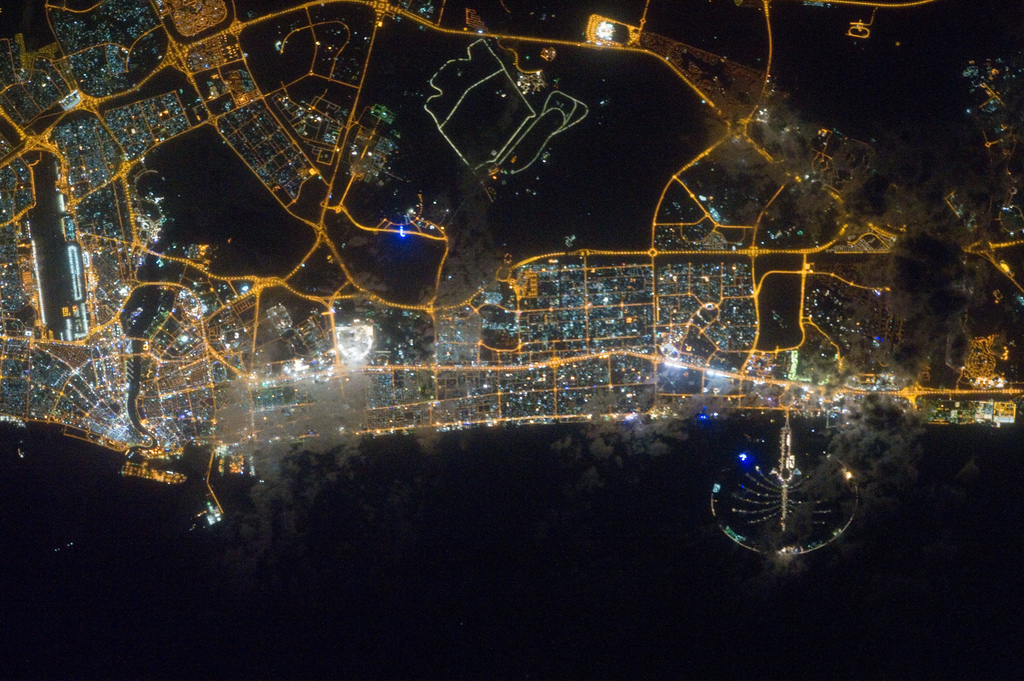 |
|