rascott.com                                                                                 news, views and an occasional blog


Welcome to rascott.com
This is a personal site that reflects my interests in news,
current affairs, aviation and travel.

email me: robert@rascott.com

Home
Up

Now In Dubai:
Scott Consulting

Photo Albums
My photographs have been moved off this site and are now stored on Picasa. They were simply taking up too much space on my web host.
Please use
this link to see my list of photo albums.

Some Useful links:
Information:
World Time Clock
Exchange Rates

Journalism:
ForeignPolicy

Nationsonline.org
Project Syndicate
Amnesty International
Reporters w/o borders

The Guardian
BBC World News
CNN Asia
Bangkok Post

Daylife.com - news

Gulf News
Arabian Business
World News
WSJ - Asia
SCMP
Good causes:

Sister Joan - Bangkok

Regional Info:

BKK Magazine
HK Magazine
In Singapore Magazine
TimeOut Dubai
Back in the UK:
Newton Ferrers

And for fun:
Lin Ping live panda tv

EarthCam
History

BBC Archive

National Media Museum
The British Library
Imperial War Museum

There are many other links on my AOB blog page.


Fantasy F1 Thailand

27 September 2012

Reuters reported today that Thailand is close to securing a Formula One night race around the streets of Bangkok for the 2014 season, quoting local media sources.

It will not happen. Sports Authority of Thailand (SAT) Governor Kanokphand Chulakasem apparently met Formula One supremo Bernie Ecclestone during the Singapore Grand Prix last week and it was agreed "in principle" that Thailand would host the race, according to the Bangkok Post.

Chulakasem, was accompanied by an advisor to billionaire Red Bull owner Chalerm Yoovidhya.

Chalerm's youngest son is no stranger to car racing - Worrayuth Yoovidhaya recently ran down and killed Police Sergeant-Major Wichien Klanprasert when driving his Ferrarri at high speed.

Worrayuth fled the scene of the killing, running home to mummy and daddy. His clan then blocked access to the car until a search warrant was obtained, and allegedly had a family driver try to serve as scapegoat.

The Yoovidhya family paid the officer’s siblings 3-million baht ($97,000) last week, police Lt. Col. Viradon Thubthimdee said. The settlement is intended protect Vorayuth from a civil lawsuit.n

Yet the car involved in the accident was valued at about 30 million baht, ten times more than the proposed compensation.

Red Bull is of course an existing Formula 1 team sponsor.

Like most politically appointed Thais what the SAT governor reports in order to sound good and what is reality are probably far apart.

"It will be a city race like those in Singapore and Monaco. It will be a night race like the Singapore Grand Prix," Chulakasem was quoted as saying by the newspaper.

But the small matter of fees and other aspects of the deal were yet to be finalised. If it does proceed there will be some people making some serious dollars from staging the event,

Democracy in America

25 September 2012 - The Economist

Barack Obama gave a pretty clear defence of the universal human right to be an obnoxious, blasphemy-spewing jerk at the United Nations today. One of the interesting parts of watching the speech (full text here), for me, was trying to figure out which audiences different parts of the speech were addressed to, or how the same sections might play to different audiences. On the one hand, you had the actual people physically present in the hall, who are probably the oddest, toughest, and at the same time probably the least significant audience for the speech. These are, after all, diplomats; they aren't really supposed to have opinions or sentiments that can be moved by an address. Gatherings of international diplomats and functionaries like the UN General Assembly are by their nature very strange crowds, highly conservative, and in general only responsive to organisationally approved platitudes which they know they can applaud because they've already been voted for repeatedly in universal declarations or in a goals document named for a summit in some equatorial capital two decades ago.

I thought I detected a nod to this crowd when Mr Obama quoted Mahatma Gandhi: "Intolerance is itself a form of violence and an obstacle to the growth of a true democratic spirit." The correct move here was to couch the American defence of the right to blasphemy in the words of a hero of the non-aligned movement whom even the Egyptians might have to applaud, lest they piss off the Indians. Nobody can be against Gandhi! So it's a safe applause line, for anybody except a funky postmodern anti-anti-colonialist like Dinesh D'Souza; but I doubt he was in the audience. And I thought something similar was going on with this sequence:

“The future must not belong to those who target Coptic Christians in Egypt – it must be claimed by those in Tahrir Square who chanted “Muslims, Christians, we are one.” The future must not belong to those who bully women – it must be shaped by girls who go to school, and those who stand for a world where our daughters can live their dreams just like our sons.”

It's not always a safe applause line to bring up girls' educational rights as part of a discussion of religious tolerance and civil rights in the Muslim world. Except, that is, at the United Nations, where every country present has explicitly ratified girls' educational rights in various universal declarations and the goals documents named for the summits in the equatorial capitals, which they signed in part because they didn't think they'd actually mean anything. It is the humanitarian politician's beautiful art to exploit such settings and carelessly made promises in order to needle these countries a few centimetres closer to actually educating their girls.

So much for the audience in the room. One reason such audiences of foreign diplomats and functionaries tend to be a little bored or abstracted at these gatherings, though, is that much of what speechifying national leaders say isn't actually addressed to them. It is addressed to constituents back in their own countries. In America right now, for reasons I can barely follow myself, Mr Obama's constituents are wrapped up in an argument over whether he spends too much time condemning people who insult the Prophet Muhammad, and not enough time condemning Muslim extremists for using such insults as a pretext to commit acts of political violence. So, much of Mr Obama's speech was devoted to checking boxes in the American political debate to certify that, yes, he defends freedom of expression, and, no he doesn't think it's ever justifiable to kill people or blow things up because somebody insulted your religion.

Writing this, I realise I'm saying something odd here: I'm assuming that when Mr Obama says,

“[T]here is no speech that justifies mindless violence. There are no words that excuse the killing of innocents. There is no video that justifies an attack on an Embassy. There is no slander that provides an excuse for people to burn a restaurant in Lebanon, or destroy a school in Tunis, or cause death and destruction in Pakistan.”

...he's not actually talking to violent Muslim protestors, or even to residents of Muslim countries who may sympathise with violent protestors but to Americans who are susceptible to accusations that Barack Obama has not sufficiently denounced violent Muslim protestors. And I may be wrong about that. To be clear, I found Mr Obama's speech cogent, right, sensitive, sophisticated and moving. it may be that he really is, at least in part, addressing the better-educated, higher-information citizens of the Arab world when he says (and I'm repeating some of the above lines so we can see them in context):

“It is time to leave the call of violence and the politics of division behind. On so many issues, we face a choice between the promise of the future, or the prisons of the past. We cannot afford to get it wrong. We must seize this moment. And America stands ready to work with all who are willing to embrace a better future.

The future must not belong to those who target Coptic Christians in Egypt – it must be claimed by those in Tahrir Square who chanted “Muslims, Christians, we are one.” The future must not belong to those who bully women – it must be shaped by girls who go to school, and those who stand for a world where our daughters can live their dreams just like our sons. The future must not belong to those corrupt few who steal a country’s resources – it must be won by the students and entrepreneurs; workers and business owners who seek a broader prosperity for all people. Those are the men and women that America stands with; theirs is the vision we will support.

The future must not belong to those who slander the prophet of Islam. Yet to be credible, those who condemn that slander must also condemn the hate we see when the image of Jesus Christ is desecrated, churches are destroyed, or the Holocaust is denied. Let us condemn incitement against Sufi Muslims, and Shiite pilgrims. It is time to heed the words of Gandhi: “Intolerance is itself a form of violence and an obstacle to the growth of a true democratic spirit.” Together, we must work towards a world where we are strengthened by our differences, and not defined by them. That is what America embodies, and that is the vision we will support.”

These words could, I suppose, actually be addressed to Arab citizens. But even if they are, I don't think they'll be widely heard. Certain well-educated segments of Arab elites may watch the speech, it may be picked up to some extent in the Arab press, and that could be part of a useful conversation, I suppose, within a narrow circle. But the people who rioted over "The Innocence of Muslims", obviously, are vanishingly unlikely to hear anything Mr Obama said today. if they do, it will be in the form of a sentence or two that can be plucked out of context in order to create offence for the purpose of mobilisation, much as they used the film trailer itself. And that's what I've found so misguided about criticisms of Mr Obama (such as this post by Doug Mataconis) on the grounds that he failed to sufficiently defend freedom of speech or condemn the use of violence in response to blasphemy over the past week. Who was he supposed to be talking to? It seems to me that this is a call for Mr Obama to say something in a conversation that does not exist.

But hey, maybe I'm wrong, and there is a real politically active Arab citizenry that will see Mr Obama's speech today and engage with it in some way. I hope so!

Divided World

24 September 2012

Events over the last few weeks have suggested that a clash of civilizations between the Islamic world and Western democracy has become more rather than less likely.

There is little doubt that at a minimum we will see more rather than less conflict.

I have been trying to think how to best write this story. Flying from Washington to Dubai last week I was discussing the latest anti American protests with two Moroccan Muslim cabin crew. One was very relaxed about the youtube video that provoked the latest trouble; relaxed enough to say that we should all be able to accept people with different views; that we should be tolerant of intolerance.

The other was much more hardline. How can anyone blaspheme the prophet (pbuh)? How can anyone be allowed to make a video blaspheming the prophet. Why was the video not banned? What was the role of Israel?

The protests were violent and murderous in some cities. But how many people had actually seen the offending video. It is about 15 minutes of badly edited video posted some months ago to youtube. The film has not been released to or shown in cinemas. Yet the crew member believed that the film was on general release and widely viewed in the USA. We end up believing what we want to believe.

It is worth remembering that it is not just Muslims who periodically protest and riot - a year ago London was in flames. Rioting is often at its worst in societies with large numbers of poorly educated young men. Upheavals are often more about demography than about religion.

The crew member clearly saw ridicule of the prophet as part of a larger narrative of the West’s intolerance and humiliation of the Islamic world. Free speech was therefore only acceptable in so much as it did not "tell lies" about her religion. The fact that free speech accepts ridicule of all faiths was irrelevant. It is that fine line between ridicule and incitement through hate that censorship and control has to walk.

What was clear in the discussion and in the US media coverage of the protests was the genuine failure of understanding between Americans in particular and many Muslims. Sorry America but Muslims are not grateful to you; they have not been liberated by you. You did not lead the revolutions in Egypt and Libya. Their own people did that.

Many Muslims see the video as part of a campaign of humiliation. This was enlarged by a French magazine this week printing a new cartoon showing the prophet naked.

The violence has led to the death of the American ambassador to Libya and there others, and last Friday 15 people died in Pakistan alone as what were supposed to be peaceful protests turned violent.

The protests have continued across the Middle East and Asia. The catalyst is the video. But there are other drivers of confrontation.

The war on terrorism, U.S. drone strikes, wars in Iraq and Afghanistan and the Guantanamo Bay prison simply continue, in many Muslims' perceptions, centuries of Western meddling, hypocrisy and broken promises.

Meanwhile, many Americans see those regions as an inexplicable source of terrorism, hostage-taking, hatred and chaos. In Europe, those same concerns have become intertwined with other battles over immigration and multiculturalism.

Moderates on all sides call for greater sensitivity and understanding on both sides. Many in America would clearly be content in the USA simply abandoned the Middle East.

The "Arab Spring" has not brought new friends for America. Indeed some of the new governments will be more selective in their loyalties to the USA. The young pro-democracy activists who leapt to the fore in 2011are not the new leaders. That leaves USA and European officials having to deal with groups such as the Muslim Brotherhood who need to build their domestic support; which means less influence from the USA and Europe.

The popular image of the United States in the Middle East stands in stark contrast to the way Americans view themselves.

There is little trust of western talk of democracy and human rights. Both Washington and Europe only abandoned autocratic leaders (Mubarak and Gadaffi) when their fate was already sealed; these governments have continued to shamelessly back other governments such as Bahrain despite its repression of its own people.

Whoever wins the White House in November will face a string of challenges over the next four years across the Middle East.

Iran's nuclear program; civil war in Syria; dwindling influence over Iraq; the US and allied exit from Afghanistan; stability in Pakistan; troublesome allies in Israel and Saudi Arabia. America needs to keep Israel in check. Again Americans do not understand just how hated Israel is. Any attack by Israel on Iran would have massive consequences for the USA.

The USA and Europe need to engage not disengage from friends in the Middle East; countries that have gone through the Arab Spring were always going to be unstable but now face another five to fifteen years of uncertainty.

Part of the disaffection of so many of their young people is how slowly change has come; how slowly work has become available; how slowly the wealth of these nations is shared to the benefit of all. Uncertainty and disillusionment lead to rebellion.

Obama has to be better for the Middle East than Romney; while he has not made good on many of his commitments he has made it clear that under his watch "the one thing we can't do is withdraw from the region." But he needs more than that; he needs to lead greater engagement and understanding; to be seen as a friend and not an aggressor. And if that means that the USA pushes for the censorship of online hate and provocation that might be a good start.

Clegg's less than humble apology

21 September 2012

The trouble with Nick Clegg attempting to appear sincere is that I immediately start to feel queasy.

The trouble with him making an apology on tv is that I want the sick bag. I simply do not believe that it is anything other than another calculated political gamble coming just before his party's annual conference.

Clegg apologised this week in a released video for promising at the last election to oppose any increase in tuition fees, saying: "We made a pledge, we did not stick to it, and for that I am sorry."

It was stressed that Clegg was apologising for making the pledge to the National Union of Students before the election not to raise tuition fees, but not for the eventual decision by the coalition to lift the cap on fees to £9,000.

Lacking any adequate explanation of his behaviour the apology reopens the whole business, and raises questions once again about his judgement and motives.

What is most sickening is what he feels he needs to apologise for, and what he is not apologising for. The list is far longer than the fees policy. Lets start with the simple fact that he allowed the Tories to take office; then allowed the NHS to be wrecked and sold off; allowed the Tories to decimate benefits programs; then gave up on the Lords reforms.

Clegg claims that in the weekend FT: "I've taken a big hit - and I've taken it for the team." Such self pity. Made worse by the fact that this is all about Nick Clegg. Not about the heart and soul of the Liberal Democrats.

Feeble. Spineless. Immoral. What remains of the Lib Dem party needs to remove him immediately. They are too late to save their party from decades of oblivion but they might get some credit for swift action on this.

Clegg will be in the Tory party within a year of being sacked.

Budget Rent a Car - redefining useless

18 September 2012

Dear Sir or Madam,

I had the misfortune to rent a car from your Washington Dulles facility from 12 -17 September 2012. The contract number was 11837416.

On collection the only cars available were either mini vans or premium cars. Which makes a mockery of the reservation process. Why should I select a car and advise a collection time if there are no matched cars available? Traveling on my own I neither wanted a premium car or a van.

What I needed, and had reserved, was a working GPS.

What I did not need was a GPS that failed to charge and was therefore useless for all five days. My map reading is adequate but the non-functioning GPS cost me both time and gas.

I had pre-paid the rental as your web site encourages me to do. I had also pre-booked the GPS.

I returned the car on 17th. I advised that the GPS had not functioned. I was told that because I prepaid I could not be given a credit; just vouchers.

Now I asked a sensible question. “Can the vouchers be used internationally?”. “I think so” was the reply; the assistant checked with her colleague who said the same thing.

Mistakenly I thought Budget to be an international company. I thought Budget might recognise that a customer resident overseas may not be rushing back to the USA. But I encourage you to read the back of the vouchers; they are valid in the USA and Canada only and are only valid until the end of 2012. Three and one half months away

Your staff should know this. They could have read this. It is in the first line of the conditions on the back of the coupon.

The coupons are of no use to me whatsoever. Dulles is not some provincial airport; it is a major international facility. Your staff really should be able to give an accurate and honest answer to this question. They should also be empowered to offer credit card or cash re-imbursement when your equipment does not work.

I should not be penalised for having paid in advance.

Budget have basically stolen US$80.83 from me and provided no service at all. And I get no credit; just some worthless bits of paper.

Worse. No one even had the decency to apologise for the non-functioning GPS and for any inconvenience.

Budget does have a website for "Car Rental Experience Comment." But my attempts to leave this message there are thwarted by a response that "There were some problems with your form submission. Please correct them and submit again." There is no clarification of what the problem may be; and the required data has been accurately entered. Which makes your web site about as useless as your staff.

I look forward to hearing how you plan to reimburse me.

Yours sincerely,

Robert Scott

Letter while leaving America

17 September 2012

From onboard EK232 today: A  drive out of the big cosmopolitan US cities is always interesting; and reveals more about modern America than any of the domestic media.

Virginia is for lovers says the advertisements. And for well do white America. If is also a key state in the November election and last week both parties were canvassing hard. Virginia was long thought of as a Republican state. But Obama won in 2008 - the first time a Democrat had taken the state in 44 years. A year later the state elected a republican governor.

Virgina is a key state because it has a bit of everything - from the sprawling suburbs west and south of Washington DC to the rural farmlands of the Shenandoah valley and the Blue Ridge mountains.

It is also a state routed in the history of the American civil war; Washington was the Union capital and just 80 or so miles away Richmond, Virginia, was the Confederate capital. Many of the wars decisive battles were fought in the state.

Fredericksburg elected a Democrat mayor. But drive to Harrisonburg and the only road signs you see are for Romney and Ryan. This could be a real urban/rural split.

It is pretty country - very green, rolling countryside, big homes and farms. It is a state big on education with a university in every major city. University of Virginia on Charlottesville and James Madison University in Harrisonburg. Charlottesville has a very attractive and prosperous downtown.

It is a god fearing state. The new buildings are either gas stations, car showrooms or churches. There are more christian radio stations than news stations. It is more Fox News than CNN. It is Rush Limbaugh on the radio. That guy really is incendiary.

"They all hate us" trumpets the talking head on MSNBC this morning - they being every Arab on the planet. He cannot explain why this might be or what could be done to fix it. But he obviously has not seen the queue at Cheesecake Factory in Dubai. Once again; these are small, noisy, demonstrations. They grow because, like in America in the 1960s, there is a whole new generation that is now finding a voice.

One reason they hate you is that you think the whole world is against you. The USA is the ultimate paranoid nation. Take security at Dulles. The first long queue is to a little old lady who slowly and laboriously ticks every item on your boarding pass. If she can read - it is very slow.

Then the queue for the scanners. Of course only two out of at least eight positions are open. Staffed by people who look like they have been in a Dunkin Donuts eating contest. Everyone moves very slowly. There is no sense of urgency. No sense that anyone has any interest in making the experience remotely pleasant. The TSA has been the biggest boondoggle in history. Queues like that would never be acceptable in Dubai or Hong Kong or Singapore; places that want to be efficient international cities. If Obama is serious about cost saving I know where I would start.

Incidentally there appears to be no security on the Washington metro. So we have spent a fortune on making the skies safer. How about the trains?

Rush Limbaugh was moaning on the radio about spending cuts; their impact on the military and on the public. But he also wants tax cuts. He is a very confused man.

So Smithsonian, why not charge admission. How about a US$5 admission fee to each museum; or US$12 for a family. And a day pass to all the museums for US$12 or US$ 25 for a family. No exceptions. No dual pricing. Would visitor numbers fall? Maybe. Would the revenue allow reinvestment in the museums. Definitely.

As for Budget Car Rental at Dulles airport - useless, useless, useless. You are working at an international airport - I emphasise international. Time to think big picture.

And that in a nutshell is America. Think local. Act local. For a nation built by immigration you really have no understanding of, and not that much interest in, the rest of the world.

Letter from America

15 September 2012

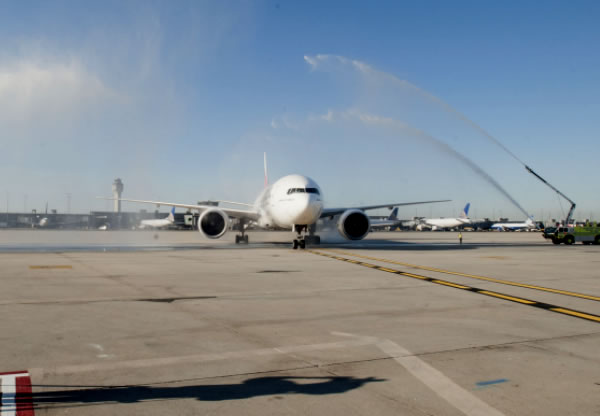
I left Dubai at 2.20 am on Wednesday 12 September. It was Emirates inaugural flight to Washington, EK 231.

Anyone expecting the airline to do something special for the first flight would have been severely disappointed.

I walked the length of the huge Terminal 3 departure hall to the check-in desks for US departures. Only to be told that the Washington flight was checking in at separate desks back near the entrance. Very frustrating.

At the departure gate there were some 200 tired looking people. But nothing that indicated that this was a first flight. No dancing girls, star-spangled banners, cake or drinks. The VIPS were presumably being bussed to the airplane as there was no sign of them at the gate.

On the flight the economy passengers were given a small box to commemorate the flight; it contained two luggage tags readily available for a few dirhams in the EK gift shop.

The flight was OK - other than the guy sitting next to me not being able to sit still at any time during the 14 hour flight. He also decide that even though he had the aisle seat he was entitled to both armrests. EK economy etiquette says that if you have the window or the aisle you get the outside arms rest and the poor sods in the middle seats get to fight out access to the middle arm rests. There should be a web site on 3-4-3 configuration etiquette.

Washington immigration was easy - no other international flights arrive at that time; minimal queue and a friendly welcome.

It was far to early to go to my hotel so a quick coffee and on my way to the Steven F. Udvar-Hazy Center near Washington Dulles International Airport, This is the companion facility to the Air and Space Museum on the National Mall. The building opened in December, 2003, and provides enough space for the Smithsonian to display the thousands of aviation and space artifacts that cannot be exhibited on the National Mall. T

The display includes the Lockheed SR-71 Blackbird, the fastest jet in the world; the Boeing Dash 80, the prototype of the 707; the Boeing B-29 Superfortress Enola Gay.

The James S. McDonnell Space Hangar opened in November 2004; the centerpiece of the space hangar is the Space Shuttle Discovery which is far bigger than I expected. Other space artifacts include the Gemini VII space capsule; the Mobile Quarantine Unit used upon the return of the Apollo 11 crew.

I took one of the guided tours of the exhibits. All guided-tours are conducted by docents (volunteer guides) and they love their musuem. Our tour took over 2 hours and only ended as our guide had to leave for an appointment. The volunteers are trained for 11 weeks agree to a two-year commitment to the program. Docents are given scheduled shifts with a minimum of eight hours per month. They are industry or air force or navy veterans and love talking airplanes.

Many of the visitors are also from the aviation industry. It makes for a fascinating tour.

By the time I got to my Fairfax hotel I was tired ! That was a long day.

With the usual jet lag I was awake at 3.30am. The subway/metro is the best way into Washington and from Vienna I took the train to Woodley Green and walked almost a mile from there to the National Cathedral.

There were press outside the cathedral but not as many as I expected. Events in the middle east have taken over television this week. I was also expecting crowds outside the cathedral to say farewell to Neil Armstrong. But there were none.

So I walked up to the desk at the entrance and asked if I could attend and was given a terrific welcome and a ticket. I was not exactly dressed for a memorial. Smart shirt and dark jeans. It was a privilege to be there. Armstrong achieved what the rest of us can only dream about. And he will be remembered long after we are gone. Eugene Cernan, the last American to walk on teh moon on Apollo 17 paid a moving tribute; Dianne Krall sang "fly me to the moon."

My mistake was then to walk the two miles from the Cathedral down Massachusetts to Dupont Circle. This is Embassy Row. Some remarkable buildings. The British Embassy sadly looks like an ugly 1960s comprehensive school. The residence next door is palatial. Like Downton Abbey in the heart of Washington. They must have some great parties on that street.

Took the metro from Dupont Circle to Eastern Market - there really is not much there - it is not Toronto's St Lawrence market for instance. But then walked back past the Capitol Library, the Capital Building and onto the Mall.

Sorry Washington; I do dislike your metro. The dark, stark, barely lit station platforms are miserable and dangerous.

Visited the Museum of the American Indian and a quick re-visit to the Air and Space Museum.

The Museum of the American Indian is a fitting tribute to the indigenous peoples. A little bit too educational rather than interactive. More pictures and descriptions rather than displays. And playing down their oppression by white settlers and the Indian Wars. The Canadian Museum of Civilization in Ottawa feels like a more fitting tribute.

The Air and Space Museum has not changed in decades and is beginning to look more tired than it should. 

Too much walking and a long day; it was time to head back to Fairfax. There is a mall almost next to the hotel. Useful for takeaway dinners.

Thursday 14th and another long walk. Starting at the White House then to Washington Monument, the WW2, Korean and Vietnam war memorials, the Lincoln Memorial, a walk from their to Georgetown; and across the bridge over the Potomac to Rosslyn.

A new Smithsonian Museum will open in 2015; the Museum of African American History and Culture.

I have reservations; for a nation promoting inclusiveness these museums are in danger of promoting exclusivity. The Museum of American History should be the single museum that relates the experiences of all Americans. What next - a Museum of Hispanic Americans, Asian Americans, Arab Americans, Irish Americans? These are all stories that should be intertwined in telling a singular story.

I am sure the Smithsonian knows this and that the new exhibition will respect a difficult story. It would be fitting for a re-elected President Obama to preside at its opening.

Another letter from America tomorrow looking at the presidential campaign.

Middle East turmoil baffles America

15 September 2012

An obscure California-made film that insults the Prophet Mohammad (PBOH) triggered an attack on the U.S. consulate in Libya's city of Benghazi that killed the U.S. ambassador and three other Americans on Tuesday, the anniversary of the September 11, 2001 al Qaeda attacks on the United States.

After weekly prayers yesterday, protesters across the Middle East and North Africa attacked US embassies and burned American flags. Fury over the film has been stoked by Internet video footage, social networks, preachers and word-of-mouth.

In Tunis, at least three people were killed and more than two dozen wounded, state television said after police gunfire near the U.S. embassy in the city that was the cradle of last year's Arab Spring uprisings for democracy. At least one person died in the Sudanese capital Khartoum, a doctor said, after some of thousands of protesters had climbed into the US embassy.

In Yemen, for a second day in the capital Sanaa, police battled hundreds of young men around the US mission.

In Khartoum, wider anger at Western attitudes to Islam also saw the German embassy overrun, with police doing little to stop demonstrators who raised a black Islamist flag. Violence at the US embassy followed protests against both Washington and the Sudanese government, which is broadly at odds with the West.

The protests present U.S. President Barack Obama with a new foreign policy crisis less than two months before seeking re-election and tests Washington's relations with nascent democratic governments newly in power across the Arab world.

Obama has promised to bring those responsible for the Benghazi attack to justice, and the United States also sent warships towards Libya which one official said was to give flexibility for any future action.

U.S. Secretary of State Hillary Clinton said Washington had nothing to do with the crudely made film posted on the Internet, which she called "disgusting and reprehensible", and the Chairman of the U.S. Joint Chiefs of Staff called a Christian pastor in Florida to ask him to withdraw his support for it.

The protests spread as about 10,000 people held a noisy protest in Dhaka, the Bangladeshi capital. They burned U.S. flags, chanted anti-U.S. slogans and demanded punishment for the offenders, but were stopped from marching to the U.S. embassy. There was no violence.

Thousands of Iranians held nationwide protests. There were also rallies in Malaysia, Nigeria, Jordan, Kenya, Bahrain, Qatar, Bangladesh, Pakistan and Iraq.

There are all sorts of issues at play here. Firstly and lost in the media's dramatic coverage of the embassy protests is just how small most of these protests actually are.

Also lost is the fact that President Assad's regime continues to attack and kill Syrian protestors while the world is focused on these new protests. And this is not even front page news now. Assad gets away with it because the Arab and Western governments let him.

Eleven years on from 9/11 and Americans are still confused. How can these people dislike us so much after we do so much for them?

One prominent strain shaping American reaction to the protests in the Muslim world is bafflement, and even anger, that those Muslims are not more grateful to the US. After all, goes this thinking, the US bestowed them with the gifts of freedom and democracy – the very rights they are now exercising – so how could they possibly be anything other than thankful?

On Wednesday, USA Today published an article with the headline "After attacks in Egypt and Libya, USA Today asks: Why?" The paper appeared to tell its readers that it was the US that freed the Egyptian people from tyranny:

"Attacks in Libya that left four US diplomats dead – including Ambassador Christopher Stevens – and a mob invasion of the US Embassy in Cairo, in which the US flag was torn to shreds, have left many to wonder: How can people the USA helped free from murderous dictators treat it in such a way?"

Did you know that the "USA helped free" Egyptians from their murderous dictator? It is a creative rewriting of history.

On Thursday night, NBC News published a nine-minute report on Brian Williams' "Rock Center" program saying much the same thing. Richard Engel, reporting on the demonstrations in Cairo, said: "It is somewhat ironic with American diplomats inside the embassy who helped to give these demonstrators, these protesters, a voice, and allowed them to actually carry out these anti-American clashes that we're seeing right now."

Reality check: The US spent decades arming, funding and supporting the hated dictator Mubarak and his family. Egyptians would likely find it difficult to reconcile Engel's claim that the US freed them with the "made in USA" logos on the tear gas cannisters used against them by Mubarak's security forces; or with Hillary Clinton's touching 2009 declaration that "I really consider President and Mrs Mubarak to be friends of my family"; or with Obama's support for Mubarak up until the very last minute when his downfall became inevitable; or with the fact that the Obama administration plan was to engineer the ascension of the loathed, US-loyal torturer Omar Suleiman as Mubarak's replacement in the name of "stability".

Given the history of the US in Egypt, both long-term and very recent, it takes an extraordinary degree of self-delusion and propaganda to depict Egyptian anger toward the US as "ironic" on the ground that it was the US who freed them and "allowed" them the right to protest. But that is precisely the theme being propagated by most US media outlets and the republican campaign.

Even in Libya, where it's certainly true that many Libyans are happy about the Nato intervention, this bafflement is misplaced. The result of the revolution in Libya has been lawlessness and instability.

What does anger so many people outside the US is the litany or broken promises and lies used to justify actions. Remember that it was the US that attacked another country based on nonexistent weapons and fabricated secret alliances with al-Qaida.

Americans argue that this anger is fueled by conspiracy theories and tyrannical propaganda. But the Arab world's view is that the US and Israel have continuously brought extreme amounts of violence to the Muslim world, routinely killing their innocent men, women and children.

The anger arises from years of bombing of Gaza and Lebanon, the almost five-decade long oppression of Palestinians, the widely hated, child-killing drone campaign, and the attack on Iraq.

That is reality not conspiracy. Intense Muslim animosity toward the US, including in Egypt, long pre-dates this film, and the reasons aren't hard to discern.

After Obama was elected in 2008 he gave a keynote speech in Cairo in June 2009

"I believe that America holds within her the truth that regardless of race, religion, or station in life, all of us share common aspirations – to live in peace and security; to get an education and to work with dignity; to love our families, our communities, and our God. These things we share. This is the hope of all humanity."

"It is easier to start wars than to end them. It is easier to blame others than to look inward; to see what is different about someone than to find the things we share. But we should choose the right path, not just the easy path. There is also one rule that lies at the heart of every religion – that we do unto others as we would have them do unto us. This truth transcends nations and peoples – a belief that isn't new; that isn't black or white or brown; that isn't Christian, or Muslim or Jew. It's a belief that pulsed in the cradle of civilisation, and that still beats in the heart of billions. It's a faith in other people, and it's what brought me here today."

Barack Obama's Arab honeymoon has been squandered. These riots are not a reaction to a low budget hate film. They are the reaction to decades of mistrust and anger. They are the response to actions that belie Obama's words and promises.

Dignified memorial for a legend

14 September 2012

Apollo 11 crewmates Buzz Aldrin and Michael Collins and Mercury astronaut John Glenn were among 2,500 people in the vast Washington National Cathedral yesterday.

The last man to leave his footprints on the moon paid tribute to the first moon-walker at a national memorial service for the late astronaut Neil Armstrong.

Eugene Cernan, who followed in Armstrong's 'small steps' as the 12th and last American astronaut to stand on the lunar surface, joined NASA Administrator Charles Bolden and the former Secretary of the Treasury John W. Snow to deliver remarks celebrating Neil Armstrong, commander of the Apollo 11 mission.

Thursday's public memorial in Washington, DC, precedes Armstrong's burial at sea, to be conducted by the Navy today.

The memorial service at the cathedral, for which a limited number of seats were reserved for the public to attend, brought together dignitaries, community and political leaders, Armstrong's family members, and members of the NASA family, including current and former astronauts.

Armstrong's Apollo 11 crewmate, Michael Collins, led the assembly in prayers.

In July 1974, Collins, Neil Armstrong and Buzz Aldrin donated one of the moon rocks they brought back to Earth to the National Cathedral. A sliver of that same lunar rock is now on display there, embedded in a stained glass window that pays tribute to their historic moon landing.

In between the tributes and readings, including a biblical passage read by former Secretary of the Navy John Dalton, musicians dedicated performances to the late Armstrong. Canadian jazz pianist Diana Krall sang solemn version of "Fly Me to the Moon" as arranged by Frank Sinatra.

The Metropolitan Opera Brass, the U.S. Navy Band "Sea Chanters," and the Cathedral Choristers also performed pieces, including "America the Beautiful."

The ceremony closed with Bolden's presentation of an American flag to Carol Armstrong, the astronaut's widow. The U.S. flag was flown over the Mission Control Center at NASA's Johnson Space Center in Houston on the day of Armstrong's passing.

Armstrong's family earlier gathered for a private service on August. 31 in Cincinnati, Ohio. The family also established the "Neil Armstrong New Frontiers Initiative," a memorial fund for the Cincinnati Children's Hospital Medical Center.

They have asked that memorials be made to the Initiative, or to two scholarship funds setup in Armstrong's name by the Telluride Foundation and by the American Institute of Aeronautics and Astronautics (AIAA).

The family also suggested for those wishing to pay tribute, that they "honor his example of service, accomplishment and modesty, and the next time you walk outside on a clear night and see the moon smiling down at you, think of Neil Armstrong and give him a wink."

So great was Armstrong’s status, there had been a clamour for him to receive the honour of a full state funeral.

The inter-faith memorial service was more fitting for the intensely private engineer and aviator.

‘You have now shown once again the pathway to the stars,’ Eugene Cernan, the last man to walk on the Moon said in a tribute to Armstrong.

‘As you soar through the heavens beyond even where eagles dare to go, you can now finally put out your hand and touch the face of God.’

Nasa administrator Charles Bolden, a former astronaut read a letter from Barack Obama saying ‘the imprint he left on the surface of the Moon is matched only by the extraordinary mark he left on ordinary Americans.’

Armstrong, who died last month in Ohio aged 82, walked on the Moon in July 1969.

He was born on August 5, 1930, on a farm in Ohio but was proud of his Scottish roots. In 1972, he accepted the freedom of the town of Langholm in Dumfries and Galloway.

Angus Sutherland, dressed in Clan Armstrong tartan, piped in the Armstrong family by playing Mist Covered Mountains. Mr Sutherland was originally from Kelso in the Borders but now lives in Washington DC.

Flying into regulation problems

14 September 2012

The Qantas and Emirates alliance is not a done deal yet. The deal needs regulatory approval and one big obstacle may be Emirates dominance of routes between Australia and the U.K.

Qantas, whose international business is ailing, desperately needs the link-up to help slash costs and extend its reach into both Europe and Asia.

But according to analysts at Macquarie, joining forces with Emirates on the Kangaroo route–which Qantas has been flying since 1947–means the pair would end up with a 42% share of that market segment, and an even bigger slice of the business-class portion.

That will concern Australia’s competition regulators.

In a submission this week to the Australian Competition and Consumer Commission, Qantas argued that if the Emirates deal fell through, it may have no choice but to cut back its loss-making European operations even more–which would ultimately reduce competition in Australia for overseas travel.

It also argued that competition is set to intensify as Chinese carriers and other Middle Eastern airlines such as Etihad expand their global reach.

Qantas’ points amount to a “sound argument for regulator approval,” of the Emirates deal, according to the aviation analysts over at Macquarie.

But for the analysts the biggest concern remains the route between the U.K. and Australia, where the dominance would be most acute between Melbourne and London, and where Qantas and Emirates already enjoy a combined 56.6% of the business-class segment.

The ACCC didn’t have any problem with a partnership Qantas previously had with British Airways on the same route, which Qantas just exited as part of its deal with Emirates.

At one point, their joint market share on the route was as high as 42%, according to Macquarie. It was just 30% when the pair parted ways, thanks to competition from carriers like Emirates and Etihad.

But just because the regulator was okay with a 42% market share more than 10 years ago doesn’t mean it will permit such a strong concentration today.

The regulator has confirmed it’s probing the deal and has called for submissions from interested parties by September 21. Will their be submissions from any other airlines expressing concern at the proposed deal?

Emirates announces Algiers

14 September 2012

Emirates has officially announced a new daily nonstop service to ALG-Algiers, Africa effective 1 March 2013.

Daily flights will be operated using an A330-200 departing DXB at 0845 and arriving back by 0055 the next day. Another flight departing in the morning rush hour!

The launch of our third African route in just 13 months is a further demonstration of the huge potential of this fast-expanding economic region. As a key oil and gas supplier, Algeria has an abundance of natural resources and Emirates’ new service will help to grow trade routes and create new markets for imports and exports,” Shaikh Ahmad Bin Saeed Al Maktoum, President of Dubai Civil Aviation and Chairman and CEO of Emirates airline and Group, said in a statement.

Algeria will mark Emirates’ 130th destination and its fifth destination within North Africa, following the resumption of services to Libya in November 2012.

Shameful - a 23 year fight for the truth

13 September 2012

It has taken 23 years to get to the truth of events at Hillsborough, Sheffield. Now we have the truth we should also expect justice.

Hillsborough report key findings:

• Police carried out criminal record checks on the deceased to 'impugn reputations'
• Senior officers privately discussed 'animalistic behaviour' of 'drunken marauding fans'
• New evidence suggests dozens survived past 3.15pm inquest cut-off point
• 116 of the 164 South Yorkshire Police statements were doctored
• South Yorkshire Ambulance Service evidence was misleading
• No evidence to support police account that fans were drunk and aggressive
• Margaret Thatcher expressed concern in Cabinet that the first inquiry into the disaster contained 'devastating criticism of the police'
• Weight placed on blood alcohol levels among the dead was 'inappropriate'
• The Sun's allegations originated from police and a local MP

The Hillsborough Independent Panel delivered their report at a press conference this week in Liverpool. Journalists sat in disbelief at the revelations contained in this landmark report.

Hillsborough remains the biggest disaster in British sport. On a spring day 23 years ago 96 fans died at the FA Cup semi-final between Liverpool and Nottingham Forest; the match was to have been played at Sheffield Wednesday's Hillsborough stadium.

The Hillsborough Independent Panel, chaired by the bishop of Liverpool, James Jones, had inspected 450,000 documents generated by the police, Sheffield Wednesday and all other bodies responsible, and delivered its remarkable 395-page report indicting official failings and vindicating the victims and football supporters.

Some of what happened to cause the disaster, and the police's subsequent blame-shifting, has been exposed over these long decades. But the depth of what the families call a cover-up, in particular the deliberate, relentless South Yorkshire police campaign to avoid its own responsibilities and craft the false case against the supporters, was still startling.

In a concerted campaign begun even as the dead were lying in a temporary mortuary at Hillsborough itself – led, the panel found, by the chief constable, Peter Wright – the South Yorkshire police marshalled their story that drunken supporters or those without tickets had caused the disaster. The victims, most younger than 30, many of them teenagers, the youngest aged 10, had their blood tested for alcohol levels. This was "an exceptional decision", the panel said, for which it found "no rationale". One of the new revelations from this extraordinary process, in which all the organisations released to the panel their internal documents relating to Hillsborough, was that where victims had no alcohol in their blood, the police then checked to find if they had criminal records.

The report, substantially authored by professor Phil Scraton of Queen's University, Belfast, and unanimously agreed by the panel of eight experts, found there was "no evidence … to verify the serious allegations of exceptional levels of drunkenness, ticketlessness or violence among Liverpool fans".

Four days after the tragedy on 19 April 1989 Kelvin MacKenzie's Sun newspaper splashed its headline "The Truth" over lies fed to it by four senior South Yorkshire police officers.

Yesterday MacKenzie, editor of the Sun at the time of the Hillsborough disaster, offered the people of Liverpool his "profuse apologies" for his front page story, headlined "The Truth", which falsely alleged that drunken fans had urinated on police and pickpocketed the dead.

Earlier on Wednesday following publication of the Hillsborough report, David Cameron referred in the Commons to the "despicable untruths" in the Sun's 1989 story.

Victims' families were outraged. The Sun has been a pariah in Liverpool ever since.

London mayor Boris Johnson was also called upon to apologise to the people of Liverpool. In 2004, when Johnson was editor of the Spectator, the magazine carried an editorial which blamed "drunken fans at the back of the crowd who mindlessly tried to fight their way into the ground" for playing a part in the disaster. The editorial added: "The police became a convenient scapegoat, and the Sun newspaper a whipping boy for daring, albeit in a tasteless fashion, to hint at the wider causes of the incident."

Johnson swiftly said he regretted the editorial, but Labour MP Yasmin Qureshi asked David Cameron to demand a proper apology from Johnson. The prime minister agreed.

"People right across the country, whether they are in positions of power or not, this now is the proper explanation of what happened and people who thought it was something else need to come to their senses and realise this is what happened."

The Labour leader, Ed Miliband, made his own apology for his party not doing more to uncover the truth during its 13 years in office from 1997 to 2010.

The report found that it was the mismanagement of the crowd by South Yorkshire police, commanded by an inexperienced Chief Superintendent David Duckenfield, which was "the prime cause" of the disaster. The police lost control outside the ground, where 24,000 Liverpool fans had to be funnelled through just 23 turnstiles, so Duckenfield ordered a large exit gate to be opened and a large number of people to be allowed in. His "blunder of the first magnitude", according to Taylor, was the failure to close off the tunnel that led to the already overcrowded central "pens" – a dreadful word for a sports venue – of the Leppings Lane terrace.

Tragically the report found that 41 of the 96 who died could possibly have been saved had the police and ambulance service done their jobs decently and promptly is damning of those bodies and difficult for the families to contemplate.

When the Daily Mirror's Brian Reade asked if we had seen the biggest cover-up in British history, Michael Mansfield QC simply answered: "Yes."

The report is a warning of how systemically justice can be corrupted, and as a reminder that right can still triumph over might.

The ramifications of the Hillsborough independent panel report will play out over the coming weeks and months. Some 23 years on, this is once again a running story.

What the South Yorkshire police did at Hillsborough deserves huge media attention. See it in the context of other attempts by police forces to spin the media when things go wrong - the killing of Jean Charles de Menezes, the killing of Mark Duggan and the death of Ian Tomlinson. And, close to home, see it also in terms of the Met police's response to The Guardian's phone hacking revelations back in 2009.

The Attorney General must take this on. So must the courts.

Those who spread smears must be arraigned. Justice will bring undeniable succour to the families if never, ever closure.

They deserve to know who tested the blood levels of a 10-year-old for alcohol.

After so many years, so much pain, so long and terrible a battle waged by families who would not give up for their loved ones, one thing has been finally reclaimed. The truth.

The second tragedy is that this took 23 years.

Remembering Neil Armstrong

13 September 2012 - Wall Street Journal

As America pays tribute to Neil Armstrong in a memorial service Thursday at the National Cathedral in Washington, I would like to reflect on the life and legacy of this great space-exploration pioneer.

The memorial service, I note, falls one day after the 50th anniversary of President Kennedy's "moon speech" at Rice University in Houston, a speech that fired the nation's imagination and energies to undertake "the most hazardous and dangerous and greatest adventure on which man has ever embarked."

I was deeply saddened to learn of Neil's passing—my good friend and Apollo 11 crewmate along with Michael Collins. It never occurred to me that our mission commander might be the first of us to pass.

Thinking about Neil, I was reminded of the statement attributed to Sir Isaac Newton in the 17th century, when he attempted to explain how he was able to develop a powerful understanding of physics and mathematics: "If I have seen further, it is because I have stood on the shoulders of giants."

For the Apollo program, Neil was that giant. He was the consummate test pilot and astronaut whose skills were demonstrated repeatedly throughout his career, whether expanding the envelope of the X-15 space plane to the very edge of space (207,500 feet) at nearly 4,000 mph; gaining control of his spinning spacecraft during Gemini 8 in 1966 and guiding it safely back to Earth; ejecting at the last possible moment before the Lunar Lander Training Vehicle crashed, then quietly returning to his office to analyze the cause of the malfunction and file a mishap report; or, most especially, skillfully guiding the Apollo 11 Lunar Module Eagle to a safe landing in a boulder-strewn lunar expanse.

I still vividly recall standing with Neil on the barren, desolate, yet beautiful surface of the moon, looking at the small, brilliant-blue planet Earth, suspended in the blackness of space, while Mike orbited above us awaiting our return, as virtually the entire world took that journey with us.

Neil did not see Apollo 11 as an ending—rather, he regarded the moon landing as a first small step for humankind into the cosmos. If Neil was an extraordinary engineer, astronaut and leader, he was also soft-spoken and reserved, preferring to advocate quietly for space exploration from behind the scenes. He didn't seek fame or praise for the work that he knew countless others had done to make the moon landing possible.

The last time Neil and I met at the White House, which we did periodically to boost the space policy with a succession of presidents, we talked about where the next step into the future should lie: to the moon or Mars? I said Mars. Neil said: "No!" He thought that we had much to learn from the moon before moving on to other challenges. But in the end, while we differed at times on where next to go and how best to get there, we always shared a common belief that America must lead in space.

As we contemplate his passing, let us also pause to remember those who gave their lives in pursuit of achieving the dream of space exploration: the crews of Apollo 1, Challenger and Columbia. We can honor them all, and the president who first set the moon-landing challenge before the nation, by renewing our dedication to space exploration—and resolving to pursue it with the same determination and enduring commitment to excellence personified by Neil Armstrong.

Dr. Aldrin, an astronaut on Apollo 11 and Gemini 12, is the CEO of Buzz Aldrin Enterprises.

Emirates low key launch to Washington

12 September 2012

Emirates launched its daily non-stop service from Dubai to Washington Dulles International Airport (IAD) on September 12. It is the seventh gateway for Emirates in the United States, and the 12th new route to join the airline’s international network in 2012.

The delegation on board the inaugural flight from Dubai included Tim Clark, president of Emirates Airline; Michael Corbin, U.S. Ambassador to the U.A.E.; Francisco Sanchez, Under Secretary of Commerce for International Trade, Orhan Abbas, Senior Vice President Commercial Operations, The Americas and Pradeep Kumar, Senior Vice President, Revenue Optimisation and Systems, Emirates SkyCargo.

There was also plenty of non-celebrities on board - including me - enduring the 14 hour flight from 33F.

Here is CNBC's film of our arrival:  http://video.cnbc.com/gallery/?video=3000115587

From September 12th, EK 231 will leave Dubai daily at 2:20 am and arrive at Washington Dulles International Airport (IAD) at 8:50 am. EK 232 will depart Dulles at 10:55 am arriving in Dubai at 8:00 am the following day.

Domestic flights in the UAE

11 September 2012

Abu Dhabi’s Rotana Jet has announced a series of double daily domestic flights between the UAE capital and Fujairah, Al Ain and Sharjah, with one-way fares starting from US$40, it was announced.

Rotana Jet announced the scheduled flights in association with Abu Dhabi Airports Company (ADAC) and followed the recent launch earlier this year of domestic flights to Sir Bani Yas and Delma Island.

Starting from September 19, the double daily flights to Fujairah will be operated by an Embraer ERJ145 aircraft with 50 seats. Flights to Al Ain will commence on September 20 and the Sharjah service will follow later this year.

Connecting passengers to international connections via Abu Dhabi, all inclusive one way fares to Fujairah and Sharjah will start from AED200 (US$54) and Al Ain starts at AED150 (US$40).

“Air connectivity is a key component of any country’s development. At Rotana Jet, we are committed in developing a safe, reliable, and efficient air transport connecting the various emirates of UAE with the capital,” said Dr. Sheikh Ahmed bin Saif Al‐Nahyan, chairman of Rotana Jet.

The announcement comes on the back of Etihad Airways’s signing of a codesharing agreement with local carrier RAK Airways....see below. RAK Airways operation between Ras Al Khaimah and Abu Dhabi will start on October 3.

Hub power has spoken - or not !


10 September 2012 - Flight Global


"The jumbo jet is among the great legacies of the 1960s to modern air travel - but so is the hub. Through hubs, the US carriers of yesteryear discovered they could vastly broaden their network simply by connecting city pairs through a single key point.

The arrival of long-range, economical types such as the Boeing 777-300ER and the Airbus A380 has set the stage for the Gulf region to become the world's ultimate hub. From this strategic point, long-haul aircraft can fly to virtually any destination, bringing together a staggering array of potential city pairs.

The alliance between Australia's Qantas Airways and Dubai's Emirates is a sharp reminder - if one were needed - of the Arabian peninsula's immense potential. Qantas has suffered losses on international routes for years, with some of the punishment likely coming from Emirates and its Gulf neighbours. The pressure eventually became too great for Qantas, hence what can be viewed as a capitulation. Although Qantas will benefit from its wide-reaching deal with Emirates, which covers everything from codesharing to air miles, the real winner here is Emirates.

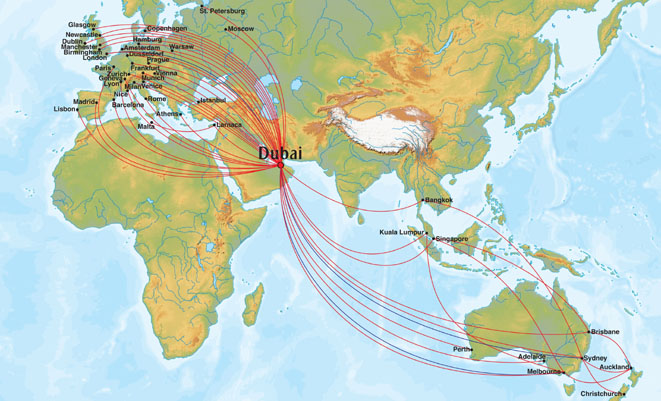
Provided regulators approve the deal, in one stroke Emirates has neutralised a major competitor between Australia and Europe. At the same time, Qantas's decision to abandon Singapore in favour of Dubai for its European services gives Emirates an excellent feed for more than 70 European destinations. Operating on its own, Qantas could never have hoped to even remotely match this powerful network.

Emirates also gains access to Qantas's strong domestic network, challenging the in-roads Etihad has made via co-operation with Virgin Australia.

As with all major changes in the industry, there are losers. By abandoning Singapore, Qantas has raised questions about the city state's viability as a hub.

Customers, of course, stand to benefit. If passengers want to fly from Sydney to Rome on Qantas today, they are obliged to stop in Singapore, fly onwards to London or Frankfurt, and change aircraft for a flight to Rome. Under the new deal they stop once at Dubai's swanky Terminal 3, switch aircraft, and are on their way.

In Europe and Asia, legacy carriers will struggle to compete with the sheer convenience of one-stop travel offered by the Gulf's "big three" carriers.

Therefore, tie-ups between legacy carriers and the big three look likely to be ongoing. The Gulf is simply too well located to be ignored."

(This first appeared as the leading article in 11 September Flight International - the only sensible point raised is the last one about how well located the Gulf airlines are. The rest is a bit of a nonsense that reads like it was written by Gulf News!)

So here was my response:

This reads more like Gulf News than Flight International.

1) "Emirates has neutralised a major competitor between Australia and Europe."

With flights into Heathrow and Frankfurt Qantas was hardly a major competitor to Europe. Australians wanting to fly to Europe already catch Emirates/Etihad or Qatar and transit through the gulf. Many also fly Thai or SQ through their hubs with access to their European networks.


2. "Qantas's decision to abandon Singapore in favour of Dubai for its European services gives Emirates an excellent feed for more than 70 European destinations."

Poor - Emirates does not have 70 European destinations - it has 31. Add the GCC/Middle East/Africa destinations and you get to 70.

Qantas will fly two daily A380s into Dubai and onto London). To arrive in London (as they do now) at the prime early morning slots thes flights will need to land in Dubai around midnight/1am. There are very few EK connections into Europe in the 2am/3am departure block. Passengers transferring to EK's European network will need a 6 hour or longer stop in Dubai. It is likely that most passengers on the Qantas 380s will continue to London rather than connect to Emirates.

3. "Emirates also gains access to Qantas's strong domestic network, challenging the in-roads Etihad has made via co-operation with Virgin Australia."


I am not sure this is much upside for Emirates - When EK adds Adelaide it will be flying to all 5 major Australian cities reaching some 80% of the population. Etihad only flies to MEL/SYD/BNE - so the Virgin Australia domestic network is more useful to them.

4. "As with all major changes in the industry, there are losers. By abandoning Singapore, Qantas has raised questions about the city state's viability as a hub."

Qantas has not abandoned Singapore. Jetstar Asia is still based there. And Qantas is likely to improve its schedules and connectivity into both Singapore and Hong Kong to focus on growing its Asia business.

5. "Although Qantas will benefit from its wide-reaching deal with Emirates, which covers everything from codesharing to air miles, the real winner here is Emirates."

Highly questionable given the above. The big opportunity for Qantas is to eliminate the loss that it has been making on its international operations. The carrier lost A$450 million ($467 million) on international routes in the year to June 30. If Qantas can turn around its international business then the airline and its shareholders are winners from this deal.

Paralympic Games: Inside the theatre of miracles

10 September 2012 by Cole Moreton for London 2012 and the Douglas Bader Foundation

The thrilling achievements of the Paralympians have caused us to see them as role models, not victims. They have changed our lives.

I was on my feet in the Olympic stadium, yelling at the top of my voice, when I thought of her. Sharon, a friend from a long time ago. She lived a mile or so from where this great theatre of miracles now stands.

We grew up together in these parts, back when Stratford was a landscape of scrapyards, dodgy lock-ups and falling-down factories. The sort of place where The Sweeney would corner a gang of villains. Not a wasteland, despite what the politicians say, but far from a paradise. Sharon lived in a council house by the railway yards with her mum, who never let her go anywhere. Sharon had cerebral palsy.

She could walk fast enough, and boy could she talk, but at the age of 20 she had never even been to the West End. It’s only 20 minutes away on the Tube, but her mum would not take her and she certainly would not let her go on her own. The world was deemed too hostile for someone like her.

Not surprisingly, Sharon didn’t have the confidence to challenge this. Not until she fell in with a group of us and started to push the boundaries. That meant coming along one night to the Lee Valley Ice Rink.

It’s still there, almost within the boundaries of the Olympic Park. Back then it was new, and best known for a rowdy Saturday night disco on ice. We went as a group, and were almost in, but Sharon was refused.

“No,” said the bouncer, talking to us and not to her. “She can’t skate.” Sharon was outraged, of course. “I can do it!” she shouted, but he would not yield. So we decided that half of us would skate and half would watch from the side. “No,” said the bouncer again. “I’m not letting her in. She’ll put everyone else off.”

Now there were tears, of frustration and righteous anger. I thought of them in that moment of high emotion, shouting along with my children in the stadium, as I felt my eyes well up at yet another great performance in these extraordinary Games. This time it was a 400m race in the T38 class, and the winner had cerebral palsy.

I wonder if Sharon was there. What would she make of athletes with her condition winning to such acclaim, so close to the scene of her humiliation? Well, one of her humiliations. She was used to being shouted at in the street, even spat on. She was feisty and funny but few people ever listened to what she shouted after them.

We lost touch when I went abroad, and I have been unable to find her again. I would have loved her to be there. For one thing, she might have been able to make more sense of the classification system. It may be the only way of ensuring fair play but it is fiendishly difficult to understand. You end up playing a sort of disability Top Trumps, trying to work out why someone with two apparently good legs is racing against someone with one leg. “How is that fair?”

It’s all part of the learning process we have been through as a nation over these past weeks.

The Olympics reminded us that the British are funny, that we can laugh at ourselves and that there are heroes among us – role models in a nation sick and tired of glamour models and reality shows.

The Games also showed us how much we are changing. Plenty was made of Mo Farah becoming a British hero, having arrived here as a refugee from Mogadishu; but perhaps even more significantly, nothing was made at all of Jessica Ennis being the daughter of a man from Jamaica. That is how it should be – but Sharon would know how significant that was. She was of mixed race, and she grew up with me on the streets of the East End when skinheads marched here with NF tattooed on their hands.

London 2012 was a celebration of new Britishness. We didn’t want the Games to stop. Let’s be honest, that’s why so many of us bought tickets for the Paralympics: to keep the good times rolling, to see the venues and take our kids, so they could say they were there.

Maybe, in our ignorance, some of us gave the impression that these tickets were a consolation prize for not being able to get in to see Bolt or Mo. But my children laughed in my face at that.

“Dad, the Paralympics are better!” said Josh, and his sisters joined in. “Yeah, these people are amazing. Yeah, they have to be amazing even to get there in the first place, have you seen them? And then they do amazing things as well!”

At first I put this down to youthful enthusiasm and propaganda – including that jaw-dropping Channel 4 advertisement for “The Superhumans”. Paralympians had visited schools. Children had played goalball or seated volleyball. They were way ahead of their parents in understanding the Games. But then I began to watch.

The morning that Sarah and Barney Storey won medals on the same cycling track was a love story spun in gold. Half an hour’s yomp across the park, Ellie Simmonds won a race as thrilling as any that has been seen in the Aquatic Centre. The 100m clash between Jonnie Peacock and Oscar Pistorius was a sporting contest of the finest kind.

But to be honest, these events are easy to love. They are easy to watch and to understand. These are athletes who strive to match the non-disabled and who often race against and beat them.

The venues, the rituals and the kits have all been the same, so that some events have seemed like the Olympics Plus. Ilke Wyludda, a veteran German discus thrower, said last week: “It is unprecedented to have an 80,000 crowd at the Paralympics. The way the British have done it, the Games have become almost synonymous with the Olympics.”

But there has been another Paralympics, too. Another Games, far more challenging to the spectator. Easy and patronising terms like “brave” fail when you see a man who has no arms and only one leg win gold in the backstroke.

How are you supposed to react? By getting to your feet again and yelling for Juan Reyes until your throat goes raw, in tribute to the sheer bloody-mindedness that got him from Mexico to London 2012 in the first place, let alone that mind-boggling win. How is it possible for anyone to do that? Is it even backstroke?

These Games have caused us to question ourselves, as much as what we are seeing. The writer Melanie Reid, who became tetraplegic after falling off her horse, wrote as they began: “Never underestimate the challenge of life with devastating injury or damage, the extent of the sadistic battle involved in getting out of bed and facing every day. Never forget that this amounts to a shared hinterland of practical and emotional despair, above which every Paralympian has risen. But then, of course, that victory simply becomes a given.”

She continued: “The ability to defeat a screwed-up body gets the athletes merely to first base. Now comes the second great task, the years of dedication, self-sacrifice and sweat that will qualify them to perform on this particular international stage.”

We know that now. Some of us didn’t think about it before, in our blindness and indifference. We have learned. That’s why we give standing ovations to those who trail in last. Not because we pity them, but because that kind of world class determination deserves applause.

The International Olympic Committee has built a pseudo religion around the idea that it is not the winning but the taking part that counts – but at the Paralympics, that rhetoric becomes reality.

The Olympics often seem to worship youth, beauty and physical perfection. (The Americans are particularly devout, which may be why their media has almost entirely stayed away in the last couple of weeks, unable to watch something that goes against their aspirations and assumptions.) At the Paralympics, the competitors are older and their bodies are not perfect. There is physical beauty in abundance – the ceaseless smile of Hannah Cockroft, for example, lights up a television screen. But it is not always easy to be a spectator at these Games.

Take boccia. They say it has the skill of boules and the strategy of chess, but there is also something unsettling about watching a competitor so severely impaired that he can only roll the ball by starting it off with his head, so that it rolls down a slope. Should we even be watching? Of course we should. The sport allows us to see the human. We should have seen him before – that was our failing. The Games have helped us see victors, not victims.

The Games Maker Emily Yates, 19, who plays wheelchair basketball at home in Leeds, told me last week that people were looking at her differently now. “The taxi driver smiled at me because he thought I was a Paralympian. I thought, ‘He thinks I’m famous.’ I’m not, but that’s cool.”

My friend Catherine von Ruhland, who lives in south-west London and uses a dialysis machine three times a week, has come to the Games as often as possible. “I was impressed by what was happening in the Olympic Park as a whole, and not just in the sports arenas. Disabled people were accommodated, supported, acknowledged and given respect,” she said. “Walking through Kingston town centre after a visit to the Park I was struck by how odd it seemed that there was not one person in a wheelchair, without sight, or lacking one or more limbs, to be seen. During the Paralympics it has felt as if we’ve been given a glimpse of how we’re supposed to treat each other.”

It’s a fragile thing. The British athletes hid their lanyards during the opening ceremony in protest at the sponsorship of Atos, the company used by the Government to assess disability benefits. The booing of George Osborne was evidence of anger. One recent survey showed that the public thought people with disabilities were being treated unfairly; but another showed that some were still being called names and spat at in the street and in playgrounds.

So it’s not all good. Not by a long way. We won’t know for a while what lasting impact the Paralympics have had on us. But there are signs that it will be positive. Lives will be changed, if they haven’t already. Attitudes certainly have.

Our children have watched Paralympians compete on home soil. They have embraced them wholeheartedly as heroes in the same way as Olympians. Maybe even more so. That has to mean something.

As the most impressive and revelatory Games of all time come to an end today, we can be proud. I hope you saw it, Sharon. I hope you were there, in the stadium, in the old manor, watching. Jumping for joy. Cheering them all.

And I hope that old bouncer was, too.


The new green


9 September 2011 - The Economist

If Chief executives won medals, Justin King of J. Sainsbury, a British supermarket chain, would be sporting a gold in the marketing marathon for his prescient decision to concentrate sponsorship on the Paralympics rather than the glitzier Olympics. The plaudits he and other companies have received for backing what was previously seen as a sideshow could help change corporate attitudes to disability.

Caroline Casey of Kanchi, a non-profit organisation she founded in 2004, says the cause is “the new green”. Starting in Ireland and then in Spain, Kanchi’s Ability Awards highlight companies that deal with disabled employees and customers. Now in partnership with Telefónica, a Spanish telecoms giant, it plans to hold the awards in other countries too, including Britain, Germany and Brazil.

Jorge Perez of Manpower, an employment-services firm, says disabled people frequently have unusually high productivity. Thorkil Sonne, the founder of Specialisterne, a Danish firm that finds high-tech jobs for autistic people, says they can focus on repetitive tasks that might be boring to other workers. Britain’s electronic-espionage centre, GCHQ, (pictured) eagerly recruits people with autism and Asperger’s syndrome. Their ability to spot patterns can make them ace code-crackers.

But to show their talents, disabled people must first get the job. Susan Scott-Parker of the Employer’s Forum on Disability, a British auditing group, notes that many firms still fall down on basics, such as using online application forms that deter blind people.

Disabled people are not just potential employees. While working at Merrill Lynch, Rich Donovan, who has cerebral palsy, looked at disabled people as an emerging market and found it much bigger than he expected: “1.1 billion people, that’s the size of China.” He noted two trends. A generation of people who had benefited from disability laws is coming out of education and into work; second, as the babyboomers age, disabilities are spreading rapidly. That means rising demand for products and services for this unprecedentedly wealthy and consumerist generation.

Yet when he analysed companies in the S&P 500 index, Mr Donovan—who now runs his own firm—found that only a quarter had a strategy aimed at these markets and only 6% were doing serious business in them. He has devised a “Return on Disability” index, which tracks the shares of the 100 firms that deal best with disabled people. Over the past five years it has outperformed the broader stockmarket. Later this month Bloomberg will include this on its financial-information terminals.

Such approaches contrast with the way businesses usually look at disabled people: as charity cases, or as needing lots of box-ticking compliance rules and as the source of annoying lawsuits. Good treatment can make business sense, too.


The Asian threat to Qantas

7 September 2012

Having given up Europe (other than London) to Emirates what is left for Qantas international. There is Asia, trans-Tasman and the Americas.

Across the Tasman Qantas will apparently code share on daily A380 rotations between Auckland and both Sydney and Melbourne, and in the frequent 777-300ER operations Emirates also uses on the NZ routes from Brisbane as well as Sydney and Melbourne.

Good news for Emirates as this will fill up the sometimes light passenger loads on these add-on routes.

In South East Asia Qantas will code share on Emirates existing 777-300ER flights between Australian cities and Singapore and Bangkok.

At the same time Qantas has vowed to significantly improve its frequencies and connections between Australia and Singapore and Hong Kong.

That sounds like Qantas will leave Australia to Bangkok flights to either Emirates or the Qantas low cost (and low service subsidiary) Jetstar. This could be good news for Thai Interntaional who should be able to fill their Australia flights with a combination of full service and no extras sold at low fares. It would not be a surprise to see Thai route its new A380s to Australia.

Meanwhile for the Qantas Group Singapore is a Jetstar/Qantas to Jetstar Asia hub. But Jetstar Asia is competing on the home turf of Singapore Airlines and its full service  SilkAir subsidiary. It is also competing with strong LCCs in Singapore, including Air Asia and Tiger Airlines. This leaves Singapore Air as the quality product from Singapore into Australian markets.

In Hong Kong, Cathay Pacific is similarly dominant in association with its full service subsidiary Dragonair. CX and KA link Hong Kong with the PRC, and with a radius that readily includes Taiwan, Vietnam, Korea, Japan, and the Philippines.

So how will Qantas serve its full service business and leisure customers with connections out of Hong Kong? To date this has been through One World with Cathay Pacific and Dragonair. But Qantas has not had the uplift into Hong Kong to seriously impact Cathay Pacific's dominance over flights to and from Australia.

So Qantas has planned a Jetstar Hong Kong operation in association with China Eastern. How to further damage Qantas' reputation inside One World. I am not sure Qantas can or should stay in this alliance. And business travelers into China want the reliability, network and full service of Cathay and Dragonair. Jetstar is for leisure travelers with plenty of patience. Jetstar Hong Kong isn’t ever going to be an answer acceptable to the higher yield market that Cathay Pacific comprehensively addresses.

The relevance of connectivity over Hong Kong is also under siege by China Southern’s ambitions for vastly higher capacity services to Perth, Melbourne, Sydney, Brisbane and Cairns.

Access into China is also an issue with China Eastern looking to expand its Australian operations.

Qantas CEO Alan Joyce yesterday referenced ‘fleet changes’ to better suit its Asia ambitions. The Jetstar 787s should come to the Qantas fleet. Provided the 787-8 becomes reliable, and meets all of the promises, it will give Qantas a medium term chance to compete with Cathay Pacific’s very well appointed A330-300s, and their A350 successors.

Similarly, on services to Singapore, the 787-8 would give Qantas something new, and hopefully still exciting, to compete with the range of A380s, 777s and A330s Singapore Airlines now flies to Australian cities, and before it takes delivery of the large fleet of 787-9s and A350-900s it has on order.

And finally back to Emirates; the A380 will 777s on many routes - including its remaining 777 routes to Australia - after all the airline has 90 on order. And for business and leisure travelers these planes are a huge step up in comfort from the 777s. Expect to see the A380s in both Brisbane and Perth in 2013 and 2014. And it is likely that they will replace the 777s on routes through Bangkok and Singapore. Another threat to Qantas in SE Asia.

Which leaves the Americas. And Emirates has designs there as well.

I still think the Qantas deal was good for Qantas; but maybe it was good because there really was no other option. It was a huge acceptance of the reality of the Middle East airlines and their connectivity. The challenge will be keeping Qantas relevant in other markets.

Etihad on the RAK

7 September 2012

Starting on 3 October 2012 RAK Airways is launching Ras al-Khaimah to Abu Dhabi service, offering 4 weekly flights on board Airbus A320 aircraft. This is the first UAE’s Domestic route.

From the same day, the carrier will also launch a reciprocal codeshare service with ETIHAD, where ETIHAD will display its “EY” code on this route. In return RAK Airways will codeshare on selected ETIHAD’s European service.

Schedule of Ras al-Khaimah – Abu Dhabi service:

RT316/EY4300 RKT0640 – 0730AUH 320 x125
RT317/EY4301 AUH1000 – 1045RKT 320 x125

RAK to display its “RT” code on ETIHAD service to London Heathrow, Manchester, Dublin, Bangkok and Geneva.

It is a strange schedule; not daily and not business friendly. An early morning flight and an evening flight in both directions would at least be business friendly.

The 07.30 arrival into AUH is presumably designed to feed into Etihad's morning departures to Europe.

Emirates alliance a flying leap of faith

7 September 2012
Sydney Morning Herald

 To Qantas  chief executive Alan Joyce, it is a coup that marks a step change for Australia's de facto national airline.

Not only is it a key to returning Qantas' international premium operations to the black after huge losses over the past year, but a deal that heralds a new era in global aviation.

After failed attempts to set up a premium airline in Asia, a decimated share price and a fare war in its home market, Joyce desperately needed a deal with Emirates to give investors confidence in his leadership.

He delivered that in the form of a ''benefit-sharing'' alliance with Emirates, the Middle Eastern airline which until yesterday had shown a distaste for tie-ups under the leadership of Tim Clark.


The deal was far more extensive than envisaged when the serious talks began between both sides more than six months ago. It was far more wide-ranging than investors had expected, too.

Importantly, Joyce bought time to prove he can turn Qantas around.

But to some aviation veterans, the unveiling of the deal with Emirates signifies a further retreat by Qantas and the possibility of it one day ending up as a mere regional airline - a raising of the white flag in the face of an aggressive onslaught from Middle Eastern and Chinese airlines, they said. ''It is a code-share on steroids but not real steroids,'' exclaimed one.

Their fear remains that Qantas will end up gifting its passengers to Emirates.

And that the ditching of Qantas flights to Frankfurt - its last remaining destination in continental Europe - merely signifies a further shrinking of the Flying Kangaroo's network to Asia and a few other countries such as the US, Chile and South Africa.

The question remains: is a deal with your fiercest competitor the key to your fortunes?


Qantas International the winner in Emirates deal

6 September 2012

Qantas and Emirates today announced a new aviation partnership. The highlights are:

It is a 10 Year agreement.
The partnership will commence in April 2013 - subject to regulatory approval.
Qantas will fly daily A380 from SYD-DXB-LHR and MEL-DXB-LHR. They will share Emirates new dedicated A380 concourse.
Qantas will withdraw from the Singapore-Frankfurt route
The Frequent Flyer programs will be aligned.
EK gets codeshare rights on QF domestic flights.
QF gets codeshare rights on EK flights from DXB to Europe and Africa.
Neither airline will take equity in the other.
Qantas will terminate its agreement with British Airways from March 2013 as a result of the Emirates deal.

The combined EK/QF network to Europe

The move, described as a "momentous day" in global aviation, was welcomed by the Sydney stock market with Qantas shares jumping nearly five per cent by early afternoon. The only thing momentous about this deal is that it would have been unthinkable a few years ago. Times change.

For SYD and MEL passengers this might look like a win; they can fly to Dubai on a QF QF 380 and then onto Europe, the Middle East and Africa on Emirates. And they get their QF points for the whole flight. But if I had been flying from say SYD to ATH I would probably have booked an Emirates ticket for the whole flight anyway. And EK would have picked me up and dropped me off at both ends, at least for Biz and First customers.

What is not clear is whether QF will drop any of its flights into Singapore and Bangkok because of this agreement. Probably not. They will simply boost their flights into Asia and this will be the focus of QF's growth. Which makes a massive amount of sense. In particular increasing flights into China.

Indeed Qantas says that it will increase dedicated capacity to Singapore and re-time flights to Singapore and Hong Kong to enable more ‘same day’ connections across Asia.

Together Emirates and Qantas will offer 98 weekly services between Australia and Dubai. This means no new flights for EK (after adding a third daily to Perth).

EK will be operating daily 3xSydney, 3xMelbourne, 2xBrisbane, 1xAdelaide, 3xPerth for for 84 weekly flights. The daily QF from MEL and SYD take the number to the 98 flights a week announced in today's press release.

For Emirates customers the agreement will open up Qantas’ Australian domestic network of more than 50 destinations and 5,000 flights per week. The carriers will also coordinate on their services between Australia and New Zealand and services between Australia and South East Asia.

Tim Clark described the benefits to EK as follows : "By establishing this partnership we are providing our passengers with additional connectivity in Australia and the region, the ability to utilise reciprocal frequent flyer benefits and access to premium lounges and travel experiences."

It is hard to get excited about access to QF's domestic network when EK already flies to the five major urban centers representing some 80% plus of the Australian population.

QF and EK say that the 10-year partnership will go beyond codesharing and include integrated network collaboration with coordinated pricing, sales and scheduling as well as a benefit-sharing model. Emirates and Qantas will provide reciprocal access to tier status benefits including end-to-end customer recognition, lounge access, priority check-in and boarding and other exclusive services.
 
Maybe the big opportunity for Emirates is through the Qantas frequent flyer program.
EK gets a huge benefit out of this. Access to 8.6million frequent flyers and their points redeemable in cash to EK.

What this means for the OneWorld alliance is unclear. The IAG (BA and Iberia)/Qantas link is cut. Could Qantas pull out of One World?

The airlines will submit an application for interim authorisation to the Australian Competition and Consumer Commission (ACCC) in order to begin commercial planning. Subject to regulatory approval, it is anticipated that the partnership will commence in April 2013.

At the risk of stating the obvious the one thing that this new alliance shows is just how critical to global travel the gulf airlines have become.

The other obvious statement is that this agreement and the routes operated will change over the next ten years. For now it is clear that the real winner in this deal is Qantas' international network which adds global access through Emirates at minimal risk while focusing its growth on Asia.

There is a new Qantas/Emirates web site here.

Some analysis from Australian Aviation:

If you can’t beat ’em, join ’em
For Qantas and Emirates, how times have changed

Aggressive Emirates eyes bigger pie of Indian skies

5 September 2012 FirstPost - India

Emirates wants more of the Indian skies. It is looking at a 52 percent increase in the number of seats on Indian flights, from 54,200 now to 80,000 eventually.

It is already the largest international airline carrying Indians overseas and has been roundly criticised several times in the past for taking away Indian passengers which would have otherwise been flying an Indian airline.

So why does Emirates want more traffic from India, especially when the Indian government has decided against signing fresh air bilateral rights with Gulf countries?

The logic is simple. India is one of the few aviation markets in the world which is underserved and has a vast growth potential in terms of air traffic. Besides, as pointed out by Will Lofberg, Emirates’ Senior Manager (Public Environment Affairs), 11 percent of Emirates’ total global network capacity is deployed in India and “with no increase in entitlements since 2008 and high seat factors (84%), carriage growth has been marginal in 2011-12.”

Lofberg did not confirm whether Emirates has indeed sought an increase in per week seat entitlements to 80,000 but the carrier has funded a study by the National Council of Applied Economic Research (NCAER) which says as much.

The findings of this study give out overall economic benefits which would accrue to India if the government allows Emirates more capacity from India. This study also hints at Emirates wanting four additional ports of call – Amritsar, Mangalore, Pune and Trichy. At present, it flies to 10 Indian airports.

So should Emirates be allowed to get an even bigger share of the Indian international air traffic pie than it already has?

In a policy paper released recently, the Civil Aviation Ministry pointed out that convenient onward connections and financial clout of its large airline ensure that the UAE takes away one in four international passengers who would have otherwise used an Indian airport to take onward international connections.

If we take the six airports in Gulf countries together – Dubai, Doha, Sharjah, Bahrain, Abu Dhabi and Muscat – then the traffic “leakage” – which means international passengers taken away from Indian airports by other airports for onward connections – is a whopping 5.36 million passengers every year or close to 40% of the transfer international traffic from India.

Not just the UAE, Qatar, Saudi Arabia and Oman have also approached the Ministry for increasing either the number of seats per week for their respective airlines or increasing the number of ports of call (cities from which airlines of these countries can take Indian passengers).

The Ministry officials feel this is not fair and they have indicated in the past that Gulf carriers have 7-8 points of call in India whereas Indian airlines have just one or two in these countries. The Gulf airlines are carrying a bulk of our passengers to their cities like Dubai and providing them onward connections to Europe and the Americas, hurting domestic carriers.

Kapil Kaul of CAPA begs to differ though. He points out that the government’s policy on awarding air bilateral flying rights is flawed. “Before we plan bilateral, we must forecast medium- and long-term capacity requirements …. We have no clear stated objective for bilaterals.”

Also, Indian airlines would be unable to handle the projected traffic growth in the coming years since they neither have financial muscle nor capacity addition plans commensurate with traffic. CAPA projections suggest that the two main Indian airlines which fly international – Air India and Jet Airways – between them have just 39-40 wide body aircraft which are functional. And over the next decade, these two airlines will add just about 47 aircraft to their fleet, which Kaul says is simply not enough to cater to overseas traffic.

The NCAER study estimates a combined economic benefit of $106 million if Emirates is allowed flights to the four new airports mentioned earlier. And if the airline is allowed to raise total seats to 80,000 per week, the Indian economy will benefit by $790 million.

As for the Indian carriers, they perhaps need to beef up their balance sheets and enhance capacity addition spends to be able to compete with the might of the Gulf carriers.

Routehappy Raises $1.5M To Build A ‘Flight Experience Search Engine’

5 September 2012

Congratulations to Robert Albert, CEO and co-founder of Routehappy, on raising $1.5 million in seed funding.

Albert says his goal is to build “the world’s flight experience search engine.” Whenever you look for flights online now, it’s basically all about price and schedule. For many of us, those probably seem like the two most important factors — until we’re crammed into a tiny seat for hours and discover that there’s no on-flight WiFi.

Albert and his team want to bring a lot more data to bear on the problem. For one thing, he says Routehappy is connected to “hundreds” of third-party data sources, allowing users to find relevant information specifically a flight that they’re thinking about booking, like aircraft quality, seat type, and whether it has plugs and WiFi.

In addition, Routehappy allows experts to share their tips. In other words, if you’re a frequent flyer from (say) San Francisco to Los Angeles, then you’ve probably got a good idea of how to improve the experience — the fastest security line, the best food options in the terminal, and so on.

Routehappy first launched its beta website in March, and since then users have contributed more than 90,000 ratings, tips, photos, and other pieces of content. Routehappy also launched its iPhone app for sharing and reading tips last month.

The funding comes from High Peaks Venture Partners, Contour Venture Partners, and Vocap Ventures, as well as angel investors from the travel industry. High Peaks’ Brad Svrluga and Contour’s Matt Gorin are joining the board, which also includes Albert, co-founder Adam Gwosdof, and TripIt co-founder Scott Hintz.

So how broad is the potential user base? Albert says there are two different audiences. First, there are the “experience optimizers,” who will embrace this as a way to improve their flying experience without having to do a lot of research on their own. But there are also “A to B flyers,” who mostly just care about price and schedule, but probably care about at least a few elements of the experience beyond price — at least when they think about it. Albert is hoping to draw the latter group to the Routehappy site, but he’s also planning to reach them through content deals with other flight search sites, which could provide a subset of Routehappy’s data and rankings.

Speaking of data, the company has also released a ranking of airlines based on seat comfort, specifically the number of “roomy”, “standard”, and “tight” seats on each flight. At the top of the list? JetBlue, US Airways, and Virgin America. JetBlue and Virgin are pretty predictable, but not US Airways. We can expect more of these “hidden insights” from Routehappy in the future, Albert says.

The implication of this is that the business is still very USA centric.

But what RouteHappy really wants to do is share all the data that until now only the most avid aviation geeks would have been aware of. The challenge will be to see how much consumers really care about flight amenities as they vary aircraft to aircraft rather than price and schedule.

Emirates the ‘missing piece in earnings bridge’ for Qantas

5 September 2012 Sydney Morning Herald

The value to Qantas of a code-share alliance with Middle Eastern airline Emirates has been estimated at up to $90 million a year in pre-tax earnings.

The estimate by Macquarie Equities analysts comes as the Emirates chief executive, Tim Clark, visits Sydney this week, fuelling further speculation that the Dubai-based airline is on the verge of signing an alliance with Qantas covering routes between Australia and Europe.

The code-share agreement is believed to include route swaps whereby Emirates would operate the majority of flights on some routes, such as those out of Perth to Europe.

Critics say Qantas is acting from a position of weakness in pursuing a code-share deal, and risks handing passengers to Emirates without significant benefits.

But Macquarie’s transport analyst, Russell Shaw, has described a tie up with Emirates as the “missing piece in the earnings bridge” for Qantas in helping to turn around its premium international operations, which lost $450 million in the year to June.

Mr Shaw has estimated that the annual benefits to Qantas of a tie up with Emirates will be between $80 million and $90 million in pre-tax earnings.

“We expect an agreement to be announced shortly, with the two carriers likely to code-share over Dubai into Europe, as well as on certain Tasman and Asian services,” he said in note today.

The code-share arrangement would also free up additional Boeing 737 aircraft for Qantas, as well as allowing it to accelerate the retirement of up to six older 747 jumbos.

Qantas is understood to have wanted to pursue a deeper alliance with Emirates than just a code-share deal but the Middle Eastern airline would not entertain the proposal. A more substantive revenue or profit-sharing alliance would have taken at least a year to complete.

Emirates has also repeatedly ruled out taking an equity stake in Qantas.

Despite the prospects of a deal with Emirates, Mr Shaw said Qantas still faced challenges in the medium term in improving its network in Asia to help it to compete against Cathay Pacific and Singapore Airlines.

“Changing the flight timings will be a positive move, but the existing array of partners represents a lack of consistency in product and quality across the Asian network,” he said.

Qantas also faces a short-term hit to its earnings in the domestic market in the new financial year as it seeks to repel the advances of Virgin Australia. The latter is seeking to grab a bigger share of the lucrative corporate travel, which Qantas has dominated since Ansett’s collapse in 2001.

“Clearly the pending Emirates announcement is a major positive catalyst … but the domestic capacity outlook remains elevated and Qantas’s reluctance to provide quantitative yield commentary … will do little to quell investor concerns over any deterioration in the domestic market,” Mr Shaw said.

Qantas has stopped giving a figure on the movement in yields – or returns from fares – in its monthly traffic statistics after a decade of doing so.


Four more years?

2 September 2012 - The Economist

In Denver four years ago, an inspiring presidential candidate announced that he would change America. Barack Obama promised to put aside partisan differences, restore hope to those without jobs, begin the process of saving the planet from global warming, and make America proud again.

Next week Mr Obama will address his fellow Democrats at their convention in Charlotte, North Carolina, with little of this hopeful agenda completed. Three million more Americans are out of work than four years ago, and the national debt is $5 trillion bigger. Partisan gridlock is worse than ever: health-care reform, a genuinely impressive achievement, has become a prime source of rancour. Businessfolk are split over whether he dislikes capitalism or is merely indifferent to it. His global-warming efforts have evaporated. America’s standing in the Muslim world is no higher than it was under George W. Bush, Iran remains dangerous, Russia and China are still prickly despite the promised resets, and the prison in Guantánamo remains open.

The defence of Mr Obama’s record comes down to one phrase: it could all have been a lot worse. He inherited an economy in free fall thanks to the banking crash and the fiscal profligacy that occurred under his predecessor; his stimulus measures and his saving of Detroit carmakers helped avert a second Depression; overall, he deserves decent if patchy grades on the economy (see article). Confronted by obstructionist Republicans in Congress, he did well to get anything through at all. Abroad he has sensibly recalibrated American foreign policy. And there have been individual triumphs, such as the killing of Osama bin Laden.

But this does not amount to a compelling case for re-election, in the view of either this paper or the American people. More than 60% of voters believe their country to be on the wrong track. Mr Obama’s approval ratings are well under 50%; almost two-thirds of voters are unimpressed (however harshly) by how he has handled the economy. Worn down by the difficulties of office, the great reformer has become a cautious man, surrounded by an insular group of advisers. The candidate who promised bold solutions to the country’s gravest problems turned into the president who failed even to back his own commission’s plans for cutting the deficit.

Were he facing a more charismatic candidate than Mitt Romney or a less extremist bunch than the Republicans, Mr Obama would already be staring at defeat. The fact that the president has had to “go negative” so early and so relentlessly shows how badly he needs the election to be about Mr Romney’s weaknesses rather than his own achievements. A man who four years ago epitomised hope will arrive in Charlotte with a campaign that thus far has been about invoking fear.

Mr Obama must offer more than this, for three reasons. First, a negative campaign may well fail. The Republicans are a rum bunch with a wooden leader; but Mr Romney’s record as an executive and governor is impressive, and his running-mate, Paul Ryan, is a fount of bold ideas. Mr Obama’s strategy of blaming everything on Republican obstructionism will strike many voters as demeaning.

Second, even if negative campaigning works, a re-elected Mr Obama will need the strength that comes from a convincing agenda. Otherwise the Republicans, who will control the House and possibly the Senate too, will make mincemeat of him. And, third, it is not just Mr Obama who needs a plan. America does too. Its finances and its government require a drastic overhaul. Surely this charismatic, thoughtful man has more ideas about what must be done than he has so far let on?

A tempting option will be to galvanise his party base, with talk of more health reform and threats of higher taxes on business and the rich. Rather than redesigning government, he could suck up to the public-sector unions by promising that jobs will not be cut. Rather than cutting entitlement programmes, he could reassure the elderly that America can actually afford them.

Such an approach would fit the pattern of too much of his presidency, and his campaign so far; but it would do America a disservice, and it might not help Mr Obama either. His victory in 2008 relied on reaching beyond the groups that traditionally vote Democratic and bringing in young voters and wealthier whites. Many of them are centrists who are suspicious of Mr Romney, but since they have to foot the bill for government profligacy, they will not vote for a president who promises more of the same.

Appealing to the centre is not easy for Mr Obama. His allies on the left are powerful and, in a country so polarised, the middle ground can be a dangerous place. But there are plenty of things that many on both sides of the political aisle could agree on, including tax and immigration reform, investment in schools and aid to businesses that are creating jobs. Crucially, Mr Obama could explain how he intends to cut the still-soaring debt without pretending that taxing only the rich will help in any meaningful way.

Mr Obama has a strong belief in social justice. It drove his health-care reform. But he needs to distinguish between a creditable desire to help the weak and a dangerous preference for the public over the private sector. The jobs that poor Americans need will be created by companies. Smothering firms in red tape is not the way to help them; Mr Obama should vow to stop adding to it, and to start cutting some of it away. The party faithful in Charlotte might not like centrist ideas much. But they would appeal to the voters Mr Obama needs to win over and, should he be re-elected, they will strengthen him in his dealings with the Republicans in Congress.

Incumbents tend to win presidential elections, but second-term presidents tend to be disappointing. Mr Obama’s first-term record suggests that, if re-elected, he could be the lamest of ducks. That’s why he needs a good answer to the big question: just what would you do with another four years?

The EK/QF speculation continues

1 September 2012

Emirates and Qantas had better announce something later this week or a lot of armchair analysts will have wasted a great deal of time speculating what this deal could be:

Two obvious issues:

Key for Qantas is stemming the losses in its international division.

Secondly flying to anywhere in continental Europe via London is miserable. Yet this has been at the heart of Qantas' kangaroo route services. Travelers have long abandoned London as a waste of time and money and instead flown to Europe through Singapore or the Middle East.

After more than a decade of denial over the need to participate in a Middle East hub, Qantas will do what a smarter management is telling it to do. Qantas's European business will be supported by Emirates. Qantas internationally and through Jetstar will focus on the growing Asia market especially China.

Some possibilities for this week:

QF will drop Perth and Adelaide to Singapore. QF will drop Frankfurt and Bangkok. Its only remaining Europe route will be to Singapore and onto Heathrow and even that may be passed to Emirates in time. Emirates will immediatley take up one ex QF Heatthrow slot.
QF will fly daily to DXB and be given access to Terminal 3 to ease transfers onto Emirates.
Any Boeing 777s that are moved from Emirates to the Qantas Group will go to Jetstar for the SIN , HNL AND BKK routes to free up more A330's for QF Dom.
744 retirement accelerated
380 number 13 and 14 to be delivered.

Rumour has it that the EK executive team arrives in Sydney on EK412 on 5 September. The announcement is expected on Thursday, the 6th September in Sydney.

The Auckland leg of EK 412/413 has been cancelled on this day (Dep DXB 5/9), presumably to allow Joyce and Clark to get a nice picture of them with the big bird(s).

This time next week we will know more

Qantas - A little international difficulty (The Economist)

Middle Eastern carriers move in


1 September 2012 - The Sydney Morning Herald

The intimidating growth of Middle East carriers such as Emirates, Etihad and Qatar Airways, has sent the market share of full-service airlines - think Qantas - domiciled in high-labour cost, full-taxing countries into a nose dive.

Recent data published by the Transport Department in Canberra showed that in the Australian aviation market, the combined share of Middle East carriers has grown from less than 1% in the early 90's to more than 11% currently. At the same time, Qantas's share has halved from 40% to 18%.

When economists explain market-share improvements they usually look to cheaper prices or superior products as the key explanatory variables. In the case of Middle East, carriers a case can be made for both, especially at the all-important front of the plane.

Middle East airlines offer some of the cheapest premium seat airfares in the world.

For a booking made today for travel between Sydney and London Heathrow departing November 30, 2012, the Qantas internet fare quote was either $7,316 or $11,510 one-way.

For the same booking period and city pair, the Emirates internet fare quote was $5,278.92.

The Emirates business class service is therefore a 28% discount to the cheapest Qantas rate and a 54% discount to the most expensive.

Some say that the Qantas product is superior and this difference explains the price premium. Having sat at the front of a Qantas plane many times, I agree that it is an exceptional product. Surveys consistently suggest, however, that the Qantas product generally rates behind the Middle East.

The most respected airline survey in the world, the Skytrax World's Best Airline survey, has Middle East airlines sitting first (Qatar), sixth (Etihad) and eight (Emirates) in 2012.

No Australian airline sits in the top ten in the Best Airline category, although Qantas ranks 10 in the best business class category and ranks 1 for the best first-class lounge (and deserves the ranking).

These surveys are based on 18 million airline customers and 160 countries. Rarely do you get a more comprehensive survey.

In an attempt to reverse the market share slide, the response of legacy airlines - most notably Lufthansa, British Airways, Air France, Qantas, and Air Canada - has been to send lobbying teams to meet the various governments.

Heavy criticism of Middle East carriers often laces CEO speeches, which focus on the cost assistance they allegedly enjoy, ranging from fuel and direct subsidies, cheap airport charges, tax advantages and low interest rates.

In the case of Lufthansa the lobbying pressure has been influential, with the German Government recently ordering Emirates to raise its business class fares on a number of international services.

In response to the hostility shown towards them by legacy carriers, Emirates Airlines has published a series of reports that address the criticisms head-on. I've read most of them.

On balance, I think it's reasonable to say that Middle East carriers are likely to have a material after-tax unit cost advantage. What is unreasonable is to conclude that it is exclusively because of government subsidies or support.

A large part of the unit cost advantage that they enjoy is a result of very astute decision making and advantages related to geographical location.

For example, the Middle East airlines have some of the youngest fleets in the world. New fleet are generally more fuel and maintenance cost-efficient.

They have one of the highest aircraft utilisation and labour productivity rates in the world, both of which drive costs down.

They buy aircraft in bulk, enabling them to secure significant volume discounts while their rapid growth has enabled them to target significant scale and scope economies.

Middle East carriers also have very potent revenue advantages, the most important emanating from their ideal geographical location.

Middle East airports are located within a relatively short flying distance of major global population centres. For example, Dubai airport is within 3,450 nautical miles of major points in Europe, Africa and the Middle East and within 5,000 nautical miles of major points in Asia.

These short sectors enable the airline to fly passengers into their Middle East hubs, aggregate other passengers at the hub, and then send them spoke-like to wherever they need to go with minimal transit and flight time.

This outcome generates a very strong customer-value proposition, which in turn drives higher loads and yield.

Short sectors with strong demand also allow the airlines to fit the right aircraft to the right route at the right time, which generates both yield and cost benefits.

Middle East Airlines are located in a part of the world where economic growth is a strong, positive function of high oil prices. When oil prices are higher, the carriers operate, or are exposed to, a strong revenue environment, enabling them to pay for higher oil costs.

Middle East airlines are here to stay in Australia. They are high quality, exceedingly well priced and brilliantly managed and operated. But you don't need me to tell you that - the market share gains speak for themselves.

Tony Webber was Qantas Group chief economist between 2004 and 2011. He is now managing director of Webber Quantitative Consulting and Associate Professor at the University of Sydney Business School, and contributed this article to BusinessDay.

Qantas bets on EK

31 August 2012

The Qantas - Emirates rumours are running wild at the moment. Something will be announced. No one knows quite what it will be.

But Tim Clarke - Emirates CEO - will arrive in Sydney on 5 September. There will follow a number of announcements.

Speculation: The removal of FRA from the QF schedule - Frankfurt and Heathrow are the only European destinations flown by Qantas. Qantas flights to LHR will presumably also be taken over by Emirates - maybe not immediately.

Qantas to codeshare on all Emirates flights to Dubai and onward flights to Europe.

This will not be just a code share - there is more to the deal that simply putting Qantas passengers onto Emirates jets.

There is speculation that Qantas will get some of the near future slots for 777 deliveries to Emirates. Emirates has some 100 airframes on order. Emirates would get two of Qantas' existing Heathrow landing slots; taking the daily DXB- LHR flights from 5 to 7.

The code-share agreement is believed to include route swaps whereby Emirates would operate the majority of flights on some routes such as those out of Perth to Europe. Qantas would give up Perth to Singapore and passengers would fly on Emirates through Dubai.

There are concerns - what happens to Qantas’s longstanding revenue-sharing agreement with British Airways on the kangaroo route between Australia and the UK. What happens to Qantas' membership of the One World alliance.

"I don't understand this – it just means less and less Qantas," was one analyst quote adding that "it is just a huge downgrading of the Qantas presence and handing it over to Emirates."

Last week Qantas cancelled orders for 35 Boeing Dreamliner aircraft. Although the cancellation will boost Qantas's bottom-line earnings in 2012-13, it has raised questions about a further shrinking of the airline’s international network. Some 777s would at least replace some of that capacity.

For the highly paid Alan Joyce this is all about turning around the Qantas international operations, which lost $450 million last financial year.

The selling point of the code-share deal to investors and consumers is that the two airlines would have a combined eight A380 superjumbos flying each day from Australia to Dubai, and offer a large number of destinations beyond the Emirates base.

An Emirates equity stake in Qantas remains unlikely; although a successful commercial agreement might bring the two airlines much closer together.

Pan Am's view of Thailand from 1960

31 August 2012

Why the Paralympics matter so much

30 August 2012

There is a risk of being patronising about the Paralympics; there is also a risk of being too politically correct. But the sheer happiness of the 4,500 plus athletes at the Olympics opening ceremony said all that needed to be said.

For these athletes this is their achievement; their ambitions realised. And in reality it does mean more than the able bodied games; because these athletes have looked at adversity and said sod it - I can beat this.

And for the rest of us watching the twin messages are ever clearer; be grateful for what you have and make the very best of what you are given.

But the ceremony did not beat home this message. It was a ceremony of ideas based on the theme of enlightenment from the 18th-century onrush of scientific knowledge and the quest for the rights of man to the Hadon collider.

The opening ceremony was lower budget; it might have erred on the over-serious; it probably over did the umbrella theme. But it had Stephen Hawking who declared: "Look up at the stars and not down at your feet. Try to make sense of what you see, and wonder about what makes the universe exist. Be curious."

The opening ceremony covered everything from the Big Bang to Black Holes to Newton's theories of gravity (62,000 apples all bitten at the same time!) to the universal declaration of human rights; to a recreation of the Large Hadron Collider at CERN.

It was more profound than playful. More classical than pop.

The musical highlight was Elin Manahan Thomas singing Handel's Eternal Source of Light Divine accompanied by a solo trumpeter. The music changed to an aerial ballet featuring the disabled dancer David Toole and the 42 disabled volunteers. The soundtrack to the performance, a rendition of the Antony Johnson song Bird Gerhl by 16-year-old singer Birdy. This was followed by the joyful badness of Ian Dury's Spasticus Autisticus.

The closing music - a rousing gospel rendition of "I am what I am" felt entirely appropriate.

The only problem with the ceremony was its length - largely due to the parade of athletes from 164 teams; this took time. I fell asleep at G and woke up at R....so don't ask me what the Mexican team were wearing but apparently they looked great.

Even the national anthem sounds better in sign language.

In welcoming the athletes, officials and spectators Lord Coe said that "sport is about what you can do, what you can achieve, the limits you can reach, the barriers you can break. Sport shows what is possible. Sport refuses to take no for an answer."

Embracing these games is about changing (or evolving) perceptions of the rights and roles of disabled people in our national life. The opening ceremony – passionate, smart, moving and original – honoured the athletes and set the tone.