|
Welcome to rascott.com
This is a
personal site that reflects my interests in news,
current affairs, aviation and travel.
email me:
robert@rascott.com
Home
Up
Now In Dubai:
Scott
Consulting
Photo Albums
My photographs have been moved off this site and are now stored on Picasa. They
were simply taking up too much space on my web host.
Please use
this link to see my list of photo albums.
Some
Useful links:
Information:
World Time
Clock
Exchange Rates
Journalism:
ForeignPolicy
Nationsonline.org
Project Syndicate
Amnesty International
Reporters w/o borders
The Guardian
BBC World News
CNN Asia
Bangkok Post
Daylife.com - news
Gulf News
Arabian Business
World News
WSJ - Asia
SCMP
Good causes:
Sister
Joan - Bangkok
Regional Info:
BKK Magazine
HK Magazine
In
Singapore Magazine
TimeOut Dubai
Back in the UK:
Newton Ferrers
And for fun:
Lin Ping live panda tv
EarthCam
History
BBC Archive
National Media
Museum
The British Library
Imperial War Museum
There are many other links on my
AOB blog page.
| |
|
Filipino maid wins landmark HK case on
residency
30 September 2011
This was a
landmark day in Hong Kong as a Filipino maid won the right to apply for
permanent residency in a massive legal victory for hundreds of thousands of
foreign maids fighting for equal treatment.
And it also shows
just how important is the separation of the government and the judiciary to
effective law in Hong Kong.
The Court of First
Instance rejected arguments by Hong Kong government lawyers that the foreign
maids did not have the same residency status as other foreign residents.
Friday’s ruling says that the immigration provision denying them the right
to apply for permanent residency after seven years was inconsistent with the
Basic Law, Hong Kong’s mini-constitution. Other foreign residents have the
right to apply after that time.
The case has
polarized public opinion over the rights of domestic helpers.
Evangeline Banao Vallejos, who has lived in Hong Kong since 1986, challenged
the rejection of her application for permanent residence, asking the court
why expatriates such as bankers and cooks could apply for permanent
residency after living in the city continuously for seven years.
At least three political parties said an influx would strain the Chinese
city’s health care, public housing and education resources.
“We are disappointed at today’s judgment,” said Joseph Law, chairman of the
Employers of Domestic Helpers Association in Hong Kong. “We can’t
accommodate such a sudden influx of population as this would impose a
profound strain on our resources.”
Judge Lam ruled the immigration law that bars foreign domestic helpers from
eligibility for permanent residency “derogates” the meaning of the Basic
Law. The Basic Law is the de-facto constitution that Hong Kong adopted after
the British handed the city back to China. The city has 7.1 million
residents.
“The government needs to appeal this case,” Paul Tse, a lawmaker
representing the Hong Kong tourism industry, said by phone. “This could lead
to enormous pressure on our medical, educational and welfare system.”
Government lawyer David Pannick argued that Hong Kong’s Basic Law allows
lawmakers to determine the status of foreign residents and that the maid
wasn’t eligible to apply.
Hong Kong’s population is 95 percent ethnic Chinese, according to the most
recent census data from 2006. The special administrative region was
guaranteed an independent judiciary for 50 years under the “one country, two
systems” framework following the handover from British to Chinese rule in
1997.
About 290,000 of Hong Kong’s 7.1 million people are foreign maids. Most of
them are from the Philippines or Indonesia.
The Hong Kong
government will inevitably, and mistakenly, appeal the decision.
Thailand: the
high price of freebies
30 September
2011 -
The Financial Times
In the big risk
sell-off, Bangkok was always going to be vulnerable. Thailand has an export
dependency higher than most up-and-coming economies and an untested, very
free-spending government. In the four days before Tuesday’s rally, its SET
index lost about one-eighth as foreigners sold en masse.
The surge in the market after Puea Thai’s election victory in July had
fragile underpinnings. Stocks least affected by political volatility –
energy, utilities and consumer staples – did best, as investors mulled an
early dissolution of the PT-led, five-party coalition. Now, though, fears
that Yingluck Shinawatra may not last a four-year term have been replaced by
fears that she will.
On the evidence so far, the government seems more interested in doling out
freebies – tax breaks for first-time car buyers; cuts to oil fund
contributions, lowering prices at the pump – than attending to the nation’s
chronic infrastructure constraints. The rice-price guarantee programme, due
to run for the first five months of the fiscal year beginning in October, is
a case in point. It may cost about Bt190bn ($6.2bn): much more than a
similar scheme three years ago, and a sum not included in the estimated
budget deficit of Bt350bn, or about 3.6 per cent of gross domestic product.
Granted, PT owes its majority to support from the north and north-east,
where incomes are low. But by raising prices it could dent the
competitiveness of Thai rice exports – about 30 per cent of total world
shipments – while imperilling state finances. Sovereign credit default swap
prices have leapt about 50 per cent since the scheme was outlined. It is
noteworthy, too, that non-Thais mostly sat out Tuesday’s equity rally,
putting back $19m, or 3 per cent of this month’s net outflows. Foreign
capital is sceptical that this regime can pay its own way.
Press release of the day
29 September
2011
This must be
today's most entertaining press release from Dubai Properties as they
happily announce that the grand total of two stores - a supermarket and a
dry cleaner - have been opened on Bay Avenue....two years after residents
moved into Executive Towers.
Maybe they need
another release to say that some trees have been planted?
And this was
especially good - DPG was "founded
on principles of transparency, accountability, and dedicated customer focus"
- it may have been founded on those principles but it has never adhered to
them.
"Dubai Properties Group (DPG), a member of Dubai Holding, has announced that
Bay Avenue, its retail offering at Business Bay, is open for business.
Designed as a venue for al fresco eating, shopping and entertainment, Bay
Avenue is a retail walkway at Business Bay, offering two levels of indoor
and outdoor space that will feature cafés, restaurants, shops, sporting
facilities and essential services.
Among Business Bay's current operational offerings are a Spinneys
supermarket and a Champion Cleaners, catering to the needs of Executive
Towers and Business Bay residents. Other retail outlets that are currently
under fit-out for opening soon include a Coffee Bean & Tea Leaf, Curry Box,
Umi Sushi, Aster Medical Centre, and Emirates Driving Institute.
Located in the heart of Business Bay, adjacent to the central business
district of Downtown Dubai, DPG has designed Bay Avenue as a community focal
point for the residents of The Executive Towers and Business Bay.
Khalid Al Malik, Group Chief Executive Officer, Dubai Properties Group,
said, "We are focused on creating communities that provide a high quality
environment for our residents and commercial partners. As Bay Avenue
develops, it will become an integral part of the Business Bay community
meeting the needs of residents and visitors alike."
About Dubai Properties Group:
Dubai Properties Group (DPG), a member of Dubai Holding, develops and
manages properties, communities and destinations. Through its subsidiaries
DPG provides end to end solutions for a variety of services including sales,
leasing, facilities management and security.
Founded on principles of transparency, accountability, and dedicated
customer focus, Dubai Properties Group aspires to become the best partner in
providing unique lifestyles, by creating a world class organization that
offers a wealth of industry knowledge and expertise. DPG will constantly
seek new and innovative ways to deliver comprehensive solutions to its
stakeholders, investors and business partners.
Gulf royalty pretends it is a special case
29 September 2011 The Financial Times
"Gulf rulers are sending the world an unequivocal message – their countries
will remain an exception to the Arab awakening. As the winds of change blow
through the Middle East and north Africa, Gulf states are behaving as if
it’s business as usual, pursuing small, incremental political reforms that
would be deemed irrelevant, if not insulting, in other parts of the region.
In Bahrain, where a Shia uprising was crushed this year, the authorities
held a by-election last weekend to replace Shia members who had withdrawn
from parliament in protest at the harsh security crackdown. They portrayed
the exercise as a confirmation of the al-Khalifa family’s commitment to
political reforms.
Next door in the United Arab Emirates another election was held, this one to
a federal national council that has a purely advisory role and in which half
the members are, in any case, appointed. The election was billed as a step
forward because the number of citizens entitled to take part was
significantly increased.
Saudi Arabia will stage its second ever municipal elections on Thursday,
with only one part of the population, the men, voting for only half the
seats in local councils. To appease women, King Abdullah promised this week
to include them in the unelected shoura council, another Gulf advisory body
but women will have to wait until the next municipal poll for the right to
vote and stand in elections.
For now, most of the Gulf’s royal families can afford to pretend that they
are a special case. A more pliant civil society dependent on government
employment and patronage and plenty of oil money to spread around have kept
their people quiescent, with the notable exception of Bahrain and, to a
certain extent, Oman.
To bolster their long-term resilience, the six nations of the Gulf
Co-operation Council have been acting as a cohesive bloc, their members
setting aside differences in favour of unusual solidarity.
The Gulf states, however, are not a homogeneous group. Qatar and the UAE are
enormously wealthy and their indigenous populations tiny. Sultan al-Qassemi,
the Emirati commentator, argues that citizens in Qatar and the UAE are also
wary of creating a precedent that could lead millions of foreigners living
in their countries to make their own demands. They are therefore content
with what he calls the “jobs for (political) apathy phenomenon”.
The regime in Saudi Arabia, where a larger population faces the same
frustrations as their brethren in north Africa, moved quickly to ease
potential popular pressures this year, buying time with tens of billions of
dollars of social spending. The royal family has also consolidated its
alliance with the conservative religious establishment, which has always
provided its main source of legitimacy.
In nearby Bahrain, however, the picture is radically different. Manama
remains vulnerable to protests by the Shia majority whose demands for fair
representation are not being answered. Oman was also hit by popular protests
this year, leading its ruler, Sultan Qaboos, to promise constitutional
reforms that, if implemented, would go much farther than what his neighbours
offer.
Being part of the GCC has strengthened the hand of the rulers in both
countries. Troops from other GCC states were sent to shore up Bahrain’s
al-Khalifa royal family and the rich members will be subsidising the poor,
with Manama and Muscat set to receive some $20bn in assistance.
“The Gulf is part and parcel of what’s going on in the region – the case of
Bahrain and Oman showed how people could be inspired by what’s going on
elsewhere,” says Abdulkhaleq Abdulla, a professor of political science at
Emirates University.
But the Gulf also has its specificities. “The forces of status quo are much
stronger than the forces of change and the regimes and the resources they
have make them resistant to change,” says Professor Abdulla. “There is also
a feeling that in the Gulf you are more privileged than the rest of the Arab
world and that regimes also go back in history.”
The Gulf’s exception might be that popular sentiment is more in favour of
reform than revolution – even Bahrain’s distraught Shia community would
settle for a constitutional monarchy rather than the overthrow of the al-Khalifas.
But this attitude should not be confused with immunity. Timid demands for
reform today could become bolder if political transitions in north Africa
provide a successful model of change, or if oil prices drop and governments’
financial largesse evaporates."
EK's new routes
28 September
2011
This page needs a
quick summary of what is new on Emirates over the next six months:
St.
Petersburg from 1 November 2012
Baghdad from 13 November 2012
Rio de Janeiro and Buenos Aires (shared flight) from 3 January 2012
Dublin from 9 January 2012
Lusaka and Harare from 1 February 2012
Dallas from 2 February 2012
Seattle from 1 March 2012
EK's US growth
30 September
2011 - Update
The EK press
release was a little misleading - The new DFW flight in fact replaces the
second IAH flight, which will stop operating when the DFW flight comes
online. The DFW schedule EK221/222 is also a virtual copy of the EK213/214
rotation. The last day of operation of EK213/214 is Jan 31. First day of
operation of EK221/222 is Feb 02.
28 September 2011
Emirates will
launch daily service from Dubai to Dallas & Seattle from 2nd February & 1st
March 2012.
Tim Clark said
that these two routes will be two of three US destinations added in 2012 and
that within five years Emirates could be serving more than 10 cities, all
with its ultra-large Airbus A380.
Dallas and Seattle
will be EK's fifth and sixth US destinations.
Bets on the next
US destination include Washington, Chicago and Miami.
Emirates will start its daily flight to Dallas-Fort Worth on February 2nd,
with the Seattle service launched on March 1st, both using Boeing 777
aircraft.
The choice of Dallas-Fort Worth and Seattle surprised some US airline
executives, with Chicago, Boston and Washington D.C. seen by some as more
likely choices, but Emirates pointed to demand in the two cities created by
the energy, tech and aerospace sectors.
The impact of the US. expansion is being closely watched by the industry as
some European airlines (and of course Air Canada) continue to protest
against Emirates' development in the region, claiming the airline is sucking
business through its Dubai hub with the assistance of unfair government
subsidies, a charge the company vehemently denies.
US carriers, with the exception of Delta Air Lines Inc., have so far stopped
short of voicing criticism, and United Continental Holdings Inc. (UAL) CEO
Jeff Smisek last month praised the airline and Dubai's aviation policy,
drawing comparison with the perceived absence of support for the industry
from the US administration.
Smisek's remarks were notable because of the fierce stand taken against
Emirates by Deutsche Lufthansa AG (and Air Canada), United's partner in the
Star alliance.
The Americas was Emirates' fastest-growing region in the year to March 31
with revenue up 37.9%, while sales in its largest geographical area of
operations--east Asia and Australasia--rose by 30.9%. Sales in the Americas
lagged those on flights to Africa, where it serves 19 cities with plans to
add two more early next year.
Emirates and rivals such as Abu Dhabi-based Etihad Airways and Qatar Airways
have capitalized on their geographical location to use new long-range
aircraft to funnel business through their hubs.
Growth in new
routes has slowed down in the last year as the airline has taken delivery of
only six planes in the past six month.
But EK now has 52
airplanes due in the next 18 months or so and is accelerating network
expansion accordingly.
There are A380s
being delivered each month from now to April 2012 and 2 777s arriving each
month through 2012. Some A330s may leave the fleet, but they are useful in
starting secondary routes to Africa and Europe and the A350 is still a few
years away.
The DFW market is
demographically large and growing, economically strong (relatively
speaking), and has a substantial market especially to India and South Asia.
SEA is also logical - the technology market to and from India is
substantial. A feeder/code share with Alaskan Airlines would be interesting.
The flight times are:
Dallas (From 2nd
February 2012 until 10th March 2012)
DXB-DFW 02:45-09:05 16hrs 20mins D 77L
DFW-DXB 11:50-12:20 + 1 14hrs 30mins D 77L
Dallas (From 11th March 2012)
DXB-DFW 02:45-10:05 16hrs 20mins D 77L
DFW-DXB 12:50-12:20 + 1 14hrs 30mins D 77L
Seattle (From 1st March 2012 until 10th March 2012)
DXB-SEA 09:50-13:10 15hrs 20mins D 77W
SEA-DXB 17:10-19:40 + 1 14hrs 30mins D 77W
Seattle (From 11th March 2012)
DXB-SEA 09:50-13:50 15hrs D 77W
SEA-DXB 17:25-18:55 + 1 14hrs 30mins D 77W
The target market
once again will be transfer traffic to the Indian sub continent. And this is
going to put even more pressure on the European carriers who fly from the US
through their hubs including Amsterdam, Frankfurt and London.
EK can afford to
expand during an economic downturn and this could be critical in building
traffic on these routes.
Delta will be under pressure to restart its non-stop US-India flights to
remain viable against Emirates. This ironically would also hurt its Skyteam
partner KLM at its Amsterdam hub.
The Nazis are
back in Chiang Mai
28 September
2011
There is nothing
nicer than a girl in uniform; except when it is a school event and the girls
have dressed up as Adolf Hitler and a group of jack-booting Nazis. It should
not come as a surprise; it has happened before. There is the customary
outrage; there are the usual complaints about the Thai education system.
There is the usual hapless apology from the school and we can all come back
and do this again in a couple of years.
This time the
event even made in to the
Wall Street Journal.
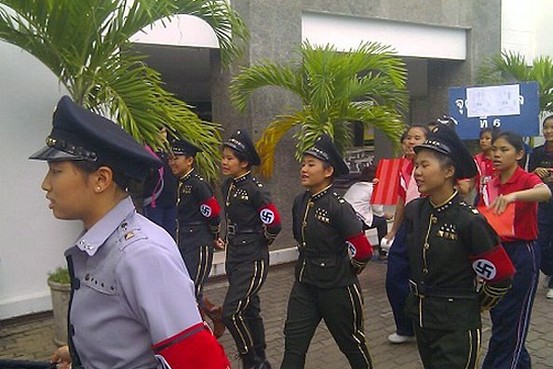
This was sports
day at the Sacred Heart catholic school in Chiang Mai where children
traditionally choose their own theme for the day.
Last week’s event was a shocker with children dressed up in Nazi regalia
marching into the school displaying one-armed salutes.
Local honorary consuls from a number of countries visited the school on
Monday to ask why the parade was allowed to take place and came back with
the answer that the students didn’t realize it would upset anybody.
The local private
education authority also received the same response from the Roman Catholic
school.
“It happened because the students were unaware and I have asked the school
to make sure they are more careful in the future,” Chanwit Tuphsuphan,
secretary-general of the Office of the Private Education Commission, was
reported as saying in the Bangkok Post.
After all it is
not just Thais who think that there is something entertaining about dressing
as a villainous Nazi - in 2005 Britain’s Prince Harry – then 20 years old –
was pictured on the front of The Sun newspaper wearing a swastika armband to
a friend’s fancy dress party.
The reality is
that the Thai education system is so poor that there is little awareness of
any history outside Thailand. Indeed, ask Thais about their own country's
history in the second world war and you will mostly get a blank stare.
The World Economic Forum recently published its annual competitiveness
survey, and the quality of secondary and tertiary education in Thailand was
ranked 77th out of 142 countries surveyed, compared with Singapore’s number
2 ranking, 14 for Malaysia and 61 for the Philippines.
As for the school
- this was there official response - which hardly constitutes either
awareness or an apology; rule one of an English language press release -
have it read first by a native English speaker.
REF: Deeply Apologies
To whom this may concern,
On 23 September 2011, at Sacred Heart School of Chiang Mai has organized a
sport day activity and it has been divided into groups of 7 different colors
and amongst its various colors, there was the “Red” color group which was
dressed up imitating some Nazi symbols. The purpose and motivation was to
provide a sense of participation in much closer knowledge of being together
for this particular “Red” color group. In fact, the main reason and desire
behind of imitating some of these symbols was not to create any differences
of damaging each individual image and identity.
We, the entire Sacred Heart School personal are deeply saddened by this
incident which has caused much undesirable inconvenience. And we wish to
extent our sincerity and our deepest regret towards all those who have
provided us the utmost knowledge and are more aware of getting our teachers,
staffs and students in fulfilling and realizing in the most respectful and
civilize behavior in this society. We will be take more serious approach and
provided more positive behavior for not creating any sure event in our
school compound in anytime, anywhere.
We deeply and sincere apologies.
Yours respectfully,
Sr. Darunee Sripramong
Director of Sacred Heart School
It is ignorance not
malice; ask any non Thai child about the Khmer Rouge and Cambodia and you
will get a blank look. But if you want to dress up as a villain at least
find out a little about who the villains are and who you might be offending.
After all Thais are the first to complain at perceived cultural wrongs by
foreigners.
It is also unlikely that
the students could be so well prepared without both awareness and support of
both parents and staff at the school.
These
pictures do not help the school's feeble defence:
who paid for the large banners? who hung the large banners?
Sadly the school takes
no responsibility and simply blames the students. Sadly typical.
From 707 to 787
27 September
2011
|
 |
 |
|
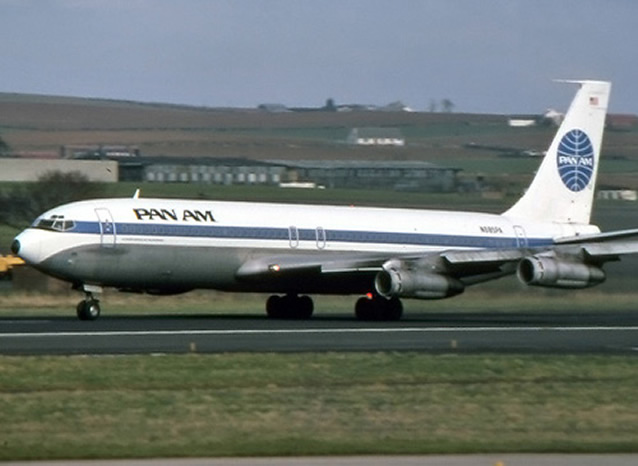
Boeing 787
Dreamliner airframe #8's landing gear breaks contact from the ground on
departure from Paine Field in Everett, Washington, September 27,2011,
for delivery to the 787's first customer, All Nippon Airways (ANA) of
Japan. Love the wings! |
From the
wonderful site -
www.aviationexplorer.com |
Pan Am - on TV
27 September
2011
One election;
two stories
26 September
2011
|
Polls a
great achievement: Gulf News
Observers blame the drop in voter turnout on lack of parliamentary
culture
Emiratis on
Election Day expressed strong support for empowering the Federal
National Council (FNC), a top official said yesterday describing
Saturday's polls as a great achievement for the UAE.
The UAE leadership's vision of promoting political participation is an
integral part of the country's progress and overall development, said Dr
Anwar Mohammad Gargash, Minister of State for Foreign Affairs, Minister
of State for Federal National Council (FNC) Affairs and Chairman of the
National Election Committee (NEC).
"The UAE citizens have expressed their strong support in empowering the
FNC in its second milestone in the political development in the
country," Dr Gargash said.
However, observers felt that the voting turnout at the FNC elections
which was about 28 per cent was low and blamed it on the lack of
electoral culture among a large segment of citizens. They said the lack
of publicity and preparations and the limited mandate of the House had
played a significant role and failed to pull large number of voters.
Article continues below
"Despite repeated calls for expanding the FNC's mandate since 2006
elections, the power of the members of the House remained unchanged, a
matter which left many citizens unwilling to go to the polls," said Dr
Nisreen Morad, assistant professor of political science at the UAE
University.
Ahmad Bin Shabib Al Daheri, former deputy speaker of the FNC, said the
drop in voter turnout to 28 per cent from 74 per cent in the 2006
elections was mainly caused by lack of parliamentary culture among
citizens on the electoral rolls.
****************************************************
In other local Media the
Khaleej Times trumpeted : FNC Elections: UAE makes history reporting
that the UAE was swept by celebrations after a historic election saw 20
new members elected to the Federal National Council on Saturday.
********************************
Note that there are 430,000 Emiratis above the age of 21; of this number
129,000 were selected to vote. |
UAE poll attracts low turnout : Financial Times
Elections in the oil-rich United Arab Emirates saw a turnout of barely
more than a quarter, official results showed, capping a low-key event
that made only a small nod to pressures for democratic change elsewhere
in the Middle East.
Voters’ reasons for staying away from the vote for the consultative
Federal National Council varied from an apathy borne of material
contentment, to unhappiness at the restricted electoral franchise and
the powerlessness of the body they were selecting, analysts said.
The UAE’s approach is a test of whether an autocratic state that is both
wealthy and largely free from the sectarian divisions behind the crisis
in the fellow Gulf nation Bahrain can ride out the Arab political
awakening sweeping through the Middle East.
Taufiq Rahim, a Dubai-based political analyst, said: “If there is one
thing this election reinforces, for better or for worse, it’s that the
UAE has its own timeline. It responds to the circumstances and concerns
of its own citizens, rather than the region.”
Only about 28 per cent of eligible voters cast their ballots in
elections held on Saturday, said Anwar Mohammed Gargash, chairman of the
national election committee, according to the Emirati state news agency.
He said participation had been good, if not quite as broad as the
government had hoped for, adding that the UAE had “presented a new
transparent experiment in the electoral process”.
Analysts said the low turnout may have been partly because most people
were unused to voting. The franchise was expanded – by a process not
detailed by the government – from 7,000 at the first ballot five years
ago to 130,000 this time, although that is still a minority of the UAE’s
voting-age population.
The 20 generally well-connected Emiratis elected included only one
woman, even though women play an increasingly high-profile role in the
still-conservative society and significantly outnumber men in university
intakes.
At Dubai’s World Trade Centre polling station, one of only 13 in the
country, mainly male candidates in traditional white dress and their
supporters gathered on election day in coffee shops near the entrance,
discussing the day’s developments.
There was evidence of greater enthusiasm for the election in the poorer
northern emirates, the target of a government investment programme of
more than $1.5bn announced earlier this year, in what some observers see
as a response to the economic discontent partly underpinning the
uprisings in other Arab countries. In the emirate of Ras al-Khaimah,
candidates’ election posters lined the streets, competing for lamppost
space.
The balance of Emiratis’ political views is hard to measure in a society
with no tradition of opinion polling and where locals are outnumbered
more than five to one by expatriate workers.
Ibtisam al-Ketbi, a sociology professor at Emirates University, said the
election experience had been positive, adding that more voters would
turn out in future as they became more familiar with the process and
more comfortable with the institutions representing them.
She said: “Part of it is understanding the meaning of the elections;
they don’t understand the role or the Federal National Council, or are
not convinced that [it] has a big role in their life. Even in the more
democratic countries some are reluctant to vote; they feel their vote is
not counted.”
|
Easyjet versus
Fastjet
26 September
2011
There is news in
the UK today that EasyJet is considering legal action after being notified
that its founder Sir Stelios Haji-Ioannou is setting up a rival airline
called Fastjet.
In a statement EasyJet announced it was told of the new launch, and that it
will act to protect its rights.
The budget airline added that it had a number of rights under its agreements
with SIr Stelios and his easyGroup holding company and that if any of these
are infringed, it "will take necessary action to protect the rights of
easyJet and the interests of its shareholders".
Sir Stelios, who founded the airline and remains a non-executive director on
its board, has alleged that easyJet breached the terms of a contract between
the two parties, according to the airline.
easyJet said it "emphatically rejects" this and "continues to seek
constructive dialogue with easyGroup and Sir Stelios".
The news comes just after the easyGroup founder withdrew his calls for an
extraordinary general meeting in order to remove a member of the airline's
board.
Easyjet shareholders must be nervous. Sir Stelios pioneered low cost flying
in Europe with Easyjet and having done it once must believe that he can do
it again.
However Sir Stelios and his family are the largest shareholders in easyJet
with 38% ownership. So he is likely to be careful not to damage Easyjet's
value.
The Fastjet website only has the words "Fastjet.com by Stelios. Coming
Soon!"
Cottoning on
The West’s relative decline is inevitable but the East’s rise will still
be troublesome
25 September 2011 The Economist
It is a crisp Friday morning in Santa Isabel, a small Brazilian town 60km
north-east of São Paulo. Gabriel de Matos, technology director at Paramount
Textiles, is taking delivery of the latest machine for dyeing the wool yarn
that is made here. It won’t look out of place: most of the equipment is less
than ten years old. The machines for spinning yarn are 40% faster than the
ones they replaced. The new kit has allowed Paramount to supply finer-grade
wools for the men’s suits its customers make.
The factory refit and the move upmarket was a response to competitive
pressures that have driven many local rivals out of business. The global
market for woollens has halved since the mid-1990s. Consumers these days
prefer casual clothes, but Brazil is now too rich to compete with cotton
producers in Vietnam or Indonesia. “We need a premium product like wool to
cover our costs,” says Mr de Matos. China also produces wool and its land,
labour and capital are often cheaper. “Thank goodness we are so far away,”
he says. “Time is money and that gives us some breathing space.”
Paramount is copying the tricks long used by rich-world businesses to fend
off low-cost rivals from emerging markets: better designs, newer machinery,
shorter production runs (to give rarity value to each line) and faster
delivery to local markets.
Britain bounded ahead in textile production two centuries ago, and
established firms have been looking over their shoulder ever since. An early
challenge came from the textile industry in New England, where countless
townships called Manchester were founded (of which one survives). That
cluster soon faced competition from factories in the low-wage American
South.
The cotton industry has carried on travelling: its technology moves easily
to wherever labour costs are low. The pattern has been repeated for other
sorts of ventures. More complex technologies are harder to copy, so their
diffusion has been slower. But technology eventually spreads. It is what
drives economic convergence, making large parts of the developing world
better off year by year.
Demography is destiny again
For much of the past two centuries the know-how that determines productivity
and living standards has been concentrated in the West. That is true of hard
engineering technology as well as the tacit knowledge of how best to
organise production, support markets and manage aggregate demand. Because
large productivity gains were confined to the West, the populous parts of
the world stayed poor.
That was anomalous. Population has determined economic power for most of
human history. Now demography and productivity are pushing in the same
direction. America and Europe are demographic minnows compared with the
developing world’s two giants, China and India. And the rich world’s
financial crisis and its aftermath is accelerating the shift of economic
power eastwards. Just as the catch-up in emerging markets is speeding up and
broadening out, the rich world’s economies seem to be grinding to a halt. If
China can avoid a blow-up in the next decade, it is likely to become the
world’s biggest economy—though its citizens would still be poor by American
standards.
The big question for the global economy is whether the rapid growth in
emerging markets can continue. The broad economic logic suggests more of the
world economy’s gains should come from convergence by emerging markets than
from the rich world pushing ahead. Each innovation adds less to rich-world
prosperity than the adoption of an established technology does to a poor
country. At the start of the industrial revolution the cotton industry alone
could make Britain’s productivity jump. But now that the frontier is wider,
there is less scope for leading economies to surge ahead. More of the
world’s growth ought to come from catching up.
But contrary to some excited forecasts, the growth of emerging economies is
unlikely to continue at the same pace, or in a straight line. Economic
convergence is a powerful force but cannot knock over every obstacle. And
the barriers to growth become bigger as economies enter the difficult
middle-income phase of development.
Moving capital and workers from dying to rising ventures is trickier than
transplanting poor rural migrants to cities in the early phase of catch-up.
As economies become richer they can rely less and less on the brute force of
additional machine power to drive their prosperity. They have greater need
of a skilled workforce and a financial system that is attuned to where the
best returns are likely to be made. Countries that have relied on exports to
fuel their growth need to shift to internal sources of spending, with all
the associated headaches for monetary and fiscal policy. In the past many
middle-income economies have run aground because they have failed to meet
such challenges.
Careful what you wish for
The biggest emerging markets, with their huge foreign-exchange reserves,
appear to be almost crisis-proof (at least outside eastern Europe) in
contrast to the seemingly crisis-prone rich world. But setbacks in making
the shift from poor to rich are inevitable. Indeed a lesson of recent
economic history is that countries and regions that ride out a crisis well
are all the more vulnerable to the next one. Hubris leads to policy
mistakes, as the developed world has proved so devastatingly. So thick is
the gloom pervading the rich world that the once-regular emerging-market
crises have almost been forgotten. But this makes it even likelier that they
will one day return.
Those anxious that the rich world’s economic power is ebbing might welcome a
few emerging-market slip-ups. A less frantic rate of growth in the
developing world would also slow the relative decline of the West and allow
it to cling on to some of its privileges for longer. The dollar and the euro
could maintain a reserve-currency duopoly for longer; commodity-price
pressures on businesses and consumers would ease; and the impact of
developing economies on relative wages and jobs turnover might be less
jarring.
Yet the emerging markets are the best hope for global growth—for the next
few years at least. Japan’s economy is in a funk; the euro zone is in danger
of imploding; and much of the rest of the rich world is hung-over from a
giant credit boom. America, Britain and others took on debts that now look
steep compared with incomes and the value of the homes against which much of
the money was borrowed. They are saving hard to fill the gap. Those with
cash (including a chunk of the corporate world and not a few households that
gained from the housing boom) are clinging on to it because of uncertainty
about future demand, job prospects, taxes, the supply of credit and much
else.
That is the main reason why a fast rate of catch-up by the emerging markets
would be better for the West than a faltering one. A richer and more
consumer-led China would be likelier to buy more of the services in which
developed countries have a comparative advantage.
It would be healthy, too, if the developing world could break the rich
world’s monopoly on international finance. The emerging markets account for
almost half of global GDP but have no reserve currency of their own. For now
there seems little alternative to the dollar as a financial lodestar and the
main storehouse for the world’s precautionary saving. The yuan is the
likeliest candidate to supplant it but has so far taken only baby steps to
becoming international. The longer it takes for the yuan to emerge, the more
risky the global financial set-up will become. The worry is that strong
demand for Treasuries as reserves might tempt America to overstretch itself.
The wreckage from the rich world’s housing bust shows the dangers of money
that is too cheap.
The growth of emerging economies will not continue at the same pace, or in a
straight line. Setbacks in making the shift from poor to rich are
inevitableIn other ways, too, it might be better for the rich world if China
and others caught up with it sooner rather than later. Faster catch-up would
narrow the wage gap between emerging and rich countries and help to relieve
the downward pressure on unskilled wages. A mature Chinese economy would
waste fewer natural resources on hard-to-justify investments. Many in the
rich world fear the loss of economic dominance that will be the eventual
outcome of convergence. But perhaps losing it is worse than having lost it.
And perhaps the pessimism about America and Europe is as overdone as the
optimism about emerging markets. The rich world is an enticing place when
viewed from the developing world. For all its troubles, America’s economy is
a source of envy. Europe’s high-end industries and luxury goods are not
easily mimicked. Emerging-market firms find it easier to do business, to
raise finance and to find skilled workers in the rich world. Such attributes
are hard to replicate. If it were easy, the emerging economies would already
be rich.
A piece of Canada on Sheikh Zayeed Road
24 September
2011
So Tim Horton's
has opened on Sheikh Zayeed Road. A prime location for a budget brand.
It is next door to
a Starbucks and is probably stealing their customers.
Tim Hortons' new
Dubai location represents "the first true export of the brand," said CEO
Paul House at Tuesday's opening.
The chain has some self-serve kiosks in the UK and Ireland, and a temporary
location at the Kandahar Airfield for troops in Afghanistan, but the Dubai
store is its first full-serve restaurant outside of North America.
The menu is apparently identical to that in Canada; presumably with the
Dubai mark up on prices. Although Dubai is a "mature" coffee market, Tim
Horton's sees opportunity in its value-priced food options, which it says
are not readily available in the region; Doughnuts, Bagels and Soups.
The store in Dubai is the first of a development plan with Dubai-based
Apparel Group to build 120 stores in the United Arab Emirates, Qatar,
Bahrain, Kuwait and Oman over the next five years.
But the Canadian coffee-and-doughnut chain says it's in no rush to enter
another country and isn't committed to a vigorous timetable for
international expansion.
Instead, the chain plans to keep international efforts focused on the U.S.
market, where it says it is making in-roads through non-traditional model
stores — kiosks in places like gas stations and universities. To be honest
that would probably work better in the UAE. Tim Horton's is coffee that you
buy on the road or at airports. And it does well because of its cheaper
pricing.
A Tim Hortons at
DXB would do well; maybe even better if it is in Terminal 2?
Based in Oakville, Ont., Tim Hortons (TSX:THI) is Canada's biggest
restaurant chain and the fourth-biggest in North America with more than
3,700 restaurants on the continent.
Camfrog Thaksin?
23 September
2011
This was not a
good move. The Thai prime minister, Yingluck Shinawatra, allowed her brother
and deposed leader Thaksin Shinawatra, to summon government ministers for a
meeting by webcam from his self-imposed exile abroad.
The question is
who is in charge. The reality is that it is Thaksin; and that the people who
voted for Puea Thai and Yingluk were in reality voting for her brother.
Bangkok's taxi drivers know the score; the other day my driver was telling
me that Thaksin will be back soon.
On Wednesday, Thaksin joined a meeting with Thai ministers at Yingluck's
party headquarters via Skype. OK - so he was not on Camfrog!
"Ministers squirmed uncomfortably in their chairs as Thaksin acted like a
teacher, 'lecturing' some of them who failed to measure up at the
tension-filled meeting, which lasted for more than two hours," the Bangkok
Post newspaper reported on Friday.
Thaksin went into detail on plans for a big increase in the minimum wage and
a rice intervention plan, it said, adding that he would chair similar
meetings each week. Only ministers and deputy ministers from Yingluck's Puea
Thai party were involved, but the party has the bulk of cabinet positions.
This has to weaken Yingluck and open her up to constant criticism.
"Thaksin has been pulling the strings for a while behind the scenes. Now he
has decided to come out publicly," said Pavin Chachavalpongpun, a fellow at
Singapore's Institute of South-east Asian Studies. "But he pushes too hard,
moves too fast, and thus leaves too little room for Yingluck to breathe."
The question is
how will the Thai military and nationalists respond. So we go back to 2006
and find a reason to remove Puea Thai and the Shinawatras.
Yingluck has played down the Skype episode. "It was a normal chat, just with
Puea Thai ministers, not the whole cabinet. Thaksin called during the end of
the meeting to show support to all, not to advise on anything," she said.
It won't make the
government collapse, but it does hurt Yingluck internationally and takes
away her credibility.
But in reality she
is just another puppet. Abhisit was the military's puppet and Yingluck's
strings are pulled by Thaksin.
Let them
default
22 September
2011
Athens has agreed
another package of last-minute measures to secure another €8-billion of
emergency funding. Once again it has been forced to implement a policy that
is not working, ever more severe rounds of austerity, to secure a dubious
reward: enough cash to keep the country ticking over until next time.
It is not working.
The Greeks cannot take the pain. There are massive strikes across the
country today. And the Germans and French have little interest in providing
additional bail out funds.
Even with the swingeing new measures, the government will miss its targets
for deficit reduction. The case for allowing Greece to default has never
been stronger.
Given the structural problems the economy faces, the government deserves
credit for addressing at least some of them. Among the measures are a
reduction in the tax-free allowance on salaries from €8,000 to €5,000, a 20
per cent reduction in pensions above €1,200 a month, and a proposed
reduction of 30,000 in the state work force. A huge battle can now be
expected in parliament, echoing the unrest in the streets.
Such measures should secure release of the next €8-billion of bail-out
funds, and are essential for Greece’s long term economic viability. Yet the
country’s fundamental position remains unchanged. The 2011 budget deficit
target is 7.6 per cent of gross domestic product, but data to the end of
August suggest the deficit is about 5 per cent wider than required to meet
that target. The economy is likely to shrink 5.5 per cent this year,
undermining its revenue base.
Policy makers should accept that Greece is insolvent and begin the process
of managing a restructuring of its debt. That will require more pain for
banks than has been proposed so far. Too bad. The banks lent too much money
to Greeks who could not fund the repayments. Let the banks take the pain.
Investors who have
remained invested throughout the crisis may well lose everything. That is a
high price to pay, but it is essential if the euro zone is ever to escape
the consequences of its blind date with Athens.
England Pakistan schedule
22 September
2011
Pakistan cannot
host International cricket in their country after the Lahore attack on Sri
Lankan team.
Pakistan play
their home series overseas, mostly in UAE. They played a series against
Australia in England and against South Africa in the UAE Next up is their
International home series against England.
Pakistan vs England 2012 Series Schedule: there will be 3 test matches, 5
One Day Internationals and 3 Twenty Twenty matches in the series which will
start on 17 January 2011 and finish on 27 February. All three test matches
will be played in Dubai. And these will be the biggest games hosted in
Dubai's splendid cricket stadium at Sports City. Lets just hope that
transport and parking is well organised. Based on previous evidence this is
unlikely.
It is a shame that
none of the one day games are being played in Sharjah.
Pakistan vs England – 1st Test Match
Dubai, UAE Jan 17- Jan 21 2012
Pakistan vs England – 2nd Test Match
Dubai, UAE Jan 25 – Jan 29 2012
Pakistan vs England – 3rd Test Match
Dubai, UAE Feb 03- Feb 07 2012
Pakistan vs England – 1st ODI
Abu Dhabi, UAE 13 Feburary 2012
Pakistan vs England – 2nd ODI
Abu Dhabi, UAE 15 Feburary 2012
Pakistan vs England – 3rd ODI
Dubai (DSC), UAE 18 Feburary 2012
Pakistan vs England – 4th ODI
Dubai (DSC), UAE 21 Feburary 2012
Pakistan vs England – 1st Twenty20
Dubai (DSC), UAE 23 Feburary 2012
Pakistan vs England – 2nd Twenty20
Dubai (DSC), UAE 25 Feburary 2012
Pakistan vs England – 3rd Twenty20
Abu Dhabi, UAE 27 Feburary 2012
Nakheel's silted sukuk
22 September
2011
Just when you
think that the Dubai property sector might slowly return to sanity there
comes another shocker - and once again it is from Nakheel; who many will
remember were at the forefront of Dubai's 2008 financial crisis.
Now it has been
revealed that much of the land backing a $1.03bn sukuk bond from Dubai
property developer Nakheel is unreclaimed seabed.
Trade creditors
holding the paper have little if any recourse to tangible assets in the
event of a default.
The Islamic bond, or sukuk, is part of Nakheel’s $16bn debt restructuring
deal which repays trade creditors 40 percent in cash and 60 percent via the
bond.
The two assets that back the sukuk are a strip of waterfront land and a
still partially submerged crescent that will form part of a man-made island
shaped like a palm at Jebel Ali, on Dubai’s outskirts.
The land plot consists of 350 million square feet of undeveloped land at
Waterfront South. This was advertised as being the new Hong Kong. No
development has ever commenced. The second asset is made up of 1.3 billion
square feet along the Palm Jebel Ali crescent, of which only 10 percent has
already been reclaimed from the sea.
The sukuk prospectus does not outline the assets allocated to support the
sukuk but a term sheet distributed to creditors details the area.
Such intangibility would usually cause investors to steer clear but
Nakheel’s trade creditors really have no where else to turn to. It is that
or nothing.
Many contractors, who have waited over two years for the cash owed to them,
have sought to exit the sukuk instrument in the secondary market. The paper
is already trading at a chunky discount. Yesterday it was at between 75.7890
and 78.316 for a corresponding yield of 17.555 percent and 16.631 percent,
according to Thomson Reuters data. That is down from 78.900 to 80.050 for a
yield of 16.415 percent and 16.011 percent a day earlier.
Nakheel is now wholly-owned by the Dubai government as part of its parent
Dubai World’s debt restructuring. The company has hit back at "foreign
media" reports doubting the real value of its land assets.
Nakheel chairman Ali Rashid Lootah was reacting to reports by Reuters and
other agencies and newspapers that the company’s property is overestimated
on the grounds much of it is unreclaimed seabed.
Reuters, citing banking sources in the UAE, said Nakheel’s land plot
consists of 350 million sq ft of undeveloped land at Waterfront South. The
remainder is made up of 1.3 billion sq ft along the Palm Jebel Ali crescent,
of which only 10 percent has already been reclaimed from the sea.
“Such news leaks will only hurt the investors as they are not based on facts
and real investment value,” Lootah told the Sharjah-based daily Alkhaleej on
Thursday. “Nakheel’s assets against sukuk have been evaluated by specialized
international parties and have been accepted by Ernst and Young auditors and
by all financial and commercial creditors…this was evident in the company’s
success in issuing Dh3.8 billion sukuk as a first tranche of Dh4.8 billion.”
The Ernst and
Young valuation would be interesting. Meanwhile Nakheel is back to blaming
foreign media; yet it is the foreign media that provides the critique that
the local media all to often ignores.
Asset quality concerns, and ambiguity over what happens if a default occurs,
have been a major problem for the sukuk market. Realistically the land
itself may be valueless without the reclamation/construction efforts of
Nakheel.
In the sukuk prospectus Nakheel says it has postponed any reclamation
efforts for the near-term, leaving sukuk holders with an investment backed
in part by seabed for the foreseeable future.
Thai Smile
design unveiled
22 September 2011
 Thai
Airways International (Thai) has unveiled the aircraft design for its
low-cost unit, Thai Smile Air, which is designed to reflect its
"trendy-friendly-worthy" concept. Where do they get these ideas from? Thai
Airways International (Thai) has unveiled the aircraft design for its
low-cost unit, Thai Smile Air, which is designed to reflect its
"trendy-friendly-worthy" concept. Where do they get these ideas from?
"Smile" in the sub-brand's name represents friendliness and follows "Thai"
which represents quality and premium service," said Thai President
Piyasvasti Amranand.
"Hence, in combination, THAI Smile Air and its logo convey light, friendly
premium service. The Thai Smile Air aircraft design has three ribbons
streaming across its fuselage in cool pink, yellow, and orange, to
demonstrate the Thai Smile Air's image of Trendy-Friendly-Worthy.
In October, Thai Smile Air will begin its staff recruitment through Wingspan
Services Co Ltd, an outsourcing subsidiary of Thai. In the first phase, 40
pilots will be recruited in October and 100 female cabin crews will be
recruited in November.
This means that
although the crew will be flying airplanes in Thai colours they will not
have a Thai Airways contract and will presumably be on different and no
union employment contracts.
Thai Smile Air will eventually operate eleven Airbus A320. The first
aircraft delivery is in June 2012, the 2nd and 3rd aircraft delivery will be
in August and the 4th aircraft delivery will be in September. Thereafter,
two A320s will be delivered in January and March 2013, respectively.
Flight operations can begin July 2012. Initially THAI Smile Air will operate
domestic flights such as Ubon Ratchathani, Udon Thani, Khon Kaen, Chiang Rai,
and Surat Thani. I assume they will take over existing TG operations on
these routes. Thai will continue to serve its profitable domestic
destinations of Phuket and Chiang Mai. Thai Smile will look to fly on
international routes to China and India from 2013.
In the meantime
the Thai/Tiger joint venture appears to have been shelved. Not a surprise.
The UAE's quiet election
22 September
2011
The UAE has an
election this weekend on 24 September. But the majority of this country's
residents know little about it and certainly cannot participate.
This will be the
second elections in the UAE's 40-year history, but officials and candidates
are finding it tough to answer a commonly asked question: why can't everyone
vote?
The UAE government in July hand-picked 129,000 voters to elect 20 of the 40
members of the Federal National Council (FNC), an advisory assembly with
very limited parliamentary powers.
The pool represents just 12 per cent of Emirati nationals.
The rest of the FNC will be directly by the ruling families.
The government has not disclosed how the voters were selected, and the
selection process for candidates has also been unclear.
A list of voters has been released, but candidates still wonder how best to
communicate with their audience, a minority of the population. The problem
is exacerbated by the fact the population is around 5 million when you
include expatriates.
So go back; of 5
million residents, just 129,000 have been selected to vote.
Candidates can spend up to 2 million dirhams ($544,000) of their own money
or raise funds from local communities to finance their campaigns. Foreign
donations are strictly forbidden.
The UAE government held seminars in the past few weeks for candidates about
the rules of campaigning while at least one non-profit organisation held a
training course on "how to run a successful campaign."
But many candidates still appear to lack a basic understanding of the FNC's
constitutional powers, which are virtually nil.
Some have promised to introduce new legislation, even though only government
ministries are allowed to do so. The council can only suggest changes to
draft bills. Even then, the country's president can overturn any proposed
changes.
But it is a step forward; less than 7,000 people, or less than 1 percent of
the population, were allowed to vote in the UAE's first elections for the
council in 2006.
Baby steps; but at
least they are heading in the right direction.
America's death
penalty is wrong
22 September
2011
There really is no
point in lecturing the world on human rights when you cannot put your own
house in order. At some stage America needs to have an adult conversation
about the death penalty. Yesterday the state of Georgia executed convicted
murderer Troy Davis in a case that drew international attention because of
claims by his advocates that he may have been innocent.
Davis, convicted of the 1989 killing of a police officer, was put to death
by lethal injection at 11.08 local time Thursday at a prison in central
Georgia after the U.S. Supreme Court declined to hear a final appeal, a
prison official said.
The case has attracted international attention and an online protest that
has accumulated nearly a million signatures because of doubts expressed in
some quarters over whether he killed police officer Mark MacPhail in 1989.
MacPhail was shot and killed outside a Burger King restaurant in Savannah,
Georgia, as he went to the aide of a homeless man who was being beaten.
MacPhail's family say Davis is guilty and called for his execution.
Yet even now a majority of Americans support the death penalty and most
executions attract little national attention.
However the Davis
case prompted a rash of protests as well as expressions of concern from
Europe.
France and the Council of Europe this week urged U.S. authorities to stay
the execution. The pope, South Africa's Desmond Tutu and former President
Jimmy Carter are among thousands of influential dignitaries, and more than
600,000 people in total, who signed a petition seeking to stop Davis'
execution.
In the end, their efforts made no difference
Since Davis's conviction, seven of nine witnesses have changed or recanted
their testimony, some have said they were coerced by police to testify
against him and some say another man committed the crime.
There is no physical evidence linked Davis to the killing.
The Supreme Court took the rare step in 2009 of allowing the defense to
present its case to an evidentiary hearing but a federal judge in Savannah
said it cast "minimal doubt" on the conviction.
Once a death warrant was signed, Davis's best hope of avoiding execution had
rested with the Georgia Board of Pardons and Paroles but on Tuesday it
denied him clemency following a one-day hearing.
On Wednesday, his lawyers went through a series of maneuvers in an attempt
to stay the execution finally reaching the Supreme Court.
It took the court more than four hours to issue its one-sentence order, an
unusually long time in such cases.
Brian Kammer, a lawyer for Davis, said in seeking a stay from the Supreme
Court that newly available evidence revealed false, misleading and
inaccurate information was presented at the trial, "rendering the
convictions and death sentence fundamentally unreliable."
"I did not take
your son, father, brother" - Troy Davis at his execution according to media
witness, his last words "For those about to take my life, may God have mercy
on your souls. May God bless your souls."
And of course Troy Davis was black. The bottom line is, in the end, it
doesn't matter if a person is guilty or not. In the end it comes down to the
fact that killing is wrong. Society has the right to punish; it doesn't have
the right to kill.
And if you accept
that then you also have to accept that sometimes you have to defend the
right to life for some of the most indefensible of crimes.
Emirates adds
Lusaka and Harare in 2012
21 September
2011
Emirates is adding
Lusaka, the capital of Zambia, and Harare, the capital city of Zimbabwe, to
its African network.
Zambia and Zimbabwe, which share a border with the Victoria Falls, one of
the natural wonders of the world, will now be linked with a five times
weekly flight from Dubai, starting from 1st February 2012.
Zambia and Zimbabwe will be EK's 20th and 21st African destinations.
The Dubai-Lusaka-Harare service will be operated by an A330-200 aircraft in
a three-class configuration.
A must-see for any
visitor to Zambia or Zimbabwe is the Victoria Falls, a UNESCO World Heritage
site. The 1.7 km wide natural wonder cascades for over 100 metres, making
the Falls the largest curtain of water in the world. Both countries also
boast a wealth of other breathtaking sights, including world-class national
safari parks, and in Zimbabwe's case a nation ruined by greed and held
ransom to poverty.
Starting 1st February 2012, EK 713 will depart Dubai on every Monday,
Tuesday, Wednesday, Friday and Sunday at 0925hrs, arriving in Lusaka at
1450hrs. The service will depart Lusaka at 1620hrs, arriving in Harare at
1720. The return flight leaves Harare at 1920, arriving Lusaka at 2020. It
departs Lusaka at 2150 and lands in Dubai at 0710hrs the next day.
Making sense of the daily deal.
21 September
2011
"Today only, 84
percent off a massage!"
"Half off all garden tools!"
"47 percent off a family photo!"
These deals are in
every city and in every language; not from high street stores but from web
site vendors that no one had heard of a few years ago.
The big names are Groupon and LivingSocial in a virtual marketplace that has
blossomed over the past three years.
It is not really a
new business; newspapers have been providing coupons to clip and use for
decades.
But some observers say that the experience of recent years suggests that the
hyper-discounts for which Groupon has become famous might not last. The
trouble with the discounting business is that there is little evidence of
creating loyal customers.
The growth of the industry has relied on big volumes and huge discounts
offered by over 500 companies and counting. The No. 1 daily-deal site,
Groupon has gone from zero to several billion dollars in value in the blink
of an eye and has announced plans to issue an IPO in the near future.
Meanwhile, LivingSocial, one of the next largest, is already in 552 daily
markets worldwide.
From the businesses' perspective, one of the main goals of
offering the deals is to drive repeat business; but many
merchants argue that daily-deal "groupies" simply seek the day's most
outrageous deal and do not develop any brand loyalty.
But the success of
these companies is not assured. According to the 2010-2011 Daily Deal M&A
Activity and Valuation Multiples Report, from CB Insights, the price of
acquisitions has been plummeting.
“Since their peak hit just two quarters ago in Q1 2011, the Price per
Subscriber and Price per Voucher Sold multiples paid in private company M&A
transactions have declined 36% and 40% respectively in Q3 2011,” the report
says.
Part of the reason is that there are simply too many companies out there,
the report says.
The report could be good news for Groupon, LivingSocial, Google Offers, and
Amazon Local. Investors are nervous about throwing more money into this
industry right now.
The technical barriers to entry in the daily deal business are low, but
scaling the business requires significant amounts of capital. Companies hire
armies of sales staff and account managers to develop relationships with
merchants, and this is expensive. They also spend large sums on marketing.
The
cost of acquiring subscribers who redeem a daily deal has skyrocketed during
the past two years. While snagging early adopters who were curious about
daily deals initially required little marketing, it now takes more spending
to get to remaining consumers and to cut through the noise created by so
many competitors.
For example, Groupon, the daily-deals market leader that filed to go public
in June, spent about $7.99 to acquire each subscriber who actually redeemed
a daily deal in the first quarter of 2010, according to regulatory filings.
By the second quarter of 2011, that figure had nearly tripled to $23.46.
Overall, Groupon spent $378.7 million in marketing initiatives in the first
half of 2011, up from $35.5 million in the same period a year earlier,
according to regulatory filings. Many smaller websites don't have the war
chest to compete.
At the same time, daily-deal sites also increasingly have to hire more
salespeople to line up coupon offers from local merchants. Groupon has 990
sales employees in North America, up from 201 a year earlier, according to
its regulatory filings. LivingSocial, the No. 2 player in the space, has
beefed up its sales force to 700 employees from 191 a year ago, said a
company spokesman.
Groupon pays sales associates about $35,000 a year, and those salaries can
jump to as high as $100,000 with commissions, according to a person familiar
with the matter. Smaller sites that typically hire only a handful of sales
employees and pay on a commission-only basis are hard-pressed to compete
against those compensation packages, industry executives said.
In the USA nearly
one-third of all daily-deal sites nationwide—or 170 of 530—have shut down or
been sold in 2011. Even big operations such as Facebook Inc. and Yelp Inc.
that could capitalize on their large audiences to build a daily-deals
business have recently pulled back on the service.
What is clear is that millions of people are buy daily deals each day. The
industry will continue to grow and evolve like any other. Daily deals are a
recession proof business.
Success in the deals business means getting good deals; deals that are
interesting to consumers and useful for merchants. And that means hitting
the pavement. Deals might be a flashy new Web 2.0 industry, but it relies
largely on a human sales staff knocking on doors, just as much as any
old-school publishing business ever did.
It is also not
just about charming merchants with a smile and a persuasive tongue. The best
deals companies will be the ones that invest in serious analytics to figure
out what kinds of deals work best for which kind of merchants. It’s not a
one-size-fits-all, just-give-'em-all-50%-off kind of business. The kinds of
deals that work best for salons are going to be different than the ones that
work for hot air balloon operators. Which makes the sales staff all the more
important: They need to sit down with merchants and walk them through how to
structure their deals to get the best results.
Groupon gets that. It has a huge number of boots on the ground. According to
its revised S-1 filing, 50% of the company’s 9,625 employees as of June 30,
or approximately 4,800, were on the sales team. (For comparison, only 380
people were on the technology team.) LivingSocial's staff numbers aren't
public, but it also has said in the past that it is hiring sales people by
the boatload.
Where are the big
guys in this; Google’s big advantage is its insight into your “purchase
intent.” It knows what you might be in the market for based on what you
search for. Google has long used that insight to power its AdWords business
and serve up highly relevant ads. Now it is starting Google Offers to
leverage that same capability to serve up highly relevant deals.
As for Amazon, people are used to buying stuff from it, so it doesn’t have
to overcome the trust hurdle that a newcomer does. Add to that the fact that
Amazon already has everyone's credit cards on file and the fact that it’s an
expert in making buying things so simple.
So it’s probably
no surprise that, even though Amazon is new to this space (its AmazonLocal
product only launched this summer), it’s showing promising signs. Active in
only three markets for the full month of August, the business made $1.4
million that month.
It is also a fair
bet that Facebook will do something in this space: Friends’
recommendations will have plenty of influence in getting Facebook users to
snap up deals. Facebook has ceased its Deals program for now; but this may
be a pause not a cancellation.
The good news - if there is any - you still have to leave you home to take
advantage of your coupon; people still need to go to the restaurant, salon
or store !
Apple's new UAE
online store
20th September 2011
Apple launched its online retail store in the UAE yesterday, undercutting
local retailers by up to Dh500 on a high-end Mac laptop.
Residents can now purchase an Apple iPad, iPhone or computer with a credit
card online and have them delivered in three days.
Experts said the move would shake the electronics industry in the UAE. The
lower are expected to make store-based retailers respond by cutting their
prices.
The Apple online store sells versions of the iPad 2, iPhone 4 and Macbook
Pro at Dh2,099, Dh2,299 and Dh6,499 respectively.
This is hundreds of dirhams below the prices currently being offered in
store and online by Plug-Ins Electronix, Sharaf DG and Carrefour UAE.
Sharaf DG sells each of these products at Dh2,149, Dh2,699 and Dh6,999,
Plug-Ins sells the iPad and iPhone 4 in store at Dh2,149 and Dh2,449.
Carrefour also sells the iPad 2 at Dh2,149.
Apple will deliver its products from a variety of warehouses around the
world and has made its call centre in Ireland available to UAE customers.
The online store will also allow for the customisation of Macs before buying
and for free engraving of iPads, iPhones and iPods.
Customisation of Macs has often been an issue for consumers in the UAE.
Delays of up to two months with local retailers are common for computers
ordered with, for example, extra memory or bigger hard drives.
FlyDubai launches Belgrade in November
19 September
2011
Flydubai will
operate four times-a-week direct service to Serbia's White City, Belgrade,
from November 10, the Dubai-based budget carrier said Monday.
Flights will depart Dubai's Terminal 2 at 09.10am, landing at Belgrade
Nikola Tesla Airport at 11.55am (local time), it said, adding that the
return flight departs at 12:40pm arriving in Dubai at 8:45pm.
"We anticipate a strong demand for flights, both from the Serbian community
in the UAE as well as travellers looking for a low-cost link into one of the
most dynamic cities in the world," Ghaith Al Ghaith, Flydubai's CEO, said in
a statement, adding that Serbia has a strong presence in the UAE thanks to a
5,000-strong Serbian expatriate population.
FlyDubai is really
extending the duration of its 737s and if this flies as a turnaround it will
push the crews to the limit as well.
The Twelve Attributes of a Truly Great Place to
Work
19 September 19
Harvard Business Review
Republished here as the list is interesting. Though it seems to me to
miss one critical factor - being surrounded by interesting and challenging
colleagues; preferably in a diverse workforce with a range of views,
experience and backgrounds:
"More than 100 studies have now found that the most engaged employees —
those who report they're fully invested in their jobs and committed to their
employers — are significantly more productive, drive higher customer
satisfaction and outperform those who are less engaged.
But only 20 per cent of employees around the world report that they're fully
engaged at work.
It's a disconnect that serves no one well. So what's the solution? Where is
the win-win for employers and employees?
The answer is that great employers must shift the focus from trying to get
more out of people, to investing more in them by addressing their four core
needs — physical, emotional, mental and spiritual — so they're freed, fueled
and inspired to bring the best of themselves to work every day.
It's common sense. Fuel people on a diet that lacks essential nutrients and
it's no surprise that they'll end up undernourished, disengaged and unable
to perform at their best.
Our first need is enough money to live decently, but even at that, we cannot
live by bread alone.
Think for a moment about what would make you feel most excited to get to
work in the morning, and most loyal to your employer. The sort of company I
have in mind would:
1. Commit to paying every employee a living wage. To see examples of how
much that is, depending on where you live, go to this site. Many companies
do not meet that standard for many of their jobs. It's nothing short of
obscene to pay a CEO millions of dollars a year while paying any employee a
sum for full time work that falls below the poverty line.
2. Give all employees a stake in the company's success, in the form of
profit sharing, or stock options, or bonuses tied to performance. If the
company does well, all employees should share in the success, in meaningful
ways.
3. Design working environments that are safe, comfortable and appealing to
work in. In offices, include a range of physical spaces that allow for
privacy, collaboration, and simply hanging out.
4. Provide healthy, high quality food, at the lowest possible prices,
including in vending machines.
5. Create places for employees to rest and renew during the course of the
working day and encourage them to take intermittent breaks. Ideally, leaders
would permit afternoon naps, which fuel higher productivity in the several
hours that follow.
6. Offer a well equipped gym and other facilities that encourage employees
to move physically and stay fit. Provide incentives for employees to use the
facilities, including during the work day as a source of renewal.
7. Define clear and specific expectations for what success looks like in any
given job. Then, treat employees as adults by giving them as much autonomy
as possible to choose when they work, where they do their work, and how best
to get it accomplished.
8. Institute two-way performance reviews, so that employees not only receive
regular feedback about how they're doing, in ways that support their growth,
but are also given the opportunity to provide feedback to their supervisors,
anonymously if they so choose, to avoid recrimination.
9. Hold leaders and managers accountable for treating all employees with
respect and care, all of the time, and encourage them to regularly recognize
those they supervise for the positive contributions they make.
10. Create policies that encourage employees to set aside time to focus
without interruption on their most important priorities, including long-term
projects and more strategic and creative thinking. Ideally, give them a
designated amount of time to pursue projects they're especially passionate
about and which have the potential to add value to the company.
11. Provide employees with ongoing opportunities and incentives to learn,
develop and grow, both in establishing new job-specific hard skills, as well
as softer skills that serve them well as individuals, and as managers and
leaders.
12. Stand for something beyond simply increasing profits. Create products or
provide services or serve causes that clearly add value in the world, making
it possible for employees to derive a sense of meaning from their work, and
to feel good about the companies for which they work.
In more than a decade of working with Fortune 500 companies, I've yet to
come across a company that meets the full range of their people's needs in
all the ways I've described above. The one that comes closest is Google. I'm
convinced it's a key to their success.
How does your company measure up? What's the impact on your performance?
Which needs would your company have to meet for you to be more fully
engaged?"
Corruption in Thailand begins right at school
19 September
2011
Bangkok Post letters page
"Re: ''In bad
taste: tea money'' (BP, Editorial, Sept 15). Parents who worry about their
inability to pay sufficient ''tea money'' to get their children into
Thailand's so-called elite schools should think themselves fortunate.
What kind of education would they be buying for their kids? Their first
lesson would be that it is fine to bribe authorities to get whatever you
want, and that money and connections are all that matter.
Secondly, that a good education can be bought at a secret auction, and no
doubt the qualifications, too. Is it any wonder that the practice of graft
is so deeply embedded in Thai society, when it starts at such a young age?
Students need to understand that learning requires effort, and true rewards
come from achieving good results, not by buying them. Ironically, by paying
the most, those wealthy parents are giving their kids the worst possible
start to their young lives. Perhaps these parents need some schooling, too?
D COOKSON"
And one comment on
the BP web site:
"D Cookson. The
scary thing about the truth in your letter is that Thai children see
corruption and bribery as normal behavior. When many Thai adults especially
those with influence behave with impunity what lesson do you think it gives
young impressionable minds. The lesson is that money buys you literally
everything from a place in a good school to a promotion in the workplace.
The government talk about addressing corruption but they have no power
against those with the most money who prefer to perpetuate it, as its easy
money. Politicians and their families have created an art form in perfecting
graft. Reform must start at the top as Thai society has always worked this
way. Children will mi mick and adopt the behavior of their elders. So where
are the moral and ethical elders? Where pray tell????"
Five years on
19 September
2011
Today is the five
year anniversary of the 2006 military coup - and Thailand still suffers from
the consequences.
Here is my commentary on the coup
as it happened.
And my page of news on the
coup from five years ago.
The coup was
bloodless and at least in Bangkok was quietly accepted. Sadly the five years
that have followed have seen Thai society polarised.
Thailand is not better, fairer, more progressive or competitive. What the
coup did was maintain the status quo that retained the privileges,
perquisites and inherent advantages in upward mobility for the coup makers
and their supporters.
There is no such thing as a good coup. It reverses democracy.
At the time there
was a conspicuous silence from civil society, the business community, and
Bangkok's middle classes.
Remember that the
coup removed a Thaksin government that had been re-elected by a massive
landslide in February 2005. The yellow shirts under the People's Alliance
for Democracy began to mobilise in August the same year, sporadic and
scattered at first, thin in ranks and low on popular appeal.
But Thaksin did
enough damage over the next 18 months to ensure there was little opposition
to the coup.
The reality is
that the Thaksin government was beset with all kinds of infractions,
conflicts of interest, human rights violations, and abuses of power.
The Thaksin
government had a new focus - the enrichment of his family and cronies. The
final mistake took place in Jan 2006 when Thaksin decided to sell his Shin
Corp telecommunications conglomerate to Singapore's Temasek Holdings amidst
the political turbulence.
This sale became a lightening rod to the anti-Thaksin coalition.
So the coup
removed bad government. The trouble is what followed was worse. The generals
were in charge. Through coercion and manipulation, the 2007 constitution was
rushed through a plebiscite with a bogus ''approve-first, amend-late''
understanding.
The promised
December 2007 election did take place - but having tasted government the
military were not keen to give up. To its credit, the Surayud government
organised the election and left office expeditiously.
The Dec 2007 polls
became the turning point of the coup.
Despite the
constitutional changes
the pro-Thaksin People Power Party won and took power in
2008.
This was not the
outcome expected by the coup makers. Prime Minister Samak Sundaravej
was disqualified because he had hosted a cooking show. Truly.
As 2008 progressed
the winning party was not allowed to govern because of PAD protests,
featuring the takeover of both of Bangkok's main airport ahead of the
dissolution of PPP and a ban on its leading politicians.
With the PPP
dissolved the majority party became the Democrats who then formed a military
supported coalition
which was famously brokered in an army barracks.
The rest should not have been a surprise. The disenfranchised red shirts
took to the streets in 2009 and 2010 and eventually the military fought
back.
Then in July 2011
the pro-Thaksin Pheu Thai Party was returned and we are back to the Thai
politics of 2008. Whether the election winners are allowed to rule and
whether they can rule with manageable infractions and abuses will determine
Thailand's near-term political stability. It is another chance for both
Thaksin and his adversaries to come to terms and for Thailand to move ahead.
But recent history
suggests more turbulence is ahead.
The 2006 coup
failed because Thailand simply cannot reverse the powerful economic, social
and political developments that have been unfolding over the past 50 years.
Instead the coup has left Thaksin Shinawatra in a stronger political
position than he would have been if the coup had not taken place. The coup
has also weakened other establishment figures who were seen as supporters of
the coup.
But Thailand
remains sufficiently polarised between rich and poor, city and country,
yellow and red, that no one should discount more unrest or even another
coup.
********************************
See also -
Red Shirts remember five year anniversary of Thailand’s military coup – A
photo essay
********************************
And this was the Guardian editorial five years ago:
The generals
strike
Leader
Thursday September 21, 2006
Thailand's move from the ranks of constitutional monarchies to military
dictatorship has been sudden, well-executed and dismaying to those who hoped
the country might overcome its severe problems through constitutional means.
The prime ministership of Thaksin Shinawatra, a nationalist oligarch who ran
the country as if it was his own private business and roused support from
his rural powerbase through a well-funded appeal to patriotism, has been
decaying for months. His rule did not serve the country well and he should
have remained out of office after leaving it briefly following the country's
confused general election earlier this year. Instead Thaksin persisted,
driven by a mix of arrogance and greed, in the face of opposition in the
country's main cities and from many of its established institutions,
including the army and the monarchy.
These forces came together in a coup that had the tacit endorsement of the
king and which has so far proved both bloodless and popular, at least in
Bangkok. Adrift in London and facing the threat of prosecution, Thaksin is
now unlikely to return to power, something which will not trouble most Thai
democrats. But the manner of his removal pollutes the country's claim to be
emerging as one of the world's developed democracies. It is a throwback to a
time when the king and his army saw themselves as the guarantors of national
stability. Democratic institutions, including parliament, the courts and the
constitution, have turned out to have shallow roots, ripped out with ease by
the tanks and troops which appeared on the streets of Bangkok. Promises of a
return to civilian rule and elections within the next year are no substitute
for a political system resilient enough to renew itself without the need to
call on the army.
Blame for the crisis lies at Thaksin's door, not just because of the way he
profited from his power but because of his systematic undermining of
national order. This was most explicit in the south of Thailand, partly
Muslim and witness to growing violence, where Thaksin's bull-headed
confrontation made the situation worse. The coup leader and army chief,
General Sonthi Boonyaratglin, who is Muslim, has called for a different
approach, and military and royal concern about Thaksin's record in the south
was a factor in his downfall. The opposition Democrat party, which can
expect to gain from this week's events, is strong in that part of the
country.
But however dubious his record, Thaksin retained the affection of many
Thais, especially those who have not profited from the country's breakneck
pace of development over the past two decades. The fact that his opponents
had to wait for the military to remove him, rather than trust in a second
general election which might have taken place before the end of the year, is
a sign of this. Opposition democrats who took to the streets in Bangkok
earlier this year rather than engage in the first election are also partly
responsible for prompting this week's events. However well-intentioned, they
too helped destabilise the country.
Without Thaksin's presence and his money, his Thai Rak Thai party is likely
to fall apart. It remains to be seen whether he is confident enough to
return to Bangkok: the failure of any part of the army to back him suggests
he will not. Ultimate authority rests with the Thai king, who has proved his
democratic sympathies in past coups and who is likely to hold the army to
its promises this time. But he is ageing and increasingly unwell. In the
long-term, Thais will not be able to rely upon his presence to untangle the
country's political difficulties. The king's son and heir does not appear to
have his father's wisdom. The country needs to build democratic institutions
that are strong enough to ensure that Thailand's 18th military coup since
becoming a constitutional monarchy in 1932 is also the country's last.
Thai agency seeks new probe into death of Reuters
cameraman
17 September 2011 Reuters
"Thai authorities
pressed for a new investigation on Friday into the death of Reuters
cameraman Hiro Muramoto and 12 other civilians killed during political
unrest last year, and said troops may have had a hand in the shootings.
The statement by the Department of Special Investigation (DSI) marked a
dramatic reversal from February when the agency's chief concluded the
43-year-old Japanese journalist and others could not have been shot by
soldiers.
Muramoto was killed by a high-velocity bullet wound to the chest while
covering clashes between "red shirt" protesters and troops in Bangkok's old
quarter on April 10. He was among 25 people, including soldiers, who died
that night.
Mysterious gunmen clad in black were seen among the red-shirted protesters,
firing at troops.
Witness accounts in a preliminary DSI investigation seen by Reuters in
December said the fatal shot came from the direction of troops. A witness
was quoted as saying he saw "a flash from a gun barrel of a soldier", then
watched Muramoto fall after he was shot in the chest while filming the
security forces.
But on Feb. 27, DSI Director-General Tharit Pengdit issued a new statement
that contradicted the preliminary report, saying the bullet came from an
AK-47 assault rifle, which did not match weapons used by soldiers in the
area that day.
The Bangkok Post reported that, before Tharit made the claim soldiers were
not involved, the army chief of staff had paid him a visit "to complain
about an initial department finding". The DSI denied the report.
It was unclear what caused the DSI chief to change position again and assert
soldiers may have played a role in civilian deaths -- an extraordinarily
sensitive issue in Thailand where the military is extremely powerful and
deeply politicised.
"We want the court to be the one who investigates this so that the result
can be accepted by all," Tharit told Reuters on Friday. "The DSI has
insisted from the beginning that we found soldiers may have been involved in
the deaths."
Tharit said his agency would send on Monday the cases of the 13 civilians
killed to police, which would then submit the findings to prosecutors, who
would bring the cases to Thailand's Criminal Court for a final
investigation.
"We welcome this development and have always wanted to see this case fully
investigated in a transparent manner. Muramoto-san's family and Reuters
colleagues deserve to know how this tragedy occurred and who was behind it,"
Stephen Adler, editor-in-chief of Reuters News, said in a statement.
One crucial difference between now and February is a change of government
and the rise of political leaders with ties to the red-shirt protest
movement.
A party backed by red-shirt protesters won parliamentary elections by a
landslide in July. Their leader, Prime Minister Yingluck Shinawatra, is the
sister of deposed premier Thaksin Shinawatra, the figurehead of the
red-shirt protest movement.
Yingluck's government has ushered in a series of changes to senior positions
in several ministries and key institutions, including plans to change the
chief of Bangkok's police. The red shirts, whose votes were crucial in her
election victory, have long demanded a full investigation into the deaths.
Deputy Prime Minister Chalerm Yoobamrung told reporters on Friday that the
deaths of the 13 were "unnatural" and that it was unclear whether troops
were involved.
"I want this to be very straightforward and everything is done under the
rules of law," Charlerm said.
Muramoto was based in Tokyo and had come to Bangkok to help cover the
anti-government red shirt protests from March to mid-May last year. A total
91 people were killed during the unrest, including an Italian
photojournalist and several medical workers.
The DSI has identified the cases of Muramoto and 12 other civilians, killed
over the course of the unrest, for its initial investigation.
Then Prime Minister Abhisit Vejjajiva, whose government was backed by senior
generals and the royalist establishment, repeatedly blamed the black-clad
gunmen for civilian deaths despite witness accounts of soldiers opening fire
with live ammunition on protesters."
Foreign Investors Turn Wary as Bangkok Starts Dabbling in the Financial
System
15 September
2011 -
New York Times
(Note this is just the start - this government has only been in office for
six weeks. Thaksin gives the orders, Yingluck is marginalised and Chalerm
does - and appears to have license to do, whatever he wants. Remember he is
only the deputy interior minister but he gets all the headlines. This raid
on the two brokerages got little play in the Thai medai who are all too
fixated in a likely pardon for Thaksin and on the Shinawatra family's visits
to Cambodia.)
"The confusion of Thai politics can even turn insiders into outsiders.
In the past, as the politicians played their games, foreign investors joked
about the Italy of Asia and made little effort to understand the bewildering
tangle of allegiances.
But the slowing economy and regional currency turmoil have put the country's
politics under the intense scrutiny of creditors who are frightened by what
they have found.
With 23 prime ministers, 17 coups and 15 constitutions since 1946, the
country has not been a model of political stability. Nonetheless, because of
consistent policies laid out by government technocrats, investors
confidently poured huge amounts of their money into the country in the past
decade.
Now, as an economic slowdown and regional currency turmoil throw the country
into the international spotlight, this traditional political chaos could
delay recovery.
"Today's political struggles are not that different from the past," said
Mark Sundberg, Hong Kong-based chief economist for Salomon Brothers Inc.
"But the country now has greater vulnerability to short-term capital flows,
and its policy mix has been brought into focus."
Thailand's estimated $90 billion in overseas debt has created what Mr.
Sundberg calls a structural dependency on foreign money. Much of that debt
is short-term and soon due to roll over.
"Banks are really studying every political move now," said the country
manager of an American bank that is one of Thailand's largest creditors.
"It is tough for those who don't have a presence in the country to
second-guess what is going on here, and events like the raid on the
brokerage houses last week don't put the country in a good light."
Last week, the police raided two foreign brokerage houses searching for the
source of rumors that five commercial banks would close.
The raids, which shocked the financial community, have been dismissed by
political observers as a melodramatic stunt typical of the deputy interior
minister, Chalerm Yoobamrung, who ordered them.
A Jaguar-driving former police officers with a taste for Versace shirts, Mr.
Chalerm is a Bangkok-based politician who has long wielded power beyond his
party's numerical standing, serving in most Thai governments over the past
decade.
In the November election, his Muan Chon Party won just two seats, yet the
six-party coalition awarded him a cabinet post. He has many loyal
well-placed friends in the police department but scant patience for those in
his way.
"He is like a stick that the politicians wave at barking dogs to make them
shut up," said Montri Chenvidyakarn, president of the Training Institute of
the Association of Securities Cos. "In the Thai context, nobody takes his
antics seriously."
Foreign investors, however, were not amused to have the stick waved at them.
"I just do not understand how they could do this," a Japanese analyst said.
"It is crazy."
Since the raids took place, foreign analysts and brokers have been wary of
being quoted for fear of reprisals.
Another recent intrusion of politics into economic management took place in
mid-May, when remarks by one of the prime minister's advisers triggered
speculators to attack the baht.
"With freer capital flows, Thailand now has less control over its destiny,"
a diplomat said. "The markets can punish the country more readily for its
errors and political hijinks."
After more than a decade of tightly pegging its currency, Thailand floated
the baht on July 2. Since then, it has fallen by as much as 15 percent in
value against the dollar. The baht fell to a new low on Wednesday. (Page 15)
Politics, some analysts warned, have also infected the country's financial
institutions. These analysts cite the fraud-tainted scandal at the Bangkok
Bank of Commerce, the slothful pace of mergers among the troubled finance
companies and the damaging policy debate over the adjustment of the baht.
"In the early 1980s, when the country last faced economic crisis, the
technocrats from the central bank, finance ministry and National Economic
and Social Development Board all worked together," said Arporn
Chewakrengkrai, chief economist Deutsche Morgan Grenfell Thailand.
Ms. Arporn, a former technocrat, said many of the best and brightest have
left government for higher paying jobs in the private sector.
Phuket's decline
15 September
2011
Let's be honest -
Phuket is tired, drab and for the most part hugely unattractive.
And it is a
tragedy. The island's geography and climate should make for a great holiday
destination. Mountains, sandy beaches, sunshine.
Walking the
streets of Patong the strongest smell is of walls and telephone booths used
as makeshift latrines. The loudest noise is from the touts for tuktuks,
souvenir shops, massage shops and dvd sellers.
Tourists are not
guests. They are prey. A tuktuk will set you back a minimum of Baht 200. In
Bangkok a metered taxi starts at Baht 35. The sidewalks are almost
impassable. Touts stand outside tailors trying to shake the hand of their
new best friend and drag them into their store.
There are two main
towns; old Phuket is the main Thai city; it is not a tourist destination.
However, its old town with a mix of Chinese and Thai architecture has some
appeal and there are signs of new coffee shops, bars, small guest houses and
arts/craft shops.
Patong is where
most of the tourists are. The beach could be great - except for i)
powerboats and wave boats that are far too close to shore and ii) the amount
of garbage that is washed up onto the beach.
We hired a car to
drive around the island - Karon and Kata are looking really run down and
old. In may be the quiet season but many places seemed to be shuttered for
long term closure.
Nai Harn beach is
pretty and hosts the Phuket Yatch Club hotel - but there is basically
nothing else there and the area around the beach has become scrub land.
To the north of
Patong Kamala Beach has some new development and Surin beach is pleasant
enough. The trouble with all these remoter beaches is that at some stage you
will want to get away and explore. There is little to see and do beyond the
beach and the hotel that you stay in.
If you want to
play golf be warned - Phuket has the most expensive golf courses in Thailand
- and at some a cart will be compulsory in addition to your caddy. There is
much better value golf in Bangkok, Hua Hin and Chiang Mai.
The police were
out on Beach Rd in Patong on Tuesday night - set up at the junction with
Bangla Road. It is not an issue for them that touts are harrassing tourists
to go to ping-pong shows. The police are there to get their few hundred baht
from every tourist without either a helmet or a proper license. It does not
matter that you barely see a Thai in a helmet in Phuket town. Now of course
wearing a helmet makes a whole lot of sense; but lets apply the rules
evenly.
Bangla Road is
pretty depressing - the good news is that Patong's nightlife is largely
confined to this one street and its side streets. And there is much new
building undearway along the street which suggests it is prospering. The
ping pong shows are in upstairs bars where I assume you get suitably ripped
off on drinks prices. Most of the bars are open air, noisy and harmless.
Some of the staff are working towards their pensions.
Beach Road really
could be so much nicer - the tsunami of 2004 did give the city a chance to
rebuild a new Patong; instead they recreated the old one.
The highlight on
Bangla was Wednesday night's Elvis impersonation - with a strong backing
band including a full brass section. Good fun.
Be careful of
over-priced seafood. Make sure you are given what you ordered. As for other
restaurants - the best are probably in the hotels but are pricier. There is
a decent restaurants street in the JungCeylon mall - including a Wine
Connection.
Officially tourist
arrivals to Phuket during the current “low season” are actually up
year-on-year thanks largely to the increased number of direct flights from
Australia and China, according to the Phuket Tourist Association (PTA).
The improved performance was in large part due to strong arrival figures
thanks to an increased number of direct flights from Australia.
China has become an important “new” market with non-stop service now
available from 10 major cities. But they are not long stay visitors. My
guess is that they are there for 2 or 3 nights; usually herded around in
tour buses to see what their guides are paid to let them see.
In addition to major cities such as Beijing and Shanghai, which have had
direct links to Phuket for some time, Chinese tourists can now fly direct to
Phuket from places including Xi’an, Chengdu and Chongqing.
There are also many visitors from Korea, Russia and Indian. And a large
number from the GCC nations. Patong has two "Dubai" restaurants. And shisha
is widely available.
Flood hazard
15 September
2011
The rising water
is threat enough. But worse. A pack of crocodiles has escaped from a flooded
farm near Pattaya. The animals escaped the Million Year Stone Park and
Crocodile Farm in Pattaya, 100 kilometres south-east of Bangkok, after heavy
rain triggered a flood that washed through the tourist attraction Monday.
"We don't know how
many are still missing but I'm confident that we can catch them all because
these animals aren't used to finding food for themselves," farm spokesman
Suthawudh Temthab said.
About 100
employees were sent to hunt the crocodiles down.
The largest of the recaptured reptiles, identified as Jao Yai, weighed more
than 400 kilograms and was three metres long.
"After four nights and four days, we have managed to
recapture 29 crocodiles, but some are still missing," said park chief Suan
Panomwattanakul.
He said anyone providing useful information on the animals' whereabouts
would be given Bt5,000.
Flooding has upset the lives of about 700,000 people across 23 provinces.
To date the flood-related death toll had reached 87.
Beijing's new airport plans outshine Dubai
9
September 2011
In 1994, when I
first visited, Beijing Airport was on old tired terminal, domestic flights
on old Russian planes and a handful of flights from Hong Kong and the
region.
Beijing's Capital
Airport is now 3 runways, 3 terminals (the third is massive) and will soon
be full.
This all makes
sense. Imagine how air travel unites the USA with only 1/4 the population of
China. Imagine huge hubs like Dallas and Chicago and then imagine their
Chinese equivalent.
So it is no
surprise that Beijing is moving to overtake London as the world's busiest
aviation hub with the construction of a third airport that could have as
many as nine runways.
The new mega-project is part of a huge expansion of China's airline
industry.
NACO (part if the
DHV Group) won the design competition. The location appears to be in the
rural district of Daxing, about 31 miles (50km) south-west of the city
centre.
On the roadside the Guardian has seen labourers building an elaborate
10m-high steel and concrete map of the world topped by giant red characters
declaring: "Construction of a New Airport City for the Capital."
It was only four years ago that the existing Capital airport in the north of
the city opened a huge third terminal ahead of the Beijing Olympics.
Designed by the British architect, Norman Foster, it was then the world's
biggest airport building, with more floor space than all five Heathrow
terminals combined. But it has filled faster than expected due to the rapid
growth of China's economy.
Last year, the airport handled 73.9 million passengers. By 2015, this is
expected to rise to 90 million – 12 million more than it was designed for.
A plan for the new
airport (shown in Airports of the world magazine) shows six parallel runways
as well as two more at 90 degrees as well as two terminal complexes and two
midfield satellites. The airport is planned to open in 2017 and will have a
capacity of 130mppa. This could be expanded to as many as 200 mppa.
Once completed,
the new airport will be connected to a new expressway and high-speed train
line that will speed travelers to the centre of the city in 30 minutes.
Today, however, Daxing is more than an hour's drive away.
Locals live in white-washed, one-storey brick homes, many of which are
scruffily daubed with phone-numbers advertising well-digging companies.
Incomes there are low – about 1,200 yuan (£105) to 2,500 (£215) per month.
But expectations are high for the new airport and the money it might bring.
"Everything you can see will be airport," said Cui Hongxian, a farmer who
owns a quarter hectare of land, with confidence. "We haven't negotiated yet,
but I've heard they will start building next year."
Many others are hoping for economic benefits - and not just in Beijing. The
government's latest five-year economic plan calls for the expansion of eight
international airports, the construction of many more new smaller airports
and feasibility studies for new aviation hubs in Chengdu, Qingdao and Xiamen.
It has also promised to open up private aviation, which will allow China's
mega-rich to splurge on luxury private jets as well as their Lambourghinis,.
Rolls Royces and Aston Martins.
Meanwhile Dubai's
new airport has shruk from six to five runways. Only one runway is open at
present for freighter operations. There may be some basic passenger
operations there next year but with a new concourse to terminal three and a
new terminal four to be built at the existing Dubai international airport it
will be some time before we see Dubai's new airport fully operational.
O'Emirates
8 September
2011
Emirates has
announced it is to fly daily from Dublin to Dubai from next year.
The airline will
commence services on 9 January onboard an Airbus A330-200. It will leave
Dubai at 0700 and arrive in the Irish capital at 1130, while the return
flights leaves Dublin at 1255 landing in Dubai at 0025.
"Dublin will be
our 29th route in Europe and Emirates' customers in Ireland who currently
travel through some of our UK gateways will be able to fly non-stop to our
industry leading hub in Dubai and conveniently connect onwards to our
broadening route network," said His Highness Sheikh Ahmed bin Saeed Al
Maktoum, chairman and chief executive of Emirates Airline and Group. "We see
strong potential in Ireland through its industry, technology, tourism and
the huge number of Irish nationals living overseas”.
The announcement
comes after a new passenger terminal was opened at Dublin airport.
Etihad already flies to Dublin from Abu Dhabi.
Gaddafi’s and
west’s love of the big lie
7 September 2011 The Financial Times By Kishore Mahbubani
An interesting read - though the writer forgets that however flawed
western democracy may be voters can still remove unpopular governments -
something that is impossible in many middle east or asian countries;
including some that espouse democracy.....
"Dictators are falling. Democracies are failing. A curious coincidence? Or
is it, perhaps, a sign that something fundamental has changed in the grain
of human history. I believe so.
How do dictators survive? They tell lies. Muammer Gaddafi was one of the
biggest liars of all time. He claimed that his people loved him. He also
controlled the flow of information to his people to prevent any alternative
narrative taking hold. Then the simple cell phone enabled people to connect.
The truth spread widely to drown out all the lies that the colonel broadcast
over the airwaves. Similarly in Egypt and Tunisia, the regimes lost control
of the narrative. In short, technology has undermined dictators’ ability to
lie to their people.
So why are democracies failing at the same time? The simple answer:
democracies have also been telling lies. Now we know, for example, that the
eurozone project was created on a big lie. All the major European
politicians assured their publics that the contradiction between monetary
union and fiscal independence would be resolved by insisting on fiscal
discipline. Any eurozone member that violated the 3 per cent budget deficit
rule would be punished.
All this was a big lie. When France and Germany breached the 3 per cent rule
in 2003, nothing happened. This then opened the doors for others to break
the rule (Portugal, Ireland, Greece and Spain). Even worse, Greece began
lying to its European partners from the very beginning. To be fair to
Greece, its European partners knew Greece was lying.
The people of Europe went along with the big lie as long as they did not
have to pay for it. The great western financial crisis of 2008-09 changed
everything. Bankers had to be rescued. Taxpayers had to pay the price.
Foolishly, the Irish government took on the liabilities of Irish banks,
passing the burden to Irish citizens. Today, the German taxpayers balk at
having to pay the price for rescuing an economic experiment that rested on a
big lie.
Europe is not alone. The American people are equally angry with their
government. No US leaders dare to tell the truth to the people. All their
pronouncements rest on a mythical assumption that “recovery” is around the
corner. Implicitly, they say this is a normal recession. But this is no
normal recession. There will be no painless solution. “Sacrifice” will be
needed and the American people know this.
But no American politician dares to utter the word “sacrifice”. Painful
truths cannot be told. And there is an even more fundamental reason why they
cannot tell the truth. In theory, a “government of the people, by the
people, for the people, shall not perish from the earth” in America. In
practice this is a big lie. Take the US budget process as exhibit A. In
theory, the government collects taxes to deliver public goods to the
population. In practice, the US budget has been hijacked by all kinds of
special interest groups. This is why the US stimulus plan failed. A small
portion of it went to help create jobs. Most of it was absorbed by various
special interests. As Harvard economist Jeffrey Miron says: “The stimulus
was so poorly run that stimulus money wound up going to prisoners and dead
people, bridges to nowhere, and useless government buildings.”
In short, the US political system is dangerously flawed. The American people
feel in their bones that something has gone awfully wrong. They know that
the financial elite is in bed with the political elite. The interests of the
banks will be taken care of; the interests of the people will not. Yet while
all this is happening, politics is on autopilot.
Few American politicians seem aware that the whole world was shocked that a
“deal” was reached to get America’s finances in order without raising a
single tax. When S&P delivered the natural verdict that this would not work,
the messenger, as usual, was crucified.
Most people know what is happening. Hence, there is a simple way politicians
can regain trust: tell the truth, even if it hurts. But they won’t until
they learn that lying doesn’t work – it is not just dictators like Col
Gaddafi who never will."
The writer is Dean, Lee Kuan Yew School of Public Policy, National
University of Singapore, and author of “The New Asian Hemisphere: the
Irresistible Shift of Global Power to the East”
We betrayed our values with torture
6 September
2011 Dominic Lawson in The Independent
The 10th anniversary of the destruction of the World Trade Centre towers by
two hijacked commercial airliners should be a moment of unambiguous moral
clarity. In a way, it still is. Through special newspaper supplements and TV
documentaries we are reminded (as if we ever could forget) of the horror of
that beautiful sunny morning in New York City: the sight of office workers
jumping to certain death as a merciful release from incineration; the
desperate messages as husbands and wives, parents and children, made what
they knew would be their final messages to those they loved and would never
see again.
Yet this commemoration is mixed with something else; the feeling that the
heroism of the public response to the horror of that day has been foully
polluted by what has been done in our name to prevent a second 9/11. This is
encapsulated by the revelations from documents discovered in abandoned
buildings in Tripoli, appearing to show the complicity of the British
Government in the rendition of a suspected Islamist terrorist from Hong
Kong, into the hands of Colonel Gaddafi's interrogators.
Yesterday, another former member of the Libyan Islamic Fighting Group (LIFG),
Abdelhakim Belhaj, now commander of the anti-Gaddafi militia in Tripoli,
called for the US and Britain to apologise for their role in his rendition
to Tripoli and torture there. Belhaj is now one of the officially designated
good guys, benefiting from Nato's air bombardment of Gaddafi's command and
control centres, not to mention undercover aid and advice from Britain's SAS.
Yet, as has been confirmed by other "liberated" documents published by the
Sunday Times during the weekend, the British government had previously
instructed the SAS to train the Khamis Brigade, the elite force Gaddafi
assigned to counter the threat from his internal enemies.
This, of course, was all part of the "war on terror". Libya, under Gaddafi,
had originally formed part of George W Bush's so-called axis of evil –
hostile states with programmes to develop weapons of mass destruction.
Britain's Secret Intelligence Service (SIS) played the main role in
persuading Gaddafi, through its links with the Libyan intelligence chief,
Mousa Kousa, to relinquish its WMD programme (such as it was). Most
significantly, the Libyans then revealed to us just how the Pakistani
nuclear weapons scientist AQ Khan had been offering to sell to sundry
appalling regimes the materials needed to develop WMD.
The trouble was that the then prime minister, Tony Blair, exhilarated by
this solitary foreign policy success in the "war on terror", proceeded to
treat Gaddafi not as the thug and borderline lunatic he remained, but as if
he were a civilising force in the region. The Colonel, meanwhile, with his
customary cunning, played up the threat to his regime from the LIFG, and
thus gained – as it now seems – our assistance in the capture and torture of
his domestic opponents. The fact that they were often self-proclaimed
jihadists made this all the more convincing to Washington and Whitehall.
Grotesque as Blair's smarming over the man ultimately responsible for the
blowing up of Pan Am Flight 103 over Lockerbie was, one can at least
appreciate the strategic arguments behind this wooing of a dictator. Just as
in the Cold War, when the West supped with some pretty unscrupulous types in
the fight against Soviet militarism, the full details involved in policies
adopted in the interests of national security appear neither moral nor
necessary when exposed to the light.
Yet, for all the excesses of the Cold War, we on the winning side never
countenanced torture. Indeed, that is one reason why we won. By embracing
the Helsinki process, which promoted the protection of human rights as an
integral part of the struggle, the Western nations attained a sense of moral
leadership which was deeply demoralising to the Soviet politburo. As it
became increasingly clear that they, with their "psychiatric hospitals" for
dissidents (the urban modernist successor to the Gulag), required mental
torture to persuade the unconverted, the intellectual confidence drained
away from those involved in the export of Soviet-style communism.
It is in this context that one should see the signing by President Ronald
Reagan of the United Nations convention against torture, which came into
force in 1987. It was in the clearest breach of this document that President
George W Bush, urged on by his deputy Dick Cheney, authorised the use of
torture by CIA officers on captured al-Qa'ida members – notably by the
process known as "waterboarding". (This method of simulated – but all too
real – drowning was practised during the Second World War by some Japanese
officers against captured American pilots: the perpetrators were tried and
executed as war criminals.)
As is well known, Bush and Cheney managed to obtain a legal opinion by an
assistant attorney general for the office of the legal counsel at the US
Justice Department, one Jay Bybee, to the effect that waterboarding (and
other so-called "enhanced interrogation methods") did not constitute
torture, and that therefore the US was not in breach of its treaty
obligations, or its constitution.
The Bybee memorandum declared that an interrogation method amounted to
torture only if "the physical pain is of an intensity which accompanies
serious physical injury such as death or organ failure". This novel and
deliberately unverifiable definition is well in excess of that provided in
the treaty signed by Ronald Reagan: "Torture means any act by which severe
pain or suffering, whether physical or mental, is intentionally inflicted on
a person for ... obtaining information at the instigation of or with the
consent or acquiescence of a public official".
The Bush administration argued that Reagan could not have envisaged the
circumstances prevailing in the US in the wake of 9/11 and in particular the
fact that America's enemy would not be the regular army of a recognised
state. However, article 2.2 of the convention states: "No exceptional
circumstances whatsoever, whether a state of war or a threat of war,
internal political instability, or any other public emergency, may be
invoked as a justification for torture."
In his memoirs published last week, Dick Cheney again argues that his
"enhanced interrogation techniques" at Guantanamo Bay produced confessions
that saved the lives of Americans (and Britons). That is his opinion. What
is a fact is that this policy acted like no other in recruiting young men to
al-Qa'ida. As a US officer who personally conducted hundreds of prisoner
interrogations in Iraq wrote (under the assumed name of Major Alexander) in
his book How To Break A Terrorist: "The reason why foreign fighters joined
al-Qa'ida in Iraq was overwhelmingly because of abuses at Guantanamo and Abu
Ghraib and not Islamic ideology."
In other words, it was by betraying the ideals which both America and
Britain are meant to promote and defend, that we mark the 10th anniversary
of 9/11 not just with renewed sympathy for the victims, but a sense of shame
that we have not honoured them.
Managing the swiss franc
6 September
2011
It is a risky strategy in volatile markets but the Swiss National Bank seems
determined to devalue the swiss franc which fell more than 9 per cent
against the euro on Tuesday after the country’s central bank surprised
markets by setting a minimum exchange rate target and saying it was ready to
buy foreign currency in unlimited quantities if necessary.
The euro climbed 9.5 per cent to SFr1.2158, higher than the SFr1.20 minimum
exchange rate target set by the Swiss National Bank in its effort to slow
the franc’s rapid appreciation.
The SNB said it would enforce the minimum rate with the “utmost
determination and with unlimited quantities of foreign currency”.
Investors had pushed the euro to a series of fresh record highs against the
franc as they looked for havens amid the volatility caused by eurozone debt
crisis. This had driven the SNB to intervene in the market in August,
causing the euro to surge from a low of SFr1.0094 on August 9 to just below
SFr1.20 on August 29.
But eurozone debt concerns had pushed the franc higher again, and just
before today’s action, it had been at SFr1.020 versus the single currency.
The SNB’s action may spark fears of a new round of currency wars.
Understanding
currency markets has become complex particularly for the US dollar but also
for the world's other major currencies which seem to be in a competition to
devalue. The problems are global and the markets seem to value the US$ as
the worst of a bad lot.
Go figure; The US
dollar is hit by political deadlock and rising odds of a US recession.
Japan has even
weaker political leadership and the highest debt levels in the world.
The euro has no
clear political leadership; a Greek debt default looks ever more likely and
their is little goodwill in Europe to Greece whose austerity program angers
its people while falling short of eurozone demands. Yet
the euro still buys US$1.42.
Against the dollar, the Swiss franc was down 7.8 per cent to SFr0.8480.
The US has
encouraged this revaluation of the US$. The nation needs to grow through
exports and a lower dollar helps.
But the Japanese
are desperately trying to weaken the yen. The swiss are doing the same to
their franc. And the euro is exposed.
Currencies will
remain complex and volatile for some time to come.
It's out with
the old, in with the new for Nok Air cabin crews
6 September 2011
The Bangkok Post
The chance of being served by a cabin attendant older than 30 aboard Nok Air
is already close to nil, with passengers most likely to be attended by a
stewardess in her early 20s.
The budget carrier, whose cabin crews average 26 years old, embodies the
growing trend among regional airlines, which are shortening the working life
of their onboard staff and replacing them with younger ones.
Airlines across the region are recruiting fresh, young and good-looking
faces to do the job, lowering minimum age requirements and imposing short
contract terms.
For instance, Nok Air stipulates applicants should not be over age 25, while
24 is the maximum for Thai applicants at Taiwan's EVA Air as well as Thai
Smiles, the regional offshoot planned by Thai Airways International (THAI).
In its most recent recruitment round in Bangkok ending last week, EVA even
required female applicants to be single.
Much to the displeasure of cabin attendant unions, airlines, particularly in
Asia, are grounding older cabin attendants, especially females, and
replacing them with younger ones primarily to rejuvenate brand image and
appeal to passengers.
Analysts say airlines also want to cash in on the energy, enthusiasm and
dedication that are normally associated with youth in order to drive service
efficiency and project a better impression on passengers, not to mention
reduce salary expenses.
But many bigger legacy airlines with state-controlled status or powerful
unions are prohibited from pursuing such an approach, although THAI can
still ground female cabin attendants at age 45.
"This has nothing to do with sexist attitudes, but rather marketing," said
Patee Sarasin, Nok Air's chief executive.
"We want to give Nok Air a dynamic lifestyle image while living up to
passengers' expectations of being served by fresh, friendly and efficient
staff."
The carrier's working cabin attendants range in age from 21-29, which puts
it in the running for youngest stewardesses.
A Nok Air cabin crew is given a three-year employment term, with three-year
extensions on a case-by-case basis if they prove able to sustain their work
standard and looks.
Crews then "retire" to other airlines, which has been the policy ever since
the budget airline took to the skies eight years ago.
"Pretty girls who are not very nice due to maybe big egos and ugly ones who
may have beautiful characters can become Nok Air cabin attendants. What we
do is combine the best of the two _ beautiful girls with nice
personalities," said Mr Patee.
He said the result has been that Nok Air receives very few complaints from
passengers.
Another Nok Air executive said among those that are received, the most
serious involve stewardesses not smiling enough.
The age limits and short employment contracts have never proved a barrier to
attracting new recruits for Nok Air.
More than 2,000 applicants vied for 41 positions in Nok Hunt #12, the most
recent recruitment round.
The previous round saw 4,000 girls competing for 25 slots.
"We've never had any complaints about the terms of employment. Applicants
are aware of the criteria and willingly accept them," said Mr Patee.
He said upon leaving, management helps them to find jobs at international
airlines wanting trained personnel.
"If we retired them at age 30 or above, the opportunity of finding new jobs
at other airlines would be more difficult," Mr Patee added.
Glamour in the Skies
6 September 2011
New York Times
Judging from the popularity of the Broadway show “Boeing Boeing” and plans
for a television series based on the world of Pam Am stewardesses, the
public seems to long for the days when airlines prided themselves on their
flight attendants and the pampering they provided.
Those days are long gone for most carriers. But some long-haul airlines are
betting that service that harks back to the glory days of flying will give
them an edge.
Emirates Airline is one of them. The airline, one of the fastest growing
carriers in the world, plays a crucial role in making Dubai the center of a
network that links the West and the East. It is using the image of an
Emirates flight attendant — her smiling face beneath the signature red hat —
on its Web site, on advertisements and even on duty-free shopping bags to
make the point, as one airline executive put it, that the service provided
by Emirates is of “the utmost significance.”
“It is what we are judged on more than anything else,” said the executive,
Terry Daly, a senior vice president at the airline.
Shashank Nigam, chief executive of SimpliFlying, which provides branding
advice to airlines and airports, said in an e-mail that delivering a level
of cabin service and high product quality “gives Emirates a sustainable
competitive advantage.” He added, “For an airline providing mainly long-haul
flights, the in-flight experience becomes supremely important.”
Emirates is one of a half dozen airlines, including Virgin Atlantic and
Singapore, that cultivate an elegant image for their cabin crew. Because
Emirates is growing so quickly, it is in constant need of more flight
attendants.
So far, it has had little trouble recruiting them from around the world.
“It’s a fun, glamorous job,” said Nicole Domett, chief executive of Travel
Careers and Training in Auckland, New Zealand, who has sent a few students
to Emirates. “For those who have that confidence and thrill of adventure, I
mean, wow, it’s really exciting.”
Mona Issa, for instance, was a doctor in Egypt before joining Emirates. “The
way people look at you when you say, ‘I work for Emirates,’ ” she said,
“It’s magic. Everyone will treat you with respect.”
Blake Celestino just joined the airline from Australia, while Maurine Moraa
of Kenya decided to quit her job working for a nongovernmental organization
to fly for Emirates. The job has also been a safety net for people like
Mohamed Jaber, a 31-year-old American who was laid off from JPMorgan Chase
in the economic downturn.
Newly hired cabin attendants have just over a month to earn an international
safety certificate while learning how to apply makeup flawlessly and turn an
airplane trolley into an attractive display of duty-free products.
To accommodate the 60 to 120 recruits who arrive each week, the training
center runs 16 hours a day. For the first few days, students just get
acclimated to the blazing heat and ubiquitous sand. They live in an
apartment complex in an area of Dubai where camels graze near the parking
lots. Catherine Baird, the senior vice president for cabin crew training,
said that when the trainees see the camels, it sinks in that they are a long
way from home.
Ms. Baird is equal parts cheerleader and mother superior. “We know you can
do this job,” she tells them at a morning assembly shortly after they
arrive, “because you are brilliant.” But she is also tough, if, for
instance, she sees a student in uniform with her long hair loose.
“We don’t want anything to be too distracting from the hat, from the logo,”
said a training manager, Helen Roxburgh, of the signature hat with the silky
cream-colored scarf that is evocative of the Arabic veil.
Ms. Roxburgh must teach students the rules regarding the most minute
dressing and grooming details. Acceptable shades of hair dye? No more than
two shades from one’s natural hair color. Tattoos? None that can show while
wearing the uniform. When to button the suit jacket? All the time.
The trainees also get a primer on the travel industry, learning about
everything from loyalty programs to duty-free merchandise. “Many people
think that to become an Emirates flight attendant is about pushing a trolley
up and down the aisle and pouring tea and coffee,” Mr. Daly said. “It’s way
more complex than what people think.”
Emergency procedures are taught in a full-motion cabin simulator that is
more expensive than the static training cabins used by most airlines. Kellie
White, the safety training manager, said students need to know what an
emergency looks, sounds and feels like.
“They’ve had an experience that mimics the real thing,” Ms. White said of
the cabin that rocks, pows, bangs and mists. The day Ms. Celestino practiced
water landings by jumping into the swimming pool below the school’s training
airplane, the water was uncomfortably cold, a reminder that the real thing
will not be a day at the beach.
This year, Emirates plans to add 2,500 flight attendants to its roster of
13,000 to work on the new Airbus A380 jumbo jets that will soon be
delivered. The airline must also replace flight attendants who leave. The
average time on the job is just 4.3 years, a result of the rule requiring
them to live in Dubai, Ms. Baird said. The high turnover is a challenge, but
it also has its benefits, she said.
“We want to have a balance of both. We want to keep our experience and our
maturity because you invest so much in it. But we want to have some movement
because that’s where you get the energy.”
Ms. Domett, who runs the Auckland flight crew school, said it was critical
that flight attendants felt that their job was valued by the airline. “I
don’t think that the American flight attendants feel it’s a really glamorous
job,” she said. “Americans are fantastic at service, but on an aircraft,
it’s not the same.”
Knowing that every job eventually loses its luster, Emirates has one
cost-free strategy for sustaining enthusiasm. The pilots and flight
attendants are required to walk through the airport in one large
attention-getting group, much as they do in a scene in the movie “Catch Me
if You Can.” It is a head-turning display of retro pizazz that promotes the
flight attendants and reinforces to these employees that much of the
airline’s reputation is entrusted to their care.
Top ten safest airlines
1 September
2011
The Geneva-based Air Transport Rating Agency (ATRA)
has named what it considers to be the ten safest airlines in the world.
These are mainly American and European carriers, which makes the ranking
quite different from those focusing on customer service and usually
dominated by Asian and Middle Eastern airlines.
Indeed, the Sydney Morning Herald points out that no airline is in both the
ATRA top ten and the top ten in the Skytrax awards, which recognise
“front-line product and service standards”.
ATRA came into being earlier this year, and this is the first rating in what
it intends to be an annual series. It compiled its list not only from
historic accident rates, but by assessing airlines on 15 criteria such as
net financial result, average fleet age, in-house maintenance capability and
dedicated full-flight simulators. It trumpets a similarity between its
technique and that used by the World Health Organisation.
It is interesting to consider how to respond to the rating. Would anyone
choose, say, British Airways over Singapore Airlines because of the former's
place in ATRA's list? After all, Singapore is considered a safe carrier.
Flyers might, though, choose Singapore ahead of BA for its service. I
suspect passengers are more used to the notion that the world's leading
airlines offer varying degrees of comfort, than that they offer varying
degrees of safety. ATRA's work might change that, but it's the accidents
that stick in people's minds.
ATRA's ten safest airlines (in
alphabetical order):
Air France-KLM, AMR Corporation (American Airlines, American Eagles),
British Airways, Continental Airlines, Delta Air Lines, Japan Airlines,
Lufthansa, Southwest Airlines, United Airlines, US Airways.
Emirates 777
continued flight after loud bang, messages
31 August 2011
Flight Global
The US National Transportation Safety Board revealed in a preliminary report
issued 30 August that an Emirates Boeing 777-200ER crew continued a 5h
flight from Moscow's Domodedovo airport to Dubai on 5 March after hearing a
"loud bang" and receiving several error messages on departure.
Pilots of Flight EK 132 (A6-EMH) reported the incident after landing at
Dubai, according to the General Civil Aviation Authority (GCAA) of the
United Arab Emirates, the authority handling the investigation.
"Following the bang a number of status messages were annunciated, these
messages occurred over a 16 minute time as per the Boeing AHM (airplane
health management) data," the report stated.
Messages indicated a problem with the right Rolls-Royce Trent 800 engine,
and included a thrust asymmetry compensation message that is issued when the
flight control computer automatically uses rudder input counter the yaw
effects of a failed engine.
Four additional messages were received on departure, followed by two AHM
messages after landing.
Flightglobal's ACAS database shows that the 14-year-old aircraft is owned by
Veling and has Trent 884-17 engines, members of the Trent 800 family. As of
31 June, the aircraft had accumulated 61,581 cycles and 12,945h, according
to ACAS.
Inspection of the aircraft in Dubai revealed "a large section" of the right
engine's inboard fan duct and thrust reverser were missing, starting at the
trailing edge and ripping forward.
Overall, officials estimated that 2.8-3.7m2 (30-40m2) section of engine
covering to be missing, along with the primary exhaust nozzle outer skin.
The primary nozzle inner skin had been "holed in several locations at the 12
to 1 o'clock position," the report stated.
External to the engine, the one tyre on the main landing gear "was observed
to have a large cut to the sideway" of approximately 36cm (14in), officials
said. Examination of the aircraft and engine was to continue but the results
have not yet been posted.
The report does not discuss what procedures the Emirates crew followed after
hearing the bang and receiving the AHM annunciations or whether the aircraft
should have been returned to Domodedovo.
But the
very fact that the NTSbindings of the report are a pretty big hint that
continuing this flight was imprudent.
On 22 August, an Emirates Boeing 777-300, registration A6-EMU performing
flight EK-60 from Hamburg (Germany) to Dubai (United Arab Emirates), was
enroute at 35,000 feet about 20nm east of Rzeszow (Poland) when the crew
decided to divert to Vienna (Austria) (distances: Rzeszow 20nm, Krakow
110nm, Warsaw 155nm, Budapest 200nm, Vienna 240nm) due to problems with the
left hand engine (a Rolls Royce Trent 895)
Topless air hostesses and champagne pool parties
31 August 2011
The Daily Mail
British Airways bosses fear having to scrap lucrative flights because of
mounting complaints about raucous cabin crew parties at luxury hotels. Now
BA has warned its captains to control their crews during overnight stops –
or the airline may be forced to abandon at least one route.
The problem is particularly acute on routes crewed by young recruits –
so-called ‘mixed fleet’ which was at the heart of the recent BA industrial
dispute. A BA source said: ‘Mixed fleet crews are basically kids of 18 and
20 years old, in their first jobs on pretty low pay, who think it’s a
wonderful life staying in posh hotels.
‘They pilfer champagne from the aircraft to drink in the crew hotels because
buying their own drinks in a five-star hotel is too expensive. Then they run
amok, holding wild room parties and going topless in the pool.’
Crews on long-haul flights to the Kenyan capital Nairobi have been told the
route could become ‘financially unviable’ unless they rein in their
behaviour.
But in an internal memo sent to BA captains recently, a manager warns: ‘We
continue to receive complaints from our management team at our crew hotel in
NBO [Nairobi] regarding the behaviour of some of our crews. ‘In the current
security environment, the current hotel is the only approved hotel available
to us.
‘Should they choose to terminate our contract, or elect not to renew it
later this year, the route will become financially unviable.’ The note begs
captains and senior cabin crew members to ‘sensitively manage pool/room
parties and any raucous crew behaviour’.
Other routes allegedly suffering ‘crew behaviour issues’ include Mauritius,
Las Vegas, San Diego and other U.S. destinations where the legal drinking
age is 21 – meaning crews who cannot drink alcohol in public bars are more
likely to party in their hotel rooms.
Separately, BA has sent out an internal message to all crews warning they
face dismissal if they are caught taking alcoholic drinks off planes without
paying for them. However they are allowed to buy them under the ‘crew
purchase scheme’ at cheap rates.
Although cabin crew are banned from drinking alcohol in uniform, another BA
source said: ‘Those rules are only adhered to “in public”. What goes on in
the hotel room is different.
‘Often when away from home, crew have room parties. Crew are able to buy
cheap alcohol on board the aircraft and consume this in hotel rooms, thereby
avoiding expensive bar prices. Games often played are variations on “spin
the bottle”, “truth or dare” and “I have never...”.
‘The room parties often get quite wild. I have seen damage occurring to the
hotel, I have seen nudity and streaking. I once saw two male crew members
leaving the room party with a male pilot, and they reported the next day
that they had a ‘threesome’ with the pilot.
‘In Cyprus once, crew returning to the hotel from a night out found a donkey
tied up in a field. The donkey was led back to the hotel and the crew
managed to get it into a lift and up to the fourth floor, before hotel
security intervened.’
The source added: ‘A phrase often used is: “What happens ‘down-route’ stays
down-route”, however this is not always the case. Rumours do the rounds all
the time.
'The rumours are known as “Galley FM”, and cover everything from who's
sleeping with who, to what plans the company has for routes or expansion and
so on.
‘When away from home, crew are accommodated at British Airways' expense in
luxury hotels. The agreement between the union and BA means we have to be
put up in somewhere with restaurants/bars etc, therefore we end up staying
in some of the world's finest hotels.’
A BA spokesman said: 'We speak to all of our hotel suppliers on a regular
basis. We purchase around 5,000 hotel rooms a year in Nairobi for our crew
and have received a small number of concerns from the hotel.
'We take any complaint extremely seriously and have reminded our Nairobi
crew of the high standards that are expected of them when off duty
overseas.'
Melbourne replaces Vancouver as the 'most liveable' city
31 August 2011
Melbourne is now the world’s most liveable city, ending Vancouver’s
nine-year reign on the Economist Intelligence Unit’s (EIU) bi-annual Global
Liveability Survey.
Vienna was rated the second best place to live, and Vancouver the third.
Toronto and Calgary rounded out the top five. In another coup for Australia,
Sydney jumped ahead of Helsinki to sixth spot.
Longtime runner-up Melbourne edged in front for its low crime rates,
political stability, and comprehensive health care and infrastructure.
Melbourne’s vibrant restaurant scene and European-style café culture didn't
hurt its ratings, either.
Vancouver fell from grace because of the recent intermittent closure of the
key Malahat Highway, causing the city to lose points for infrastructure,
said the EIU. Presumably the Stanley Cup rioting cannot have helped the
city's image either.
As in previous years, Australian and Canadian cities
dominated the rest of the top 10, while New Zealand's Auckland, ranked
tenth.
Cities in Africa and the Middle East languished at the bottom of the 140
cities in the survey, with Zimbabwe's Harare once again trailing in last
place due to flagging scores in stability, health care and infrastructure.
The "Arab Spring" saw a fall in regional stability, with war-torn Tripoli in
Libya sliding into the bottom 10 from its previous placement at 107.
The ongoing eurozone crisis also made European cities less liveable
generally, the report said.
Osaka and Tokyo were Asia’s top ranking cities in 12th and 18th place
respectively. Hong Kong came in 31st, Singapore 51st, Seoul 58th, and
Shanghai 79th. Mumbai moved up one place from last year at 116th.
Honolulu was placed highest in the United States at 26th, followed by
Pittsburgh at 30th. New York came 56th.
"Those that score best tend to be mid-sized cities in wealthier countries
with a relatively low population density," the EIU report pointed out. "This
can foster a range of recreational activities without leading to high crime
levels or overburdened infrastructure."
Cities are rated out of 100 points. Stability, health care, education,
infrastructure, culture and environment are factors that the survey takes
into consideration.
The world's top liveable cities:
1. Melbourne, Australia
2. Vienna, Austria
3. Vancouver, Canada
4. Toronto, Canada
5. Calgary, Canada
6. Sydney, Australia
7. Helsinki, Finland
8. Perth, Australia
9. Adelaide, Australia
10. Auckland, New Zealand
And the worst cities on the planet:
131: Abidjan, Côte d’Ivoire
132: Tehran, Iran
133: Douala, Cameroon
134: Karachi, Pakistan
135: Tripoli, Libya
136: Algiers, Algeria
137: Lagos, Nigeria
138: Port Moresby, Papua New Guinea
139: Dhaka, Bangladesh
140: Harare, Zimbabwe
|
| |
|