|
Welcome to rascott.com
This is a
personal site that reflects my interests in news,
current affairs, aviation and travel.
email me:
robert@rascott.com
Home
Now In Dubai:
Scott
Consulting
Photo Albums
My photographs have been moved off this site and are now stored on Picasa. They
were simply taking up too much space on my web host.
Please use
this link to see my list of photo albums.
Some
Useful links:
Information:
World Time
Clock
Exchange Rates
Journalism:
ForeignPolicy
Nationsonline.org
Project Syndicate
Amnesty International
Reporters w/o borders
The Guardian
BBC World News
CNN Asia
Bangkok Post
Daylife.com - news
Gulf News
Arabian Business
World News
WSJ - Asia
SCMP
Good causes:
Sister
Joan - Bangkok
Regional Info:
BKK Magazine
HK Magazine
In
Singapore Magazine
TimeOut Dubai
Back in the UK:
Newton Ferrers
And for fun:
Lin Ping live panda tv
EarthCam
History
BBC Archive
National Media
Museum
The British Library
Imperial War Museum
There are many other links on my
AOB blog page.
| |
|
Airport needs to add 100-million-passenger capacity
30 July 2013 eTN - Global
Travel Industry News
If you thought being at the home airport of the largest airline in the world
in international traffic and departing from an airport that is equally busy
24/7 means capacity, you're wrong in Dubai,
Dubai International, its main airport, is planning to add capacity to handle
more than 100 million passengers by 2018, up from a current capacity of
about 60 million and a previous goal of 90 million, by continuing with plans
to build a fourth concourse and by improving the facility's operations, Paul
Griffiths, chief executive of Dubai Airports, told The Wall Street Journal
in a recent interview.
The government-owned company will also look to accelerate the capacity
expansion of the new Al Maktoum International Airport, which is currently
forecast to manage 160 million passengers by 2030, and potentially move
Emirates to the new facility before 2020. Home carrier Emirates had
originally been penciled in to move from Dubai International to the new
airport in 2027.
Its credentials as a transport hub played a key role in Dubai's recovery and
the emirate is now looking to further increase capacity at its two
international airports as it eyes economic expansion, according to the chief
executive of Dubai Airports Co., which manages the facilities.
The plan is to move the Emirates hub sooner than originally forecast. A new
focus is to develop the master plan that enables to create enough capacity
at Dubai World Central to migrate the hub of Emirates.
The total infrastructure costs for Dubai World Central were originally
forecast at about US$33 billion. The passenger targets Al Maktoum should
increase beyond 160 million passengers by a "significant" amount, but the
company was still "working on the numbers". Dubai World Central first opened
for cargo operations in 2010 and will begin passenger operations in October.
Dubai International, which currently hosts Emirates, became the world's
second busiest for international traffic in February handling some 4.8
million passengers, up 15% on year, according to Airports Council
International, behind only London's Heathrow which managed about 5.6
million. The Dubai hub handled a total 57 million passengers last year, and
Dubai Airports forecasts it will surpass 65 million this year, while
Heathrow catered to 70 million last year.
Emirates currently makes up about 64% of passenger traffic through Dubai
International, while 10.7% of the traffic is accounted for by low-cost
carrier Flydubai.
Emirates, which is the world's largest airline by international traffic and
a key component of Dubai's ambitions, continues to grow at a rapid pace with
passenger traffic increasing 16% to 39.4 million in the year to March 31. It
had 198 aircraft on order in May worth more than US$71 billion at list
prices.
Flights of fancy
26 July 2013 -
from www.ey.com - Ernst and Young's client
magazine
"A line of dignitaries moves forward along the red carpet to the mobile
stairway, led by the then ruler of Dubai, HH Sheikh Maktoum bin Rashid Al
Maktoum. As the leased A310 climbs into the sky, the camera pans over the
beaming faces of the leadership of the Emirate of Dubai on board, while
officials await their arrival on the tarmac at Karachi International.
The year is 1985. The moment is the inaugural flight of what is destined to
become the Middle East’s biggest airline: Emirates.
Right behind HH Sheikh Maktoum that day is HH Sheikh Ahmed bin Saeed Al
Maktoum, the man who would lead a company to global pre-eminence. Under his
guidance, Emirates has grown from a tiny airline, dwarfed by regional
competitors in one of the world’s sleepiest locales, to a global powerhouse
challenging the complacency of the world’s flag carriers.
And, along the way, the Emirate of Dubai has been transformed from a desert
backwater into perhaps the foremost hub for global trade, logistics and
tourism.
As befits HH the Sheikh’s entrepreneurial nature, he serves in a plethora of
positions too numerous to mention. Among the most prominent, he is Chairman
and Chief Executive of Emirates Airline and Group, Chairman of flydubai,
President of Dubai Civil Aviation Authority and Chairman of Dubai Airports.
A symbol of Dubai’s success, it’s a sight to see him climb purposefully into
his distinctive Porsche Cayenne as he does the rounds every day in the
Emirate to keep track of his many interests. “You must wonder how I find
time to do all these jobs,” he quipped at an oil and gas event in Dubai last
year.
The Emirates Group has kept a very close watch on how the world is evolving,
and its growth has reflected the global patterns of trade. “We expand to
wherever makes sense for the business,” HH Sheikh Ahmed says. “We have a
long wish list of destinations, which we’re gradually rolling out as
aircraft arrive.” Last year, Emirates opened 15 new routes - a record year
for destination launches.
The power of Emirates continues to grow with each new destination, of which
there are now 133 in 77 countries.
“A particular strength for Emirates is the size of its network, enabling us
to activate business between all sorts of city pairs, for example within
China and Africa or throughout China and Brazil, and exploiting east-west
connectivity through Dubai. The strength of our business model and the
healthy spread of risk at many levels have been the main factors that have
helped us through the more difficult times,” HH Sheikh Ahmed says.
“From the beginning, I have concentrated on making and keeping the strategy
of Emirates very focused: to grow organically, connect cities across the
world via Dubai, offer unbeatable value for money and provide an unmatched
level of service,” he adds. “By following this strategy, we have been
profitable in all of our years of operation, apart from year two.”
Dubai-based low-cost carrier flydubai has also prospered under HH Sheikh
Ahmed’s tutelage. It was launched by the Government of Dubai in March 2008,
and began operations in June 2009 to Beirut, Lebanon.
“The vision was to provide a low-cost alternative on already popular routes
from Dubai, while opening up destinations that were underserved by the UAE.
The airline now flies to more than 60 destinations, no small achievement in
just three years,” he says proudly.
Pricing and network remain critical to the success of flydubai. To make
travel more accessible for everyone, flydubai offers unbundled fares whereby
the fare includes the cost of the seat, all taxes and hand baggage, with
everything else offered as an optional extra, putting the passenger in
control of their spend. With this strategy, in its first year of operations,
traffic to Lebanon and Egypt grew at double digit rates, with Jordan growing
as much as 40%.
“I think pricing and network remain critical to the success of flydubai. I
know the unbundled fare policy, combined with low fares, has been very
attractive to customers, allowing more people to travel, more often. This
customer service model has worked surprisingly well.”
Like any global entrepreneur, however, HH Sheikh Ahmed’s focus remains on
leanness and efficiency. “One of the common challenges to any airline, low
cost, full service or otherwise, is the cost of fuel. This continues to be a
real thorn in the side of our operations. In the last financial year,
Emirates’ fuel bill was up by 15% to US$7.6b.”
But offsetting this cost challenge, there is a low average fleet age, which
means the airline operates more fuel-efficient engines.
Overall, HH the Sheikh is optimistic about the future, but he is only too
aware, given the intensely competitive environment and the global forces at
play - such as the economy and oil prices - that the airline needs to remain
smart and reactive and stay ahead of the game.
“I think any business that wishes to be successful cannot stand still when
the world is moving and changing so quickly,” HH Sheikh Ahmed says. Indeed,
the brand has a formidable reputation for pioneering innovative new ideas in
the aviation sector: in 1993, Emirates became the first airline to introduce
telecommunications on an Airbus - in all three classes.
HH Sheikh Ahmed also points to the billions of dollars of investment
spanning Emirates’ fleet, aircraft interiors, lounges, products and services
to deliver an experience customers are eager to repeat and share.
In commending the team around him, HH Sheikh Ahmed cites the collective
wisdom of the founding management team and staff, who are committed to
delivering daily, as one of the key reasons for Emirates’ success.
“The Emirates Group’s greatest asset is its staff. Every year, our employees
accomplish remarkable feats that help to keep us moving forward. The
cultural diversity of our staff really adds to the way we do business and it
is crucial that any new employees fit into this very international
environment.
“There is just no room for slackness in the airline business,” HH adds. “So
Emirates seeks the very best on the market.” Fortunately for him, given the
strength of the brand and the well-known success of his aviation enterprise,
they have plenty of applicants keen to join the team of 68,000 people across
the world.
With his quizzical gaze and softly spoken mien, HH Sheikh Ahmed’s demeanor
exudes the calm of a man in control not only of his own destiny, but that of
the tens of thousands who work for him.
In 2011, a report by Oxford Economics found that aviation contributed US$22b
to Dubai’s GDP, or 28% of the total, and supported 224,000, or 19%, of jobs
in an Emirate that today has a population of only 1.5 million.
“Aviation and Dubai go hand in hand. Unlike the trend in other countries,
the UAE places aviation at the center of its economy and the results of that
approach over the past 25 years are clear,” HH says. “As a result, Emirates
invests billions of dollars each year in its growth strategy, by way of new
destinations, new aircraft and innovative, customer-focused products.”
This successful business strategy, coupled with a continuing transformation
of Dubai’s aviation infrastructure, suggests that Emirates and flydubai will
soar to ever greater heights in the future with HH Sheikh Ahmed bin Saeed Al
Maktoum firmly in the cockpit.
EK/Qantas alliance now includes New Zealand
25 July 2013
From August 14th
The Qantas-Emirates partnership will be able to include destinations in New
Zealand in their codeshare and revenue planning.
From that date airlines will begin to take bookings for its operations
between Australian east coast cities and Auckland, Christchurch, Wellington
and Queenstown. This will also see aligned fares, frequent flyer benefits
and codeshare arrangements for passengers travelling on these routes.
“New Zealand was part of the Qantas-Emirates vision from the start and since
receiving government approval in May our teams have been working hard
towards switching the partnership on,” Qantas’ executive manager,
international sales, Stephen Thompson said.
The new services will see the airlines sharing 130 services per week across
the Tasman. Emirates’ trans-Tasman services will be operated by the Airbus
A380 and Boeing 777, while Qantas’ services by a dedicated fleet of next
generation Boeing 737-800s.
For the first time Wellington and Queenstown will be available to
Emirates customers as codeshares on Qantas flights.
Fair to say that
Air New Zealand and Virgin Australia cannot be happy.
Thailand's latest geographically confused airline
22 July 2013
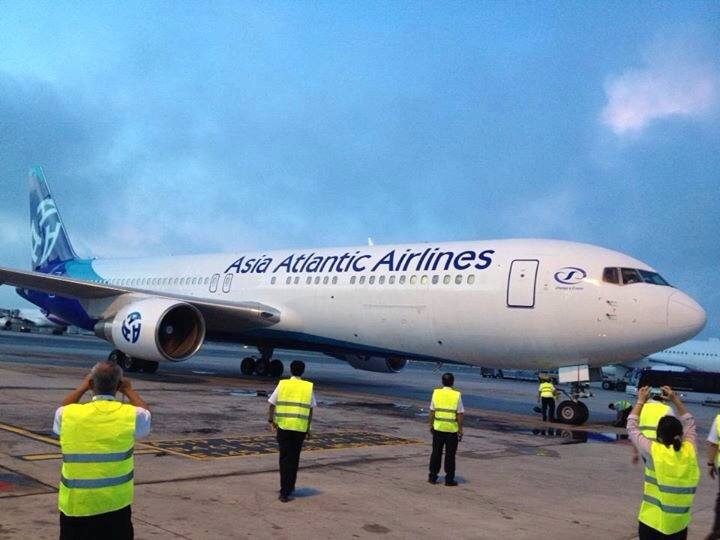
Asia Atlantic
Airlines (Bangkok Suvarnabhumi) is the latest one airplane Thai airline to
take to the skies with a single B767-300(ER) HS-AAC, msn 25287,
formerly with Ecuadorian carrier, AeroGal (2K, Quito Int'l).
The first flight
appears to have been flown to Tokyo Narita on 19 July. Backed by Japanese
travel firm, H.I.S, and Thai hotel operator, Baiyoke Group, Asia Atlantic
claims it will initially be flying to Japan, Thailand, China, Korea, Hawaii,
Guam, Indonesia and Russia, with "rapid expansion plans in the pipeline."
Daily flights are
operated to Narita; these are charters and not available for pubic
reservation. Direct competition in the market to Tokyo comes from Thai
Airways (21 weekly frequencies), All Nippon Airways (14), Japan Airlines
(14), Delta Air Lines (7) and United Airlines (7). Further 21 weekly
frequencies are offered by All Nippon Airways, Japan Airlines and Thai
Airways (7 each) to Tokyo Haneda.
The airline was
originally to be called Asia Pacific Airlines. A name that was already taken
by a cargo carrier. Hence the change to the geographically challenged Asia
Atlantic.
Here are pictures
of their first airplane and crew.
|
 |
 |
www.asiaatlanticairlines.com
This could be yet
another Thai airline project that has a short life span.
Dubai's
unfortunate ability to self harm
20 July 2013
It as not been a
good week for the Dubai public relations machine and the city state is being
very slow to take any action that could appease an outcry against the city
in social media.
Over time Dubai
has discovered that the more it tries to put itself on the world stage the
more it is held up to public scrutiny. In 2008 and 2009 there were many
commentators who enjoyed the city's embarrassment as it the financial crisis
hit and the authorities scrambled to cut projects and restructure debts.
The Dubai bling
was always a source of embarrassment for many. The majority of people who
have come to this city are simply trying to make a decent living to support
their families. And they are doing so in a city where Islamic tradition,
history, law and social structures are confronting modern capitalism.
Two stories this
week have hurt. And they may do longer term damage to Dubai's growth
aspirations as they are the sort of stories that may impact delegates voting
for the host of the 2020 World Expo; a vote that takes place later this
year.
The hashtag #BoycottDubai
is now very active on twitter and it is easy to see why.
The first story
involves a Norwegian woman who was sentenced last Tuesday to 16 months in
jail in Dubai for having sex outside marriage after reporting in March 2013
that she had been raped.
This story has
been picked up globally. Nicholas Kristof from the New York Times stated on
his facebook page that "A woman reports a rape in Dubai, and then is jailed
for 16 months for having sex outside of marriage. Her alleged assailant gets
a shorter sentence. I hope there's a campaign to shame Dubai for this
misogyny and hypocrisy." Kristof is followed by 608,163 people on facebook.
An Associated
Press Report was carried by the New York Times noted that "the case has
drawn outrage from human rights groups and others in the West since the
woman, a 24-year-old interior designer, was sentenced...It also highlights
the increasingly frequent tensions between the United Arab Emirates’
international atmosphere and its legal system, which is strongly influenced
by Islamic traditions in a nation where foreign workers and visitors greatly
outnumber citizens."
Marte Deborah
Dalelv has chosen to publish her name and story as she prepares her appeal,
scheduled for early September. She worked for an interior design firm in
Qatar since 2011. She claims that she was sexually assaulted by a co-worker
in March while she was attending a business meeting in Dubai.
The Associated
Press report continues:
"She said she fled to the hotel lobby and asked that the police be called.
Hotel employees asked if she was sure she wanted to involve the police, Ms.
Dalelv said.
“Of course I want to call the police,” she said. “That is the natural
reaction where I am from.”
Ms. Dalelv said she was given a medical examination to check for evidence of
rape and underwent a blood test for alcohol. Such tests are common in the
United Arab Emirates when allegations of assault are made, as well as in
other cases. Alcohol is sold across Dubai, but public intoxication can bring
charges.
Ms. Dalelv was detained for four days after being accused of having sex
outside marriage, which is outlawed, although the law is not actively
enforced for tourists as well as hundreds of thousands of Westerners and
others on resident visas.
Ms. Dalelv was
fired by her employer, Al Mana Interiors, a month after she reported the
alleged rape; her contract was terminated due to "unacceptable and improper
behavior". This time it was the company's managing director, Mr. Wissam Al
Mana, who incidentally is the husband of Janet Jackson, who signed the
letter.
Norwegian diplomats secured her release, and she has been allowed to remain
at the Norwegian Seamen’s Center in central Dubai. She said the man she had
accused of attacking her received a 13-month sentence for out-of-wedlock sex
and alcohol consumption.
Dubai authorities did not respond to calls for comment, but the case has
brought strong criticism from Norwegian officials and activists."
A quick follow of
#Dubai on twitter reveals the extent of the outrage. Of course some of the
cries of injustice are over the top - one comment in reply to Kristof says
"Oh, they're just SO barbaric in the Middle East! Let's flip this around -
and they see this: Adult gunman shoots unarmed teen in America. Teen dies
and gunman goes free."
But two wrongs do
not make anything right. At least the justice system in the USA is open for
debate and criticism. Such criticism would be hazardous in Dubai as this
week's second story highlights.
Last Monday a
video was posted to YouTube clearly showing an Emirati man beating a
cowering Indian man with his aghal (the black rope headdress worn as part of
the traditional Arabian costume) and punching him.
The video was
taken by a young Indian parked in an adjacent car.
It is unlikely the
young guy taking the video was aware of UAE law; it is also likely that he
did not know what to do with the video. So he put it onto YouTube. Problem.
It is illegal to photograph or film someone in the UAE without their
permission - and this was certainly a case of a video taken without
permission.
Of course the law
is broken all the time. But in this case he had taken a very personal video
that would embarrass the person being filmed.
Social media was
indignant. Dubai Police acted quickly after a large number of people brought
the incident - and video - to their attention, particularly over Twitter.
The Emirati - a government official now faces a charge of minor assault.
This carries a maximum jail term of one year and a maximum fine of
Dhs10,000.
The lad who took the video and posted it to YouTube was then arrested after
the Emirati official's son lodged a defamation case against him with police.
He is being interrogated (that was the local media word) and has not been
released on bail since he was seized by police on Tuesday.
He faces a
possible charge of recording without permission and defaming a person, which
carries a two year sentence and Dhs20,000 fine.
Dubai Police have told press the man should have shared the video with them
rather than post it up publicly, where hundreds of thousands have now seen
the incident.
The son told media
the video had damaged the reputation of his father and family.
Of course the
family's reputation would not be damaged by being seen to beat a cowering
men who would never have dared to raise a hand in defence.
The reality is
that the beaten Indian would never have dared file a complaint against his
Emirati attacker so the man who committed the assault would not have been
charged without the film footage.
Had the video been
taken to the police the story would have remained buried and maybe that
would have been best - at least the status quo would have been maintained.
But potentially
going to prison for telling the truth is another damaging story for
Dubai that could have been dealt with very differently and quietly.
Dubai's
transformation has been remarkable. But its laws and legal system have not
kept up. Dubai's apparent Westernization and openness only work while you
stay on the safe side of the law. Finally its PR machine struggles to deal
with adverse and hostile commentary.
Meanwhile the city
is bidding for the 2020 World expo with the bidding committee of the Bureau
of International Expositions (BIE) in Paris due to make their decision this
year. This week has done nothing to help that bid. And the failure of the
authorities to manage these events and the coverage generated is damaging.
And that is a real
shame.
Bert Trautmann
20 July 2013 -
The Telegraph
Bert Trautmann , who has died aged 89, became the
hero of the 1956 FA Cup Final when, in one of the most famous episodes in
the history of the competition, he defied the pain of an injury to continue
in goal for Manchester City and clinch the trophy, unaware that he had
broken his neck.
Every schoolboy
goalkeeper in England in the 1960s knew this story. Trautmann was a legend.
His courage and athleticism inspired us, even at primary school. And his
story encouraged proud fathers to coach their children to be the next
Trautmann. I was one of those children; diving around the Rowheath playing
fields in Bourneville and keeping goal for the primary school team.
"The esteem in which Trautmann was held in the blue half of Manchester, and
indeed across English football, was all the more remarkable given that he
had arrived in Britain 11 years before as a prisoner-of-war — and one
regarded by the authorities as a hard-bitten Nazi because of his membership
of an elite squad of Luftwaffe paratroops.
Trautmann had in fact lost the zeal that made him a sporting champion in the
Hitler Youth after witnessing a massacre of civilians by the SS in occupied
Russia, but he remained spiky and competitive. As a PoW he persuaded the
camp authorities to let the inmates form a football team, which took on
local sides in Lancashire as post-war tensions eased.
He converted from centre half to goalkeeper after taking a knock in one game
and refusing to go off. After being signed by non-League St Helen’s Town, in
1949 he went to Manchester City, who were seeking a replacement for the
great England international Frank Swift.
The club’s choice, just four years after the war, was controversial, and
Trautmann was shocked by the hate mail he received; but the boos and
anti-German chants turned to cheers as he excelled on the pitch. He made his
mark as a keeper who dominated the penalty area, fearlessly snuffing out
threats, instead of staying on his line.
City had reached the 1956 Cup Final — Trautmann’s second — after a series of
narrow victories, while their opponents, Birmingham City, had romped to
Wembley despite having been drawn away in each round. The Manchester side
had also been hit by injury, and were forced to recall their out-of-favour
playmaker Don Revie from the reserves.
In the event, Revie proved the match winner — by the 70th minute a string of
visionary passes from him had given City a 3-1 lead. But with 16 minutes
remaining, Birmingham’s Peter Murphy was presented with a chance.
Out rushed Trautmann (newly voted Footballer of the Year) and, with his
customary courage, dived at Murphy’s feet. He succeeded in clutching the
ball, but could not prevent his head colliding with Murphy’s leg. Trautmann
was left dazed and reeling, but was determined to play on. As he rose to his
feet after treatment, the crowd broke into For He’s A Jolly Good Fellow.
At the end of the game, Trautmann was helped up the steps to collect his
winner’s medal, all the while rubbing his “stiff neck”. He joined the team
on the balcony of Manchester Town Hall as the crowd chanted: “We want Bert!”
Four days later his persistent headache forced him to attend a hospital,
where X-rays revealed a fracture. The examining doctor told Trautmann that
just one jolt of the bus back from Wembley could have killed him. He was
forced to spend five months encased in plaster from head to hips, and
thereafter played in a protective cap.
Yet Trautmann won back his place in the City team, and when he retired in
1964 (having made 545 appearances) the great names of football — Charlton,
Law, Matthews, Finney — turned out for his testimonial match, in front of a
crowd of 47,000 cheering him to the rafters. When the Inland Revenue told
him to pay tax on the proceeds, he characteristically told them to get lost.
Bernhard Carl Trautmann was born in Bremen, Germany, on October 22 1923, the
elder son of a chemical loader at the docks. He grew up during the
hyperinflationary period of the Weimar Republic, and as a teenager joined
the Hitler Youth. At 17 he volunteered for the Luftwaffe as a communications
specialist, but failed his code exams.
When Hitler invaded Russia in 1941, Trautmann was maintaining military
vehicles; and during a pause in hostilities, he disabled a staff car as a
prank so that he and some friends could go foraging once the officers had
found another vehicle. When sand was found in the engine, Trautmann was
convicted of sabotage and sentenced to nine months in a squalid former
Soviet prison at Zhitomir. Providentially, his appendix burst and after
recovering from the operation he was allowed to rejoin his unit.
Early in 1942 he volunteered for the Fallschirmjäger, the Luftwaffe’s crack
paratroops. He spent the next two years in a small group fighting the
increasingly active Soviet partisans — once narrowly escaping capture — as
the German advance turned into a slow and bloody retreat.
Shortly before D-Day Trautmann was transferred to France to train new
recruits. He fought in several desperate delaying actions across France, and
then at Arnhem; by now he had been awarded two Iron Crosses and promoted to
corporal.
While regrouping in the German town of Kleve, he was buried alive for three
days when the Allies bombed a school where his unit was billeted; most of
his comrades were killed.
In the confusion that preceded the fall of the Reich, Trautmann decided to
make for Bremen. Briefly held by the Americans, he was finally taken
prisoner by a British signals unit whose soldiers greeted him with: “Hello
Fritz, would you like a cup of tea?” His lifelong love affair with Britain
began at that moment.
Trautmann was dispatched to a PoW camp at Ashton-in-Makerfield, near Wigan,
where the government (in contravention of the Geneva Convention) was using
German labour to help rebuild Britain. His athleticism in the camp’s
football team (when he was not working with a bomb disposal unit) attracted
attention, and before long he was turning out for St Helen’s Town, whose
club secretary Jack Friar took him under his wing.
His tenacious performances put hundreds on the gate, and soon attracted
talent scouts. Friar — soon also to become his father-in-law — negotiated
with Burnley, but City made an offer and Trautmann signed for them.
The club’s decision to recruit him inevitably aroused passions in
Manchester, with its large Jewish community. Trautmann was subjected to much
abuse until the city’s chief rabbi generously gave him his blessing to play.
His nationality aside, he also had to overcome the prejudice of City fans
who believed that no one could adequately replace Swift. The German’s cause
was not helped when, in his first season at Maine Road, City were relegated
to the Second Division.
Gradually, however, the blond Trautmann — who stood 6ft 2in tall and weighed
almost 14st — began to win the affection and respect of fans and fellow
players alike. His wholehearted commitment to the team, as well as his
shot-stopping powers, led some observers to rate him not merely a better
keeper than the more flamboyant Swift, but almost as good as Lev Yashin, the
Russian who was then perhaps the best yet seen.
Bobby Charlton, for one, considered Trautmann responsible for the finest
save he had ever witnessed. Trautmann was picked twice for the Football
League representative side, but never won an international cap, as West
Germany then had a policy of not selecting those who played abroad.
Although City’s league record was indifferent (their best seasons with
Trautmann came in 1951, when they were runners-up in the Second Division,
and in 1956, when they finished fourth in the top flight), his skills came
into their own in close-fought, one-off cup matches. In 1955 City reached
the Cup Final, but were forced to play most of the match with 10 men after
Jimmy Meadows was injured. Their opponents, Newcastle, eventually won 3-1,
but it was only Trautmann’s agility that had kept City in the game.
The following year saw both the zenith and nadir of Trautmann’s fortunes. A
month after his heroics in the Cup Final, his six-year-old son was killed
while crossing the road. Trautmann struggled to come to terms with his loss,
which in time led to the break-up of his marriage.
Trautmann considered quitting football after leaving City, but in 1966 he
became manager of Stockport County. The team won promotion to the Third
Division and the gates rose, but then he had a row with the chairman and
walked out. Thereafter he found it hard to get work within the sport and,
angry and despairing, sparked a police hunt when he disappeared from home in
1971. But he turned up safe, and soon afterwards took a post with the German
FA, pioneering soccer in developing countries.
Over the years he coached in Burma (taking its team to the 1972 Munich
Olympics), Tanzania, Liberia, Pakistan and North Yemen. But there was always
a welcome for him in Lancashire.
“My education only began the day I arrived in England,” Trautmann recalled.
“People were so kind and decent, they didn’t see an enemy prisoner, they saw
a human being. The British made me what I am ... When I visit Germany, they
say to me: 'Be honest, you’re English through and through’. And I’m mighty
proud so to consider myself. I come back four or five times a year and
always think 'Great, I’m home.’”
In 2000 the Football League voted Trautmann one of its 100 Players of the
Century, and in 2004 he was appointed OBE for his work encouraging
Anglo-German relations. Days later he was presented to the Queen and the
Duke of Edinburgh at the Berlin Sinfonia, where 66 years earlier he had been
honoured by Hitler’s sports minister for coming second in athletics in the
whole of the Reich.
Trautmann lived for a time in Germany, then retired to Spain, where he owned
a vineyard near Valencia. He followed the Premiership on satellite
television, and was a regular visitor to Maine Road and later the City of
Manchester Stadium.
He suffered no lasting effects from his broken neck, though from time to
time he would feel a twinge whenever he looked sharp left while riding his
bicycle.
Bert Trautmann married Margaret Friar in 1950. His second marriage, to
Ursula von der Heyde, also broke down. He retired to Spain with his third
wife, Marlis, who survives him. He had two other sons by his first marriage,
and a daughter from an earlier relationship with Marion Greenhall.
Bert Trautmann, born October 22 1923, died July 19 2013"
Boris is right
- it is time to scrap Heathrow
15 July 2013
Heathrow is a
disaster. It is old; there is no room to effectively expand. It limits the
growth of the UK's air traffic business; it limits opportunities for British
business. It is a third world airport in a first world city. All that saves
it from being completely inoperable is the efficiency of the UK's air
traffic controllers who make the best use of Heathrow's two runways and
crowded terminal space.
Now Mayor of London Boris Johnson is set to unveil plans to build homes on
Heathrow and build a new airport to the east of London.
He is right. But
predictably he is opposed by Heathrow's chiefs who will unveil proposals for
further runways.
Johnson will on Monday set out three options for a four-runway hub to the
east of London, at the expense of Heathrow. His proposals are part of a
submission to the Airports Commission, a body appointed by the government to
draw up options for new runways.
Johnson proposes two new sites in the Thames estuary and an expanded
Stansted, with a Norman Foster-designed project on the Isle of Grain in Kent
thought to be his favoured plan.
At the same time, he will call for the closure or scaling down of Heathrow,
claiming the land could sustain a thriving new London borough.
Heathrow and local councils have argued that building a new hub would force
the airport out of business, causing substantial job losses in the area.
Those jobs of course would not disappear for over a decade while the new
airport is constructed; and those jobs will be replaced to the west of
London by new developments arising from the old Heathrow with thousands of
new homes and businesses in the heart of London's affluent western suburbs.
A Heathrow spokesman said: "It seems extraordinary that any mayor of London
would propose forcibly buying and then closing Heathrow. The mayor's
proposals would leave 114,000 people facing redundancy, cost taxpayers more
and take longer to deliver than building on the strength we already have at
Heathrow."
Heathrow will respond on Wednesday with a series of specific options for a
third runway, none of which replicate the plans scrapped by the coalition in
2010.
One proposal is believed to be a new runway towards Stanwell Moor to the
south-west of the existing airport, although the most realistic option is
still to the north, where land was safeguarded for a third runway.
The village of Sipson, earmarked for demolition before the 2010 election
under the third runway proposals, will apparently not be reprieved. It is
understood the village features in at least one of the options being
proposed.
Heathrow will also signal that a fourth runway should not be necessary for
decades, in an attempt to head off Johnson's demands for a four-runway hub
and to limit any public backlash from London residents threatened by noise
from new flight paths.
Amsterdam already
has six runways.
Meanwhile Gatwick will submit plans for its own second runway to the
commission, arguing for a "constellation approach" to airport capacity
around London. That runway would be operational around 2025 at the earliest.
In this vision, Heathrow, Gatwick and an expanded Stansted would provide
competition to each other on a more equal footing.
Birmingham airport believes that Britain's capacity needs can be met through
a network of long-haul airports connected by the HS2 rail line.
Manchester Airports Group, which bought Stansted earlier this year, has yet
to say whether it supports any of Johnson's or Gatwick's expansion plans for
the single-runway Essex airport.
The commission will announce a shortlist of new runway options by the end of
the year, with detailed studies to be carried out in 2014. It will set out
its final recommendations after the general election in 2015.
Then there are
public enquiries.
And eventually
something or nothing is done.
Meanwhile London's
other hub airport in Dubai will have expanded to 90 million passengers a
year and be ready to move to a 160 million passengers per year five runway
airport at Jebel Ali.
London is in real
danger of being left behind and it needs a long term strategy not a short
term band aid.
Emirates to
Kiev in 2014
11 July 2013
Dubai’s Emirates
Airline on Thursday unveiled new expansion plans in Eastern Europe,
announcing its first service to the Ukraine.
Emirates will
launch daily services to Kyiv Boryspil International Airport in the capital
Kiev from January 16, 2014.
The flight, EK171,
will be operated by an Airbus A340-500 with first, business and economy
classes.
It will depart
Dubai at 5.15pm, arriving in Kiev at 8.35pm. The return flight to Dubai
leaves Kiev at 10.10pm, arriving into Dubai at 4.55am the following day.
America against
democracy
10 July 2013 The Economist
Revelations in the wake of Edward Snowden's civil disobedience continue to
roll in. The New York Times reports that the Federal Intelligence
Surveillance Court, also known as the FISA court, "has quietly become almost
a parallel Supreme Court, serving as the ultimate arbiter on surveillance
issues and delivering opinions that will most likely shape intelligence
practices for years to come..." How is the FISA court like a shadow Supreme
Court? Its interpretation of the constitution is treated by the federal
government as law. The Times reports:
In one of the court’s most important decisions, the judges have expanded the
use in terrorism cases of a legal principle known as the “special needs”
doctrine and carved out an exception to the Fourth Amendment’s requirement
of a warrant for searches and seizures, the officials said.
Of course, there are important differences. None of the judges of the FISA
court were vetted by Congress. They were appointed by a single unelected
official: John Roberts, the chief justice of the Supreme Court. And then
there's the fact that "the FISA court hears from only one side in the
case—the government—and its findings are almost never made public." A court
that is supreme, in the sense of having the final say, but where arguments
are only ever submitted on behalf of the government, and whose judges are
not subject to the approval of a democratic body, sounds a lot like the sort
of thing authoritarian governments set up when they make a half-hearted
attempt to create the appearance of the rule of law.
According to the Times, Geoffrey Stone, a law professor at the University of
Chicago, "said he was troubled by the idea that the court is creating a
significant body of law without hearing from anyone outside the government,
forgoing the adversarial system that is a staple of the American justice
system." I'm troubled, too.
Meanwhile, the Wall Street Journal adds some meat to the story by reporting
that "The National Security Agency’s ability to gather phone data on
millions of Americans hinges on the secret redefinition of the word
'relevant'".
In classified orders starting in the mid-2000s, the court accepted that
"relevant" could be broadened to permit an entire database of records on
millions of people, in contrast to a more conservative interpretation widely
applied in criminal cases, in which only some of those records would likely
be allowed, according to people familiar with the ruling.
"Relevant" has long been a broad standard, but the way the court is
interpreting it, to mean, in effect, "everything," is new, says Mark
Eckenwiler, a senior counsel at Perkins Coie LLP who, until December, was
the Justice Department's primary authority on federal criminal surveillance
law.
Two senators on the Intelligence Committee, Ron Wyden (D., Ore.) and Mark
Udall (D., Colo.), have argued repeatedly that there was a "secret
interpretation" of the Patriot Act. The senators' offices tell the Journal
that this new interpretation of the word "relevant" is what they meant.”
Think about that. Doesn't that suggest to you that Messrs Wyden and Udall
were afraid they might be subject to some sort of censure or reprisal were
they to share with the public specific details about the official
interpretation of the law to which the public is subject? And those specific
details were about the interpretation of "relevant"? Now that that cat's out
of the bag, I guess we're in danger?
All this somehow got me thinking of the doctrine of "democracy promotion",
which was developed under George W. Bush and maintained more or less by
Barack Obama. The doctrine is generally presented as half-idealism,
half-practicality. That all the people of the Earth, by dint of common
humanity, are entitled to the protections of democracy is an inspiring
principle. However, its foreign-policy implications are not really so clear.
To those of us who are sceptical that America has the authority to intervene
whenever and wherever there are thwarted democratic rights, the advocates of
democracy-promotion offer a more businesslike proposition. It is said that
authoritarianism, especially theocratic Islamic authoritarianism, breeds
anti-American terrorism, and that swamp-draining democracy-promotion abroad
is therefore a priority of American national security. If you don't wish to
asphyxiate on poison gas in a subway, or lose your legs to detonating
pressure-cookers at a road-race, it is in your interest to support American
interventions on behalf of democracy across the globe. So the story goes.
However, the unstated story goes, it is equally important that American
democracy not get out of hand. If you don't want your flight to La Guardia
to end in a ball of fire, or your local federal building to be razed by a
cataclysm of exploding fertiliser, you will need to countenance secret
courts applying in secret its own secret interpretation of hastily drawn,
barely debated emergency security measures, and to persecute with the full
force of the world's dominant violent power any who dare afford a glimpse
behind the veil.
You see, democracy here at home must be balanced against the requirements of
security, and it is simply too dangerous to leave the question of this
balance to the democratic public. Open deliberation over the appropriate
balance would require saying something concrete about threats to public
safety, and also about the means by which those threats might be checked.
But revealing such information would only empower America's enemies and
endanger American lives. Therefore, this is a discussion Americans can't
afford to have. Therefore, the power to determine that this is a discussion
the public cannot afford to have cannot reside in the democratic public.
That power must reside elsewhere, with the best and brightest, with those
who have surveyed the perils of the world and know what it takes to meet
them. Those deep within the security apparatus, within the charmed circle,
must therefore make the decision, on America's behalf, about how much
democracy—about how much discussion about the limits of democracy, even—it
is safe for Americans to have.
This decision will not be effective, however, if it is openly questioned.
The point is that is not up for debate. It is crucial, then, that any
attempt by those on the inside to reveal the real, secret rules governing
American life be met with overwhelming, intimidating retaliation. In order
to maintain a legitimising democratic imprimatur, it is of course important
that a handful of elected officials be brought into the anteroom of the
inner council, but it's important that they know barely more than that there
is a significant risk that we will all perish if they, or the rest of us,
know too much, and they must be made to feel that they dare not publicly
speak what little they have been allowed know. Even senators. Even senators
must fear to describe America's laws to America's citizens. This is, yes,
democracy-suppression, but it is a vitally necessary arrangement. It keeps
you and your adorable kids and even your cute pet dog alive.
Now, I don't believe I've heard anyone make this argument, no doubt because
the logic of the argument cuts against it being made. Yet it seems similar
reasoning must underpin the system of secret government that has emerged
from the examination of Mr Snowden's leaks, and I cannot help but suspect
that something along these lines has become the unspoken, unspeakable
doctrine of Mr Obama's administration. Yet I remember when the Mr Obama
announced this:
"My Administration is committed to creating an unprecedented level of
openness in Government. We will work together to ensure the public trust and
establish a system of transparency, public participation, and collaboration.
Openness will strengthen our democracy and promote efficiency and
effectiveness in Government.”
That would have been some real democracy-promotion, right here in the
homeland. What happened? Is it naive to think Mr Obama really believed this
stuff? I'll admit, with some embarrassment, that I'd thought he did believe
it. But this "commitment" has been so thoroughly forsaken one is forced to
consider whether it was ever sincere. It has been so thoroughly forsaken one
wonders whether to laugh or cry. What kind of message are we sending about
the viability these democratic ideals—about openness, transparency, public
participation, public collaboration? How hollow must American exhortations
to democracy sound to foreign ears? Mr Snowden may be responsible for having
exposed this hypocrisy, for having betrayed the thug omerta at the heart of
America's domestic democracy-suppression programme, but the hypocrisy is
America's. I'd very much like to know what led Mr Obama to change his mind,
to conclude that America is not after all safe for democracy, though I know
he's not about to tell us. The matter is settled. It has been decided, and
not by us. We can't handle the truth.
Emirates announces sixth daily flight to Bangkok
10 July 2013
Why open up new
routes when you can make more money expanding services on existing highly
profitable routes?
With that in mind
from 27 October 2013 Emirates Airline will add a new afternoon service to
Bangkok, departing Dubai at 1520 and arriving at Suvarnabhumi airport at
0020. The return service will leave Bangkok at 0155, getting back into Dubai
International Airport at 0545. The new daily service will be operated using
a three-class Boeing 777-200ER with 12 seats in first class, 42 in business
class and 220 in economy.
From the same date, Emirates will also upgrade another of its Dubai-Bangkok
flights (EK372) to the larger Airbus A380 aircraft.
“Emirates’ sixth daily service to Bangkok launches on the same day as the
start of our second daily Airbus A380 service to the city, demonstrating the
importance of Thailand to the airline,” said Barry Brown, Emirates’
divisional senior vice president of commercial operations for the region.
“Due to passenger demand, we have seen a steady increase in terms of
services and capacity on our Southeast Asian routes. In addition to the
Bangkok sixth daily, Emirates is also increasing its Hong Kong services to
four daily from 27 October and will be launching a daily, non-stop service
to Clark in the Philippines from 1 October,” he added.
The announcement of the latest increase comes just six months after Emirates
added its fifth daily Bangkok flight; though that is still an old and rather
unpleasant A330.
77 years
7 July 2013
77 years of grass
court gloom on 7/7....and this picture which is in Monday's Times tells the
story:

Asiana 777
accident at SFO
6 July 2013
Breaking news
tonight of an Asiana Airlines accident on landing at SFO. Appears that there
are 2 deaths and 61 injured. But with the plane landing short of the runway
it is remarkable that there were not more casualties.
Also remarkable
that passengers could just amble away from this accident walking with there
carry on baggage. The airplane is now a burned out shell.
There is no sign
of the no 1 engine. The tail-plane has been ripped of.
A fire clearly
broke out but appears to have started after most of the passengers had
evacuated.
A NOTAM indicates
San Francisco runway 28L glideslope was declared out of service as of Jun 1,
effective through Aug 22. In addition it appears that the PAPI was not
functioning.
But the weather
was clear with a light wind of just 7 knots.


No such thing
as a good coup
4 July 2013
I doubt that
Egyptians will see this as their independence day.
Egypt's army
yesterday ousted a democratically elected government that had been in office
for just one year.
The Americans do
not want to call this a coup. And most of the GCC nations approve the army
led change with the lonely exception of Qatar.
But may no mistake
this was a traditional coup d’état.
Troops surrounded state broadcasting headquarters early in the day and, once
the army commander had finished his televised announcement of the
government’s demise, the plugs were pulled on the ruling party, silencing
its television stations.
General Abdel
Fattah al-Sisi, the army chief of staff, replaced Mr Morsi, elected juts one
year ago, and his Muslim Brotherhood with a transitional government. Making
the announcement on tv he was flanked by the Sheikh of al-Azhar university,
the leading Sunni Muslim authority; the Pope of Egypt’s sizeable Coptic
minority; Mohamed ElBaradei, Nobel peace laureate and leader of Egypt’s
liberals; and youthful activists who brought down the army-backed
dictatorship of Hosni Mubarak in 2011, the high spring of the new Arab
awakening.
Huge crowds in Tahrir Square erupted in joy every bit as spectacular as the
way they greeted the toppling of Mr Mubarak. But it cannot bode well when
those who profess to be liberals need the army bayonets to force their case.
The joy may well be short-lived, because what really happened in Egypt was
that it went back two years. With Morsi gone, the old regime is back where
they want to be, pulling the levers of power. It is now only a matter of
time before the loser of the last presidential election, Ahmed Shafiq comes
back from exile.
Over the last two days an army that appeared to be retreating from politics
after the departure of Hosni Mubarak in February 2011 has stepped back into
the arena again, first by issuing an ultimatum to an elected president to
obey it or resign, and then by going through with its threat and laying out
a road map that deposes him and suspends the constitution.
In doing so the army rejected the results of elections that were widely
deemed to be free and fair and set aside the country's basic law. The
similarities o 2006 in Thailand are strong.
Blaming Morsi for
not resurrecting the Egyptian economy was one excuse though there is no
ready solution that provides enough jobs for tens of thousands of young
people who are graduating every year, let alone for an older generation that
is out of work. Morsi went along with the International Monetary Fund's
plans for an end to subsidies on food and utility prices that would only
create more austerity, but so did most of the established opposition leaders
who are now clamouring for power. As for the failure of the tourism sector
to revive, the main reason for the chaos and instability that put off
outsiders rests with the constant street demonstrations.
Anyone who believe that the military's main objective is to preserve the new
freedoms will soon be disappointed. From Chile in 1973 to Pakistan in 1999
(and several times before that) and Thailand in 2006, long is the history of
military takeovers that were welcomed in their first hours and days but
regretted in the years of despair that followed. F
General Abdel
Fattah al-Sisi has appointed the head of the supreme constitutional court as
interim head of state. No one in Egypt knows who this man Adli Mansour is.
But he will be the public face of a new army backed legislature.
Gen Sisi called for presidential and parliamentary elections and a panel to
review the constitution, but no timelines were given.
Let us be clear, Mr Morsi failed to make good on the promise he made to
represent all the factions that ousted Hosni Mubarak two years ago. When he
offered concessions, such as a government of national unity and a neutral
committee to rewrite the constitution, it was too late. Something as
fundamental as a constitution should never have been rammed through, after
half of the members of its constituent assembly had resigned and with the
promise that it could be amended in the future. Mr Morsi had a valid
argument when he said that the opposition refused to participate from the
start. But he nevertheless should not have proceeded without them. He should
have enforced the rule of law, especially against the police.
Even so, what took shape last night was more fundamental than any of the
conflicts that led to it. To dispose of Egypt's first democratically elected
president, to disenfranchise all those who participated in the free
elections for the presidency and the parliament and the referendum for the
constitution is another matter entirely. Each of these nascent institutions
were castigated by foreign governments and human rights groups for falling
below international standards. Mr Morsi was given lectures about how
democracy is more than just the ballot box. But which standard is more
important than the one which decrees that transfers of power can only be
enacted peacefully and through the ballot box? That has just been trashed.
The spectacle presented by the first elected parliament after the fall of
Mubarak – an Islamist-dominated assembly arguing about prayer times and
obsessing over curtailing women’s rights – was a setback for democracy.
Attempts to manipulate the judiciary by all sides – the generals, the
Mubarak “deep state”, the liberals and the Brotherhood – were a setback for
democracy.
By no means least, the manifest inability of secular, urban and modern
Egyptians to organise their political representation was – and remains – a
setback for democracy.
And now the
biggest steback of all.
Elected
governments are removed at the ballot box not at the point of a gun; and new
elections and stable government look a long way off in Egypt.
Meanwhile the GCC
countries, except Qatar, have welcomed the coup amid their own concerns
about the Muslim Brotherhood and the USA has remarkable failed to call ths a
coupe since the Egyptian military is largely US funded and trained.
Why the doors have slammed in Edward Snowden’s face
4 July 2013 Reuters
Edward Snowden is still holed up in the transit lounge of Moscow’s
Sheremetyevo airport. From almost every corner of the world has come the
sound of doors slamming. The US wants the former US security contractor
extradited home to face trial. The rest of the world – including, I suspect,
his Russian hosts – see a story they would like to go away.
Mr Snowden has confirmed many prejudices about the use, and abuse, of
American power. But the truth is we are sated with secrets. Not so long ago
the disclosure of the nefarious surveillance activities of US intelligence
agencies would have been met with international uproar. Now it produces a
diplomatic ripple like that from a pebble thrown into a pond.
True, various European governments have complained about the US habit of
spying on its allies. Predictably enough, France has led the field, warning
that the disclosures could wreck transatlantic trade talks. The European
Commission has lodged a protest – although one suspects it may be thrilled
that Washington thinks it important enough to bug its fax machines.
None of the Europeans will take in Mr Snowden. Those prone to Orwellian
nightmares profess themselves horrified by the revelations. Just about
everyone else already knew that the US bugs just about everyone. Why pick a
fight with Washington over a self-styled whistleblower? True, Bolivia is up
in arms after this week’s enforced diversion of its president’s flight from
Moscow. But even Ecuador, which hosts WikiLeaks’ Julian Assange in its
London embassy, seems reluctant to welcome Mr Snowden.
For the US, mass surveillance is a supply-driven activity. The sole
superpower has to do something with its vast national intelligence complex
and unmatched electronic snooping technology. If the National Security
Agency can scoop up conversations between François Hollande and Angela
Merkel along with those of Taliban commanders, why not?
Nor is the US alone in checking up on friends. Europeans are nervous about
bugging the Americans but they take their chances when they arise. They
certainly spy on each other. The French steal the commercial secrets of the
Germans; the British monitor Commonwealth partners such as South Africa and
India. The Israelis bug everyone.
As for the Chinese and the Russians, while they have enjoyed America’s
discomfort, they are hardly novices when it comes to trawling through cyber
space.
There are other reasons for the muted reaction. One is that citizens have
become careless about their privacy. Societies in which individuals
willingly hand over vast amounts of their own, often intimate, data to
internet providers, social media sites and commercial enterprises are less
concerned when governments listen in.
There are also suspicions about the motives of self-described
whistleblowers. Mr Assange comes across more egomaniac than disinterested
seeker of truth. Mr Snowden’s choice of authoritarian refuges does not speak
to a natural reverence for the rule of law.
Publics are conscious that digital networks provide the supply routes for
cross-border terrorism. If those intent on bringing down civilian aircraft
or setting off bombs in crowded cities can plot their atrocities over the
web, it seems reasonable enough that intelligence agencies should be able to
listen in – just as they once bugged telephones and opened letters. The
reason they hoover up so much data is because, well, there is so much of it.
There is something to all these points. It would be a great pity, however,
if Mr Snowden’s central insight was lost to the brouhaha about his motives
and his present predicament.
The lesson is surely that democratic accountability and oversight of the
intelligence agencies have been left behind by fear of jihadi terrorism and
advances in digital innovation. It is far from evident that the US Congress
– or for that matter the legislatures in other mature democracies – have
kept up with the capabilities and operations of the secret world of
surveillance. Nor have citizens and politicians properly understood how data
gathered by commercial enterprises can be used by the US government.
In this respect, whatever his motives, Mr Snowden has done the rest of us a
service.
In major shock Dubai will build something small
4 July 2013
Dubai’s ruler
Sheikh Mohammed Bin Rashid Al Maktoum has approved a number of new projects
proposed by the Dubai Municipality, including a ‘Mini World Park’.
The development will be designed to showcase replicas of famous monuments
from across the world. The location and financial details were not
disclosed.
Some of the displays expected include miniature versions of the Burj Khalifa,
Burj Al Arab, Empire State Building, Carlton Tower, CN Tower and the
Petronas Towers.
Historical landmarks such as Egypt’s pyramids, the Great Wall of China,
Jordan’s Petra and the Roman Colosseum will also be featured, and the
project will also contain models of natural monuments such as the Hanging
Gardens of Babylon, Raouche Rock from Lebanon, and the Niagara Falls, among
others.
Apart from the Mini World Park, another project approved by Sheikh Mohammed
is a new maritime museum, which will primarily host aquatic species.
The museum, to be built in the shape of a snail, will feature views of the
Ras Al Khor Sanctuary and is estimated to cost Dhs35 million.
The municipality is also planning to construct a central library in Dubai.
Called the Sheikh Mohammed bin Rashid Al Maktoum library, it will be
designed in the form of book bearer or an open book. Spread across 50,000 sq
metres, the building, which includes seven levels, will display one million
books in addition to 1.2 million books in storage.
Long sentences in the UAE dissent trial
3 July 2013
More than 65
people accused of plotting an Islamist coup in the United Arab Emirates have
been handed prison sentences – some of up to 15 years – in a mass trial that
reflected the widening concerns about dissent and anti-government action
across the Gulf region.
Rights groups have accused their concern at the judicial process that saw 94
people on trial, including teachers, lawyers and even the cousin of one of
the UAE's rulers.
The Gulf News
reports extensively on the trial and verdict; and outlines plots to
overthrow the UAE's government through the activities of an Islamic front
organisation accused of having links to the Muslim Brotherhood, Al Islah.
It is hard, as a
foreigner, to have an opinion, on what clearly is an issue of concern to
Emiratis. The only reporting of substance has been generated through the
national newswire of the UAE, WAM.
Without any
alternative voice and with no investigative reporting it is hard to comment
on the detail of the case.
In the case
against the 94 defendants, prosecutors claimed the al-Islah group was
influenced by Muslim Brotherhood ideology to oppose the western-oriented
system in the UAE.
The defendants rejected the claims, saying the group only supported Islamic
viewpoints and carried out necessary social outreach in poorer areas of the
country beyond the skylines of Dubai and Abu Dhabi.
Al-Islah has operated openly for decades in the UAE under the tacit
agreement that members would not get involved in political affairs.
A few links might
give more detail.
UAE94 trial was 'just and fair' - Human Rights Assoc
UAE security trial: Verdict described as ‘strictly fair’
UAE: Grossly unfair trial of government critics
Amsterdam -
London's best airport
2 July 2013
For many travelers
Amsterdam airport is a favorite transit hub. And it is easy to see why.
Airside six
runways eliminate anything but the worst weather delays.
Landside the
airport is a wondrous mix of shopping mall, rail station, social gathering
place and transport hub.
Shuttle buses to
the airport hotels are free - take that Heathrow with your gbp4 charge.
The train to
Amsterdam city centre is Euro3.80. The Gatwick and Heathrow expresses are
both close to gbp20.
Now Dutch aviation chiefs have brazenly launched a fresh campaign to promote
Schiphol as a hub airport for Britain.
They are even said to have cheekily nicknamed one of the six runways at the
Amsterdam airport “Heathrow’s third runway”.
Amsterdam boasts more than 100 daily flights from the UK to Schiphol, with
connections to more than 275 destinations around the globe. WIth flights
into all the major UK airports as well as minors such as Norwich and
Cambridge it is easy to see why passengers are happy to fly through
Amsterdam rather than having to haul their way through any of London's
airports.
Indeed the major
competition to Amsterdam is from other hubs such as Frankfurt or even from
Dubai based upon Emirates flights from UK regional airports.
The Schiphol Group president Jos Nijhuis said: “Each year we serve seven
million passengers to and from Britain. In September UK business travellers
voted us best European airport for the 23rd time. We are proud to be the
UK’s preferred non-British airport.”
Amsterdam serves 23 destinations in Britain, compared with Gatwick’s 12 and
Heathrow’s seven.
Of course
Amsterdam has the advantage of a huge amount of green space around its
airport which serves a city with a population of around a million compared
to London's 10 million.
The only downside
at Amsterdam; the cattle pens used to herd Easyjet passengers to their
flights. Awful.
Emirates
launches Conakry
3 July 2013
Emirates Airline
has announced plans to introduce a linked service to Conakry, the capital
city of Guinea, from October 27.
The linking of Conakry to the four times weekly Dubai to Dakar service will
provide new opportunities for business and leisure travelers in Guinea to
connect to the airline's worldwide network through its Dubai hub.
Conakry is the largest city of Guinea in West Africa and is situated on the
Atlantic Ocean and serves as the economic, financial and cultural centre of
the country with an estimated population of 1.5 million people.
Guinea is a developing economy with a strong mining sector.
The Dubai to Dakar
route was serviced by an A330-200 aircraft, but since the end of March a
slightly larger A340-300 was introduced onto the route, ahead of the October
launch of the Conakry link.
The Dakar/Conakry flight mirrors the existing Accra/Abidjan flight and is a
useful means of adding passenger and cargo revenues to an existing service.
|
| |
|