|
Welcome to rascott.com
This is a
personal site that reflects my interests in news,
current affairs, aviation and travel.
email me:
robert@rascott.com
Home
Up
Now In Dubai:
Scott
Consulting
Photo Albums
My photographs have been moved off this site and are now stored on Picasa. They
were simply taking up too much space on my web host.
Please use
this link to see my list of photo albums.
Some
Useful links:
Information:
World Time
Clock
Exchange Rates
Journalism:
ForeignPolicy
Nationsonline.org
Project Syndicate
Amnesty International
Reporters w/o borders
The Guardian
BBC World News
CNN Asia
Bangkok Post
Daylife.com - news
Gulf News
Arabian Business
World News
WSJ - Asia
SCMP
Good causes:
Sister
Joan - Bangkok
Regional Info:
BKK Magazine
HK Magazine
In
Singapore Magazine
TimeOut Dubai
Back in the UK:
Newton Ferrers
And for fun:
Lin Ping live panda tv
EarthCam
History
BBC Archive
National Media
Museum
The British Library
Imperial War Museum
There are many other links on my
AOB blog page.
| |
|
Revamped Don Muang Terminal Ready for Service
31 July 2011
Bangkok's original airport at Don Muang Airport is still in service for some
domestic flights and some international charters. Nok Air and One-Two-Go
still operate bases there.
On 1 August all flights will move from the old domestic
terminal to the revamped Terminal 1 which can manage 16 million passengers
per year.
The Airports of Thailand Authority say that the relatively cheap 13-million
baht renovation has been completed. The third floor of Don Muang's Terminal
1 will be used for departures while the first floor for arrivals. Both
international and domestic flight passengers are able to access the arrival
and departure lobby.
Current passenger numbers however are a mere 2.5 million a
year, an average of less than 7,000 a day.
The AOT plans to use the free zones in the old domestic terminal to hold
various events and exhibitions to generate additional revenue.
Nok Air will be the first flight taking off from the upgraded terminal at 6
A.M. en route to Nakhon Ratchasima while One-Two-Go will depart at 7:40 A.M.
to Trang Province.
Emirates gets Real
31 July 2011
Emirates Airline has signed a five-year sponsorship deal with
Spanish football team Real Madrid.
The deal, announced at a press conference at the Santiago Bernabeu Stadium,
sees Emirates become a partner and official airline to the world's most
successful football club.
The sponsorship deal, over five seasons, gives Emirates international brand
visibility at the Santiago Bernabeu Stadium and Real Madrid City, as well as
promotional and hospitality rights worldwide.
Florentino Perez, president of Real Madrid, said in a statement: “Emirates
is a world-renowned company that has always respected and valued sport. The
airline shares our belief in loyalty, effort, commitment and innovation and
these common principles will create a special understanding. We strongly
believe this is a strategic alliance bridging us with our many followers all
over the world."
Sheikh Ahmed bin Saeed Al Maktoum, chairman and chief executive, Emirates
Airline and Group, added: "Adding Real Madrid to our European football
sponsorship line-up further enhances a superb list of European teams that we
support including Arsenal, HSV, PSG, AC Milan and Olympiacos."
Having launched flights to Madrid on August 1 last year, Emirates said the
sponsorship was a "tremendous way" to mark the first anniversary of the
route.
It looks from the announcement that this is not a shirt
sponsorship deal. So a little like Turkish Airlines and Manchester United
this gets some ground advertising and marketing rights.
From Ambridge to Dubai
30 July 2011
Dubai's towers and lavish shopping malls have turned up in the unlikely
setting of "The Archers," the world's longest-running radio soap opera,
which normally confines itself to an imaginary, rural English backdrop.
My Mum will be delighted - every evening at 7pm she is glued
to the latest rural intrigue from the fictional village of Ambridge.
Generations of Britons have grown up following the much-loved radio series,
which runs six days a week on BBC Radio 4 and has been broadcast for more
than 60 years. It attracts five million listeners in the UK, and a million
more around the world tune in online.
A new storyline has seen two of the characters, James Bellamy and girlfriend
Leonie Snell, come to Dubai on holiday.
They blogged about their experiences and news of how they were getting on
came in a scene featuring David's mother, Lilian Bellamy, and Leonie's
father and stepmother, Robert and Lynda Snell.
Lilian asks the other two if they have been following the blog, and adds:
"Isn't it fun? Sounds like they've been having the most marvellous time. The
shopping sounds out of this world."
It is not clear whether this marks the start of a major
storyline. James and Leonie have now returned home from Dubai, and listeners
have been primed to expect them to make a big announcement arising from the
trip at a party in a few days' time.
A BBC spokesman said the references to Dubai were intended to "provide a
sense of the world outside of village life". It would have made a much more
entertaining story if they had been arrested for a quick snog on the beach !
The Archers is not the only UK soap to feature Dubai. Ricky Butcher, a
character in the TV series EastEnders, spent a short spell working as a car
mechanic in the city earlier this year. He returned home to London, but has
now flown back to Dubai for a six-month stay. Sid Owen, the actor who plays
him, is taking a break from the show
What happened on AF 447
29 July 2011
Far more detail is available on
avherald.com
- including a transcript from the cockpit voice recorder - which above all
else indicates that the crew had no idea of what was happening or what to do
about it.
************************************
The latest official interim report on the Air France 447
accident report was released yesterday.
According to the
BEA, the national aviation investigative unit of France, “this report
presents the exact circumstances of the accident with an initial analysis
and some new findings based on the data recovered from the flight
recorders.”
The official accident report comes more than two years after Air France 447
disappeared approximately two hours en route from Rio de Janeiro to Paris.
While some debris from the A330 was found floating in the Atlantic shortly
after the incident, the majority of the wreckage, including the flight data
recorders, was not discovered until April of this year.
Perhaps the key finding, which Air France are likely to dispute, is
that the pilots could still have saved the situation after the jet lost its
speed data. Most newspapers are interpreting the report as "pilot error"
which is likely to them involve Air France in lengthy and expensive court
hearings as families seek financial settlements.
"The situation was salvageable," Jean-Paul Troadec, director of the BEA air
accident investigator, told reporters following the release of an updated
report on the crash.
Caught in a thunderstorm while Captain Marc Dubois was resting,
Pierre-Cedric Bonin, 32, was flying the airplane. Dubois took more than a
minute to respond to calls for help from 37-year-old David Robert, the third
pilot, who had flown 6500 hours and who took control from Bonin one minute
before the end.
A detailed analysis of two black box flight recorders from the Airbus A330,
which was on route from Rio de Janeiro to the French capital, has
established that airspeed sensors had malfunctioned - probably due to frozen
pitot sensors.
The confused pilots were dealing with a situation that they
did not understand. Meanwhile flight 447 spent three-and-a-half minutes
plunging into the sea at a speed of 180 feet a second. Caught in a
thunderstorm, pitch dark outside. the airplane sensors giving false
information, and the airplanes computer potentially responding to false
data. A nightmare.
Two-and-a-half hours into the flight, and nine minutes after
Captain Dubois had left the cockpit for his regulation rest, Bonin told
flight attendants to prepare for a 'little bit of turbulence'.
The Airbus climbed to 38,000 feet and then began a dramatic rolling
movement, with Bonin getting passengers to fasten seat-belts.
It does appear that the Air France pilots turned a serious, but not
unprecedented, temporary loss of airspeed sensors into a major disaster. All
three pilots became confused and in disagreement about whether they were
pointed up or down, and they totally ignored loud and repeated “Stall”
warnings.
The warning, an artificial voice calling “Stall, Stall,” is
accompanied by a loud chime and a red warning light on the instrument panel.
Yet for more than three minutes, the pilots failed to push
the nose down, regain flying speed, and recover.
The report is quite blunt simply stating that neither of the pilots made
any reference to the stall warning and that neither of the pilots formally
identified the stall situation.
Both Air France and Airbus are facing manslaughter charges,
with a judicial investigation led by Paris judges under way. A judge has
already ordered Air France to pay some 120,000 pounds in compensation to the
families of each victim, but this is just a provisional figure which is
likely to multiply many times over.
Air France will face massive – perhaps record-setting – civil
damages if, as now seems likely, it can be proven that the pilots failed to
regain control of an undamaged aircraft, with all its flight controls and
engines functioning. Those damages will be even higher if the long minutes
of fall were evident to the doomed passengers.
Wired magazine spoke to an Airbus captain who they say is
usually understated, but who gave the magazine an uncharacteristically
lengthy reply. This is what Wired magazine reported:
"The key ingredient most everyone seems to be overlooking: The flight
control laws of an Airbus. An Airbus has flight envelope protections that
cannot be overridden by the pilot. This is almost always a good thing
because the airplane won’t allow the pilot to overspeed, stall, overbank or
overload the airplane. In the peculiar case of [Air France Flight] 447, the
airspeed reading was inaccurate because the pitot tubes were blocked — a
very rare occurrence in a jet — almost never happens.
The reality is that large passenger airplanes like an Airbus are not
required to be recoverable from deep stalls like the one that may have
occurred with AF447. They’re supposed to be difficult, near on impossible to
stall, and pilots are trained to avoid stalls. The training is on how to
recover from “approaches to stalls,” not “full stalls” or “deep stalls.”"
Fate is indeed the hunter.
Puea Thai takes charge next week
28 July 2011
Thailand's new parliament will formally open next Monday on
Monday 1st August, the royal palace has said, paving the way for the
selection of the prime minister as early as next week.
Crown Prince Maha Vajiralongkorn will deliver a ceremonial inauguration
speech on behalf of the king in the capital Bangkok on Monday afternoon, the
palace said in a statement late on Wednesday.
The 500-seat lower house is due to start work on Wednesday 3rd August with
the election of a house speaker, followed by the selection of the premier on
Friday, said a source from the Puea Thai party which convincingly won the
July 3rd national elections.
The Puea Thai party's Yingluck Shinawatra, the sister of fugitive former
prime minister Thaksin Shinawatra who was ousted in a 2006 coup, is expected
to be appointed the nation's new premier in the parliamentary vote.
Ms Yingluck, who will be the first woman to ever take on the role, has
formed a six-party coalition that will hold about three-fifths of the lower
chamber's seats.
Late on Wednesday, the Election Commission said it had endorsed dozens of
winning candidates from the national polls, bringing the total approved to
496 - passing the 95 per cent threshold needed by law for the house to
convene.
So the current Prime Minister who has never led the Democrats
to an election win will have to bow out with his dysfunctional government
propped up by military support and an unlikely alliance with the BJP party.
The new government will need an agenda of rapid action to
show that it is in charge. A 100 day agenda would be entirely appropriate.
Where will the NOTW scandal end?
28 July 2011
In today's latest shock in the NOTW scandals Sara Payne,
whose eight-year-old daughter Sarah was abducted and murdered in July 2000,
has now been told by Scotland Yard that they have found evidence to suggest
she was targeted by the News of the World's investigator Glenn Mulcaire, who
specialised in hacking voicemail.
Police had earlier told her correctly that her name was not among those
recorded in Mulcaire's notes, but on Tuesday officers from Operation Weeting
told her they had found her personal details among the investigator's notes.
These had previously been thought to refer to a different target.
This is the same Sara Payne who became a friend of the NOTW
as the paper campaigned for "Sarah's Law." Payne also wrote a farewell
column for the paper's final edition on 10 July, referring to its staff as
"my good and trusted friends".
Even more bizarrely the evidence that police have found in Mulcaire's notes
is believed to relate to a phone given to Sara Payne by Rebekah Brooks as a
gift to help her stay in touch with her supporters.
So the phone was a gift from the NOTW which the paper then
hacked into. They could have just called her if they wanted to ask her
anything.
Mulcaire's notebooks have thousands of names in them and
police at Operation Weeting are only slowly going through the numbers. This
could take years. If any of the families of the 9-11 victims are on that
list and have been hacked then the US investigation of News International
will be ramped up and that could be the end for News International.
Police have some 11,000 pages of notes which Mulcaire made in
the course of intercepting the voicemail of targets chosen by the News of
the World.
Coming after the disclosure that the News of the World hacked and deleted
the voicemail of the murdered Surrey schoolgirl Milly Dowler, the news will
raise further questions about whether News Corporation is "fit and proper"
to own TV licences and its 39% share of BSkyB.
The latest disclosure also revives speculation about any
possible role in phone hacking of Rebekah Brooks.
Operation Weeting are now reviewing all high-profile cases involving the
murder, abduction or assault of any child since 2001 in an attempt to find
out if any of those involved was the target of phone-hacking.
After the killing of her daughter, Sara founded The Phoenix
Foundation, a charity that helps victims of sex crimes.
Rebekah Brooks issued a statement tonight saying that she and
the editorial team and senior executives at the NOTW had no knowledge of
these actions.
There are rumours of more revelations later this evening in
the UK.
There is of course another possibility here. Mulcaire, the
private investigator at the heart of this story, was not exclusive to the
NOTW. Could another newspaper have hacked the phone in order to scoop the
News of the World?
But if Sara Payne's phone was indeed hacked then it is
incomprehensible and morally wrong.
No one to blame but themselves
26 July 2011
Sorry Americans - it really is a mess of your own making. You
voted for divided government and you got dysfunctional government. Add to
that when you only elect a President for a two year term he is hamstrung and
impotent for most of the last two years.
The tax cuts of the Bush era are killing America and are at
the heart of the deficit. There was no income to pay for the costs that the
new government inherited.
America's debt crisis has moved closer as talks appear to
have reached a stalemate.
With no compromise in sight over a deal to increase the US's borrowing limit
ahead of an 2 August deadline, the IMF chief, Christine Lagarde, warned the
political impasse in Washington would have serious consequences for the
world economy.
The US dollar is weakening further; and those of us working
in currencies tied to the dollar continue to hurt.
If the two sides cannot reach a solution by next week, the
government will run out of cash and have to stop paying many of its bills.
Welfare checks wont be issue. Government contracts will not be paid.
It may be that some form of stop-gap solution will happen. But the Democrats
do not want this to be a 2012 campaign issue so are seeking a longer term
agreement. Some political pundits believe Tuesday's deadline may pass
without a resolution. Joshua Trevino, author of the conservative Redstate
blog, said many Republicans were convinced it was better in the long-term to
block any rise in the US debt and Democrats were convinced Republicans were
damaging their political chances with their refusal to compromise. "At the
moment each side does not see sufficient downside in default," he said.
Time is running out fast to reach a compromise and get the necessary
legislation passed by the House and Senate.
Frankly if this is the state of the world's most powerful
nation it is pathetic. The USA looks impotent.
Not plane sailing
26 July 2011
The personal Boeing 737 of Thai Crown Prince Maha
Vajiralongkorn looks set to gather dust in a hangar at Munich airport after
a German court ruled that he would have to pay 20 million euros to get it
back. The case is linked to a dispute between Germany and Thailand over an
outstanding debt.
The German embassy in Bangkok issued
this press release to clarify some of the more misleading statements
from the Thai media.
German insolvency officials seized the Boeing 737 two weeks ago in an
attempt to force the Thai government to repay an outstanding debt exceeding
€30 million ($43.4 million) to a German construction firm, Walter Bau, which
built a 26-kilometer (16.15 mile) stretch of motorway in Thailand in the
1990s.
Thailand responded by saying the plane wasn't government property and
belonged to the Thai royal family. In mid-July, Foreign Minister Kasit
Piromya personally traveled to Berlin to secure the release of the plane.
According to the Bangkok Post, he warned that German-Thai relations would be
damaged if no satisfactory solution were found, and said German authorities
were making a "huge mistake."
But the German government said it couldn't intervene in a court matter.
Thailand does not seem to understand this separation of the state and the
judiciary. I wonder why!?
Meanwhile, Der Spiegel reports that the prince, in
Germany on a summer vacation, went picking strawberries in the Bavarian
countryside -- 60 kilos of them -- with his entourage in a convoy of
unimpounded limousines. Reports say he also browsed toy stores and enjoyed
the German delicacy of sausage covered in curry sauce.
A court last week ruled the plane could be released upon payment of €20
million in cash or guarantees, an offer the prince declined. He finally
returned to Bangkok. German media reports said he had a second jet flown in
to pick him up. This also appears to be a royal flight 737-400, registered
HS-HRH.
The vice president of the district court in the Bavarian town of Landshut,
Christoph Fellner, said on Monday he did not expect the money to be paid
anytime soon -- which means the Prince's Boeing will remain in a hangar at
Munich airport for the foreseeable future.
The prince, a regular visitor to Germany, may need to keep his other plane
out of German airspace in the future. The insolvency administrator, Werner
Schneider, was quoted by Bild am Sonntag on Sunday as saying he was ready to
impound that as well.
Illegal children will be confiscated
The one-child policy is not just a human-rights abomination; it has also
worsened a demographic problem
25 July 2011
The
Economist
“Before 1997 they usually punished us by tearing down our houses for
breaching the one-child policy…After 2000 they began to confiscate our
children.” Thus Yuan Chaoren, a villager from Longhui county in Hunan
province, describing in Caixin magazine the behaviour of family-planning
bureaucrats. According to Caixin, local officials would take “illegal
children” and pack them off to orphanages where they were put up for
adoption. Foreign adoptive parents paid $3,000-5,000 per child. The
bureaucrats collected a kickback.
Stealing children is not an official part of Beijing’s one-child policy, but
it is a consequence of rules that are a fundamental affront to the human
rights of parents and would-be parents. The policy damages families and
upsets the balance between generations. It is so hated that even within
China it is now coming under political attack. For the first time a whole
province, Guangdong, with a population of over 100m, is demanding exemptions
(see article).
Chinese officials are fiercely attached to the one-child policy. They
attribute to it almost every drop in fertility and every averted birth: some
400m more people, they claim, would have been born without it. This is
patent nonsense. Chinese fertility was falling for decades before the
one-child policy took effect in 1979. Fertility has gone down almost as far
and as fast without coercion in neighbouring countries, including those with
large Chinese populations. The spread of birth control and a desire for
smaller families tend to accompany economic growth and development almost
everywhere.
But the policy has almost certainly reduced fertility below the level to
which it would have fallen anyway. As a result, China has one of the world’s
lowest “dependency ratios”, with roughly three economically active adults
for each dependent child or old person. It has therefore enjoyed a larger
“demographic dividend” (extra growth as a result of the high ratio of
workers to dependents) than its neighbours. But the dividend is near to
being cashed out. Between 2000 and 2010, the share of the population under
14—future providers for their parents—slumped from 23% to 17%. China now has
too few young people, not too many. It has around eight people of working
age for every person over 65. By 2050 it will have only 2.2. Japan, the
oldest country in the world now, has 2.6. China is getting old before it has
got rich.
The policy’s distortions have also contributed to other horrific features of
family life, notably the practice of aborting female fetuses to ensure that
the lone child is a son. The one-child policy is not the sole cause, as
India shows, but it has contributed to it. In 20 years’ time, there will not
be enough native brides for about a fifth of today’s baby boys—a store of
future trouble. And even had the one-child policy done nothing to reduce
births, the endless reiteration of slogans like “one more baby means one
more tomb” would have helped to make the sole child a social norm, pushing
fertility below the level at which a population reproduces itself. China may
find itself stuck with very low fertility for a long time.
Demography is like a supertanker; it takes decades to turn around. It will
pose some of China’s biggest problems. The old leadership is wedded to the
one-child policy, but the new leadership, which is due to take over next
year, can think afresh. It should end this abomination as soon as it takes
power.
Norway's attacks reveal world of hatred
24 July 2011
Al Jazeera Opinion page
"The Norwegian terrorist who murdered more than ninety
innocent civilians - many of whom were teenagers - did not act alone. Or
rather, he acted within a cultural and political context that legitimises
his fearful and hate-infested worldview. It is now clear that Anders Behring
Breivik was exposed to large amounts of right-wing propaganda. This tragedy
underlines the urgency with which normal people around the world must combat
fundamentalist nationalists and chauvinists wherever they may be. But it
also demonstrates the extent to which reactionary bigotry has infected
mainstream thought.
Many reacted to the news from Oslo with wide eyes and a pointed finger. The
most animated reactionaries took to the pages of the New York Times comment
section to issue sweeping proclamations about the Clash of Civilisations and
something called "the cult of death". In many ways, readers were merely
reinforcing the paper's woefully editorialised reportage. As Glenn Greenwald
helpfully pointed out, the editors of the NYT - America's allegedly liberal
newspaper - reserve the word "terrorist" solely for use in conjunction with
the word "Muslim".
When news emerged that the perpetrator of the murders - the terrorist - was
a man whose religion and skin pigmentation closely resembled those of the
editors of the NYT, the story changed. The terrorist became a deranged
"Christian extremist" whose tactics clearly mirrored "Al Qaeda's brutality
and multiple attacks". In that way, the paper linked the terrorist with
Muslims, despite his strong antipathy for them.
Blame for the Western media's panting pursuit of a non-existent Muslim
triggerman quickly focused on the feckless, credulous, overeager and inept
source of the NYT's journalistic failure. Will McCants - proclaimed by one
of his acolytes to be at the top of a "list of five terrorism experts you
can trust" - was quickly discredited. In his defence, he only sought to
affirm the confirmation bias that he and the editors of the NYT suffer from.
The meme that underpins their worldview goes something like this: "Muslims
are bad. When bad things happen, Muslims are responsible." This is a
mainstream view in the US today; it cuts across party lines.
That the purported American left maintains this bigoted outlook is an
indication of how successful the right has been at constructing the stage
upon which public debate is conducted. Two main anti-Muslim talking points
are now taken for granted in this country: First, all terrorists in the West
are Muslims; second, we are in the midst of a global civilisational war.
These are the dual planks upon which Uncle Sam squats in his Afghani
outhouse.
Objective sources have done an excellent job of discrediting the first of
the two claims that inform the 21st century American experience. The second
point however - that we are engaged in a war of civilisations - is one that
I agree with. But the combatants are not Islam and the West. Instead, the
war is between the normal, sane people of the world and the right-wing
zealots who see doom, destruction, hellfire and God's Will at every turn.
Anders Behring Breivik, Mohammed Atta and Baruch Goldstein are all cut from
the same rotten cloth. Anwar Al-Awlaki and Glenn Beck - the peddlers of the
faith - all share the same core afflictions.
These men are insecure, violently inclined, and illiberal. The outside world
scares them. They hate homosexuals and strong women. For them, difference is
a source of insecurity. Their values are militarism, conformism, chauvinism
and jingoism. Worst of all they seek to pressure us into compliance while
they work frantically to destroy themselves - and the rest of us with them.
All indications are that the hate-mongers - who are on the same side of this
war, irrespective of religion - are winning in America. The unreflective,
superficial, wan editors of the NYT are an indication of just how successful
the right wing has been at eviscerating the left.
But not all liberals are created equal.
It is a credit to the Norwegian people that their prime minister did not
respond to the terror attack with scorched-earth rhetoric or a
carpet-bombing campaign. A real liberal with strong principles, he did not
succumb to fear or vicious speculation.
Instead, he pledged to strengthen Norwegian democracy. This is what he said
shortly after the terrorist attacks: "Our answer is more democracy, more
openness to show that we will not be stopped by this kind of violence." His
words illustrate the difference between a society that takes liberal
principles as a foundation and one that treats them as an inconvenient
luxury.
Prime Minister Jens Stoltenberg's words make it clear where Norway stands on
the global war on right-wing extremism. Where does the US stand?
Another day another airplane
24th July 2011
The German insolvency administrator, Werner Schneider, has
already been declared unwelcome in Thailand. So he really has little to lose
when he was quoted today as saying he was considering impounding a second
jet used by the Thai Crown Prince, according to German tabloid Bild am
Sonntag.
"We are considering further steps, including seizing the prince's second
plane," the paper quoted insolvency administrator Werner Schneider as
saying.
German insolvency officials seized a Boeing 737 used by Crown Prince
Vajiralongkorn almost two weeks ago to force the Thai government to repay a
debt linked to a Bangkok road construction project.
A court last week ruled the jet could be released upon payment of a 20
million euro deposit, an offer rejected by the Thai government, which
maintains the rather questionable position that the jet is the personal
property of the Prince and not the government.
Bild am Sonntag said the prince had the second plane flown over to Munich to
replace the first one. I suspect this first plane, now 17 years old, may
simply be given up by the Thais.
Meanwhile AttorneyGeneral Julasing Wasantasing said yesterday
that documents given to a German court contained a list of explanations
about insignia and other marks on the aircraft that signified the prince's
private ownership of it, although the Boeing 737400 was purchased by the
Royal Thai Air Force. Registration details in international records also
show the prince owns the aircraft privately, he added.
EK operating updates
24 July 2011
Some updates on Emirates operating plan for 2011/2012
A380 flights:
Effective 01October 2011: Dubai – Johannesburg EK761/762
Airbus A380 replace 777-300ER
Effective 30 October 2011: EK302/303 DXB-PVG-DXB – upgrade to
A380-800 on a daily basis from the current 3x weekly - no more 2 and 3 day
layovers.
Effective 1 December 2011: EK097/098 DXB-FCO-DXB – aircraft upgrade from
B777-300 to A380-800 (ULR version) and EK346/347 DXB-KUL-DXB – aircraft
upgrade from B777-300ER to A380-800 (ULR version)
The above are all subject to government approval, not loaded into the
reservation system yet and still subject to change.
EK406/407 DXB-MEL-AKL-MEL-DXB will also likely upgrade to the A380 by March
2012.
Some hints at A380 plans for 2012/13 operating plan include the acquisition
of new lighter A380s which will have more range and are planned to be
deployed on EK225/226 DXB-SFO-DXB and EK261/262 DXB-GRU-DXB. No firm dates
yet.
Some other main fleet changes: new routes; additional frequencies and
some upgrades from Airbus to Boeing fleet.
Dubai – Seychelles - the planned Increase from 11 to 12 weekly has been
canceled
Effective 2 October 2011 Dubai – Sydney 2nd Daily nonstop service (3rd Daily
overall) to be resumed
EK414 DXB0140 – 2230SYD 77W D
EK415 SYD0600 – 1330DXB 77W D 03OCT11-
Effective 30 October 2011
Dubai – Cairo Increase from 12 to 13 weekly
Dubai – Dakar Service increase from 4 to 5 weekly (previous plan was 5
weekly to Daily)
Dubai – Frankfurt Increase from 14 to 18 weekly. New flight with A330-200
(until 30NOV11)
EK043 DXB0320 – 0735FRA 332 x134
EK044 FRA1000 – 1915DXB 332 x134
Dubai – Khartoum* Increase from 4 to 6 weekly
Dubai – Madrid Boeing 777-300ER replaces Airbus A340-300
Dubai – Milan Malpensa EK093/094 3-class 777-300 replace Airbus A340-300
Dubai – Nice Airbus A340-300 replace A330-200, Daily
Dubai – Singapore Introduction of 3rd Daily NONSTOP with 3-class 777-300ER
(overall SIN service increase to 4 Daily)
EK354 DXB0325 – 1445SIN 77W D
EK355 SIN0200 – 0510DXB 77W D
This Singapore flight is timed to extend to another destination - the
question is where? It has from about 16.30 until Midnight to leave and
return to SIN - Bali ?
Dubai – Tunis* Increase from 5 to 6 weekly (See also entry eff 01DEC11)
Effective 1 November 2011
Dubai – St. Petersburg NEW Daily Nonstop service with A330-200/A340-300
EK137 DXB1035 – 1615LED 343 x1
EK137 DXB1035 – 1615LED 332 1
EK138 LED1745 – 0035+1DXB 343 x1
EK138 LED1745 – 0035+1DXB 332 1
Effective 13 November 2011
Dubai – Baghdad NEW 4 weekly service with A330-200
EK941 DXB0755 – 0940BGW 332 x124
EK942 BGW1135 – 1455DXB 332 x124
Effective 1 December 2011
Dubai – Frankfurt
EK043/044 Increase from 4 weekly to Daily. Overall service increases to 21
weekly
Effective 1 January 2012
Dubai – Munich EK049/050 Airbus A380 replace Boeing 777-300
Dubai – Prague 3-class Boeing 777-300 replace 2-class Airbus A330-200.
Introduction of Regular First Class
Dubai – St. Petersburg Day 1 service Airbus A340-500 replace A330-200
Effective 3 January 2012
Dubai – Rio de Janeiro – Buenos Aires NEW Daily 777-300ER service
EK247 DXB0710 – 1537GIG1723 – 1930EZE 77W D
EK248 EZE2130 – 0123+1GIG0310+1 – 2250+1DXB 77W D
Effective 1 February 2012
Dubai – Copenhagen 3-class Boeing 777-200ER replace Airbus A330-200
Parish 'bullies' force vicar to flee his flock
23 July 2011 The Daily Mail
This is interesting; parish politics covered in the UK's
Daily Mail last week. Now time to tell my part in this story. Tai and I were
at the Christmas service at Newton Ferrers. The church was packed which was
pretty impressive for a bitterly cold day. The service was a bit strange.
The sermon was stolen from an old story that you can download off the web -
the real meaning of the 12 days of Christmas - and he had the congregation
taking part. It wasn't bad - honestly it just felt a bit lazy - because it
was clear that he was using old or borrowed material.
But it was Tai's first visit to an English church and she
enjoyed it so something was done well. And why not welcome people that do
not attend church year round. Just maybe they will come again.
Now the vicar has been forced out. No replacement has yet
been found.
And to tell the parishioners off the Bishop of Exeter send a
letter. Now that is poor. It is a 45 minute drive down the road. Go and
visit the parishioners. Meet with them. Talk with them. Dont just send them
a letter to scold them. Pathetic.
Now here is the Daily Mail's story:
"A vicar was forced out of his rural parish when his ‘bullying’ congregation
rebelled against his attempts to modernise the traditional Christmas
service. The Reverend Jonathan Cruickshank fell out of favour with church
wardens after introducing modern hymns to the service and welcoming those
who didn’t attend the church all year round, a friend said.
A whispering campaign then apparently began behind his back, with villagers
claiming he had abandoned tradition in favour of ‘happy-clappy’ informal
services. He and his wife Pauline left the parish in May after claiming they
were ‘not made to feel welcome’ during his two-year tenure at the three
churches in Holbeton, Noss Mayo and Newton Ferrers near Plymouth, Devon.
The Bishop of Exeter, Dr Michael Langrish, wrote a letter to the three
congregations, blaming them for creating a ‘culture of bullying’ that drove
Mr Cruickshank away.
He wrote that this would ‘never be acceptable within the Christian church’
and blamed people working to ‘different agendas’ for the problems.
A friend of the vicar, who did not want to be named, said: ‘The wardens call
the shots and Jonathan simply fell out of favour with them. ‘These people
are traditional and don’t like change. At the end of the day, they run the
church.
‘He made the Christmas service more informal by introducing modern hymns and
welcoming people who don’t come to church all year round. ‘The wardens
didn’t like this and a whispering campaign started behind his back.
In an extraordinary letter read out to the congregations including All
Saints in Holbeton, right, the Bishop of Exeter Dr Michael Langrish, left,
blamed Rev Cruickshank's departure on a "culture of bullying" by
parishioners
‘People started to get the idea in their heads that the old order of service
was being ditched in favour for a more “happy clappy” service, but it wasn’t
like that. ‘The bishop had asked Jonathan to try to modernise the church and
he was just following orders while trying to be sympathetic to the
traditional values of the church.’
Bishop Langrish’s letter was recently read out to the stunned congregations
in Holy Cross, St Peter’s and All Saints churches. It said: ‘It’s clear
there are a number of issues which need to be addressed if the church in
this area is to move on and fulfil its purpose of furthering God’s
mission...It is very difficult for a parish priest to be an effective
minister when different places and people are working to different agendas.’
The bishop said he was looking for a new priest who had the skills and
experience to ‘address these issues’. A member of the congregation said
hearing the letter was ‘quite a shock initially because it was a letter
really condemning the parishes and the way they had obviously treated the
outgoing vicar’.
Yesterday, other villagers said powerful members of the congregation had
decided his ‘face didn’t fit’ and had forced him out after he failed to make
a good first impression.
But others said he left because he had become sick of having to deal with
‘petty village politics’ at the ‘difficult’ parish.
A female parishioner, who attends Holy Cross Church, said: ‘What has
happened is awfully sad and very un-Christian. This is an example of the
meddling, petty village politics engulfing Newton Ferrers. ‘People who move
here are the sort of people who have powerful jobs in the work environment
and come here to retire...they like to think they still have power to meddle
in other people’s affairs. I think Rev Cruickshank found this
uncomfortable.’
Another parishioner, who did not want to be named, added: ‘The reverend was
not well liked. This is a difficult parish, with difficult people in it.
‘I’m not sure it was bullying but there are people in the community who have
the power to decide if someone is accepted or not. In some people’s eyes,
Rev Cruickshank’s face simply didn’t fit. ‘Whoever comes here next is doomed
if they don’t make a good impression straight away.’
Other members of the congregation said they had seen ‘constant criticism’ of
him by others.
The three churches Mr Cruickshank oversaw were within two miles of the
picturesque harbour village of Newton Ferrers. The village, which has a
population of around 1,100 and house prices averaging £400,000, tends to be
home to retired executives and businessmen.
Mr Cruickshank, a former Royal Navy chaplain, is now the vicar of St Peter’s
Church in St Peter-in-Thanet, Broadstairs, Kent. He described his vocation
in life as ‘reaching out with tender, loving care to welcome all to the
Christian faith and to teach and grow that faith for all ages’."
Ten years on and another carve-up
22 July 2011
Almost exactly ten years after his first significant carve up
of Reuters the CEO of what is now Thomson Reuters, Tom Glocer, has culled
another group of his senior managers.
Ten years ago Glocer had recently been appointed CEO after a
three horse race with Rob Rowley the then head of Reuterspace and
Jean-Claude Marchand, the head of Reuters Europe. Reuterspace was closed and
senior managers from Reuterspace and Reuters Europe, including the two
defeated CEO candidates, all left the company.
Now, in fairness, Reuters was in a mess. It had grown too
quickly. Revenue growth was at a near halt; the first internet bubble was
blowing up and the company's cost base needed to be cut.
What saddened many, including me, was the ruthlessness of the
process. People were leaving after years of service without so much as a
thinks and good luck. And there were some people left behind who really
should have been a part of the exodus.
Now ten years on, he is at it again.
Devin Wenig, who ran Thomson Reuters markets division since Thomson Corp’s
2008 takeover of Reuters, is the best known of the casualties and was a key
aide to Glocer in Reuters America and then Chief Operating Officer when
Glocer became CEO.
Wenig's downfall appears to be Eikon, the new trading
platform launched last year to unify the former offerings of Thomson
Financial and Reuters into one web-based product.
It is perceived by analysts and industry members to have got
off to a slower start than the company had hoped.
Glocer himself appears to be under pressure and will take personal oversight
of Thomson Reuters Markets.
In addition to Wenig five more senior executives are leaving
its Markets division including Reuters Media President Chris Ahearn and
Investment & Advisory President Eric Frank.
The other senior executives leaving are Markets Global Sales and Customer
Service Managing Director Joerg Floeck, Markets Chief Marketing Officer Lee
Ann Daly and Markets Global Head of Human Resources John Reid-Dodick, the
company said in a memo to employees on Friday.
Wenig was widely seen as a successor to Glocer; and has been
his right hand man for some 17 years. The market, and presumably the
company, did not appear to see this coming.
How not to land an A380
21 July 2011
Crosswinds at Narita a few days ago.
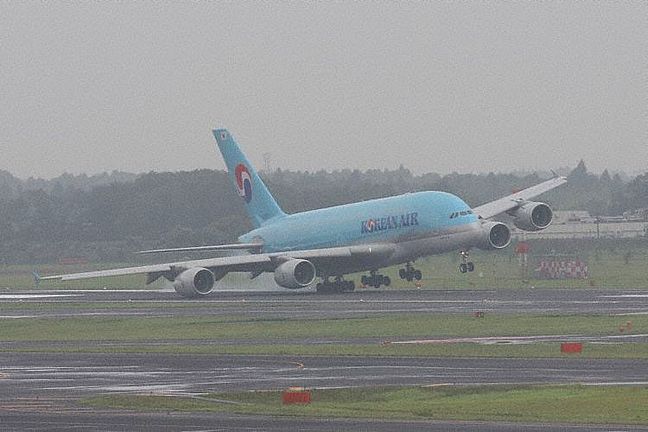
Picture from the Airliners.net forum
You can keep the jet
21 July 2011
Thailand's foreign minister appears to be going out with a
bang by waving two fingers to a German court. Remember that this is the Thai
government that has just been voted out of power at the last election.
Now K. Kasit (no stranger to airports) has ruled out paying a
multi-million dollar bank guarantee to secure the release of the Thai crown
prince's jet, which has been impounded in Germany.
The decision not to fork out the 20 million euros ($28 million) ordered by a
German court in exchange for Maha Vajiralongkorn's Boeing 737 adds a further
twist to an uncomfortable episode that has threatened ties between the
nations.
Do not be surprised if the airplane is simply marooned at
Munich; a 17 year old 737-400 has a fairly limited value. And it may be that
the royal flight sees this as an opportunity to upgrade its fleet.
"We are confident that the aircraft belongs to the crown prince. He is not
involved with this case and the documents are very solid, so there is no
need to pay the guarantee of 20 million euros," said Thai Foreign Minister
Kasit Piromya.
Yet all the registration records on the internet suggest that
the plane is owned by and maintained by the Thai air force.
On Wednesday a court in Landshut said it had received an
assurance under oath from the Thai Department of Civil Aviation's director
that the plane belonged to the prince, not the Thai state, as well as a 2007
registration certificate.
The deputy chief justice of the court, Christoph Fellner, said however that
since these documents provided only a "presumption of ownership," a bank
guarantee had to be paid.
Kasit, speaking to reporters after returning from Germany, said the court
was in possession of documents submitted by the Thai government and would
make a final ruling on ownership in August.
"The plane will be parked in the German airport until the case is resolved,"
he said.
The court said it set the guarantee to reflect the estimated value of the
plane, which the prince is said to often pilot himself.
Kasit flew to Berlin following the seizure of the aircraft, calling the
incident a "huge mistake" and meeting a senior German foreign ministry
official to press for the plane's release.
The German government had stressed that it was a matter for the courts.
Murdoch Catches a Pie—and a Break
20 July 2011
The New Yorker
Memo from Rupert Murdoch: Thank goodness for Jonnie Marbles and his fake
custard pie!
Just when it looked like the headlines from today’s extraordinary
parliamentary hearing would be about how frail and out of touch Murdoch
appeared, forward stepped Marbles, a comedian and left-wing activist, armed
with a plateful of white foam. In a perfect tabloid world, Joel Klein, the
former New York schools chancellor, who now works for Murdoch in a vaguely
defined but doubtless lucrative role, and who was sitting at his right
shoulder, would have leapt up and grappled Marbles to the ground. Alas,
Klein was as shocked and immobile as everybody else in the hearing room.
Marbles’s pie reached its target, with its hurler reportedly shouting out,
“You greedy billionaire.” It was left to Wendi Murdoch, Murdoch’s
forty-two-year-old third wife, to leap to her husband’s defense, which she
did with impressive alacrity.
“It is a far better thing that I do now than I have ever done before,”
Marbles subsequently tweeted. (Did he preload the Dickens quote, or do
British suspects under arrest now have access to Twitter?) Murdoch would
surely agree with Marbles’s sentiments. The pie-throwing attack was the
first break that he has caught in weeks. Shortly before Murdoch walked into
the hearing room, Bloomberg reported that the independent directors of News
Corporation had met to discuss removing him from his post as chief executive
and chairman. According to Bloomberg’s story, some senior executives at News
Corp. were alarmed at how poorly Murdoch performed in preparation sessions
for today’s hearing, and this prefigured the talk of staging a coup against
him. (The article has since been updated to include quotes from the hearing,
and the news that News Corp.’s stock rose 4.8 per cent this afternoon.)
If the original Bloomberg story turns out to be true, the answers Murdoch
gave before the pie-throwing incident won’t have alleviated the concerns of
his colleagues on News Corp.’s board. Many of his statements consisted of
one word, and there were long pauses between them. Overall, he displayed
very little grasp of detail.
Long renowned as the grand puppeteer who pulls the strings from afar,
Murdoch, perhaps on the advice of his lawyers, portrayed himself as the
otherwise engaged head of a big global corporation—a busy man who knew
little about what was happening at his individual London newspapers. “The
News of the World is less than one per cent of our company,” Murdoch said,
adding that he may have “lost sight” of the paper because it was “so small
in the general frame of the company.”
To the hundreds of current and former Murdoch editors who were watching
around the world, this portrait of a disengaged and hands-off proprietor
will have come as something of a shock, as will the evident decline of his
hearing and overall mental sharpness. On the BBC, Mary Ann Sieghart, the
former opinion editor of the Times of London (a Murdoch paper), said the
questioners had made Murdoch “look like a doddering old man.” Toby Harnden,
the U.S. editor of the Daily Telegraph, posted a blog post headlined “Rupert
Murdoch and the ‘know nothing’ senility defence.”
Then came Marbles. When Murdoch returned to the hearing room in his
shirtsleeves, about twenty minutes after the attack, M.P.s from both parties
expressed sympathy with him. The Conservative M.P. for Corby, Louise Mensch,
a striking blonde who prior to going into politics was a noted writer of
chick-lit, gushed to the press baron that he had shown “a lot of guts.” Even
Tom Watson, a double-chinned Labour M.P. who had earlier grilled Murdoch
mercilessly about his knowledge of the phone-hacking affair, was moved to
comment, “Mr. Murdoch, your wife has a very good left hook.” (Actually, it
was a crisp right cross that Wendi Murdoch landed on Marbles before the
police dragged him away.)
Murdoch seemed to grow in confidence and vigor. He took the opportunity to
read out a lengthy statement apologizing to the victims of phone hacking and
saying that illegal behavior had no place at News Corp. He also stated
categorically that he had no intention of resigning. “I think that, frankly,
I am the best person to clean this up.”
Earlier, it was left to James Murdoch, whose wordiness and smooth delivery
contrasted starkly with his father’s halting performance, to fill in some of
the gaps, and to annunciate News Corp.’s legal strategy going forward in
dealing with the still-mushrooming scandal. Put briefly, this consists of
blaming one of its former law firms, Harbottle & Lewis, and some of its
former executives and journalists for keeping under wraps between 2007 and
2011 information (e-mails, internal memos, etc) about rampant phone hacking
and other illegal activities at the News of the World. The position remains
that nobody at the top of the company—not the Murdochs, not Rebekah Brooks,
not Les Hinton—knew anything of this evidence until April or May of this
year, when it was discovered and turned over to the police.
This “heard nothing, knew nothing” story didn’t sound any more convincing
today than it has for the past two weeks, but it is the only one the
Murdochs have left to them. Their survival depends on it holding up.
Quick guide to the News Corp hacking scandal
19 July 2011 - Reuters
A phone-hacking scandal has rocked Rupert Murdoch's business
empire, British politicians and police, and forced News Corp to abandon a
bid to buy the whole of broadcaster BSkyB.
How did this begin?
* A reporter and a private investigator who worked for the Murdoch-owned
News of the World tabloid were convicted of phone-hacking in 2007.
* News International, Murdoch's British newspaper arm, had said the hacking
was limited to a single rogue reporter but more victims of hacking were
revealed in 2009, suggesting the practice was widespread.
Why did it suddenly blow up?
* The crisis was catapulted to a new level earlier this month when the
Guardian newspaper reported that the alleged victims included the families
of British troops killed in combat and murdered schoolgirl Milly Dowler.
* Growing public anger and advertiser pullouts prompted Murdoch to close the
paper in an attempt to contain the crisis.
* But both opposition and government politicians united in calling for News
Corp to drop its bid to buy the 61 percent of satellite broadcaster BSkyB it
does not own.
* News Corp tried to buy itself some breathing space with British regulators
but as the clamour continued, it abandoned the bid for BSkyB on July 13.
* Rebekah Brooks, News International's chief executive who was editor of the
News of the World when some of the phone-hacking occurred, resigned last
week. Brooks was arrested on Sunday over allegations of phone-hacking and
police bribery.
* Les Hinton, a former head of News International who was heading Murdoch's
Dow Jones & Company in New York, also resigned over the scandal.
* Murdoch apologised in person to Milly Dowler's family and his company took
out full-page advertisements in British newspapers saying, "We are sorry."
Who's involved?
Victims
* The victims of alleged phone-hacking, some of whom have accepted
compensation from News International, include celebrities, politicians, the
families of dead troops and people caught up in terrorist attacks and
murders.
News Corp
* Rupert Murdoch, founder and chief executive of global news and
entertainment giant News Corp, owns Britain's Sun, Times and Sunday Times
newspapers and has wielded enormous political power in the country for
decades. Murdoch flew into London on July 10 to take charge of the crisis.
He initially backed Brooks but later accepted her resignation.
* Brooks was editor of the tabloid when it was alleged some of the most
serious hacking cases took place, including Milly Dowler's voicemail. "I
hope that you all realise it is inconceivable that I knew or, worse,
sanctioned these appalling allegations," she wrote in a memo to staff.
* James Murdoch, Rupert's son and heir apparent, heads the group's Asian and
European operations. He has been criticised for failing to grasp the
enormity of the situation.
* Andy Coulson, who followed Brooks as editor of the News of the World,
resigned after the 2007 convictions and was later appointed by then
opposition leader David Cameron as his communications chief in 2007. Coulson
was arrested on July 8 on suspicion of phone-hacking and corruption, and
released on bail.
* Former News of the World journalist Sam Hoare was found dead on Monday but
police said they were not treating it as suspicious. Hoare had told the New
York Times that phone-hacking by the News of the World was more extensive
than the paper had acknowledged.
Politicians
* Prime Minister David Cameron had close links to News Corp through his
friendship with Brooks and Coulson.
(Ed - All of the political leaders have been too close to the Murdochs. Tony
Blair started this by courting their support of New Labour).
* Cameron has become vocal in his criticism of News Corp, and joined the
opposition in calling on the company to withdraw its bid for BSkyB. He has
called for an inquiry into the affair and said the cosy relationship between
British politicians and the media, including the Murdoch empire, needed to
end.
* Former Prime Minister Gordon Brown has said Murdoch's papers tried to
access his voicemail, bank details, legal file and family medical records.
News International denied wrongdoing by its papers. Like his predecessors
Tony Blair and Margaret Thatcher, Brown courted Murdoch's attentions before
and during his time in office.
Ed Miliband, leader of the opposition Labour Party, had also courted Murdoch
but has used the crisis to attack Cameron and call for changes to newspaper
regulation, boosting his political fortunes.
Police
* The scandal has raised questions about ties between reporters and police
officers, some of whom are alleged to have provided confidential telephone
numbers and other information to journalists.
* John Yates, an assistant commissioner with London's Metropolitan Police,
has been criticised for not reopening the investigation into phone-hacking
in 2009. He resigned on Monday.
* Andy Hayman, the detective in charge of an earlier phase of the
phone-hacking inquiry, was hired by Murdoch's Times newspaper as a columnist
in July 2008. He acknowledged having private dinners with people from News
International during the hacking inquiry but said there was nothing untoward
about them.
* Britain's top police chief Paul Stephenson resigned on Sunday over a
furore triggered by his hiring of former News of the World deputy editor
Neil Wallis as a consultant and for accepting 20 nights free of charge at a
luxury spa which Wallis represented.
Regulators
* Britain's media regulator Ofcom was tasked with considering whether News
Corp was a "fit and proper" owner of BSkyB.
* The Competition Commission had the option to block the takeover over
concerns about media plurality.
What happens next?
* Rupert and James Murdoch and Brooks will be grilled by parliament's
Culture, Media and Sport Committee today (19 July). Stephenson will appear
before a home affairs select committee on the same day.
* Cameron has announced the setting up of an inquiry headed by a judge to
cover all aspects of the phone-hacking scandal.
* Cameron has curtailed an already much abbreviated tour of Africa to attend
an emergency debate in parliament on Wednesday. Parliament delayed its
summer recess for the debate.
Move the Volvo golf from Bahrain
18 July 2011
Volvo Event Management appears to be about to cancel the
Volvo Champions Golf Tournament in Bahrain and relocate it to another
country.
The Tournament, scheduled to take place at the The Royal Bahrain Golf Course
in January 2012 as the European PGA season opener is to be moved,
possibly to South Africa.
The UK's Daily Express reports that European Tour officials are seeking to
move the event because of “continued sectarian violence” and because they
can “no longer be confident of hosting its Tournament of Champions in the
oil-rich Middle East kingdom.
A delegation from the European Tour has already taken a fact-finding mission
to South Africa to look at three alternative potential venues in the Western
Cape area with representatives from sponsors Volvo.
In losing this event, which will add to Bahrain’s economic woes, the world
is telling the Al Kahlif Government to seriously reform its human rights and
political policies or it will no longer be welcome on the “world stage” but
committed to the backwaters and pariah status.
The estimated value to Bahrain of the Volvo Champions Golf event is $3
million plus additional income from tourism and publicity.
Volvo Event Management president Per Ericsson told GulfWeekly: “Due to what
happened in Bahrain after our tournament, we, the European Tour and Volvo
Event Management-Golf, have not yet made up our minds for 2012, but will do
so in August at the latest. All parties will meet in a couple of weeks in
order to discuss the issue, at this time no decisions are made.”
The European Tour was set to break new ground in 2012, and also mirror the
PGA Tour, with a ‘winners’ only’ event in Bahrain to start the new season.
The Volvo Golf Champions event in Bahrain was to be the first tournament of
the 2012 Race to Dubai schedule.
While this year’s inaugural event – won by Paul Casey – played on the Colin
Montgomerie-designed Royal Golf Club course featured 126 players who between
them captured 28 victories in last year’s Race to Dubai, from next year, the
event would have been entirely for tournament winners from the 2011 Race to
Dubai programme.
Picking strawberries while hiding cars
17 July 2011 The Associated Press
"Thailand's crown prince has taken measures to prevent his Mercedes
from being impounded in Germany after his aircraft was seized at Munich
airport last week, the Bild am Sonntag weekly said on Sunday.
Maha Vajiralongkorn, heir to the throne, has 'hidden' his Mercedes SLK
sportscar in a private parking space of a luxury Munich hotel in southern
Germany where it is being watched over by 10 bodyguards, the paper said.
The 58-year-old, currently spending his time picking strawberries in the
area, has also had the car's Thai number plates removed and replaced with
diplomatic ones, the paper added, without saying where it got the
information.
Last Tuesday, German officials sealed a Boeing 737 often flown by the Thai
prince and banned it from taking off, Munich Airport said, because of a
long-running business dispute.
The move prompted a visit by Thai Foreign Minister Kasit Piromya on Friday
to Germany where he met with foreign undersecretary Cornelia Pieper to
discuss the matter, the German foreign ministry said.
Amid fears of worsening bilateral relations, the German government has said
it regrets the incident but stresses that it is powerless to act, insisting
it is a matter for the courts."
Hail strike diverts EK flight
16 July 2011
Thanks to www.avherald.com
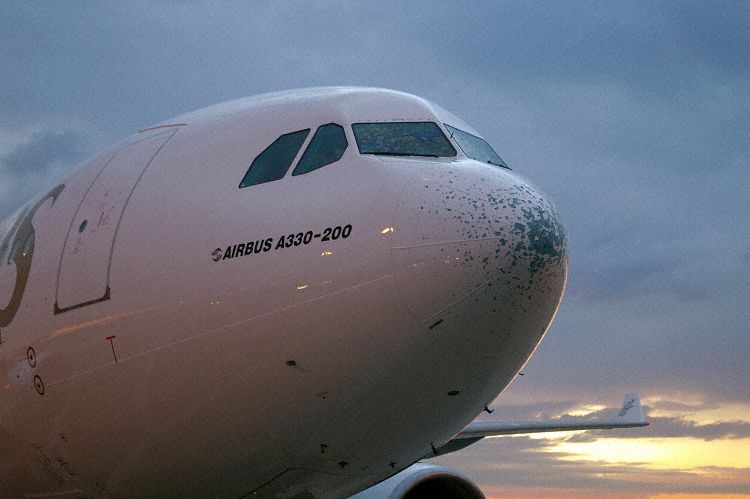
for the details on a hail strike causing the diversion of Emirates afternoon
flight to Munich two days ago.
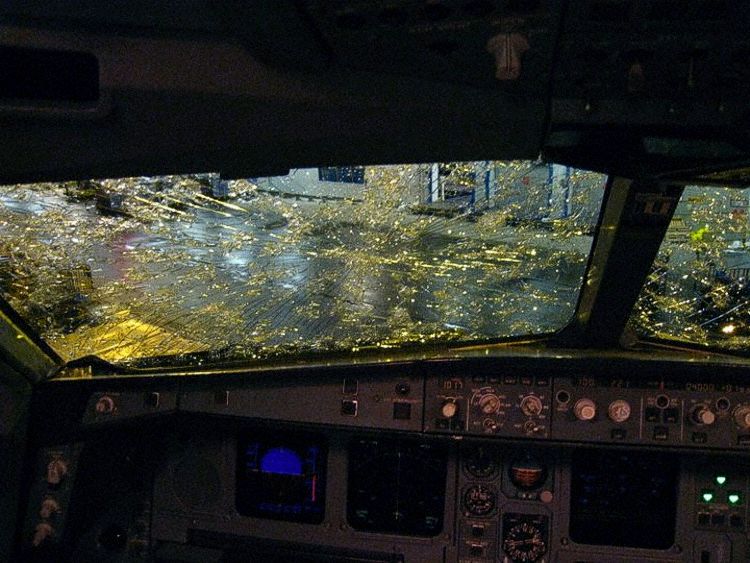
The Airbus A330-200, registration A6-EAP was performing
flight EK-51 from Dubai (United Arab Emirates) to Munich (Germany). At
34,000 feet just 30nm south of Vienna the airplane hit severe hailstorms;
the crew decided to divert to Prague after the hail caused cracked
windshields and damage to the nose cone's paint. The airplane landed safely
on Prague's runway 24 about 40 minutes after the decision to divert.
The passengers were taken to local hotels. A replacement Airbus A330-200
registration A6-EKT was dispatched from Dubai to Prague and reached Munich
with a delay of 17 hours.
How bad was it - well from avherald here are a couple of interesting
pictures:
|
 |
 |
Songs as the key of life
16 July 2011
Everyone has songs that take them back to a place in time; or
an event; or maybe even a person.
I was wandering around the supermarket earlier today and the
Tears For Fears song - Head over Heels - that was my summer song in (I
think) 1986 when I was working for Reuters out in Chicago. That was a great
summer. We worked hard. But Chicago was fun. My (very distant) cousin was
great company and I got to spend weekends watching open air Romeo and Juliet
in Geneva (the Michigan version not the Swiss version!).
Other songs:
Beatles - Hey Jude - that was always playing on our school
bus driving back and forwards to King Edward VI in Stafford.
10CC - I'm not in Love - was my study song at school.
Lisa Stansfield's Been Around the World - this was played
every morning as four of us walked to the Recreation Ground in St John's
Antigua in 1992 where England were playing the fifth test against the West
Indies.
Teresa Teng - in Chinese - the Moon represents my Heart.
Bouncing around the living room holding Alex while we were living in
Singapore.
Elgar - Nimrod Overture from Enigma Variations. My classical
choice from Hong Kong; played by the HKG Philharmonic as the British left
HKG and the governor, Chris Patten, put his head in his hands.
Am sure there are other songs that will come to mind - so I
may come back to this.
The quiet crackdown in a tourist playground
15 July 2011 The Independent
"With its glistening skyscraper-lined highways so far untouched by the angry
protesters who have filled the streets of other Arab cities, the United Arab
Emirates appears on the surface to have escaped the dissent sweeping the
Middle East. But the Emirates have not been immune to the ripples of the
Arab Spring: a vociferous minority is demanding change, only to be met with
a clandestine crackdown on dissent.
While other countries in the Gulf have expedited reforms to appease citizens
demanding more freedom, the UAE – despite having long-attempted to present
itself as a model of progress – has taken a different tack, silencing any
individuals or organisations questioning the status quo.
The surreptitious crackdown has affected all spheres – professional
associations, non-governmental organisations, think-tanks, the blogosphere
and even art exhibitions.
Five Emirati bloggers and academics who were rounded up in April are
currently on trial for "opposing the government", threatening state security
and insulting the country's leaders. The arrests have shocked the desert
nation. Dr Nasser bin Ghaith, one of the accused, is an academic at the Abu
Dhabi branch of the Sorbonne University.
Since the arrests, authorities have cast their net wider, dissolving the
boards of several non-governmental organisations such as the Jurists'
Association, a group active in the defence of human rights, and replacing
them with government appointees. The Teachers' Association has received
similar treatment. Rights groups have described the move as a "hostile
takeover of civil society".
"What we are seeing is a collapse in democratic rights," said one activist,
who, like many, now declines to have his name published for fear of
reprisals. "We have gone back 30 years. They are afraid the revolutions will
come to the UAE so they are scaring people into keeping silent."
The targeting of respected academic institutions has raised eyebrows as they
are hardly revolutionary hotbeds. Last month the Gulf Research Centre, one
of the UAE's few political think-tanks, said it was being forced to leave
the country after "objections by the Dubai government to various aspects of
GRC's work." The head of the Dubai School of Government has also resigned.
Amid an ever-growing state of paranoia, the chief of the Arab world's
biggest art show, the Sharjah Biennale, has also been sacked for not
sufficiently censoring the exhibition.
The government's attack on the country's pro-reform voices began after 133
prominent Emiratis signed a petition in March requesting the right of all
citizens to vote for members of the country's Federal National Council.
Currently a government-appointed electorate votes for half the members of
the council, which wields virtually no legislative authority, leaving power
in the hands of the al-Nayhan royal family, headed by President Sheikh
Khalifa bin Zayed.
Signatories say they have since been threatened by security officials. "They
come to us and say we will be the next in jail. They say we are trying to
destroy our country," said one.
Before his arrest, Ahmed Mansoor, one of the five activists on trial and a
prominent Dubai-based blogger who helped organise the petition, wrote a
final dramatic blog post.
Entitled "They came to take me in at 3.50am", it described the moment his
building's security guard knocked on his door to tell him three policemen
outside wanted to speak to him about a problem with his car. "They make such
tricks to and take you," Mr Mansoor wrote.
Mr Mansoor had long suspected that his blog would lead him into trouble with
the authorities. "My family have mixed feelings; they think this might bring
trouble not only for me, but for them too," he said in an interview with The
Independent before his arrest. "On several occasions they've asked me not to
talk about more sensitive topics."
There is concern that the trial, which resumes on 18 July, will result in
heavy sentences. Professor Abdulkhaleq Abdulla, a politics lecturer at UAE
University who knows several of the detainees, described the charges as
"heavy and loaded."
"We can only hope the trial will be free and fair. This doesn't fit the
image of the UAE: it has promoted itself as a country without political
prisoners," he said.
The oil-rich nation has played a careful balancing act since citizens across
the Arab world took to the streets demanding the end of dictatorships. While
outwardly trying to maintain the façade of a progressive haven for Western
business and expatriate workers, in reality it has been increasing its grip
on power.
The country's divided interests are evident in its diplomacy. Abu Dhabi's
F-16s and Mirage jets are supporting the Libyan rebels fighting against
Gaddafi's brutal regime. But the UAE remains one of the most visible
supporters of the region's other embattled leaders, with the President
sending messages of solidarity with his Syrian counterpart Bashar al-Assad,
and the Foreign Minister, Sheikh Abdullah bin Zayed, visiting in a gesture
of fraternity. He paid a similar visit to Egyptian dictator Hosni Mubarak
shortly before he was ousted.
It remains to be seen whether the recent crackdown will silence the dissent,
or help to galvanise the reform movement. For one of the petition's
signatories the latter seemed more likely. "Emiratis can't accept this
treatment: the people are angry," he said.
Then there are the reported lay-offs of hundreds of expatriates in the
public sector as the UAE leaders scramble to bring down 14 per cent
unemployment. With those expatriates who have been asked to leave said to
have been given just weeks to go, the leadership's urgency in pacifying the
country's disaffected youth is evident.
DAE - from bubble to busted
14 July 2011
From pin up boy to near nothing the fall of Dubai Aerospace
has been rapid.
Firstly chief executive Robert Genise resigned from Dubai
Aerospace Enterprise (DAE) Capital
Then the leasing company cancelled all of its outstanding
Airbus orders.
Now it has cancelled its remaining Boeing 737 orders.
Meanwhile the company faces a deadline for repayment of more than US$700
million (Dh2.57 billion) of bank loans due within the next two weeks.
DAE had made world headlines in 2006 when it was introduced
as a $15bn aircraft leasing and services company to complement Dubai's
airport development boom. Its customers include Virgin Blue, Emirates,
Easyjet and Kingfisher.
In June the leasing company cancelled all of its remaining Airbus orders
worth $5.8 billion including
11 A350s and 34 A320s.
Now Dubai Aerospace Enterprise has cancelled its remaining 35
Boeing 737s on order, eliminating its entire narrowbody backlog.
DAE has 56 unfilled orders from Boeing including 15 of its newest freighters
based on the 747-8 stretch jumbo, according to the U.S. company's website.
The latest move puts this $9 bn order in doubt.
The cancellation wipes out the lessor's 737 backlog, which originally stood
at 70, ordered in November 2007 as part of a 200 aircraft, $27.2 billion
buying spree from Boeing and Airbus. Only three of the seventy aircraft were
delivered, all in 2010 and all 737-800s.
It would be no surprise if DAE moves out of the leasing business altogether.
An analyst said that there "was no pressing need to cancel these orders,
many of which were not due for delivery until mid/late this decade. The fact
that they have done so is so they no longer have to make airplane progress
payments, they strengthen what they have in their coffers and can exit the
leasing business quietly and without fanfare."
The good news for Boeing and Airbus is that it is a strong
buyers market at present so lost orders now means greater slot availability
for other customers looking for more fuel efficient airplanes.”
There has been speculation over the whole future of DAE since Dubai’s
well-respected head of civil aviation and Emirates airline, Sheikh Ahmed bin
Saeed al Maktoum stepped down as chairman of the company last year.
It was created in 2006 as a collaboration between several Dubai names
including sovereign wealth arm Investment Corporation of Dubai, developer
Emaar and state-linked DIFC Investments. The companies were hit badly by the
world financial crisis which affected Dubai more than any other Arab state.
Khuram Maqsood, former director at a Dubai investment fund was reported by
news agency Reuters as commenting "The shareholders in DAE are government
entities and each of them own at minor stake.
More than 60 key staff in the organisation are said to have left over the
past quarter.
Chief executive Genise stepped down on June 30 after four years at the helm
l. In a statement Khalifa Al Daboos, the DAE managing director said: "We
will take this opportunity to consolidate the management of this business in
Dubai," said. "The business will report to the chief operating officer and
will be managed in a more integrated manner with the rest of DAE."
Mr Genise is leaving because he "wanted to be involved in a more
entrepreneurial venture", the statement said.
UAE's mission impossible: Cooling the desert
13th July 2011 - Reuters
Ali's air conditioning quietly cools his spacious Dubai apartment around the
clock and all year round, even when he is away on holiday.
With outside temperatures soaring toward 50 degrees in summer, he likes to
come home to his chilled oasis in this skyscraper city sprouting from the
desert.
"When I go outside I feel that a gigantic hair dryer is blowing in my face,"
the 36-year old marketing manager said.
"If I turn off the air-conditioning when I leave the house, I will spend
even more energy to cool down the house when I'm back. So I leave it."
Ali, whose name has been changed for privacy, is not unusual in this
high-rise city that has rapidly transformed from a sleepy fishing village to
an international financial center.
Many of Dubai's estimated 2 million inhabitants leave their air-conditioning
running 24/7, shrugging off tips from Dubai Electricity and Water Authority
(DEWA) for electricity and water conservation.
Dubai's non-stop running air-conditioners help drive the emirate's summer
peak demand per person to more than three times that of Spain -- where
cooling demand from its 47 million citizens has also surged over the last
decade in scorching summers on the Iberian Peninsula.
Such heavy consumption in well-to-do UAE cities like Dubai and federal
capital Abu Dhabi mean the wealthy Arab state could see another summer of
sporadic power blackouts in the northern emirates. It will also face a
ballooning gas bill for the fuel used to generate 85 percent of its
electricity with global gas prices having doubled from a year ago.
In Dubai, major landmarks such as an indoor ski slope -- where snow made at
minus 8 degrees Celsius blankets three football pitches worth of pistes --
have helped drive power consumption and climate-warming carbon emissions
skyward.
The Burj Khalifa, the world's tallest building, uses some 150 megawatts of
power, equal to about a tenth of the output of the world's biggest nuclear
reactors in a region that relies almost entirely on fossil fuels.
At its base, one of the world's largest malls houses an Olympic-sized ice
rink that helps keep some 150,000 daily visitors cool in the searing heat,
desert dust and humidity.
Dubai alone used nearly 34,000 gigawatt hours (GWh) of electricity, with 46
percent being used by the commercial sector and nearly 30 percent in
housing. The number of electricity consumers in the UAE's business and
trading hub rose nearly 10 percent in one year to over 580,000 in 2010.
The natural desire to keep cool and entertained in the Gulf's hostile
climate has helped make the United Arab Emirates one of the world's top five
power consumers per capita while emissions of climate-warming carbon from
Emiratis are more than twice those of U.S. citizens.
Dubai's power demand alone accounts for nearly half of the UAE's supplies
and its use of precious electricity could leave the northern emirates, which
receive supplies after Dubai and Abu Dhabi, in the dark.
The demand is expected to be even higher this year with the holy month of
Ramadan falling in August, prompting citizens who traditionally flock abroad
in the summer to stay home.
Residents of northern emirates such as Sharjah and Ras Al Khaimah are no
strangers to blackouts. In 2009, residents had to rent hotel rooms or drive
to relatives' homes to escape the suffocating heat after power went off for
many hours a day.
Authorities have promised a blackout-free summer 2011, for Dubai at least,
despite industry officials expecting power demand to rise at least another 5
percent this year -- and severely strain resources.
"I can assure you there will be no power shortage for the next five years,"
Saeed Mohamed al-Tayer, the chief executive of Dubai Electricity and Water
Authority (DEWA), said in late June.
But a series of mid-June power cuts in Khor Fakkan, which is based in the
neighboring emirate of Sharjah and is home to a major container terminal,
has raised fears of yet another UAE summer with long, hot hours to endure
with no power.
"There's not enough planning in the northern emirates on how they'll get the
power for their industrial development," Robin Mills, a Dubai-based energy
economist said.
"Then there's the problem of gas shortage where, especially in the northern
emirates, you have to burn oil instead of gas, which is much more
expensive," he added.
Around 80 to 85 percent of the UAE's power is generated from burning natural
gas and the rest comes from oil -- an option of last resort due to the
higher cost of crude and the loss of lucrative crude exports.
The UAE's gas reserves are plentiful but have not been developed fast enough
to meet the soaring demand for power and industrial gas feeds.
In March, the UAE pledged $1.6 billion for infrastructure in less developed
northern emirates, seen as more prone to unrest than Dubai, the business
hub, or Abu Dhabi, the federal capital.
Peak electricity demand in the UAE is estimated to rise by more than 12
percent annually between 2010-2020, according to Abu Dhabi Water and
Electricity Company (ADWEC). ADWEC officials, contacted by Reuters, were not
immediately for available for comment.
In a bid to diversify its energy sources, the country plans to build four
1,400 megawatt nuclear reactors on the coast of Abu Dhabi, with the first
expected to open in 2017.
Until then, in a region so dependant on cooling, efficient use of the scarce
power supplies should be top of the agenda for the UAE, experts say.
"Up to 70 percent of your energy is going to cooling and air con units are
running at full capacity," Dustin Cherniawski, director of GreenWave
Capital, which brings energy-saving technologies to the Middle East.
"But they have to be in excellent shape so you don't waste any
energy...."The majority of AC units we encounter would benefit from
increased frequency and quality of maintenance.."
Crown Prince's jet impounded in Germany
13 July 2011
A Thai Air Force Boeing 737 used solely by Thai Crown Prince
Maha Vajiralongkorn has been impounded by insolvency administrators in
Germany seeking payment of an old debt owed by the Thai government to a
collapsed German firm.
Described by the administrators as a "spectacular coup", the jet, was
apparently slapped with forms and stickers from the bailiffs yesterday.
Apparently the bailiffs had followed the airplane around Germany waiting for
a suitable opportunity to impound the jet.
"We have been seeking payment of more than 30 million euros ($42.9 million)
for years and this drastic measure is virtually the last resort,"
administrator Werner Schneider said.
The debt goes back more than 20 years to when German firm Dywidag helped
build a 26 kilometre-long toll road between Bangkok and Don Muang airport.
Dywidag merged in 2001 with Walter Bau AG, which later became insolvent.
The administrators said the legality of the demand had been confirmed by a
court of arbitration.
More details:
Thai govt 737 impounded at Munich over unpaid debts
Rome strains Italophile Germans
13 July 2011 - The Financial Times
The contagion in Europe’s sovereign debt markets that is spreading from
Greece to Italy could scarcely have come at a more perilous and frustrating
moment for Germany’s anxious financial controllers...namely the folks who
really run the Euro economies.
After months of strenuous efforts to contain the effects of the debt crises
in the smaller economies of the eurozone it looked as if the preferred
German version of a new Greek rescue – involving private creditors as well
as public cash – was close to agreement at the weekend.
According to those close to the negotiations, all it needed was a few calm
weeks in the markets to finalise the complex details, and all would be well.
But there is little chnace of calm at the moment. The Greeks remain in
turmoil; some form of default seems inevitable and political change likely.
Moody's have reduced Irish bonds to junk status.
But the flight of bondholders from Italian debt over the past
few days has suddenly raised the temperature – and the pressure – for
something more urgent to be done.
An Italian debt crisis has always been seen as too ghastly to contemplate.
But the combination of Rome’s huge public debt and dysfunctional political
system remains an accident waiting to happen.
Greece, Ireland and Portugal are all small economies whose plight can be
contained with the money already pledged by the eurozone partners. Spain
would be a challenge, but eventually manageable. But Italy, with a debt
burden of almost 120 per cent of gross domestic product, is in a whole
different league.
Hans Tietmeyer, stern monetarist president of the Bundesbank from 1993-99,
told the German parliament in 1998 that Italy's excessive debts must be
radically reduced, or the debt level would “very quickly” cause conflict
within the monetary union. That was over a decade ago.
Mr Tietmeyer also warned about the lack of closer political integration to
underpin the monetary union. “In the long run, monetary union cannot and
will not survive without being embedded in a broad political, common
environment,” he told the FT in 1994.
He went on: “If we create a monetary union, and this proves to be a failure,
this will be a very, very sad result for Europe. A breakdown of such a union
would be more dangerous than not to have it in the first place.”
We seem to be edging ever closer to exactly that event - a breakdown of the
euro-zone. And the currency markets seem to be edging that way as well.
Air Asia X to move to Gatwick
12 July 2011
Air Asia will switch its London operations from Stansted to
Gatwick airport starting from October 24.
The low-cost carrier launched services to London Stansted in March 2009 but
CEO Azran Osman-Rani announced that flights will be switched to Gatwick in
October due to the airport's "bigger, broader catchment area", and "the
increased opportunities for connections, including flights to the US East
Coast". Osman-Rani also said that recent increases in APD charges "had
reduced the advantages Stansted has a long-haul hub".
The carrier has been granted similar slot times to those planned for
Stansted for the winter season, and passengers with existing bookings from
Stansted after October 24 will be offered bus transfers where needed.
Easyjet says it will also transfer passengers with connecting flights onto
similar services from Gatwick.
Unlike the Stansted launch though there will be no £99 promotional one-way
fares - Osman-Rani admitted such offers were no longer possible as "the
taxes alone are in three figures". He also said that if fuel prices were to
stay at current levels, there would be no new European routes in the next
twelve months.
Air Asia currently operates the London-KL route with A340 aircraft, but will
take delivery of two A330-200s next year which will be used on the route.
These aircraft will feature an increased number of Premium Fly Flat seats
(24 as opposed to 18 on the A340s), and the carrier also plans to trial a
new wifi inflight entertainment system on the London-KL route from this
December.
Having lost several long-haul routes over the last few years, Gatwick has
announced two routes to South East Asia in as many months, with Vietnam
Airlines also due to launch a twice-weekly service from this December.
What the papers won’t say
11 July 2011 The Spectator
"The omertà of Britain’s press and politicians on phone-hacking amounts to
complicity in crime
This should have been one of the great stories of all time. It has almost
everything — royalty, police corruption, Downing Street complicity,
celebrities by the cartload, Fleet Street at its most evil and disgusting.
One day, I guess, it will be turned into a brilliant film, and there will be
a compulsive book as well.
The truth is that very few newspapers can declare themselves entirely
innocent of buying illegal information from private detectives. A 2006
report by the Information Commissioner gave a snapshot into the affairs of
one such ‘detective’, caught in so-called ‘Operation Motorman’. The
commissioner’s report found that 305 journalists had been identified ‘as
customers driving the illegal trade in confidential personal information’.
It named each newspaper group, the number of offences and the number of
guilty journalists (see above). But, as the commission observed, coverage of
this scandal ‘even in the broadsheets, at the time of publication, was
limited’. The same reticence has been seen, until now, over the
voicemail-hacking scandal.
By minimising these stories, media groups are coming dangerously close to
making a very significant statement: they are essentially part of the same
bent system as News International and complicit in its criminality. At heart
this is a story about the failure of the British system, which relies on a
series of checks and balances to prevent high-level corruption. Each one of
them has failed: parliament because MPs feel intimidated by the power of
newspapers to expose and destroy them; and opposition, because Ed Miliband
lacked the moral imagination to escape the News International mindset —
until he was forced to confront it all by the sheer horror of the Milly
Dowler episode.
That leaves the prime minister. He finally woke up to the kind of company he
has been keeping on Tuesday when during his Afghanistan visit he declared
the Milly Dowler revelations ‘truly dreadful’. David Cameron has repeatedly
displayed an inability to make a distinction between right and wrong. The
press ought to have stepped into the breach. Unfortunately, we in Fleet
Street have forgotten that the ultimate vindication of journalism is not to
intrude into, and destroy, private lives. Nor is it the dance around power,
money and social status. It is the fight for truth and decency."
Can EK salvage Qantas cockpit crew
11 July 2011
In the next month Qantas will announce a significant re-organisation
which will reduce its international flights, closing some and transfering
others to Singapore based Jetstar.
Pre-empting this Qantas has told its pilots that it will give
first officers three years leave without pay to go and fly for its fastest
growing long haul competitor, Emirates.
The notice, circulated by Qantas this week, says Emirates has approached its
Flight Operations division “requesting assistance in the supply of crew…but
at this stage only for applicants prepared to fly as first officers.”
Qantas even says it will facilitate annual leave for pilots that wish to
travel to Dubai to attend interviews or participate further in the Emirates
selection process. The number of first officer positions that Emirates is
prepared to offer successful Qantas applicants is said to be 120.
However Emirates is more broadly believed to be seeking up to 700 qualified
foreign pilots by the end of next year, and has been a regular recruiter of
talent in Australia.
With 2 planes a month to be delivered to Emirates over the
next five years the new pilots are a necessity.
Qantas is bound by provisions in its current pilot agreements that allow
pilots leave without pay to fly for a defined term for other carriers. In
general, it means that at the end of such leave, pilots can return to
Qantas, but not necessarily to the positions or type of airliner that they
were flying at the stage of their careers when they exercised their right to
unpaid leave.
The likelihood is that after August 24 Qantas international, as it is now
known and operated as an Australian airline, will be very different and much
smaller.
For Qantas first officers who see few if any chances of promotion to the
left seat a move to Emirates, whether for three years or more, that is
facilitated by both airlines, may be a workable solution.
Malaysia's discontent
9 July 2011
With the distraction of events in Thailand I have failed to
follow the weeks of rising tensions in Malaysia which boiled over today as
police fired tear gas and water cannons on demonstrators in downtown Kuala
Lumpur and arrested more than a thousand people at the country's largest
political rally in several years.
Thousands of protesters seeking reforms to Malaysia's electoral system
descended upon central Kuala Lumpur by mid-afternoon, despite stern warnings
from the government, which sealed off roads and shut down train stations to
try to keep people away. Federal police said they had detained 1,667 people.
Ambiga Sreenevasan, one of the main organizers of the rally, had been
detained but was later released.
Authorities fired their water cannons and tear gas to scatter the crowds as
they tried to mass near the city's famous Merdeka Stadium. Witnesses said
police charged on demonstrators with batons, while other protesters shouted
"Reform!" and "Long live the people!"
There were no immediate reports of serious injuries. Authorities estimated
the total number of protesters at 5,000, though supporters of the activists
said they believed the number was as high as 50,000. So somewhere in between
should be about right.
The government response appears heavy handed and will damage Malaysia's
reputation as one of Asia's more stable countries. It is a
predominantly-Muslim nation but racial tensions have been there for years as
ethnic Chinese, Indian and other residents demand reforms to boost their
standing compared with the country's powerful Malay majority.
Activists organized Saturday's rally to publicize their demands for changes
to Malaysia's electoral system, including equal media coverage for all
election candidates and stronger measures to curb fraud, including the past
practice of people voting multiple times. Although fresh elections aren't
required under Malaysian law until spring 2013, many analysts expect Prime
Minister Najib Razak – whose ruling UNMO led coalition has long dominated
the country – to call them much earlier.
Authorities arrested more than 200 activists in the days leading up to the
protest, leading to a rare intervention by Malaysia's constitutional
monarch, Tuanku Mizan Zainal Abidin, who issued a statement asking both
sides to step back from the brink of a broader conflict. The tensions
appeared to ease for a while, as protest organizers negotiated with
authorities to schedule a sanctioned rally at a site approved by the
government.
But the talks broke down by week's end, and government officials began
warning residents it would tolerate no public demonstration at all.
Malaysia's popular opposition leader, Anwar Ibrahim, has been on trial for
allegedly breaking Malaysia's strict (no) sodomy laws, which he denies. Mr.
Anwar said on Twitter Saturday that he sustained a "minor injury" at the
rally when his group was hit by tear gas.
Protesters on the scene, meanwhile, said they were heartened by the turnout
despite official efforts to keep the number of participants low.
The Arab Spring is extending to Muslim nations elsewhere are Malaysia's
heavy handed response is far less satisfactory than debate and
inclusiveness.
The coming demise of Watford
8 July 2011
Disclosure - my Dad was a Watford fan. He grew up there. I
first saw them in 1970. I watched them through the 70s and 80s until I moved
to Canada in 1988. I still follow them every week.
Watford is a nice, inoffensive club. It had family enclosures
before anyone else. The fans are real fans; not corporate box and and prawn
sandwich fans; and they do care.
But the old stadium has not seen a lick of paint this side of
the millennium celebrations. The main stand remains closed because of safety
concerns after being condemned three years ago. It’s a disgrace.
What is happening to Watford, my club, is a morality tale of our times. It
could happen to your club next.
We’ve never had much money, even when Sir Elton John was bankrolling the odd
player or two. We have none now. The new owner, Laurence Bassini, admits he
changed his name from Bazini when he was made bankrupt in 2007. His
management strategy seems to involve whistling a happy tune and assuring us
all will be well.
Graham Taylor, our very own former England manager, is hanging in there as
chairman. It’s an admirable act of self-sacrifice. He must be allowing his
heart to rule his head. There’s no other logical explanation.
Earlier this week Malky Mackay, who walked out on Watford to join Cardiff,
returned to pinch Scotland international midfield player Don Cowie.
Malky – who this time last year was quite literally working out whether
Watford could afford smoked-salmon sandwiches in the boardroom – had already
been back to take three of the backroom staff. I don’t blame him – he was
criminally underrated. He also knows there is money at Cardiff and none left
at Watford.
Sean Dyche, his former assistant, has been promoted to manager. It is the
cheapest option. He is a good coach and will attempt to build a team in his
own image; it will not be pretty. It will be survival.
Danny Graham, last season’s top scorer, has been sold to Swansea for £3.5m.
Winger Will Buckley, one of the most promising players outside the Premier
League, has been given away to Brighton for £1m. The ground share with
Saracens has been renewed for another year. The rent is useful income but
the damage to the pitch is makes it almost unplayable.
The money taken in by the club must be being used elsewhere -
not on players - the big signing so far is David Mirfin from Scunthorpe on a
free transfer.
How did the club hang on to Scott Loach - maybe they will
lose him before the season starts.
Relegation looks a racing certainty.
Climbing through the clouds
8 July 2011 - The Economist
Last month 230 international airlines gathered in Singapore for the annual
meeting of the International Air Transport Association (IATA), their trade
body. The price of oil, at more than $110 a barrel, cast a pall over
proceedings: a rise of $1 a barrel adds $1.6 billion to airlines’ costs, and
IATA expects a barrel to cost an average of $30 more this year than last.
The industry’s net profits of $18 billion in 2010, a rare good year, were
forecast to plunge to $4 billion in 2011. Yet only a fortnight later at the
Paris Air Show airlines went on a $90 billion shopping spree, ordering 730
planes from Airbus and 142 from Boeing, enough to keep production lines
humming for seven years.
Two things explain this paradox. The first is that because oil accounts for
a third of operating costs, airlines are desperate for more fuel-efficient
planes. Late last year Airbus brought out a re-engined version of its A320
single-aisle family, offering fuel savings of up to 15%. It has become the
fastest-selling new aircraft in history. More than 1,000 have been ordered,
many of them by fast-growing budget airlines. The biggest demand is in the
Asia-Pacific region: India’s IndiGo and Malaysia’s AirAsia ordered 380
between them in Paris. This illustrates the second explanation, the tilt of
aviation, like that of so many other industries, to the east. Profits in
Asia were double those in the rest of the world last year and growth rates
there are stronger than in Europe and North America.
But civil aviation is undergoing a more wrenching change than just a drift
eastward. A history of regulation and government involvement has left it
burdened by trade protection, inefficiency and excess capacity. Airlines
helped to bring about globalisation, but their own industry is far from
globalised. Instead of globe-spanning giants, the world has 230
flag-carriers and several dozen budget airlines. Even last year the
industry’s profit margins were not fat. Only those innovative low-cost
carriers make decent money.
Yet this old model is coming under pressure: consolidation of a sort is
taking place at a regional or continental level. The rapid growth of Asian
traffic is one reason for this. The rise of low-cost carriers born in
liberalised markets is another. And over the past decade airlines have been
buffeted by one external shock after another, from the terrorist attacks of
September 11th 2001 and the SARS health scare to recession in Western
economies, volcanic eruptions (last year in Iceland, this year in Chile),
the Japanese earthquake and tsunami, and the rise in oil prices.
The effect of this succession of troubles can be seen in airlines’ profits.
Airlines took six years to recover from losses of $13 billion in the annus
horribilis of 2001 and made a profit of $14.7 billion in 2007. But then the
cost of a barrel of jet fuel more than doubled, to $170, just as the
recession sent load factors down. Some airlines, such as Ryanair, the
biggest European budget carrier, have taken to parking many of their planes
in the winter rather than burning fuel in half-empty aircraft.
The sharp recovery that began last year as fuel costs eased and demand
picked up was soon snuffed out when oil prices rose again. Giovanni
Bisignani, a former boss of Alitalia and the head of IATA from 2002 until
this year, reminded colleagues in his leaving speech in Singapore that even
in 2010, “the best year of the decade”, they had “a pathetic [net profit]
margin of 3.2%”. For most of the past 40 years, he notes, margins were
merely 0.1-0.2% on average. At the best of times airlines are fragile. Even
low-cost successes such as easyJet and Ryanair make losses some of the year.
IATA claims that its members have made great strides in cutting costs,
carving out $55 billion a year. For example, persuading countries to open
air space to allow more direct routes has saved $16 billion on fuel.
Squaring up to monopoly suppliers such as airports and air-traffic-control
services has yielded a further $19 billion. A broad programme to simplify
the business by, for example, phasing out paper tickets for online bookings,
introducing bar-code boarding passes and streamlining baggage and freight
handling is worth about $18 billion. Although this sounds impressive, it
amounts to a saving of only 10%—and it took seven years.
Some efforts have gone further. For years airlines in America staggered in
and out of Chapter 11 bankruptcy, which was supposed to give them protection
from creditors until they became fit to fly profitably again. Their reliance
on this device was criticised by foreign carriers as a disguised subsidy
that maintained excess capacity and postponed overdue consolidation. Yet it
did eventually lead to reductions in cost, for example by allowing airlines
to renegotiate labour agreements with unions.
The industry’s plight also led to an easing of the antitrust scrutiny that
had attended airline mergers. Delta was cleared to take over Northwest
Airlines in October 2008. Struggling United Airlines and Continental were
allowed to merge in September 2010, after several spells in Chapter 11. The
mergers helped airlines trim their capacity and restore profits (although
rising oil prices pushed them back into loss this year). The only network
carrier in America not to go through Chapter 11, American Airlines, has
fallen on hard times, slipping from the number-one slot to number three. Its
share price has fallen by about 80% in the past five years as it has slid
into loss. Without the pain of bankruptcy to force change, it is left with
the highest labour costs and pension obligations.
European airlines have been consolidating too. Air France and KLM led the
way, merging in 2004. They created a holding company so that each airline
could keep nation-specific traffic rights under bilateral deals with
countries outside Europe and America. The liberalising “open skies” deal
between these two blocks, signed in 2007, made European mergers much easier
by allowing European and American airlines to fly from anywhere on one side
of the Atlantic to anywhere on the other.
After much dithering British Airways and Iberia got together in 2010. BA
plans to use Madrid as a second base to get around capacity limits at
Heathrow, where plans for a third runway have been blocked. Paris-Charles de
Gaulle and Frankfurt now serve more destinations directly than London’s main
airport does. Lufthansa has swallowed Swissair and Sabena, and has taken
full control of bmi British Midland. However, the European Commission has
blocked purely national mergers between Ryanair and Aer Lingus, in Ireland,
and Olympic and Aegean, in Greece.
The big limitation of the open-skies arrangement was that it left in place
the 25% limit on foreigners’ stakes in American carriers. In the European
Union non-EU investors are restricted to 49%. Limits on foreign ownership
have spurred international airline alliances, which for years have pooled
marketing and sold seats on each other’s flights, to press for the antitrust
immunity needed for deeper integration, or “virtual” merger. The pursuit of
this is justified by a (contested) theory that virtually merged airlines
offer lower fares on flights through their hubs. Separate carriers, seeking
to maximise profit on each leg of a journey, would charge more.
As a result of all this consolidation on both sides of the Atlantic,
Aviation Economics, a consultancy, says that this summer three virtually
merged groupings will carry 73% of traffic across the ocean. These are: (one
world) International Airlines Group (BA and Iberia) plus American Airlines;
(star allinace) United, including Continental, and Lufthansa and Air Canada;
and (skyteam) Air France-KLM with Delta, incorporating Northwest. Some
routes from continental airports, such as Frankfurt or Amsterdam, are
monopolised.
The failure to scrap barriers to foreign ownership has meant there are no
intercontinental mergers. Aviation has thus missed out on the sort of global
rationalisation that occurs in most other industries. Apart from the
transatlantic joint ventures, attempts at linking up between continents have
tended to be disappointing. Singapore Airlines makes no secret of its desire
to ditch its 49% stake in Virgin Atlantic, which is in turn up for sale by
Virgin Group because it can no longer compete across the Atlantic with
merged and virtually merged rivals.
Perhaps the most surprising bout of consolidation and revival, however, has
been in Latin America. Governments in the region have followed Chile’s lead
and decided to get out of the way of private airlines. The failure of
Brazil’s state-owned airline, Varig, was a turning-point. It helped the rise
of Gol, a Brazilian low-cost carrier, and TAM, which has a more traditional
network. Now TAM is planning to merge with LAN, a privatised Chilean airline
which has long set the regional standard for efficiency in its open,
liberalised home market. LAN has built partnerships with airlines in
Colombia, Costa Rica and Panama. Most of these are family-owned and are
therefore able to act quickly and boldly without the hindrance of nervous
capital markets or restrictive state shareholders. The merged company, LATAM
Airlines Group, will be one of the largest quoted airlines in the world.
The rise of another region, the Gulf, is causing acute pain to American and
European airline executives. Led by Dubai’s Emirates, Gulf airlines are
redefining long-haul travel. Emirates is often accused by envious Europeans
of growing thanks to state subsidies. It is owned by the government, but had
only a tiny capital injection to get going 25 years ago.
Since then it has expanded profitably, helped by its government’s
pro-aviation policies such as the rapid expansion of its home airport and
the provision of efficient air-traffic control. Above all, Emirates, led by
two British veterans, Maurice Flanagan and Tim Clark, twigged that in the
age of aircraft capable of flying 18 hours non-stop, Dubai was the ideal
spot for a new kind of hub. Planes such as Boeing 777s (of which it is the
biggest buyer) and Airbus A380s (ditto: 15 are already flying and 90 are on
order) can fly anywhere in the world from Dubai. It is free of air-traffic
congestion, has no ban on night flights and has plenty of runway space.
Emirates’ remarkable success is one reason why air-travel growth is fastest
in the Middle East.
Dubai is handily placed to connect nearby emerging markets, such as India
and Pakistan, with the rest of the world: as people there become better off,
they want to travel more. But it has built links to Europe too. While
Europe’s flag carriers concentrated on their hubs, Emirates sought secondary
markets such as Manchester, Glasgow, Hamburg and Dusseldorf. Messrs Flanagan
and Clark saw that passengers would happily fly from such cities to Cape
Town, say, via Dubai, stopping briefly or even overnight, if transit was
pleasant and the fare was cheap.
When Emirates was setting up these routes, European governments saw no
threat from this upstart Arabian airline and were happy to grant it traffic
rights in liberal bilateral treaties. Now they are stuck with them and can
do nothing to fight the competition, since Dubai is, in essence, a tax-free
zone with access to cheap labour from the Indian subcontinent. Emirates
reported a 52% rise in profits this May; the year before they increased
fivefold. Because its routes are exclusively long-haul, Emirates has planes
flying 18 hours a day, making them remarkably productive.
Dubai already has the world’s third-busiest international airport, with
traffic growing at 20% a year. On July 6th it said it would spend $7.8
billion on expanding it. Yet a huge new one, costing $35 billion, is being
built and is already open for cargo. In about ten years, with its five
runways and capacity to handle 160m passengers a year, it will be the
largest airport in the world.
Emirates will also have the biggest fleet of the biggest airliners. Some
observers believe that Emirates is a pioneer of low-cost long-haul travel,
capable of keeping economy fares below competitors’ if it has to. By
deploying so many large, economical aircraft from a vast base, open around
the clock and halfway between Europe and Asia, Emirates could in effect run
a global hub, reducing European airports to a feeder role and impoverishing
their associated flag carriers. No wonder airlines such as Lufthansa keep
sniping at Dubai and its alleged “subsidies”. And no wonder aviation
accounts for 28% of Dubai’s GDP.
For the first half-century of its emergence after the second world war,
civil aviation was dominated by the huge American market, where distance
favoured air travel for domestic journeys. Internationally, other countries
were afraid of the dominance of the two biggest American carriers, TWA and
Pan American. For their part, Americans were afraid of hostile European
planes flying over their homeland, perhaps to drop bombs rather than
passengers. That mutual lack of trust gave rise to the Chicago Convention on
air travel in 1944 and then to restrictive bilateral air-traffic deals,
exemplified by the so-called Bermuda agreement covering transatlantic
flights. IATA was formed to run this regulated aviation commerce, acting as
a clearing house for payments between airlines and drawing up rules for
everything from the size of sandwiches to the price of headphones for
in-flight films.
Those days are on the way out. Mr Bisignani, the retiring boss of IATA,
reckons that China will lead the way now. The Asia-Pacific region already
accounts for 40% of the air-cargo market and 26% of passenger travel, making
it bigger than America. By 2014 the region is forecast to have 30% of the
world air-travel market, adding 210m passengers from China alone. China has
built 45 new airports in the past five years and plans another 52 by 2020.
India is waking up to aviation after a long sleep. It has fast-growing
low-cost airlines and plans to make Delhi a regional hub.
The capital markets seem to have spotted this reshaping of world aviation.
Emirates is still locked away in the ownership of the Al Maktoum family,
which runs Dubai (although Dubai’s financial troubles in 2008 at one point
seemed likely to force a flotation to repay debts). But three of the world’s
leading airlines by market capitalisation are from East or South-East Asia:
Air China, Singapore Airlines and China Southern Airlines. With LATAM on the
way, the top five will contain only one European airline, Lufthansa, and not
a single American carrier, even though American airlines still fly most
passengers.
Asia is also proving an unlikely champion of free trade, with little
enthusiasm for clinging to outdated, traffic-limiting bilateral deals.
ASEAN, the Association of South-East Asian Nations, is working on
establishing a single aviation market with no traffic restrictions by 2015.
“China will break Bermuda and the old IATA system,” says Mr Bisignani. Thus
a new economic power that joined the World Trade Organisation only in 2001,
whose trade policies are frequently criticised by members of longer
standing, is likely to play a leading role in tearing down the restrictions
of the most regulated of global industries.
When the dust clears from the sensational order boom (at least for Airbus)
in Paris, perhaps reality will crowd in. Past experience suggests that, to
paraphrase St Matthew, many are ordered but fewer are delivered. But that
seems unlikely this time, given the need for more fuel-efficient planes and
the fact that the orders are coming largely from the undersupplied and
booming Asia-Pacific region. And there are other sources of demand.
Emirates is already muttering about more orders at the next big air show, in
November on its home turf in Dubai. Whereas in Paris carriers splurged on
single-aisle planes, the rise of long-haul budget carriers could boost sales
of wide-bodied craft in the next few years. Tony Fernandes, boss of AirAsia,
wants Airbus to put new engines and improvements on the A330, which is used
by his company’s long-haul budget airline, AirAsia X. And European carriers
such as Air France-KLM and Americans such as American Airlines urgently need
to replace ageing wide-bodied planes with more efficient modern ones.
The shifts in global aviation may affect builders of aircraft as well as
buyers. Boeing and Airbus could lose their tight grip. Embraer in Brazil and
Bombardier in Canada are moving up from smaller regional jets to big ones;
and Russia’s Irkut and China’s Comac are entering the international market
for single-aisle airliners. Ryanair has signed a co-operation deal with the
Chinese company, with a view to using it as an alternative to Boeing, its
sole supplier. As aviation goes properly global, so might the aircraft
industry. Wherever you look, newcomers are muscling in on what was once a
Western domain.
The revenge of the Dems
8 June 2011
Here we go again - Every true democracy accepts the outcome
of it's elections. There are winners and losers; why do the Thais not
understand this.
Thailand's outgoing ruling party has launched legal action
seeking to dissolve the party of former premier Thaksin Shinawatra,
following its election loss.
The Democrat Party asked the Election Commission to recommend the rival Puea
Thai Party, the poll winner, be abolished on the grounds that banned
politicians were involved in its campaign, the head of the Democrats' legal
team told AFP.
The legal process is expected to take several months at least to be
completed and is not expected to prevent Thaksin's youngest sister Yingluck
Shinawatra from becoming Thailand's first female prime minister.
"We asked EC to recommend to the Constitutional Court to dissolve Puea
Thai," Wiratana Kalayasiri, head of the Democrats' legal team, told AFP.
"The accusation is that Puea Thai allowed people subject to five-year
political bans to become involved in policy planning, phone-ins and video
addresses and also the selection of candidates," he said.
Bizarre really - since the Democrat government was a
coalition in Parliament with Newin Chidchob's BJP party. Chidchob is himself
under a 5 year political ban.
Two Thaksin parties have been dissolved in the past and their top
executives, including the controversial former leader, were banned from
politics. The Democrats came to power in 2008 after the forerunner to Puea
Thai was dissolved for electoral fraud.
In addition the Election Commission has launched the
investigation into a complaint that in a campaign demonstration in Nakhon
Ratchasima, Yingluck cooked and handed out a local noodle dish, known as Mee
Korat. Under the campaign rules, the hand-out of food or material gift is
classified as vote-buying.
The lowest low
8 June 2011 - The Economist explains the phone hacking
scandal and the fall-out
Until this week, the victims in the scandal over the illegal
hacking of mobile-phone messages by the News of the World seemed mostly to
be celebrities, royals and others too privileged to command much sympathy.
For the tabloid, that was a useful mitigation in the court of public
opinion, if not in law. No longer. The sordid antics of Britain’s
biggest-selling Sunday paper—owned by News International, Rupert Murdoch’s
British newspaper outfit—look more promiscuous and more gravely criminal.
And the circle of blame and taint is widening.
The big difference is Milly Dowler, a 13-year-old schoolgirl who was
murdered in Surrey in March 2002. On July 4th the Guardian reported
allegations that Glenn Mulcaire, a private investigator working with News of
the World journalists, hacked into Dowler’s voice-mail in the days after her
disappearance, removing some messages to free up space when her account
became full. The effect was to make her family think she might still be
alive. The relatives of people killed in the terrorist attacks in London of
July 2005, and of soldiers killed in Iraq and Afghanistan, might also have
been targeted. Ditto the families of two girls murdered in Cambridgeshire in
2002: in a bizarre cameo in what is an increasingly baroque saga, the actor
Hugh Grant made that link in April, in a covertly recorded interview with a
former journalist. Tom Watson, a Labour MP, made an even more serious charge
in Parliament on July 6th: that News International paid people to interfere
in a murder case “on behalf of known criminals”. The firm says it doesn’t
understand that accusation.
Mr Mulcaire was jailed in 2007 for hacking voice-mail messages of members of
the royal household, along with Clive Goodman, the News of the World’s royal
correspondent. At the time, and for a long time afterwards, executives at
News International insisted that Mr Goodman was a lone, rogue operator. In
the past few months that defence has collapsed, amid a deluge of civil cases
brought by the lengthening list of hacking victims, pay-offs, and the arrest
of more journalists. Yet the Dowler development has supercharged the
scandal—not just because of its callous immorality but also because it
potentially involves perversion of the course of justice, a new level of
criminality.
If much of this is true, there were no qualms, and few limits, in the way
the paper went after scoops. There might be serious legal and commercial
consequences for News International. But others have been discredited,
too—not least the police.
On July 5th News International acknowledged that, last month, it gave the
Metropolitan Police a set of e-mails documenting (illegal) payments to
police officers from News of the World journalists in 2003 and after. That
is only the latest aspersion cast on various police forces by this affair.
The police in Surrey seem to have known about the Dowler hacking but
overlooked it. Worse, the Met itself stands accused of failing for several
years to notify potential victims of hacking and failing to pursue leads:
the evidence for many recent allegations comes from notes seized from Mr
Mulcaire in 2006. The Met launched a fresh probe, under new command, in
January. But its contacting of targets remains mystifyingly lacklustre.
Whether intentionally or otherwise (News International says it wasn’t), the
news about police payments deflected attention onto Andy Coulson, the News
of the World’s editor from 2003 to 2007—and thus, indirectly onto David
Cameron. Mr Coulson resigned from the paper in 2007 after Mr Goodman and Mr
Mulcaire were convicted, though he insisted that he knew nothing of their
nefarious methods. He resigned again, this time from his job as Mr Cameron’s
communications chief, in January this year, as the hacking scandal
escalated. Mr Cameron’s judgment in hiring Mr Coulson after his tabloid
escapades now looks ropier than ever (see Bagehot).
As it happens, Mr Coulson’s predecessor as editor, and News International’s
current chief executive, Rebekah Brooks (above, with Mr Murdoch), is a close
friend of Mr Cameron, too. Mrs Brooks was in the editor’s chair in 2002; if
the latest hacking allegations stand up, her position looks at least as
compromised as Mr Coulson’s was in 2007. But, so far, she has rebuffed calls
for her resignation, declaring herself “shocked” at the latest charges and
promising to “vigorously pursue the truth”. Critics wonder whether Mrs
Brooks, who has in the past been insouciantly unco-operative with
parliamentary inquiries into phone-hacking, or indeed anyone else at News
International, with its history of collective obfuscation, is well-placed to
do that.
For the moment, at least, Mrs Brooks appears to be protected by what
insiders describe as an intense, almost familial bond with Mr Murdoch, who
is said to prize her business acumen and contacts: Mr Murdoch this week
called the recent allegations “deplorable”, but stood by her. Events might
yet test just how much their bond is worth. Public anger has already
persuaded several advertisers to suspend their dealings with the News of the
World; some readers may choose to boycott it.
Still, Claire Enders, a media analyst, thinks the commercial impact is
likely to be modest, given the paper’s dominance in the Sunday newspaper
market. Much worse, for Mr Murdoch, is the slim chance that the scandal
might affect his bid to buy the rest of BSkyB, a hugely profitable satellite
broadcaster in which News Corporation, his parent company, already has a 39%
stake. Jeremy Hunt, the culture secretary, looked set finally to approve the
deal after a consultation on its impact on media plurality ends on July 8th.
Meanwhile Ofcom, the broadcasting regulator, is obliged to consider whether
the holders of broadcasting licences are “fit and proper”. It is “closely
monitoring the situation”.
And it isn’t only the Murdoch press that is set to feel the backlash.
Whereas in America journalism is a respectable, even venerated profession,
in Britain it has always been regarded as grubby. But it has rarely been so
reviled as now. Ed Miliband, the leader of the Labour Party, wants a public
inquiry into the culture and regulation of the press; Mr Cameron agrees that
there ought to be one or more inquiries, after criminal proceedings are
over. One result might be a change to the current model of newspaper
self-regulation; the Press Complaints Commission, the toothless body
responsible for it, has handled the hacking affair woefully.
Most MPs were in the past much more diplomatic about the press, especially
the Murdoch stable, which, so exaggerated legend had it, could decide the
fate of governments. But the calculus for politicians has suddenly shifted.
Mr Miliband’s tough stance towards News International—he joined the clamour
for Mrs Brooks’s resignation—would have been unthinkable in the Blair years.
Mr Cameron shied away from calling for his friend’s head too, but described
the allegations as “truly dreadful”. And there may be more to come in this
mad, metastasising story.
Murdoch stuns critics, shuts down scandal-hit paper
7 July 2011Reuters
In a breathtaking response to a scandal engulfing his media
empire, Rupert Murdoch moved on Thursday to close down the News of the
World, Britain's biggest selling Sunday newspaper.
As allegations multiplied that its journalists hacked the voicemails of
thousands of people, from child murder victims to the families of Britain's
war dead, the tabloid had hemorrhaged advertising, alienated millions of
readers and posed a growing threat to Murdoch's hopes of buying broadcaster
BSkyB.
Yet no one, least of all the 168-year-old paper's 200 staff, was prepared
for the drama of a single sentence that will surely go down as one of the
most startling turns in the 80-year-old Australian-born press baron's long
and controversial career.
"News International today announces that this Sunday, 10 July 2011, will be
the last issue of the News of the World," read the preamble to a statement
from Murdoch's son James, who chairs the British newspaper arm of News Corp.
It seemed a bold gamble, sacrificing a historic title that is suffering from
the long-term decline of print newspapers to stave off a threat to plans to
expand in television -- "Talk about a nuclear option," said a "gobsmacked"
Steven Barnett, professor of communications at Westminster University.
But some analysts said Murdoch would still face pressure to remove his close
confidante and top British newspaper executive Rebekah Brooks, a friend of
Prime Minister David Cameron. Her editorship of the News of the World a
decade ago is at the heart of some of the gravest accusations.
Praising a fine muck-raking tradition at the paper, which his father bought
in 1969, James Murdoch wrote in a statement to stunned staff that the
explosion of a long-running scandal over phone hacking by journalists had
made the paper unviable:
"The good things the News of the World does ... have been sullied by
behavior that was wrong. Indeed, if recent allegations are true, it was
inhuman and has no place in our company. The News of the World is in the
business of holding others to account. But it failed when it came to
itself."
It was unclear whether the company would produce a replacement title for the
lucrative Sunday market, in which, despite difficult times for newspaper
circulations, the News of the World is still selling 2.6 million copies a
week.
One option, analysts said, might be for its daily sister paper the Sun to
extend its coverage to a seventh day.
Stephen Adams, a fund manager at Aegon asset management, which is one of the
biggest shareholders in BSkyB, told Reuters:
"We see it as something to restore or remedy a tarnished reputation for the
News Corp group. But we also critically see it as a reflection of News
Corp's desire to progress the BSkyB bid and have full ownership of the
company."
Cameron's government had already given an informal blessing to the takeover,
despite criticism on the left that it gave Murdoch too much media power. But
the storm of outrage at the News of the World had turned attention on
Cameron's own links to the paper -- he made another former editor his
spokesman -- and so had fostered concerns among investors that there could
be snags in securing final approval for the $14-billion bid.
In his statement, James Murdoch said: "This Sunday will be the last issue of
the News of the World.
"In addition, I have decided that all of the News of the World's revenue
this weekend will go to good causes ... We will run no commercial
advertisements this weekend."
Journalists said that an emotional editor Colin Myler had read out the
announcement at the east London newsroom where Murdoch changed the face of
British journalism in the 1980s by breaking the power of the printing
unions.
Myler, journalists said, had asked Brooks to leave the room, adding that
many were angry that some 200 people were losing jobs in what they saw as a
move to shield the former editor.
James Murdoch made clear Brooks remained in place as chief executive,
telling Sky News he was satisfied that Brooks knew nothing of the crimes
allegedly committed when he was editor.
One employee of the doomed paper told Reuters: "We didn't expect it at all.
We had no indication. The last week has been tough. None of us have done
anything wrong. We thought we were going to weather the storm."
One source at News International said the decision had been taken and acted
upon with little delay.
The journalists' trade union said it was Brooks, not they, who should be
fired: "It is the people at the top who need to be punished, not ordinary
working journalists," the union said.
The leader of the opposition Labor party Ed Miliband also said Brooks should
go. "What I'm interested in is not closing down newspapers, I'm interested
in those who were responsible being brought to justice and those who have
responsibility for the running of that newspaper taking their responsibility
and I don't think those two things have happened today."
Ian Hargreaves of the Cardiff School of Journalism called closing the paper
"an astonishing and unprecedented act": "It is appropriate to the moral
horror that the owners of the newspaper faced but...killing the paper does
not kill the story."
Tom Watson, a Labour member of parliament who had campaigned for a reckoning
from the paper over the phone hacking scandal, said: "This is a victory for
decent people up and down the land.
"I say good riddance to the News of the World."
The scandal had deepened on Thursday with claims News of the World hacked
the phones of relatives of British soldiers killed in action in Iraq and
Afghanistan. Britain's military veterans' association broke off a joint
lobbying campaign with the paper and said it might join major brands in
pulling its advertising.
The British Legion said it could not campaign with the News of the World on
behalf of the families of soldiers "while it stands accused of preying on
these same families in the lowest depths of their misery."
Signaling how far the racy, flag-waving title has alienated a core
readership already horrified by suggestions its reporters accessed the
voicemails not only of celebrities and politicians, but also of missing
children and crime victims, an online boycott petition garnered hundreds of
thousands of signatures.
News Corp wants to buy out the 61 percent of BSkyB it does not already own.
The government has said the News of the World case should not affect that.
But U.S. shares in News Corp fell over 5 percent on Wednesday, though they
recovered somewhat in a stronger general market on Thursday.
Formal approval for the deal had been expected within weeks after the
government gave its blessing in principle. But it now seems unlikely for
months, although officials denied suggestions that they were delaying a
decision because of the scandal.
"The Secretary of State has always been clear that he will take as long as
is needed to reach a decision. There is no 'delay' since there has been no
set timetable for a further announcement," a government spokesman said. Some
British media reported that a decision was now expected in September.
The main accusations are that journalists, or their hired investigators,
took advantage of often limited security on mobile phone voicemail boxes to
listen in to messages left for celebrities, politicians or people involved
in major stories.
Disclosure that the practice involved victims of crime came when police said
a private detective working for the News of the World in 2002 hacked into
messages left on the phone of murdered schoolgirl Milly Dowler while police
were still looking for her.
Police have also been criticized over allegations officers took money from
the News of the World for information. London's Evening Standard newspaper
said on Thursday that police officers took more than 100,000 pounds
($160,000) in payments from senior journalists and executives at the paper.
Analysts believe the global Murdoch empire, which includes Fox television
and the Wall Street Journal, can weather a storm of reproach from
advertisers, readers and politicians in Britain -- though there were signs
of international ramifications.
In Murdoch's native Australia, the leader of the Greens party said he wants
the government to examine the ramifications on Australia of the phone
hacking scandal.
The News of the World is gone (for now)
7 July 2011
News International announced today that it is closing
the News of the World
after this Sunday's edition, with no end in sight to the political and
commercial fallout from the phone-hacking scandal after 72 hours of mounting
crisis.
Sunday's edition of the paper will be the last, News International chairman
James Murdoch told shocked News of the World staff on Thursday afternoon.
Murdoch told employees at the 168-year-old title: "The News of the World is
in the business of holding others to account. But it failed to when it came
to itself".
Murdoch said in a statement: "Wrongdoers turned a good newsroom bad and this
was not fully understood or adequately pursued."
Murdoch also conceded the company had "made statements to parliament without
being in full possession of the facts. This was wrong".
He said "the News of the World and News International wrongly maintained
that these issues were confined to one reporter" and that the company had
passed information to the police which would demonstrate this. "Those who
acted wrongly will have to face the consequences," he said.
Murdoch also said in his statement to staff that he had authorised
out-of-court payments to victims of hacking: "I now know that I did not have
a complete picture when I did so."
He added: "That was wrong and is a matter of serious regret."
The News of the World was Rupert Murdoch's first UK newspaper acquisition in
1968. The title remains the UK's biggest-selling paper, with a circulation
of 2.66m in May this year. However, in 1962, when the Audit Bureau of
Circulations began publishing regular newspaper sales figures, the News of
the World was selling 6.66m.
A spokesman for the company would not comment on whether News International
will continue to publish a tabloid title on a Sunday. Inevitably, there are
already industry rumours that the News of the World's stablemate the Sun
could be turned into a seven-day operation. News International has already
announced plans to move to seven-day working across its four titles – the
Sun, News of the World, the Times and Sunday Times – and the internet domain
name thesunonsunday.co.uk was registered two days ago, although the
purchaser's identity is unclear.
The closure of the paper is a dramatic and potentially very cynical move to
head off public anger at shocking revelations about the behaviour of its
journalists, but it is unlikely that NI's printing presses will be left idle
on a Sunday.
The NOTW was facing
a revolt by advertisers that had gathered pace in the past 24 hours as Prime
Minister David Cameron announced public inquiries into phone hacking and
criticism of the paper's activities mounted from politicians and the general
public.
Most NoW advertisers, including Sainsbury's, Asda, Dixons, Boots, Specsavers,
Ford, Halifax, Co-op and Npower had already pulled their campaigns. It is
understood News International only had four left – BSkyB, British Gas, Mars
and Tesco.
The number of alleged phone-hacking incidents perpetrated by the paper in
years gone by had also continued to grow, with the latest (and this is
outrageous) involving families of members of the armed forces killed in Iraq
and Afghanistan. More details were also emerging about alleged payments by
News of the World journalists to Metropolitan police officers.
The decision to close the paper is understood to have come following a
meeting on Thursday between executives including James Murdoch, who is also
the deputy chief operating officer of NI-owner News Corp and oversees the UK
business, Brooks, and the publisher's commercial managing director, Paul
Hayes.
The
Guardian newspaper has pursued these allegations for two years and editor
Alan Rusbridger has issued the following statement in reaction to the News
of the World closure.
"James Murdoch's statement describes the crisis at the News of the World as
eloquently as anything that has been written in the Guardian. He admits - as
we have been reporting for two years - that the paper has been "sullied by
by behaviour that was wrong...and inhuman." He concedes - as we reported -
that the paper has misled parliament and that he was wrong personally to
make the out of court settlements which the Guardian revealed in July 2009.
Mr Murdoch blames "wrongdoers" who "turned a good newsroom bad." He does not
say who these wrongdoers were - and that is the crucial question people will
be asking, including those who are paying with their jobs and who are angry
about the loss of a 168-year old newspaper title.
There are numerous outstanding unanswered questions - over the behaviour of
the police and the complete failure of the current News International
management to uncover what had gone on inside the company."
Sadly the
NOTW closure looks more like a cynical commercial decision
that will put innocent people out of work. The closure should not stop the
investigation into the actions of News International staff and the
Metropolitan police. Expect more arrests.
Rebekah Brroks still has a job. Bizarre.
If News Corp think that this will be the end of the scandal
they are sadly mistaken.
China's unnecessary secrecy
7 July 2011
Chinese state media denied rumours today that former
president Jiang Zemin despite a Hong Kong television station saying he was
dead and sparking a wave of speculation about a leadership transition due
next year.
But the rumours are rife online in China despite government
denials. And frankly there is no reason not to be honest. Jiang is 84 years
old, in poor health and has been out of Chinese politics for 10 years. Yet
"recent reports of some overseas media organizations about Jiang Zemin's
death from illness are pure rumor," the official Xinhua news agency quoted
"authoritative sources" as saying.
Reuters reports that Jiang is in intensive care in Beijing at the No. 301
military hospital after suffering a heart attack.
In the opaque world of Chinese politics, the health of a leader is fodder
for rumors about how the balance of power is shifting at the highest levels
of the government.
Current President Hu Jintao retires from office from late next year in a
sweeping leadership overhaul, and the rumors about Jiang's health underscore
the uncertainties around this.
Hong Kong's Asia Television interrupted its main newscast on Wednesday
evening to announce solemnly that Jiang had died, and followed with a brief
profile. It kept up the news for several hours on a ticker and then said it
would air a special report on Jiang's life late in the evening.
It later canceled the report, and withdrew the ticker after failing to get
official confirmation.
On Thursday afternoon, the television station issued a statement to
apologize to its audience and Jiang's family. Bizarre. "Asia Television has
taken note of this afternoon's report from Xinhua and has withdrawn last
night's report about Mr. Jiang Zemin's death and would like to apologize to
our audience and Mr. Jiang Zemin's family," the statement said.
Meanwhile, the Shandong News website (www.sdnews.com.cn) in northeast China
posted a black banner with white characters, saying "Our Respectable Comrade
Jiang Zemin Is Immortal." The site was no longer accessible on Thursday.
China's foreign ministry spokesman Hong Lei deflected numerous questions
about Jiang at a regular news briefing, saying Xinhua had already made a
full explanation and that he had nothing further to add.
Searches on a popular Chinese micro-blogging site with terms ranging from "Jiang
Zemin" to the Yangtze River (Jiang's surname means "river"), are blocked, a
sign that China's censors are concerned about public debate about his
health.
Jiang Zemin's passing -- on the surface at least -- would likely have
limited impact on the direction of China's politics and economic
development.
He retired long ago, handing over the Communist Party's top job to Hu in
2002 and his other posts over the next two years. Hu and Premier Wen Jiabao
have since led the country on a decade-long charge that saw it grow from an
economy the size of Britain to one that has surpassed Japan.
But the prospect of Jiang's passing would add a breeze of uncertainty to a
transition that is widely thought to hand power from Hu to a new generation
led by Xi Jinping, currently vice president. That would take place at the
18th Communist Party Congress expected sometime in the autumn of 2012.
Xi, anointed as Hu's heir apparent at the congress in 2007, was considered
acceptable to both the Hu and Jiang camps.
But in China, the death of a senior leader can be cause for worry, and even
spell disaster, for proteges and allies who are no longer protected.
The Nation's nonsense
7 July 2011
The Nation newspaper does write some crap. Genuine,
scurrilous, baseless, evidence-less, mischievous, mud slinging crap.
Try this example:
"Northeast MPs to fly to Dubai demanding Cabinet seats
By The Nation
A group of incoming Pheu Thai MPs from the Northeast will fly to Dubai
because they want to pay a visit to ousted prime minister Thaksin Shinawatra,
incoming MP Sakda Kongpet from Roi Et said on Thursday denying speculation
about demand for ministerial job.
Sakda said his Roi Et colleague Niran Namuangrak had falsely accused him of
lobbying for Cabinet quotas for northeastern MPs.
"The allocation of Cabinet seats will be done by Pheu Thai executive board,"
he said.
All constituents would want their MPs to sit on the Cabient but the final
decision rests with the party, he added."
Read the headline - and then read the story. They say completely opposite
things. But that is typical of the post election nation. They throw as much
mud as possible in the hope that some of its sticks.
Thailand: A divisive dynasty
7 July 2011 - The Financial Times
As the scale of the opposition victory in Thailand’s general election became
clear last Sunday, Thamolwan Jamjaeng, a street vendor, joined thousands of
others waiting outside party headquarters to catch a glimpse of Yingluck
Shinawatra, the prime minister-elect.
Dressed in a red shirt, a statement of allegiance in Thailand’s colour-coded
politics, her voice almost drowned out as the crowd bellowed every time
another win flashed up on the television monitors, Ms Thamolwan vented her
euphoria. “Puea Thai will be able to solve all our problems,” she said. “We
want democracy and a peaceful country.”
Those expectations could be a problem for Ms Yingluck, the 44-year-old
businesswoman about to become the country’s first female prime minister. She
finds herself trapped between the extraordinary hopes of ordinary people
such as Ms Thamolwan and a hostile elite that backed the outgoing Democrat
party in the election and still controls the army, the bureaucracy and much
of the economy.
Many argue that the demands of the two sides are irreconcilable; and that,
far from heading into a new dawn of democratic agreement and economic
progress, Thailand is heading into yet another round of confrontation and
political paralysis. “It would be too optimistic to say ‘the people have
voted and that will be respected’, because that hasn’t happened in the
past,” says Supavud Saichua, managing director of Phatra Securities in
Bangkok.
With its positioning between the regional powerhouses of China and India and
its developed infrastructure, Thailand has the potential to become a focal
point for, and beneficiary of, south-east Asia’s increasing integration as
the Association of South East Asian Nations moves towards enacting a free
trade area in 2015.
The country has endured more than five years of turmoil, which has created a
political chasm the election has done little to bridge. “Has anything
changed? It is the same group of people on both sides doing the same things.
Nothing has changed,” Mr Supavud says.
But in the past few years it has lost investments in industries such as
automobiles and aeronautics to competitors like Indonesia and Vietnam, which
offer a political stability despite their other drawbacks.
At the heart of Thailand’s trouble – perpetrator or victim, depending on
which side of the divide the speaker stands – is Thaksin Shinawatra, Ms
Yingluck’s elder brother and himself a former prime minister. First elected
in 2001, he is the only other Thai leader to have won an absolute majority.
Styling himself the “CEO prime minister”, the telecommunications billionaire
and former police colonel and earned the lasting loyalty of millions of poor
Thais with policies such as cheap healthcare and village loans.
However, his increasingly autocratic style and the corruption of his
administration alienated the establishment and the middle classes to such a
degree that he was removed in a military coup in 2006. He now lives in Dubai
to avoid a two-year sentence for breaching laws on conflict of interest, a
charge he says was politically motivated.
When the army stepped down in 2007, Mr Thaksin’s supporters won the
subsequent election, but their administration was hamstrung by a series of
controversial court decisions. One prime minister was removed from office
after being found guilty of conflict of interest for being paid to appear on
a cooking show. Rolling demonstrations by hardline conservatives, known as
yellow shirts after their trademark attire, culminated in the takeover of
Bangkok’s two main airports.
It is Mr Thaksin’s enduring popularity that launched Ms Yingluck on her
trajectory to high office, but the enduring and undimmed enmity he inspires
among the elite is likely to prove her biggest handicap. The most obvious
potential flashpoint is Mr Thaksin’s return, which would create deep
unhappiness in the establishment. Although Ms Yingluck was careful not to
promise to bring him back, she has mooted an amnesty for political crimes,
which supporters read as a pledge that a return would be possible.
Chris Baker, co-author of a biography of Mr Thaksin, says any move to open
the way for his return would be the signal for a resumption of political
hostilities, starting with the sort of demonstrations that brought down the
2007-08 pro-Thaksin government. “I think they will do everything they can to
prevent Thaksin’s return by putting yellow shirts back out on the streets as
soon as there is a mention of an amnesty,” says Mr Baker.
Mr Thaksin himself says, unconvincingly for some, that he is prepared to
hold off to avoid creating conflict. “If my return is going to cause
problems, then I will not do it yet. I should be a solution, not a problem,”
he told reporters after his sister’s victory was declared on Sunday night.
Ms Yingluck has distanced herself from the amnesty, setting up a committee
to handle the issue and declaring that any decision would not be specific to
her brother. “The amnesty would only be a technique of reconciliation, so
I’m leaving it to the reconciliation committee to work out,” she told the
Financial Times on Wednesday.
Much of Mr Thaksin’s mystique rests on his ability to deliver on his
promises in past elections – but given the scale of the giveaways promised
during their campaign, his heirs in Puea Thai might struggle. Ms Yingluck
ran on an overtly populist ticket, offering enticements such as a rise in
the minimum wage by 40 per cent (which she now says will not happen until
next year), a tablet computer for every high school student, and an
intervention buying scheme to raise farm-gate rice prices by 50 per cent.
Mr Supavud, of Phatra Securities, says the party’s economic policies could
backfire. “I would argue that these policies are going to increase the costs
of production,” he says. “The Bank of Thailand is already complaining about
inflation, and if this feeds into price increases they will further clamp
down on rates and that will harm growth.”
If Puea Thai’s policies feed into price rises, the Bank of Thailand will
clamp down on rates and that will harm growthForeign investors seem to be
taking the risks in their stride. The Stock Exchange of Thailand index
surged almost 5 per cent last Monday, but that was seen more as a
celebration of the fact that Puea Thai’s overall majority had obviated the
need for messy coalition talks than an assessment of the long-term viability
of the new government.
Those who invest in Thailand are no strangers to political turmoil. There
have been 18 coups, (11 of them successful), 18 constitutions and 27 prime
ministers since the end of absolute monarchy in 1932, but few of them have
had a significant long-term impact on the economy. Thailand Inc has not done
badly despite the political turmoil. David Beller, head of research at Asia
Plus Securities points out that, since the 2006 coup, bank loans have grown
by 42 per cent, showing robust confidence among investors and consumers. He
also notes that listed operators in the bellwether retail and mobile markets
increased revenue by more than 30 per cent.
But there is increasing evidence that the ongoing political problems are
extracting a substantial cost. It is notable that, in terms of expected
earnings, the SET has traded at a discount of between 15 and 20 per cent to
its regional competitors for much of the past five years.
Puea Thai might be able to manage its economic challenges, but there seems
no easy way to satisfy perhaps Ms Yingluck’s supporters’ most important
demand – accountability for crimes committed in recent years, particularly
during last year’s anti-government protests. At least 91 people, the vast
majority of them red-shirted pro-Thaksin demonstrators, were killed in
botched attempts by the army to clear them from the Ratchaprasong district
of central Bangkok and other areas.
“They are going to have to do something about settling the score for
Ratchaprasong,” Mr Baker says. “It will need some delicate negotiations with
the army, but I think they have to respond.”
That would put the new government on a collision course with the army.
Despite being nominally above politics, the military is the most powerful
operator in the field, and has traditionally enjoyed impunity for its
frequent and bloody interventions. Ms Yingluck says she will appeal to its
sense of fair play. “Let’s find the facts first then we can find a way out,
because we need to do this together,” she says. “As long as you are fair and
you treat everyone equally, everyone should accept that, right?”
As her core supporters are unlikely to be willing to compromise on justice,
Ms Yingluck will need to tread carefully in dealing with the problem – her
brother’s clumsy attempts to bring the army to heel in 2006 contributed to
his downfall. Many analysts have argued that the scale of her victory – she
won 265 out of 500 seats in the lower house, and has since forged alliances
with minor parties that gives her 299 votes – will intimidate the
establishment into respecting the result. But Mr Thaksin held 377 seats at
the time of his removal in 2006.
“There is no indication that the palace, the military and the elite are any
more prepared to accept the verdict of the people than they were four years
ago,” says Federico Ferrara, a political scientist at the City University of
Hong Kong, referring to the 2007-2008 government. “I’m pretty sure there
will be attempts to undo the election or undermine this government.”
Less than a week after their victory, Puea Thai’s officials remain
optimistic, but those at the sharp end of politics have few illusions that
the country’s political battles are over. “Sure, there will be trouble but
nothing comes easy,” said Boonyong Kanurai, a Puea Thai supporter, as the
results of the ballot became clear on Sunday. “We are fighting for the long
term.”
Going to extremes - from the city to the farm
6 July 2011
Canada Day brought Oh My Darling, Alex Cuba, Karka and Blue
Rodeo to London. The Brits sent Kate and Wills to Ottawa. It was a good deal
for everyone gathered to celebrate on a warm evening in Trafalgar Square.
This was the 6th anniversary of Canada Day in Trafalgar Square and it is
becoming a big event. The bars were emptied of Sleeman and Canadian. Tim
Horton's had Krispy Kreme length donut queues. There was poutine though I
have heard dreadful allegations that it was made from shredding cheese as
opposed to using cheese curds.
Mike Myers interrupted Karkwa to say hallo; enough for one of the biggest
cheers of the night.
The square was packed by the time BR took the stage in front of a well
lubricated crowd. The sounds system was poor for such a large venue. And too
much pushing and shoving in the crowd was unfortunate with many families and
children there. Why why is it that some people insist on loudly using the f
word and all its derivatives every other word?
But you dont want my gripes from the evening. It was for the most part a
great crowd - maybe as many as 50,000.
Greg was back in the UK after missing last year's tour. He only played
acoustic and Colin Cripps did the electric. Wayne Petty also played with
them.
The short playlist included the following - I did not/could not take notes
so am sure I have missed something:
Hasnt Hit Me Yet
5 Days in July
Cynthia
One more Night
What am I doing here
Bad Timing - in Spanish with Alex Cuba
Trust Yourself
Lost Together
Bad Timing in Spanish sounded great. Released as a single this could open up
a whole new market!
The night ended with a rousing "Oh Canada" and ended about 10.15pm.
From 50,000 people in Trafalgar Square the band headed into the farming
lands of Suffolk to the Maverick Festival with maybe 2,000 guests attending
on the Saturday listening to music on three separate stages.
The Maverick Festival is held over three days on an old farm in the small
village of Easton. The farm is now (for want of a better description) a farm
theme park - with exhibits and displays. There was for instance a wooden cow
with rubber udders if you wanted to learn the finer arts of milking !
Really. Though in its surroundings it felt a little like a trip to the farms
of Northern Ontario.
In addition to the music stages (the main stage is in a field the other two
stages are in old barns) there was a collection of real ales, ciders and
wines, many different foods from peking duck wraps and chorizo pizza to
locally baked cakes and home made lemonade. All very relaxed and friendly.
You could even buy a harmonica or a ukelele.....
Blue Rodeo closed off the afternoon's concert on the main stage at the
centre of the farm.
The crowd lie on the grass, or sit on their camper chairs. They have had a
good long lunch. It is warm. The sky is a stunning shade of blue. Not a
cloud in site. Families have brought their aging relatives, their dogs and
their kids. It is not a get up and dance crowd (except for three people with
more energy than the rest). But it is a crowd that enjoys its music.
The playlist:
Hasnt Hit me Yet
One Day in July
Cynthia
One More Night
Til I am Myself Again
What am I Doing Here
English Bay
It could happen to you
Arizona Dust
To Love somebody
Better off as we are
Lost together
It was hot! And the stage faced directly into the sun. Jim worked up a
sweat. Mike seemed to be having a thoroughly good time - his Wanch (a Hong
Kong bar) t shirt gave us something to talk about after the show!
Al and Suzanne has also made the trip from Hampshire to London and onto
Suffolk - nice folk - a big hallo to them !
This was a gig where the band could walk around the food vendors and no one
recognised them. It was a gig where after the concert Oh My Darling and
Manchester based (and very good) The Traveling Band cemented a transatlantic
alliance over a game of frisbee.
The band might be concerned that the crowd was a bit reserved - dont be.
They were just being English! Here is a paragraph from
www.rythmandtheblues.org.uk - " Blue Rodeo - Canadian country rock
institution, for many it's a mystery why the band never got much beyond cult
status in the US or Britain. Even after 30 years, here was a band still
playing like they meant it. They have any number of great songs from which
to choose, and played many of the big Canadian hits as well as a few
extended jams, always melodic, never self indulgent. A real highlight of the
day."
The band left late in the afternoon to overnight near Heathrow and catch the
morning flight to Montreal.
Meanwhile I am still waiting for their debut in Dubai !
DXB announces strategic plan to 2020
6 July 2011
Dubai Airports have released there strategic plan for the
decade up to the year 2020. You can
read and download the brochure here.
The main items are:
Infrastructure expansion, worth $7.8bn over the next 10
years.
Concourse 3 will be completed next year.
The airport is also adding Concourse 4.
Terminal 2 to be expanded with completion in 2013.
In total, 675,000 sq m of floor space will be added to the airport, which
equates to twice the size of Heathrow's latest facility, Terminal 5.
Outside the passenger areas, a new taxiway will be built,
alongside a 60 percent increase in the number of aircraft stands.
Plans also include a new dedicated baggage facility.
Concourse 4 will be dedicated to international airlines who will have to
move from the existing Terminal 1.
The existing Terminal 1 and 3 comprising concourses 1, 2 and
3 will be dedicated to Emirates passengers.
Concourse 4, at the north end of the airport is expected to be opened in
2015.
Dubai Airports CEO Paul Griffiths said that the focus of the emirate's
aviation sector expansion would remain with Dubai International for now.
"We simply can't build Dubai World Central fast enough to keep up with the
growth of the airlines [Emirates and FlyDubai]," he said.
Dubai Airports forecasts a cumulative annual growth rate of 7.2%. This is a
much stronger rate than the industry average forecast of around 5% from
sources such as Boeing and Airbus. Furthermore, based on the past 25 years
of data, Dubai Airports fully expects those additional seats to be filled
and forecasts passenger numbers to more than double
from the 47.2 million that passed through Dubai International in 2010 to
98.5 million by the end of the decade.
Similarly, bolstered by expanded trade and commerce,
airfreight volumes will almost double from the 2.2 million tonnes recorded
in 2010 to 4.1 million tonnes in 2020 based on a
6.7% annual growth rate.
Whilst much of the growth is driven by additional hold
capacity in the passenger fleet, the forecast also suggests a significant
increase in freighter capacity.
Infrastructure Expansion
Concourse 3 will increase capacity from 60 million to 75 million by the the
end of 2012.
As airspace opens up, additional aircraft movements will need
to be accommodated on the ground to ensure a smooth flow for arrivals and
departures. On the airfield, that means the addition of new taxiways and
rapid entry/exit points on Dubai International’s two runways. It also
requires an increase in the number of stands needed to park and service
aircraft.
Plans also include the construction of a remote baggage facility designed to
provide fast and accurate processing of high volumes of luggage. Coupled
with this will be a high-speed baggage link that will feed the entire south
side of the airfield and protect minimum connection times.
Cargo freighters will gradually be repositioned to Dubai World Central as
will general aviation to make room for increased passenger traffic at Dubai
International.
With additional facility enhancements and operational efficiencies contained
in SP2020, Dubai International’s capacity will expand to 90 million
passengers per year by 2018.
But; this will change. All good plans change at some point!
The big question can be delayed for now - can Dubai afford the new DWC
airport; or can it afford not to build it?
Political headwinds for Thailand's airlines
6 July 2011
The change of government in Thailand may have implications
for Thailand’s airline industry according to aviation analysts.
The Puea Thai Party’s landslide victory may be good news for Thai AirAsia
and bad news for Thai Airways International and its partner, Tiger Airways.
It could also spell trouble for Nok Air, a carrier that has links to the
Thai monarchy.
Thai Airways President Piyasvasti Amranand was appointed in June 2009 after
the Democrat Party came to power in December 2008. His political backers are
Prime Minister Abhisit Vejjajiva and Finance Minister Korn Chatikavanij, who
have been swept from power as a result of the July 3 election. Piyavasti is
a former energy minister under Gen. Surayud Chulanont’s government, which
came to power in October 2006 after a military coup that toppled Thaksin
Shinawatra’s government.
Based on what has happened after past elections, a change in
government will lead to a change in president at Thai Airways. This can
occur because Thailand’s finance ministry owns 51% and ultimately has
control of the carrier. Piyavasti tried last year to get the finance
ministry to reduce its stake to 49%, so that Thai Airways would no longer be
a state-owned enterprise. He told Aviation Week in October 2010 that the
finance minister and prime minister supported this initiative. It remains
unclear why Piyavasti was unable to achieve this reform.
Piyavasti may in fact be expected to stay with the airline.
His achievements include implementing improved corporate governance and
helping to stamp out corporate corruption. He has stopped the airline’s
board from meddling in the day-to-day running of the airline, and he has
ensured that top management is accountable and empowered to manage the
carrier.
Piyavasti cleverly made sure that before the election, the
Democrat-controlled cabinet approved Thai Airways’ fleet renewal plans. But
Piyasvasti was unable to push through the proposed Thai-Tiger venture. This
new low-cost carrier joint venture, between Thai Airways and Singapore’s
Tiger Airways, needed the approval of the transport minister, Sophon Saram,
a member of the Bhumjaithai Party, the Democrats’ junior coalition partner.
The Shinawatra family has long standing connections to Air Asia which means
that the Thai Tiger tie (thai!) up is even less likely. The Shinawatras
founded Thai telecommunications conglomerate Shin Corp. and it was Shin
Corp. that partnered with AirAsia in late 2003 to found Thai AirAsia. The
Shinawatra family sold Shin Corp. to the Singapore government’s investment
firm Temasek Holdings in January 2006.
Thai Airways owns 39% of Nok Airways and was trying to buy some other
shareholders out, so it could achieve 51%. Noks major shareholders include
Crown Property Bureau (CPB) Equity and Siam Commercial Bank. CPB Equity is a
subsidiary of the Crown Property Bureau, the agency responsible for managing
the personal wealth of the king.
Nok’s CEO, Patee Sarasin, is the son of Arsa Sarasin, the principal private
secretary of the Thai king, Bhumibol Adulyadej. Nok’s livery and brand are
yellow, the color of the monarchy. Thai AirAsia’s brand and livery are red,
the color of the Puea Thai Party. Don't expect Puea Thai to do much to
assist Nok Air.
A Maverick Festival review - Saturday 2nd July
6 July 2011 from -
http://www.rhythmandtheblues.org.uk
"First time visitors to the Maverick Festival at Easton Farm
Park - inexcusable really as it's just a few miles up the road. Americana in
Suffolk, great weather and lovely venue. And many highlights.....
OK, so not strictly R&B. But plenty for a blues, country blues and roots fan
to enjoy. The non music essentials were all there. Excellent local real ale
at pub (or less) prices, nice selection of food stalls - duck sausage
sandwich was a first! And no queueing for the loos.
There were four stages, so you had to pick and choose. Highlights included:-
Henry Brothers - despite hailing from Norfolk, these guys harmonise as well
as the best from the USA. They like to sing about murder and other untimely
deaths but as I said, they are from Norfolk.
Songs From The Blue House - rootsy folk/country. Fine songs and
arrangements, seemingly purpose built for festivals such as Maverick. Easy
listening without any hint of blandness. Catch them if you can.
Stompin' Dave Allen - American roots on banjo and guitar, although he also
plays fiddle and piano. "Stompin" because he, erm, stomps whilst he's
playing, adding a rhythm to the great playing. Likes a bit of behind your
head Hendrix style picking, which is a bit surreal on a banjo. Highlight is
"Duelling Banjos" performed in two parts by just one man on one banjo -
whilst still 'stompin'.
Society - Country rock all the way from West Sussex. Definitely a cut above,
with echoes of the Band, especially the vocal interplay. Even dress a bit
like them (see photo, right)
Oh My Darling - Four women from Canada playing country music with some
Appalachian thrown in. You can see why they are already picking up roots
awards back in their homeland.
Blue Rodeo - Canadian country rock institution, for many it's a mystery why
the band never got much beyond cult status in the US or Britain. Even after
30 years, here was a band still playing like they meant it. They have any
number of great songs from which to choose, and played many of the big
Canadian hits as well as a few extended jams, always melodic, never self
indulgent. A real highlight of the day.
We also managed to catch sets, or part sets, from Sadie & the Hot Heads,
Dead Rock West, Linda McRae, the Orbitsuns and the Vagaband, who brought
Saturday to a close with a suitably lively blend of country, folk, rock,
soul & swing (emphasis on the swing).
Last but not least, special mention to Otis Lee Crenshaw, Rich Hall's
'wayward uncle' and sometime country & western stalwart with a very
particular take on life. Improvisation, the wonderful 'Don't Hurt Me' and
hilarious ad libbing throughout.
There were plenty more we didn't get to see. Annoyingly missed Brooks
Williams (my fault), who we know is a great picker and sometimes blues
interpreter. The Rosellys and Roosevelt Bandwagon also played Saturday and
I'm sure would have been worth a listen - maybe next time!
Congrats to all involved at the Maverick. A masterclass in how to put on a
friendly, well organised, perfectly sized festival where music is still the
top attraction. Long may it continue.
Will hopefully be back next year, this time for all three days..."
Etihad to Shanghai
5 July 2011
Subject to Government Approval, Etijah Airways will start 1
March 2012 service from Abu Dhabi to Shanghai Pu Dong service, operating 5
times weekly. This will be its 3rd destination in China. Service will
increase to daily starting 16 April 2012.
Shanghai schedule as follows:
EY862 AUH1010 – 2145PVG 332 x15
EY867 PVG0020 – 0630AUH 332 x26
Still too little and too late
5 July 2011
The Gulf News is pressing on with reports about what they
present as the great new residence visa for foreign property owners.
Today GN has a story headed 'New residence visa will increase flexibility
for real estate investors'.
But remember that this is not a residence visa. It is amulti-entry visit
visa available to some qualifying property owners. And there are
plenty of conditions attached - many of them not announced yet.
Sadly the picture is very confused. While the Gulf News seems to think the
property market is saved it is clear that the rules have not been
determined.
Last Wednesday Gulf News quoted Maj. Gen. Nasser Bin Al Awadi Al Menhali,
Assistant Undersecretary for Naturalisation, Residence & Port Affairs, as
saying: "Investors who own property worth Dh1 million can get three year
mutiple-entry visit visas. However, they have to exit the country every six
months". But today they quote 'senior government officials' as saying: "The
visa...will allow property investors to sponsor their families and stay in
the UAE for three years without leaving."
So they either have to exit the country every six months or they don't. Wait
for more 'clarification'.
As for the unannounced conditions, Major General Nasser Bin Al Awadi Al
Menhali has told Gulf News that the full details of the law would be made
public soon.
The report goes on to point out that: "It is still unclear if the visa
provides investors all the usual benefits of a residence visa, such as
enabling them to open bank accounts and apply for local driving licences."
Oops. So far there is no evidence that the 3 year visa will
restore confidence and increase sales in the property market.
Etihad can do Chengdu?
5 July 2011
Etihad Airways said today that it will launch services to
Chengdu in southwest China from December 15, but this is subject to
government approval.
Chengdu, the capital of Sichuan province and the airline's 69th destination,
will be connected to the airline's hub in Abu Dhabi by four non-stop return
services per week.
The new Abu Dhabi-Chengdu service would provide the first ever flight link
between the UAE and Sichuan province.
Emirates should be pursuing new China routes; Chengdu,
Kunming and Chongqing should all be on the list supporting the rapidly
growing Chinese outbound travel market.
Li Wei, chairman of Sichuan Airport Group, said: "Etihad Airways is a
reputable and well-established airline. We are glad to see Etihad starting a
direct service from Chengdu to Abu Dhabi, and we look forward to having more
airlines here."
Etihad will operate an Airbus A330-200 aircraft in a two-class configuration
on the sector - offering 22 Pearl Business class and 240 Coral Economy class
seats.
Thailand's new PM Yingluck Shinawatra secures agreement
with coalition colleagues
5 July 2011
The Independent
The woman set to become Thailand’s first female prime minister sought to
seize the momentum today, securing an agreement with coalition colleagues in
order to bolster her party’s mandate and starting work on what she hopes
will become her flagship policies.
A day after her Peau Thai (PT) party secured a landslide win, Yingluck
Shinawatra announced she would form a five party coalition that would
control 299 seats of the 500 in the country’s parliament. Officials said the
move was taken to bolster her government’s appeal and to guard action
possible interference from the military or her political opponents.
“The expectation is high. We have to get things done as quickly as possible.
We are not going to enjoy a grace period,” said the party’s deputy leader,
Kanawat Wasinsungworn. He said although PT had won a simply majority, it had
been decided to reach out to coalition partners in case there were
challenges to the legitimacy of some of those elected. “We need stability,”
he added.
By broadening the base of its support, PT will be hoping to avoid a repeat
of the 2006 military coup which saw Ms Yingluck’s brother, former prime
minister Thaksin Shinawatra, forced from power and driven into exile. Since
1930, the military has led 18 such coups.
Today, a military commander who is close to those officers involved in the
2006 coup, told Reuters that the army had no such plans. “I can assure that
the military has no desire to stray out of its assigned roles,” said General
Prawit Wongsuwan. Ms Yingluck may not be greatly relieved by his comments;
in 2006 another general gave similar assurances just months before it seized
power.
The party headed by the 44-year-old businesswoman has said its priorities
will be introducing a series of economic stimulus measures and working to
reconcile a still divided nation. Mr Kanawat said the party also had plans
to help benefit the rural working class, among whom PT has secured much of
its support. Indeed, an election map printed in Thailand’s The Nation
newspaper showed a country neatly split between the red of PT in the north
and north-east and eastern Bangkok, and the blue of the Democrat party in
the south and western Bangkok.
In the village of Nong Jok, where new housing projects have come up amid
paddy fields and grazing cattle, Malee Pungchalern explained why she
supported PT. “I am very excited. I think we will see some changes? I
believe in Thaksin. He is talented,” she said. “This is a victory [for us]
because the rich people in Bangkok have money and Thaksin’s policies may not
support them as much.”
While PT and Thakin’s support among the rural classe is often talked of,
this community west of Bangkok reveals rural communities are themselves
changing. Lee Lawadee and her family moved here four years ago and bought a
three-bedroom house in a pastel-coloured gated community. She said
affordable healthcare schemes introduced by Mr Thaksin when he was prime
minister had helped her family and her friends while Ms Yingluck’s plan to
introduce a minimum monthly wage of 15,000 baht (£300) for graduates would
benefit her son.
Both Mrs Lee and Mrs Malee said they hoped Mr Thaksin would soon return to
Thailand. But PT officials, wishing to avoid triggering controversy before
they have even formally formed the government, stress that is not a priority
for them and say it would be unfair to introduce an amnesty just for one
person.
Mr Thaksin has said he is happy in Dubai for now. However, in a comment that
may he a sign-post of potential problems ahead, he said he wanted to attend
the wedding of his daughter, due to be held in Thailand in December.
Speaking from the Middle East, he said: “That is just a wish. Many wishes do
not come true. That will depend on the amnesty.”
Fly Dubai's Russian growth
5 July 2011
Get out your maps - flydubai continues its service expansion
in Russia. Starting 14 September 2011, it will launch 1 weekly Dubai – Kazan
service, followed by 1 weekly Dubai – Ufa from 17 September 2011.
Kazan and Ufa is the carrier’s overall 44th and 45th destination, as well as
its 3rd and 4th destination in Russia. It currently operates 2 weekly each
to Ekaterinburg and Samara.
Schedule:
Dubai – Kazan
FZ933 DXB1000 – 1510KZN 73H 3
FZ934 KZN1640 – 2145DXB 73H 3
Dubai – Ufa
FZ939 DXB1025 – 1730UFA 73H 6
FZ940 UFA1830 – 2130DXB 73H 6
Singapore's Tiger woes
5 July 2011
Singapore Airlines appears to have screwed up big tine down
under.
The low-cost carrier's domestic flights in Australia have
been grounded until at least Saturday, after CASA listed several safety and
maintenance concerns.
The Civil Aviation Safety Authority initially grounded the airline for five
working days. To go any longer than that, CASA must approach the Federal
Court, and put a case for extending the grounding.
It is the first time CASA has grounded an entire airline.
Tiger Airways chief executive Tony Davis has rejected CASA's claims, saying
he does not accept there are immediate risks to air safety.
He says he hopes services can resume as soon as possible because Australians
want competition and lower airfares.
Why the grounding - well this incident did not help - flight
TT6207 from Sydney to Melbourne was making its final approach to Avalon
Airport just after 11pm on Thursday, when air-traffic controllers at
Melbourne's Tullamarine Airport saw the aircraft, which can carry 180
passengers, flying dangerously low as it approached from the north.
It was 15 kilometres from the runway when it was tracked flying just below
500 metres in a zone where the minimum safe altitude is 760 metres.
But was this enough to shut down an airline - after all the terrain alarm
would have sounded in the cockpit as the plane dipped below the minimum
altitude levels.
It was apparently the second time this year the
Singapore-based budget airline had breached the low flight limits.
On June 7, another A320 - cleared to descend to 760 metres north-east of
Tullamarine Airport - dropped to just above 600 metres over the outlying
Melbourne suburb of Epping.
Singapore Air is the main shareholder of Tiger Airways and
has been putting pressure on chief Tony Davis to fix the problems. Davis is
an experienced low cost operator.
In a curt statement to the Singapore Stock Exchange, Tiger said: ''The board
has directed Mr Tony Davis, group president and chief executive officer of
the company, to focus on assisting Tiger Airways Australia to resume
operations as soon as possible.''
But it was the second point in the statement - that Chin Yau Seng had been
appointed as an additional executive director with immediate effect - that
broadcast the message loud and clear. Singapore and Tiger were no longer
happy campers.
A former senior executive at Singapore Airlines and chief executive of Silk
Air, Chin ''will work with Mr Davis in providing oversight of the rest of
the company's interests''.
There are also likely to be repercussions at a political and diplomatic
level as the island state has long believed that its national airline has
been unfairly targeted by the Australian government.
Expect for instance significant focus on Jetstar's hub
operations in Singapore.
The timing of the suspension is unfortunate and maybe deliberately damaging
as it is right at the start of the school holidays despite being put on
notice right at the start of Easter holidays.
But CASA must have had its reasons; although they appear hard
to find in the media. What is clear is that Tiger was making neither money
nor friends. The airline has not been profitable and by all accounts has
managed to create an unusual amount of animosity among suppliers, state
governments and state tourism bodies, particularly in Tasmania and South
Australia, demanding cheap landing fees and promotional funds in exchange
for promises of greater tourist numbers and benefits that never eventuated.
With Qantas' Jetstar and Virgin Australia already large
domestic players it maybe that their was not room for a third carrier;
although the presence of Tiger did drive airfares down. Still Tiger has
managed to snare less than 6 per cent of the national market in its four
years of operation.
The reality is that Tiger is a loss-making airline, it has been grounded and
its parent is not at all impressed.
It may not be seen again in Australia.
Winning Smile
4 July 2011 -
The Economist
Two months ago, Yingluck Shinawatra was a run-of-the-mill
businesswoman and a political neophyte. Now she is set to become Thailand’s
first female prime minister after a stunning victory for her opposition
party, the Pheu Thai (PT), in Thailand’s election of July 3rd. The election
commission announced on Monday that PT won an outright majority, taking 265
of 500 seats in parliament. The ruling Democrat Party took just 159 seats,
down from the 170 they enjoy in the current assembly of 480 seats. A handful
of smaller parties will share the remainder; some are clambering to join PT
in a coalition government. The turnout was nearly 75%, as it was the last
time Thais came out to vote, in 2007. The biggest losers are the royalist
generals who tried and failed to stop PT in its tracks. The outgoing prime
minister, Abhisit Vejjajiva, has announced that he will be stepping down as
his party's leader.
Ms Yingluck’s transformation into a popular symbol of resistance to the
military-backed coalition is quite a feat. An adept campaigner with a keen
sense of the common touch, she capitalised on public grumblings over high
prices for food and fuel. The Democrat Party trailed in the polls and
struggled to convince voters that it could revive a slowing economy. Its
main coalition partner, a breakaway faction of PT’s predecessor, was mired
in allegations of graft. Ultra-conservative yellow shirts peeled away more
votes that might have gone to the Democrats with their own “Vote No”
campaign.
But Ms Yingluck’s victory also has a lot to do with her pedigree as the
younger sister of the former prime minister, Thaksin Shinawatra, whose
well-oiled political machinery she inherited. Mr Thaksin has called her his
“clone”, and everyone knew it, though she insists that voters plumped for
her policies and management style. People “didn’t select me because my last
name is Shinawatra,” she told reporters jammed into the party headquarters,
while jubilant fans cheered in the corridors. The former premier was quick
to speak out from his self-imposed exile in Dubai, congratulating his sister
on her victory and hailing the results as a vote for “change in a peaceful
manner”.
Last year all of Thailand seemed on the brink of a violent upheaval, as Mr
Thaksin’s red-shirted supporters clashed with troops on the streets of
Bangkok. By the time the protests were put down, 92 people had been killed.
The chaos deepened Thailand’s social divisions and hardened the views of the
red shirts, whose leaders are now poised to re-enter parliament. Since 2001,
Thais have overwhelmingly backed Mr Thaksin and his political parties in
four straight elections. His allies have a lock on much of Thailand’s
populous north and north-east, while the Democrat Party is solid in the
south and won most of Bangkok’s seats.
Mr Abhisit congratulated Ms Yingluck on her win, but managed a dig at Mr
Thaksin in a brief concession speech on the evening of July 3rd, saying that
PT’s vote was not a “mandate” to grant amnesties to anyone. PT leaders have
proposed a political amnesty for Mr Thaksin as path to the sort of
reconciliation that might end the years of turmoil that have followed the
2006 coup. But his enemies want him to serve two years in jail for his
conviction on abuse of power, a charge that he has dismissed as “Mickey
Mouse”. The road ahead is rocky: no wonder that few expect a PT-led
government to serve a full, four-year term. Anti-Thaksin protesters have
already vowed to resist any attempt to rehabilitate him.
Parliament must convene within 30 days of the election to choose the house
speaker, and subsequently to pick the prime minister. He or she is then to
select a cabinet, which will be subject to royal appointment. Some insiders
have speculated that the party might substitute another candidate for Ms
Yingluck, partly as a sop to the army and to palace factions that loathe her
brother. But Ms Yingluck’s margin of victory and her personal popularity
suggest that Thailand will see its first female prime minister.
This is a smack in the face for the army chief, General Prayuth Chan-ocha,
who urged voters on June 14th not to elect “the same people” to run the
country and lambasted the red shirts as anti-monarchists. It is hard to see
how General Prayuth, who commanded troops in the 2006 coup, could get along
with a PT-led government that includes abrasive red-shirt leaders such as
Nattawut Saikua, who has been charged with terrorism. But Phongthep
Thepkanjana, an adviser to the party and a former minister, brushes off the
implied threat. General Prayuth “is one in 65m”, he says. The election
result “is the resolution of the people.”
A Thai government wish list
4 July 2011
Just the start up list - the policy list can wait until the
government is fully functioning. But no previous Thai government will ever
have come under this much scrutiny so it needs to be seen to be clean.
1. free all prisoners jailed or charged under the notorious
lèse majesté law
2. end censorship of all types, especially of the internet and community
radio stations
3. establish an all party public enquiry into the riots of
April and May 2010
4. temporarily re-introduce the 1997 constitution, instead of the present
military constitution, and start a process to rewrite the constitution to
increase freedom and democracy
5. scrapping the lèse majesté and computer crimes laws that prevent freedom
of expression.
6. complete the prosecution of those who closed bkk's
airports in 2008
7. if Thaksin returns he has to be arrested and held on bail
pending an appeal against his corruption sentence - better to leave him in
Dubai until a deal has been agreed for his return
8. no change in PT leader - the people voted for Yingluck -
she now has to be seen to be an effective PM
Thailand votes - what happens next ?
3 July 2011
It is the end of the 3rd July. Thais have voted - but this
may not be their independence day. I fear it is just the next chapter of a
political soap opera that still has a long way to run.
Yingluck Shinawatra has won a resounding victory for Peua
Thai but whatever the outcome there will be people who declare that the
election result is invalid.
Sadly Abhisit and his democrats did not deserve to be elected
to power. Abhisit was PM because the courts declared the two previous
Thaksin backed governments to be invalid. The Democrats then allied with
Newin's BJP party to form an alliance that owed its position to the army who
it repaid with dramatic increases in military spending.
Abhisit had a chance to lead. He had a chance to be seen to
be fair. He had a chance to prosecute the yellow shirts for their 2008
closure of Bangkok's airports. He failed to peacefully manage the 2010 red
shirt occupation of central Bangkok. He had the chance to investigate the 91
deaths resulting from those April/May protests. He failed to do so.
He may indeed be a decent guy. But he was been the wrong guy
in the wrong place at the wrong time.
But what of Thaksin. His sister ran a good campaign. If she
does in fact become Thailand's first woman prime minister everyone expects
that she will have to bring Thaksin back. But his vengeance on those who
forced him into exile will be unpleasant. Unless some sort of deal can be
done behind the scenes.
There was no viable alternative.
But will the army accept Yingluck led government. They
must have already talked about it behind closed doors. Will the courts find
another reason to ban Puea Thai? If they do the red shirts will be back in
Bangkok in force? But will a PT led government bring the yellow shirts be
back protesting.
Either way this election will not settle anything. All it has
shown is that PT is better led and far more effective that the Democrats had
expected.
The Democrats tactic of focusing on Bangkok with a campaign
that was severely negative was poorly thought through.
Bangkok Pundits's analysis explains this in more detail.
Who wins Thailand’s election matters less than how the
loser copes with defeat
1 July 2011 - The
Economist
That Thailand is holding a general election at all on July 3rd is welcome.
That the campaign to date has been more peaceful than expected comes as a
relief. After an army coup in 2006 ousted Thaksin Shinawatra, the former
prime minister now living in exile in Dubai, politics in Thailand fled
parliament for the streets, leading to colour-coded stand-offs and violence:
last year central Bangkok became a battlefield, when more than 90 people
died during the suppression of protests by pro-Thaksin “red shirts”. Now,
against recent odds, many Thais dare hope that the election will mark a
clean break from the recent gridlock and violence, and that politics will
move back from the streets to parliament. After all, that is what both main
parties say they want.
Both parties also make a play of listening to the concerns of the large
numbers of poor Thais who have long felt marginalised in an over-centralised
country dominated by a Bangkok elite. These have long been Mr Thaksin’s
electoral base, which has been re-energised by a woman whom Mr Thaksin calls
his “clone”: his good-looking younger sister Yingluck, head of the Pheu Thai
party. But the Democrat Party, led by the prime minister, Abhisit Vejjajiva,
has also borrowed Thaksinite prescriptions, such as promises of free or
cheap access to health care and education.
Mr Abhisit and his key government ally, the finance minister, Korn
Chatikavanij, say they are cosmopolitan, fiscally conservative market
liberals. But they have not ruled as such. And the prime minister has one
huge point against him: he owes his position to an army-backed stitch-up.
However well-meaning, he has been shaped by events instead of controlling
them. The suspicion remains that in a crisis he is still the puppet of what
is often described as the “irresistible force” of the army and the
monarchist establishment.
Meanwhile, Ms Yingluck is running a slick and brilliant campaign. She
deserves credit for a conciliatory tone. She promises not to avenge the coup
or to rush into pardoning and bringing home her brother. But there are
doubts about her sincerity, worries about her inexperience and a real fear
that her brother may overrule her and rush home. His unbrokered return would
probably be disastrous, taking the country back to the brink of breakdown.
Another risk is that Pheu Thai’s spending promises prove ruinous; though
with luck, Ms Yingluck—a successful businesswoman in her own right—has the
nous to recognise that Thailand cannot afford her most extravagant promises.
Pheu Thai has pulled ahead in the polls. The powerful people in the military
and monarchist camps who are used to running Thailand do not like this.
Having overthrown Mr Thaksin in a coup and backed the toppling of elected
pro-Thaksin governments through parliamentary and legal manoeuvres, the army
will not cheer a Pheu Thai victory. But it has amply showed what a mess it
makes of politics, and should stay firmly in its barracks now. Whatever the
doubts about Ms Yingluck, if Thais vote for her their choice must be heeded.
Mr Abhisit’s other powerful supporters among the monarchists and the Bangkok
rich are similarly loth to accede to the electorate’s infuriating habit of
returning unacceptable governments. They too must accept the result,
whatever it is. Pheu Thai is more likely to win a plurality than a clear
majority and then try to entice a few small, venal parties into a governing
coalition. If it handsomely beats the Democrats yet is kept from power by a
blocking coalition or by the disqualification through the courts of some of
its candidates, its supporters will feel, yet again, that they have been
cheated. They may abandon hopes for change through the ballot box.
The election was the easy part. The difficult bit comes now. Two huge
issues—devolving power away from Bangkok and defining the future role of the
monarchy—were ignored in this campaign. If they are to be addressed, the
normal process of government must resume; and for that to happen, the losing
party must learn to behave as a loyal opposition.
|
| |
|